–I’m angry with the Chicago Tribune

An alternative to popular faith

I live in Chicago, and I’m angry with the Chicago Tribune. It continues to be clueless about economics. In a June 15th editorial, the Tribune said, “With 79 percent of Americans rating (the federal debt) ‘extremely serious’ or ‘very serious,” it tied with terrorism for the top (‘scariest threat’). So what does the Obama administration plan to do about it? It proposes to pile on more debt. . . . Americans have good reason to be so worried about the . . . that someone will have to repay.”

Does the term “exploding national debt” sound familiar. If you go back and read TICKING TIME BOMB , MORE BOMB NONSENSE and DEBT BOMB REDUX you will see that the Tribune and its media friends have been referring to the federal debt in explosive terms for the past seventy years! Think about it. For seventy years the media has told you a debt bomb is been ready to explode, and today we are no closer to any of those dire forecasts than we were in 1940.

Does daily failure of prediction stop the Tribune? Nope. Tribune readers keep following their prophet up the mountain to await the end of the world. When the world fails to end, do they ever begin to question their leader? No, they march back down, and sit mesmerized as their prophet repeats the same old predictions – for more than seventy, long years.

Here is what outrages the Chicago Tribune today: “$50 billion in emergency spending to help state and local governments . . . avert massive layoffs of teachers, police and firefighters . . . Block a 21 percent scheduled cut in reimbursements to doctors who treat Medicare patients.

Yes, helping avert layoffs of teachers, police, firefighters and doctors truly is awful, especially when compared with the unsupported, unproven, patently wrong “risk” of a federal debt that in the Tribune’s misguided words, “someone will have to repay.”

If you read some of the posts on this blog, starting with SUMMARY you will see there is no “someone” who has to pay. Taxpayers neither owe nor service the federal debt. There is no relationship between federal income and federal spending. The so-called “debt” merely is a balance sheet calculation of net money created by the federal government, a calculation that neither inhibits, nor is inhibited by, federal spending.

A curse be upon the person who first labeled this balance sheet column “debt” rather than the correct, “net money created.” Incorrectly calling it “debt” has misled millions of otherwise intelligent people, and worse, has prevented important programs (See: CHILDREN & GRANDCHILDREN) of benefit to us all.

I’m angry with the Tribune, not because they are clueless. Each of us is clueless about many things. I’m angry with them because they have such power to make a positive difference in our economy, but instead they are too intellectually lazy to learn, preferring to parrot the popular myths of the day. What a waste.

Rodger Malcolm Mitchell
http://www.rodgermitchell.com

No nation can tax itself into prosperity
–Is Federal money better than other money??

Mitchell’s laws:
●The more budgets are cut and taxes increased, the weaker an economy becomes.

●Until the 99% understand the need for federal deficits, the upper 1% will rule.
●To survive long term, a monetarily non-sovereign government must have a positive balance of payments.
●Austerity = poverty and leads to civil disorder.
●Those, who do not understand the differences between Monetary Sovereignty and monetary non-sovereignty, do not understand economics.

==========================================================================================================================================

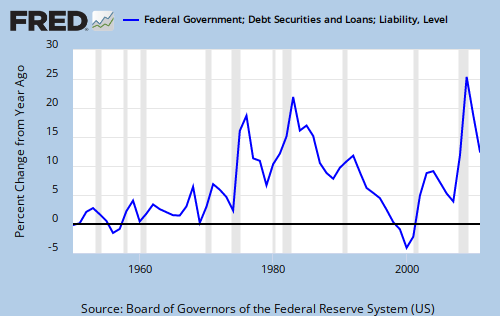
In other posts on this blog, we have discussed how reductions in federal debt growth, as shown by the following graph, “Federal Government Debt-Domestic Nonfinancial Sectors,” immediately precede recessions. This comes as no surprise, since a growing economy requires a growing supply of money, and deficit spending is the federal government’s method for adding money to the economy.

Federal debt
FEDERAL GOVERNMENT DEBT- PERCENTAGE CHANGE FROM YEAR AGO

Clearly, federal debt/money growth is essential to keep us out of recessions. Yet, when we look at “Debt Outstanding Domestic Nonfinancial Sectors” which includes not only Federal debt, but also outstanding credit market debt of state and local governments, and private nonfinancial sectors we do not see the same pattern.

Total Nonfinancial Debt
TOTAL DOMESTIC NONFINANCIAL DEBT — PERCENTAGE CHANGE FROM YEAR AGO

In fact, when we subtract federal debt from total debt, leaving only state, local and private debt, we see the opposite pattern. Recessions more often seem to follow increases in state, local and private debt.


STATE, LOCAL AND PRIVATE DEBT, PERCENT CHANGE FROM YEAR AGO

Now in one sense, money is money. Your buying on your credit card creates debt/money, just as federal deficit spending creates debt/money. Presumably, both should have the same stimulative effect on the economy. They do, but not long term. Why?

Because, unlike the federal government, you, your business and local governments cannot create new money endlessly to service your debts. Your debts can pile up to the point where you must liquidate them by paying them off or by going bankrupt. When non-federal debts become too large, a growing number of people, states, cities and businesses must pull back and stop further borrowing, i.e. stop creating money, or even destroy money by paying off loans. When that happens, we have a recession.

(As an aside, this is one reason the early stimulus efforts had so little effect. People used the stimulus money to pay off loans, so while the federal deficit spending created money, the loan pay-downs destroyed it. Debt reduction destroys debt/money.)

During the recession, and for a short time after, we tend to cut back on our personal borrowing and liquidate debt/money. Then we begin to resume borrowing, more and more, until again, we hit our personal limits and cut back, causing yet another recession. The sole prevention of this cycle, which averages about 5 years in length, is to make sure that federal deficit spending grows sufficiently to offset periodic money destruction by the private sector.

In summary, federal deficit spending is good for the economy, always good, endlessly good (up to the point of inflation). Private and local government spending/borrowing also is good, but not endlessly. Unlike the federal government, the private and local-government sectors eventually reach a point where debt is unaffordable and unsustainable.

To prevent recessions, the government continuously must provide stimulus spending, then provide added stimulus spending to offset the periodic reduction of money creation by the private sector.

Rodger Malcolm Mitchell
Monetary Sovereignty


==========================================================================================================================================
No nation can tax itself into prosperity, nor grow without money growth. Monetary Sovereignty: Cutting federal deficits to grow the economy is like applying leeches to cure anemia. Two key equations in economics:
Federal Deficits – Net Imports = Net Private Savings
Gross Domestic Product = Federal Spending + Private Investment and Consumption + Net exports

#MONETARY SOVEREIGNTY

–How the debt hawks will destroy the U.K.

An alternative to popular faith

Cameron Warns Britons of ‘Decades’ of Austerity
By SARAH LYALL, Published: June 7, 2010

LONDON — Prime Minister David Cameron said Monday that Britain’s financial situation was “even worse than we thought” and that the country would have to make savage spending cuts to bring its swelling deficit under control.

Stern and grim-faced in a speech in Milton Keynes, just north of London, Mr. Cameron said, “How we deal with these things will affect our economy, our society — indeed our whole way of life. The decisions we make will affect every single person in our country,” he said. “And the effects of those decisions will stay with us for years, perhaps decades, to come.
[…]
Dave Prentis, the general secretary of Unison, a union that represents many public service workers, nonetheless told the Press Association news agency that Mr. Cameron’s speech was “a chilling attack on the public sector, public sector workers, the poor, the sick and the vulnerable, and a warning that their way of life will change.”
[…]
“Nothing illustrates better the total irresponsibility of the last government’s approach than the fact that they kept ratcheting up unaffordable government spending even when the economy was shrinking,” Cameron said.
[…]
As a cautionary tale, he mentioned Greece, where profligate spending led to a huge budget deficit and eventually a downgrading on financial markets.

While Britain’s economic position is stronger than that of Greece, he said, “Greece stands as a warning of what happens to countries that lose their credibility, or whose governments pretend that difficult decisions can be avoided.”

—————————————————————————————————————————————————————————

The U.K. was smart not to lose control over their money. They remain monetarily sovereign. Unlike the euro-using nations, the U.K. can create their money at will. But suddenly, they have forgotten why they didn’t switch to the euro.

Now, the debt hawks have the U.K. preparing for “decades of austerity” (aka, decades of poverty), as they falsely compare themselves to Greece. Wake up, U.K. You aren’t like Greece and you don’t need to choose poverty.

Mr. Cameron said, “. . . if you start with a large structural deficit, ramping up spending even further is likely to undermine confidence and investment, not encourage it.” This is as false a statement as it’s possible to make. I challenge Mr. Cameron to explain how government spending, which is the way government adds money to the economy, can reduce investment or economic growth. It simply is total nonsense.

It’s difficult to imagine why an otherwise intelligent people intentionally will subject themselves to decades of misery based on a foolish belief that not only is unproven, but factually has been proven wrong on many levels. While some of the same ignorance exists in the U.S., we only can pray it does not reach the extreme levels of utter stupidity it apparently has reached in the U.K.

Rodger Malcolm Mitchell
http://www.rodgermitchell.com

No nation can tax itself into prosperity

–Get rid of big government

An alternative to popular faith

Ever since Ronald Reagan said, “In this present crisis, government is not the solution to our problem. Government is the problem,” (then proceeded to run the largest federal deficits in history), the chic thing has been to criticize big government as an affront to our self reliant, can-do, cowboy heritage. The media pundits, both major political parties and the Tea Party repeatedly call for less government.

On March 24, 2009, Bobby Jindal, governor of Louisiana said, “There has never been a challenge that the American people, with as little interference as possible by the federal government, cannot handle.” Oh, really? Today, May 31, 2010, the Chicago Tribune published a wonderful article written by Leonard Pitts, all government haters should read. I’ll quote a few passages:

“. . . Bobby Jindal . . . is singing a new song . . . Now, he’s BEGGING for federal ‘interference.’ He wants federal money, federal supplies, wants the feds to help create a barrier island to protect Louisiana wetlands from oil.
[…]
“One hears pointed questions about President Barack Obama’s engagement or lack thereof in the unfolding crisis. One hears accusations that the government was lax in its oversight duties and too cozy with the oil industry it was supposed to be regulating. One hears nothing about deregulation, about leaving the free market alone to do its magic […] the sudden silence of the apostles of small government and free markets is telling.

“Yes, government is not perfect […] Any bureaucracy serving 309 million people . . . is likely to have flaws. […] But . . . people like Jindal rail against the very concept of government itself, selling the delusional notion that taxation and regulation represent the evisceration of some essential American principle. They wax eloquent about what great things the free market and the free American could do if government would just get off their backs.

“One thinks of one’s meat oozing with salmonella, one’s paint filled with lead, one’s car getting 12 miles to the gallon, one’s self being breezily denied a job for reasons of race, creed, gender or sexual orientation and yes, one’s ocean covered from horizon to horizon with a sheen of oil. And one shudders.

“[…]there are no small government disciples in massive oil spills. No, . . . Bobby Jindal turned righteously to that big, sometimes bloated, often intrusive federal government and asked for help. He said, Send money, send resources. You will notice he never once said, send less.”

Yes, it is so terribly chic, so wonderfully clever to criticize big government, as though each of us were ready to shoulder the responsibilities of the army, Social Security, Medicare, roads, bridges, education, policing and the thousands of other tasks we happily delegate to the bureaucracy.

I have spoken about this on many occasions, for instance YOUR CHILDREN WON’T PAY FOR DEFICITS and EUROPEAN WELFARE STATE and TEA PARTY CONFUSION, but Leonard Pitts said it better.

Rodger Malcolm Mitchell
http://www.rodgermitchell.com

No nation can tax itself into prosperity