More proof that the Internation Monetary Fund is a group of fools and con men

No sooner do I publish, “Historical BULLSHIT Claims the Federal Debt Is a ‘Ticking Time Bomb’” than this IMF article pops up:

World’s $100 Trillion Fiscal TIMEBOMB Keeps Ticking
Story by Craig Stirling

(Bloomberg) — Even before global finance chiefs fly into Washington over the next few days, they’ve been urged in advance by the International Monetary Fund to tighten their belts.

Two weeks ahead of a potentially era-defining US election, and with the world’s recent inflation crisis barely behind it, ministers and central bankers gathering in the nation’s capital face intensifying calls to get their fiscal houses in order while they still can.

Debt Loads Are Set to Expand Globally |
© Bloomberg
The fund, whose annual meetings begin there on Monday, has already pointed to some of the themes it hopes to press home with a barrage of projections and studies on the global economy in coming days.

The IMF’s Fiscal Monitor on Wednesday will feature a warning that public debt levels are set to reach $100 trillion this year, driven by China and the US.

Managing Director Kristalina Georgieva, in a speech on Thursday, stressed how that mountain of borrowing is weighing on the world.
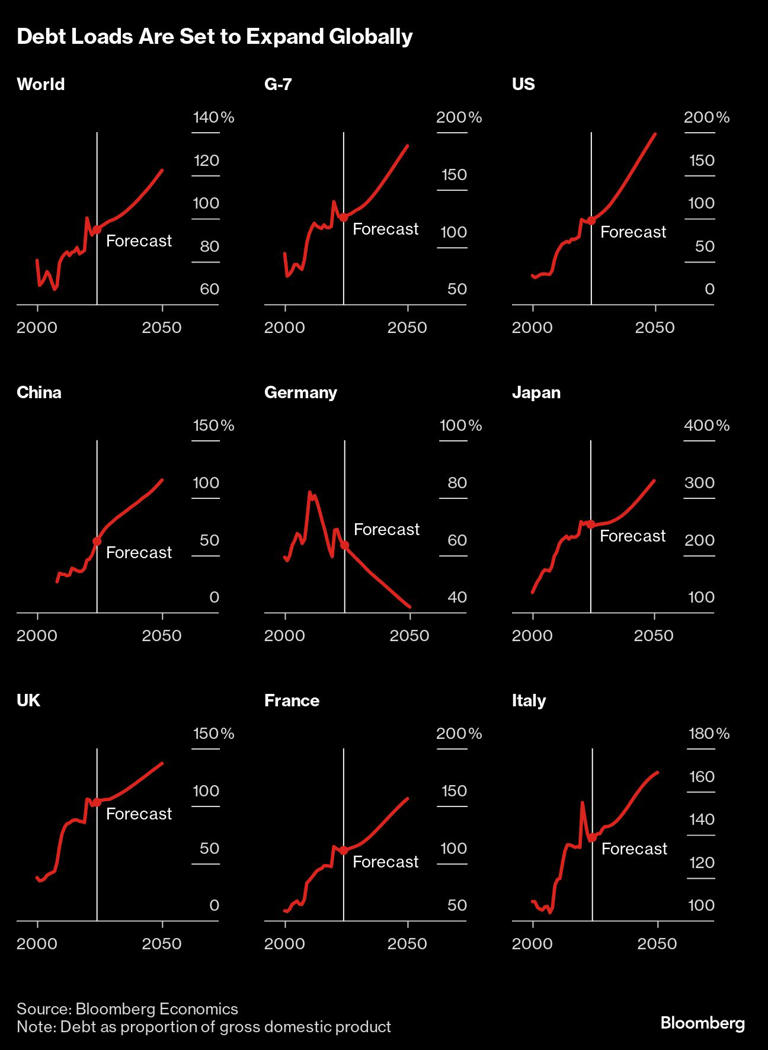
Debt Loads Are Set to Expand Globally |
How to lie with facts. Use meaningless numbers and compare non-comparable things.

Before we continue, let me show you the graphs showing the debt/GDP ratios of several countries. Look at the graphs and tell me what is misleading about them.

The graphs at the right have two main problems:

1. They combine two completely different things: Monetarily Sovereign nations and monetarily non-sovereign nations.

A Monetarily Sovereign nation has the infinite ability to create its own sovereign currency. It never can run short of money to pay its bills.

The U.S. cannot run short of dollars. China cannot run short of yuan. Japan cannot run short of yen, and the UK cannot run short of pounds. These nations are Monetarily Sovereign.

They all can pay any debt denominated in their sovereign currency, merely by tapping a computer key.

Former Federal Reserve Chairman Alan Greenspan: “A government cannot become insolvent with respect to obligations in its own currency.”

By contrast, Germany, France, and Italy are monetarily non-sovereign. They all use the euro, and can run short of euros to pay their debts. They must borrow from the European Union (EU) when they run short of euros.

The G-7 graph is a mongrelization of Monetarily Sovereign and monetarily non-sovereign nations (Canada, France, Germany, Italy, Japan, United Kingdom, United States) and thus is useless and misleading.

2. The debt/Gross Domestic Product ratio, which is the subject of the graphs is meaningless, though it often has been used by those who do not understand Monetary Sovereignty.

Take a look at this worldwide comparison of debt/GDP and see if you can find any evaluative or predictive purpose for the ratio.

Here are the ten nations with the supposedly “worst” (highest) ratios:

Debt to GDP Ratio (%); Japan 264%, Venezuela 241%, Sudan 186%, Greece 173%, Singapore 168%, Eritrea 164%, Lebanon 151%, Italy 142%, United States 129%, Cape Verde 127%

Japan and the U.S. are ranked worst, along with Sudan, Greece, Lebanon, and Cape Verde.

Who would you prefer to lend to, Japan or Cape Verde? The United States or Sudan?

Now, here are the ten nations with the “best” (lowest) debt/GDP ratios: Brunei 2.1%, Kuwait 2.9%, Cayman Islands 4.5%. Afghanistan 7.4%. Turkmenistan 8%, Azerbaijan 11.7%, Burundi 14.5%, DR Congo 14.6%, Russia 17.2%, Palestine 18.5%

That’s right. According to the IMF, those are the financially safest places in the world.

The debt/GDP ratio is akin to a butter/butterfly ratio. Completely and utterly useless, yet here is the equally useless IMF shrieking about it.

This is what the IMF says about itself:

The International Monetary Fund (IMF) is an organization that aims to ensure the stability of the international monetary system. Its primary purposes are to:

1. Foster collaboration among countries to achieve global monetary stability.
2. Promoting exchange rate stability
3. Support economic policies that promote growth and reduce poverty.
4, Offer loans and financial aid to member countries facing balance of payments problems or economic crises.
5. Provide economic and financial advice.

It does none of those, except #4, which it uses like a loan shark, extorting unreasonable terms from weak countries. And really, would you take “economic and financial advice” from a group that doesn’t know the difference between Monetary Sovereignty and monetary non-sovereignty.

It is like taking medical advice from a quack doctor who doesn’t know the difference between heartburn and sunburn.

Continuing with the article:

“Our forecasts point to an unforgiving combination of low growth and high debt — a difficult future,” she said. “Governments must work to reduce debt and rebuild buffers for the next shock — which will surely come, and maybe sooner than we expect.”

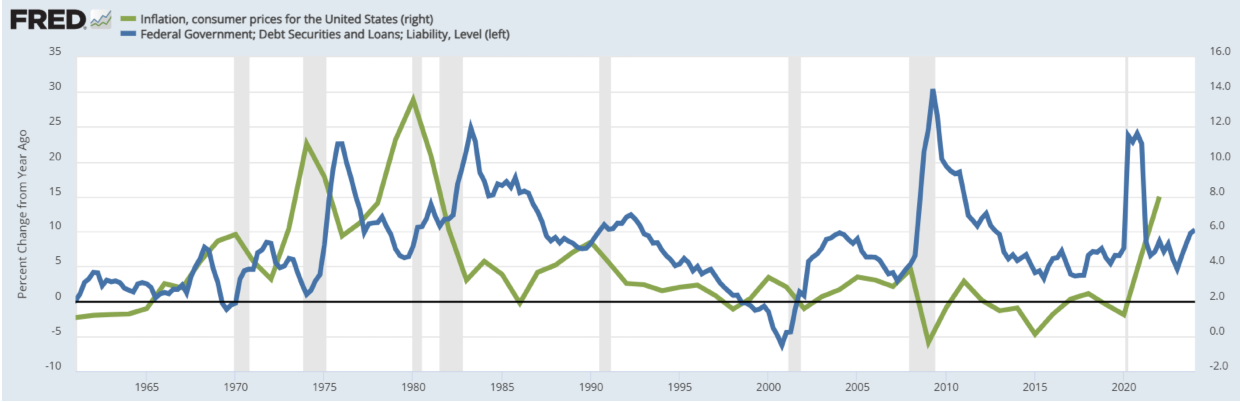
For a Monetarily Sovereign nation “high debt” generally means the government is pumping more growth dollars into the economy. Lack of debt growth leads to recessions:

A decline in debt growth (red line) causes recessions (vertical gray bars) which are cured by an increase in debt growth.

Thus, the IMF’s “cut debt” advice is diametrically wrong, like taking blood from a patient to cure his anemia.

Some finance ministers may get further reminders even before the week is over.

UK Chancellor of the Exchequer Rachel Reeves has already faced an IMF warning of the risk of a market backlash if debt doesn’t stabilize. Tuesday marks the last release of public finance data before her Oct. 30 budget.

The UK tax office is taking a tougher approach to clawing back debts, insolvency specialists say, a bid to squeeze £5 billion ($6.5 billion) in extra revenue.

The above simple proves that many government economists are as financially ignorant as the IMF economists.

We have the same problem in the U.S., with so-called experts claiming our federal debt (which isn’t “federal” and isn’t “debt”) is a “ticking time bomb.” Total bullshit.

What Bloomberg Economics Says:
“For all the talk of black holes, the overall effect of Reeves budget will be a policy that’s looser, not tighter, relative to the previous government’s plans.”

As it should be if the UK wants economic growth. If the UK is foolish enough to listen to the IMF and cut debt (which means take dollars out of the economy), it will have a recession.

Meanwhile, Moody’s Ratings has slated Friday for a possible report on France, which faces intense investor scrutiny at present. With its assessment one step higher than major competitors, markets will watch for any cut in the outlook.

France, being monetarily non-sovereign, does risk it’s debt being too high to service. The EU, which is Monetarily Sovereign, could solve France’s financial problems by simply giving them euros. That would cost European taxpayers nothing, and would prevent debt from being an issue.

As for the biggest borrowers of all, the glimpse of the IMF’s report already published contains a grim admonishment: your public finances are everyone’s problem.

True for monetarily non-sovereign nations; not true for Monetarily Sovereign nations.

“Elevated debt levels and uncertainty surrounding fiscal policy in systemically important countries, such as China and the United States, can generate significant spillovers in the form of higher borrowing costs and debt-related risks in other economies,” the fund said.

We’ll end with the final dollop of bullshit from the IMF. China’s and the US’s increase in debt means other nations are being enriched by dollars and yuan. The more these two governments spend on foreign goods and services, the better all the other governments’ finances will be.

As usual, the fools and con men of the IMF offer diametrically the opposite of good advice.

Here comes the IMF to demonstrate its incompetence

The sole purpose of government is to improve and protect the people’s lives.

Why else would we, the people, turn over control of our lives to a government?

Why else would we. the people, give our precious money and limited power to a small group that tells them what they are allowed to do and not allowed to do?

But the International Monetary Fund (IMF) has different purposes, according to their site:The International Monetary Fund

1. Furthering international monetary cooperation for consultation and collaboration on international monetary problems.
2. Facilitating the expansion and balanced growth of international trade, and to contributing thereby to the promotion and maintenance of high levels of employment, real income and productive resources.
3. Promoting orderly exchange arrangements among members, and to avoiding competitive exchange depreciation.
4. The elimination of foreign exchange restrictions which hamper the growth of world trade.
5. Making the resources of the Fund temporarily available to members to correct maladjustments in their balance of payments without measures destructive of prosperity.
6. Shortening the duration and lessening the degree of disequilibrium in the international balances of payments of memberss

Nowhere are improving and protecting the people’s lives mentioned. It’s all about the governments and their money.

That is why the IMF never met an austerity it didn’t love.

It almost always recommends some form of austerity as a cure for what it deems “excessive” government debt. 

Here’s what austerity means:Is Your State One of the Worst for Paying Taxes? | The Fiscal Times

  1. Reducing Expenditure: Governments may cut spending on public services, welfare benefits, and salaries for public sector workers. This can include limiting the terms of unemployment benefits, reducing government employees’ wages, or cutting programs for the poor.

  2. Increasing Revenue: This can be achieved by raising taxes, targeting tax fraud and evasion, or privatizing government-owned businesses to raise capital.

  3. Economic Impact: Austerity measures act like contractionary fiscal policy, which can slow economic growth. This is because they reduce the amount of money circulating in the economy, which can lead to lower consumer spending and investment.

  4. Debt Management: The primary goal of austerity is to reduce the risk of default on government debt. High levels of debt can lead to creditors demanding higher interest rates, making it more expensive for a country to borrow money.

Cut benefits, increase taxes, slow growth, and ensure the government pays its obligations to other governments. That is about as pro-government and “non-people” as you can get. 

It can be said sweetly and nobly as President John Kennedy with his “Ask not what your country can do for you — ask what you can do for your country” speech.

Ah, those lofty words that sound so patriotic and easy on the ear, but are a prescription for an impoverished nation living under a dictatorship.

I prefer to ask politicians, “What will you do for us in return for your salary, lifestyle, and the prestige we have given you?”

What would you do if you had infinite money? - Quora
Alan Greenspan: “A government cannot become insolvent with respect to obligations in its own currency.”

The IMF functions as an employee of governments and not of the people.

Based on history and its own statements, the IMF may have a different maxim: The sole purpose of people is to improve and protect their government.

That is true in America. Here, the federal government has infinite money but still demands taxes from the people.

Here, politicians decry federal deficits, though the government can pay any invoice merely by pressing computer keys.

Here, our government pretends to struggle with funding benefits for the poor, though it has no trouble funding tax breaks for the rich.

“Improving and protecting the people’s lives” seems to be the last thing the IFM and U.S. politicians worry about.

Soaring U.S. debt poses risks to global economy, IMF warns
Story by David J. Lynch

U.S. government budget deficits and an escalating debt load pose “a growing risk” to the global economy, marring an otherwise stellar economic performance, the International Monetary Fund said on Thursday.

Translation: The federal government is putting more dollars into people’s pockets than it is taking out, and as a result, the economy is doing great.

The “growing risk” is that somehow the poor will discover the government’s infinite ability to fund benefits, and demand more and better.

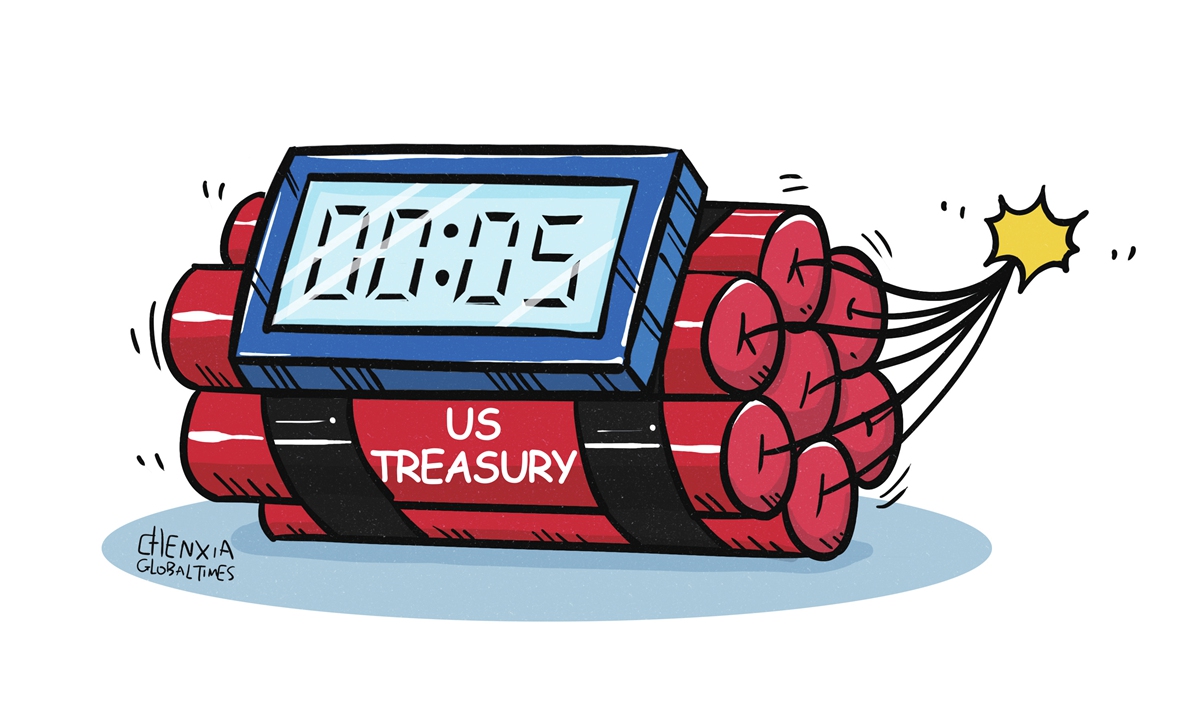
Ballooning US debt a ticking time bomb for world economy - Global Times
The “ticking time bomb” of federal debt has been ticking since 1940. Still ticking.

The United States over the next several years faces “a pressing need” to reduce its debt burden, which could require broad-based income tax increases and cuts in popular entitlement programs, the fund said at the conclusion of its annual review of the U.S. economy.

Translation: This “pressing need” often has been described as a “ticking time bomb,” which has been “ticking” for eighty-four years without exploding. 

Our Monetarily Sovereign (MS) government has infinite dollars.

Why then does the IMF want, the government unnecessarily to take more money from the people and cut benefits to those who need them.

The required fiscal adjustment will mean “difficult political decisions over the course of multiple years,” the fund said, warning that an unchecked rise in debt could eventually sap U.S. growth and snowball into global financial distress.

Translation: “Difficult political decisions” are those that screw the people while sounding like the IMF is helping them.

For instance, raising Medicare, Social Security, and unemployment taxes with the false explanation that these taxes are needed to “save” the benefits.

These decisions are difficult, but we politicans, being heroic, are ready to sacrifice your lives to make the rich richer.

The rise in debt stimulated U.S. growth and “snowballed” into the people’s financial success. So, cut the debt.

“Now is a good time,” said Kristalina Georgieva, the fund’s managing director. “The U.S. economy is very strong, and it is in good times where you can do more to prepare yourself for risks in the future.”

Translation: The U.S. economy is very strong because the government has increased spending.

Therefore, now is a good time to weaken it by taking money out of the economy. GDP=Federal and Non-federal Spending + Net Exports.

You can be sure that if the economy was suffering, Ms. Georgieva would offer the same prescription: Austerity. It’s what they always recommend, regardless of the circumstances.

President Biden has ruled out at least one of the fund’s suggested remedies: Higher taxes on people making less than $400,000 a year.

Translation: The IMF wants to take dollars out of the pockets of the poorer people.

Apparently, these people should ask not what the country can do for them but what they can do for the rich people.

But debt aside, the IMF statement praised the U.S. economy for “a remarkable performance” in recent years.

Inflation has largely been brought under control without the sharp increase in unemployment that many economists had expected.

Gross domestic product (GDP) growth remains above expectations and is expected to continue.

Translation: We, the IMF, are completely clueless about how high levels of federal deficit spending can cause these remarkable outcomes, but whatever the reason, we want it stopped.

“The U.S. is the only G-20 economy whose GDP level now exceeds the pre-pandemic level. This is good for the U.S. and it is good for the global economy,” Georgieva told reporters.

Translation: The federal debt (that isn’t federal and isn’t debt — See: National Debt ) is up, and all this good stuff is happening. We of the IMF don’t understand why, and we want it stopped.

Despite the U.S. debt bulge, financial markets remain untroubled. The return that the government must offer to entice investors to purchase 10-year treasury securities hovers around 4.2 percent, below rates that were typical before the Great Recession.

Translation: The IMF is shocked that financial markets are untroubled by sales and profit growth.

Amazon.com: deAO Kids Steering Wheel for Backseat with Key Pretend Driving  Simulated Steering Wheel Toy with Light and Music Gifts for Kids Toddlers  Blue : Automotive
Jerome Powell: “Look how well I’m driving.”

The U.S. government doesn’t really don’t care how many treasury securities are purchased.

Those dollars mean nothing to a government that has infinite dollars.

The government sets the interest rate at any level the Fed chooses.

It’s what the Fed does to make people think it is driving the car when, in fact, it is just going along for the ride.

The U.S. economy also is attracting an increasing share of global capital, according to Georgieva.

Before the pandemic, 18 percent of funds invested outside national borders was placed in the United States.

Today, the U.S. share of mobile finance is 33 percent, she said.

Translation: The so-called “federal debt” that bothers the IMF doesn’t seem to bother knowledgeable investors. 

Debts and deficits will be an early challenge for the next president. In early 2025, Congress must lift the statutory debt ceiling or see the United States default on its debt.

Lawmakers also must decide by the end of 2025 to extend Trump’s 2017 tax cuts or allow them to expire, thus increasing taxes on most Americans.

Translation: Debts and deficits will grow the economy, but politicians, economists, the media and IMF will argue that the debt and deficits should be reduced. It’s what the very rich want us to say.

In April, as part of a separate review, IMF officials chided the United States for government deficits that stimulated the economy, saying they effectively made it more difficult for the Federal Reserve to cut interest rates.

Translation: Deficits grew the economy and enriched the private sector, but how is the Fed going to justify its existence if it can’t manipulate interest rates?

The IMF’s slogan should be: The sole purpose of people is to protect and improve their government and the rich people.

On Thursday, citing potential upside risks to inflation, the IMF said the Fed should wait to cut interest rates until “at least late 2024.”

Translation: Otherwise, it will be too easy for those who aren’t rich to buy cars, houses, refrigerators, furniture, and every other product whose price is increased by high interest rates (i.e., all products).

Thursday’s IMF statement is just the latest warning on the U.S. debt picture.

On Tuesday, the Organization for Economic Co-Operation and Development said that adding debt at a time of higher interest rates will limit the ability of the United States to meet other needs, including defense, an aging population, and future economic shocks.

Translation: We have no idea what this means. The U.S. government has proved it has infinite money to meet all needs, including defense, an aging population, and future economic shocks. But, the IMF felt compelled to make a statement, however wrong.

Years of repeated tax cuts have narrowed the government’s revenue base at a time when it faces escalating spending commitments for programs such as Social Security and Medicare, as well as rising interest charges, the OECD said.

Translation: Federal taxes do not fund federal spending. Even if it collected zero taxes, it could continue spending forever.

But then, it couldn’t take dollars from the poor for social benefits or just limit those benefits altogether.

That is not what our real patrons, the rich, want.

As a share of the economy, corporate income tax payments are now less than half what they were in 1967, according to the Congressional Budget Office.

Interest expenses on the national debt over the same period have doubled to 2.4 percent of gross domestic product.

Translation: The government is taking comparatively less money from corporations, and adding more money to the economy in interest. This is working spectacularly, so it must be stopped???

The OECD, a group of more than three dozen advanced economies, called for a “sustained but steady multiyear” budget effort to curb debt.

Only Italy, Greece and Japan have higher gross debt-to-GDP ratios, the OECD said in its annual assessment of the U.S. economy.

Translation: Because the IMF is are clueless about the fundamental differences between a Monetarily Sovereign (MS) government and a monetarily non-sovereign government, it lumps Italy, Greece, and Japan into our comparison.

Italy and Greece, not being MS, must rely on the (EU) European Union to provide them with money. Japan, being MS, doesn’t need any help.

Government debt held by the public, which excludes Treasury securities in the Social Security Trust Fund, is equal to 99 percent of total U.S. output and is expected to hit 122 percent in 2034, according to the CBO.

Translation: The useless Debt/GDP ratio is the phony number of last resort for those who don’t understand MS; therefore, the IMF tries to fool you with it.

And as for that Social Security Trust Fund, it isn’t a trust fund.

Many economists say the government’s growing debt burden must be addressed with a mix of spending cuts and tax increases.

Stabilizing the debt relative to the size of the economy is “a really important goal,” Jared Bernstein, the chairman of the White House Council of Economic Advisers, said at the Brookings Institution this week.

Someone please tell Mr. Bernstein that federal debt is two things, neither of which has any meaning relative to the size of our economy (which is GDP).

The two meanings of federal debt are:

  1. The historical net total of federal deficits — the difference between federal spending and federal taxes. Simply add all the spending the government has ever done and subtract all the income the federal government has ever received. That’s the debt.
  2. The current total of all outstanding Treasury Securities (T-bills, T-notes, T-bonds, etc.)

With regard to #1, the “debt” would have some meaning if the federal government was monetarily non-sovereign: it doesn’t use a currency it issues. This resembles city, county, and state governments, as well as businesses, you, and me.

It’s relevant because we monetarily non-sovereign types might have difficulty paying all those outstanding bills. The Monetarily Sovereign U.S. government has no such difficulty because it has the infinite ability to create dollars.

Regarding #2, Treasury Securities are accounts wholly owned by the depositors. The government doesn’t owe the contents of those accounts because it never takes ownership of the money. It just holds the dollars for safekeeping.

This resembles bank safe deposit boxes. The contents are not part of bank debt because the bank never owns them.

By contrast, city, county, and state notes and bonds are in accounts owed by the respective cities, counties, and states, which rely on income to pay them off.

Rodger Malcolm Mitchell

Monetary Sovereignty

Twitter: @rodgermitchell Search #monetarysovereignty Facebook: Rodger Malcolm Mitchell; MUCK RACK: https://muckrack.com/rodger-malcolm-mitchell

……………………………………………………………………..

The Sole Purpose of Government Is to Improve and Protect the Lives of the People.

MONETARY SOVEREIGNTY

The easy we make difficult, but it takes a long time.

The U.S. military has a motto: The difficult we do immediately. The impossible takes a little longer.

I suggest a motto for the science of economics: “The easy we make impossible, but it takes forever.”

I say that because of my 25 years critiquing economics articles, and most recently because of an article titled, “Do Budget Deficits Cause Inflation?”

The answer to the question is, “No, not for Monetarily Sovereign nations,” and the article comes to that “No” conclusion. Except:

  1. It never differentiates between Monetarily Sovereign governments (which create and control the value and supply of the money they use) and monetarily non-sovereign governments (cities, counties, states, euro nations, nations that use another nation’s currency, and nations that peg their currency to another nation’s currency}.
  2. It never mentions shortages of critical goods and services, most commonly oil, food, and labor, which are the real causes of inflation.
  3. It complexifies a straightforward solution: To cure a problem, eliminate the cause of the problem. In the case of inflation, the cause is shortages. To cure inflations, eliminate the shortages.
Keith Sill
Keith Sill, Senior Vice President of Research and Director of the Real-Time Data Research Center. keith.sill@phil.frb.org (215) 574-3815

Here are some examples from  “Do Budget Deficits Cause Inflation?”, by Keith Sill.

In 2004, the federal budget deficit stood at $412 billion and reached 4.5 percent of gross domestic product (GDP).

Though not at a record level, the deficit as a fraction of GDP is now the largest since the early 1980s.

Moreover, the recent swing from surplus to deficit is the largest since the end of World War II.

Comment: The deficit as a fraction of GDP is irrelevant to inflation. Federal deficits are beneficial because they add GDP growth dollars to the economy.

Federal surpluses take dollars from the economy, causing depressions and recessions. Mr. Sill could have answered the title question with two simple graphs:

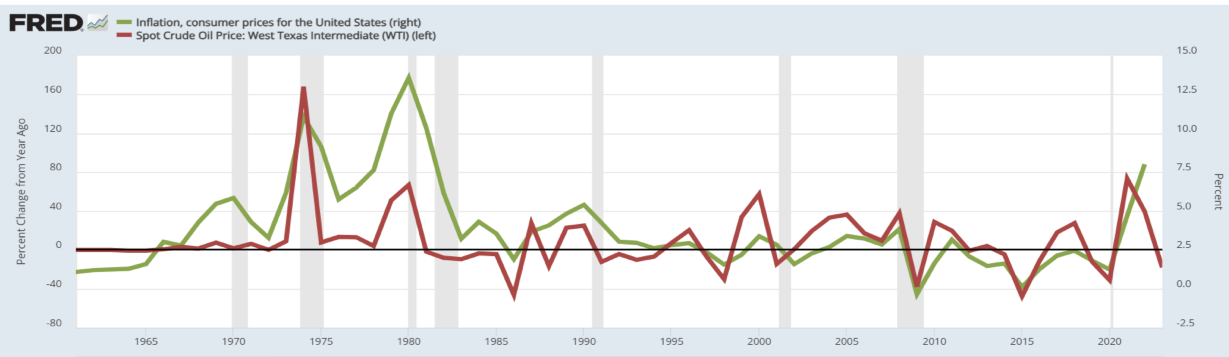
There is no relationship between federal deficit spending (blue line) and inflation.
There is a strong relationship between the oil supply (red line) and inflation.

Inflation is caused by shortages of critical goods and services, most often oil, food, and labor.

The flip side of deficit spending is that the amount of government debt outstanding rises: The government must borrow to finance the excess of its spending over its receipts.

Comment: The federal government, being Monetarily Sovereign, never borrows. Why would it? It has the infinite ability to create its sovereign currency, the U.S. dollar, at virtually no cost (aka, “seigniorage”).

Further, unlike state/local government taxes, which fund state/local spending, federal taxes do not fund federal spending.

Federal taxes are destroyed upon receipt, while state and local tax dollars remain in the economy’s private banks. To finance all its spending, the federal government creates new dollars ad hoc.

It does this regardless of taxes collected. Even if federal tax collection totaled $0, the government could continue spending forever.

For the U.S. economy, the amount of federal debt held by the public as a fraction of GDP has been rising since the early 1970s. It now stands at a little over 37 percent of GDP.

The debt/GDP fraction is meaningless. It has no predictive or analytical power and does not tell anything about an economy’s health.

Do government budget deficits lead to higher inflation? When looking at data across countries, the answer is: it depends. Some countries with high inflation also have large government budget deficits. This suggests a link between budget deficits and inflation.

Yet for developed countries, such as the U.S., which tend to have relatively low inflation, there is little evidence of a tie between deficit spending and inflation.

Mr. Sill falsely equates “developed” with Monetary Sovereignty. However, there are “developed” nations – for example, Italy, France, Greece, etc. that are monetarily non-sovereign. They use the euro.

Why are budget deficits are associated with high inflation in some countries but not in others? Government deficit spending is linked to the quantity of money circulating in the economy through the budget restraint, i.e. the relationship between resources and spending.

Money spent has to come from somewhere: In the case of local and national governments, from taxes or borrowing.

But, national governments can also use monetary policy to help finance the government’s deficits.

I believe that Mr. Sill’s use of “resources” means the amount of money a government can spend, which it gets from taxes or borrowing.

Since he doesn’t differentiate among Monetarily Sovereign, monetarily non-sovereign, and “nationally,” his comments are either partially or totally wrong. First, a reminder about the differences between monetary policy and fiscal policy:

  • Monetary policy involves changing the interest rate and influencing the money supply.
  • Fiscal policy involves the government changing tax rates and spending levels to influence aggregate economic demand. (“Aggregate demand” is Gross Domestic Product at a specific time.)

Here are the sources of confusion:

1. Raising interest rates causes prices to rise. The cost of every product includes the cost of interest. Amazingly, this is the Fed’s tool to combat inflation. The Fed’s theory seems to be that raising prices will reduce demand, causing a recession that supposedly will cure inflation.

In short, the Fed causes inflation to cure inflation while claiming to hope a recession doesn’t occur but secretly relies on recession to cure inflation. (Clear?)

Of course, a result can also be stagflation, a combination of recession and inflation, at which point Fed Chairman Jerome Powell, having no solutions, will hide in his closet and pray. (The cure for stagflation is federal deficit spending to obtain and distribute the scarce products while adding growth dollars to the economy.)

2. As the issuer of its money, only a Monetarily Sovereign government can change interest rates by fiat. It sets the lowest rate on its Treasury Securities.

Because a monetarily non-sovereign government is not an issuer of money, it cannot unilaterally change interest rates. It must rely on markets or the issuer of its money.

For example, Italy cannot arbitrarily raise interest rates on euro-based loans. It uses the euro but is not the issuer.

3. Monetarily Sovereign governments don’t borrow their own currency. The above-mentioned Italy, being monetarily non-sovereign, borrows euros.

In short, Sill, an economist at the Fed (!), is confused about what different kinds of governments can do. Next, he confuses households with our Monetarily Sovereign government:

Budget constraints are a fact of life we all face. We’re told we can’t spend more than we have or more than we can borrow.

The U.S. government “has” infinite dollars, so it does not borrow dollars. Those federal T-securities are not a form of borrowing, which is what a monetarily non-sovereign government does when it needs money.

Rather than providing the U.S. government with dollars, T-securities:

  1. Provide a safe parking place for unused dollars — safer than any other storage place (i.e., bank accounts, safe deposit boxes, etc.) The government never touches those dollars. They remain the property of the depositors.
  2. Assist the Fed in controlling interest rates by setting a floor rate.

In that sense, budget constraints always hold: They reflect the fact that when we make decisions, we must recognize we have limited resources.

See the confusion? “We” and the Italian government have limited resources (money), but the U.S. government does not. It has unlimited money. Next, Mr. Sill expressly shows us his confusion between federal finance and personal finance:

Imagine a household that gets income from working and from past investments in financial assets. The household can also borrow, perhaps by using a credit card or getting a home-equity loan.

The household can then spend the funds obtained from these sources to buy goods and services, such as food, clothing, and haircuts.

It can also use the funds to pay back some of its past borrowing and to invest in financial assets such as stocks and bonds.

The household’s budget constraint says that the sum of its income from working, from financial assets, and from what it borrows must equal its spending plus debt repayment plus new investment in financial assets. 

Not one word of the above applies to the U.S. government.

The government does not borrow or use dollars obtained from any source. It creates ad hoc all the funds it spends. Any income the federal government receives is destroyed upon receipt. (See: “Does the U.S. government really destroy your tax dollars?“)

The only federal budget constraint is not a budget constraint at all. Federal agencies routinely exceed budgets. The restraint is whatever Congress and the President say it is at any given moment.

Congress and the President have the unlimited ability to create dollars and stimulate the economy, plus a strong, though not unlimited, ability to obtain and distribute the scarcities causing inflation.

Mr. Sill continues with an explanation that is irrelevant to federal financing.

The household’s sources of funds and spending are all accounted for, and the two must be equal. The household may use borrowing to spend more than it earns, but that funding source is accounted for in the budget constraint.

If the household has hit its borrowing limit, fully drawn down its assets, and spent its work wages, it has nowhere else to turn for funds and would, therefore, be unable to finance additional spending.

I have no idea what Mr. Sills hoped to accomplish by giving household finances as his explanation for federal finances. The two are fundamentally opposite.

Here, Mr. Sills makes sure to show you that he doesn’t understand the difference between the federal government’s Monetary Sovereignty and your household’s monetary non-sovereignty:

Just like households, governments, face constraints that relate spending to sources of funds.

Governments can raise revenue by taxing their citizens, and they can borrow by issuing bonds to citizens and foreigners. In addition, governments may receive revenue from their central banks when new currency is issued.

Governments spend their resources on such things as goods and services, transfer payments such as Social Security to its citizens, and repayment of existing debt.

Central banks are a potential source of financing for government spending, since the revenue the government gets from the central bank can be used to finance spending in lieu of imposing taxes or issuing new bonds.

No, the U.S. government is not “just like households. It does not raise revenue by taxing you. It doesn’t borrow from the central bank. It doesn’t have an existing debt to repay.

And it finances its spending not with taxes or bonds but by creating new money ad hoc. Who says so, Mr. Sill? Your former bosses:

Former Fed Chairman Alan Greenspan: “A government cannot become insolvent with respect to obligations in its own currency. There is nothing to prevent the federal government from creating as much money as it wants and paying it to somebody. The United States can pay any debt it has because we can always print the money to do that.”

Former Fed Chairman Ben Bernanke: “The U.S. government has a technology, called a printing press (or, today, its electronic equivalent), that allows it to produce as many U.S. dollars as it wishes at essentially no cost. It’s not tax money… We simply use the computer to mark up the size of the account.”

Mr. Sill’s article continues for many more paragraphs, so I will just quote one more thought:

There may be limits on the government’s ability to borrow or raise taxes. Obviously, if there were no such limits, there would be no constraint on how much the government could spend at any point in time.

Congress and the president are the only constraints on federal spending. Unlike your checking account, There are no financial constraints. That is why net spending (spending vs. taxing) has risen to $32 trillion.

Certainly governments are limited in their ability to tax citizens. (That is, the government can’t tax more than 100 percent of income.) But are governments constrained in their ability to borrow?

Monetarily non-sovereign governments are constrained by their full faith and credit, i.e., their credit rating. Monetarily Sovereign governments have no need to borrow, so there is no constraint.

Indeed they are. Informally, the value of government debt outstanding today cannot be more than the value of the government’s resources to pay off the debt.

The U.S. government has the infinite ability to pay for anything. Just ask Fed Chairmen Greenspan and Bernanke.

How do governments pay their current debt obligations? One way is for the government to collect more tax revenue than it spends. In this case, the surplus can be used to pay bondholders.

Wrong. All a federal surplus does is reduce Gross Domestic Product, i.e., cause a recession or depression.

Another way to finance existing debt is to collect seigniorage revenue and use that to pay bondholders.

Half right, half wrong. “Collect seigniorage” is a fancy way to say “print money.”

Seigniorage is the difference between the face value of dollars and the cost of creating them, which comes close to zero. However, holders of U.S. Treasury bonds are paid in two ways: Seigniorage pays the interest, and the principal is paid by returning the bondholder’s deposit.

Finally, the government can borrow more from the public to pay existing debt holders.

Wrong again. The federal government does not borrow, though monetarily non-sovereign governments do borrow.

SUMMARY

It is discouraging to read an article written by the Senior Vice President of Research and Director of the Real-Time Data Research Center for the Federal Reserve that displays so little understanding of Monetarily Sovereign finance.

The article claims that federal finance is similar to personal finance, but it does not demonstrate any knowledge of the vast differences.

Cities, counties, states, businesses, and euro nations can run short of money. The federal government cannot, and a key figure in the Federal Reserve seems to not understand that.

The answer to the title question is, “No, deficits do not cause inflation. Inflation is caused by shortages of key goods and services, most often oil, food, and labor.

Deficit spending can cure inflation by paying for scarce goods and services and ending shortages.

Rodger Malcolm Mitchell

Monetary Sovereignty Twitter: @rodgermitchell Search #monetarysovereignty Facebook: Rodger Malcolm Mitchell; MUCK RACK: https://muckrack.com/rodger-malcolm-mitchell

……………………………………………………………………..

The Sole Purpose of Government Is to Improve and Protect the Lives of the People.

MONETARY SOVEREIGNTY

The “National Debt” isn’t national and it isn’t a debt. Eric Boehm remains clueless.

The problem with Libertarians like Eric Boehm . . . where do I begin? They have so many issues. First, they don’t understand this equation: Gross Domestic Product = Federal Spending + Non-federal Spending + Net Exports. Gross Domestic Product (GDP) is the most commonly used measure of the economy. The equation tells you that the more the federal government spends, the more the economy grows. But Libertarians don’t like government spending. How does one reason with such people? Mainly, how does one acquaint them with Monetary Sovereignty, which says, “Federal financing is different from non-federal financing.” If they can’t understand, or more accurately, refuse to understand, those two concepts—GDP and Monetary Sovereignty—how can their opinions be respected? Here is the latest “Boehmism,” which, remarkably, may exceed all his previous work in ignorance and/or deception (It’s hard to know which:

The National Debt Is a National Security Issue The growing debt will “slow economic growth, drive up interest payments,” and “heighten the risk of a fiscal crisis,” the CBO warns. ERIC BOEHM | 3.21.2024 1:50 PM

It’s a dangerously addictive habit that threatens to ruin our children’s lives and undermine America’s national security—and this week, Congress finally acknowledged as much. However, it remains unclear if lawmakers have the guts to do anything substantial.

No, I’m not talking about TikTok. I’m talking about the $34.6 trillion national debt.

The Senate unanimously approved a resolution on Wednesday calling the debt “a threat to the national security of the United States” and calling expected future budget deficits “unsustainable, irresponsible, and dangerous.”

Ticking Time Bomb Images – Browse 1,847 Stock Photos, Vectors, and Video | Adobe Stock
1940 “Debt” was called a “ticking time bomb.”
The Senate votes to please voters, and sadly, most voters believe anything called “debt” should not be large. They don’t understand that federal “Debt” is not federal and it isn’t debt.

“We have more than doubled our national debt in just ten years,” said Sen. Mike Braun (R–Ind.), who sponsored the resolution.

“America is moving down a dangerous and unsustainable path of reckless spending, and the federal government has yet to take it seriously.”

“Unsustainable” is the Libertarian’s favorite word when describing the so-called national (or federal) debt, which is neither national, federal, nor debt. They use that word because it has no specific meaning. They don’t say precisely what is “unsustainable” about it. The federal government, being uniquely Monetarily Sovereign (Libertarians don’t understand that concept, either), can pay any debt denominated in U.S. dollars.
Ticking Time Bomb Images – Browse 1,847 Stock Photos, Vectors, and Video | Adobe Stock
1950 “Debt” was called a “ticking time bomb.”
Whether a debt is $100 or $100 trillion, the federal government could pay it instantly by pressing computer keys. The federal government pays all its debts the same way. It creates new dollars ad hoc. To pay any creditor, the government sends instructions, not dollars, to the creditor’s bank, instructing the bank to increase the balance in the creditor’s checking account. Those instructions are electronic or paper (a check), saying, “Pay to the order of _____. ” The instant the bank does as instructed, new dollars are created and added to the M2 money supply measure.

Alan Greenspan: “A government cannot become insolvent concerning obligations in its own currency. There is nothing to prevent the federal government from creating as much money as it wants and paying it to somebody. The United States can pay any debt it has because we can always print the money to do that.”

That is how the federal government creates dollars and pays its bills. There is no limit to the government’s ability to send instructions, and thus no limit to the government’s ability to create dollars. No debt is “unsustainable.”
Ticking Time Bomb Images – Browse 1,847 Stock Photos, Vectors, and Video | Adobe Stock
1960 “Debt” was called  a “ticking time bomb.

The passage of a nonbinding resolution on the Senate floor is several steps short of addressing the federal government’s addiction to borrowing—but, as they say, recognizing that you have a problem is the first step toward solving it.

The federal (or national) debt is not a debt because the federal government does not borrow. Why would it? Given its infinite ability to create dollars, why would the federal government borrow dollars? It wouldn’t, and it doesn’t. Those things called T-bills, T-notes, and T-bonds do not represent borrowing. Although “notes” and “bonds” are evidence of borrowing in the private sector, federal finance is different.
Ticking Time Bomb Images – Browse 1,847 Stock Photos, Vectors, and Video | Adobe Stock
1970 “Debt” was called a “ticking time bomb.
T-securities are evidence of deposits into savings accounts at the Federal Reserve, the contents of which are wholly owned by the depositors. The government neither needs nor uses those deposits. It merely holds them in safekeeping for the depositors. The federal government’s main purpose in offering T-security accounts is to provide the public and other nations with a safe, interest-paying place to store unused dollars, which helps stabilize the dollars. By paying interest, these accounts help the federal government control interest rates.
Ticking Time Bomb Images – Browse 1,847 Stock Photos, Vectors, and Video | Adobe Stock
1980 “Debt” was called a “ticking time bomb.
The government does not owe the dollars deposited in T-security accounts. The government merely stores them for the depositors. Upon maturity of any T-security, the government merely gives the dollars, that never had left the account, back to their owner, the depositor. It’s not a federal debt, just as the contents of a bank safe deposit box are not a bank debt.

And the approval of that resolution was timely. Later on Wednesday, the Congressional Budget Office (CBO) published its latest long-term budget projections. The report shows that annual budget deficits are on pace to grow from an expected $1.6 trillion this year to $2.6 trillion in 2034, $4.4 trillion in 2044, and $7.3 trillion in 2054.

A federal budget deficit is much different from a personal budget deficit.
Ticking Time Bomb Images – Browse 1,847 Stock Photos, Vectors, and Video | Adobe Stock
1990 “Debt” was called a “ticking time bomb.
If you or I were to run a budget deficit, we would have to obtain the money to pay our bills, either by borrowing or from our income or savings. The federal deficit merely is the bookkeeping difference between taxes and spending. The spending has already been paid for by money creation. Here again, one must understand Monetary Sovereignty. State and local taxes do fund state and local taxes. The state and local governments are monetarily non-sovereign, like you and me.
Ticking Time Bomb Images – Browse 1,847 Stock Photos, Vectors, and Video | Adobe Stock
2000 “Debt” was called a “ticking time bomb.
So what is the purpose of federal taxes, if not to fund federal spending?
  1. To help the federal government control the economy by taxing what the government wishes to discourage and by giving tax breaks to what the government wishes to reward/
  2. To assure demand for the U.S. dollar by requiring federal taxes to be paid in dollars.
  3. To make the public believe that federal benefits are limited by tax receipts or borrowing. (This last is at the behest of the very rich, who get wealthier by widening the income/power Gap between them and the rest of us.)

As a result of those rising budget deficits, the national debt will continue to accelerate upward.

The misnamed “national debt” is not a threat or a burden on anyone- not the government or taxpayers. Even if the “debt” were hundreds of trillions of dollars, the federal government could continue paying its bills without collecting a penny more in taxes, nor borrowing a single dollar.
Ticking Time Bomb Images – Browse 1,847 Stock Photos, Vectors, and Video | Adobe Stock
2010 “Debt” was called a “ticking time bomb.

The CBO projects that the federal government’s debt will total $114 trillion by 2054. The debt is already roughly the size of the nation’s economy and is expected to surpass the all-time high of 106.4 percent of gross domestic product (GDP) by 2028.

By the end of the 30-year projection, the debt is estimated to reach 166 percent of GDP.

The oft-mentioned “Debt”/GDP ratio is meaningless for several reasons:
  1. The government does not owe or pay the “debt.”
  2. GDP does not owe or pay the “Debt.”
  3. The ratio says nothing about the health of the U.S. economy.
  4. The ratio says nothing about the federal government’s ability to pay its bills.

“Such large and growing debt would have significant economic and financial consequences,” the CBO warns. “

Among its other effects, it would slow economic growth, drive up interest payments to foreign holders of U.S. debt, heighten the risk of a fiscal crisis, increase the likelihood of other adverse outcomes, and make the nation’s fiscal position more vulnerable to an increase in interest rates.”

The above paragraph is wrong in every respect:
Ticking Time Bomb Images – Browse 1,847 Stock Photos, Vectors, and Video | Adobe Stock
2220 “Debt” was called a “ticking time bomb.
  1. A large and growing “Debt” merely means our Monetarily Sovereign federal government is pumping more growth dollars into the economy. The larger the “Debt,” the more growth dollars and the faster the economic growth. Remember: GDP = Federal Spending + Non-federal Spending + Net Exports. Federal Spending even increases Non-federal Spending
  2. Our Monetarily Sovereign U.S. federal government has the infinite ability to create the dollars that pay foreign holders of U.S. debt. Paying dollars to foreign nations increases foreigners’ ability to purchase our goods and services (Net Exports).
  3. No “fiscal crisis” has been or can be caused by the growing federal debt. The federal government always will be able to pay all its bills.
  4. The large and growing “Debt” causes no “other adverse outcomes. The Debt/GDP ratio is fiscally meaningless for a Monetarily Sovereign nation.
  5. Our Monetarily Sovereign government’s fiscal position is vulnerable only to the ignorance of those who do not understand the differences between Monetary Sovereignty and monetary non-sovereignty. The government can pay any amount of interest simply by pressing computer keys.
In 1940, the federal “Debt” was only $43 billion. Those who are ignorant about federal finances called it a “ticking time bomb.” Today, the “Debt” totals more than $33 trillion, and that phony time bomb is still a dud—and always will be.

Higher interest rates are already significantly affecting the federal budget. This year, payments on the existing debt will total an estimated $870 billion, which is more than the Pentagon’s budget. Thanks to higher interest rates and a larger debt load, debt payments have jumped by 32 percent since 2023.

Interest payments have indeed had an effect on the federal budget. They have forced the federal government to spend more, which pumps more growth dollars into the economy and increases GDP. Again, the Libertarians seem to have forgotten: GDP = Federal Spending + Non-federal Spending + Net Exports. Not only does Federal Spending directly lift GDP, but it also lifts Non-federal Spending, which, in turn, lifts GDP
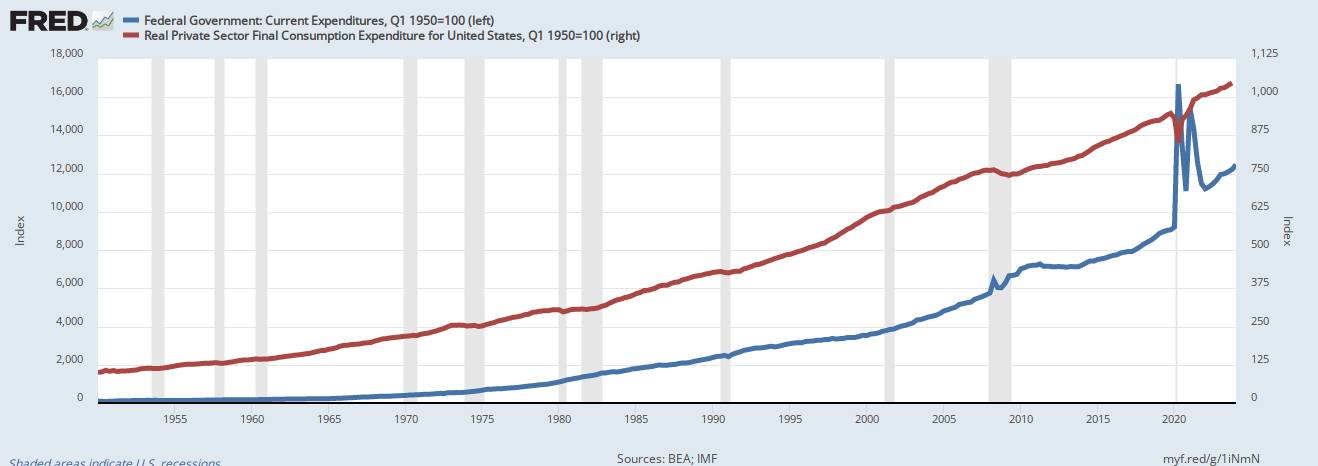
As federal “Debt” has grown, so has the economy (GDP).
As federal spending has grown, so has the economy (GDP).
There seems to be no sign that federal spending or federal “Debt” is “unsustainable,” “slows economic growth,” “heightens the risk of a fiscal crisis,” “causes other adverse outcomes,” or makes the nation’s fiscal position more vulnerable to an interest rate increase.” On the contrary, increases in federal “Debt,” yield all positive outcomes, while decreases in debt cause depressions and recessions:

U.S. depressions tend to come on the heels of federal surpluses.

1804-1812: U. S. Federal Debt reduced 48%. Depression began 1807. 1817-1821: U. S. Federal Debt reduced 29%. Depression began 1819. 1823-1836: U. S. Federal Debt reduced 99%. Depression began 1837. 1852-1857: U. S. Federal Debt reduced 59%. Depression began 1857. 1867-1873: U. S. Federal Debt reduced 27%. Depression began 1873. 1880-1893: U. S. Federal Debt reduced 57%. Depression began 1893. 1920-1930: U. S. Federal Debt reduced 36%. Depression began 1929. 1997-2001: U. S. Federal Debt reduced 15%. Recession began 2001.

Deficit reductions (purple line) lead to recessions (vertical gray bars) which are cured by deficit increases.
GDP = Federal Spending + Non-federal Spending + Net Exports. Not only does Federal Spending increase GDP directly, but it also increases Non-federal Spending by providing the private sector with money.

The new CBO report shows that debt payments will be one of the fastest-growing parts of the budget for the foreseeable future, along with the twin old-age entitlement programs of Social Security and Medicare.

By 2051, interest payments will be the single largest line item in the federal budget.

If there’s a sliver of good news to be found in the new CBO projections, it is that the situation looks slightly less dire than it did last year. That improvement is due to higher expected levels of immigration and stronger estimates of future economic growth—not because of anything that policy makers in Washington have done.

(If anything, they seem determined to prevent those improvements from coming to pass, whether by limiting immigration or regulating the economy more strictly.)

This is the ultimate of ignorance. The data stare him in the face, but instead of reevaluating his position, he claims the good news comes despite the data. In essence, Boehm has two conclusions:
  1. If the data support his belief, he calls attention to that.
  2. If the data do not support his belief, he ignores the data.
Thus, he is incapable of learning.

We should also keep in mind the usual caveats here: The CBO does not account for the possibility of recessions, natural disasters, wars, or other unpredictable events that could cause the federal government to borrow more heavily than current law expects.

The past 30 years have included 9/11, the war on terror, the Great Recession, and the COVID-19 pandemic, so it seems pretty likely that the next three decades will include at least a few emergencies that drive deficits higher.

Boehm doesn’t stop to think about why emergencies drive deficits higher: Emergencies, in of themselves, tend to impede economic growth, so the government increases deficit spending to save the troubled economy. Why does the government need to wait for emergencies before it stimulates economic growth. Why not stimulate growth during non-emergency times, too? This is a question the Libertarians and the right wing never asks, because the answer goes against their beliefs.

“There is no way to look at these eye-popping numbers without realizing we need to make a change,” Maya MacGuineas, president of the Committee for a Responsible Federal Budget, which advocates for lower deficits, said in a statement about the CBO report.

“And yet we have lawmakers promising what they won’t do: I won’t raise taxes, I won’t fix Social Security, I won’t pay for all the things I do want to do. And so we continue on this dangerous path.”

MacGuineas has been president of the CRFB for many years. She and her group are bought and paid for by the rich, so they espouse beliefs that would make the rich righer by widening the Gap between the rich and the rest.
  1. “I won’t raise taxes.” That is a good thing. Federal taxes remove growth dollars from the economy.
  2. “I won’t fix Social Security.” To MacGuineas, “fix” means cut benefits or raise taxes, both of which are unnecessary and harmful to the economy. The federal government has infinite money to pay for Social Security.
  3. “I won’t pay for all the things I want to do.” The government is perfectly capable of paying for anything and everything. It’s people like Boehm and MacGuimeas who hinder the government from doing what it was created to do: Protect and improve the lives of the people.

Indeed, on Thursday, Speaker of the House Mike Johnson (R–La.) told reporters that he supports plans for a so-called “fiscal commission”—which could propose some solutions to Congress’ budgeting problems—but only if the agency could not suggest tax increases or cuts to entitlement programs.

Obama had a “fiscal commission.” Its “increase- taxes, cut-spending” recommendations would have sent the economy into a depression. Fortunately, Congress didn’t listen.

That approach guarantees that the federal government will have to continue borrowing heavily to make ends meet.

Again, the U.S. government never borrows its own sovereign currency. Boehm does not recognize the differences between a Monetarily Sovereign entity and a monetarily non-sovereign entity. Either he is paid to act ignorant or he does it without pay.

Despite the Senate’s declaration that the national debt is a national security risk and the CBO’s attempts to sound the alarm about the federal government’s fiscal trajectory, there’s still a major shortage of elected officials who want to take the problem seriously.

He is correct that there’s “a major shortage of elected officials who want to take the problem seriously.” Without that shortage, the government could fund such benefits to America as:
  1. Comprehensive, no-deductible healthcare insurance or every American.
  2. More medical personnel at all levels, plus more hospitals with advanced equipment
  3. Social Security for Americans of all ages.
  4. The reduction of poverty and homelessness in America
  5. With the reduction of poverty, there would be a significant reduction in crime.
  6. A greater ability to accept fully vetted immigrants, whose work and intelligence would help America grow.
  7. Education, including advanced degrees, for all those who want it.
  8. More scientific innovation in disease prevention and cure.
  9. More efforts to reduce global warming.
  10. A dramatic reduction in federal taxes, which do nothing but remove growth dollars from the economy.
  11. Pay students a salary so that families would not need to favor dropping out of school to help support the family.
The government can pay for all of it, without taxes and without inflation. Anyone not want it? Rodger Malcolm Mitchell Monetary Sovereignty Twitter: @rodgermitchell Search #monetarysovereignty Facebook: Rodger Malcolm Mitchell

……………………………………………………………………..

The Sole Purpose of Government Is to Improve and Protect the Lives of the People.

MONETARY SOVEREIGNTY