Those, who do not understand the differences between Monetary Sovereignty and monetary non-sovereignty, do not understand economics.
============================================================================================================================================================================================================
The “no pain, no gain” crowd believes someone – preferably the poor – must suffer for us all to reach happiness. Here is a sampling of how they suggest achieving economic nirvana through economic agony:
1. Cut Social Security
2. Cut Medicare
3. Cut Medicaid
4. Cut the Supplemental Nutrition Assistance Program (SNAP) aka “food stamps”
5. Cut support for community health centers
6. Cut support for job re-training
7. Cut support for affordable housing programs
8. Cut funding for the Administration for Children and Families
9. Reduce the number, pay and retirement benefits of federal employees
10. Eliminate subsidies of student loans
11. Cut all inflation-based program benefits by changing the definition of inflation
See a pattern there? They all would impact low- to middle-income families most. See anything missing? Yes, we also could raise the income tax rates to cut the deficit, but that might impact upper-income families a tad. Republicans have declared income tax rate increases “off the table.” In fact, some Tea (formerly Republican) presidential candidates want to cut the highest tax rates (on the wealthy) further.
The Democrats, which own the Presidency and the Senate, hide in corners and wring their hands helplessly, hoping not to be seen. Though they portray themselves as the champions of the underclass, they have paid the wealthy bankers, then caved in to Republican threats to destroy the American economy (by refusing to raise the debt ceiling.) Instead, the Dems, the cowardly lions of politics, have agreed that benefits for the poor should be cut. Hey, could it be because they themselves are rich?
Understand, there is no financial difference between raising taxes and cutting federal spending. Both reduce the deficit equally. Nevertheless, I am a proponent of cutting federal taxes; they serve no useful purpose. Our Monetarily Sovereign government neither needs nor even uses tax money. It’s destroyed upon receipt.
Though followers of MMT (Modern Monetary Theory) claim taxes create demand for the dollar, there are plenty of state and local taxes to accomplish that purpose. Federal taxes not only are useless, but harmful, in that they remove money from the economy. So I am with the Republicans on the tax issue.
Unfortunately, the mutual desire to reduce federal spending is so wrongheadedly destructive, I say a pox on both parties; neither has even one member who understands Monetary Sovereignty.
Then we have FICA, that tax that doesn’t pay for Medicare, doesn’t pay for Social Security, and in fact, doesn’t pay for anything. It is the most useless, destructive, ignorant, regressive tax ever invented – a masterpiece of screw-the-poor.
For salaried folks, it usually is the biggest tax they pay. For the rich, it barely is noticeable, since it cuts off at $107K, and who needs salary, when you have capital gains at the lowest tax rate? Though the pretense is that business pays half, FICA functionally is a 15% payroll tax on the great unwashed.
The point of this rant is not to tell you how the wealthy minority (aided by the media barons and the clueless, old-line economists) again stick it to the “unwealthy” majority. You already know that. The point is to demonstrate how the “unwealthy” stick it to themselves.
Go into any middle- or lower-class neighborhood and ask a thousand people, “Should the federal deficit and debt be reduced?” and I predict 999 people will say “Yes,” and the other one will say, “Maybe.” These sad, brainwashed souls hardly can wait to cut off their own noses, by reducing the federal assistance they so desperately need.
Read though this blog, and you will see page after page of comments, most presumably by middle- and lower-class people, demanding the deficit and debt be cut because these measures are “unsustainable” and “ticking time bombs,” exactly the myths that have been spread since at least 1940, probably longer. (See: Unsustainable).
And these folks are determined masochists. I have been called every four-letter name essentially for not wanting to apply leeches to anemics, or for saying phrenology is quack science. The idea that the federal deficit needs to be cut is worse than quack science; it’s quack mythology.
The wealthy priests have beat the drums, convincing the lowly savages that asking for less and suffering more, will take them to heaven. The savages wholeheartedly agree, and God help anyone who tries to save them from themselves.
Lower-to-middle income debt-hawks have the same mind-set as those who volunteer to be suicide bombers. They hope to find their happiness in the afterlife.
========================================================================================================================================== No nation can tax itself into prosperity, nor grow without money growth. It’s been 40 years since the U.S. became Monetary Sovereign, , and neither Congress, nor the President, nor the Fed, nor the vast majority of economists and economics bloggers, nor the preponderance of the media, nor the most famous educational institutions, nor the Nobel committee, nor the International Monetary Fund have yet acquired even the slightest notion of what that means.
Remember that the next time you’re tempted to ask a teenager, “What were you thinking?” He’s liable to respond, “Pretty much what your generation was thinking when it ruined my future.”
The debt hawks are to economics as the creationists are to biology.
The November 2010 issue of reason.com contains an article titled, “How to Slash the State: 14 ways to dismantle a monstrous government, one program at a time”
It’s a thoughtful article, but only if you believe the federal government should be smaller, the federal deficit should be lower and taxpayers pay for federal spending. Unfortunately, there is no evidence to support any of these three beliefs. In fact, all the evidence points to the need for ever increasing federal deficit spending, i.e. money creation. (A growing economy requires a growing supply of money.) Also, in a monetarily sovereign nation, taxes do not pay for federal spending (though taxes do pay for state and local spending, as the states, counties and cities are not monetarily sovereign).
Further, some of the “dismantling” they suggest is more like shifting, because some of the suggestions merely push expenses from the federal government (which has unlimited money) to state and local governments (which are having great difficulty paying their bills) – a terrible idea.
Nevertheless, here are the ideas, with my comments.
1. Overhaul Medicaid
“stop the matching grant funding process, in which states receive federal money for each Medicaid dollar they spend” or “scrap the program entirely in favor of a temporary assistance program that doesn’t create long-term dependency.”
The first part of the suggestion shifts more burden to the struggling states, which are not monetarily sovereign, and so cannot create unlimited money. The second part of the suggestion goes under the heading, “These Medicaid recipients aren’t really poor; they are lazy. If we stop giving them help, they’ll go to work.” That simply is nuts.
2. Bring the Troops Home
“. . . a swift and total deoccupation . . . probably would save “$50 billion to $70 billion in fiscal 2011 and perhaps $80 billion to $100 billion a year in 2012 and beyond.”
I’d like to see the troops come home, but not for financial reasons. I have no idea why we’re in Afghanistan, but saving money is a foolish way to manage a war. It kills soldiers.
3. Erase Federal Education Spending
“. . . the federal education budget is full of cuttable programs. If eliminating the entire Department of Education is politically impossible, then the programs with the most tenuous relationships to raising student achievement need to be the first to go.”
This falls under the “make government more efficient” heading. Sure, who can argue with that, but again, it’s not a money thing. It’s an effectiveness thing.
4. Slash State Budgets
“ . . . lawmakers have been living way beyond their means for far too long.”
Not sure what this has to do with the federal government, but I love it. Any specific ideas?
5. End Defined-Benefit Pensions
“ . . . public servants of the future should be put into 401(k) plans like the rest of us, with responsibility to contribute to and manage their own retirement nest eggs.”
This would mean federal employees would receive less money, which would be anti-growth. I agree however, for state and local government employees, as the state and local governments spend taxpayer money.
6. Declare Defeat in the Drug War
“To enforce drug prohibition, state and federal agencies spend more than $40 billion and make 1.7 million arrests every year. This effort wastes resources that could be used to fight predatory crime. . . While imprisoned (as half a million of them currently are), drug offenders cannot earn money or care for their families, which boosts child welfare costs.”
I agree, but again not for money reasons. Prohibition didn’t work in the 1920’s. I can’t imagine why the public and the politicians think it will work, today. Prohibition caused crime in the 1920’s. It causes crime, today. The war on drugs is a perfect example of how the government and the public are incapable of learning from experience.
7. Cancel the Federal Communications Commission
“. . . just about everything the FCC does is either onerous, constitutionally dubious, ineffective, or all three.. . . its role as broadcast censor . . . The best alternative is a world in which spectrum is freely tradable private property rather than a government-managed resource, interference is treated as a tort, and no one worries about whether their next on-air word will result in a seven-figure fine—in other words, a world with no FCC at all.”
The FCC’s role as public scold is useless – actually harmful. The Internet has eliminated the prohibition against swear words, as today one easily can find the most pornographic videos. Fining CBS for Janet Jackson’s 1 second breast reveal, while every sexual act imaginable is available on the Internet, is just plain silly. But, the limited public bandwidth has to be managed to prevent monopolies.
8. Uproot Agriculture Subsidies
“They distort markets and spark trade wars. They make food staples artificially expensive, while making high-fructose corn syrup—the bogeyman of crunchy parents, foodies, and obesity activists everywhere—artificially cheap. They give farmers incentives to tamper with land that would otherwise be forest or grassland. They encourage inefficient alternative energy programs by artificially lowering the price of corn ethanol compared to solar, wind, and other biomass options. School lunches are jammed full of agricultural surplus goods, interfering with efforts to improve the nutritional value (and simple appeal) of the meals devoured by the nation’s chubby public schoolers.”
I agree. Any time the federal government subsidizes an industry, it controls that industry. So you have bureaucrats determining what food is best. While those agriculture subsidies are stimulative, in that they add money to the economy, they distort the market.
9. Unplug the Department of Energy
“. . . more than half of the department’s $26 billion budget ($16 billion) was devoted to managing . . . facilities that make and dispose of materials used for nuclear weapons. . . If Congress and the White House must pursue the development of alternative energy via social engineering, a far more effective alternative to allowing DOE bureaucrats to pick technology “winners” would be a tax on conventional energy. The boost in energy prices would at least encourage inventors and entrepreneurs to get to work.”
All taxes hurt the economy. Taxing energy would tax us all, as we all use energy. The federal gasoline tax has accomplished nothing but take money out of the economy. It certainly has not reduced the consumption of gasoline. It has been an economic cost. This falls under the heading: “If something is harmful, do it again, only more so.” Once again, a failure to learn from experience.
10. Dismantle Davis-Bacon
“. . . which requires all workers on federal projects costing more than $2,000 to be paid the “prevailing wage,” which typically means the hourly rate set by local unions. . . . born as a racist reaction to the presence of Southern black construction workers on a Long Island, New York, veterans hospital project.”
I agree. See #8. It’s another example of the federal government distorting the market, this time the labor market.
11. Repeal the Stimulus
“. . . as of early September, 18 months after the stimulus was passed, an estimated $301 billion remained unspent. That money should be banked, not wasted . . . deficit spending has crowded out private investment.”
A demonstration of financial ignorance. There is no way federal money can be “banked.” And there is no way deficit spending can “crowd out” anything. This is a myth. Without deficit spending, we would be in the deepest depression one could imagine. Of all 14 suggestions, this is the most ignorant.
12. Spend Highway Funds on Highways
“ . . . just to maintain the Interstate Highway System at a decent level is $10 billion to $20 billion per year. . . . lesser highways should all be the states’ problem.”
In other words, transfer the cost from the federal government, which can afford it, to the state governments, which can’t. And how does this help the taxpayer?
13. Privatize Public Lands
“Letting the states manage this land instead would take up to $5 billion a year off the federal books. . .One Forest Service contractor in Arizona recently offered to take over six state parks targeted for closure amid budget cuts. The concessionaire would collect the same visitor fees the state charges today while taking the operations and maintenance costs off the state’s books entirely. Further, the company would pay the state an annual “rent” based on a percentage of the fees collected, turning parks into a revenue generator instead of a money eater.”
In the very few cases where a private company could do this, profitably and under federal supervision, it could be a good idea. Now let’s talk about the other 99% of the public lands. Get real.
14. End (or at Least Audit) the Fed
It’s not explained how auditing would cut federal spending. Bernanke warned that opening the Fed’s books would diminish the central bank’s political independence. I believe him. Imagine relying on Congress to make quick economic decisions. These people can’t decide to go to the bathroom without the threat of filibuster. Let’s face it. The most dysfunctional of all federal agencies is Congress.
In summary, most of these suggestions simply are foolish or would not save taxpayers anything. A couple have some value, not because they “save” money, but because they are good governing policy. All are based an the false assumption that federal spending should be reduced.
Think of the economy as a child and money is its food. Today, the child is starving. To make the child healthy, we must feed it. As the child grows, it will need an increasing amount of food. Yes, if you overfeed the child, it will become fat (inflate), but we are a long way from that. The debt hawks want to starve the child, and then always are surprised when it becomes ill.
On March 20, the Wall Street Journal’s editorial, “The ObamaCare Crosswords” said, “The Congressional Budget Office estimates ObamaCare will cost taxpayers $200 billion per year when fully implemented and grow annually at 8% . . . Soon the public will reach its taxing limit . . . medicine will be rationed by politics. . . “
On March 22nd, the Chicago Tribune editorialized, “The health care reform legislation would raise, not lower, federal deficits by $562 billion . . .(there is time) to craft a more sensible compromise that extends health care coverage to more people without breaking the bank.”
Which bank? Do you mean the federal government, which has increased its debt in the past 30 years an astounding 1,400%, from $800 billion to $12 trillion, yet never has had, and never will have, any difficulty whatsoever in servicing its debt? Or do you mean the taxpayers, already suffering, but whom debt hawks will require to send additional money to a federal government that neither uses nor needs the money?
The Tribune’s solution: “Our choice would require insurers to take all comers but give them a big new customer base: American who now don’t have health coverage but who don’t need an overhaul this expensive in order to get it.” And who are these Americans? They fall into two main categories: Lower income people who can’t afford health insurance and people who have pre-existing health problems.
To assist the former would require insurers to lower rates, thus increasing premiums for everyone else. To cover the later would require insurers to accept greater risk and provide greater payouts, thus again increasing premiums for everyone else.
The strange belief that a federal government, which repeatedly demonstrates it has the unlimited ability to create money without inflation, suddenly would have difficulty servicing additional debt, has caused otherwise intelligent people to lose their ability to reason. Though our government continuously has proved it can service a debt of any size, taxpayers are limited in what they can service. So, why do respected media editors prefer tax increases to federal debt increases, especially when increasing federal debt stimulates the economy?
Contrary to media demagoguery and popular faith, taxpayers do not pay for federal spending. When the government spends, it merely reaches out and credits the bank accounts of its creditors. There is no limit to the government’s ability to activate these credits, which are not in any way affected by tax receipts. If all federal taxes were eliminated today, the federal government’s future ability to spend would not change by even one penny.
The confusion comes because the federal government is unlike you, me, companies and state, county and local governments. We all must obtain money to spend money, and we are limited in our ability to obtain money. By contrast, the federal government creates money out of thin air, with no limits. Taxpayers are not involved in the process.
Astute politicians are aware of the disconnect between taxes and spending, which is why Vice President Cheney, in an unguarded moment, famously said, “Deficits don’t matter.” But politicians, knowing the public believes taxes pay for spending, and not wanting to appear imprudent, go along with the myth.
We could have a health care program in which doctors, nurses and hospitals are well paid, pharmaceutical companies are incented to create new drugs, and all Americans receive optimum health care. Instead, wrong-headed budget concerns have taken precedence over human health concerns, leaving us with a crazy-quilt, inadequate health care bill.
The current plan is to take money from Medicare, from doctors, nurses and hospitals, from employers and from those who currently pay for health insurance. What a terrible, unnecessary human tragedy we have created, all because of ignorance about federal budgets.
Mitchell’s laws: The more budgets are cut and taxes inceased, the weaker an economy becomes. To survive long term, a monetarily non-sovereign government must have a positive balance of payments. Austerity = poverty and leads to civil disorder. Those, who do not understand the differences between Monetary Sovereignty and monetary non-sovereignty, do not understand economics.
Kermit the frog famously said, “It isn’t easy being green.” It also isn’t easy convincing people that traditional economics not only is hypothetically wrong, not only is factually wrong, but is wrong to such a degree it is extremely harmful to our economy.
The more extreme debt hawks believe the U.S. federal government should run a balanced budget or even have no debt at all. The more moderate debt hawks feel some debt may be necessary at times, but to them, federal debt is like bitter medicine you take only when absolutely necessary.
All debt hawks, whether extreme or moderate, are long on twisted “facts” but short on evidence.
Their “facts” inevitably include federal deficit and debt measures, projections for the future, debt/GDP ratios, and spending on Medicare and Social Security.
However, when they interpret the facts, they provide no evidence that their interpretations reflect reality.
By contrast, here are facts and a few opinions, which you may interpret for yourself.
1. Fact: Money is the way modern economies are measured. By definition, a large economy has a larger money supply than does a small economy. Therefore, a growing economy requires a growing supply of money. QED
The graph below shows the essentially parallel paths of GDP vs. perhaps the most comprehensive measure of the money supply, Domestic Non-Financial Debt:
One could argue that money begets production or that production begets money, and both would be correct. The point is that money supply (i.e. debt) and GDP go hand-in-hand. Reduced debt growth results in reduced economic growth.
Gross Domestic Product = Federal Spending + NonFederal Spending + Net Exports.
Thus, by formula, a cut in federal spending cuts GDP.
2. Fact: All money is debt and all financial debt is money. In addition to being state-sponsored, legal tender, there are four criteria for modern money:
–Monetarily Sovereign money must be defined in a standard unit of currency.
–MS money has no, or limited, intrinsic value.
–The demand for money is determined by its risk (danger of default or devaluation, i.e., inflation) and its reward (interest rates).
–To have value, money must be owned by an entity other than the entity that created it.
The above criteria describe many forms of money, including currency, bank accounts, T-securities, corporate bonds, and money markets. All forms of money are debt, and a growing economy requires a growing supply of debt/money.
2.a. Fact: Federal “deficit” is a statement of the net amount of money the federal government has created in one year. Opinion: The word “deficit” is pejorative. A more neutral description would be money “created” or “added,” as in, “The government has created $1 trillion,” or “The government has added $1 trillion to the economy.”
Compare the psychological meaning of those statements with the current phrasing, “The government has run a $1 trillion deficit.”
3. Fact: U.S. depressions tend to come on the heels of federal surpluses.
1804-1812: U. S. Federal Debt reduced 48%. Depression began 1807. 1817-1821: U. S. Federal Debt reduced 29%. Depression began 1819. 1823-1836: U. S. Federal Debt reduced 99%. Depression began 1837. 1852-1857: U. S. Federal Debt reduced 59%. Depression began 1857. 1867-1873: U. S. Federal Debt reduced 27%. Depression began 1873. 1880-1893: U. S. Federal Debt reduced 57%. Depression began 1893. 1920-1930: U. S. Federal Debt reduced 36%. Depression began 1929. 1997-2001: U. S. Federal Debt reduced 15%. Recession began 2001.
4. Fact: Recessions tend to follow reductions in federal debt/money growth (See graph below), while debt/money growth has increased when recessions are resolving.
Taxes reduce debt/money growth. No government can tax itself into prosperity, but many governments tax themselves into recession.
Recessions repeatedly come on the heels of deficit growth reductions, and are cured with deficit growth increases.
5. Fact: On August 15, 1971, the federal government gave itself the unlimited ability to create debt/money by completely abandoning the gold standard. This ability is called Monetary Sovereignty.
Because the federal government now has the unlimited ability to create dollars, it neither taxes or borrows in order to obtain dollars. It simply creates them ad hoc. Tax dollars are destroyed upon receipt.
When you pay your taxes, you take dollars from your checking account. These dollars were part of the M2 money supply measure.
When they reach the Treasury, they cease to be part of any money supply measure. They effectively are destroyed. To pay its bills, the federal government creates new dollars, ad hoc.
6. Fact: Federal “debt” is the total of outstanding Treasury Securities. Here is how Treasury Securities, incorrectly termed “borrowing” come into existence.
–You tell the government to debit your checking account and credit your Treasury security account by the same amount. The process is similar to transferring money from your checking account to your bank savings account.
To “pay off” the Treasury Security, the government simply debits your T-security account and credits your checking account.
Thus, the government could pay off all its so-called “debt” tomorrow simply by debiting all T-security accounts and crediting the T-Security owners’ checking accounts.
The entire process neither adds nor subtracts money from the economy (but for interest paid).
Our Monetarily Sovereign government does not borrow the money it has already created but rather exchanges one form of U.S. money (T-securities) for another (dollars). The entire “borrowing” process is nothing more than an asset exchange.
Do T-securities have any benefit? Yes, federal interest payments add to the money supply, an economically stimulative event. Federal interest payments help the government control interest rates and the dollar’s value. (The higher the interest, the greater the value of the dollar, and the more the economy receives in growth dollars.)
The most important purpose of T-securities is to provide a safe place to store unused dollars. This stabilizes the dollar while increasing its value.
T-securities (debt) are not functionally related to the difference between taxes and spending (deficits). They are related only by laws requiring the Treasury to create T-securities in the amount of the deficit.
The Treasury can create T-securities (debt) without a deficit, and the government can run a deficit without creating T-securities. Federal debt is not functionally the total of federal deficits.
The federal government could pay off the entire so-called “debt” today, merely by returning the dollars to the T-security depositors.
7. Fact: Federal taxes, as a money-raising tool, are unnecessary, harmful and futile:
— unnecessary because since 1971 (when the U.S. government became fully Monetarily Sovereign), the government has had the unlimited ability to create money without taxes,
— harmful because taxes reduce the money supply, which reduction leads to recessions and depressions, and
–futile because tax money sent to the government is destroyed upon receipt by the U.S. Treasury.
When you send taxes to the government, you are sending M2 dollars, but when they reach the Treasury, they cease to be part of any money supply measure. They effectively are destroyed.
Our Monetarily Sovereign government does not store dollars for future use. It can create unlimited dollars ad hoc by paying bills.
The so-called “debt” merely accounts for the total outstanding T-securities created out of thin air by the federal government.
The government decides to create T-securities equal to the deficit, but this requirement became obsolete in 1971 when we went off the gold standard and became Monetarily Sovereign.
Today, the federal government creates money by spending, i.e. it credits checking accounts to pay its bills. This crediting of checking accounts adds dollars to the economy.
The federal “deficit” is the net money created in one year and the federal “surplus” is the net money destroyed in one year. In short, deficit spending creates money and taxing destroys money. If taxes fell to $0 or rose to $100 trillion, this would not affect by even one dollar, the federal government’s ability to spend.
Further, (opinion)all tax (money-destroying) systems are unfair. See: http://rodgermitchell.com/FairTaxes.html. For a country with the unlimited power to create money, spending is not related in any way to taxing.
8. Fact: Contrary to popular myth, there is no post-gold standard relationship between federal debt and inflation. (See graph, below)
Also, contrary to popular myth, inflation is not caused by “excessive federal spending.” Inflation is caused by shortages of crucial goods and services, most often oil and/or food. (See the graph, below)
In this regard, hyperinflations are not caused by “money-printing,” but rather by shortages. So-called “money printing” (ala Zimabwe and Germany), were the governments’ response to hyperinflation, not the cause.
The Zimbabwe inflation was caused by food shortages. (The government stole land from farmers and gave it to non-farmers.) Money “printing” was the faulty response to inflation, not the cause.
The most recent inflation was caused by COVID-related shortages of oil, food, shipping, computer chips, metal, housing, lumber, and labor, among other things. As the shortages have been reduced, so has the inflation.
WWII Context: During World War II, many consumer goods were in short supply because production was focused on the war effort. When the war ended, the supply of goods resumed, and the previously unmet demandwas suddenly able to be fulfilled.
Oil Crises: Similarly, during the oil crises of the 1970s, the reduced supply of oil caused prices to spike, not because of a sudden increase in demand, but because the existing demand couldn’t be met.
COVID-19 Pandemic: Supply chain disruptions and production bottlenecks during the pandemic created shortages in various goods, leading to price increasesonce supply constraints eased and the pent-up demand was met.
While the underlying demand might have been consistent, the ability to fulfill that demand was constrained by supply issues. When supply bottlenecks were removed, the previously suppressed demand could finally be expressed, leading to price increases.
Latent Demand: The concept of latent demand suggests that consumers’ desire for goods remains constant, but it is the availability of those goods that fluctuates.
Supply Constraints: Supply-side constraints create temporary mismatches between demand and supply, leading to inflationary pressures once those constraints are lifted.
Observing changes over time can reveal the true causes of economic phenomena. By examining what happens just before and during an inflationary period, we often find that supply-side disruptions are the primary drivers.
Gradual Demand Changes: Demand usually changes slowly, giving the economy time to adjust. This gradual change rarely leads to significant price fluctuations on its own.
Sudden Supply Changes: Supply-side shocks, such as natural disasters, geopolitical events, or production bottlenecks, can occur rapidly and unpredictably. The economy struggles to adjust quickly to these disruptions, leading to price increases as a balancing mechanism.
9. Fact: There is no post-gold standard relationship between federal debt and your taxes.
Unlike state/local governments, which are monetarily non-sovereign, the federal government does not use tax dollars to pay its bills. It creates new dollars, from thin air, every time it pays a creditor.
The sole purposes of federal taxes are:
–To control the economy by taxing what the government wishes to discourage and by giving tax breaks to what the government wishes to reward.
–To assure demand for the U.S. dollar by requiring all federal taxes to be paid in dollars.
Taxes do not pay for federal spending. Federal spending creates dollars.
9.a. Fact: Federal deficit spending does not use “taxpayers’ money.” Federal spending creates money ad hoc.
When the government spends it credits bank accounts. No taxes involved. By definition, deficit spending means taxes do not equal this year’s spending let alone previous year’s spending. Only surpluses use taxpayers’ money, by causing recessions.
For the above reasons, our children and grandchildren will not pay for today’s money creation. Still, they will benefit from today’s deficit spending — better infrastructure, army, education, R&D, safety, security, health, and retirement.
Any time you hear or read about the federal government spending “taxpayers’ money,” know that the person is ignorant about Monetary Sovereignty. The federal government doesn’t spend taxpayers’ money. Period.
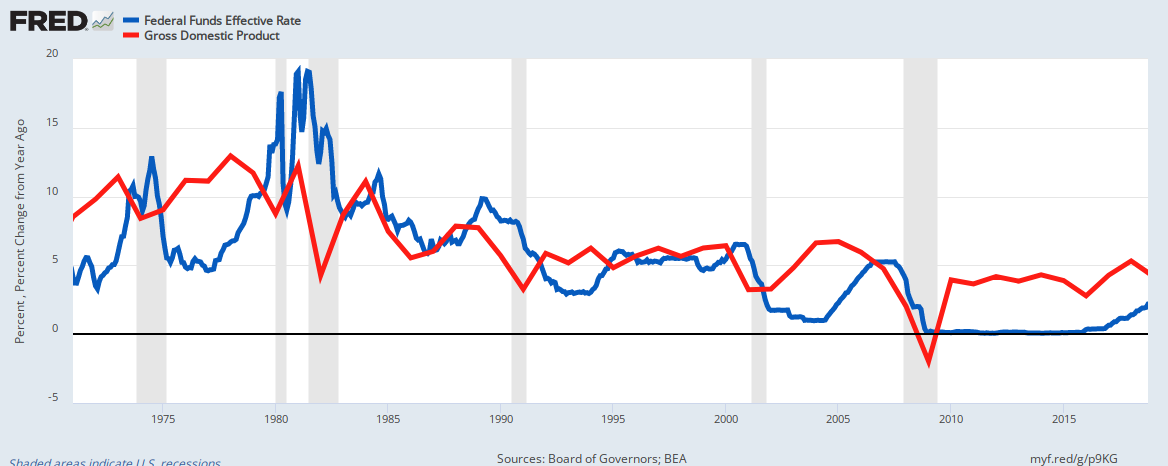
10. Fact: There is no post-gold standard relationship between low interest rates and high GDP growth. Opinion: The opposite seems true:
The interest rate and economic growth lines move in opposite directions.
Why do high interest rates stimulate? Opinion: High rates force the federal government to pay more interest, pumping more money into the economy.
The Fed increases interest rates to fight inflation. But increasing interest rates increases the prices of goods and services, i.e. causes inflation.
The Fed, in a sense, is using leeches to fight anemia.
11. Fact: The Federal debt/GDP ratio is a meaningless fraction, because it measures two, mathematically incompatible pieces of data. It’s an apples/oranges comparison. GDP is a one-year measure of output; federal debt is the net outstanding T-securities created since the nation’s birth.
The T-securities created years ago affect this year’s debt in the debt/GDP ratio, while even last year’s GDP does not affect this ratio. See: Debt/GDP
Because federal debt is the total of T-securities, and the federal government has the functional ability to stop creating T-securities at any time, the Debt/GDP ratio easily could fall to 0, depending on federal law.
11.a. Fact: The debt/GDP ratio does not measure the federal government’s ability to pay its bills. The government does not pay bills with GDP; it creates the money ad hoc to pay its bills.
Were GDP to be $0, the government still could pay bills of any size, simply by crediting the bank accounts of its creditors.
12. Facts: In 1979, gross federal debt was $800 billion. In 2009 it reached $12 trillion, a 1400% increase in 30 years. During that period, GPD rose 440% (annual rate of 5.5%>) with acceptable inflation. The same 1400% increase would put the debt at $180 trillion in 2039, a mean annual deficit of $5+ trillion.
This calculates to a 9.5% annual debt increase for the past 30 years. Repeating that growth rate would put the 2010 deficit at about $1.14 trillion, and the 2011 deficit at about $1.25 trillion. The deficit for year 2039 would be about $15.8 trillion.
Opinion: I know of no reason why the results would not be the same as they have been in the past 30 years. However, increasing the debt growth rate above 9.5% might show even better results:
In the 10 year period, 1980 – 1989, federal debt grew 210%, from $900 billion to $2.8 trillion (a 12% annual debt increase), while GDP grew .96% from $2.8 trillion to $5.5 trillion (a 7% annual increase). During that same period, inflation fell from 14.5% in 1980 to 5.2% in 1989. See graph, below.
The peaks and valleys of federal deficits (blue) generally correspond to the peaks and valleys of real (inflation adjusted) Gross Domestic Product growth. The reason: GDP = Federal Spending + Nonfederal Spending + Net Exports
Facts: In summary, large deficits have coincided with real (inflation adjusted) GDP growth
12. Facts: Any health insurance proposal that covers more people will cost more money. Extracting that money from doctors, hospitals, pharmaceutical companies, by necessity, would reduce the availability of health care.
Increasing taxes on any individuals (even the wealthy) or on businesses, will depress the economy by removing money from the economy. Only the federal government can supply additional money while stimulating the economy.
13. Fact: Social Security is supported neither by FICA nor by a trust fund. Were FICA eliminated, and benefits doubled, Social Security still would not go bankrupt unless Congress decided to make this happen.
In June, 2001, Paul O’Neill, Secretary of the Treasury said, “I come to you as a managing trustee of Social Security. Today we have no assets in the trust fund. We have promises of the good faith and credit of the United States government that benefits will flow.“
Yet, SS continues to pay benefits. Your Social Security check comes from a mythical trust fund that contains no money and receives no money.
Social Security (and Medicare) benefits are paid ad hoc by the U.S. government, not from a trust fund, and are not dependent on FICA taxes. which (opinion:) can and should be eliminated. See: FICA
14. Fact: The finances of the federal government are different from yours and mine and businesses’ and state, county and city government finances.
Unlike the federal government, which is Monetarily Sovereign, we cannot create unlimited amounts of money to pay our bills. We first need to acquire money, either by borrowing or by saving, to spend.
The federal government does not acquire money. It creates money by spending. As an accounting principle, the tax money you send to the government is destroyed upon receipt. Then the federal government creates new money to pay its bills. The government has no fund from which it pays bills.
Fact: Were taxes to decrease to zero, this would not change by even one penny, the federal government’s ability to spend.
Opinion: The failure to recognize the difference between the Monetarily Sovereign federal government and all other entities, which are monetarily non-sovereign, is the primary reason for recessions and depressions.
15. Fact: The federal government has the unlimited ability to create the dollars to pay any bill of any size. It never can run short of dollars; it never can go broke.
Opinion: The federal government should distribute dollars to each monetarily non-sovereign state, on a per capita basis.
The states would determine how they distribute the dollars (to counties, cities and/or taxpayers). I suggest a distribution of $5,000 per person or a total of $1.5 trillion.
Fact: In 1971, the U.S. went off the gold standard, thereby becoming a Monetarily Sovereign nation, and at that moment, all economics textbooks became obsolete. Sadly, mainstream economists, the politicians and the media have not yet caught up.
Summary: So there you have a list of facts, plus a few opinions, which I have noted. Read the facts and draw your own inferences.
You can find a great number of debt-hawk sites (i.e. Concord Coalition, Committee for a Responsible Federal Budget), which in essence are privately funded think tanks, paid to influence popular belief, with propaganda masquerading as data.
There, you will see data showing the size of the federal debt. These data are presented in a way designed to imply that the debt (money created) is too large.
But you will find no proof of these ideas. You will see no historical graphs equating debt with any negative economic outcome, simply because such graphs do not exist. Debt hawks believe federal deficits are so obviously bad, no proof is needed.
Yet, despite lacking proof, debt-hawks have foisted their opinions on the media, the politicians, weak-minded economists, and the public, much to the detriment of our economy.