–On being thrown off the cliff: Where is the George Washington of Greece?

Twitter: @rodgermitchell; Search #monetarysovereignty
Facebook: Rodger Malcolm Mitchell

Mitchell’s laws:
●Those, who do not understand the differences between Monetary Sovereignty and monetary non-sovereignty, do not understand economics.
●The more federal budgets are cut and taxes increased, the weaker an economy becomes. .
Liberals think the purpose of government is to protect the poor and powerless from the rich and powerful. Conservatives think the purpose of government is to protect the rich and powerful from the poor and powerless.
●The single most important problem in economics is
the gap between rich and poor.
●Austerity is the government’s method for widening
the gap between rich and poor.
●Until the 99% understand the need for federal deficits, the upper 1% will rule.
To survive long term, a monetarily non-sovereign government must have a positive balance of payments.
●Everything in economics devolves to motive,
and the motive is the Gap.

=========================================================================================================================================================================================================================

In the previous post, we showed how federal deficit cutting (austerity) and the misguided attempt to create a government surplus, harms the middle and lower income groups (the “99%”) by draining dollars from the economy.

We described how deficit cutting has been sold to the 99% as “prudent” economics, while in reality, it is a plan to widen the income/wealth/power Gap between the rich and the rest.

Not well understood is that the widening of the Gap is a self-perpetuating process that once begun, can continue and accelerate of its own momentum.

It’s much like being thrown from a cliff.

G-7 Throws Greece Under the Bus
Posted on June 8, 2015 by Yves Smith

Statements coming out of (the G-7) signal that the U.S., Canada, Germany, France, Japan, Italy and the U.K are backing the creditor position.

The Obama administration had changed its position in February from pushing the lenders to come up with more pro-growth policies (meaning give relief to Greece) to stressing that Greece needed to “find a constructive path forward in partnership with Europe and the IMF to build on the foundation that exists.”

“There was unanimity of opinion in the room that it was important for Greece and their partners to chart a way forward that builds on crucial structural reforms” and returns to growth, White House spokesman Josh Earnest told reporters.

This means, continuing the analogy, that Greece, having been thrown from the euro cliff, now must find a way magically to fly back up, with no help.

Greece does not own sufficient euros to pay its bills. Austerity already has ravaged Greece’s economy, so it has no way to generate euros. The G-7 “solution” is more austerity, which will ravage Greece’s economy further in an unending, unstoppable fall.

The G-7, having applied leeches to Greece’s economic bloodstream, and seeing that the leeches caused the inevitable economic anemia, now demand that more leeches be applied.

Poverty begets poverty by making the climb out of poverty increasingly difficult.

Impoverished people suffer from poor primary education. The schools themselves are inferior.

Additionally, college may be unaffordable, and even those few colleges that are affordable don’t have the cache to provide entry to the best jobs.

Even less understood are the austerity effects on the people themselves. Poverty begets more poverty by changing the impoverished, in body and mind.

Less nutritious food, leading to physical exhaustion, inhibit work, study and thought. Job seeking and job keeping become less successful.

But there is even more:

Look What Austerity Does to a Child’s Brain
Posted on Jun 7, 2015

The stressful conditions of poverty—“overcrowding, noise, substandard housing, separation from parent(s), exposure to violence, family turmoil”—can have toxic effects on the developing brain, permanently diminishing the ability to think clearly and calmly.

Profiling the work of Pat Levitt, a developmental neuroscientist who serves as science director of the National Scientific Council on the Developing Child, Madeline Ostrander writes at The New Yorker:

These conditions provoke the body to release hormones such as cortisol, which is produced in the adrenal cortex.

In a pregnant woman, the hormone can “get through the placenta into the fetus,” Levitt told me, potentially influencing her baby’s brain and tampering with its circuitry.

Later, as the same child grows up, cortisol from his own body may continue to sabotage the development of his brain.

The negative effect of poverty on the human brain has been documented.

In March, in the journal Nature Neuroscience, a group of researchers from nine hospitals and universities published a major study of more than a thousand children.

They took DNA samples, made MRI scans of the children’s brains, collected data on their families’ income level and educational background, and gave them a series of tests for skills like reading and memory.

The DNA samples allowed the scientists to factor out the influence of genetic heritage and look more closely at how socioeconomic status affects a growing brain.

As might be expected, more educated families produced children with greater brain surface area and a more voluminous hippocampus.

But income had its own distinct effect: living in the lowest bracket left children with up to six per cent less brain surface area than children from high-income families.

Wealth can’t necessarily buy a better brain, but deprivation can result in a weakened one.

In a longer-term study published two years ago, neuroscientists at four universities scanned the brains of a group of twenty-four-year-olds and found that, in those who had lived in poverty at age nine, the brain’s centers of negative emotion were more frequently buzzing with activity, whereas the areas that could rein in such emotions were quieter.

Elsewhere, stress in childhood has been shown to make people prone to depression, heart disease, and addiction in adulthood.

The above findings are expanded upon in the June 4, 2105 article, What Poverty Does to the Young Brain by Madeline Ostrander.

Bottom line: Greece’s austerity-riven economy is in a depression. The nation, deeply in debt, has insufficient sources of euros ever to pay that debt.

But the “troika” — European Central Bank (ECB), the European Commission (EC), and the International Monetary Fund (IMF) – knowing Greece never will repay, still insists Greece apply more of the same austerity that pushed Greece into depression.

The troika’s fear is that Greece will awaken, leave the euro, become Monetarily Sovereign by re-installing the drachma, and reclaim its sovereignty. That would put an end to the troika’s free lunch at Greece’s expense.

The myth, that Monetary Sovereignty would drive Greeks into a greater hardship than they already suffer, is ridiculous on its face (greater hardship than the current depression??)

The myth is promulgated by the banks, to dissuade Greece from freeing itself from their greedy clutches.

The troika’s even larger fear is that other euro nations, seeing Greece’s escape and resultant success, would themselves leave the euro, and then, for the rich banks, the feeding frenzy would be over.

Already impoverished, the Greek people face an increasingly difficult road, making emergence from debt ever more unlikely. The difficulties not only are financial, but physical and mental.

Ultimately, if the troika has its way, the Greek people would be turned into idiot slaves of the rich, desperate and with no hope or facilities for recovery, thankful for the crumbs the rich allow them.

Greece can put a stop to the torture of its people, simply by refusing to pay any more tribute to the troika.

This would require political courage, but just as George Washington led the United States to freedom from tyranny, the leader who leads Greece from troika tyranny, forever will be remembered as the “George Washington of Greece.”

Let us pray that, like George Washington, such a leader somehow emerges.

And let us pray that another George Washington arrives to save us from our own greedy and pusillanimous leaders, before we too are swallowed by the current austerity and the rich.

Rodger Malcolm Mitchell
Monetary Sovereignty

===================================================================================
The Ten Steps to Prosperity:

1. Eliminate FICA (Click here)
2. Federally funded Medicare — parts A, B & D plus long term nursing care — for everyone (Click here)
3. Provide an Economic Bonus to every man, woman and child in America, and/or every state a per capita Economic Bonus. (Click here) Or institute a reverse income tax.
4. Federally funded, free education (including post-grad) for everyone. Click here
5. Salary for attending school (Click here)
6. Eliminate corporate taxes (Click here)
7. Increase the standard income tax deduction annually. (Refer to this.)
8. Tax the very rich (.1%) more, with higher, progressive tax rates on all forms of income. (Click here)
9. Federal ownership of all banks (Click here and here)

10. Increase federal spending on the myriad initiatives that benefit America’s 99% (Click here)

Initiating The Ten Steps sequentially will add dollars to the economy, stimulate the economy, and narrow the income/wealth/power Gap between the rich and the rest.
——————————————————————————————————————————————

10 Steps to Economic Misery: (Click here:)
1. Maintain or increase the FICA tax..
2. Spread the myth Social Security, Medicare and the U.S. government are insolvent.
3. Cut federal employment in the military, post office, other federal agencies.
4. Broaden the income tax base so more lower income people will pay.
5. Cut financial assistance to the states.
6. Spread the myth federal taxes pay for federal spending.
7. Allow banks to trade for their own accounts; save them when their investments go sour.
8. Never prosecute any banker for criminal activity.
9. Nominate arch conservatives to the Supreme Court.
10. Reduce the federal deficit and debt

No nation can tax itself into prosperity, nor grow without money growth. Monetary Sovereignty: Cutting federal deficits to grow the economy is like applying leeches to cure anemia.
1. A growing economy requires a growing supply of dollars (GDP=Federal Spending + Non-federal Spending + Net Exports)
2. All deficit spending grows the supply of dollars
3. The limit to federal deficit spending is an inflation that cannot be cured with interest rate control.
4. The limit to non-federal deficit spending is the ability to borrow.

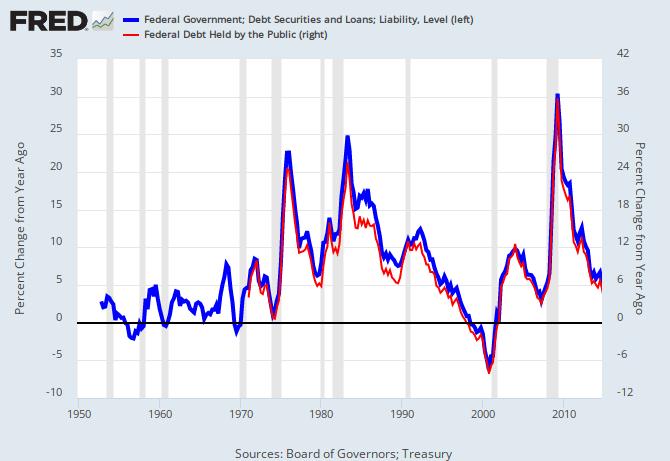
THE RECESSION CLOCK

Long term view:
Monetary Sovereignty

Recent view:
Monetary Sovereignty

Vertical gray bars mark recessions.

As the federal deficit growth lines drop, we approach recession, which will be cured only when the growth lines rise. Increasing federal deficit growth (aka “stimulus”) is necessary for long-term economic growth.

#MONETARYSOVEREIGNTY

–What is the fundamental difference between Greece and the U.S.? What is our excuse?

Twitter: @rodgermitchell; Search #monetarysovereignty
Facebook: Rodger Malcolm Mitchell

Mitchell’s laws:
●Those, who do not understand the differences between Monetary Sovereignty and monetary non-sovereignty, do not understand economics.
●The more federal budgets are cut and taxes increased, the weaker an economy becomes. .
Liberals think the purpose of government is to protect the poor and powerless from the rich and powerful. Conservatives think the purpose of government is to protect the rich and powerful from the poor and powerless.
●The single most important problem in economics is
the gap between rich and poor.
●Austerity is the government’s method for widening
the gap between rich and poor.
●Until the 99% understand the need for federal deficits, the upper 1% will rule.
To survive long term, a monetarily non-sovereign government must have a positive balance of payments.
●Everything in economics devolves to motive,
and the motive is the Gap.

=========================================================================================================================================================================================================================

What is the fundamental difference between Greece and the U.S.?

First a bit of background. Federal deficit spending creates dollars by adding them to the economy. A federal surplus destroys dollars by taking them from the economy.

It’s that simple.

Syriza Commits to Deep Austerity in Its Proposal to Creditors
Posted on June 7, 2015 by Yves Smith

We’ve been telling readers, to sometime hostile responses, that Syriza has in fact already agreed to a continuation of austerity.

“Austerity” is another word for deficit reduction, i.e. removing money (in Greece’s case, euros) from Greece’s economy.

(Finance minister) Varoufakis (is committed) to continued austerity even as he tries to present it as the reverse.

“What are we talking about? Of an independent tax agency, of keeping forever a reasonable primary surplus, of a sensible and ambitious privatization program… of a true reform of the pension system …of liberalizations of markets for goods and services etc,” he wrote.

Translation: A “reasonable” primary surplus occurs only when taxes exceed government spending.

Ask yourself this: If I give the government more in taxes than what the government gives me, will my wealth increase or decrease? Will I be able to spend more or spend less?

Will businesses, which rely on my spending, have more or less income and be more or less profitable? And will this grow the economy or shrink it?

In short, for any nation, there is no “reasonable” primary surplus.

Now as we’ve stressed, any primary surplus is contractionary, and will be particularly damaging in an economy already in depression like Greece’s.

The leaked creditor proposal offers a (surplus) target of 1% (of GDP) in 2015, 2% in 2016, 3% in 2017 and 3.5% in 2018 and beyond and asks that Greece introduce a supplementary budget for 2015 to meet the new target.

Translation: The criminal banks want to extract as much money from Greece as possible, as soon as possible. The reason: They know Greece is insolvent and will not, for long, be able to pay its suppliers of goods and services.

So the banks scramble to suck up the remaining euros, before other creditors get them, while pretending the rape of Greece is prudent economics.

The current Greek VAT system includes 3 rates (6.5%, 13%, 23%). Creditors ask to move to a 2-rates system, with the two rates being 23% and 11%.

VAT is a sales tax system, that like all sales taxes, is regressive. It punishes most the middle and lower income groups — the people who spend the greatest percentage of their incomes on goods and services.

The rich, who invest most of their income, are mostly immune to VAT. And that is the whole point. The euro system was sold as a way to improve trade efficiencies and thus, to benefit workers and small businesses.

It was a clever lie, aka “the Big Lie.”

The purpose of the euro system is to empower the rich (1%) and to enslave the middle and the poor (99%). And that is exactly what austerity mathematically must do.

By draining the blood from an economy, the rich act as the leeches, forcing the 99% to be the blood donors.

Pension reform: The creditors ask for “further immediate steps to improve the pension system, that are expected to yield around 1 percent of GDP in savings annually in 2016-17, including significantly tightening early retirements rule, increasing health contribution for pensioners, and phasing out the non-pension solidarity grant”.

Translation: The words “reform” and “improve” are euphemisms for “cut.” The rich want to cut the pensions on which the 99% survive.

The rich also want to force the 99% to work longer (“tighten early retirements”), pay more for health care insurance and eliminate government contributions to their version of Social Security.

All this so the bankers can be paid, and the Gap between the rich and the rest can grow.

And lest you believe this is a problem solely affecting the Greek people:

Obama is on track to leave a budget surplus

Bill Clinton left the presidency with a budget surplus. And although the first five years of Barack Obama’s presidency have featured high (but falling) deficits, it’s starting to look like Obama could do the same.

Obama leaving office with a balanced budget would come as a big shock to those who have compared the U.S. to crisis-stricken countries like Greece, or claimed that Obama is spending like a drunken sailor.

But that is exactly what the U.S. is on trend to do.

What does the following graph tell you about when recessions occur?

monetary sovereignty

Recessions never seem to occur when the federal deficit — the measure of federal government money being added to the economy — is above 3% of Gross Domestic Product. The strong tendency is for recessions to occur after the federal deficit falls below 3% of GDP.

And where is the line now?

Although President Clinton loves to boast about the surpluses his administration ran, the fact is that those surpluses of the late 1990s led to the recession of 2001.

There was no reason for surpluses. Inflation was low and bore no relationship to federal deficit spending:
monetary sovereignty

The surpluses were created at the behest of the rich.

The title question asks: What is the fundamental difference between Greece and the U.S.?

Greece, being monetarily non-sovereign, has no sovereign currency. It does not have the unlimited ability to create its own currency. It uses the euro, over which it has no control.

It neither can prevent nor cure recessions and depressions. It floats helplessly in a boat steered by its banker creditors, the “Troika” — the International Monetary Fund (IMF) the European Commission (EC) and the European Central Bank (ECB).

The Greek people are suffering victims of the banks.

By contrast, the U.S. is Monetarily Sovereign. It originally created, and has total control over, its sovereign currency, the dollar. It can create as much as it needs, merely by pressing a computer key.

The U.S. never can be unable to pay its debts.

Why then does the U.S. use the same austerity — the same deficit cutting — as Greece? Because just as the rich control the Greek economy, so too do the rich control the U.S. economy, specifically by controlling the President and Congress.

This control is in the form of campaign contributions and promises of lucrative employment later. In short, our government is bribed to do as the rich wish, courtesy of the U.S. Supreme Court.

The American rich want to cut pensions (including Social Security), cut Medicare, cut aids to the impoverished, cut aids to education, and make the 99% pay more for services — the same as what the European rich are doing to Greece.

It is the rich who bless American gun ownership, then look on, mouthing “tsk tak” while the 99% kill one another.

The rich are the same the world over. Their greed knows no bounds. No amount of money, wealth and power satisfies them. The distance between the rich and the rest never is great enough, despite how much the Gap has grown.

monetary sovereignty

Dictators assemble armies to beset their own countrymen; the rich assemble followers to beset the 99% who object to economic abuse.

These followers have been trained to sneer at “libs” who demand government services, and taught to claim falsely that federal spending causes inflations, sloth and dependence.

Like pet parrots, they speak the words given them by the rich, not understanding it is they, the followers, whom the rich despise for their ignorance and subservience.

The Greeks have fallen into the economic maelstrom called, “the euro.” They cannot help but be sucked down, down, down, with no depth of poverty sufficient to satisfy the rich.

But here in America what is our excuse?

Rodger Malcolm Mitchell
Monetary Sovereignty

===================================================================================
The Ten Steps to Prosperity:

1. Eliminate FICA (Click here)
2. Federally funded Medicare — parts A, B & D plus long term nursing care — for everyone (Click here)
3. Provide an Economic Bonus to every man, woman and child in America, and/or every state a per capita Economic Bonus. (Click here) Or institute a reverse income tax.
4. Federally funded, free education (including post-grad) for everyone. Click here
5. Salary for attending school (Click here)
6. Eliminate corporate taxes (Click here)
7. Increase the standard income tax deduction annually. (Refer to this.)
8. Tax the very rich (.1%) more, with higher, progressive tax rates on all forms of income. (Click here)
9. Federal ownership of all banks (Click here and here)

10. Increase federal spending on the myriad initiatives that benefit America’s 99% (Click here)

Initiating The Ten Steps sequentially will add dollars to the economy, stimulate the economy, and narrow the income/wealth/power Gap between the rich and the rest.
——————————————————————————————————————————————

10 Steps to Economic Misery: (Click here:)
1. Maintain or increase the FICA tax..
2. Spread the myth Social Security, Medicare and the U.S. government are insolvent.
3. Cut federal employment in the military, post office, other federal agencies.
4. Broaden the income tax base so more lower income people will pay.
5. Cut financial assistance to the states.
6. Spread the myth federal taxes pay for federal spending.
7. Allow banks to trade for their own accounts; save them when their investments go sour.
8. Never prosecute any banker for criminal activity.
9. Nominate arch conservatives to the Supreme Court.
10. Reduce the federal deficit and debt

No nation can tax itself into prosperity, nor grow without money growth. Monetary Sovereignty: Cutting federal deficits to grow the economy is like applying leeches to cure anemia.
1. A growing economy requires a growing supply of dollars (GDP=Federal Spending + Non-federal Spending + Net Exports)
2. All deficit spending grows the supply of dollars
3. The limit to federal deficit spending is an inflation that cannot be cured with interest rate control.
4. The limit to non-federal deficit spending is the ability to borrow.

THE RECESSION CLOCK

Long term view:
Monetary Sovereignty

Recent view:
Monetary Sovereignty

Vertical gray bars mark recessions.

As the federal deficit growth lines drop, we approach recession, which will be cured only when the growth lines rise. Increasing federal deficit growth (aka “stimulus”) is necessary for long-term economic growth.

#MONETARYSOVEREIGNTY

–Recession, again. So where is all the money?

Twitter: @rodgermitchell; Search #monetarysovereignty
Facebook: Rodger Malcolm Mitchell

Mitchell’s laws:
●Those, who do not understand the differences between Monetary Sovereignty and monetary non-sovereignty, do not understand economics.
●The more federal budgets are cut and taxes increased, the weaker an economy becomes. .
Liberals think the purpose of government is to protect the poor and powerless from the rich and powerful. Conservatives think the purpose of government is to protect the rich and powerful from the poor and powerless.
●The single most important problem in economics is
the gap between rich and poor.
●Austerity is the government’s method for widening
the gap between rich and poor.
●Until the 99% understand the need for federal deficits, the upper 1% will rule.
To survive long term, a monetarily non-sovereign government must have a positive balance of payments.
●Everything in economics devolves to motive,
and the motive is the Gap.

=========================================================================================================================================================================================================================

A good point in this article:

Economy’s biggest issue: People don’t have money to spend
By John Crudele, June 3, 2015 | 10:26pm

Anyone with even a quarter of a brain now understands that the US economy got off to a bad start this year.

There was an economic contraction in the first three months — when the nation’s gross domestic product fell at an annualized rate of 0.7 percent — that some quarter-brainers are still blaming on the cold weather, strikes at ports, the strong dollar, solar flares, Martian landings and (insert your own poor excuse here).

The truth: Most of these excuses are part of the problem.

But the biggest part is that people don’t have enough money to spend.

Interest from savings is down to zero, people don’t liquidate stock gains to make purchases, and job and income growth has been sketchy.

The economy isn’t doing much better in the current quarter either. The Federal Reserve Bank of Atlanta, an independent observer if ever there was one, measures growth so far in the second quarter at an annual rate of just 1.1 percent. That means growth — un-annualized — is a paltry 0.275 percent with less than four weeks left in the quarter.

It’s quite possible that we will eventually be told, after all revisions are made, that the economy met the official definition of a recession in the first half of 2015, which is two straight quarters of contractions.

Right. When people don’t have enough money to spend, we have a recession. Pretty basic.

So where is all the money?

There are two answers, which together encompass the two fundamental problems with our economic leadership

Answer #1. The federal government is not creating enough money.

U.S. dollars come from two sources: Lending and federal deficit spending. Bank (and other lenders’) lending is a large, but temporary source of dollars — temporary because loans must be paid back, which destroys dollars.

Federal deficit spending is a smaller, but permanent, source.

Economic growth requires growth in the money supply. The misguided drive for “smaller government” and lower deficits, translates into a drive for reduced economic growth.

Reduced deficit growth always begets reduced economic growth and recessions. Depressions have resulted from the extreme version of deficit reduction: Federal surpluses:

1817-1821: U. S. Federal Debt reduced 29%. Depression began 1819.
1823-1836: U. S. Federal Debt reduced 99%. Depression began 1837.
1852-1857: U. S. Federal Debt reduced 59%. Depression began 1857.
1867-1873: U. S. Federal Debt reduced 27%. Depression began 1873.
1880-1893: U. S. Federal Debt reduced 57%. Depression began 1893.
1920-1930: U. S. Federal Debt reduced 36%. Depression began 1929.

As you can see from the graphs shown below, we have been in a long period of slower and slower deficit (i.e. money creation) growth, which is exactly why we’ve named the graphs “The Recession Clock.”

The Obama administration proudly predicts the government soon will run a surplus, i.e. the government will take dollars out of the economy. This proud act is causing a recession, and unless reversed, will cause a depression.

(There may not even be enough money to build that opulent Obama Presidential Library to extol the recessionary / depressionary successes of President Obama.)

Answer #2. An increasing percentage of the money has gone to the very rich (the .1%).

The .1% spends proportionately (to their income) less on food, clothing, shelter, education and transportation than you and I do. They invest, which helps account for the “mysterious” increase in stock prices, together with the equally “mysterious” decrease in GDP growth.

In summary, the combination of reduced deficit growth (headed toward federal surplus), and the increased Gap between the rich and the rest, has reduced the ability of consumers to spend.

And that spells: “R E C E S S I O N.”

Here is the cure for the current recession and the prevention of future recessions: Increase federal deficit spending via the Ten Steps to Prosperity (below).

Rodger Malcolm Mitchell
Monetary Sovereignty

===================================================================================
The Ten Steps to Prosperity:

1. Eliminate FICA (Click here)
2. Federally funded Medicare — parts A, B & D plus long term nursing care — for everyone (Click here)
3. Provide an Economic Bonus to every man, woman and child in America, and/or every state a per capita Economic Bonus. (Click here) Or institute a reverse income tax.
4. Federally funded, free education (including post-grad) for everyone. Click here
5. Salary for attending school (Click here)
6. Eliminate corporate taxes (Click here)
7. Increase the standard income tax deduction annually. (Refer to this.)
8. Tax the very rich (.1%) more, with higher, progressive tax rates on all forms of income. (Click here)
9. Federal ownership of all banks (Click here and here)

10. Increase federal spending on the myriad initiatives that benefit America’s 99% (Click here)

Initiating The Ten Steps sequentially will add dollars to the economy, stimulate the economy, and narrow the income/wealth/power Gap between the rich and the rest.
——————————————————————————————————————————————

10 Steps to Economic Misery: (Click here:)
1. Maintain or increase the FICA tax..
2. Spread the myth Social Security, Medicare and the U.S. government are insolvent.
3. Cut federal employment in the military, post office, other federal agencies.
4. Broaden the income tax base so more lower income people will pay.
5. Cut financial assistance to the states.
6. Spread the myth federal taxes pay for federal spending.
7. Allow banks to trade for their own accounts; save them when their investments go sour.
8. Never prosecute any banker for criminal activity.
9. Nominate arch conservatives to the Supreme Court.
10. Reduce the federal deficit and debt

No nation can tax itself into prosperity, nor grow without money growth. Monetary Sovereignty: Cutting federal deficits to grow the economy is like applying leeches to cure anemia.
1. A growing economy requires a growing supply of dollars (GDP=Federal Spending + Non-federal Spending + Net Exports)
2. All deficit spending grows the supply of dollars
3. The limit to federal deficit spending is an inflation that cannot be cured with interest rate control.
4. The limit to non-federal deficit spending is the ability to borrow.

THE RECESSION CLOCK

Long term view:
Monetary Sovereignty

Recent view:
Monetary Sovereignty

Vertical gray bars mark recessions.

As the federal deficit growth lines drop, we approach recession, which will be cured only when the growth lines rise. Increasing federal deficit growth (aka “stimulus”) is necessary for long-term economic growth.

#MONETARYSOVEREIGNTY

–Finish this: A federal surplus = a deficit . . .

Twitter: @rodgermitchell; Search #monetarysovereignty
Facebook: Rodger Malcolm Mitchell

Mitchell’s laws:
●Those, who do not understand the differences between Monetary Sovereignty and monetary non-sovereignty, do not understand economics.
●The more federal budgets are cut and taxes increased, the weaker an economy becomes. .
Liberals think the purpose of government is to protect the poor and powerless from the rich and powerful. Conservatives think the purpose of government is to protect the rich and powerful from the poor and powerless.
●The single most important problem in economics is
the gap between rich and poor.
●Austerity is the government’s method for widening
the gap between rich and poor.
●Until the 99% understand the need for federal deficits, the upper 1% will rule.
To survive long term, a monetarily non-sovereign government must have a positive balance of payments.
●Everything in economics devolves to motive,
and the motive is the Gap.

=========================================================================================================================================================================================================================

The U.S. dollar is disappearing from the U.S. in massive amounts. The process is called “Net Imports:”

monetary sovereignty

Back in 2011, we published, Which is better for the U.S.: Increased exports or increased federal deficit spending? Thursday, Aug 11 2011″

It quoted from a Time Magazine article by Roya Wolverson, who wrote:

Many economists think that, for the U.S. economy to get back on track, exports have to grow faster.

Virtually every economist, and the public at large, seems to believe that economic growth in enhanced by exports. And I agree.

But why is this so? After all, “exports” means we sweat and strain, using our nation’s assets, to create valuable goods and services, and send them overseas.

Why do we want to do that? Because exports of goods and services actually are imports of dollars. The greater our net exports, the greater are our imports of dollars, and this growth or our dollar supply stimulates our economy.

Very simply, increasing the dollar supply increases purchases from businesses, which grows those businesses, which increases the job supply, all of which grow our economy.

But, in the past 15 years $6 – $7 trillion dollars have left the U.S. economy. That’s close to $20,000 lost to each man, woman and child in America.

Where do we get the dollars, not only to overcome that loss of $500 billion dollars per year, but additional dollars to grow the economy?

Virtually all U.S. dollars are created by U.S. lenders, including banks. It works this way:

1. Every form of lending, for which there is a written repayment obligation, creates dollars. One example: Banks are allowed to lend a percentage (10% – 15%) of their capital. They do this merely by crediting borrowers’ checking accounts, which instantly creates dollars.

(To visualize, contrast a loan with a gift, which transfers, but does not create, dollars)

2. Banks create dollars when they obey federal instructions. When a federal agency pays a bill, it sends instructions (not dollars) to the creditor’s bank, instructing the bank to increase the balance in the creditor’s checking account. At the instant the bank obeys these instructions dollars are created.

(Thus, the federal government itself has no dollars, but being Monetarily Sovereign has the infinite ability to create and send dollar-creating instructions to banks.)

Federal spending creates dollars, and federal taxation destroys dollars. In short, federal NET spending (i.e. deficit spending) creates the dollars that are lost via Net Imports and needed for economic growth.

To finish the title sentence: A federal surplus = a deficit for the private sector.

And here is the big question: Since the private sector’s (yours and mine) ability to create dollars is limited, and the federal government’s ability to instruct banks to create dollars is unlimited, why did President Clinton run a federal surplus, and why does President Obama want to do the same? Why do they want the economy to run a deficit?

Let’s take a closer look:

Uncle Sam runs $114 billion surplus in April

Federal coffers saw a 7% increase in individual income taxes and payroll taxes, a 15% increase in corporate income taxes, and a 37% increase in money paid to Treasury by the Federal Reserve.

Aside from the fact that the federal government has no “coffers,” increases in taxes are bad for the economy.

Areas that saw the biggest drops included unemployment benefits and homeland security (both down 31%), agriculture (down 12%) and defense spending (down 5%).

Reductions in: Unemployment benefits, payments to employees of homeland security, farmers, soldiers and defense manufacturers, also are bad for the economy.

Again, since all deficit reduction steps — increased taxes and reduced spending — are band for the economy, why does President Obama, and indeed, the entire Congress want to run a federal surplus?

Equally important, why have they worked so hard to convince Americans that sending more to the government, while receiving less from the government, benefits the people? And why do the people believe it?

The people believe it because they think federal financing is like personal financing.

For you and me, deficits are bad and surpluses are good. The same is true for state and local governments and for businesses. So, to the economically innocent mind, the same must be true for our federal government.

You and I, and states and counties and cities and businesses can run short of dollars. The federal government, being Monetarily Sovereign, cannot.

And the President and Congress know it.

So why do they tell us, what has become known as the “Big Lie”?

Here’s why:
1. Surpluses weaken the economy and cause recessions and depressions.
2. Recessions and depressions are marked by unemployment.
3. Unemployment leads to lower wages for the 99% (middle and lower income/wealth/power group)
4. Lower wages for the 99% widen the Gap between the 99% and the upper 1%, and widening the Gap is the primary goal of the 1%. (The gap is what makes them rich, and the wider the Gap, the richer they are).
5. The rich are the primary contributors to the politicians, so the politicians do the bidding of the rich.

And it is just that simple.

The next time someone tells you that a federal surplus is “prudent” or good in any way, know that they are parroting the myth promulgated by the rich, to make the rich richer and you poorer.

Meanwhile, $500 billion will leave the economy this year, and as the federal deficit declines, minute by minute, you and I will lose those dollars.

A federal surplus = a deficit for the private sector (and that’s you.)

The recession clock (see below) is Ticking, ticking, tick . . .

Rodger Malcolm Mitchell
Monetary Sovereignty

===================================================================================
The Ten Steps to Prosperity:

1. Eliminate FICA (Click here)
2. Federally funded Medicare — parts A, B & D plus long term nursing care — for everyone (Click here)
3. Provide an Economic Bonus to every man, woman and child in America, and/or every state a per capita Economic Bonus. (Click here) Or institute a reverse income tax.
4. Federally funded, free education (including post-grad) for everyone. Click here
5. Salary for attending school (Click here)
6. Eliminate corporate taxes (Click here)
7. Increase the standard income tax deduction annually. (Refer to this.)
8. Tax the very rich (.1%) more, with higher, progressive tax rates on all forms of income. (Click here)
9. Federal ownership of all banks (Click here and here)

10. Increase federal spending on the myriad initiatives that benefit America’s 99% (Click here)

Initiating The Ten Steps sequentially will add dollars to the economy, stimulate the economy, and narrow the income/wealth/power Gap between the rich and the rest.
——————————————————————————————————————————————

10 Steps to Economic Misery: (Click here:)
1. Maintain or increase the FICA tax..
2. Spread the myth Social Security, Medicare and the U.S. government are insolvent.
3. Cut federal employment in the military, post office, other federal agencies.
4. Broaden the income tax base so more lower income people will pay.
5. Cut financial assistance to the states.
6. Spread the myth federal taxes pay for federal spending.
7. Allow banks to trade for their own accounts; save them when their investments go sour.
8. Never prosecute any banker for criminal activity.
9. Nominate arch conservatives to the Supreme Court.
10. Reduce the federal deficit and debt

No nation can tax itself into prosperity, nor grow without money growth. Monetary Sovereignty: Cutting federal deficits to grow the economy is like applying leeches to cure anemia.
1. A growing economy requires a growing supply of dollars (GDP=Federal Spending + Non-federal Spending + Net Exports)
2. All deficit spending grows the supply of dollars
3. The limit to federal deficit spending is an inflation that cannot be cured with interest rate control.
4. The limit to non-federal deficit spending is the ability to borrow.

THE RECESSION CLOCK

Long term view:
Monetary Sovereignty

Recent view:
Monetary Sovereignty

Vertical gray bars mark recessions.

As the federal deficit growth lines drop, we approach recession, which will be cured only when the growth lines rise. Increasing federal deficit growth (aka “stimulus”) is necessary for long-term economic growth.

#MONETARYSOVEREIGNTY