–Pulitzer winner James B. Stewart writes “Common Sense” column for N.Y. Times — and gets it wrong

Mitchell’s laws: To survive, a monetarily non-sovereign government must have a positive balance of payments. Economic austerity causes civil disorder. Reduced money growth cannot increase economic growth. Those, who do not understand the differences between Monetary Sovereignty and monetary non-sovereignty, do not understand economics.
==========================================================================================================================================================================

James B. Stewart writes the “Common Sense” column for the Business Day section of The New York Times. He shared the Pulitzer Prize for explanatory reporting back in 1988, when he was a reporter at The Wall Street Journal. He now is a professor of business journalism at the Columbia University Graduate School of Journalism.

He wrote a column recently, in which he said:

. . . our political leaders and those who aspire to replace them should be debating the fiscal policies that will put Americans to work in the short term and reduce the deficit in the long term . . .

Really? Think about it Mr. Stewart. Fiscal policy that stimulates employment in the short term, then reduces the deficit in the long term? How and why should the federal government spend more today to stimulate the economy and employment, then when that effort works, make a U-turn, abandon what works, then spend less – to do what? Strangle the economy and reduce employment?? Even a non-economist should recognize the silliness of that concept.

And your column is titled, “Common Sense”? Yikes!

O.K., so you “only” won a Pulitzer for reporting and not a Nobel for economics (not that it makes any difference, based on Nobels awarded to date). But, there is zero data to indicate that reductions in federal spending will do anything other than lead to recessions.

Sadly, you got your information from Ben Bernanke, who you quoted, “To achieve economic and financial stability, U.S. fiscal policy must be placed on a sustainable path that ensures that debt relative to national income is at least stable or, preferably, declining over time.”

And where did Mr. Bernanke get that? Gross National Income (GNI) for all practical purposes is Gross Domestic Product (GDP) less comparatively small amounts of interest paid to other countries. So, Mr. Bernanke says, for U.S. fiscal policy to be sustainable, Debt/GDP must remain the same or decline.

As readers of this blog know, the Debt/GDP ratio is meaningless. Federal debt is a life-of-nation measure that easily could be eliminated tomorrow. GDP is a one-year measure, unrelated to T-securities (aka “Debt”). There is not one iota of historical data to support Mr. Bernanke’s conclusion that Debt/GDP should be reduced in a Monetarily Sovereign nation.

What reporter believes science is based on common sense rather than on facts? If only reporters would do a bit of fact-checking, the public might not be so confused by common nonsense.

Rodger Malcolm Mitchell
http://www.rodgermitchell.com


==========================================================================================================================================
No nation can tax itself into prosperity, nor grow without money growth. Monetary Sovereignty: Cutting federal deficits to grow the economy is like applying leeches to cure anemia. The key equation in economics: Federal Deficits – Net Imports = Net Private Savings

MONETARY SOVEREIGNTY
–Et tu, Yves? Will the real Susan Webber please stand up.

Mitchell’s laws: To survive, a monetarily non-sovereign government must have a positive balance of payments. Economic austerity causes civil disorder. Reduced money growth cannot increase economic growth. Those, who do not understand the differences between Monetary Sovereignty and monetary non-sovereignty, do not understand economics.
==========================================================================================================================================================================

Susan Webber, aka Yves Smith, runs perhaps the best economics blog, Naked Capitalism. She is very smart, and usually on target with her comments. Usually.

A recent post, titled “Hoover’s Great Depression” contained this comment:

First, it is clear that depressionary credit crises lead to political dysfunction and a worsening fiscal picture that results from the conflicting priorities which emanate from that dysfunction. This was true during the Great Depression. We have witnessed it in Japan in the last twenty years and we are certainly witnessing it again in the US and Western Europe.

Here she equates Western Europe, most of which is monetarily non-sovereign, with the U.S. and Japan which are Monetarily Sovereign. She continues:

. . . no amount of government spending is going to allow this credit system to grow its way out of debt. The problem isn’t ‘fixable’ without significant deleveraging. . . There are four ways to reduce real debt burdens:

1. by paying down debts via accumulated savings.
2. by inflating away the value of money.
3. by reneging in part or full on the promise to repay by defaulting
4. by reneging in part on the promise to repay through debt forgiveness

In not differentiating between the federal government (Monetarily Sovereign) and private debtors (monetarily non-sovereign), Yves provides solutions for one that do not apply to the other.

Solution #1 does not apply to a Monetarily Sovereign nation, as such a nation does not service debts with “savings.” The government pays its debts by instructing creditors’ banks to increase the numerical balance in the creditors’ checking accounts. It does this without any reference to so-called “savings.”

Solution #2 also does not apply to a Monetarily Sovereign nation, as such a nation does not service debts with money value. If the federal government owed $1 trillion, and annual inflation were 10% or 100% or 1,000%, the federal government would pay its debt the same way: By crediting the bank accounts of its creditors for exactly $1 trillion, regardless of the purchasing power of that money.

Solutions #3 and #4 are unnecessary for a Monetarily Sovereign nation, though appropriate for the euro nations.

All four of the above solutions could apply to private debt, which is monetarily non-sovereign, but the statement “. . . no amount of government spending is going to allow this credit system to grow its way out of debt,” is not correct. In fact, federal spending is exactly what is needed.

Yves concludes her post with:

Now intellectually, you can make all sorts of arguments about the US’s being the sovereign issuer of currency or how the government is not like households or how we need to increase aggregate demand or how the government’s deficit is the non-government sector’s surplus. I certainly do. You can make these arguments until the cows come home. It’s not going to work.

Perhaps she understands Monetary Sovereignty, but she dismisses it with “It’s not going to work.” Well, yes, it won’t work if you ignore the facts. It won’t work if you pretend the facts don’t exist. In essence what Yves tells her readers is: “We know the world is round, but people think it’s flat. So there is no reason to argue with what people erroneously believe. Rather than telling them the truth, we should act as though the world is flat, and agree not to sail too far west.”

Shame on you, Yves. You could be a voice for truth, but prefer to go along with the ignorance. Sounds like another “Obama compromise” to me.

Rodger Malcolm Mitchell
http://www.rodgermitchell.com


==========================================================================================================================================
No nation can tax itself into prosperity, nor grow without money growth. Monetary Sovereignty: Cutting federal deficits to grow the economy is like applying leeches to cure anemia. The key equation in economics: Federal Deficits – Net Imports = Net Private Savings

MONETARY SOVEREIGNTY

–Here is an example of an “Obama compromise”

Mitchell’s laws: To survive, a monetarily non-sovereign government must have a positive balance of payments. Economic austerity causes civil disorder. Reduced money growth cannot increase economic growth. Those, who do not understand the differences between Monetary Sovereignty and monetary non-sovereignty, do not understand economics.
==========================================================================================================================================================================

An “Obama compromise” is when you give the other person everything he demands, but pretend it either is meaningless or is something you always wanted. Here’s a classic example:

Washington Post:
—————————————-
News Alert: Obama to address joint session of Congress on Sept. 8
August 31, 2011 9:36:20 PM
—————————————-

President Obama will address a joint session of Congress on Sept. 8 to lay out his plan for jobs and the economy, the White House announced Wednesday night. The date is one day later than the president requested earlier Wednesday, but that date conflicted with a scheduled debate of Republican presidential candidates, drawing objections from GOP lawmakers. House Speaker John A. Boehner responded by suggesting that Obama come to Capitol Hill on Thursday night, a date that now puts the president up against the first game of the NFL season.

Good luck, Mr. President, getting a huge, national audience vs. the NFL opener. But at least the Tea/Republicans have what they demanded. So that’s nice.

Rodger Malcolm Mitchell
http://www.rodgermitchell.com


==========================================================================================================================================
No nation can tax itself into prosperity, nor grow without money growth. Monetary Sovereignty: Cutting federal deficits to grow the economy is like applying leeches to cure anemia. The key equation in economics: Federal Deficits – Net Imports = Net Private Savings

MONETARY SOVEREIGNTY

–Uh oh. The Debt/GDP police soon will be on the prowl.

Mitchell’s laws: To survive, a monetarily non-sovereign government must have a positive balance of payments. Economic austerity causes civil disorder. Reduced money growth cannot increase economic growth. Those, who do not understand the differences between Monetary Sovereignty and monetary non-sovereignty, do not understand economics.
==========================================================================================================================================================================

Lately federal debt as a percentage of GDP has been rising. So very soon, the Debt/GDP police will tell you that if the ratio goes above 100% or 150% or whatever number is chic these days, some terrible things will happen. What are these terrible things? No one knows, but we can assume they have to do with economic growth and/or with inflation.

Previously, I have showed how Debt/GDP is a meaningless fraction. The numerator is a life-of-nation measure, and the denominator is a one-year measure. Further, federal debt is nothing more than Treasury securities outstanding, which the federal government could eliminate tomorrow, merely by instructing banks to credit holders’ T-security accounts and debit their checking accounts.

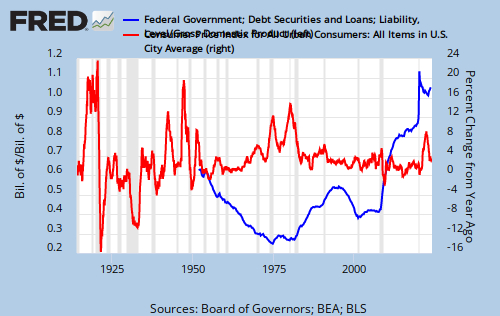
Nevertheless, it might be instructive to see whether there is any historical relationship between Debt/GDP and inflation or economic growth. Here is what GDP/Debt (blue line) looks like when compared with inflation:

Debt/GDP vs inflation

Do you see any relationship between GDP/Debt and inflation? I don’t. Not surprisingly, this meaningless fraction has had no effect on inflation.

What about Debt/GDP as compared with economic growth. Here’s what that graph looks like:

Debt/GDP vs GDP

It would be difficult to conclude that a high Debt/GDP ratio affects economic growth, negatively. In fact, one could make the case that for the past 25 years, increases in Debt/GDP have had positives effect on economic growth. Notice also, that Debt/GDP does not seem to be related to the beginning of recessions (gray bars). If fact, as befits a meaningless ratio, Debt/GDP does not seem related to any economic function.

So the next time you read a sky-is-falling article saying the Debt/GDP ratio is too high, unsustainable, will cause inflation or will reduce economic growth, send him/her this article.

Rodger Malcolm Mitchell
http://www.rodgermitchell.com


==========================================================================================================================================
No nation can tax itself into prosperity, nor grow without money growth. Monetary Sovereignty: Cutting federal deficits to grow the economy is like applying leeches to cure anemia. The key equation in economics: Federal Deficits – Net Imports = Net Private Savings

MONETARY SOVEREIGNTY