–Warren Buffett’s brilliant comments on the corporate tax.

Twitter: @rodgermitchell; Search #monetarysovereignty
Facebook: Rodger Malcolm Mitchell

Mitchell’s laws:
●The more federal budgets are cut and taxes increased, the weaker an economy becomes.
●Austerity is the government’s method for widening the gap between rich and poor,
which ultimately leads to civil disorder.
●Until the 99% understand the need for federal deficits, the upper 1% will rule.
To survive long term, a monetarily non-sovereign government must have a positive balance of payments.
●Those, who do not understand the differences between Monetary Sovereignty and monetary non-sovereignty, do not understand economics.
●The penalty for ignorance is slavery.
●Everything in economics devolves to motive.

============================================================================================================================================================================
============================================================================================================================================================================

History is loaded with examples of people who are clever at one thing, and as a result, believe they are clever at all other things — but turn out to be really stupid at those other things.

This phenomenon is particularly prevalent among people who have made money, and who believe this proves their brilliance (perhaps because rich people surround themselves with praise-spewing sycophants).

A former client, the gum-making Wm. Wrigley Jr. Company, run by the Wrigley family, was a virtual money-printing machine. It spun off so many millions, the Wrigley’s invested in such endeavors as Catalina Island, the Arizona Biltmore Hotel, the Biltmore Fashion Park and the Chicago Cubs — all financial disasters.

So astute was patriarch Philip Wrigley that he died without having created a will, thereby allowing the federal government to gobble up many of those millions, which in turn forced the panic sale (in 1981) sale of the Cubs for only $20 million (most recent valuation: $845 million).

Clearly it was someone money-addled, who first used the line: “If you’re so smart, why ain’t you rich?”

In this same vein, eighteen months ago, we published Why Lower Corporate Taxes Won’t Create More Jobs. Oh, really? Friday, Feb 24 2012, in which we detailed some particularly ridiculous comments by the acclaimed stock-trading genius, Warren Buffett:

“The idea that American business is at a big disadvantage against the rest of the world because of corporate taxes is baloney in my view. In the 50s and 60s, corporate taxes were 52%, and we were making all kinds of [job] gains.”

In essence, Buffett who made his billions buying stocks astutely, though not actually running those businesses, had decided that high corporate taxes are not an impediment to corporate profits.

Apparently, the people who actually do run businesses, disagree:

Wall Street Journal
U.S. Firms Move Abroad to Cut Taxes
By JOHN D. MCKINNON And SCOTT THURM

More big U.S. companies are reincorporating abroad. One big reason: Taxes.

A few (companies) cite worries that U.S. taxes will rise in the future, especially if Washington revamps the tax code next year to shrink the federal budget deficit.

Aon expects to reduce its tax rate, which averaged 28% over the past five years, by five percentage points over time, which could boost profits by about $100 million annually.

Eaton (said) the tax benefits would save the company about $160 million a year.

Ensco followed rivals such as Transocean Ltd., RIG, Noble Corp. and Weatherford International Ltd. that had relocated outside the U.S. The company said the move would help it achieve “a tax rate comparable to that of some of Ensco’s global competitors.”

Despite protestations by Mr. Buffett, the “Wizard of Omaha,” taxes actually do cut company profits.

Even worse, corporate taxes remove dollars from the private sector and send them to Washington, where they no longer are part of the economy and effectively are destroyed.

Businesses do two very nice things for America:
1. They create goods and services that improve our lives.
2. They employ people, paying salaries that also improve our lives.

So one might think a government that cared about our lives, would do everything possible to encourage business success. And one of the things our Monetarily Sovereign government easily could do is eliminate corporate taxes.

After all, a Monetarily Sovereign government neither needs nor uses tax dollars.

Note the above phrase, “a government that cared about our lives.” This government does not care — at least not about the lives of the less-than-rich, for corporate taxes are not paid by top corporate executives.

Corporate taxes are paid by the lowly workers and by customers, and therefore help widen the gap between the rich and the rest.

As we have discussed so many times before, the need for federal deficit reduction is the BIG LIE, a monstrous and cruel lie, developed to widen that gap, and the people who promulgate that BIG LIE either are economically ignorant or are intentionally cruel.

Most “ordinary” Americans fall into the first camp; the President, Congress and the media mostly are in the second group.

Taxing corporations is like starving the goose that lays the golden eggs. It makes no sense unless — unless the goal of the President and Congress is to give the very rich even greater power over mainstream Americans.

Eliminating the corporate tax (including FICA) would:

1. Slash unemployment
2. Increase Gross Domestic Product
3. Reduce poverty
4. Increase the quality of life for every American (except for the very rich, whose lives cannot be improved).
5. Close the wealth and power gap between the rich and the rest

And that is why this President and this Congress, bribed by the rich (via campaign contributions and promises of lucrative employment), will not eliminate corporate taxes.

Rodger Malcolm Mitchell
Monetary Sovereignty

====================================================================================================================================================
Nine Steps to Prosperity:
1. Eliminate FICA (Click here)
2. Medicare — parts A, B & D plus long term nursing care — for everyone (Click here)
3. Send every American citizen an annual check for $5,000 or give every state $5,000 per capita (Click here)
4. Free education (including post-grad) for everyone. Click here
5. Salary for attending school (Click here)
6. Eliminate corporate taxes (Click here)
7. Increase the standard income tax deduction annually
8. Increase federal spending on the myriad initiatives that benefit America’s 99% (Click here)
9. Federal ownership of all banks (Click here)

10 Steps to Economic Misery: (Click here:)
1. Maintain or increase the FICA tax..
2. Spread the myth Social Security, Medicare and the U.S. government are insolvent.
3. Cut federal employment in the military, post office, other federal agencies.
4. Broaden the income tax base so more lower income people will pay.
5. Cut financial assistance to the states.
6. Spread the myth federal taxes pay for federal spending.
7. Allow banks to trade for their own accounts; save them when their investments go sour.
8. Never prosecute any banker for criminal activity.
9. Nominate arch conservatives to the Supreme Court.
10. Reduce the federal deficit and debt

No nation can tax itself into prosperity, nor grow without money growth. Monetary Sovereignty: Cutting federal deficits to grow the economy is like applying leeches to cure anemia.
Two key equations in economics:
1. Federal Deficits – Net Imports = Net Private Savings
2. Gross Domestic Product = Federal Spending + Private Investment and Consumption – Net Imports

THE RECESSION CLOCK
Monetary Sovereignty Monetary Sovereignty

As the lines drop, we approach recession, which will be cured only when the lines rise.

#MONETARY SOVEREIGNTY
–The Recession Clock

Twitter: @rodgermitchell; Search #monetarysovereignty
Facebook: Rodger Malcolm Mitchell

Mitchell’s laws:
●The more federal budgets are cut and taxes increased, the weaker an economy becomes.
●Austerity is the government’s method for widening the gap between rich and poor,
which ultimately leads to civil disorder.
●Until the 99% understand the need for federal deficits, the upper 1% will rule.
To survive long term, a monetarily non-sovereign government must have a positive balance of payments.
●Those, who do not understand the differences between Monetary Sovereignty and monetary non-sovereignty, do not understand economics.
●The penalty for ignorance is slavery.
●Everything in economics devolves to motive.

=====================================================================

The formula for Gross Domestic Product, the most common measure of economic growth and shrinkage, is: Gross Domestic Product (GDP) = Federal Spending (FS) + Private Investment and Consumption (PIC) – Net Imports (NI).

So, it makes sense that reductions in Federal Spending growth, and/or in Private Investment and Consumption growth, would affect GDP growth adversely.

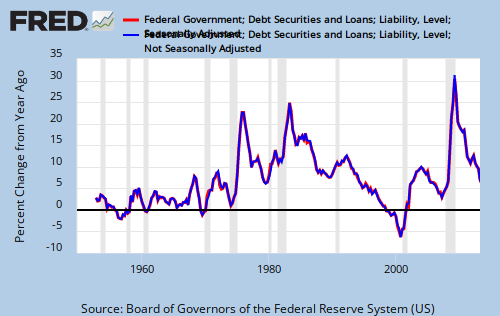
Reductions in Federal Deficit Spending growth reduce both FS and PIC growth. Although recessions have many causes, one would expect to see some relationship between reduced deficit growth and recessions. And so it is.

In the blog post, This graph predicts the future. What does it tell you? we looked at the following graph.

Monetary SovereigntyThe FRED series, Total Credit Market Debt Owed by Domestic Nonfinancial Sectors – Federal Government, is now known as Federal Government; Credit Market Instruments; Liability.

And we asked the following four questions:

1. What does the federal government do in the years leading up to recessions? (Answer: Cut growth in deficit spending)

2. What does the government do that cures recessions? (Answer: Increase deficit spending growth)

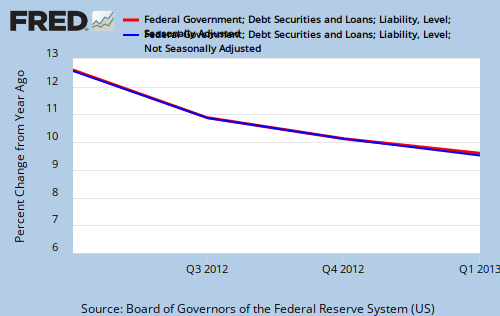
3. What is the government doing now? (For a clearer picture, here is a closeup of the most recent past):

Monetary Sovereignty

4. Why is the government cutting deficit spending growth, despite overwhelming evidence this causes recessions? (Because of the false premises that the federal government can run short of dollars, or by creating dollars, could cause inflation.)

On many occasions, we have discussed why it is 100% impossible for our Monetarily Sovereign U.S. government involuntarily to run short of dollars, most recently at: I just thought you should know. Lunch really can be free (Saturday, Jul 27 2013).

Even were zero taxes collected, the federal government could not be forced to run short of dollars.

And at: Federal deficit spending doesn’t cause inflation; oil does (Tuesday, Apr 6 2010), we have demonstrated that federal deficits (i.e. increase in money supply) have not been a cause of inflation

In answer to question #4, Why?, we have discussed how federal spending helps the lower income groups more than it does the higher income groups. So, the rich bribe the politicians (via campaign contribution and promises of lucrative employment) to cut federal spending and to increase taxes on the lowest groups. The FICA increase and the push for “broadening the tax base” are but two examples.

The purpose: To widen the gap between the rich and the rest.

To smooth the path to austerity (i.e. deficit cuts), the voting public is brainwashed by the wealthy-owned media, partly via the publication of various “debt clocks.” The purpose of debt clocks is to shock the public into believing, falsely, the U.S. government is burdened by too much debt.

Missing from these “debt clocks” is any evidence that the government really is burdened or that debt has any negative economic effects. Presumably, the use of the word “debt” provides sufficient shock, despite evidence that lack of debt does have negative economic effects.

For those reasons, it might be helpful to publish in every post, from this day forth, a “Recession Clock” from which the public can draw correct conclusions about austerity, the government’s actions and the probability of those actions causing a recession.

THE RECESSION CLOCK
Monetary Sovereignty Monetary Sovereignty

As the lines drop, we approach recession, which will be cured only when the lines rise. This leads to question #5:

5. Why do we allow Congress and the President to make the lines drop?

Rodger Malcolm Mitchell
Monetary Sovereignty

====================================================================================================================================================
Nine Steps to Prosperity:
1. Eliminate FICA (Click here)
2. Medicare — parts A, B & D plus long term nursing care — for everyone (Click here)
3. Send every American citizen an annual check for $5,000 or give every state $5,000 per capita (Click here)
4. Free education (including post-grad) for everyone. Click here
5. Salary for attending school (Click here)
6. Eliminate corporate taxes (Click here)
7. Increase the standard income tax deduction annually
8. Increase federal spending on the myriad initiatives that benefit America’s 99% (Click here)
9. Federal ownership of all banks (Click here)

10 Steps to Economic Misery: (Click here:)
1. Maintain or increase the FICA tax..
2. Spread the myth Social Security, Medicare and the U.S. government are insolvent.
3. Cut federal employment in the military, post office, other federal agencies.
4. Broaden the income tax base so more lower income people will pay.
5. Cut financial assistance to the states.
6. Spread the myth federal taxes pay for federal spending.
7. Allow banks to trade for their own accounts; save them when their investments go sour.
8. Never prosecute any banker for criminal activity.
9. Nominate arch conservatives to the Supreme Court.
10. Reduce the federal deficit and debt

No nation can tax itself into prosperity, nor grow without money growth. Monetary Sovereignty: Cutting federal deficits to grow the economy is like applying leeches to cure anemia.
Two key equations in economics:
1. Federal Deficits – Net Imports = Net Private Savings
2. Gross Domestic Product = Federal Spending + Private Investment and Consumption – Net Imports

#MONETARY SOVEREIGNTY

–Obama: Edward Snowden is a stinkin’ traitor and should be hung . . . er . . . ah . . . I said what?

Twitter: @rodgermitchell; Search #monetarysovereignty
Facebook: Rodger Malcolm Mitchell

Mitchell’s laws:
●The more federal budgets are cut and taxes increased, the weaker an economy becomes.
●Austerity is the government’s method for widening the gap between rich and poor,
which ultimately leads to civil disorder.
●Until the 99% understand the need for federal deficits, the upper 1% will rule.
To survive long term, a monetarily non-sovereign government must have a positive balance of payments.
●Those, who do not understand the differences between Monetary Sovereignty and monetary non-sovereignty, do not understand economics.
●The penalty for ignorance is slavery.
●Everything in economics devolves to motive.

=====================================================================

In two posts, Police state: Which vital secret did Edward Snowden reveal? and Which vital secret did Edward Snowden reveal? Part II we recounted the foaming-at-the-mouth utterances of our politicians. For instance:

Senator Dianne Feinstein, Chairman of the United States Senate Select Committee on Intelligence, said Edward Snowden is a traitor. He committed treason. He should be found and extradited.

The ever-reliably doltish House Speaker John Boehner said, “He’s a traitor. The disclosure of this information puts Americans at risk. It shows our adversaries what our capabilities are. And it’s a giant violation of the law.”

And the blogsphere was filled with teeth gnashing by angry “patriots,” who want Snowden drawn and quartered and after that have some really bad stuff done to him.

What we didn’t read, and what we have yet to read, is the answer to the question, “What vital secret did Snowden reveal?” Maybe here is the clue:

Reuters, August 9, 2013; Obama pledges greater transparency in surveillance programs
By Steve Holland and Jeff Mason

WASHINGTON, Aug 9 (Reuters) – President Barack Obama announced plans on Friday to limit sweeping U.S. government surveillance programs that have come under criticism since leaks by a former spy agency contractor, saying the United States “can and must be more transparent.”

“Given the history of abuse by governments, it’s right to ask questions about surveillance, particularly as technology is reshaping every aspect of our lives,” Obama told a news conference at the White House.

Saying that it was important to strike the right balance between security and civil rights, Obama said he was unveiling specific steps to improve oversight of surveillance and restore public trust in the government’s programs.

Despite the announcement, the Obama administration has vigorously pursued Snowden to bring him back to the United States to face espionage charges for leaking details of the surveillance programs to the media.

“I don’t think Mr. Snowden was a patriot,” Obama said.

“I, as your President, want you to understand:

“1. Many other governments illegally spy on their citizens.
“2. But not my government — no, absolutely not my government.
“3. And although my government absolutely did not spy on you, we won’t do it again.
“4. You wouldn’t have known about this if it weren’t for that stinkin’ Snowden, so I’m going to track him down and string him up. Why? Because he’s a traitor for letting you know what I’ve been hiding from you.
“5. I want you to remember, I’m the transparency President.”

Obama said he plans to overhaul Section 215 of the anti-terrorism Patriot Act that governs the collection of so-called “metadata” such as phone records, insisting that the government had no interest in spying on ordinary Americans.

“I am not spying on you. Do you consider yourself ‘ordinary’?

“I am just collecting and analyzing data on you, your spouse, your children, your friends, your children’s friends, your relatives, their friends, your neighbors and their friends, your associates and anyone you ever have seen, known, or been near, plus what you read, where you go and what you do.

“But I am not spying on you. Understand?”

Obama will also reform the secretive Foreign Intelligence Surveillance Court, which considers requests from law enforcement authorities to target an individual for intelligence gathering.

He wants to let a civil liberties representative weigh in on the court’s deliberations to ensure an adversarial voice is heard.

“Of course, the ‘weigh in’ will be secret, and you won’t know who the ‘civil liberties representative’ is, what he says, when or why he says it. That’s what I consider “transparency.

“(Hmmm . . . I wonder whether Michelle will take the job.)”

The secretive court, makes its decisions on government surveillance requests without hearing from anyone but U.S. Justice Department lawyers in its behind-closed-doors proceedings.

“Yes, they hear only one side of the story, which is why they never deny a surveillance request — heck, that court would let me spy on your dog if I felt like it. But, what’s wrong with that?

“You never heard of Spy Dog?

“Really, there wouldn’t be a problem if it weren’t for that stinkin’ Snowden spilling the beans.”

Obama also said he wants to provide more details about the NSA programs to try to restore any public trust damaged by the Snowden disclosures.

“Why don’t you people trust me? I’m the President and I know what’s best for you. Don’t ask questions.”

The administration will also form a high-level group of outside experts to review the U.S. surveillance effort.

“Yeah, right. I’ll select outside experts. Sure I will. But ‘experts” in what? Spying on Americans? Baseball? Politics? Movies? Travel? Don’t worry; they’ll be experts in something.”

It is not clear if Congress will take up the initiatives. A number of influential lawmakers have vigorously defended the spying programs as critical tools needed to detect terrorist threats.

“Oh, gee. I really want to stop spying on you, but mean old Congress won’t let me. Also, I didn’t want to raise your FICA tax, cut your Social Security and impose the sequester. Nothing is my fault. I’m just a President. I can’t control this stuff.”

The Snowden disclosures generated concerns about whether people were being forced to sacrifice their constitutionally guaranteed civil liberties in the open-ended search for terrorism links.

“It’s like this. No matter how much we spy on you and take away your liberties, there never can be 100% security. So we always will tell you we need to spy more and more and more, and allow you less and less and less liberty.

“Pretty soon, we’ll need to know what you do in your bedrooms, because you may be discussing terrorist acts, there.

“That stinkin’ Snowden may have slowed us a bit, but by next year, you’ll forget all about him, and we’ll be taking away even more of your freedom.”

The search for Snowden has upset U.S. relations with some Latin American countries, China and, above all, Russia. Obama this week canceled a planned summit in Moscow with President Vladimir Putin.

The revelation of the sweeping U.S. electronic spying programs has also alienated countries such as Germany, which fiercely defends its citizens’ privacy rights.

“I really don’t care what Americans say. I don’t even care what the Germans and China say. And as for Putin, what can I say about a guy who rides horses with his shirt off?

All that concerns me is what my legacy and my rich backers will say. Will I have to include this in my Obama Library? (I’ll ask Penny Pritzker.)

“Meanwhile, wait ’til I get my hands on that stinkin’ Snowden.”

Rodger Malcolm Mitchell
Monetary Sovereignty

====================================================================================================================================================

Nine Steps to Prosperity:
1. Eliminate FICA (Click here)
2. Medicare — parts A, B & D plus long term nursing care — for everyone (Click here)
3. Send every American citizen an annual check for $5,000 or give every state $5,000 per capita (Click here)
4. Free education (including post-grad) for everyone. Click here
5. Salary for attending school (Click here)
6. Eliminate corporate taxes (Click here)
7. Increase the standard income tax deduction annually
8. Increase federal spending on the myriad initiatives that benefit America’s 99% (Click here)
9. Federal ownership of all banks (Click here)

10 Steps to Economic Misery: (Click here:)
1. Maintain or increase the FICA tax..
2. Spread the myth Social Security, Medicare and the U.S. government are insolvent.
3. Cut federal employment in the military, post office, other federal agencies.
4. Broaden the income tax base so more lower income people will pay.
5. Cut financial assistance to the states.
6. Spread the myth federal taxes pay for federal spending.
7. Allow banks to trade for their own accounts; save them when their investments go sour.
8. Never prosecute any banker for criminal activity.
9. Nominate arch conservatives to the Supreme Court.
10. Reduce the federal deficit and debt

No nation can tax itself into prosperity, nor grow without money growth. Monetary Sovereignty: Cutting federal deficits to grow the economy is like applying leeches to cure anemia.
Two key equations in economics:
1. Federal Deficits – Net Imports = Net Private Savings
2. Gross Domestic Product = Federal Spending + Private Investment and Consumption – Net Imports

#MONETARY SOVEREIGNTY

–naked capitalism blog almost, but not quite, sees the light about the euro

Twitter: @rodgermitchell; Search #monetarysovereignty
Facebook: Rodger Malcolm Mitchell

Mitchell’s laws:
●The more federal budgets are cut and taxes increased, the weaker an economy becomes.
●Austerity is the government’s method for widening the gap between rich and poor,
which ultimately leads to civil disorder.
●Until the 99% understand the need for federal deficits, the upper 1% will rule.
●To survive long term, a monetarily non-sovereign government must have a positive balance of payments.
●Those, who do not understand the differences between Monetary Sovereignty and monetary non-sovereignty, do not understand economics.
●The penalty for ignorance is slavery.
●Everything in economics devolves to motive.

=====================================================================

One of my favorite blogs, “naked capitalism,” this week included an article about the euro. It comes to essentially the same conclusions I voiced back in 2005, when I told a class at UMKC, “Because of the Euro, no euro nation can control its own money supply. The Euro is the worst economic idea since the recession-era, Smoot-Hawley Tariff. The economies of European nations are doomed by the euro.”

The euro requires every euro nation to be monetarily non-sovereign, similar financially to every U.S. state, county and city, you and me. None of us uses a currency over which we are sovereign.

So to survive long term, we must have net income (which the U.S. government does not need).

For a government, income has three sources: Taxes, borrowing and exports. But taxes and borrowing are not net income. Taxes merely circulate money within the government’s borders, and borrowing must be repaid.

That leaves net exports which includes anything that brings in money from non-residents.

The resultant mathematical problem is quite basic: All nations cannot be net exporters. So long-term, monetarily non-sovereign governments survive is by receiving money from Monetarily Sovereign governments.

U.S. states survive either from exports or from a positive balance of payments with our Monetarily Sovereign national government. The same is true for our counties and cities, which also may receive some of that federal money through an intermediary – their state.

The euro nations, not being able to create euros, are slowly growing broke – at least those who have a negative balance of payments.

The so-called solutions, recommended by economists everywhere, are to tax and borrow more, and to spend less. Since taxing and borrowing more do not add net money to the economy, the impoverished euro nations have begun to rely on spending less – less on food, less on housing, less on education, infrastructure, health – less on everything that supports the middle- and lower-income groups – a prescription for economic disaster.

European Pundits Starting to Give Up on the Eurozone
08/03/2013 – Yves Smith (Susan Webber)

We’ve been pointing out for some time that Germany has refused to budge from wanting contradictory things relative to the Eurozone.

Germany wants to continue to run trade surpluses, which are now predominantly with other countries in Europe. That means it needs to finance its trade partners’ deficits.

But Germany simultaneously does not want to do that. The only way to square that circle would be if the euro were vastly cheaper, so that Germany’s trade surplus was more with the rest of the world than with its fellow Europeans, and that countries like Spain could achieve a trade surplus with the rest of the world.

No one has entertained that as a solution, since the required level of euro depreciation would be so large as to invite retaliation from Europe’s major trade partners.

Translation: The euro nations could survive if somehow they found a way to have an positive trade balance with Monetarily Sovereign nations, like the U.S., Canada, China, Japan, Australia et al.

But despite the fact that MS nations have the unlimited ability to support the euro nations, no MS nation acknowledges it is MS.

The whole premise of the EU/Eurozone project was successive crises would force further integration.

Translation: Financial integration, in which the EU gives (not lends) euros to needy euro nations, is one of the two possible solutions to the euro mess (the other being for each nation to re-adopt its own sovereign currency).

However, only a crisis of even greater magnitude than the current crisis, will allow for financial integration. The rich don’t want it. They want the middle- and lower-income groups to suffer. They want the gap to widen, and provide a larger servant class.

European officialdom has managed to pull off years of “barely enough at the last minute” salvage operations to keep things from falling over. But the Germans have also insisted on crushing and failed austerity, and refuse to relent even as compliant periphery countries keep missing their targets and in the case of Greece, the result of breaking a country on the rack is a failed state.

Translation: It is the wealthy of Germany, in cahoots with the wealthy of the world, who want the other euro nations impoverished so the gap can be widened.

James Galbraith said, “Integration has a lot of efficiencies associated with it. In any event it creates a world in which there are cross-border interdependencies. And if you want to break them up, you can, but the price is on the order of 40%.

So that’s a good benchmark for what might happen to living standards if you suddenly went back to capital controls and trade barriers and national industries.

Galbraith predicts that if the euro nations returned to their sovereign currencies, there would be a loss of exports, resulting in a reduction in GDP. What he does not take into consideration is the fact that a Monetarily Sovereign nation always can create its sovereign currency, so does not need exports. A Monetarily Sovereign nation can be self sufficient.

Despite the considerable cost of a Eurozone breakup, that the experts are struggling to find a resolution that is acceptable politically to Germany.

Translation: Experts are struggling to find a resolution acceptable to the very rich.

“The idea of a common currency union is a big mistake, an adventurous, reckless and mistaken goal which will not unite Europe but, instead, divide it”. Lord Dahrendorf, 1995.

The good Lord Dahrendorf is 100% correct. They should have listened to him.

I now believe that Lord Dahrendorf was right. Right not only then but, even more so, today.

I had observed how a small economy which had totally collapsed could be successfully turned around in only a few years with the right domestic economic leadership and the right support from abroad. And I thought the same could happen easily in Greece. Well, it’s not happening in Greece because the country does not have the right economic and political leadership nor the right support from abroad.

Actually, collapse is exactly what the political leadership wants. It creates a larger pool of the servant class. Anyway support need not come from abroad. It could have come from the EU in the form of spending, not lending.

The eye opener was the book “The Euro-Liars” by Hans-Olaf Henkel, whose argument is, like Lord Dahrendorf said almost 20 years earlier, that the Euro does not unite Europe but, instead, it splits it. Henkel argues that the Euro not only limits (if not destroys) economic potential in the South but also in the North.

The Euro, as it was designed, does not fit the cultures of countries like Greece, Portugal and Spain (Henkel also adds Italy and France!). Neither is today’s Euro suitable for the North because it makes it too easy for Germany & Co. to export.. If Germany & Co. were not in the Euro, they would have to become even more innovative and productive to remain competitive in the world and their surpluses would most likely come down.

The problem is not so-called “culture,” (a euphemism meaning northern Europeans like to work harder than southern Europeans). It’s a matter of Monetary Sovereignty, or rather, the lack of it, that dooms all euro nations.

My original optimism about Greece was based on the following logic: a long-term economic development plan (at least for 10 years) would be necessary to build up domestic economic value creation (and/or repatriate it through import substitution);

A shift of the necessary foreign funding from loans to direct investment by foreign private sectors in the Greek private sector; EU-incentives to facilitate that (such as guarantees for the political risk including a Grexit);

Possibly temporary ‘infant industry protection’ (incentivating the repatriation of monies held by Greeks abroad and/or limitations on capital outflows).

This is not happening (and I no longer have the hope that it will happen) because the EU never thought in those terms and Greek leadership never showed the will or, more importantly, the capability to effect the necessary reforms.

Translation: “I blame Greece for its problems, when I should blame the EU and the demand for loss of Monetary Sovereignty, which makes long-term survival impossible”

As Prof. Galbraith argues, austerity alone is not the solution; neither is stimulus alone the solution. It would require a ‘European Initiative’ comparable to what the US government might do in a similar situation.

A United States of Europe with a federal government? Who would elect that government? Would national governments appoint it or would voters Europe-wide elect it? A Finn campaigning for election in Greece? A Greek in Germany?

The present EU as a role model for a future federal government? An EU which currently seems more outside of Europe than part of it? An EU which tells us which shape cucumbers must have; what kind of light bulbs we can buy; what kind of bathroom fixtures?

Since I have about 10.000 qm of grass to take care of, I am particularly interested in the latest EU regulation which will tell me what type of machinery I can use during which hours of the day/week!

One can imagine thousands of such objections, but the original 13 colonies faced exactly the same problems. The result was the United States of America.

So, I admit defeat in my belief that ‘European policy-makers would come to grips with fundamental economics’. They seem incapable of that.

All those ideas which aim at solving the Eurozone’s problems through generating aggregate demand are pipe dreams. They might work in the United States of America with a strong federal government but they are pipe dreams in a Europe of administrators, technicians and bureaucrats focusing on national interests, all speaking in different languages and different directions.

Translation: Although 13 colonies, run by administrators, technicians and bureaucrates, focusing on state interests, having different beliefs and fighting a war with a dominant foe, were able to create the Unites States of America, the European nations can’t do it.

Perhaps, what Europe needs is a dominant foe that could unite them.

Note to Europe: The United States of America exists. The model exists. The solution exists.

Sadly, your will does not exist. Your rich are too greedy. They want that gap widened.

Rodger Malcolm Mitchell
Monetary Sovereignty

====================================================================================================================================================

Nine Steps to Prosperity:
1. Eliminate FICA (Click here)
2. Medicare — parts A, B & D — for everyone (Click here)
3. Send every American citizen an annual check for $5,000 or give every state $5,000 per capita (Click here)
4. Long-term nursing care for everyone
5. Free education (including post-grad) for everyone. Click here
6. Salary for attending school (Click here)
7. Eliminate corporate taxes (Click here)
8. Increase the standard income tax deduction annually
9. Increase federal spending on the myriad initiatives that benefit America’s 99% (Click here)

10 Steps to Economic Misery: (Click here:)
1. Maintain or increase the FICA tax..
2. Spread the myth Social Security, Medicare and the U.S. government are insolvent.
3. Cut federal employment in the military, post office, other federal agencies.
4. Broaden the income tax base so more lower income people will pay.
5. Cut financial assistance to the states.
6. Spread the myth federal taxes pay for federal spending.
7. Allow banks to trade for their own accounts; save them when their investments go sour.
8. Never prosecute any banker for criminal activity.
9. Nominate arch conservatives to the Supreme Court.
10. Reduce the federal deficit and debt

No nation can tax itself into prosperity, nor grow without money growth. Monetary Sovereignty: Cutting federal deficits to grow the economy is like applying leeches to cure anemia.
Two key equations in economics:
1. Federal Deficits – Net Imports = Net Private Savings
2. Gross Domestic Product = Federal Spending + Private Investment and Consumption – Net Imports

#MONETARY SOVEREIGNTY