–Finish this: A federal surplus = a deficit . . .

Twitter: @rodgermitchell; Search #monetarysovereignty
Facebook: Rodger Malcolm Mitchell

Mitchell’s laws:
●Those, who do not understand the differences between Monetary Sovereignty and monetary non-sovereignty, do not understand economics.
●The more federal budgets are cut and taxes increased, the weaker an economy becomes. .
Liberals think the purpose of government is to protect the poor and powerless from the rich and powerful. Conservatives think the purpose of government is to protect the rich and powerful from the poor and powerless.
●The single most important problem in economics is
the gap between rich and poor.
●Austerity is the government’s method for widening
the gap between rich and poor.
●Until the 99% understand the need for federal deficits, the upper 1% will rule.
To survive long term, a monetarily non-sovereign government must have a positive balance of payments.
●Everything in economics devolves to motive,
and the motive is the Gap.

=========================================================================================================================================================================================================================

The U.S. dollar is disappearing from the U.S. in massive amounts. The process is called “Net Imports:”

monetary sovereignty

Back in 2011, we published, Which is better for the U.S.: Increased exports or increased federal deficit spending? Thursday, Aug 11 2011″

It quoted from a Time Magazine article by Roya Wolverson, who wrote:

Many economists think that, for the U.S. economy to get back on track, exports have to grow faster.

Virtually every economist, and the public at large, seems to believe that economic growth in enhanced by exports. And I agree.

But why is this so? After all, “exports” means we sweat and strain, using our nation’s assets, to create valuable goods and services, and send them overseas.

Why do we want to do that? Because exports of goods and services actually are imports of dollars. The greater our net exports, the greater are our imports of dollars, and this growth or our dollar supply stimulates our economy.

Very simply, increasing the dollar supply increases purchases from businesses, which grows those businesses, which increases the job supply, all of which grow our economy.

But, in the past 15 years $6 – $7 trillion dollars have left the U.S. economy. That’s close to $20,000 lost to each man, woman and child in America.

Where do we get the dollars, not only to overcome that loss of $500 billion dollars per year, but additional dollars to grow the economy?

Virtually all U.S. dollars are created by U.S. lenders, including banks. It works this way:

1. Every form of lending, for which there is a written repayment obligation, creates dollars. One example: Banks are allowed to lend a percentage (10% – 15%) of their capital. They do this merely by crediting borrowers’ checking accounts, which instantly creates dollars.

(To visualize, contrast a loan with a gift, which transfers, but does not create, dollars)

2. Banks create dollars when they obey federal instructions. When a federal agency pays a bill, it sends instructions (not dollars) to the creditor’s bank, instructing the bank to increase the balance in the creditor’s checking account. At the instant the bank obeys these instructions dollars are created.

(Thus, the federal government itself has no dollars, but being Monetarily Sovereign has the infinite ability to create and send dollar-creating instructions to banks.)

Federal spending creates dollars, and federal taxation destroys dollars. In short, federal NET spending (i.e. deficit spending) creates the dollars that are lost via Net Imports and needed for economic growth.

To finish the title sentence: A federal surplus = a deficit for the private sector.

And here is the big question: Since the private sector’s (yours and mine) ability to create dollars is limited, and the federal government’s ability to instruct banks to create dollars is unlimited, why did President Clinton run a federal surplus, and why does President Obama want to do the same? Why do they want the economy to run a deficit?

Let’s take a closer look:

Uncle Sam runs $114 billion surplus in April

Federal coffers saw a 7% increase in individual income taxes and payroll taxes, a 15% increase in corporate income taxes, and a 37% increase in money paid to Treasury by the Federal Reserve.

Aside from the fact that the federal government has no “coffers,” increases in taxes are bad for the economy.

Areas that saw the biggest drops included unemployment benefits and homeland security (both down 31%), agriculture (down 12%) and defense spending (down 5%).

Reductions in: Unemployment benefits, payments to employees of homeland security, farmers, soldiers and defense manufacturers, also are bad for the economy.

Again, since all deficit reduction steps — increased taxes and reduced spending — are band for the economy, why does President Obama, and indeed, the entire Congress want to run a federal surplus?

Equally important, why have they worked so hard to convince Americans that sending more to the government, while receiving less from the government, benefits the people? And why do the people believe it?

The people believe it because they think federal financing is like personal financing.

For you and me, deficits are bad and surpluses are good. The same is true for state and local governments and for businesses. So, to the economically innocent mind, the same must be true for our federal government.

You and I, and states and counties and cities and businesses can run short of dollars. The federal government, being Monetarily Sovereign, cannot.

And the President and Congress know it.

So why do they tell us, what has become known as the “Big Lie”?

Here’s why:
1. Surpluses weaken the economy and cause recessions and depressions.
2. Recessions and depressions are marked by unemployment.
3. Unemployment leads to lower wages for the 99% (middle and lower income/wealth/power group)
4. Lower wages for the 99% widen the Gap between the 99% and the upper 1%, and widening the Gap is the primary goal of the 1%. (The gap is what makes them rich, and the wider the Gap, the richer they are).
5. The rich are the primary contributors to the politicians, so the politicians do the bidding of the rich.

And it is just that simple.

The next time someone tells you that a federal surplus is “prudent” or good in any way, know that they are parroting the myth promulgated by the rich, to make the rich richer and you poorer.

Meanwhile, $500 billion will leave the economy this year, and as the federal deficit declines, minute by minute, you and I will lose those dollars.

A federal surplus = a deficit for the private sector (and that’s you.)

The recession clock (see below) is Ticking, ticking, tick . . .

Rodger Malcolm Mitchell
Monetary Sovereignty

===================================================================================
The Ten Steps to Prosperity:

1. Eliminate FICA (Click here)
2. Federally funded Medicare — parts A, B & D plus long term nursing care — for everyone (Click here)
3. Provide an Economic Bonus to every man, woman and child in America, and/or every state a per capita Economic Bonus. (Click here) Or institute a reverse income tax.
4. Federally funded, free education (including post-grad) for everyone. Click here
5. Salary for attending school (Click here)
6. Eliminate corporate taxes (Click here)
7. Increase the standard income tax deduction annually. (Refer to this.)
8. Tax the very rich (.1%) more, with higher, progressive tax rates on all forms of income. (Click here)
9. Federal ownership of all banks (Click here and here)

10. Increase federal spending on the myriad initiatives that benefit America’s 99% (Click here)

Initiating The Ten Steps sequentially will add dollars to the economy, stimulate the economy, and narrow the income/wealth/power Gap between the rich and the rest.
——————————————————————————————————————————————

10 Steps to Economic Misery: (Click here:)
1. Maintain or increase the FICA tax..
2. Spread the myth Social Security, Medicare and the U.S. government are insolvent.
3. Cut federal employment in the military, post office, other federal agencies.
4. Broaden the income tax base so more lower income people will pay.
5. Cut financial assistance to the states.
6. Spread the myth federal taxes pay for federal spending.
7. Allow banks to trade for their own accounts; save them when their investments go sour.
8. Never prosecute any banker for criminal activity.
9. Nominate arch conservatives to the Supreme Court.
10. Reduce the federal deficit and debt

No nation can tax itself into prosperity, nor grow without money growth. Monetary Sovereignty: Cutting federal deficits to grow the economy is like applying leeches to cure anemia.
1. A growing economy requires a growing supply of dollars (GDP=Federal Spending + Non-federal Spending + Net Exports)
2. All deficit spending grows the supply of dollars
3. The limit to federal deficit spending is an inflation that cannot be cured with interest rate control.
4. The limit to non-federal deficit spending is the ability to borrow.

THE RECESSION CLOCK

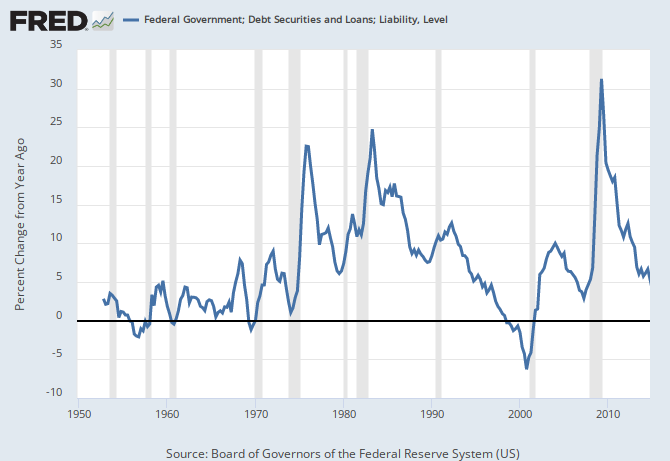
Long term view:
Monetary Sovereignty

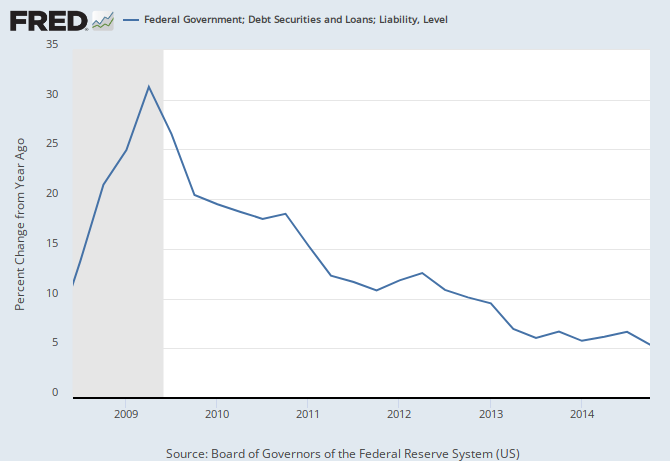
Recent view:
Monetary Sovereignty

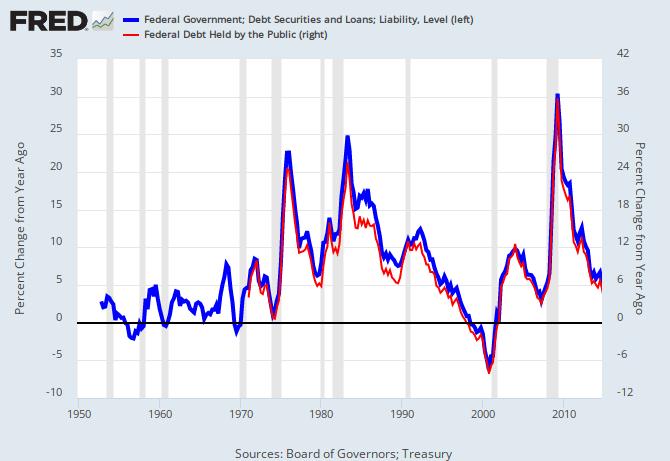
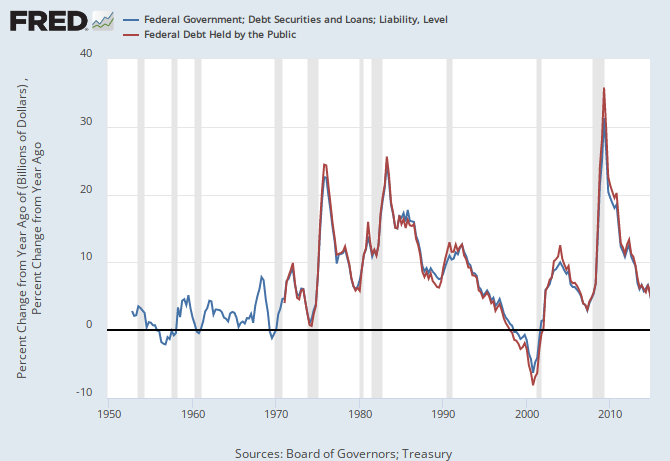
Vertical gray bars mark recessions.

As the federal deficit growth lines drop, we approach recession, which will be cured only when the growth lines rise. Increasing federal deficit growth (aka “stimulus”) is necessary for long-term economic growth.

#MONETARYSOVEREIGNTY
–The irony and the hypocrisy of libertarians — flunkies for the rich

Twitter: @rodgermitchell; Search #monetarysovereignty
Facebook: Rodger Malcolm Mitchell

Mitchell’s laws:
●Those, who do not understand the differences between Monetary Sovereignty and monetary non-sovereignty, do not understand economics.
●The more federal budgets are cut and taxes increased, the weaker an economy becomes. .
Liberals think the purpose of government is to protect the poor and powerless from the rich and powerful. Conservatives think the purpose of government is to protect the rich and powerful from the poor and powerless.
●The single most important problem in economics is
the gap between rich and poor.
●Austerity is the government’s method for widening
the gap between rich and poor.
●Until the 99% understand the need for federal deficits, the upper 1% will rule.
To survive long term, a monetarily non-sovereign government must have a positive balance of payments.
●Everything in economics devolves to motive,
and the motive is the Gap.

=========================================================================================================================================================================================================================

Whether of not it claims the title, the entire Republican party has, in fact, turned libertarian.

What is a libertarian? Libertarians preach freedom and liberty. Who could argue against freedom and liberty? But freedom and liberty for whom?

There are many forms of libertarianism, from outright anarchists to more moderate bents. But today’s libertarianism seems to focus on the notion that the federal government — not state and local governments or private industry — the federal government takes away our freedoms and so, is “too big.”

Specifically, what does it mean for the federal government to be “too big”?

According to the Republican/libertarians, “too big” means:
1. The federal government gives too much to the poor and middle income groups.
2. The federal government takes too much from the rich.
3. The federal government makes too many rules.
4. Everything the federal government does can be done better, more honestly and more compassionately by state and local governments and by the private sector.

Consider this headline:

Ted Cruz Demands Federal Money For Texas Floods After Blocking Hurricane Sandy Relief

Ted Cruz’s position is clear. Disaster relief is vital only when it is for his state. Red state need is the only real need that counts.

Is it irony or is it hypocrisy, to deride all federal spending, except when it benefits your own people? (Even more irony and hypocrisy: Cruz opposes expanding Medicaid, which would bring billions to his state.)

Then consider this article”

Do the wealthy pay lower taxes than the middle class?

A new study from the Institute on Taxation and Economic Policy, found that “virtually every state’s tax system is fundamentally unfair, taking a much greater share of income from low- and middle-income families than from wealthy families.”

It added that state and local tax systems are “indirectly contributing to growing income inequality by taxing low- and middle-income households at significantly higher rates than wealthy taxpayers.”

Is it irony or hypocrisy to claim that because the federal government is “too big,” many federal functions should be taken over by state and local governments?

There is zero evidence that state and local governments are more honest, caring, compassionate or efficient than the federal government. In fact, the evidence is quite the other way.

Is your experience similar to mine? I’ve seen a higher percentage of local politicians than federal politicians sent to prison. (And the only reason even more locals weren’t prosecuted is that our states attorney is the daughter of the state’s biggest wheeler/dealer. But that’s another story.)

What about the private sector? Is it too big or too small? Is it honest, caring and effective? To generalize about the private sector is no easier than to generalize about the federal sector.

Some companies are “good” because their CEO’s are good. Some are good because it’s good business to be good. Some are good because the CEOs are afraid that if they aren’t good, the federal government will send them to prison.

I suspect no one would claim the big banks are “good.” And, if all businesses were good, we never would have had the need for unions.

Government and business are made up of people, and people follow essentially the same rule of life: Power corrupts, and the more power, the more corruption.

Federal power, state and local power, business power: They all corrupt.

Consider private businessman Jimmy John Liautaud.

Jimmy John’s CEO under fire in new lawsuit

Liautaud has been criticized for hunting big game, Raw Story reported, and donating funds to an allegedly illegal re-election fund for controversial Maricopa County Sheriff Joe Arpaio of Arizona.

Photos published by Smile Politely show Liautaud posing with two dead elephants and a dead leopard shot and killed while on a safari. Another photo published by the Facebook group “Boycott Jimmy John’s” shows Liautaud posing with a dead bear.

O.K., so maybe this honest, compassionate and private businessman needs to kill endangered animals to provide ingredients for his elephant and leopard pizza. Who knows?

Anyway, that’s not all for private businessman, Jimmy John:

Jimmy John’s Makes Low-Wage Workers Sign ‘Oppressive’ Noncompete Agreements

A Jimmy John’s employment agreement provided to The Huffington Post includes a “non-competition” clause that’s surprising in its breadth.

Noncompete agreements are typically reserved for managers or employees who could clearly exploit a business’s inside information by jumping to a competitor.

But at Jimmy John’s, the agreement apparently applies to low-wage sandwich makers and delivery drivers, too.

The company’s definition of a “competitor” goes far beyond the Subways and Potbellys of the world. It encompasses any business that’s near a Jimmy John’s location and that derives a mere 10 percent of its revenue from sandwiches.

Kathleen Chavez (an attorney handling a suit against Jimmy Johns) said the effective blackout area for a former Jimmy John’s worker would cover 6,000 square miles in 44 states and the District of Columbia. Founded in 1983, the college-town staple now has more than 2,000 locations.

So, for two years, you are prevented from not just driving, but prevented from working, for just about any restaurant in America — even including school cafeterias.

Presumably, Liautaud’s highly paid delivery drivers are privy to so much secret corporate information, it makes sense to bar them from finding another job anywhere in America, for two long years.

Why doesn’t the “big, bad” old federal government, the so-called “leviathan” the right-wing libertarians love to hate, have the same rules?

Why does Jimmy Johns do this? Because they have power over their workers and are answerable to no one. So, having the power, they abuse it.

As HuffPost reported in August, Jimmy John’s workers recently brought two lawsuits accusing the company of engaging in wage theft by forcing employees to work off the clock.

What? A private company forces employees to work off the clock. Have you ever heard of such a thing?

I’ll bet you have.

Anyway, Jimmy Johns may not be the worst place to work in America. Undoubtedly, there are much worse. And that is the point. Given power, people will abuse it, whether they are government bureaucrats or work in private industry.

So it makes absolutely no sense to say the federal government is too big, any more than it is to say that private industry is too big. A sheriff in a town of 1,000 people can be far more corrupt and overbearing than the President of the United States.

It’s power, not size, that fosters corruption and loss of freedom.

So why do the right-wing libertarians claim the federal government is “too big”?

Republicans are pro-business, pro-rich and anti-poor and middle class. If there is one thing the rich hate, it’s government telling them what they can’t do (aka “regulations.”)

The rich want to rule, and those mean old regulators sometimes make onerous demands, like “be fair to your employees” and “be honest with your customers.”

And this is especially galling for those really big companies, whose CEO’s easily can bully individual towns and states, but less easily, the federal government.

When a right-wing libertarian Republican tells you the federal government is “too big,” he really wants to:

–Cut your Social Security, Medicare and Medicaid benefits
–Cut benefits to the uneducated, unemployed or otherwise impoverished
–Eliminate regulations that protect you when you buy stock, use a bank, buy pharmaceuticals and buy food
–Stop going after Ponzi schemers and other crooks who try to cheat you.
–Stop building roads and bridges, stop protecting national forests from oil, mining and lumber interests, stop guarding our waterways, and stop protecting America from our enemies.
–Stop growing the economy

Republicans want to allow the private sector industry magnates unfettered ability to do whatever they please because, as the rich want you to believe, the private sector always can be relied upon to protect you and do what’s right.

You may not like some of the things the government does. You also may not like some of the things state and local governments and business do.

But America needs both the private sector and the public sector, and for anyone to claim flatly that “the federal government is too big,” indicates either economic ignorance or a desire to widen the Gap between the rich and the rest — or both.

The federal government exhibits its “bigness” in three ways:
1. By spending, the vast majority of which benefits the economy
2. By taxing, the vast majority of which hurts the economy
3. By regulating, some of which benefits and some of which hurts the economy.

Libertarianism wants to get rid of all three — the “throw the baby out with the bathwater” syndrome — all to increase the power of the rich.

And that is the irony and the hypocrisy of today’s Republicans. They preach freedom and liberty, but in reality, they are flunkies for the rich, who care nothing for your freedom and liberty.

Rodger Malcolm Mitchell
Monetary Sovereignty

===================================================================================
The Ten Steps to Prosperity:

1. Eliminate FICA (Click here)
2. Federally funded Medicare — parts A, B & D plus long term nursing care — for everyone (Click here)
3. Provide an Economic Bonus to every man, woman and child in America, and/or every state a per capita Economic Bonus. (Click here) Or institute a reverse income tax.
4. Federally funded, free education (including post-grad) for everyone. Click here
5. Salary for attending school (Click here)
6. Eliminate corporate taxes (Click here)
7. Increase the standard income tax deduction annually. (Refer to this.)
8. Tax the very rich (.1%) more, with higher, progressive tax rates on all forms of income. (Click here)
9. Federal ownership of all banks (Click here and here)

10. Increase federal spending on the myriad initiatives that benefit America’s 99% (Click here)

Initiating The Ten Steps sequentially will add dollars to the economy, stimulate the economy, and narrow the income/wealth/power Gap between the rich and the rest.
——————————————————————————————————————————————

10 Steps to Economic Misery: (Click here:)
1. Maintain or increase the FICA tax..
2. Spread the myth Social Security, Medicare and the U.S. government are insolvent.
3. Cut federal employment in the military, post office, other federal agencies.
4. Broaden the income tax base so more lower income people will pay.
5. Cut financial assistance to the states.
6. Spread the myth federal taxes pay for federal spending.
7. Allow banks to trade for their own accounts; save them when their investments go sour.
8. Never prosecute any banker for criminal activity.
9. Nominate arch conservatives to the Supreme Court.
10. Reduce the federal deficit and debt

No nation can tax itself into prosperity, nor grow without money growth. Monetary Sovereignty: Cutting federal deficits to grow the economy is like applying leeches to cure anemia.
1. A growing economy requires a growing supply of dollars (GDP=Federal Spending + Non-federal Spending + Net Exports)
2. All deficit spending grows the supply of dollars
3. The limit to federal deficit spending is an inflation that cannot be cured with interest rate control.
4. The limit to non-federal deficit spending is the ability to borrow.

THE RECESSION CLOCK
Monetary Sovereignty

Monetary Sovereignty

Vertical gray bars mark recessions.

As the federal deficit growth lines drop, we approach recession, which will be cured only when the growth lines rise. Increasing federal deficit growth (aka “stimulus”) is necessary for long-term economic growth.

#MONETARYSOVEREIGNTY

–Is AARP clueless or owned by the rich?

Twitter: @rodgermitchell; Search #monetarysovereignty
Facebook: Rodger Malcolm Mitchell

Mitchell’s laws:
●Those, who do not understand the differences between Monetary Sovereignty and monetary non-sovereignty, do not understand economics.
●The more federal budgets are cut and taxes increased, the weaker an economy becomes. .
Liberals think the purpose of government is to protect the poor and powerless from the rich and powerful. Conservatives think the purpose of government is to protect the rich and powerful from the poor and powerless.
●The single most important problem in economics is
the gap between rich and poor.
●Austerity is the government’s method for widening
the gap between rich and poor.
●Until the 99% understand the need for federal deficits, the upper 1% will rule.
To survive long term, a monetarily non-sovereign government must have a positive balance of payments.
●Everything in economics devolves to motive,
and the motive is the Gap.

=========================================================================================================================================================================================================================

Those of us who are retired or looking forward to retirement, sometimes make the mistake of believing that the people of AARP have our best interests at heart.

If they do, they certainly are clueless about Social Security. Here is a survey AARP just published:

How Would You Strengthen Social Security and Medicare?

To ensure that Americans get clear information, AARP asked the conservative Heritage Foundation, the progressive Brookings Institution and respected independent experts on both programs to provide the pros and cons for 12 proposals to change Social Security and 15 options to change Medicare.

Each set of proposals is detailed in a downloadable brochure at You’ve Earned a Say

Hmmm . . . the ultra-conservative, Koch-ruled Heritage Foundation?

And the “progressive” Brooking Institution? I’d have more faith in Brookings’s progressivism if its trustees weren’t all wealthy corporate heads — (*See below) — the very people who want to widen the Gap between the rich and the rest.

Here is the intoduction to AARP’s survey titled, “How Would You Strengthen Social Security”:

How Would You Strengthen Social Security?

AARP believes you’ve earned a say in the future of Social Security. That’s why we’ve developed a tool you can use to make your own choices about how to strengthen Social Security.

Social Security faces long-term financial challenges as the overall U.S. population ages, and contributions aren’t keeping up with longer life expectancies.

And there it is: The Big Lie that FICA “contributions” are necessary to pay Social Security benefits.

Never mind that federal finances are different from personal finances.
Never mind that the federal government never can run short of its own sovereign currency.
Never mind that even if FICA fell to $0, the federal government could continue paying benefits, forever.

When you begin with the Big Lie, everything that follows is a lie. For instance:

While the Social Security Trustees project that the program can pay full benefits for the next 20 years, it would only be able to pay about 75 percent of promised benefits after that.

The federal government (unlike state and local governments) creates dollars ad hoc, by paying bills. FICA removes dollars from the economy.

If FICA were eliminated (which it should be), Social Security benefit dollars would be added to the economy, stimulating economic growth.

The following is true:

The longer it takes for Washington to strengthen Social Security and close the funding gap, the harder it will be for workers to plan for their future.

If Washington simply eliminated FICA and continued to pay all benefits, workers would have no trouble planning for their future.

The AARP survey begins this way: You are given only two basic choices: ADJUST (increase) CONTRIBUTIONS or ADJUST (reduce) BENEFITS.

According to AARP, there is no other way to “strengthen” Social Security. (How about eliminating contributions and increasing benefits? Those choices are not considered.)

Here are the AARP alternatives under the “ADJUST CONTRIBUTIONS” heading:

Increase the Payroll Tax Cap; Increase Payroll Tax Rate; Apply Payroll Tax to All Salary Reduction Plans; Add All New State/Local Gov’t. Workers to Social Security

Note how they all widen the Gap between the rich and the rest.

And here are the AARP alternatives under the “ADJUST BENEFITS” heading:

Raise the Full Retirement Age; Begin Longevity Indexing; Means Test for Higher-Income People; Reduce Benefits for Higher Lifetime Earners; Raise Number of Years Used to Compute Retirement Benefits; Recalculate COLA; Improve Benefits for Targeted Groups

Note again how they all widen the Gap between the rich and the rest. AARP even includes a graph to show how much your answers would “fill the (non-existent) gap.”

Everything AARP proposes either would pay the “99%” less or charge the “99%” more.

Since everything in economics devolves to motive, what is AARP’s motive?

AARP fundamentally is a big business — mostly a huge insurance brokerage. It receives massive amounts of money from big insurance companies.

It’s leaders are rich and it consults the rich when it seeks answers. And it is the rich who want the public to believe that FICA funds Social Security (and Medicare).

Why? Because that belief requires FICA to be increased and/or benefits to be decreased, both of which widen the Gap between the rich and the rest.

That really is all the rich want: To widen the Gap. It is the Gap that makes them rich. Without the Gap, no one would be rich, and the wider the Gap, the richer they are.

In short, AARP, like the politicians, most of the media and most university professors are owned by the rich, whose primary goal is to widen the Gap between them and the rest of us.

…………………………………………………………………………………………………………………………………………………………………………….

*BROOKINGS INSTITUTION BOARD OF TRUSTEES
Robert J. Abernethy
President
American Standard Development Co., Inc.

Paul M. Achleitner
Chairman of the Supervisory Board
Deutsche Bank AG

Liaquat Ahamed
Former Chief Executive Officer
Fischer Francis Trees and Watts, Inc.

Dominic Barton
Global Managing Director
McKinsey & Company, Inc.

Robert M. Bass
President
Keystone Group, L.P.

Alan R. Batkin
Chairman
Converse Associates, Inc.

Crandall Bowles
Chairman
The Springs Company

Hanzade Dogan Boyner
Vice Chairwoman
Dogan Holding Sirketler Grubu A.S.

Paul L. Cejas
Chairman
PLC Investment, Inc.

W. Edmund Clark
President and CEO
TD Bank Group

Abby Joseph Cohen
President, Global Markets Institute and Senior Investment Strategist
Goldman, Sachs & Co.

Betsy Z. Cohen
Chief Executive Officer
The Bancorp

Arthur R. Collins
Managing Partner
theGROUP

Howard E. Cox
Advisory Partner
Greylock

Arthur B. Culvahouse Jr.
Partner
O’Melveny & Myers LLP

Alan M. Dachs
President and CEO
Fremont Group

Paul Desmarais Jr.
Chairman and Co-CEO
Power Corporation of Canada

Kenneth M. Duberstein
Chairman and CEO
The Duberstein Group, Inc.

Cheryl Cohen Effron
Founder
Conjunction Fund

Alfonso Fanjul
Chairman and Chief Executive Officer
Fanjul Corp. and Florida Crystals Corporation

Bart Friedman
Senior Partner
Cahill Gordon & Reindel

Ann M. Fudge
Former Chairman and CEO
Young & Rubicam Brands

Ellen Futter
President
American Museum of Natural History

Brian L. Greenspun
Chairman and CEO
Greenspun Media Group

Pete Higgins
Founding Partner
Second Avenue Partners

Shirley Ann Jackson Ph.D.
President
Rensselaer Polytechnic Institute

Benjamin R. Jacobs
Senior Advisor/Founder
The JBG Companies

Richard A. Kimball Jr.
Chief Strategy Officer
Accretive Health Inc.

Klaus Kleinfeld
Chairman and Chief Executive Officer
Alcoa, Inc.

Philip H. Knight
Chairman
Nike, Inc.

Nigel Morris
Managing Partner
QED Investors

James Murren
Chairman and CEO
MGM Resorts International

Thomas C. Ramey
Former Chairman
Liberty International, Liberty Mutual Group

Steven Rattner
Chairman
Willett Advisors LLC

Edgar Rios
Co-Founder and Managing Director
Wenzi Capital Partners

James Rogers
Chairman
Duke Energy

Wilbur Ross
Chief Executive Officer
WL Ross & Co. LLC

Haim Saban
Chairman and CEO
Saban Capital Group, Inc.

Victoria P. Sant
President
The Summit Foundation

Leonard D. Schaeffer
Founding Chairman & CEO
WellPoint

Peter Scher
Executive Vice President and Head of Corporate Responsibility
JPMorgan Chase & Co.

Lynn Thoman
Co-President
Leon Lowenstein Foundation

Andrew H. Tisch
Co-Chairman of the Board
Loews Corporation

Beatrice W. Welters
Founder and Co-Chairperson
AnBryce Foundation

John H. White Jr.
President and CEO
Taco, Inc.

Tracy R. Wolstencroft
CEO
Heidrick and Struggles

Daniel Yergin
Vice-Chairman
IHS, Inc.
Founder
IHS Cambridge Energry Research Associates

Lei Zhang
Founder and CEO
Hillhouse Capital Management

Daniel B. Zwirn
Managing Partner
Zwirn Family Interests, LLC

===================================================================================================================================================================================================

Rodger Malcolm Mitchell
Monetary Sovereignty

===================================================================================
The Ten Steps to Prosperity:

1. Eliminate FICA (Click here)
2. Federally funded Medicare — parts A, B & D plus long term nursing care — for everyone (Click here)
3. Provide an Economic Bonus to every man, woman and child in America, and/or every state a per capita Economic Bonus. (Click here) Or institute a reverse income tax.
4. Federally funded, free education (including post-grad) for everyone. Click here
5. Salary for attending school (Click here)
6. Eliminate corporate taxes (Click here)
7. Increase the standard income tax deduction annually. (Refer to this.)
8. Tax the very rich (.1%) more, with higher, progressive tax rates on all forms of income. (Click here)
9. Federal ownership of all banks (Click here and here)

10. Increase federal spending on the myriad initiatives that benefit America’s 99% (Click here)

Initiating The Ten Steps sequentially will add dollars to the economy, stimulate the economy, and narrow the income/wealth/power Gap between the rich and the rest.
——————————————————————————————————————————————

10 Steps to Economic Misery: (Click here:)
1. Maintain or increase the FICA tax..
2. Spread the myth Social Security, Medicare and the U.S. government are insolvent.
3. Cut federal employment in the military, post office, other federal agencies.
4. Broaden the income tax base so more lower income people will pay.
5. Cut financial assistance to the states.
6. Spread the myth federal taxes pay for federal spending.
7. Allow banks to trade for their own accounts; save them when their investments go sour.
8. Never prosecute any banker for criminal activity.
9. Nominate arch conservatives to the Supreme Court.
10. Reduce the federal deficit and debt

No nation can tax itself into prosperity, nor grow without money growth. Monetary Sovereignty: Cutting federal deficits to grow the economy is like applying leeches to cure anemia.
1. A growing economy requires a growing supply of dollars (GDP=Federal Spending + Non-federal Spending + Net Exports)
2. All deficit spending grows the supply of dollars
3. The limit to federal deficit spending is an inflation that cannot be cured with interest rate control.
4. The limit to non-federal deficit spending is the ability to borrow.

THE RECESSION CLOCK
Monetary Sovereignty

Monetary Sovereignty

Vertical gray bars mark recessions.

As the federal deficit growth lines drop, we approach recession, which will be cured only when the growth lines rise. Increasing federal deficit growth (aka “stimulus”) is necessary for long-term economic growth.

#MONETARYSOVEREIGNTY

“Shell” we return to the cowry?

Twitter: @rodgermitchell; Search #monetarysovereignty
Facebook: Rodger Malcolm Mitchell

Mitchell’s laws:
●Those, who do not understand the differences between Monetary Sovereignty and monetary non-sovereignty, do not understand economics.
●The more federal budgets are cut and taxes increased, the weaker an economy becomes. .
Liberals think the purpose of government is to protect the poor and powerless from the rich and powerful. Conservatives think the purpose of government is to protect the rich and powerful from the poor and powerless.
●The single most important problem in economics is
the gap between rich and poor.
●Austerity is the government’s method for widening
the gap between rich and poor.
●Until the 99% understand the need for federal deficits, the upper 1% will rule.
To survive long term, a monetarily non-sovereign government must have a positive balance of payments.
●Everything in economics devolves to motive,
and the motive is the Gap.

=========================================================================================================================================================================================================================

Because the entire Republican platform is shaped by, and skewed for, the rich (the 1%), those middle- and lower-income folk (the “99%”) who vote Tea/Libertarian/Republican are #1 on the “I-know-nothing-about-economics” list in America.

But a close #2 on that list are those people who wish to return to a gold standard. They believe, based on zero evidence, that somehow gold prevents recessions, depressions, inflations, stagflations and even tribulations.

Sadly, gold standards have given the world all of the above-mentioned maladies.

Though gold is pretty in the eyes of some, and has been used as money collateral for centuries, it also is heavy, has little use, varies wildly in price, is expensive to store, ship and insure, and pays no interest or dividend. And no power guarantees its acceptance.

The great majority of “gold bugs” are not exactly disinterested parties. They are people and companies whose income relies on the buying and selling of gold to the suck . . . er, uh . . . investors who believe the “safety” myth of gold vs. the “danger” of so-called “fiat” money, i.e. “paper” money.

Actually, all money is “fiat” in that it is based on some organization’s fiat, and no money is paper. The printed paper only represents ownership of money, just as a printed car title only represents ownership of a car. A dollar bill is just a title to a dollar.

All the above factors lead me to recommend that we return to a cowry standard.

In my opinion, cowries are much more beautiful than gold. They also have a smooth, delightful surface, much more pleasant to handle than gold.

monetary sovereignty
The “Map” Cowry

Per Wikipedia” (Like gold),the shells of cowries (especially Monetaria moneta — the “money” cowry) were used for centuries as a currency in Africa. Huge amounts of Maldivian cowries were introduced into Africa by western nations during the period of slave trade.

The Ghanaian unit of currency known as the Ghanaian cedi was named after cowry shells. Starting over three thousand years ago, cowry shells, or copies of the shells, were used as Chinese currency.

They were also used as means of exchange in India.

The Ojibway aboriginal people in North America use cowry shells, which are called sacred Miigis Shells or whiteshells in Midewiwin ceremonies, and the Whiteshell Provincial Park in Manitoba, Canada is named after this type of shell.

Finding the cowry shells so far inland could indicate the previous use of them by an earlier tribe or group in the area, who may have obtained them through an extensive trade network in the ancient past. Petroforms in the Whiteshell Provincial Park may be as old as 8,000 years.

Cowries have a long and honored history. They have been used for centuries, require shipping and storage, do not pay interest or dividends and essentially are useless — just like gold.

Perfect.

Currently, there are no crooked cowry dealers to sell cowries to unsuspecting rubes, who can be counted upon to believe stories of cowry safety. But dealers will come. Depend on it.

Finally, if you so love the color, you simply cannot bring yourself to divorce from useless gold, may I suggest the equally useless “golden cowrie” (Lyncina aurantium).

monetary sovereignty

The golden cowry gives you the best of both worlds: The color of gold plus the beauty and handling pleasure of a cowry.

If we return to a cowry standard, I will be happy to sell some to you — plus my exorbitant commission, of course.

As with gold, commerce will require that all nations print “cowry bills,” which cowry bugs will denounce as “fiat money,” not understanding what the word “fiat” means. (Some people are impossible to please.)

Anyway, my cowry sales motto: If you like gold, you’ll love the cowry.

And then you may like that bridge in Brooklyn.

Rodger Malcolm Mitchell
Monetary Sovereignty

===================================================================================
The Ten Steps to Prosperity:

1. Eliminate FICA (Click here)
2. Federally funded Medicare — parts A, B & D plus long term nursing care — for everyone (Click here)
3. Provide an Economic Bonus to every man, woman and child in America, and/or every state a per capita Economic Bonus. (Click here) Or institute a reverse income tax.
4. Federally funded, free education (including post-grad) for everyone. Click here
5. Salary for attending school (Click here)
6. Eliminate corporate taxes (Click here)
7. Increase the standard income tax deduction annually. (Refer to this.)
8. Tax the very rich (.1%) more, with higher, progressive tax rates on all forms of income. (Click here)
9. Federal ownership of all banks (Click here and here)

10. Increase federal spending on the myriad initiatives that benefit America’s 99% (Click here)

Initiating The Ten Steps sequentially will add dollars to the economy, stimulate the economy, and narrow the income/wealth/power Gap between the rich and the rest.
——————————————————————————————————————————————

10 Steps to Economic Misery: (Click here:)
1. Maintain or increase the FICA tax..
2. Spread the myth Social Security, Medicare and the U.S. government are insolvent.
3. Cut federal employment in the military, post office, other federal agencies.
4. Broaden the income tax base so more lower income people will pay.
5. Cut financial assistance to the states.
6. Spread the myth federal taxes pay for federal spending.
7. Allow banks to trade for their own accounts; save them when their investments go sour.
8. Never prosecute any banker for criminal activity.
9. Nominate arch conservatives to the Supreme Court.
10. Reduce the federal deficit and debt

No nation can tax itself into prosperity, nor grow without money growth. Monetary Sovereignty: Cutting federal deficits to grow the economy is like applying leeches to cure anemia.
1. A growing economy requires a growing supply of dollars (GDP=Federal Spending + Non-federal Spending + Net Exports)
2. All deficit spending grows the supply of dollars
3. The limit to federal deficit spending is an inflation that cannot be cured with interest rate control.
4. The limit to non-federal deficit spending is the ability to borrow.

THE RECESSION CLOCK
Monetary Sovereignty

Monetary Sovereignty

Vertical gray bars mark recessions.

As the federal deficit growth lines drop, we approach recession, which will be cured only when the growth lines rise. Increasing federal deficit growth (aka “stimulus”) is necessary for long-term economic growth.

#MONETARYSOVEREIGNTY