–Want to stimulate the economy? Then, increase federal debt. Here’s the evidence.

Mitchell’s laws: Reduced money growth never stimulates economic growth. To survive long term, a monetarily non-sovereign government must have a positive balance of payments. Austerity breeds austerity and leads to civil disorder. Those, who do not understand the differences between Monetary Sovereignty and monetary non-sovereignty, do not understand economics.
==========================================================================================================================================

Changes in federal debt seem to foretell changes in per capita GDP.

The following chart depicts the entire period, from the time the U.S. became Monetarily Sovereign until the most recent data:
Federal Debt vs Per Capita GDP  #1

To get a closer look, I’ve divided the above chart into segments. Here’s 1972 – 1975:
Federal debt and real GDP per capita changes both peak in 1973.
Federal debt and real GDP per capita changes both trough in 1974
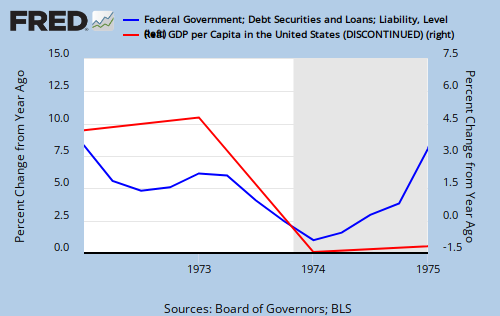
Federal Debt vs per capita GDP 1972-1975 Monetary Sovereignty

1975-1978:
Federal debt and real GDP per capita both peak in 1976
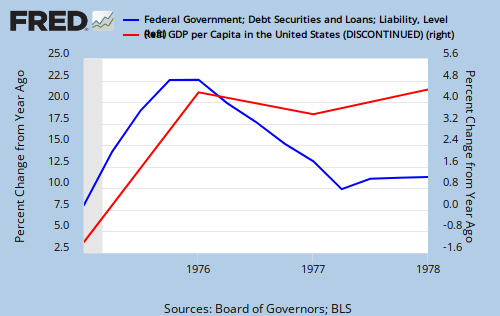
Federal Debt vs per capita GDP 1975-1980 Monetary Sovereignty

1980 – 1993:
Federal debt and real GDP per capita both peak in 1981.
Debt troughs in 1981; GDP troughs the next year, in 1982.
Debt peaks in 1983. GDP peaks the next year, in 1984.
Debt troughs in 1989; GDP troughs the next year, in 1990.
Federal debt vs per capita GDP 1980-1993 Monetary Sovereignty

2000-2006:
Federal debt troughs in 2000; real GDP per capita changes trough the next year, in 2001.
Federal debt and real GDP per capita changes both peak in 2004
Federal debt vs. per capita GDP 2000-2006 Monetary Sovereignty

2007 – 2010:
Debt troughs in 2007; GDP per capita troughs in 2009
Debt peaks in 2009 then drops precipitously; GDP per capita rises in 2010.
2005-2010 Federal debt vs. per capita GDP Monetary Sovereignty

GDP per capita data is not yet available for 2011, but total GDP direction may give us a hint, as it peaks in 2010:
Federal debt vs. per capita GDP 2005-2010 Monetary Sovereignty

In summary, changes in federal debt correspond with, or closely precede the same changes in per capita GDP. What does that tell you about the “super” committee’s efforts to reduce federal deficit spending?

(See a related post at “Oh, you want to cure unemployment?“)

Rodger Malcolm Mitchell
http://www.rodgermitchell.com


==========================================================================================================================================
No nation can tax itself into prosperity, nor grow without money growth. Monetary Sovereignty: Cutting federal deficits to grow the economy is like applying leeches to cure anemia. The key equation in economics: Federal Deficits – Net Imports = Net Private Savings

MONETARY SOVEREIGNTY

–Letter to President Obama with one big question about Social Security and Medicare. Can you answer it?

Mitchell’s laws: Reduced money growth never stimulates economic growth. To survive long term, a monetarily non-sovereign government must have a positive balance of payments. Austerity breeds austerity and leads to civil disorder. Those, who do not understand the differences between Monetary Sovereignty and monetary non-sovereignty, do not understand economics.
==========================================================================================================================================

Here is my (dumb?) question about Social Security and Medicare:

The “experts” tell us: More and more people will receive benefits from Social Security and Medicare. Current FICA payments are inadequate to cover these increased benefits. So, either FICA must be increased and/or benefits must be decreased. Otherwise, Social Security and Medicare will go bankrupt.

In short, Social Security and Medicare are self-funding entities. They even lend money to the government. They are separate from the rest of the U.S. government finances, which is why they can go bankrupt.

But . . .

Mr. President, you and Congress tell us the federal deficit is too high, and the federal government must “live within its means,” and one way to accomplish this is to cut Social Security and Medicare benefits.

Now wait a minute. You can’t have it both ways. If Social Security and Medicare finances are separate from the U.S. government, and these agencies could go bankrupt separately from the U.S. government, that means the federal government isn’t supporting them.

So my dumb question is: If the government isn’t supporting Social Security and Medicare, how can cuts in benefits help the government live within its means? And if the government is supporting them, how can they go bankrupt?

I look at it this way: My working adult child receives no financial aid from me. Her job doesn’t pay enough, so she either must cut her expenses or go bankrupt. How does her cutting her expenses help me live within my means?

It’s all so terribly confusing, Mr. President. Can you clarify this for me, before I award myself a dunce cap?

Rodger Malcolm Mitchell
http://www.rodgermitchell.com


==========================================================================================================================================
No nation can tax itself into prosperity, nor grow without money growth. Monetary Sovereignty: Cutting federal deficits to grow the economy is like applying leeches to cure anemia. The key equation in economics: Federal Deficits – Net Imports = Net Private Savings

MONETARY SOVEREIGNTY

How the President and Congress will fix the lost decade. (Curing anemia by bleeding the patient)

Mitchell’s laws: Reduced money growth never stimulates economic growth. To survive long term, a monetarily non-sovereign government must have a positive balance of payments. Austerity breeds austerity and leads to civil disorder. Those, who do not understand the differences between Monetary Sovereignty and monetary non-sovereignty, do not understand economics.
==========================================================================================================================================

At the end of this post, I pose a question to the President of the United States and for Congress:

Obama urges supercommittee leaders to reach deal; warns against undoing consequences of failing to reach accord

Andrew Harrer/BLOOMBERG , By Rosalind S. Helderman, Published: November 11

President Obama called the Democratic and Republican chairmen of Congress’s special deficit reduction supercommittee Friday and urged them to reach a deal, as the panel’s deadline for agreeing on a strategy to slash the nation’s debt rapidly approaches.

The congressional supercommittee has less than two weeks left to agree on a plan to reduce the federal deficit and avoid harsh, across-the-board spending cuts to every government agency.
[…]
According to that agreement, if the committee of six senators and six representatives deadlocks, budgets will be cut automatically by $1.2 trillion over the next decade.

Half of those cuts would come from the Pentagon, a prospect daunting enough that leading lawmakers have suggested the cuts should be repealed. But the so-called sequester could not be undone without a sign-off from Obama, and he made clear Friday that he would not agree.

“The sequester was agreed to by both parties to ensure there was a meaningful enforcement mechanism to force a result from the Committee,” the White House said in a statement. “Congress must not shirk its responsibilities. The American people deserve to have their leaders come together and make the tough choices necessary to live within our means, just as American families do every day in these tough economic times.

Translation of Mr. Obama’s comment: “Your income is down, and you must cut back on your spending. So I, your leader, will cut back on government payments to you. See? We’re in this together.”

It is frightening indeed, that the President of the United States of America does not understand the difference between the U.S government (Monetarily Sovereign) and American families (monetarily non-sovereign).

While the President wants to cut federal deficit spending, here is a snapshot of the past decade:

Mr. President, ladies and gentlemen of Congress: does this really look like an economy that needs cuts in federal deficit spending? Will reduced federal spending help increase health insurance coverage, reduce home vacancies, reduce unemployment, support national defense and reduce mortgage delinquencies? Really?

I award 3 dunce caps to the President for wanting to raise taxes while cutting Social Security and Medicare.

I award just two dunce caps to Congress for wanting to cut spending, but at least having the sense not to increase taxes.

(This brings my dunce cap deficit to 1075. Taking my lead from President Obama, I plan “to make the tough choices necessary to live within my means”, and cut back on my dunce cap spending “just as American families do every day in these tough economic times.”)

Rodger Malcolm Mitchell
http://www.rodgermitchell.com


==========================================================================================================================================
No nation can tax itself into prosperity, nor grow without money growth. Monetary Sovereignty: Cutting federal deficits to grow the economy is like applying leeches to cure anemia. The key equation in economics: Federal Deficits – Net Imports = Net Private Savings

MONETARY SOVEREIGNTY

–Oh, you want to cure unemployment? Why didn’t you say so? Here’s how:

Mitchell’s laws: Reduced money growth never stimulates economic growth. To survive long term, a monetarily non-sovereign government must have a positive balance of payments. Austerity breeds austerity and leads to civil disorder. Those, who do not understand the differences between Monetary Sovereignty and monetary non-sovereignty, do not understand economics.
==========================================================================================================================================
Here is a hint about how to cure unemployment.

In the following graph, the blue line shows annual percentage changes in the civilian employment / population ratio. The higher the line, the lower is unemployment (allowing for varying definitions of “unemployment.”)

The red line shows annual percentage changes in federal debt, which under current law corresponds to annual percentage changes in the federal deficit.

Unemployment vs deficits Monetary Sovereignty

Notice how movement in the blue line (employment %) generally follows movement in the red line (deficits) by 1 to 3 years. For clarity, let’s examine the results in smaller increments. Take the period, 1975 – 1980:

Unemployment graph, Monetary Sovereignty 1975 - 1980

Deficit growth reaches a peak in 1976, then declines. Employment reaches a peak in 1978, then declines.

Or take the period, 1979 – 1985. Deficit growth peaks in 1981, falls back, then peaks again in 1983. Employment peaks in 1981, falls back, then peaks again in 1984.

Third Graph deficit growth vs employment

In the next graph, deficit growth reaches a trough in 1989; employment reaches a trough in 1991.

In the next graph, deficits peak in 1992 and 2004. Employment peaks in 1994 and 2006. The 2000 deficit trough is followed by the 2002 employment trough.

And now we come to the latest graph. Deficits peak in 2009 and employment — well, we don’t know. What do you think will happen if the Congressional supercommittee succeeds in cutting deficits? (Remember that the U.S. is Monetarily Sovereign, so has zero need to reduce deficits.)

I know. I know. Correlation doesn’t necessarily mean causation. But add the above data to the fact that every depression has been preceded by years of federal surpluses, plus the sheer logic of money supply reductions having an adverse affect on the economy, and I come to one inescapable conclusion: Deficit-cutting by Congress, the President and the “super committee,” will give us a super recession, with massive unemployment.

The American economy needs federal deficit increases, today, tomorrow and far into the future. The American government, being Monetarily Sovereign, can and should provide those deficit increases.

Rodger Malcolm Mitchell
http://www.rodgermitchell.com


==========================================================================================================================================
No nation can tax itself into prosperity, nor grow without money growth. Monetary Sovereignty: Cutting federal deficits to grow the economy is like applying leeches to cure anemia. The key equation in economics: Federal Deficits – Net Imports = Net Private Savings

MONETARY SOVEREIGNTY