The battle of money is being fought on the field of morality

Mitchell’s laws:
●The more budgets are cut and taxes increased, the weaker an economy becomes.

●Until the 99% understand the need for federal deficits, the upper 1% will rule.
●To survive long term, a monetarily non-sovereign government must have a positive balance of payments.
●Austerity = poverty and leads to civil disorder.
●Those, who do not understand the differences between Monetary Sovereignty and monetary non-sovereignty, do not understand economics.

==========================================================================================================================================

Economics is morality. The science attempts to answer the question, “How can we improve our lives?” a moral and an economic question.

The right wing and the left wing have divergent views of morality. In the early 1860’s, the South, which at the time was mostly Democratic and also more right wing, felt virtue included slavery.

Even with southern preachers famously thumping their bibles and denouncing Satan, the notion of enslaving human beings, and denying them what we today consider human rights, the South was able to rationalize slavery. A master could beat, whip, starve and even kill his slaves, and no court would condemn him. That was considered moral by loyal church goers of the religious right.

A more left-leaning Republican North disputed this version of morality, and a civil war was fought over the difference, although as is the case with most morality questions, money was the underlying issue. The Civil War was the intersection of morality, religion, politics and economics, with each being used to justify the other.

Most Americans knew then and know now, slavery is immoral; the South was in league with the very Satan their religious preachers loudly warned about.

Today, the parties have flipped their right/left orientations; the Democrats believe those enduring poverty, sickness, homelessness and illiteracy are victims of fate, unfortunates who need and deserve direct support from a benevolent and financially limitless federal government.

The right wing, most pious voters believe otherwise, and tend to blame the victims, as exemplified in the following article from the Washington Post:

Romney attacks Obama over welfare reform

ELK GROVE VILLAGE, Ill. – Mitt Romney sought to inject welfare as an issue in the presidential campaign here Tuesday, accusing President Obama of dismantling federal welfare reform and creating a “culture of dependency.”

The presumptive Republican nominee charged the Obama administration with effectively reversing the popular bipartisan welfare reform signed into law in 1996 by President Bill Clinton by allowing waivers to states from welfare work requirements.

“That is wrong. If I’m president, I’ll put work back in welfare,” Romney said, campaigning in this suburb just outside Obama’s hometown of Chicago. He added, “We will end the culture of dependency and restore a culture of good hard work.”

The right wing version of morality is akin to “tough love.” It says people are responsible for their own misery, and government-provided benefits merely encourage sloth and Romney’s so-called “culture of dependency.”

Earlier Tuesday, the Romney campaign rolled out a new 30-second television advertisement, “Right Choice,” that says, “Obama guts welfare reform.” This is Romney’s latest attempt to cast Obama as a big-government liberal.

The Obama campaign responded by noting that in 2005, then-Massachusetts governor Romney and most other Republican governors requested state waivers similar to those the Obama administration began allowing with the Department of Health and Human Services’ July 12 announcement.

Obama campaign spokeswoman Lis Smith said the waivers give states additional flexibility only if they move more people – not fewer – from welfare to work. She said, “These false and extremely hypocritical attacks demonstrate how Mitt Romney lacks the core strength and principles the nation needs in a President.

In today’s political language, welfare “reform” actually is a move toward less welfare.. “Reform” often is invoked by the religious right to justify punishing the middle and lower classes. Social Security “reform” means lower or later benefits. Medicare “reform” means less Medicare. Tax “reform” means closing so-called “loopholes” such as the mortgage interest deduction and the medical deduction. Beware of “reform” in the hands of the religious right.

The fact that United States Presidential hopeful Romney lacks core beliefs comes as no surprise, but his repeated, pusillanimous flip-flopping is not the issue.

The issue is, what is the morality of federal aid?

Ezra Klein’s WONKBLOG included these comments:

Ron Haskins, one of the reform’s main authors enthusiastically supports the waivers. Waivers are what made welfare reform possible in the first place, he argues, by letting states experiment with new practices and they can be useful going forward.

“Do you trust that the secretary of HHS is only going to grant waivers that really are promising? Maybe I’m naïve, but I just don’t come to the conclusion that the Democrats would really use the waiver to undermine welfare reform.”

One reasons he’s doubtful of the Republican attacks is the experience of the stimulus package, which included new welfare funding for states. Republicans and conservatives attacked the idea as undermining the principle that states should be funded based on their success in keeping people off welfare.

But a study by LaDonna Pavetti, Liz Schott and Elizabeth Lower-Basch put out by the Center for Budget and Policy Priorities found (pdf) that the funding created 260,000 jobs and was actually used to promote welfare-to-work initiatives, not undermine them.

If the Obama administration wanted to undermine the reform’s work requirements, Haskins asks, “why did they allow the states to use the $5 billion to subsidize work?”

Personal opinion: It is unseemly — no, disgusting — for a man worth hundreds of millions of dollars to suck up to the 1% highest income group, by speaking against aid to the poor, and pretending this is in some way, “good for them” — and that to do otherwise is to create a “culture of dependency.”

Let’s face it, the rich pretend to believe they succeeded not by good fortune, but by hard work, and if only the poor had worked as hard, they wouldn’t be poor. So, to make this possible, the poor should be denied “charity,” which will force them to work hard and thus be successful.

Very conveniently, denying aid to the poor and middle classes helps enlarge the income gap between them and the rich. Less Medicare, less Social Security, less Medicaid, fewer food stamps, less aid to education, less unemployment insurance — less federal spending in total — all balloon the income gap.

But this is justified on a moral principle, not the true financial principle. Reducing assistance supposedly cures the 99%’s “addiction” to government aid, and oh yes, it widens the gap.

The battle of money is being fought on the field of morality.

Sadly, the lower income groups, tending to be more pious, are more responsive to a moral argument. By voting for the right wing, they tacitly accept the thesis that they are responsible for their own misery, and if only they were more ambitious and smarter, and less willing to be “food stamp queens” and “unemployment kings” they could have succeeded, just like Mitt Romney.

They also are susceptible to the false “fairness” argument that taxpayers pay for these subsidies (they don’t in a Monetarily Sovereign govenment), and the government can’t afford them (it can). It all works to keep the middle and lower classes down and the 1% up, up, up.

Once again, the so-called “religious” right-wing is on the side of money and on the wrong side of morality.

And as for Mitt Romney, he is neither moral nor immoral. He is amoral, a man with no underlying beliefs, a man who blows with the wind, genuflecting to the right one day, to the left the next, displaying a degree of spinelessness amazing even for a politician. But it doesn’t matter. This election has nothing to do with Romney. He might as well be Casper the Ghost. This election is all about hating or loving Barack Obama.

And money-biased morality.

Rodger Malcolm Mitchell
Monetary Sovereignty


==========================================================================================================================================
No nation can tax itself into prosperity, nor grow without money growth. Monetary Sovereignty: Cutting federal deficits to grow the economy is like applying leeches to cure anemia. Two key equations in economics:
Federal Deficits – Net Imports = Net Private Savings
Gross Domestic Product = Federal Spending + Private Investment and Consumption + Net exports

#MONETARY SOVEREIGNTY
–Political correctness gone wild

Mitchell’s laws:
●The more budgets are cut and taxes increased, the weaker an economy becomes.

●Until the 99% understand the need for federal deficits, the upper 1% will rule.
●To survive long term, a monetarily non-sovereign government must have a positive balance of payments.
●Austerity = poverty and leads to civil disorder.
●Those, who do not understand the differences between Monetary Sovereignty and monetary non-sovereignty, do not understand economics.

==========================================================================================================================================

Sorry for being the mean old Grinch who stole Christmas, but I found the following headline intriguing:

“Double amputee Oscar Pistorius, a.k.a ‘Blade Runner,’ has qualified for the 400m finals.” (http://us.mg4.mail.yahoo.com/neo/launch?.rand=aov0i3n8ko7s4)

Here’s my prediction: The day he wins a medal is the day the IOC and the world will begin to realize he has, or soon will have, an unfair advantage — something akin to performance improving drugs.

Every year, manufacturers will find ways to make the blades better and better. Perhaps, in the next couple of years, someone using new improved blades will run the 100 meters in 5 seconds, run a mile in 2 minutes, do a 50 foot long jump and a 15 foot high jump — maybe even do the pole vault without a pole.

Ironically, the IOC just banned performance enhancing swim suits, so I guess there’s no chance we’ll see swim fins for legless swimmers. Or is there?

His using the blades is political correctness gone wild. But, as with economics, sometimes the obvious takes a bit of time to become . . . well, obvious.

Rodger Malcolm Mitchell
Monetary Sovereignty


==========================================================================================================================================
No nation can tax itself into prosperity, nor grow without money growth. Monetary Sovereignty: Cutting federal deficits to grow the economy is like applying leeches to cure anemia. Two key equations in economics:
Federal Deficits – Net Imports = Net Private Savings
Gross Domestic Product = Federal Spending + Private Investment and Consumption + Net exports

#MONETARY SOVEREIGNTY

–With your approval, the government steals dollars from you

Mitchell’s laws:
●The more budgets are cut and taxes increased, the weaker an economy becomes.

●Until the 99% understand the need for federal deficits, the upper 1% will rule.
●To survive long term, a monetarily non-sovereign government must have a positive balance of payments.
●Austerity = poverty and leads to civil disorder.
●Those, who do not understand the differences between Monetary Sovereignty and monetary non-sovereignty, do not understand economics.

==========================================================================================================================================

Here is yet another example of how the government, with the unquestioning approval of the voters, steals dollars out of the economy

Yahoo Finance
Treasury says to raise $5 billion from AIG stock sale

WASHINGTON (Reuters) – The U.S. Treasury Department said on Friday it expects to raise $5 billion from its sale of American International Group (AIG) stock, cutting the government’s stake in the bailed-out insurer to 55 percent.

Translation: The U.S. Treasury, which creates dollars, and so, does not need to receive dollars from anyone, expects to drain $5 billion from the U.S. economy.

The sale, which would bring a profit of about $300 million to the U.S. Treasury, comes as President Barack Obama campaigns for a second term and has been forced to defend his administration’s decision to use taxpayer money to prop up companies during the crisis.

Translation: $300 million of those dollars are in addition to the dollars the Treasury previously had pumped into the economy as a stimulus. So our struggling economy has now been “unstimulated” by the previous stimulus plus an extra $300 million drained out.

The Treasury Department priced the offering at $30.50 a share, six percent above the $28.72 price needed for the U.S. government to break even on its investment in the insurer.

Translation: The Treasury hopes to drain as many stimulus dollars out of the economy as possible.

AIG intends to buy up to $3 billion of the offering.

Translation: Although taxes weaken the economy, AIG intends to pay $3 billion in extra taxes.

The sale of 163.9 million shares of AIG stock will reduce the government’s holding in the insurer to 55 percent from 61 percent. The offering is expected to close next week.

Translation: The Treasury will continue to drain many billions of dollars from the economy.

The insurer received multiple bailouts under both the Obama and Bush administrations, with the government pledging as much as $182 billion in aid. After the latest sale, the Treasury’s investment in AIG will be about $25 billion.

Translation: The economy received multiple stimuli under both the Obama and Bush administrations. Since then, the Treasury has drained all but $25 billion of that stimulus. The Treasury still intends to drain $25 billion more out of the economy.

The Obama administration has been unwinding its position in the politically unpopular financial crisis bailout programs. More than 300 small banks have yet to repay taxpayers. The administration could sell its remaining stake in AIG this year but has been adamant in saying it will not act for political reasons.

Translation: “Politically unpopular” means the voters have not been told the truth: The economy needs the dollars and the federal government does not. When 300 small banks pay extra tax to the government, the economy will suffer even more. The administration’s political reasons for not acting are simple: It knows the economy would suffer, and that would help sink President Obama’s reelection chances.

Summary: The upper income 1% wants the economy to tank, because that opens the gap between the 1% and the 99%. As we have explained previously, absolute income is less important than comparative income. The 1% prefers the income gap to open, even if that means they themselves lose a bit of income.

The administrate, being beholden to the 1%, also wants the gap to open, but realizes the resultant economic decline would mitigate against reelection, so will hold off on further austerity measures until after November.

And the 99%, having been brainwashed by the 1%, not only approves of anti-stimulus, money draining, they insist on it.

Rodger Malcolm Mitchell
Monetary Sovereignty


==========================================================================================================================================
No nation can tax itself into prosperity, nor grow without money growth. Monetary Sovereignty: Cutting federal deficits to grow the economy is like applying leeches to cure anemia. Two key equations in economics:
Federal Deficits – Net Imports = Net Private Savings
Gross Domestic Product = Federal Spending + Private Investment and Consumption + Net exports

#MONETARY SOVEREIGNTY

–I’m really surprised to find myself disagreeing with Marshall Auerback about minimum wage

Mitchell’s laws:
●The more budgets are cut and taxes increased, the weaker an economy becomes.

●Until the 99% understand the need for federal deficits, the upper 1% will rule.
●To survive long term, a monetarily non-sovereign government must have a positive balance of payments.
●Austerity = poverty and leads to civil disorder.
●Those, who do not understand the differences between Monetary Sovereignty and monetary non-sovereignty, do not understand economics.

==========================================================================================================================================

Marshall Auerback is a hedge fund manager who seems to understand the fundamentals of Monetary Sovereignty and economics in general. So I was a taken aback by his article referenced in the Naked Capitalism blog site:

Top 5 Reasons Why Raising the Minimum Wage Is Good for You and Me

In recent months, a number of states have again taken the lead on measures to raise the minimum wage. Massachusetts is moving toward a minimum of $10 per hour. Other measures are on the table in New York, Illinois, New Jersey, Connecticut and Missouri. Meanwhile Sen. Tom Harkin, D-Iowa, is pressing for the federal minimum wage to rise to $9.80 per hour by 2014.

Here are five reasons why we should cheer for working America getting a raise.

1. Good for Families: According to economist James Galbraith, raising the minimum wage would raise the incomes of 28 million Americans. Women would particularly benefit because they tend to work for lower wages than men. As Galbraith sees it, raising the minimum wage is family friendly policy:

With more family income, some people would choose to retire, go back to school, or have children, making it easier for others who need jobs to find them. Working families would have more time for community life, including politics; Americans would start to reclaim the middle-class political organization that they once had. Because payroll- and income-tax revenues would rise, the federal deficit would come down. Social Security worries would fade.

Wait a second, “Raising the minimum wage would raise the incomes of 28 million Americans,” and raising people’s pay encourages them to retire? Am I the only one who sees a disconnect, here?

With higher pay, working families will have more time for politics? Huh? And reducing the federal deficit is a good thing? Marshall, have you forgotten all you know about Monetary Sovereignty?

2. Good for Economic Recovery: To get the economy back on track, spending power has to be in the hands of those who actually spend in the real economy. That means regular people, not the super-wealthy who tend to hoard wealth or invest in financial products.

Every “investment in financial products” transfers dollars from one person to another. The dollars keep moving, from one bank account to the next, and during this process, some are spent.

Minimum wage makes automation more attractive, which leads to unemployment.

3. Helps People Get Out of Debt: As our economy has become increasingly directed toward Wall Street and the so-called FIRE (finance, insurance, real estate) sectors, more wealth has migrated to the top 1 percent. On top of that, real wages have increasingly lagged behind the growth in productivity. It is also clear that hours worked and persons employed in the “productive” sector have been in decline over the last few decades.

This all may be true, but is irrelevant to the question of minimum wage, which generally is paid to people with the lowest productivity (their productivity is not enhanced by computers). Giving them raises won’t increase their productivity, nor will it have a meaningful effect on the income gap.

An increase of a couple of dollars per hour or more in the minimum wage could make huge improvements in the difficult existence of the working poor, perhaps allowing them to exit the debt treadmill and stand a better chance of eventually rising into a revitalized middle-class.

Or, they could be fired as too expensive — to be replaced by machines.

Admittedly, corporate profits might suffer a little and some businesses at the lowest end might disappear. That said, corporate profits as a percentage of national economic output are already at an all-time record levels. And it’s questionable whether such levels of profitability can be sustained. Firms have lots of unused capacity lying around because people can’t afford to buy products and services. Sluggish sales growth is directly connected to lagging wage rates.

Raising the minimum wage will do little to correct “lagging wage rates,” most of which are far above the minimum rate. Firms have unused capacity, which mitigates against inflation. Reduce that capacity, and prices will rise, hurting all workers.

At the same time, dependence on food stamps has surged by over 14 million over the same period. And “financial engineering” has helped to create a significant escalation in debt being borne by the private sector, particularly consumers.

Food stamp usage has surged because we still are in a recession. Raising the minimum wage merely reduced business profits, but does nothing to cure the recession. Increased federal deficit spending is needed for that.

4. Protects Workers From Abuse: A higher minimum wage would also help to mitigate the abusive, exploitative working practices of a number of employers, who take advantage of the currently low minimum wage to seek cut-rate help. Such employers often use undocumented labor, which further undermines America’s working poor.

By definition, the current minimum wage always is “low,” so employers paying the minimum wage always can be accused of “taking advantage. Undocumented labor will not be helped by increases in the legal minimum wage.

5. Justice for Working Americans: The past 30 years have witnessed a dramatic redistribution of national and personal income in favor of profits for the rich. At the same time, this period has been associated with a dramatic decline in the performance of the US economy. To raise the minimum wage would be literally the minimum we could do for those who have suffered from the economic crisis: the working population. It would be an act of justice.

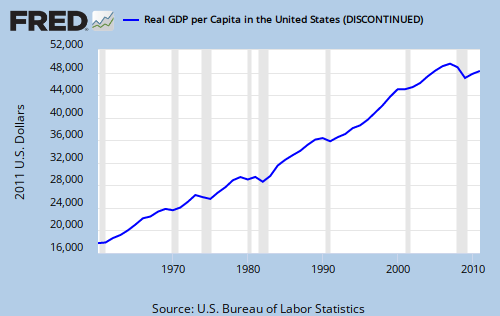
He says the past 30 years have “been associated with a dramatic decline in the performance of the US economy”? Really? His definition of “performance” must be different from mine. Here is the Real (inflation adjusted) Per Capita Gross Domestic Product for the past 50 years:

Monetary Sovereignty

That looks like pretty good performance growth, but for the current recession period.

Bottom line, minimum wage laws do have some benefit. They prevent employers from being too exploitative and paying desperate workers starvation wages. But there is a downside — a major downside: Businesses measure production value of each asset, including employees.

As employee costs goes up, businesses look for alternatives, like mechanization and shipping jobs overseas. So minimum wage runs head-on into unemployment. Further, it does nothing at all, for the vast majority of people who already receive more than minimum wage, but still are part of the 99% lower income group.

Finally, minimum wage does not add dollars to the economy, so is not stimulative. It may, in fact, subtract dollars from the economy, as overseas payrolls increase.

All 5 of Mr. Auerback’s goals can be accomplished with the following nine steps, none of which involve minimum wage:

1. Eliminate FICA (Click here)
2. Medicare — parts A, B & D — for everyone
3. Send every American citizen an annual check for $5,000 or give every state $5,000 per capita (Click here)
4. Long-term nursing care for everyone
5. Free education (including post-grad) for everyone
6. Salary for attending school (Click here)
7. Eliminate corporate taxes
8. Increase the standard income tax deduction annually
9. Increase federal spending on the myriad initiatives that benefit America

In short, the solutions lie with added government deficit spending, not with added burdens to business.

Rodger Malcolm Mitchell
Monetary Sovereignty


==========================================================================================================================================
No nation can tax itself into prosperity, nor grow without money growth. Monetary Sovereignty: Cutting federal deficits to grow the economy is like applying leeches to cure anemia. Two key equations in economics:
Federal Deficits – Net Imports = Net Private Savings
Gross Domestic Product = Federal Spending + Private Investment and Consumption + Net exports

#MONETARY SOVEREIGNTY