–You never will know what you have lost: Part V. Bedbugs and bypass operations

Twitter: @rodgermitchell; Search #monetarysovereignty
Facebook: Rodger Malcolm Mitchell

Mitchell’s laws:
●Those, who do not understand the differences between Monetary Sovereignty and monetary non-sovereignty, do not understand economics.
●The more federal budgets are cut and taxes increased, the weaker an economy becomes. .
Liberals think the purpose of government is to protect the poor and powerless from the rich and powerful. Conservatives think the purpose of government is to protect the rich and powerful from the poor and powerless.
●The single most important problem in economics is
the gap between rich and poor.
●Austerity is the government’s method for widening
the gap between rich and poor.
●Until the 99% understand the need for federal deficits, the upper 1% will rule.
To survive long term, a monetarily non-sovereign government must have a positive balance of payments.
●Everything in economics devolves to motive,
and the motive is the Gap.

=========================================================================================================================================================================================================================

This is the fifth in a series of posts titled, “You never will know what you have lost” (Part I, Part II , Part III) and Part: IV

Each post describes the invisible, but real costs of federal deficit reduction, aka “austerity.”

The first of the posts contained these paragraphs:

The list goes on and on: The lame who might have walked. The blind who might have seen. The children who might have given to America. The tornadoes and hurricanes and earthquakes that might have been foreseen.

The money that investors might have saved. The inventions never invented. The recessions and depressions that might have been avoided. The wars that might have been won or prevented. The life-saving drugs that might have been developed. The people who might not have died too soon. The beauty never created. The ideas lost. The better world that might have been.

You never will know.

Day by day, we die the death of a thousand invisible cuts, at the hands of people who know not or care not what they do. Like doctors who would treat anemia by bleeding the patient with leeches, they bleed the economy of its blood, its dollars, in the name of frugality.

In 1972, who would have guessed that 43 years later, we still would have no plans to walk there again, or to explore further there, or to build a station there?

Why did we stop? Because we were told the federal government — which has the unlimited ability to create dollars — somehow could not create sufficient dollars to pay for the trip.

And, we are told, deficit spending causes inflation, though no such relationship exists.

But really, who cares about such exploreation? What possible good is walking on the moon, or any other space exploration?? Or, for that matter, what possible good is any basic research that does not have an easily seen payout?

Of course, if such research isn’t done, you never will know whether anything has been lost.

Recently, in the Rosetta mission, the European Space Agency landed “Philae” on the surface of comet “67P.” Huh? Landing on one of the millions of comets and other bodies circling the solar system? How is that supposed to help me?

Here are excerpts from an article in NewScientist Magazine:

Rosetta’s real revolution is right here on Earth
From heart surgery breakthroughs to robotic sniffers and bedbug detectors, space tech spin-offs from the mission have a real world purpose

BEDBUGS suck our blood while we sleep and evade detection by dint of their nocturnal lifestyle and millimetre-scale bodies. A portable bedbug detector that sniffs out the chemical signals they send to one another is just one of many unusual spin-offs from the Rosetta mission.

“Space stands for low-weight, robust, temperature-resistant technology that has to work,” says Frank Salzgeber, head of technology transfer for the European Space Agency, which launched Rosetta.

Geraint Morgan of the Open University in Milton Keynes, UK, who helped design the Rosetta instrument, is also involved in another sniffer spin-off. This time the aim is to detect Helicobacter pylori, a bacterium that causes stomach ulcers and can raise risk of stomach cancer.

Other putative spin-offs using Rosetta’s gas-sniffing technology range from a system to monitor air quality on the UK’s proposed new fleet of nuclear submarines to a robotic nose that will “detect the complex, changing mixtures of airborne molecules encountered by consumers in everyday situations” – a device that the perfume company Givaudan wants to use in developing new fragrances.

It’s a similar story for Rosetta’s atomic force microscope MIDAS. As a dust speck passes through MIDAS, a finely controlled needle gently scans the grain’s geometry, creating a three-dimensional picture of it. The company that developed the system, Cedrat Technologies, based near Grenoble in France, is now using the needle’s sensitive actuators in a device for fiddly coronary artery bypass operations.

More prosaically, the company is working with skiing equipment manufacturer Rossignol to see whether a similar system could make skis vibrate less at high speeds.

A European Space Agency spin-off, Giaura, based in the Netherlands, is hoping to find terrestrial uses for the porous beads that scrub carbon dioxide from the air aboard the International Space Station. The idea is to capture atmospheric CO2 to boost the growth of greenhouse tomato plants, make carbonated drinks and cement or – in the first prototype – to pump it into aquariums to help keep water plants healthy.

Steel workers struggle with conventional underwear as cotton retains heat, and can easily catch fire from a stray spark. “Thunderwear” – prototype flame-resistant bras and underpants developed in collaboration with ESA – is made from Nomex, a fabric used in spacesuits.

The Vatican Library’s collection of 180,000 manuscripts and 1.6 million books is being digitised using a system developed by ESA and NASA to store data from satellites.

The anti-science ignoranti ask, “How does research for space help us in our terrestrial world?”

Bedbugs, cancer and ulcer treatments, air quality monitoring, perfume manufacture, coronary bypass, skis, tomato plant growth, carbonated drinks, cement, aquariums, steel workers’ underwear, digitized libraries — the list is as extensive as it is varied. And it is but the tip of the iceberg.

In the years to come, thousands of discoveries, inventions and processes will evolve from what our space efforts teach us. If there were no space effort, many of these discoveries and inventions would not exist.

But you never would know what you have lost — all because the government told you the federal deficit was “unsustainable” or will cause hyper-inflation (the two elements of the Big Lie.)

The bigger question is: What are we and our children losing now, every day, because deficit spending is cut?

It’s something important, that we are forced to do without. What is it?

We never will know.

Rodger Malcolm Mitchell
Monetary Sovereignty

===================================================================================
The Ten Steps to Prosperity:

1. Eliminate FICA (Click here)
2. Federally funded Medicare — parts A, B & D plus long term nursing care — for everyone (Click here)
3. Provide an Economic Bonus to every man, woman and child in America, and/or every state a per capita Economic Bonus. (Click here) Or institute a reverse income tax.
4. Federally funded, free education (including post-grad) for everyone. Click here
5. Salary for attending school (Click here)
6. Eliminate corporate taxes (Click here)
7. Increase the standard income tax deduction annually. (Refer to this.)
8. Tax the very rich (.1%) more, with higher, progressive tax rates on all forms of income. (Click here)
9. Federal ownership of all banks (Click here and here)

10. Increase federal spending on the myriad initiatives that benefit America’s 99% (Click here)

Initiating The Ten Steps sequentially will add dollars to the economy, stimulate the economy, and narrow the income/wealth/power Gap between the rich and the rest.
——————————————————————————————————————————————

10 Steps to Economic Misery: (Click here:)
1. Maintain or increase the FICA tax..
2. Spread the myth Social Security, Medicare and the U.S. government are insolvent.
3. Cut federal employment in the military, post office, other federal agencies.
4. Broaden the income tax base so more lower income people will pay.
5. Cut financial assistance to the states.
6. Spread the myth federal taxes pay for federal spending.
7. Allow banks to trade for their own accounts; save them when their investments go sour.
8. Never prosecute any banker for criminal activity.
9. Nominate arch conservatives to the Supreme Court.
10. Reduce the federal deficit and debt

No nation can tax itself into prosperity, nor grow without money growth. Monetary Sovereignty: Cutting federal deficits to grow the economy is like applying leeches to cure anemia.
1. A growing economy requires a growing supply of dollars (GDP=Federal Spending + Non-federal Spending + Net Exports)
2. All deficit spending grows the supply of dollars
3. The limit to federal deficit spending is an inflation that cannot be cured with interest rate control.
4. The limit to non-federal deficit spending is the ability to borrow.

THE RECESSION CLOCK
Monetary Sovereignty

Monetary Sovereignty

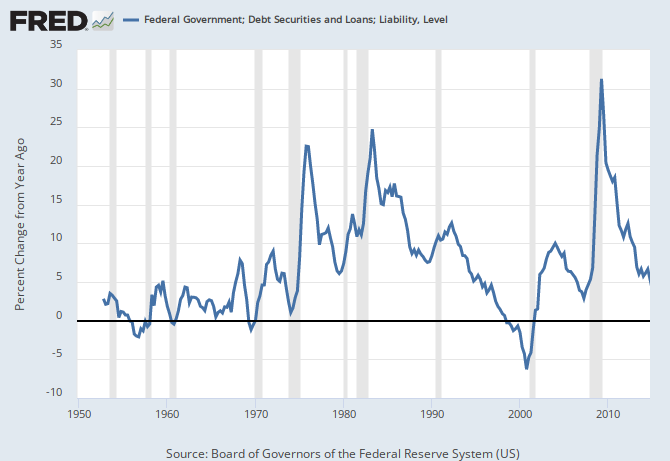
Vertical gray bars mark recessions.

As the federal deficit growth lines drop, we approach recession, which will be cured only when the growth lines rise. Increasing federal deficit growth (aka “stimulus”) is necessary for long-term economic growth.

#MONETARYSOVEREIGNTY

–Your budget brainwashing goes into overdrive

Twitter: @rodgermitchell; Search #monetarysovereignty
Facebook: Rodger Malcolm Mitchell

Mitchell’s laws:
●Those, who do not understand the differences between Monetary Sovereignty and monetary non-sovereignty, do not understand economics.
●The more federal budgets are cut and taxes increased, the weaker an economy becomes. .
Liberals think the purpose of government is to protect the poor and powerless from the rich and powerful. Conservatives think the purpose of government is to protect the rich and powerful from the poor and powerless.
●The single most important problem in economics is
the gap between rich and poor.
●Austerity is the government’s method for widening
the gap between rich and poor.
●Until the 99% understand the need for federal deficits, the upper 1% will rule.
To survive long term, a monetarily non-sovereign government must have a positive balance of payments.
●Everything in economics devolves to motive,
and the motive is the Gap.

=========================================================================================================================================================================================================================

As readers of this blog know, the primary goal of the upper 1% income / wealth / power group is to widen the Gap between them and the rest of us.

It is the Gap that makes them rich. Without the Gap no one would be rich. And the wider the Gap, the richer they are.

So the 1% bribes the politicians (via campaign contributions and promises of lucrative employment later), to cut spending that benefits the 99% and to increase taxes on the 99%.

They do this in the name of “fiscal responsibility.” That is the Big Lie in economics.

The media go along with it, because they are owned by the rich. The economists go along with it, because they are employed by the rich.

So, with the election season having already begun, you will see more and more brainwashing articles. Here is one from Investors.com, published by Investors Daily (Guess who their readers are):

Social Security Benefits Will Be Cut In 2017
BY JED GRAHAM, INVESTOR’S BUSINESS DAILY, 05/14/2015

No matter who wins the White House in 2016, there’s no getting around it: Social Security benefits will be cut starting in 2017.

A 1983 pact between President Reagan and the Democrat-led Congress to stave off an imminent Social Security financing crisis included a hike in the official retirement age from 65 to 67 somewhere in the far-off future.

Translation: Because there is a financing “crisis,” a benefit cut is inevitable, so don’t fight it. Just go along with it.

The retirement age rose to 66 in two-month increments between 2000 and 2005. Between 2017 and 2022, the retirement age will rise to 67.

In practical terms, workers claiming benefits at age 62 in 2022 and beyond will face a 30% reduction in the annual benefit that they receive throughout their lives. When the retirement age was 65, those claiming benefits at 62 suffered a 20% cut.

Translation: It’s a long way off, and anyway, it already has been happening, so it’s all just normal stuff. Just sit back and don’t worry about it. We’ll take care of everything.

Yet despite the coming rise in the retirement age, Social Security’s cash deficit is set to explode to $361 billion in 2025 from $74 billion in 2014, the Congressional Budget Office estimates.

The CBO’s estimates point to the $2.8 trillion trust fund being depleted late in 2029, after which program revenues will cover only about 75% of scheduled benefits.

Translation: Yes, we’re stealing money from you and your family, but we aren’t stealing enough.

See, we invented the mythical Social Security “trust fund,” which supposedly pays benefits, but it’s not a real “trust fund.” It’s an accounting fiction.

We could fill that “trust fund” any time we wished, but if we did, we couldn’t cut your benefits, which is our goal.

Something has to be done to put the program on a firmer footing, and potential Republican candidates have begun stepping forward with their ideas.

Chris Christie and Jeb Bush have both put themselves squarely behind a further increase in the retirement age. Christie specifically advocated a hike to age 69, closing a bit more than one-third of the financing shortfall.

Translation: Now that we have you softened up for widening the Gap, we really are going to sock it to you. You won’t get normal benefits unless you work 4 more years, and even then, only 1/3 of the so-called “shortfall” will be covered.

This gives us plenty of room to keep cutting you down. Hey, as long as you’re sucker enough to believe what we’re telling you, we’ll just keep cutting you.

And now we come to the ever-reliable (for cutting benefits to the 99%) Committee for a Responsible Federal Budget (CRFB).

You might recognize a couple of names on its board: Erskine Bowles and Alan Simpson. They are the authors of the notorious “debt reduction plan” (aka the “sequester”) that dramatically slowed our recovery.

Also on the board is the even more notorious Pete Peterson, the multi-billionaire founder of the Concord Coalition, and contributor to many anti-99% causes.

Here is what the CRFB says:

CRFB’S PLAN TO REPAIR THE HIGHWAY TRUST FUND

Yes, it’s another fake federal “trust fund” that isn’t a trust fund, but rather an accounting placeholder. It has no real trust fund functions. Unlike the way a real trust fund works, the federal government can increase or decrease this “trust fund” at will.

With the deadline for extending the surface transportation authorization just a few weeks away and Highway Trust Fund (HTF) bankruptcy approaching this summer, CRFB has released the The Road to Sustainable Highway Spending, a detailed plan to fix the HTF’s finances and bring greater rationality to the process of determining highway spending and revenue.

Translation: We begin our article with two lies:
1. O.K., the “trust fund” can’t go “bankrupt.” Bankruptcy is a legal term describing a legal process. What we really mean is that Congress will not pay for roads, and it’s using the mythical “trust fund” as an excuse.

(Visualize someone with a full refrigerator telling you they are starving because they won’t open the refrigerator door.)

2. And, O.K., our use of the word “sustainable,” never is explained, because there is no explanation. As a Monetarily Sovereign government, the U.S. never can run short of dollars.

In fact, it creates dollars merely by the process of paying bills. So everything is “sustainable” for the U.S. government.

But we don’t want you to know that.

While at least a short-term general revenue transfer is likely needed, it would be irresponsible to enact a transfer without equal-sized spending cuts or revenue increases to offset the cost.

Translation: The federal government easily could “transfer” dollars to the mythical fund (aka arbitrarily increase the balance shown), but that wouldn’t cut deficit spending. So what’s the point if it doesn’t widen the Gap?

Our plan consists of four main parts: a $25 billion general revenue transfer to pay for “legacy costs,” or projects authorized prior to this year that are being paid out of current funding; $100 billion from raising the gas tax by 9 cents per gallon starting in 2016; $50 billion from freezing highway spending for two years, then limiting it to the previous year’s revenue plus interest collections; and creating a “fast lane” for tax reform that allows lawmakers to identify alternative revenue sources to replace an equivalent amount of the other changes.

Translation: See that “raising the gas tax” buried in there? Guess who will pay that tax. You suckers of the 99%.

And see that “freezing highway spending” buried in there? That’s the way we solve the highway funding problem. Just don’t fix ’em. Clever, huh?

And see that “tax reform” and “alternative revenue sources” in there? By now you should have learned that anytime we say “reform,” or “alternative revenue sources” we mean “charge the 99% more.”
…………………………………………………………………………………………………………………………………………………………………………………………….

For the next 1 1/2 years expect to read and hear more and more about how the poor, impoverished federal government needs more and more dollars from us flush-with-cash 99%ers.

You may begin to arouse from the concussion caused by the Big Lie, and complain that while your personal income is stretched and limited, the federal government has the unlimited ability to create dollars.

But, this is what you’ll be told: “We can’t afford it because inflation, inflation, inflation, Wiemar, Wiemar, Wiemar.” That part of the Big Lie has worked for 75 years, so why stop now?

Watch as your budget brainwashing goes into overdrive.

Rodger Malcolm Mitchell
Monetary Sovereignty

===================================================================================
The Ten Steps to Prosperity:

1. Eliminate FICA (Click here)
2. Federally funded Medicare — parts A, B & D plus long term nursing care — for everyone (Click here)
3. Provide an Economic Bonus to every man, woman and child in America, and/or every state a per capita Economic Bonus. (Click here) Or institute a reverse income tax.
4. Federally funded, free education (including post-grad) for everyone. Click here
5. Salary for attending school (Click here)
6. Eliminate corporate taxes (Click here)
7. Increase the standard income tax deduction annually. (Refer to this.)
8. Tax the very rich (.1%) more, with higher, progressive tax rates on all forms of income. (Click here)
9. Federal ownership of all banks (Click here and here)

10. Increase federal spending on the myriad initiatives that benefit America’s 99% (Click here)

Initiating The Ten Steps sequentially will add dollars to the economy, stimulate the economy, and narrow the income/wealth/power Gap between the rich and the rest.
——————————————————————————————————————————————

10 Steps to Economic Misery: (Click here:)
1. Maintain or increase the FICA tax..
2. Spread the myth Social Security, Medicare and the U.S. government are insolvent.
3. Cut federal employment in the military, post office, other federal agencies.
4. Broaden the income tax base so more lower income people will pay.
5. Cut financial assistance to the states.
6. Spread the myth federal taxes pay for federal spending.
7. Allow banks to trade for their own accounts; save them when their investments go sour.
8. Never prosecute any banker for criminal activity.
9. Nominate arch conservatives to the Supreme Court.
10. Reduce the federal deficit and debt

No nation can tax itself into prosperity, nor grow without money growth. Monetary Sovereignty: Cutting federal deficits to grow the economy is like applying leeches to cure anemia.
1. A growing economy requires a growing supply of dollars (GDP=Federal Spending + Non-federal Spending + Net Exports)
2. All deficit spending grows the supply of dollars
3. The limit to federal deficit spending is an inflation that cannot be cured with interest rate control.
4. The limit to non-federal deficit spending is the ability to borrow.

THE RECESSION CLOCK
Monetary Sovereignty

Monetary Sovereignty

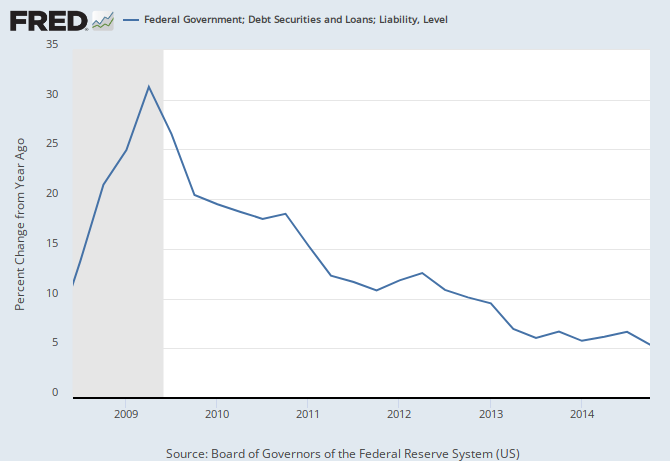
Vertical gray bars mark recessions.

As the federal deficit growth lines drop, we approach recession, which will be cured only when the growth lines rise. Increasing federal deficit growth (aka “stimulus”) is necessary for long-term economic growth.

#MONETARYSOVEREIGNTY

–The four questions that may have turned on a light — maybe

Twitter: @rodgermitchell; Search #monetarysovereignty
Facebook: Rodger Malcolm Mitchell

Mitchell’s laws:
●Those, who do not understand the differences between Monetary Sovereignty and monetary non-sovereignty, do not understand economics.
●The more federal budgets are cut and taxes increased, the weaker an economy becomes. .
Liberals think the purpose of government is to protect the poor and powerless from the rich and powerful. Conservatives think the purpose of government is to protect the rich and powerful from the poor and powerless.
●The single most important problem in economics is
the gap between rich and poor.
●Austerity is the government’s method for widening
the gap between rich and poor.
●Until the 99% understand the need for federal deficits, the upper 1% will rule.
To survive long term, a monetarily non-sovereign government must have a positive balance of payments.
●Everything in economics devolves to motive,
and the motive is the Gap.

=========================================================================================================================================================================================================================

You never can win an argument.

If it’s a contest, to be won or lost, the other guy will refuse to lose. So all the logic and facts in the world will not dent his faith and brainwashed head.

Despite every economic fact showing that federal deficit spending is not “unsustainable,” as the rich would have you believe — and despite the basic simplicity of Federal Deficits = Economy’s Surplus — the man-in-the-street can’t/won’t get it.

His faith and belief, that federal finances are like personal finances, is too strong.

But on at least one occasion, I may have found a way. I asked a friend four questions. The dialog went like this (somewhat edited):

1. Question: Which is better for the U.S. economy, a trade surplus or a trade deficit?

His answer: A trade surplus.

2. Question: Why?

His answer: Because a trade surplus brings dollars into the economy, which helps grow the economy.

3. Question: So, which is better for the U.S. economy, a federal surplus or a federal deficit?

His answer (after a long pause): I’d say, a federal surplus.

4. Question: When the government runs a surplus, where do the dollars come from?

His answer (after an even longer pause): I see what you’ve been telling me.

Because the word “surplus” generally is good and the word “deficit” generally is bad, people tend to think that ALL surpluses are good and ALL deficits are bad. So they immediately accept the notion that a federal surplus must be good.

But when put into context of money into and out of the economy, a light can go on.

In retrospect, I might have done as well with just two questions:

Why is a trade surplus better than a trade deficit?

When the federal government runs a surplus, where does the money come from?

And those are the two questions I plan to ask of my Senators and Representative.

You might want to do the same. I’d be interested to learn what they tell you.

Rodger Malcolm Mitchell
Monetary Sovereignty

===================================================================================
The Ten Steps to Prosperity:

1. Eliminate FICA (Click here)
2. Federally funded Medicare — parts A, B & D plus long term nursing care — for everyone (Click here)
3. Provide an Economic Bonus to every man, woman and child in America, and/or every state a per capita Economic Bonus. (Click here) Or institute a reverse income tax.
4. Federally funded, free education (including post-grad) for everyone. Click here
5. Salary for attending school (Click here)
6. Eliminate corporate taxes (Click here)
7. Increase the standard income tax deduction annually. (Refer to this.)
8. Tax the very rich (.1%) more, with higher, progressive tax rates on all forms of income. (Click here)
9. Federal ownership of all banks (Click here and here)

10. Increase federal spending on the myriad initiatives that benefit America’s 99% (Click here)

Initiating The Ten Steps sequentially will add dollars to the economy, stimulate the economy, and narrow the income/wealth/power Gap between the rich and the rest.
——————————————————————————————————————————————

10 Steps to Economic Misery: (Click here:)
1. Maintain or increase the FICA tax..
2. Spread the myth Social Security, Medicare and the U.S. government are insolvent.
3. Cut federal employment in the military, post office, other federal agencies.
4. Broaden the income tax base so more lower income people will pay.
5. Cut financial assistance to the states.
6. Spread the myth federal taxes pay for federal spending.
7. Allow banks to trade for their own accounts; save them when their investments go sour.
8. Never prosecute any banker for criminal activity.
9. Nominate arch conservatives to the Supreme Court.
10. Reduce the federal deficit and debt

No nation can tax itself into prosperity, nor grow without money growth. Monetary Sovereignty: Cutting federal deficits to grow the economy is like applying leeches to cure anemia.
1. A growing economy requires a growing supply of dollars (GDP=Federal Spending + Non-federal Spending + Net Exports)
2. All deficit spending grows the supply of dollars
3. The limit to federal deficit spending is an inflation that cannot be cured with interest rate control.
4. The limit to non-federal deficit spending is the ability to borrow.

THE RECESSION CLOCK
Monetary Sovereignty

Monetary Sovereignty

Vertical gray bars mark recessions.

As the federal deficit growth lines drop, we approach recession, which will be cured only when the growth lines rise. Increasing federal deficit growth (aka “stimulus”) is necessary for long-term economic growth.

#MONETARYSOVEREIGNTY

Cutters: How they destroy our middle class and depress the nation

Twitter: @rodgermitchell; Search #monetarysovereignty
Facebook: Rodger Malcolm Mitchell

Mitchell’s laws:
●Those, who do not understand the differences between Monetary Sovereignty and monetary non-sovereignty, do not understand economics.
●The more federal budgets are cut and taxes increased, the weaker an economy becomes. .
Liberals think the purpose of government is to protect the poor and powerless from the rich and powerful. Conservatives think the purpose of government is to protect the rich and powerful from the poor and powerless.
●The single most important problem in economics is
the gap between rich and poor.
●Austerity is the government’s method for widening
the gap between rich and poor.
●Until the 99% understand the need for federal deficits, the upper 1% will rule.
To survive long term, a monetarily non-sovereign government must have a positive balance of payments.
●Everything in economics devolves to motive,
and the motive is the Gap.

=========================================================================================================================================================================================================================

Cutters: How they destroy the American middle class and depress all America

The Cato Institute is an American libertarian think tank headquartered in Washington, D.C. It was founded as the Charles Koch Foundation in 1974 by Ed Crane, Murray Rothbard, and Charles Koch.

Here is what the Cato Institute proposes:

(What do these cuts have in common?)

(A) Table 1. Proposed Federal Budget Cuts

Health Care and Social Security, Annual Savings, $Billions, 2025

Health Care
(B) Repeal ACA exchange subsidies 107.0
(B) Repeal ACA Medicaid expansion 105.0
(B) Block grant Medicaid and grow at 2% 110.0
(B) Increase Medicare premiums 60.0
(B) Increase Medicare cost sharing 19.0
(B) Cut HHS non-Medicaid state grants by 50% 43.5
Total cuts 444.5

Social Security Administration
(B) Price index initial Social Security benefits 39.1
(B) Raise the normal retirement age for Social Security 10.4
(B) Cut Social Security Disability Insurance by 25% 54.0
(B) Cut Supplemental Security Income by 25% 18.0
Total cuts 121.5

Total annual spending cuts in 2025 $566.0
………………………………………………………………………………………………………………………………………………………………………………………….
(A) Table 2. Proposed Federal Budget Cuts

Discretionary Programs and Other Entitlements, Annual Savings, $Billions, 2015

Department of Agriculture
(B) End farm subsidies 24.8
(B) Cut food subsidies by 50% 53.2
(B) End rural subsidies 4.2
Total cuts 82.2

Department of Commerce
(B) End telecom subsidies 0.8
(B) End economic development subsidies 0.5
Total cuts 1.3

Department of Defense
End overseas contingency operations 74.0
Total cuts 74.0

Department of Education
(B) End K-12 education subsidies 26.3
End all other programs (?) 77.0
Total cuts (terminate the department) 103.3

Department of Energy
(B) End subsidies for energy efficiency 2.4
(B) End loan programs 0.2
(B) End fossil/nuclear/electricity subsidies 3.5
(C) Privatize the power marketing administrations 0.4
Total cuts 6.5

Department of Homeland Security
(C) Privatize TSA airport screening 5.1
(B) Devolve FEMA activities to the states 14.2
Total cuts 19.3

Department of Housing and Urban Development
(B) End rental assistance 30.4
(B) End community development subsidies 11.2
(B) End public housing subsidies 6.4
Total cuts (terminate the department) 48.0

Department of the Interior
(B) Cut net outlays by 50% through spending
cuts, privatization, and user charges 6.5

Department of Justice
(B) End state/local grants 5.4

Department of Labor
(B) End employment and training services 3.5
(B) End Job Corps 1.6
(B) End Community Service for Seniors 0.4
(B) End trade adjustment assistance 0.3
Total cuts 5.8

Department of Transportation
(B) Cut highway/transit grants to balance trust fund 13.0
(C) Privatize air traffic control (federal fund savings) 1.3
(C) Privatize Amtrak and end rail subsidies 3.3
Total cuts 17.6

Department of the Treasury
(B) Cut earned income tax credit by 50% 30.1
(B) End refundable part of child tax credit 21.5
(B) End refundable part of AOTC 4.3
Total cuts 55.9

Other Savings
Cut foreign aid by 50% 12.0
(B) Cut federal civilian compensation costs by 10% 32.9
(C) Privatize the Corps of Engineers (Civil Works) 7.5
(C) Privatize the Tennessee Valley Authority 1.0
(C) Repeal Davis-Bacon labor rules 9.0
(B) End EPA state/local grants 4.1
Total cuts 66.5

Total annual spending cuts $492.2.0

…………………………………………………………………………………………………………………………………………………………………………………………….

What do these cuts have in common?
(A) 1. They all take dollars from the private sector, thus depressing the economy
(B) 2. (With only a handful of exceptions) They punish the middle and lower income groups.
(C) 3. A few benefit the rich directly while punishing the rest.

This is the classic Republican/Libertarian approach to economics: Take from the middle and poor, and give to the rich, i.e widen the Gap between the rich and the rest.

As we have seen from the previous post (The solution to the single, most serious problem facing the U.S. economy), as people are impoverished, they become less productive.

Reduced productivity by an ever greater proportion of the American public has adverse effects on all of America. We lose economic competitiveness in an ever more competitive world.

Think of America as a team. Does it benefit the team to punish some teammates and make them less productive?

This is what Cato says:

Spending cuts would spur economic growth by shifting resources from lower-valued government activities to higher-valued private activities.

How do spending cuts “shift” any resources? Spending cuts merely . . . cut spending. No “shift” involved.

Cuts would also expand freedom by giving people more control over their lives and reducing the regulations that come with federal programs.

Yes, federal programs come with laws and regulations, the vast majority of which protect the public.

No wonder the rich hate laws and regulations. They want to be the ones to control the lives of the people.

The rich have their minions work tirelessly to return to the “good old days,” when the public was enslaved by monopoly coal barons, railroad barons, oil barons (Hello, Koch brothers) and bankers, and there were fewer regulations.

The rich use their money to elect puppets in Congress, who continually invent new fake reasons to oppress the poor and middle income people — our “teammates” — without whose efforts America will fall as a world power.

The cutters are taking from you. They are destroying America.

Rodger Malcolm Mitchell
Monetary Sovereignty

===================================================================================
The Ten Steps to Prosperity:

1. Eliminate FICA (Click here)
2. Federally funded Medicare — parts A, B & D plus long term nursing care — for everyone (Click here)
3. Provide an Economic Bonus to every man, woman and child in America, and/or every state a per capita Economic Bonus. (Click here) Or institute a reverse income tax.
4. Federally funded, free education (including post-grad) for everyone. Click here
5. Salary for attending school (Click here)
6. Eliminate corporate taxes (Click here)
7. Increase the standard income tax deduction annually. (Refer to this.)
8. Tax the very rich (.1%) more, with higher, progressive tax rates on all forms of income. (Click here)
9. Federal ownership of all banks (Click here and here)

10. Increase federal spending on the myriad initiatives that benefit America’s 99% (Click here)

Initiating The Ten Steps sequentially will add dollars to the economy, stimulate the economy, and narrow the income/wealth/power Gap between the rich and the rest.
——————————————————————————————————————————————

10 Steps to Economic Misery: (Click here:)
1. Maintain or increase the FICA tax..
2. Spread the myth Social Security, Medicare and the U.S. government are insolvent.
3. Cut federal employment in the military, post office, other federal agencies.
4. Broaden the income tax base so more lower income people will pay.
5. Cut financial assistance to the states.
6. Spread the myth federal taxes pay for federal spending.
7. Allow banks to trade for their own accounts; save them when their investments go sour.
8. Never prosecute any banker for criminal activity.
9. Nominate arch conservatives to the Supreme Court.
10. Reduce the federal deficit and debt

No nation can tax itself into prosperity, nor grow without money growth. Monetary Sovereignty: Cutting federal deficits to grow the economy is like applying leeches to cure anemia.
1. A growing economy requires a growing supply of dollars (GDP=Federal Spending + Non-federal Spending + Net Exports)
2. All deficit spending grows the supply of dollars
3. The limit to federal deficit spending is an inflation that cannot be cured with interest rate control.
4. The limit to non-federal deficit spending is the ability to borrow.

THE RECESSION CLOCK
Monetary Sovereignty

Monetary Sovereignty

Vertical gray bars mark recessions.

As the federal deficit growth lines drop, we approach recession, which will be cured only when the growth lines rise. Increasing federal deficit growth (aka “stimulus”) is necessary for long-term economic growth.

#MONETARYSOVEREIGNTY