–Er, ah, excuse me, but aren’t you the folks who want to cut federal spending?

Mitchell’s laws:
●The more federal budgets are cut and taxes increased, the weaker an economy becomes.
●Austerity is the government’s method for widening the gap between rich and poor,
which leads to civil disorder.
●Cutting the deficit is the government’s method for taking dollars from the middle class and giving them to the rich.
●Until the 99% understand the need for federal deficits, the upper 1% will rule.
●To survive long term, a monetarily non-sovereign government must have a positive balance of payments.
●Those, who do not understand the differences between Monetary Sovereignty and monetary non-sovereignty, do not understand economics.

●The penalty for ignorance is slavery.
==========================================================================================================================================

This goes under the title, “If it’s important to me, pass it. If it’s not important to me, block it.” Or, “Listen to what I say. Pay no attention to what I do.”

‘A Knife In The Back’: Boehner Faces Bipartisan Fury After Punting Sandy Aid
January 2nd, 2013, Henry Decker

House Speaker John Boehner is facing a bipartisan firestorm over his decision not to vote on Hurricane Sandy relief before the 112th Congress adjourns, creating a new crisis for Republican leadership just hours after the end of the “fiscal cliff.”

On December 28th, a bipartisan coalition of 49 Democrats and 12 Republicans passed a $60 billion aid package through the Senate to provide relief to the states that were devastated by the storm in October. But after dragging their feet on the measure for weeks, on Tuesday night Republican leadership decided that the bill would not be considered until the 113th Congress convenes on Thursday

“This was a disgrace. They are inexcusable,” Rep. Peter King (R-NY) said of Speaker Boehner and Majority Leader Cantor last night. King, normally a reliable Republican vote, described the decision not to provide hurricane relief as a “knife in the back,” and warned that Republicans are “going to have to go a long way to get my vote on anything” after the debacle.

King also called on New Yorkers to stop contributing to the Congressional Republicans who have ignored their urgent needs. “These Republicans have no problem finding New York when they’re out raising millions of dollars. They’re in New York all the time filling pockets with money from New Yorkers,” King raged. “I’m saying anyone from New York and New Jersey who contributes one penny to Congressional Republicans is out of their mind.”

Hey, what happened to all those “unaffordable,” “unsustainable,” “time bomb to bankruptcy” arguments favoring reduction of federal spending?

Tea Party-backed Rep. Michael Grimm (R-NY) concurred with King, calling Boehner and Cantor’s move “a personal betrayal.”

Whaaa – – -even the Tea Party wants to spend another $60 billion (that “b” for billion, not “m” for million)?

Some are wondering if the House GOP’s decision is related to the northeastern states’ reliably Democratic voting record; as Rep. Rush Holt (D-NJ) said on the floor, “I’d like to think this is not a partisan matter, but I have to wonder what is going on here.” Indeed, House Republicans have never hesitated to approve federal aid for disasters that struck red states; for example, it took less than a month for a Republican Congress to approve $62.3 billion in disaster aid after Hurricane Katrina battered the reliably Republican Gulf Coast.

One cannot believe that the Republicans, the party of religion and family values, the party that staunchly is pro-life and absolutely adores microscopic embryos, would delay helping sick, suffering and destitute Americans of all ages, just because they tend to vote Democrat.

No, tell me it cannot be true.

The other likely explanation for the GOP’s intransigence is Speaker Boehner’s fear of proposing billions in federal spending, just hours after nearly blowing the fiscal cliff deal due to his caucus’ insistence on adding spending cuts to the bill.

If this were Boehner’s calculation, he would be following the advice of right wing Washington Post blogger Jennifer Rubin, who coldly suggested that the speaker could “save face” by leaving Sandy victims to suffer.

Whaaa – – those warm-hearted, pro-gun, pro-execution, pro-“stand your ground” right wingers letting victims (including embryos) suffer and die? Say it isn’t so.

New Jersey governor Chris Christie and New York governor Andrew Cuomo also released a joint statement calling for action, noting that “This failure to come to the aid of Americans following a severe and devastating natural disaster is unprecedented,” and that “The fact that days continue to go by while people suffer, families are out of their homes, and men and women remain jobless and struggling during these harsh winter months is a dereliction of duty.”

Jeez, and you two guys call yourselves Republicans? C’mon, tell your citizens to get some guns and go out and take what they need. Tell ’em to stop asking Big Government to give ’em handouts. Next thing you know, they’ll want food stamps and more unemployment insurance! What sloths!

This is the right wing’s opportunity to stand up for what they believe.

–Scientific American editors break own rules.

Mitchell’s laws:
●The more federal budgets are cut and taxes increased, the weaker an economy becomes.
●Austerity is the government’s method for widening the gap between rich and poor,
which leads to civil disorder.
●Cutting the deficit is the government’s method for taking dollars from the middle class and giving them to the rich.
●Until the 99% understand the need for federal deficits, the upper 1% will rule.
●To survive long term, a monetarily non-sovereign government must have a positive balance of payments.
●Those, who do not understand the differences between Monetary Sovereignty and monetary non-sovereignty, do not understand economics.

●The penalty for ignorance is slavery.
==========================================================================================================================================

Scientific American magazine publishes articles that bridge the distance between deep science and popular science. It seldom publishes articles about economics, apparently feeling economics is not a real science (as opposed to, for instance, sociology and psychology [Yikes!] about which it has published many articles.

That should give you some idea of SA’s priorities and biases.

The January, 2013 issue included an article by Jacob Tanenbaum, titled: Creation, Evolution and Indisputable Facts. The article correctly excoriates creationism and other religious pretenders to science:

As a science teacher, I am always curious about people’s attitudes toward what I teach. Since more than 40 percent of U.S. adults believe literally what is written the Book of Genesis — that Earth and the universe were created in six days about 6,000 years ago — and since I was in the neighborhood recently, I decided to visit the Creation Museum in Petersburg, Ky, run by the Answers in Genesis Ministry.

That shocks him? Creationists are mere amateurs in the dopey beliefs competition. He should visit economics, where surely 99% of U.S. adults believe the federal deficit should be reduced.

In the main lobby, a large display depicts life just after creation. (I)t features a small boy playing while two dinosaurs graze nearby. According to the exhibits, the stars are younger than Earth (they were created on Day 4), and Noah saved all the animal species that we see today from the flood. Earth had its one and only ice age, lasting a few hundred years.)

The hilarious nonsense continued — we’ve seen and heard it all before — but one bit of phrasing struck me:

Creationists begin with answers and work to prove that those answers are right. This is antithetical to the scientific process.

Exactly. We all know it, which is why I continue to be amazed at Scientific American for what its own editors say. In the very same issue as the condemnation of the unscientific method, there appears an article written by the editors themselves.

It includes this frightening thought:

The president and Congress must reach at least three additional objectives for the U.S. to rehabilitate its alarmingly dysfunctional health care system:
1) figure out a way to lower medical costs, which threaten to bankrupt the country, if they continue spiraling upward
2) improve the health outcomes of its patients; and
3) make health care affordable for businesses and individuals

Of the three, #2 is reasonable though essentially a tautology, #3 is misdirective and #1 simply is wrong, wrong, wrong — and unscientific.

#3 seems to assume that businesses and individuals must or should “afford,” i.e. pay for, health care. No alternative like Medicare for Everyone even is suggested. But, perhaps they meant to include that in affordability, so I may be too harsh.

#1 is outrageous, however. It is flat out impossible for medical costs to bankrupt America. First, nothing can bankrupt a nation having the unlimited ability to pay its bills. We are Monetarily Sovereign.

And second, the vast majority of federal health care spending goes to doctors, nurses, hospitals, medical equipment suppliers and pharmaceutical companies in America, thus stimulating, not bankrupting, the country’s economy.

The point is that SA’s editors do exactly what their other article decries: They begin with a belief (impending bankruptcy of America caused by too much federal spending), and work backwards to demonstrate this answer is correct, applicable and logical — with nary a datum to back it up.

I hope to be alive on the day when Scientific American at long last, will publish an article by someone who understands Monetary Sovereignty.

Really SA editors, you will not go to hell for that.

Rodger Malcolm Mitchell
Monetary Sovereignty

====================================================================================================================================================

Nine Steps to Prosperity:
1. Eliminate FICA (Click here)
2. Medicare — parts A, B & D — for everyone
3. Send every American citizen an annual check for $5,000 or give every state $5,000 per capita (Click here)
4. Long-term nursing care for everyone
5. Free education (including post-grad) for everyone
6. Salary for attending school (Click here)
7. Eliminate corporate taxes
8. Increase the standard income tax deduction annually
9. Increase federal spending on the myriad initiatives that benefit America’s 99%

No nation can tax itself into prosperity, nor grow without money growth. Monetary Sovereignty: Cutting federal deficits to grow the economy is like applying leeches to cure anemia. Two key equations in economics:
Federal Deficits – Net Imports = Net Private Savings
Gross Domestic Product = Federal Spending + Private Investment and Consumption – Net Imports

#MONETARY SOVEREIGNTY

Middle class screwed again. FICA increased. Gap between the rich and the rest grows

Mitchell’s laws:
●The more federal budgets are cut and taxes increased, the weaker an economy becomes.
●Austerity is the government’s method for widening the gap between rich and poor,
which leads to civil disorder.
●Cutting the deficit is the government’s method for taking dollars from the middle class and giving them to the rich.
●Until the 99% understand the need for federal deficits, the upper 1% will rule.
●To survive long term, a monetarily non-sovereign government must have a positive balance of payments.
●Those, who do not understand the differences between Monetary Sovereignty and monetary non-sovereignty, do not understand economics.

●The penalty for ignorance is slavery.
==========================================================================================================================================
Here is how deficit reduction really works:
.

We told them we’d raise
.
taxes only on the rich

Monetary Sovereignty

Then we increased FICA

.

Monetary Sovereignty Monetary Sovereignty Monetary Sovereignty

Cut food stamps . . . Cut Social Security . . Cut Medicare
.
Widen the gap between the rich and the rest of us
——————————————————————————————————————————————————————————————————

Rodger Malcolm Mitchell
Monetary Sovereignty

Nine Steps to Prosperity:
1. Eliminate FICA (Click here)
2. Medicare — parts A, B & D — for everyone
3. Send every American citizen an annual check for $5,000 or give every state $5,000 per capita (Click here)
4. Long-term nursing care for everyone
5. Free education (including post-grad) for everyone
6. Salary for attending school (Click here)
7. Eliminate corporate taxes
8. Increase the standard income tax deduction annually
9. Increase federal spending on the myriad initiatives that benefit America’s 99%

No nation can tax itself into prosperity, nor grow without money growth. Monetary Sovereignty: Cutting federal deficits to grow the economy is like applying leeches to cure anemia. Two key equations in economics:
Federal Deficits – Net Imports = Net Private Savings
Gross Domestic Product = Federal Spending + Private Investment and Consumption – Net Imports

#MONETARY SOVEREIGNTY

–Screwed again, and proud of it. Federal debt vs. business debt

Mitchell’s laws:
●The more federal budgets are cut and taxes increased, the weaker an economy becomes.
●Austerity is the government’s method for widening the gap between rich and poor,
which leads to civil disorder.
●Cutting the deficit is the government’s method for taking dollars from the middle class and giving them to the rich.
●Until the 99% understand the need for federal deficits, the upper 1% will rule.
●To survive long term, a monetarily non-sovereign government must have a positive balance of payments.
●Those, who do not understand the differences between Monetary Sovereignty and monetary non-sovereignty, do not understand economics.

●The penalty for ignorance is slavery.
==========================================================================================================================================

President Obama is breaking is own arm, patting himself on the back for applying leeches to an anemic patient (i.e. draining billions of dollars from our sick economy).

He has given the upper .1% income group the increase in FICA (the worst tax in America) they wanted. No, not wanted for themselves. They don’t pay FICA. They wanted it for the 99.9%, to increase the income gap.

Just in this way alone, Obama has damaged America far more than Osama ever did.

Fortunately for the economy, raising the top rate on people making above $400 thousand per year, will collect so little money as to be essentially meaningless. (Those people know how to stay out of the top rate. Ask Warren Buffett.)

So while the tax increase on the rich does no good for anyone, it scarcely does any harm, either. It took Congress and the President all these months to create a nothing. And the Champagne glasses are lifted on high.

(And who cares about that FICA tax increase on the middle class anyway? After all, isn’t the federal government running short of dollars? And the middle and lower classes have plenty of dollars to spare, don’t they?)

The first myth of economics is: Federal deficits are too high. It is a myth promulgated by politicians, who are paid by the upper .1% income group to widen the gap between them and the rest.

The second myth of economics is: Social Security will run out of money. Also promulgated by that same nefarious group, who are paid by that other nefarious group. It’s all about the income gap.

My estimate: About 99% of the nation believes these myths, putting lie to the notion that you can’t fool all the people all the time. (Hey, even I have dear friends who tell me they are proud to pay taxes to support America. And these are advanced-degree-smart people.)

This blog has provided repeated proof of the myths’ fallacies, so we needn’t deal with them further, here. Instead, let’s deal with another myth: Federal deficits are harmful while private borrowing is helpful.

The Fed, Congress, the President, and most of the sages commenting in the media are convinced that all things private are superior to all things public. I often read how “the government doesn’t create anything,” which I suppose almost, but not quite, is true if one eliminates from consideration all federally funded projects that are executed by the private sector.

That is, the government does not build roads, bridges and dams. Private contractors do. The government doesn’t do much research, doesn’t grow much food, doesn’t create many medicines, doesn’t cure diseases, doesn’t do much educating, doesn’t build many ships and planes — the government doesn’t do much except fund these activities — activities that wouldn’t happen without federal funding.

So perhaps, for a new year’s resolution, the wags can vow not to say during all of 2013, “The government doesn’t create anything.”

Sadly, the Fed, an agency of the government (yes, it is), seems to believe the myth, for it repeatedly lowers interest rates (that’s what QE is all about) in a silly effort to get the private sector borrowing, at the same time, advocating less deficit spending by the federal government.

In their upside-down world, deficit spending by an entity with the unlimited ability to create dollars, is unsustainable and should be reduced, while deficit spending by entities that repeatedly run short of dollars and go bankrupt, should be encouraged!

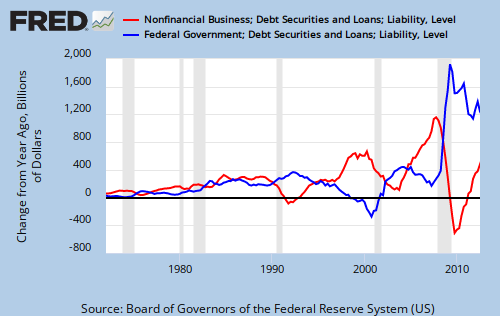
The graph below shows annual changes in Federal debt (blue line) and annual changes in business debt (red line). Does it strike you how these two lines relate to recessions?

Monetary Sovereignty

Business debt rises in advance of recessions and predictably, falls during recessions. Federal debt falls in advance of recessions and rises during recessions. Again and again and again. (I stress “again and again” to give the “correspondence doesn’t prove cause” deniers something to chew on.)

How do you explain this phenomenon? My explanation is that as businesses borrow more, they becomes overextended. Meanwhile, as the federal government, which never can be overextended, deficit spends less (probably because of Congress and the President), the economy suffers from a lack of funds (the anemic patient being bled by leeches).

These two processes meet at a recession, at which time business borrowing virtually stops and federal deficit spending must be increased to end the recession. Funny, how the much-loathed deficits are necessary to rescue a dying economy.

The following graph shows essentially the same thing, except rather than showing absolute debt numbers it compares the ratio of federal debt to total debt vs. the ratio of business debt to total debt.

Monetary Sovereignty

Again we see that as personal debt rises, here as a share of total debt, and federal deficits fall, also as a share of total debt — that’s when we have recessions. Further, recessions are cured when federal deficits are a rising share of total debt, and business debt is a smaller share.

Interestingly, we only seem to have recessions when the year-to-year change in the federal debt / total debt ratio is less than 0.00.

So what is happening today?

Today, Federal debt is falling as a share of total debt and business debt is rising — a recession scenario, with only one positive note: The year-to-year change still is above 0.00. So, that could mean another recession is not yet upon us. But, it’s coming soon enough.

Today’s scenario is what one would expect from a President and Congress that have been bribed by campaign contributions to reduce federal deficits and to increase private borrowing (via low interest rates).

As this is written, President Obama is strutting about his great “victory,” but barring unforeseen changes, history will judge him as mediocre at best — probably closer to the bottom than to the top.

And we had such great hopes.

Rodger Malcolm Mitchell
Monetary Sovereignty

====================================================================================================================================================

Nine Steps to Prosperity:
1. Eliminate FICA (Click here)
2. Medicare — parts A, B & D — for everyone
3. Send every American citizen an annual check for $5,000 or give every state $5,000 per capita (Click here)
4. Long-term nursing care for everyone
5. Free education (including post-grad) for everyone
6. Salary for attending school (Click here)
7. Eliminate corporate taxes
8. Increase the standard income tax deduction annually
9. Increase federal spending on the myriad initiatives that benefit America’s 99%

No nation can tax itself into prosperity, nor grow without money growth. Monetary Sovereignty: Cutting federal deficits to grow the economy is like applying leeches to cure anemia. Two key equations in economics:
Federal Deficits – Net Imports = Net Private Savings
Gross Domestic Product = Federal Spending + Private Investment and Consumption – Net Imports

#MONETARY SOVEREIGNTY