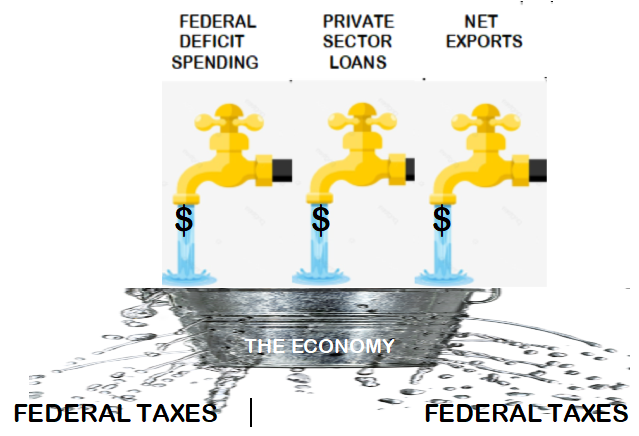
Every day, U.S. dollars are created by federal government spending and by private sector lending.
And every day, dollars are destroyed by federal taxing and by private sector loan repayment.
Because private sector loans eventually are repaid, they do not permanently add dollars to the economy. By contrast, federal spending seldom is balanced by federal taxes — the government runs deficits almost every year — and those deficit dollars not offset by taxes, are permanently added to the economy.
Thus, federal deficits are the primary way dollars are permanently added to the economy.

America’s population is growing, and we have inflation every year. Further, our imports generally exceed our exports, so dollars leave the economy.
Just to remain level on a real (inflation-adjusted) per capita basis, our economy requires a growing supply of dollars:
GDP = Federal Spending + Nonfederal Spending + Net Exports
Mathematically, the economy (GDP) can’t grow unless the money supply increases. Without federal deficit spending, both “Federal Spending” and “Nonfederal Spending” would decrease, and “Net Exports” already is below zero.
In summary, the federal government must grow GDP to account for:
-
- Inflation: According to the Bureau of Labor Statistics consumer price index, the average inflation rate of the US dollar between 1970 and today was 3.98% per year. This means that today’s prices are 7.93 times as high as average prices since 1970. So far, in 2023, the inflation rate has been about 8%. The Federal Reserve aims for 2% inflation.
- Population growth: According to the United Nations, the population of the United States in 1970 was 205,052,174. As of 2023, the population of the United States is estimated to be 339,996,563. Therefore, the population of the United States today is approximately 65.8% higher than in 1970. The current population of U.S. in 2023 is 339,996,563, a 0.5% increase from 2022 or about 2 million more people.
- Net imports: According to the World Bank, the U.S. trade balance for 2021 was $ 861.71B, a 37.32% increase from 2020.
- Economic growth. Just to achieve zero economic growth, the U.S. government must run deficits that overcome Inflation, Population growth, and Net imports of $861B. For economic growth, the federal government must run additional deficits.
There are various ways to calculate how much the federal deficit needs to be to achieve economic growth.
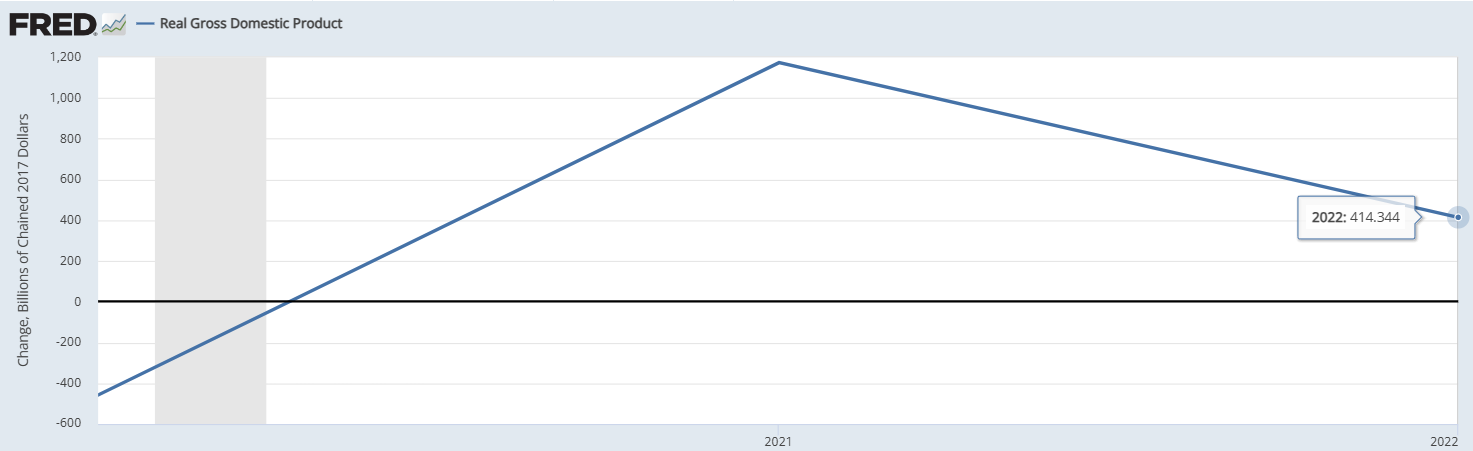
Here is a genuinely rough estimate, only as an example. The most recent GDP increase was $414 Billion.
That increase was achieved with a $1.7 Trillion deficit and $861 Billion Net Imports. This left about $839 Billion in the economy.
At 8% inflation, achieving the same level of GDP growth, Population Growth, and Net Imports would require a federal deficit of (108% x 1.7 Trillion) $1.8 Trillion.
Again, this is just “back of the envelope” stuff, leaving out many variables. It’s only to demonstrate one fact: Deficits are necessary for economic growth. Period.
$10 trillion in added debt shows ‘Bush and Trump tax cuts broke our modern tax structure’ Jon Queally, Common Dreams, October 22, 2023, 7:05AM ET $10 trillion in added debt shows ‘Bush and Trump tax cuts broke our modern tax structure.’
The “modern tax structure” is broken, but not because of “added debt.” It’s broken because the purpose of federal taxes differs from the purpose of state/local taxes.
Federal taxes do not fund federal spending. Our Monetarily Sovereign government funds its spending by creating new dollars ad hoc.
No tax dollars are used. Taxes are paid with dollars from the M2 money supply measure. But when they reach the Treasury, they disappear from any money supply measure. The Treasury has infinite dollars; no measure exists.
Federal tax dollars effectively are destroyed upon receipt.
Today, federal taxes have two explicit purposes and one hidden purpose.
-
-
-
- Federal taxes help the government control the economy by taxing what the government wishes to discourage and giving tax breaks to what the government wishes to reward.
- Federal taxes also assure demand for the U.S. dollar by requiring dollars to be paid for all tax obligations.
- The hidden purpose is to enrich the wealthy by widening the income/wealth/power Gap between the rich and the rest of us. The tax structure contains tax loopholes not available to the rest of us. These were put there via political bribes from the rich.
-
-
The U.S. Treasury Department on Friday released new figures related to the 2023 budget that showed a troubling drop in the nation’s tax revenue compared to GDP — a measure that fell to 16.5% despite a growing economy — and an annual deficit increase that essentially doubled from the previous year.
This above is an oblique reference to the meaningless Federal debt/GDP ratio. It is a ratio that compares two unrelated measures. Federal “debt” is nothing like actual debt. It is deposits into Treasury Security accounts (T-bills, T-notes, T-bonds).
These accounts are held by the government but are owned by the depositors (the buyers of those T-securities). The government never uses those dollars other than to add interest.
Upon maturity, the government merely transfers the dollars from the depositors’ T-security accounts to the depositors’ checking accounts. It is a simple asset transfer like moving dollars from your savings account to your checking account.
This so-called “debt” is not a financial burden on anyone — not on the government or on taxpayers.
The purpose of those accounts is not to provide spending money to the government. Rather, they are a safe place to store unused dollars, which stabilizes the dollar and helps provide demand for the dollar.
The other side of the Debt/GDP ratio, GDP, is total spending in America. It is not related in any way to deposits into T-security accounts.
The Debt/GDP ratio predicts nothing. It measures nothing. The ratio does not indicate the federal government’s ability to pay its bills, an infinite ability. The federal government cannot run short of dollars. Not now. Not ever.
The ratio does not indicate the economy’s health, which is characterized by such measures as inflation, employment, unemployment, GDP growth, healthcare, etc.
Look at any list comparing the ratio among the world’s various nations, and you will not be able to discern anything about those nations. For example:
Countries with the Highest Debt-to-GDP Ratios (%) Venezuela — 350% Japan — 266% Sudan — 259% Greece — 206% Lebanon — 172% Cabo Verde — 157% Italy — 156% Libya — 155% Portugal — 134% Singapore — 131% Bahrain — 128% United States — 128%
Countries with the Lowest Debt-to-GDP Ratios (%) are Brunei — 3.2%, Afghanistan — 7.8%, Kuwait — 11.5%, Congo (Dem. Rep.) — 15.2%, Eswatini — 15.5%, Burundi — 15.9% Palestine — 16.4% Russia — 17.8% Botswana — 18.2% Estonia — 18.2%
As you can see, the debt/GDP ratios tell you nothing about the economies of any country. Low ratios mean nothing. High ratios mean nothing.
Similarly, tax revenue/GDP means nothing. Yet the author, Jon Queally, finds it “troubling.”
That ratio tells you nothing about the government’s ability to pay its bills (which, again, is infinite). It tells you nothing about the current or future health of the economy.
The only thing this ratio tells you is how many dollars the government is taking from the private sector compared to spending in the private sector. While Queally is concerned about the ratio being too low, he really should be concerned about it being too high.
Taking money from the economy is recessionary. The higher the tax revenue/GDP ratio, the fewer growth dollars remain in the economy. In finding the reduced ratio “troubling,” Queally has it all backwards, which is typical for people who do not understand Monetary Sovereignty.
It is far more troubling that economists find a meaningless ratio “troubling,”
“The deficit unexpectedly jumped this year to roughly $2 trillion.”
Bobby Kogan, senior director for federal budget policy at the Center for American Progress, has argued repeatedly that growing deficits in recent years have a clear and singular chief cause: Republican tax cuts that benefit mainly the wealthy and profitable corporations.
Federal deficits add growth dollars to the economy. The bigger the deficit, the more GDP growth.
The problem arises not because the deficits are too large but rather because they benefit the very rich by narrowing the income/wealth/power Gap between the rich and the rest.
The solution is not to levy more taxes on the general public or to reduce federal spending, both recessionary. The solution is to narrow the Gap by taxing the rich more and the rest of us less.
The first step should be to eliminate the FICA tax. It is America’s most regressive tax, punishing low-level salaried people the most.
Despite claims that FICA funds Medicare and Social Security, it does nothing of the sort. Medicare and Social Security benefits are funded by federal government money creation. If FICA were eliminated, this would have no effect on the government’s infinite ability to pay benefits.
Like all tax dollars, those FICA dollars are destroyed upon receipt by the U.S. Treasury.
In response to the Treasury figures released Friday, Kogan said that “roughly 75%” of the surge in the deficit and the debt ratio, the amount of federal debt relative to the overall size of the economy, was due to revenue decreases resulting from GOP-approved tax cuts over recent decades. “
Of the remaining 25%,” he said, “more than half” was higher interest payments on the debt related to Federal Reserve policy.
Federal tax cuts and federal interest payments both add growth dollars to GDP. It is hard to explain why anyone would wish to take more dollars from the private sector and give them to the Monetarily Sovereign federal government.
“We have a revenue problem due to tax cuts,” said Kogan, pointing to the major tax laws enacted under the administrations of George W. Bush and Donald Trump. “
The Bush and Trump tax cuts broke our modern tax structure. Revenue is significantly lower and no longer grows much with the economy.”
Is it possible for an economist to be too ignorant to understand that taxes take dollars out of the economy, which is recessionary?
And he offered this visualization about a growing debt ratio:
“The point I want to make again and again and again is that, relative to the last time CBO was projecting stable debt/GDP, spending is down, not up,” Kogan said in a tweet Friday night. “
It’s lower revenue that’s 100% responsible for the change in debt projections. If you take away nothing else, leave with this point.”
This truly is beyond ignorant. Kogan claims taking money from the economy is good for the economy, while adding dollars to the economy is bad for the economy.
In a detailed analysis produced in March, Kogan explained that, “If not for the Bush tax cuts and their extensions — as well as the Trump tax cuts — revenues would be on track to keep pace with spending indefinitely, and the debt ratio (debt as a percentage of the economy) would be declining.
It’s difficult to understand how a thinking human could claim that taking dollars from the monetarily non-sovereign private sector and giving them to the Monetarily Sovereign federal government somehow is good for America.
Shall we now apply leeches to cure anemia? Same ignorance.
Instead, these tax cuts have added $10 trillion to the debt since their enactment and are responsible for 57 percent of the increase in the debt ratio since 2001, and more than 90 percent of the increase in the debt ratio if the one-time costs of bills responding to COVID-19 and the Great Recession are excluded.
As we have shown, the debt/GDP ratio is meaningless. And as for the federal “debt,” it isn’t even debt. It is deposits into Treasury Security accounts, which more than anything, resemble safe deposit boxes.
The federal government does not spend the dollars in T-bill, T-note, and T-bond accounts. The government never touches those dollars, all of which are the property of the depositors.
Those so-called deposits are not a debt burden on the federal government. As each account reaches maturity, the dollars in the accounts are returned to their depositors.
It’s a simple asset exchange from the depositor’s T-security account to the depositor’s checking account.
Just as with deposits into safe deposit boxes, the contents of T-security accounts are not owed or owned by the federal government.
“Tax giveaways for the wealthy are continuing to starve the federal government of needed revenue: those passed by former Presidents Trump and Bush have added $10 trillion to the debt and account for 57 percent of the increase in the debt-to-GDP ratio since 2001,” read the statement.
“If not for those tax cuts, U.S. debt would be declining as a share of the economy.”
It is not possible to “starve the federal government” of dollars. It creates all the dollars it needs, at the touch of a computer key.
Kogan has no idea what Monetary Sovereignty means. He seems to think federal finances are like personal finances.
Whitehouse, who chairs the Senate Budget Committee, said the dip in federal revenue and growth in the overall deficit both have the same primary cause: GOP fealty to the wealthy individuals and powerful corporations that bankroll their campaigns.
GOP “fealty to the wealthy individuals” is well known. The only people more ignorant that those who worry about the meaningless Debt/GDP ratio are the middle- and lower-income people who vote for the party that tries to cheat them every day.
“In their blind loyalty to their mega-donors, Republicans’ fixation on giant tax cuts for billionaires has created a revenue problem that is driving up our national debt,” Whitehouse said Friday night.
“Even as federal spending fell over the last year relative to the size of the economy, the deficit increased because Republicans have rigged the tax code so that big corporations and the wealthy can avoid paying their fair share.”
The “giant tax cuts for billionaires” is not a federal debt problem. The debt is no problem at all.
The tax cut for billionaires is a Gap problem. The wider the Gap between the rich and the rest, the wealthier and more powerful the rich become and the poorer and more powerless the rest of us become.
Offering a solution, Whitehouse said, “Fixing our corrupted tax code and cracking down on wealthy tax cheats would help bring down the deficit.
It would also ensure teachers and firefighters don’t pay higher tax rates than billionaires, level the playing field for small businesses, and promote a stronger economy for all.”
The goal is not to “bring down the federal deficit.” The deficit enriches the economy. The goal is to narrow the Gap between the rich and the rest.
None of the latest figures — those showing that tax cuts have injured revenues and therefore spiked deficits and increased debt — should be a surprise.
Tax cuts reduce federal revenues. Federal revenues come out of the economy. Tax cuts enrich the economy. Is this so hard to understand? Growing GDP requires growing the money supply.
In 2018, shortly after the Trump tax cuts were signed into law, a Congressional Budget Office report predicted precisely this result: that revenues would plummet; annual deficits would grow; and not even the promise of economic growth made by Republicans to justify the giveaway would be enough to make up the difference in the budget.
“The CBO’s latest report exposes the scam behind the rosy rhetoric from Republicans that their tax bill would pay for itself,” Sen. Chuck Schumer (D-N.Y.), and now Senate Majority Leader, said at the time.
“Republicans racked up the national debt by giving tax breaks to their billionaire buddies, and now they want everyone else to pay for them.”
The Republicans lie; the Democrats lie. The media lie. The politicians lie. The economists lie. They all tell the Big Lie that federal spending is funded by federal taxes.
The purpose of the Big Lie is to make you believe the federal government cannot afford to give you benefits unless taxes are increased.
The plan is to make you ignorant so you will not demand increases in Medicare and Social Security benefits, poverty aids, infrastructure aids, and all the other benefits that supposedly are “unaffordable.”
For all the empty promises and howling from the GOP and their allied deficit hawks, the economic prescription they forced through Congress has resulted in an annual deficit of more than double, all while demanding the nation’s poorest and most vulnerable pay the price by demanding key social programs—including food aid, education budgets, unemployment benefits, and housing assistance — be slashed.
And being ignorant about federal finances, many of the “poor and most vulnerable” keep voting for Republicans.
Meanwhile, the GOP majority in the U.S. House — with or without a Speaker currently holding the gavel — still has plans to extend the Trump tax cuts if given half a chance.
In May, a CBO analysis of that pending legislation found that such an extension would add an additional $3.5 trillion to the national debt.
In other words, it would add 3,5 trillion growth dollars to the economy.
“Republicans racked up the national debt by giving tax breaks to their billionaire buddies, and now they want everyone else to pay for them,” Whitehouse said at the time.
“It is one of life’s great enigmas that Republicans can keep a straight face while they simultaneously cite the deficit to extort massive spending cuts to critical programs and support a bill that would blow up deficits to extend trillions in tax cuts for the people who need them the least.”
It’s one of life’s great mysteries why people who author articles about economics fail to understand that federal taxes remove growth dollars from the economy, federal deficit spending adds growth dollars to the economy, and the federal government never can run short of dollars but the economy can..
Rodger Malcolm Mitchell
Monetary Sovereignty
Twitter: @rodgermitchell Search #monetarysovereignty
Facebook: Rodger Malcolm Mitchell
……………………………………………………………………..
The Sole Purpose of Government Is to Improve and Protect the Lives of the People.
MONETARY SOVEREIGNTY

 #Monetary Sovereignty - Mitchell