This is an update of the many, many previous posts showing the seemingly never-ending warnings about “federal debt” (that isn’t federal and isn’t debt).
The purpose has been to demonstrate how, year after year, so-called experts claim the U.S. is about to enter catastrophe because federal debt is “too high,” while the experts are proven wrong year after year. The economy grows and grows and is healthier than ever.
I’ve been doing this for over 20 years; the experts have been wrong for over 85 years, and they never seem to learn. While I find it frustrating, I’ve tried to remain civil and merely recite the facts. But now, as I pass my 90th year, and the road ahead is short, I’ve grown impatient with civility, and I’ve decided to call it like it is: BULLSHIT.
Last year, what set me off is a BULLSHIT tweet (or whatever “X” calls them now), from the richest man in the world, who, despite his great wealth, seems to know diddly-squat about federal finance:

No Elon, the U.S. federal government, being Monetarily Sovereign, cannot go bankrupt. Even if tax collections fell to $0, and spending tripled, the federal government could continue to pay all its bills, forever.
The Big Lie in economics is: “Federal taxes fund federal spending.” Wrong. Wrong. Wrong.
The truth is that federal taxes fund nothing. They are destroyed upon receipt by the Treasury.
The purpose of federal taxes is to:
- Control the economy by taxing what the government wishes to discourage and by giving tax breaks to those the government wishes to reward (mainly the wealthy).
- Assure demand for the U.S. dollar by requiring taxes to be paid in dollars.
That’s it. Taxes do not fund federal spending. Period.
The U.S. federal government is not like state/local governments, not like euro governments, not like businesses, and not like you and me.
It is uniquely Monetarily Sovereign. It cannot, unwillingly, run short of its own sovereign currency, the U.S. dollar. As real experts have said:
Former Federal Reserve Chairman Alan Greenspan: “A government cannot become insolvent with respect to obligations in its own currency. There is nothing to prevent the federal government from creating as much money as it wants and paying it to somebody. The United States can pay any debt it has because we can always print the money to do that.“
Former Fed Chairman Ben Bernanke: “The U.S. government has a technology, called a printing press (or, today, its electronic equivalent), that allows it to produce as many U.S. dollars as it wishes at essentially no cost. It’s not tax money… We simply use the computer to mark up the size of the account.”
Statement from the St. Louis Fed: “As the sole manufacturer of dollars, whose debt is denominated in dollars, the U.S. government can never become insolvent, i.e., unable to pay its bills. In this sense, the government is not dependent on credit markets to remain operational.”
Press Conference: Mario Draghi, President of the Monetarily Sovereign ECB, January 9, 2014. Question: Can the ECB ever run out of money? Mario Draghi: Technically, no. We cannot run out of money.
Fed Chairman Jerome Powell stated, “As a central bank, we have the ability to create money digitally.”
Paul Krugman (Nobel Prize–winning economist): “The U.S. government is not like a household. It literally prints money, and it can’t run out.” — Numerous op-eds/blog posts
Hyman Minsky (Economist, key influence on MMT)
“The government can always finance its spending by creating money.”
Eric Tymoigne (Economist) “A sovereign government does not need to collect taxes or issue bonds to finance spending. It finances directly through money creation.”
Because the U.S. federal government has the infinite ability to create its sovereign currency, the U.S. dollar, it never borrows dollars.
Contrary to popular wisdom, T-bills, T-notes, and T-bonds do not represent borrowing. They are deposits, the purpose of which is to provide a safe place to store unused dollars and to help the Fed control interest rates.
The government never touches those dollars, which remain the property of the depositors. Not only can our Monetarily Sovereign government not run short of dollars, but federal deficits are necessary to grow the economy, as evidenced by the formula: Gross Domestic Product = Federal Spending + Nonfederal Spending + Net Exports.
The formula shows that economic growth requires federal deficit spending growth.

The next graph shows that reduced deficit growth (red) is associated with recessions (vertical gray bars), and increased deficit growth cures recessions.
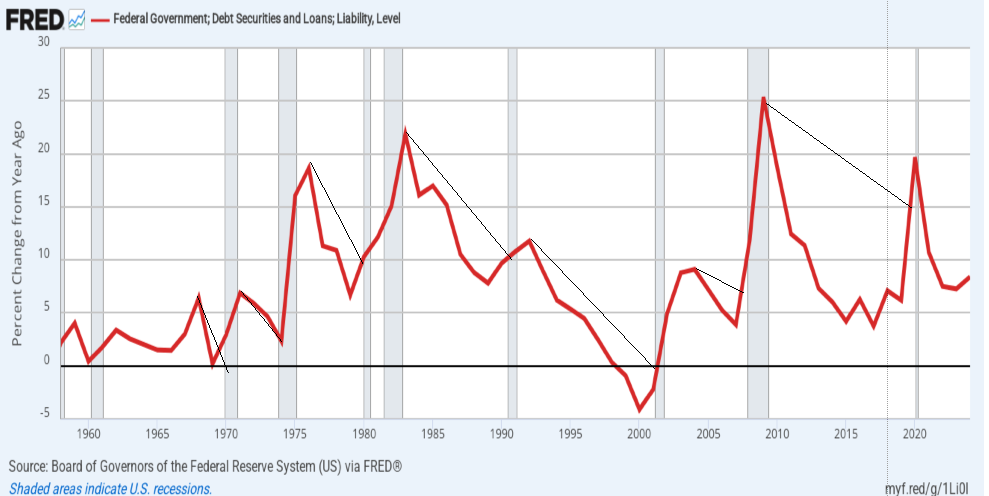
When we don’t have sufficient federal deficits, we have depressions and recessions:
U.S. depressions tend to come on the heels of federal surpluses.
-
-
-
- 1804-1812: U. S. Federal Debt reduced 48%. Depression began 1807.
- 1817-1821: U. S. Federal Debt reduced 29%. Depression began 1819.
- 1823-1836: U. S. Federal Debt reduced 99%. Depression began 1837.
- 1852-1857: U. S. Federal Debt reduced 59%. Depression began 1857.
- 1867-1873: U. S. Federal Debt reduced 27%. Depression began 1873.
- 1880-1893: U. S. Federal Debt reduced 57%. Depression began 1893.
- 1920-1930: U. S. Federal Debt reduced 36%. Depression began 1929.
- 1997-2001: U. S. Federal Debt reduced 15%. Recession began 2001.
-
-
Periodically, we publish yet another shrieking claim that the U.S. federal debt is “unsustainable” and a “ticking time bomb.”
This lie has been told to you every year (really, almost every day) since 1940, and that bomb has never exploded, nor will it.
Rather than repeat the entire list of the thousands of lies to which you have been subject, I will list samples here as a reference and add periodically, at the end, new “federal debt is a ticking time bomb“ BULLSHIT claims as I encounter them.
Read these and see that even respected economists replace facts with BULLSHIT:
————————//—————————
September 26, 1940, New York Times: The federal budget was a “ticking time-bomb which can eventually destroy the American system,” said Robert M. Hanes, president of the American Bankers Association. BULLSHIT
(Yes, the record of bad predictions goes all the way back to 1940. It probably goes back longer, but I don’t have the examples.)

By 1983: “The debt probably will explode in the third quarter of 1984,” said Fred Napolitano, former National Association of Home Builders president.BULLSHIT
In 1984: AFL-CIO President Lane Kirkland said. “It’s a time bomb ticking away.”BULLSHIT
In 1985: “The federal deficit is a ticking time bomb, and it’s about to blow up,” U.S. Sen. Mitch McConnell. (Remember him?)BULLSHIT
Later in 1985: Los Angeles Times: “We labeled the deficit a ‘ticking time bomb‘ that threatens to permanently undermine the strength and vitality of the American economy.”BULLSHIT
In 1987: Richmond Times-Dispatch – Richmond, VA: “100TH CONGRESS FACING U.S. DEFICIT’ TIME BOMB‘”BULLSHIT
Later in 1987: The Dallas Morning News: “A fiscal time bomb is slowly ticking that, if not defused, could explode into a financial crisis within the next few years for the federal government.”BULLSHIT
In 1989: FORTUNE Magazine: “A TIME BOMB FOR U.S. TAXPAYERS“BULLSHIT
In 1992: The Pantagraph – Bloomington, Illinois: “I have seen where politicians in Washington have expressed little or no concern about this ticking time bomb they have helped to create, that being the enormous federal budget deficit, approaching $4 trillion.“BULLSHIT
Later in 1992, Ross Perot said, “Our great nation is sitting right on top of a ticking time bomb. We have a national debt of $4 trillion.”BULLSHIT
In 1995: Kansas City Star: “Concerned citizens. . . regard the national debt as a ticking time bomb poised to explode with devastating consequences at some future date.”BULLSHIT
In 2003: Porter Stansberry, for the Daily Reckoning: “Generation debt is a ticking time bomb . . . with about ten years left on the clock.”BULLSHIT
In 2004: Bradenton Herald: “A NATION AT RISK: TWIN DEFICIT A TICKING TIME BOMB” BULLSHIT
In 2005: Providence Journal: “Some lawmakers see the Medicare drug benefit for what it is: a ticking time bomb.” BULLSHIT
In 2006: NewsMax.com, “We have to worry about the deficit . . . when we combine it with the trade deficit, we have a real ticking time bomb in our economy,” said Mrs. Clinton. BULLSHIT
In 2007: USA Today: “Like a ticking time bomb, the national debt is an explosion waiting to happen.” BULLSHIT
In 2010: Heritage Foundation: “Why the National Debt is a Ticking Time Bomb. Interest rates on government bonds are virtually guaranteed to jump over the next few years. BULLSHIT
In 2010: Reason Alert: “. . . the time bomb that’s ticking under the federal budget like a Guy Fawkes’ powder keg.” BULLSHIT
In 2011: Washington Post, Lori Montgomery:”. . . defuse the biggest budgetary time bombs that are set to explode.” BULLSHIT
June 19, 2013: Chamber of Commerce: Safety net spending is a ‘time bomb’, by Jim Tankersley: The U.S. Chamber of Commerce is worried that not enough Americans are worried about social safety net spending. The nation’s largest business lobbying group launched a renewed effort Wednesday to reduce projected federal spending on safety-net programs, labeling them a “ticking time bomb” that, left unchanged, “will bankrupt this nation.” BULLSHIT
On June 15, 2014: CBN News: “The United States of Debt: A Ticking Time Bomb” BULLSHIT
On June 18, 2015: The ticking economic time bomb that presidential candidates are ignoring: Fortune Magazine, Shawn Tully, BULLSHIT
On February 10, 2016, The Daily Bell: “Obama’s $4.1 Trillion Budget Is Latest Sign of America’s Looming Collapse” BULLSHIT
On January 23, 2017: Trump’s ‘Debt Bomb‘: Deficit May Grow, Defense Budget May Not, By Sydney J. Freedberg, Jr. BULLSHIT
On January 27, 2017: America’s “debt bomb is going to explode.” That’s according to financial strategist Peter Schiff. Schiff said that while low interest rates had helped keep a lid on U.S. debt, it couldn’t be contained for much longer. Interest rates and inflation are rising, creditors will demand higher premiums, and the country is headed “off the edge of a cliff.” BULLSHIT
On April 28, 2017: Debt in the U.S. Fuel for Growth or Ticking Time Bomb?, American Institute for Economic Research, by Max Gulker, PhD – Senior Research Fellow, Theodore Cangeros BULLSHIT
February 16, 2018 America’s Debt Bomb By Andrew Soergel, Senior Reporter: Conservatives and deficit hawks are hurling criticism at Washington for deepening America’s debt hole. BULLSHIT
April 18, 2018 By Alan Greenspan and John R. Kasich: “Time is running short, and America’s debt time bomb continues to tick.” BULLSHIT
January 10, 2019, Unfunded Govt. Liabilities — Our Ticking Time Bomb. By Myra Adams, Tick, tick, tick goes the time bomb of national doom. BULLSHIT
January 18, 2019; 2019 Is Gold’s Year To Shine (And The Ticking U.S. Debt Time-Bomb) By Gavin Wendt BULLSHIT
April 10, 2019, The National Debt: America’s Ticking Time Bomb. TIL Journal. Entire nations can go bankrupt. One prominent example was the *nation of Greece which was threatened with insolvency a decade ago. Greece survived the economic crisis because the European Union and the IMF bailed the nation out. BULLSHIT
July 11, 2019: National debt is a ‘ticking time bomb ‘: Sen. Mike Lee BULLSHIT
SEP 12, 2019, Our national ticking time bomb, By BILL YEARGIN SPECIAL TO THE SUN SENTINEL | At some point, investors will become concerned about lending to a debt-riddled U.S., which will result in having to offer higher interest rates to attract the money. Even with rates low today, interest expense is the federal government’s third-highest expenditure following the elderly and military. The U.S. already borrows all the money it uses to pay its interest expense, sort of like a Ponzi scheme. Lack of investor confidence will only make this problem worse. BULLSHIT
JANUARY 06, 2020, National debt is a time bomb, BY MARK MANSPERGER, Tri City Herald | The increase in the U.S. deficit last year was about $1.1 trillion, bringing our total national debt to more than $23 trillion! This fiscal year, the deficit is forecasted to be even higher, and when the economy eventually slows down, our annual deficits could be pushing $2 trillion a year! This is financial madness. there’s not going to be a drastic cut in federal expenditures — that is, until we go broke — nor are we going to “grow our way” out of this predicament. Therefore, to gain control of this looming debt, we’re going to have to raise taxes. BULLSHIT
February 14, 2020, OMG! It’s February 14, 2020, and the national debt is still a ticking time bomb! The national debt: A ticking time bomb? America is “headed toward a crisis,” said Tiana Lowe in WashingonExaminer.com. The Treasury Department reported last week that the federal deficit swelled to more than $1 trillion in 2019 for the first time since 2012. Even more alarming was the report from the bipartisan Congressional Budget Office (CBO) predicting that $1 trillion deficits will continue for the next 10 years, eventually reaching $1.7 trillion in 2030 BULLSHIT
April 26, 2020, ‘Catastrophic’: Why government debt is a ticking time bomb, Stephen Koukoulas, Yahoo Finance [Re. Monetarily Sovereign Australia’s debt.] BULLSHIT
August 29, 2020, LOS ANGELES, California: America’s mountain of debt is a ticking time bomb. The United States not only looks ill, but also dead broke. To offset the pandemic-induced “Great Cessation,” the U.S. Federal Reserve and Congress have marshalled staggering sums of stimulus spending out of fear that the economy would otherwise plunge to 1930s soup kitchen levels. Assuming that America eventually defeats COVID-19 and does not devolve into a Terminator-like dystopia, how will it avoid the approaching fiscal cliff and national bankruptcy? BULLSHIT
April 16, 2021, NATIONAL POLICY: ECONOMY AND TAXES / MARK ALEXANDER / The National Debt Clock: A Ticking Time Bomb: At the moment, our national debt exceeds $28 TRILLION — about 80% held as public debt and the rest as intragovernmental debt. That is $225,000 per taxpayer. Federal annual spending this year is almost $8 trillion, and more than half of that is deficit spending — piling on the national debt. BULLSHIT
June 17, 2022, Time Bomb On National Debt Is Counting Down Faster Thanks To Fed’s Rate Hike, Tim Brown /We are now staring down the barrel of the end of the U.S. economy based on fiat money, printed out of thin air but charged back to the people at ridiculous interest rates. BULLSHIT
Now, the national debt is approaching $31 trillion, which is $12 trillion more than when Donald Trump took office in 2017, and more than half of that debt was tacked on in his final year. Then we’ve had the disastrous year and a half of Joe Biden. Now, the Fed is hiking its rates, and that spells even more trouble for the national debt and the economy at large. BULLSHIT
December 4, 2022 America’s ticking time bomb: $66 trillion in debt that could crash the economy By Stephen Moore, The national debt is $31 trillion when including Social Security’s and Medicare’s unfunded liabilities. Wake up, America. BULLSHIT
That ticking sound you’re hearing is the American debt time bomb that, with each passing day, is getting precariously close to detonating and crashing the US economy. BULLSHIT
January 13, 2023. A ticking time bomb in the U.S. economy is running perilously close to detonation. Long considered a harbinger of bad luck, Friday, January 13 came with a warning for Congress that the country could default on its debt as soon as June. BULLSHIT
February 5, 2023, ‘The world’s largest Ponzi scheme’: Peter Schiff just blasted the US debt ceiling drama. Here are 3 assets he trusts amid major market uncertainty. Story by Bethan Moorcraft, A ticking time bomb in the U.S. economy is running perilously close to detonation. With the U.S. reaching its debt limit of $31.4 trillion on Jan. 19, Treasury Secretary Janet Yellen urged lawmakers to increase or suspend the debt ceiling. BULLSHIT
April 22, 2023 The Debt Ceiling Debate Is About More Than Debt, Jim Tankersley, WASHINGTON — Speaker Kevin McCarthy of California has repeatedly said that he and his fellow House Republicans are refusing to raise the nation’s borrowing limit, and risking economic catastrophe, to force a reckoning on America’s $31 trillion national debt. “Without exaggeration, America’s debt is a ticking time bomb that will detonate unless we take serious, responsible action,” he said this week. BULLSHIT
November 3, 2023 The Fuse on America’s Debt Bomb Just Got Shorter, J Antoni Heritage Organization. The Treasury is now on track to borrow almost as much in just six months as it did in the previous 12 months. That’s nearly a doubling of the deficit. Because the federal debt is $33.7 trillion, just a 1 percent increase in yields adds $337 billion to the annual cost of servicing the debt over time. Absent spending reform, eventually no one will be willing to hold the bomb anymore, and the yields on U.S. debt will begin to resemble those in Argentina. BULLSHIT
February 2, 2024 How Florida can help defuse the nation’s debt bomb By BARRY W. POULSON, professor emeritus of economics at the University of Colorado Boulder and DAVID M. WALKER, former comptroller general of the United States. Washington’s out-of-control spending, combined with fiscal and monetary policies have resulted in trillion-dollar-plus annual deficits, over $34 trillion in federal debt, over $125 trillion in total federal liabilities and unfunded obligations, and excess inflation. Excessive spending and loose monetary policy increase inflation in the short term, and mounting debt burdens serve to reduce future economic growth and shift the economic burden and consequences of mounting debt burdens to future generations. BULLSHIT
February 8, 2024 Legendary investor Paul Tudor Jones says a ‘debt bomb’ is about to go off in the U.S.: ‘We’re fast-pouring consumption like crazy’. The U.S. economy may seem like it’s firing on all cylinders, but underneath the surface, a “debt bomb” could be on the verge of exploding, according to billionaire hedge fund manager Paul Tudor Jones. The esteemed investor said in an interview with CNBC that he couldn’t deny the economy was strong, but that it was actually “on steroids” due to massive government spending and borrowing. BULLSHIT
Jones is not the only one to call attention to the growing deficit issue in the U.S. On Sunday, Federal Reserve Chairman Jerome Powell took a rare dive into politics, telling CBS’s 60 Minutes that the national debt was “growing faster than the economy,” and calling for lawmakers to get the federal government “back on a sustainable fiscal path.” Meanwhile, U.S. Treasury Secretary Janet Yellen has said she is not yet worried about the increasing national debt as long as the government keeps in check the net payments it makes on its debt relative to GDP. BULLSHIT
Those payments are projected to rise from 2.5% last year to 2.9% next year, according to the Office of Management and Budget, below their level in the early 1990s. Jones told CNBC that the strong economy could postpone the effects of the government’s deficit spending, but only for a little while. “The only question is … when does that manifest itself in markets?” he added. BULLSHIT
“It could be this year, it could be next year. Productivity may mask, and it might be three or four years from now. But clearly, clearly we’re on an unsustainable path.” BULLSHIT
June 21, 2024 My Weekly Column: Our debt crisis is a ticking time bomb by Randy Feenstra: On June 18, the nonpartisan Congressional Budget Office (CBO) – the government agency tasked with monitoring our nation’s fiscal health – confirmed my serious concerns with President Biden’s reckless spending agenda. BULLSHIT
His administration’s fiscal policies have not only caused cumulative inflation to skyrocket by over 20% since he took office, but they have also accelerated our accumulation of debt to levels that are beyond unsustainable. Instead of changing course, he recently released his budget for Fiscal Year 2025, which has a $ 7.3 trillion price tag and looks to raise taxes on our families, farmers, and businesses to the tune of $5.5 trillion. BULLSHIT
The CBO estimates that his debt “cancellation” policies will cost taxpayers nearly $400 billion over the next ten years. I strongly oppose these bailouts. Iowans who never attended college, entered the workforce early, or helped put their kids through school should not be forced to pick up the tab for President Biden’s costly and unfair executive orders. BULLSHIT
July 22, 2024 Federal debt is the ticking bomb in your wallet By E.J. Antoni a public finance economist and the Richard F. Aster fellow at the Heritage Foundation, and a senior fellow at Unleash. The federal government is already running $2 trillion annual deficits, driving up interest on the debt exponentially. The time bomb of federal finance has already started ticking down. BULLSHIT
October 10, 2024, U.S. Debt Bomb is ticking louder by Nick Beams, World Socialist Website. The immediate economic question is: when will the rise in US government debt give rise to a crisis for the US dollar, a major meltdown in the market for debt, the Treasury bond market, or some other area of the financial system? Government debt is now heading towards $36 trillion and increasing at a pace that is regarded as “unsustainable” by Federal Reserve chair Jerome Powell, along with many others. BULLSHIT
May 30, 2025 DEFICIT DANGER. BOJ governor warns US debt time bomb outweighs trade war risks. By Dashan Hendricks. BANK of Jamaica (BOJ) governor Richard Byles has issued a stark warning that America’s spiralling budget deficits now present a more severe danger to the global economy than ongoing trade conflicts, as the world’s largest economy grapples with its third credit rating downgrade since 2011. His comments follow Moody’s recent decision to cut the US government’s credit rating from its top-tier Aaa to Aa1, citing concerns over its US$36-trillion debt burden, which now exceeds the nation’s US$30 trillion GDP. BULLSHIT
August 12, 2025 Rep. Nancy Mace (R-S.C.) Nancy Mace’s Debt Alarm Tweet was hit with a fact-check after warning on social media that the U.S. national debt had reached $37 trillion, calling it “a bill our kids can’t afford to pay.” The post, shared on Twitter, received over 2 million views and framed the soaring debt as a dire generational crisis.
(No kids will pay the national debt.) It’s not debt, and it’s paid by returning the dollars already in storage.
———————–//———————–
The above articles contain the same old BULLSHIT (“unsustainable,” “cost taxpayers,” “our kids will pay”) that they’ve been telling us since 1940. To buttress their lies, they make false comparisons to family finances or the finances of other monetarily non-sovereign entities like businesses or euro nations.
They have been wrong, repeatedly wrong, for all those years. If we wait long enough, perhaps something might happen to prove them right, perhaps in a thousand years? Today, this makes “only” 85 years of the debt nuts’ BULLSHIT.
The federal deficit yields economic growth year after year. When deficits are insufficient, we have had recessions, which were cured by increased deficits.
If respected economists keep predicting something terrible is imminent year after year, yet exactly the opposite happens, at what point do they reexamine their beliefs?
At what point does the public say, “Fool me once; shame on you. Fool me repeatedly for 85 years; shame on me. This is just a steaming pile of BULLSHIT“?
Whew, I feel a little better, now — but just a little.
Rodger Malcolm Mitchell
Monetary Sovereignty Twitter: @rodgermitchell Search #monetarysovereignty Facebook: Rodger Malcolm Mitchell; MUCK RACK: https://muckrack.com/rodger-malcolm-mitchell; https://www.academia.edu/
……………………………………………………………………..
The Sole Purpose of Government Is to Improve and Protect the Lives of the People.
MONETARY SOVEREIGNTY


 #Monetary Sovereignty - Mitchell