Here is a letter from a doctor, a cardiologist, who begs the U.S. government to understand Monetary Sovereignty. But, he may not know it.
He may not know that the U.S. federal government is Monetarily Sovereign, so it never can run short of its sovereign currency, the U.S. dollar.
He may not know that despite the common but mistaken, bleating about the federal debt and deficits, the U.S. has, and always will have, plenty of money to pay any bills, foreseeable and unforeseeable.
Present the federal government with a billion-dollar invoice, and it could pay it in full today. Make that invoice a trillion dollars or a hundred trillion.
Same thing.
He may not know that even if the federal government also stopped collecting income tax dollars, FICA tax dollars, tariff dollars, student loan dollars, and all the other dollars it now receives, the government still could spend forever.
Even without collecting any money, the Monetarily Sovereign U.S. government could pay any obligation denominated in dollars. Creating massive deficits does not affect the federal government’s ability to pay its creditors.
The doctor may not know thatfederal deficits don’t cause inflation (Inflation is caused by shortages of crucial goods and services, most often oil and food.)

In short, the doctor may not know that the U.S. government is infinitely wealthy, and that federal spending is necessary to grow the economy.
And no, this has nothing to do with government ownership of the Mississippi River, the Rocky Mountains, the 200-mile Exclusive Economic Zone (EEZ), Lake Michigan, or the Statue of Liberty.
It has to do with the fact that a Monetarily Sovereign nation has the infinite ability to create its own sovereign currency.
This truth has been recognized by at least two respected Chairmen of the Federal Reserve, by a spokesperson for the St. Louis Federal Bank, by the head of the European Union, and by those of us who recognize the power of Monetary Sovereignty:
Alan Greenspan: “A government cannot become insolvent with respect to obligations in its own currency. There is nothing to prevent the federal government from creating as much money as it wantsand paying it to somebody. The United States can pay any debt it has because we can always print the money to do that.”
Ben Bernanke: “The U.S. government has a technology, called a printing press (or, today, its electronic equivalent), that allows it to produce as many U.S. dollars as it wishesat essentially no cost.”
Scott Pelley: Is that tax money that the Fed is spending?Ben Bernanke: It’s not tax money… We simply use the computer to mark up the size of the account.
Statement from the St. Louis Fed:“As the sole manufacturer of dollars, whose debt is denominated in dollars, the U.S. government can never become insolvent, i.e., unable to pay its bills. In this sense, the government is not dependent on credit markets to remain operational.”
Question: I am wondering: can the ECB ever run out of money?Mario Draghi, President of the Monetarily Sovereign ECB: “Technically, no. We cannot run out of money.”
Mentally juxtapose the above facts about Monetarily Sovereign money issuers with these facts:
By 2025, the firm forecasts a shortage of more than 400,000 home health aides and 29,400 nurse practitioners.
Sick, and waiting for a doctor.
A major factor is demographics: People are living longer, requiring more medical attention as they do, while members of the aging healthcare workforce are starting to retire faster than they can be replaced.
Other reasons include burnout(overworked employees are leaving the profession at an accelerating rate); the rise in chronic conditions such as diabetes, heart disease, cancer, and Alzheimer’s disease (leading to overextended staff at hospitals and long-term care facilities); and the nation’s inability to produce enough doctors and nurses to meet growing demand (partly because of faculty shortages at nursing and medical schools).
Shortages of certain kinds of healthcare practitioners, such as nurses and certified nursing assistants, are also due to the relatively low compensation levels, relatively high job demands, and education requirements in those fields.
In summary:
Our Monetarily Sovereign federal government has infinite dollars and infinite control over the value of its sovereign currency.
There is an increasingly severe shortage of doctors, nurses, other healthcare workers, and hospitals.
Does putting # numbers 1 and 2 together give you any ideas?
Now read the doctor’s letter:
The Broken Medicare System Is Forcing Physicians Out— Yet another physician pay cut will prevent timely access to careby Rick W. Snyder II, a cardiologist. November 20, 2023In any career, 25 years of dedicated work is much to let go of. In medicine, it amounts to hundreds of patient relationships and the blood, sweat, and tears that go into starting and maintaining a practice.
Yet, after all that time, one of my physician colleagues recently had to let go of her beloved private practice — not by choice and not without tears for her dear, elderly Medicare patients who now face fewer options for care.
Her story is, unfortunately not unique.
Physicians and their patients have suffered through more than 2 decades of uncertainty caused by precarious Medicare funding.
We’ve seen how these cuts have forced unwanted changes in medical practices. While their practices stay open, the Medicare system underpays our nation’s physicians to the point that some are forced to make difficult decisions about which patients they can care for.
Eventually, when these practices barely have their heads above water, that “next round of cuts” proves to be the last straw.
Like clockwork, another Medicare physician payment cut is on the horizon for January.
Why does an infinitely wealthy government cut payments to doctors, particularly when there is a growing shortage of doctors?
Who is at fault for this ridiculous situation?
I’m afraid the day is near — if not already here — that there will not be enough physiciansto care for Medicare patients.
Physicians who participate in the program are forced to do more with less, which leaves no good choices. The situation hinders our ability as physiciansto provide the complex, quality care these elderly and sometimes disabled patients need and prevents us from seeing as many Medicare patients as we would like.
Furthermore, it contributes to burnout and moral distress because we can’t do what we swore an oath to do: to put our patients first.
As president of the Texas Medical Association (TMA), I hear concerns from our physician members as they face ongoing practice viability challenges.
“If this additional [Medicare] payment cut goes through, in the midst of inflation and COVID causing rising costs for staff salaries and benefits, I would have no choice but to stop caring for these patients,” a worried physician shared with TMA.
“We are dying,” said another. “I can’t even keep a full staff. All the doctors I have referred patients to are leaving or gone.”
“I’m terrified for what this will mean for my elderly patients and their access to care,” yet another concerned doctor said.
“The mental stress of making ends meet is not good for patient care,” another colleague warned.
Not only is this system unsustainable for our nation’s physicians, but it’s also unfairly stacked against them.
It’s the same system that concurrently pays hospital-based clinics more for some of the same services an independent community physician provides. On top of that, Medicare helps hospitals cover uncompensated care.
I’m not saying hospitals don’t deserve to be paid for what they do. But when independent physician practices get swallowed up by a hospital or bought out by another entity just to survive, the cost of care can increase, creating ripple effects on our economy.
This kind of rapid consolidation is rampant in our healthcare system, partly because of payment incentives like those in Medicare.
“Our practice is already shutting its clinic doors as we instead focus on being a purely hospital-based practice due to already meager reimbursement,” another worried Texas physician shared with TMA.
“We simply cannot afford the overhead. Ongoing cuts to [Medicare] physician reimbursement not only hurt us — the physicians trying to provide the best quality care to our patients — but it ultimately hurts the patients and their loved ones suffering from life-altering conditions.”
“I barely scrape through making payrolls every pay period. Any more [Medicare] reimbursement [cuts are] going to put me and thousands of physicians like me underwater and force us to shut down or join [a private] equity company or [insurer-owned] clinics who put their wallets ahead of patient care,” said another frustrated physician.
We should be preserving independent medicine and patient choice — not undermining it. It’s time for Congress to address the root of the problem.
Solutions
The first simple step physicians and other healthcare professionals can take is to advocate for Congress to enact laws directed at paying physicians fairly for services provided to Medicare patients.
At a minimum, that entails pay that keeps pace with inflation. Like other industries’ labor costs are tied to the Consumer Price Index (CPI).
But even a tie to the CPI won’t cure the growing shortage of doctors. America needs more doctors, not just the same number.
Medicare physician payments should at least be tied to a similar physician practice cost inflation measure, the Medicare Economic Index (MEI).
Several physician members of Congress are leading the charge on such a reform with a bipartisan House bill that behooves support: H.R. 2474, the Strengthening Medicare for Patients and Providers Act.
The legislation’s centerpiece is an annual, inflation-based Medicare physician payment update based on the full MEI.
Our current predicament is tied to the fact that Medicare physician payments haven’t even come close to keeping up with inflation over more than 20 years.
Since 2001, Medicare physician payments have lagged 26% behind inflation while hospital and other health industry payments have kept pace, according to the American Medical Association. Over the same period, the CPI for physician services in U.S. cities increased by 65%.
Just think about that: What would you say if you worked more than 20 years with no raise and pay cuts to boot? I know what my colleagues across Texas are saying:
“If [another cut is] enacted, our [Medicare] reimbursement rate will be lower than what we received in 2012,” one physician calculated.
Another said, “My Medicare reimbursement, factoring for inflation, is less than half of what it was in 1998.”
The frustration and the effect of Medicare payment cuts on physician practice viability are real. Likewise, access to care concerns for Medicare patients is therefore very real, too.
Don’t let a broken Medicare system break the backbone of the healthcare system for our most vulnerable patients.
Rick W. Snyder II, MD, opens in a new tab or window is a cardiologist and president of the Texas Medical Association.
Who is at fault for the cuts to doctor’s reimbursement, when funding should be increased dramatically to support the need for more doctors?
Congress and the President, particularly the Libertarians and the Republicans, both of which care more about federal government money than the health of Americans.
The American people have not questioned why the finances of the Monetarily Sovereign government take precedence over the finances of the monetarily non-sovereign public.
For more than 30 years, those few who understand Monetary Sovereignty have been explaining why an infinitely wealthy, Monetarily Sovereign government has the infinite ability and the moral obligation to fund certain services to the public, including:
Education
Health
Shelter
The environment
Science
Energy
Elderly support
This does not imply government ownership (aka “socialism”) but rather, government fundingof the private sector.
The federal government already provides some funding for all these services, just not enough. The shortfall in funding results from the wrongheaded belief that federal funding is “unsustainable.”
This is despite all the evidence that the federal government can “sustain” any level of spending.
The government could provide a generous, comprehensive, no-deductible Medicarefor every man, woman, and child in America.
There should be no need for people to guess about whether they should buy a Medicare supplement policy, “A” through “N”, or whether to buy one of a dozen different Part D plans. All medical contingencies should and could be covered for everyone.
And there should be no need for doctors and other healthcare workers to struggle financially, a struggle that leads to shortages in all areas of medical care. These people (along with teachers) should be among the best compensated of all Americans. The federal government has the wherewithal to assure that happens.
The federal government could fund all education K through 16+ without collecting a penny in taxes.
Homelessness never should become a financial necessity. Clean air, water, and land should be available to all. Scientists, who make the discoveries that improve our lives, should not be forced to beg universities for funding. The elderly should not need to struggle, financially.
Dr. Snyder was forced by circumstance to write his letter. That is a disgrace to America. It is a disgrace that Libertarians and Republicans, and to a lesser degree Democrats, allow America’s rich to dictate impoverishing terms.
If it were up to right-leaning politicians and the right-leaning public, we would have no Medicare, no “Obamacare,” no public schools, and no renewable energy. Poverty, homelessness, and starvation would be even more rampant than now. Our air, water, and land would be dirtier. Climate change will become unbearable.
We would return to the times of royalty, where a handful of people lived utopian lives and the rest of use wallowed in misery.
All who claim federal deficit spending is “unsustainable” or that “government is the problem,” fall into just two categories.
The Liars, who do the bidding of the very rich and/or
The Economically Ignorant, who were taught that federal finances are like personal finances and who haven’t been shown the facts.
There are no other alternatives. I suspect Dr. Snyder falls into category # 2.
Shame on the liars of category #1 for destroying the American dream.
Rodger Malcolm Mitchell
Monetary SovereigntyTwitter: @rodgermitchellSearch #monetarysovereigntyFacebook: Rodger Malcolm Mitchell
……………………………………………………………………..
The Sole Purpose of Government Is to Improve and Protect the Lives of the People.
The Libertarians (the cruel shills for the Republican Party) have a non-solution for a non-problem.
The non-problem is that the U.S. federal government is running short of its sovereign currency, the U.S. dollar. The non-solution is to take dollars from the poor and middle-income people.
The headline implies at least four lies:
Lie #1. The federal government can’t afford to send money to the poor and middle-income people.
Lie #2. The solution would be for the government to take dollars from Social Security.
Lie #3. Congress doesn’t dare to take Social Security dollars from the poor and middle-income people.
Lie #4. The only recourse is to take welfare dollars from the poor.
Amid the fractious debate over the federal budget, Speaker of the House Kevin McCarthy (R–Calif.) has outlined plans for cutting several prominent welfare programs to save about $150 billion annually.
According to The Washington Post, those cuts would affect a wide range of federal safety net programs, including food stamps and Meals on Wheels, which help feed needy families.
Other cuts would affect Federal Pell Grants for low-income college students, grants that help families afford housing, and a program that helps offset high heating bills.
Notice that none of the Libertarian non-solutions to the non-problem involve taking dollars from the richby eliminating the kind of tax dodges that all people like Donald Trump to pay almost $0 federal taxes.
Regardless of whether you think the federal government should be in the business of funding any of those things in the first place, there’s no denying that sudden cuts to existing welfare programs can be disruptive to the individuals and families that have come to rely upon them.
Here, the Libertarian implies that the federal government should not help low-income college students, families that can’t afford housing, or low-income families that can’t pay their heating bills. This is typical for the heartless Libertarians and Republicans.
They don’t give a damn about people but are concerned with just two things: Saving government money for a government that has infinite money and helping the rich grow richer.
Ben Bernanke: “The U.S. government has a technology, called a printing press (or, today, its electronic equivalent), that allows it to produce as many U.S. dollars as it wishes at essentially no cost.”
It’s also true that, as Reason’s Liz Wolfe points out in this morning’s newsletter, the proposed cuts reflect the reality of a government that has been living beyond its means for too long.
You and I can “live beyond our means.” but the federal government cannot. It has infinite “means.”
Alan Greenspan: “The United States can pay any debt it has because we can always print the money to do that.
“It’s not exactly a winning PR move to slash the programs that serve needy toddlers and first-generation college kids, but there’s an important fundamental truth at the heart of the fiscal hawks’ concerns: government spending simply cannot continue at current levels with no consequences,” Wolfe writes.
This lie has been told since at least 1940 and probably beyond. That was the first year I found that the federal debt, or deficit, was called a “ticking time bomb.” The phony bomb still is ticking after eighty-three years.
And precisely what are the “consequences” to which Wolfe refers and Boehm agrees? You never will see that explained in any Libertarian screed. The reason: There are no consequences. Period.
That’s true. But here’s an element of this debate that doesn’t get talked about enough: Cutting welfare programs for needy families is necessary because Congress insists that relatively wealthy senior citizens get paid first.
And here it comes: The theory is that seniors are wealthy, and despite paying the useless FICA tax for their entire lives, they really don’t deserve anything for their investment. So, cut Social Security because that’s where the money — the infinitely available money — goes. And who cares about those old folks, anyway?
Budgeting is always, at its core, an exercise in priority-setting. That’s especially true when your budget is wildly out of whack, and you’ve been borrowing at an unsustainable rate, as Congress has done for years.
What part of budgeting is “wildly out of whack”? Would reducing the money going to the middle and the low be the best way to put the budget in “whack”?
And then for two more lies in just five words (Is that a world record?) “Borrowing at an unsustainable rate.”
Lie #5. The federal government borrows. No, the federal government does not borrow dollars. Why would it borrow when it has the infinite ability to create dollars?
Statement from the St. Louis Fed: “As the sole manufacturer of dollars, whose debt is denominated in dollars, the U.S. government can never become insolvent, i.e., unable to pay its bills. In this sense, the government is not dependent on credit markets to remain operational.”
The confusion arises because private sector bills, notes, and bonds differ entirely from T-bills, T-notes, and T-bonds
The former have to do with borrowing. The latter have to do with depositing. A borrower receives from a lender money that the borrower uses. But the federal government doesn’t use or even touch the dollars deposited into T-security accounts.
The federal government, unlike state/local governments, is Monetarily Sovereign. It pays all its creditors with newly created dollars, ad hoc.
Despite Monetary Sovereignty being the single most important difference between federal and personal finances, you will never see those words in any discussion of federal budgeting being “unsustainable.”
Lie #6. “Unsustainable rate.” No amount of spending is unsustainable for the federal government. It has the infinite ability to create dollars.
When there’s no longer enough money to go around, you’re faced with a difficult proposition: Who gets paid first, and who has to wait at the back of the line?
The federal government always has enough money to go around. It cannot run short of dollars. Ever. Boehm knows this.
Alan Greenspan: “There is nothing to prevent the federal government from creating as much money as it wants and paying it to somebody.”
In the federal budget, seniors get paid first. Everyone else has to wait.
Lie #7. No, the rich are paid first. They are paid by the tax loopholes that allow them not to pay taxes in the first place.
McCarthy and his fellow Republicans are not proposing any cuts or changes to Social Security and Medicaid, the Post notes. That’s despite the fact that the two major entitlement programs are driving most of the federal government’s long-term deficit.
The federal deficit is the government’s method for pumping growth dollars into the economy. If the government did not run deficits, we would have yearly recessions and depressions.
U.S. depressions tend to come on the heels of federal surpluses.
1804-1812: U. S. Federal Debt reduced 48%. Depression began 1807.
1817-1821: U. S. Federal Debt reduced 29%. Depression began 1819.
1823-1836: U. S. Federal Debt reduced 99%. Depression began 1837.
1852-1857: U. S. Federal Debt reduced 59%. Depression began 1857.
1867-1873: U. S. Federal Debt reduced 27%. Depression began 1873.
1880-1893: U. S. Federal Debt reduced 57%. Depression began 1893.
1920-1930: U. S. Federal Debt reduced 36%. Depression began 1929.
1997-2001: U. S. Federal Debt reduced 15%. Recession began 2001.
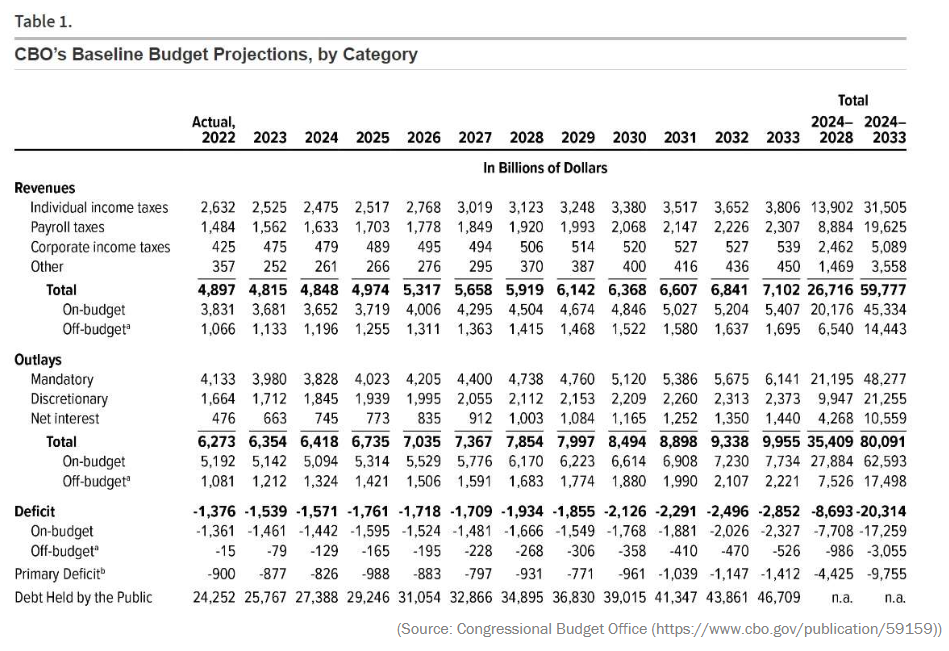
Over the next decade, discretionary spending—including those welfare programs the GOP aims to cut—is projected to decline relative to the size of the U.S. economy, according to the Congressional Budget Office’s (CBO) projections.
Meanwhile, Social Security and Medicare are growing, fast. By 2030, the CBO expects so-called “mandatory spending” on entitlement programs to consume more than 60 percent of the federal budget.
The federal budget is what Congress wishes it to be. If 60% is too much, the government merely can increase discretionary spending. This would reduce the meaningless percentage and increase the Gross Domestic Product.
Economic growth is both a direct and indirect result of federal spending. GDP=Federal Spending + Nonfederal Spending + Net Exports
Of course, because those programs are funded with a separate revenue stream—payroll taxes—it would be complicated for Congress to cut spending on Social Security to offset cuts on welfare programs.
Unlike state and local governments, the federal government does not fund programs via “revenue streams.” It supports all programs by creating new dollars, ad hoc. Tax dollars are destroyed upon receipt.
Even if all federal tax collections totaled #0, the federal government could continue spending forever.
Even so, the ongoing refusal of either major party to consider any long-term changes to the two major entitlement programs tells you all you need to know about the priorities in Washington.
What tells me all I need to know about priorities in Washington is the failure of either party to get rid of tax dodges by the rich.
There is no shortage of alternative ideas out there.
Congress could fiddle with the specifics of Social Security to make the program less expensive over the long term—raising the retirement age, for example, or changing how contributions and disbursements work.
Yes, soaking the elderly is the Libertarian mantra. But they don’t ask the rich to pay more by closing tax loopholes. That would reduce those luscious political contributions the politicians love so much.
It could (and should) allow younger Americans to opt out of the system retirement.
Boehm exceeds his stupidity allowance by suggesting that younger Americans opt out of Social Security. I can’t even go into how cruel and ignorant that idea is other than saying it does not surprise me coming from Libertarian Eric Boehm.
A pox on him and his descendants ten generations, hence.
Rodger Malcolm Mitchell
Monetary SovereigntyTwitter: @rodgermitchellSearch #monetarysovereigntyFacebook: Rodger Malcolm Mitchell
……………………………………………………………………..
The Sole Purpose of Government Is to Improve and Protect the Lives of the People.
“Libertarianism” says Robert W. Poole (Reason Magazine’s early editor) is “about more than just economics and politics, it really is. It’s about human flourishing and what are the conditions for human beings to have satisfying, flourishing [lives].”
Money is power.
Robert Poole, the voice of LibertarianismThe fundamental philosophy of Libertarians is that power should be with the people, not with the government. Yet Libertarians espouse exactly the opposite when they opt for tax increases and/or benefit decreases to reduce federal deficits.
Keep that in mind as you read the following excerpts from an article written by a leading Libertarian.
See whether you believe he believes the money and power should be with the people:
By Robert Poole, Director of Transportation Policy, September 12, 2023
(Robert Poole is one of the founders of the Reason Foundation [which publishes Reason Magazine] and served as its president and CEO from 1978 to 2000.He is currently director of transportation policy at the Reason Foundation and frequently writes about issues related to privatization.)
The national debt will affect the future of transportation funding, and the public-private partnership community needs to understand why and what the implications for P3s may be.
The most recent parts of the story began on Aug. 1, when Fitch Ratings downgraded the federal government’s bond rating from AAA to AA+. For a company, that might not be a big deal, but for the government of the world’s largest economy, the downgrade was a shot across the bow.
This was the second time a rating agency took such an action with the federal government’s bond rating, with S&P doing so in 2011.
Headlines in the financial press, such as The Wall Street Journal’s “America’s Fiscal Time Bomb Ticks Louder” and “U.S. Downgrade Flashes Warning Sign.” indicate how seriously the downgrade should be taken.
The downgrades had nothing to do with the federal government’s ability to pay. They reflected the government’s willingness to pay, as evidenced by the ridiculous debt ceiling laws.
Being Monetarily Sovereign, the federal government has the infinite ability to pay for anything. Mr. Poole confuses “ability”with “willingness.”
We have written many times about the so-called fiscal “time bomb.” The first mention we noted was in 1940;
Subsequently, references to the federal “debt” as a ticking time bomb appeared regularly in all media, from scholarly journals to daily newspapers.
The 1940 mention came when the total federal “debt” was approximately $48 Billion. Today, that debt is roughly $26 Trillion, an astounding 54,000% increase.
Despite that increase, the “ticking time bomb” still has yet to explode, but the doomsday preachers, having learned nothing from the many years of experience, continue to fret.
Eighty-three consecutive years of wrong predictions, and people still believe? What word comes to mind?
As the Journal’s Greg Ip wrote: One reason for Fitch’s downgrade was the absence of any political will to deal with the main drivers of the deficit: spending programs for older Americans, including Social Security and Medicare, and repeated cuts to tax ratesfor most households.
No, the reason for the downgrade was the uncertainty caused by the useless debt limit laws. The word “useless” is appropriate. There is no use for a law that limits the federal government’s ability to pay for what it already has purchased.
And should anyone believe the law has any purpose whatsoever, they should explain why, since 1960, Congress has acted 78 separate times to permanently raise, temporarily extend, or revise the definition of the debt limit – 49 times under Republican presidents and 29 times under Democratic presidents.
If the law had any value, why is it so easily and often increased without exploding as a “time bomb”?
Money is power, so ironically, if one truly believed the power belongs with the people and not with the government, he would favor money flowing to the people and from the government.
Yet the exact opposite is stated by the Libertarian writer.
Fitch noted how much worse U.S. fiscal metrics are than its peer countries. For example, The U.S. is on track to spend 10% of federal revenue on interest by 2025, compared with just 1% for the average triple-A-rated country and 4.8% for double-A-rated.
Why, then, isn’t the U.S. rating even lower?
Mr. Poole doesn’t give examples of those “triple-A” and “double-A” rated countries, probably because they aren’t comparable to the U.S. government.
Perhaps, they don’t have a foolish, useless debt-ceiling law. Or perhaps, they are not Monetarily Sovereign nations that can issue their national currency in unlimited amounts, as the U.S. can.
It would have been helpful for Mr. Poole to list the nations he refers to, but of course, he never will because that would destroy his argument.
Because the reserve statusof the dollar and the size and safety of Treasury debt gives the U.S. unprecedented borrowing ability.
First, the U.S. government does not borrow U.S. dollars. It pays for goods and services by creating dollars ad hoc,which it has the unlimited ability to do.
The U.S. government never unintentionally can run short of dollars.
Statement from the St. Louis Fed: “As the sole manufacturer of dollars, whose debt is denominated in dollars, the U.S. government can never become insolvent, i.e., unable to pay its bills. In this sense, the government is not dependent on credit marketsto remain operational.”
“Not dependent on credit markets” means they don’t borrow dollars.
Second, “reserve status” merely means that banks keep dollars on reserve to facilitate international trade. Not only does the U.S. dollar have reserve status, but so do numerous other currencies, depending on geography.
Though the U.S. dollar is the most common reserve currency, other reserve currencies include: the euro, the Japanese yen, the Mexican peso, the British pound, the Canadian dollar, the Australian dollar, the Indian rupee, the Swiss franc, the Swedish krona, and many other currencies now being held in reserve by banks, worldwide.
Being a reserve currency does not bestow special safety on a currency. It does not indicate a nation’s ability to pay its bills.
Third, Mr. Poole mentions the size and safety of Treasury debt in the same article about its being a “ticking time bomb.” I suggest he has just exploded his own warning, as well as he should.
Indeed, it was hard to get presidents or Congress to worry about the deficit when interest rates were low. Today, a bond market signaling that the world is no longer safe for debts may be the first step to tackling them.
Interest rates have no meaning for a Monetarily Sovereign nation like the U.S., which has the infinite ability to create its own currency. Whether interest is 1% or 50%, or anything between, the U.S. federal government simply presses computer keys to pay.
Further, the U.S. Federal Reserve pays whatever interest rate it wishes. It sets the rate by fiat. Unlike private borrowers, the Fed does not need to set a rate that is attractive to lenders because:
a. The government does not borrow. The purpose of T-bills, T-notes, and T-bonds is not to provide the government with spending money. The goal is to provide a safe storage place for unused dollars. The federal government never touches the dollars in T-security accounts.
b. If the Treasury wanted to issue T-securities that no one wanted to buy, the Federal Reserve could purchase them.
The long-term consequences of the growing debt were estimated in the latest Congressional Budget Office’s (CBO) 2023 Long-Term Budget Outlook.
Its baseline 30-year projection, which assumes no changes in existing laws and programs, is that by 2053, the national debt will constitute 181% of the U.S. Gross Domestic Product—compared with 98% today.
The debt/GDP ratio is the most misunderstood fraction in all economics. Contrary to widespread ignorance, that ratio has absolutely nothing to do with the ability of the U.S. to pay its bills.
The federal government has the infinite ability to create dollars, which it does by pressing computer keys.
Alan Greenspan: “There is nothing to prevent the federal government from creating as much money as it wants and paying it to somebody.”
The so-called “debt” is the total of T-security deposits accepted by the federal government. These are dollars in accounts owned by depositors, never touched by the federal government, and paid off simply by returning the dollars in the accounts.
The misnamed “debt” consists of net deposits made between yesterday and ten or more years ago.
By contrast, GDP (Gross Domestic Product) is a one-year spending measure. So, the debt/GDP fraction compares a multi-year total with a one-year total — mathematically senseless.
Imagine your house mortgage being $300,000 and you earning $150,000 a year. That would be a 200% ratiothat millions of people support all the time. The debt/GDP is even more senseless than that, because GDP doesn’t pay debt.
Of course, you aren’t Monetarily Sovereign — you can’t create dollars at will — and the federal debt isn’t real debt. So, the whole thing is foolish, though no more foolish than current worries about Debt/GDP ratios.
If you want to waste time evaluating the world’s most useless ratio, go here. It shows the percentages for dozens of countries. I challenge you to use those ratios to determine the world’s best and worst credit risks.
And paying interest on that debt will increase from taking 15% of federal revenue today to 35% of federal revenue in 2053 (more than any national budget item except Social Security and Medicare). And that’s just CBO’s baseline estimate.
Given that the federal government has the infinite ability to create dollars, why does Mr. Poole stress about paying interest? Ignorance or intent to deceive?
The Committee for a Responsible Federal Budget estimates that, given likely extensions of tax cuts and expansions of federal programs, the 2053 national debt will likely rise to 222% of GDP.
Whether the debt is 22%, 222%, or 2222% of GDP has zero effect on the federal government’s ability to pay its bills.
Where does transportation fit in the discussion about the national debt?
Well, in July, the House Appropriations Committee, in response to conservative members saying they’re concerned about out-of-control federal borrowing while a Democrat is in the White House—as opposed to mainly supporting massive deficit spending during the Trump administration—proposed trimming Fiscal Year 2024 Department of Transportation (DOT) discretionary grant spending by $5 billion.
Here is where we get to Congress’s misunderstanding (intentional or otherwise) of the federal government’s ability to pay for things.
Ben Bernanke: “The U.S. government has a technology, called a printing press (or, today, its electronic equivalent), that allows it to produce as many U.S. dollars as it wishes at essentially no cost.”
Even if the federal government collected zero taxes, it could continue spending forever. There is no reason to cut spending for budgetary reasons. The government has infinite money.
This relatively minor cut would affect only a few programs in six modal agency discretionary grant programs totaling $22.5 billion last year. Yet a headline in Eno Transportation Weekly read, “FY24 House Funding Bill Has Massive Cuts to DOT Grant Programs.”
This proposal raised similar cries of alarm from highway, transit, and rail organizations, such as the headline “Transportation Funding Under Threat in House of Representatives” by United for Infrastructure, which advocates for more infrastructure investment.
Suppose we make the possibly innocent assumption that the Department of Transportation (DOT) had good reasons for its discretionary grant spending. In that case, we now will be forced to do without that spending. The people will be deprived of important transportation improvements, all because of economic ignorance.
Let’s think ahead a few years to when massive federal funding in the Infrastructure Investment and Jobs Act, often referred to as the bipartisan infrastructure law, and the Inflation Reduction Act’s budget has been expended.
At that point, state transportation budgets would be expected to revert to their pre-stimulus spending levels.
This is an important point. Though the federal government, being Monetarily Sovereign, can create infinite dollars, the states, counties, and cities are monetarily non-sovereign. They can and often do run short of dollars.
Ben Bernanke: “The U.S. government has a technology, called a printing press (or, today, its electronic equivalent), that allows it to produce as many U.S. dollars as it wishes at essentially no cost.”
Why then are states asked to fund what the federal government could easily fund without collecting a penny in taxes? Economic ignorance.
But what can we expect transportation organizations and state DOTs to call for?
Based on history, it’s almost certain states will propose the most recent year of those expanded funding levels as their new budget baselines and ask Congress for federal funding.
And if Congress goes along with the calls for that level of infrastructure spending, there will be another massive amount of federal borrowing.
Reminder: The federal government does not borrow. It creates dollars at will.
Quote from former Fed Chairman Ben Bernanke when he was on 60 Minutes:Scott Pelley: Is that tax money that the Fed is spending?Ben Bernanke: It’s not tax money… We simply use the computer to mark up the size of the account.
Since CBO’s dire debt forecasts don’t include this level of increased federal transportation spending, this increase would make all CBO’s 30-year projections seriously underestimating.
Many years ago, a chairman of the Council of Economic Advisers, Herb Stein, propounded what became known as Stein’s Law. “If something cannot go on forever, it will stop.”
But the longer that rude awakening takes to happen, the worse the consequences will be.
Someone, please tell Herb Stein that because the U.S. federal government is Monetarily Sovereign, it can continue to deficit spend forever. It never needs to stop.
America’s transportation leaders should think hard about lobbying for this unsustainable spending to continue.
Sorry, Mr. Poole, but federal spending has proved to be infinitely sustainable.There is no reason for it ever to stop.
The largest contribution to the out-of-controlnational debt is the impending bankruptcy of Medicare and Social Security.
Because the U.S. government is Monetarily Sovereign, it cannot go bankrupt. For the same reason, no federal government agencies- i.e., Medicare and Social Security- can go bankrupt unless Congress and the President want them to.
The federal government could and should eliminate the FICA tax and fund Medicare and Social Security the same way it funds Congress and the White House: By creating dollars.
Federal spending is not “out-of-control.” Congress and the President control it. It is exactly what Congress and the President want it to be.
If, or when, Congress finally gets around to grappling with the costs of those programs, it’s likely that most or all federal discretionary programs, including infrastructure programs, will be in for severe and long-term spending cuts.
Transportation leaders should start planning for that significant change now.
Does “severe, long-term spending cuts” in transportation sound like “human flourishing,” the Libertarian excuse for the existence of Libertarianism?
One ray of hope for the highway and bridge sector is the opportunity that comes with the urgent need to phase out per-gallon fuel taxes and replace them with per-mile road user charges, also called mileage-based user fees.
Unnecessary taxes. All federal tax dollars are destroyed upon receipt by the Treasury.
Taxes are paid with dollars from the M1 money supply measure. When they reach the Treasury, they cease to be part of any money supply measure. Thus, federal taxes effectively are destroyed upon receipt.
If done right, that transition could fully restore the users-pay/users-benefit principles on which the gas tax was based a hundred years ago.
It could even mean converting state highway systems into revenue-financed highway utilities analogous to electric, gas, and water utilities.
Public utilities, which can be government-owned or investor-owned, charge customers based on how much of the service they use. They also issue long-term revenue bonds backed by the projected income from their user charges to fund the costs of maintaining and improving the infrastructure.
This is the usual Libertarian “soak the private sector” (as opposed to “human flourishing,”), though the federal government has infinite money.
Ironically, while Libertarians supposedly favor the private sector, they ask the private sector to give the federal government more money.
Do these folks even know what they want?
Long-time traffic and revenue consultant Ed Regan has suggested that metro areas could add a transit tax to charges in the road user charge (RUC) future.
This would mean only residents of an urban area would pay for its transit subsidies—not rural taxpayers or federal taxpayers in general.
This isn’t ideal, but it would be more equitable than today’s system of diverting nationwide highway user tax revenue to transit in a few hundred metro areas.
It would be even more equitable for the federal government to stop pretending it spends tax dollars. The purpose of federal taxes is not to provide spending dollars to a government that has infinite dollars.
The fundamental purposes of federal tax dollars are:
Primarily, to control the economy by taxing what the government wishes to discourage and giving tax breaks to what the government hopes to encourage.
Secondarily, to create demand for the U.S. dollar by requiring taxes to be paid in dollars.
In reality, to widen the income/wealth/power Gap between the rich and the rest by claiming that benefits to the poor and middle are “unaffordable” and “unsustainable.”
That is why you are falsely told that Social Security and Medicare benefits must be cut.
In the near term, as advocates of more spending point out, thousands of bridges still need refurbishment or replacement across the country.
But there is no way that federal taxpayers, via expanded federal spending, can address that total problem without massive tax increases.
That is a lie. Federal taxes do not fund federal spending. Period.
State and local transportation officials should start planning for a self-help transportation future that requires users to pay for the infrastructure they use and utilizes public-private partnerships to fund and operate significant projects.
Rather than taking from the private sector, the federal government should fund infrastructure the same way it funds everything else: By simply creating dollars.
A version of this column first appeared in Public Works Financing.
SUMMARY
Unlike state and local governments, the U.S. federal government is Monetarily Sovereign. Two hundred and sixty years ago, the government created laws from thin air, and some of those laws created dollars from thin air.
They created as many laws and dollars as they wished and gave those dollars the value they wished. It all was arbitrary.
Today, the federal government retains the infinite right to create as manydollars as it wishes and to give those dollars whatever value it wishes.
Thus the U.S. government never can run short of dollars and has absolute control over inflation. It can pay for anything instantly without collecting a penny in taxes. Unlike state/local taxes, federal taxes are destroyed upon receipt by the Treasury.
Similarly, no federal government agency runs short of dollars unless Congress and the President want them to. This includes such federal agencies as the Supreme Court, the White House, Congress, all the branches of the military, Social Security, Medicare, Medicaid, and every federal Department.
Libertarians claim to believe the federal government has too much power. Yet, to cure federal deficits, they want to cut benefits and increase taxes.
Libertarians want totake dollars from the private sector and give them to the federal government— exactly the opposite of the Libertarian stated philosophy.
They claim to wish for “human flourishing” and for “freedom,” but it is a freedom to be impoverished and without medical care and transportation, ultimately ending in anarchy.
Libertarianism is a fraud that claims to want something noble, but in practice opts for something evil.
Rodger Malcolm Mitchell
Monetary SovereigntyTwitter: @rodgermitchellSearch #monetarysovereigntyFacebook: Rodger Malcolm Mitchell
……………………………………………………………………..
The Sole Purpose of Government Is to Improve and Protect the Lives of the People.
Imagine witnessing an argument between two people. Person #1 says, “A stork delivers babies.” Person #2 says, “FedEx delivers babies.”
What would you say about that argument? That it’s so ignorant as to be beyond words?
It’s pretty much what I say about arguments concerning the U.S. federal “debt.”
Dems, Republicans Far Apart On Soaring U.S. Debt: I&I/TIPP Poll, Terry Jones,April 17, 2023
The perennial dance between the president and Congress over the budget and raising America’s debt ceiling is a widely reported but much-ignored, event. This time around, it shouldn’t be.
Even as our national debt soars, Americans are split over how serious the problem is, the latest I&I/TIPP Poll shows. Meanwhile, a government shutdown, or even possibly default, looms.
At the last official count, federal debt totaled about $31.5 trillion. Looked at from a different perspective, $31.5 trillion means each American household is now responsible for roughly $237,500 in U.S. debt.
There is the Big Lie in all its glory. As an American, you are responsible for exactly $0 of the so-called “debt” (that isn’t even a real debt).
And it’s getting bigger fast, posing a threat to both the economy and the financial system. If Congress and President Joe Biden can’t make a deal soon, a government shutdown, or worse, possible default, loom.
What exactly is the “threat”? Is it that our Monetarily Sovereign government, which has the infinite ability to create its sovereign currency, the dollar, will be unable to service the “debt”?
No, as previous Federal Reserve Chairs have said:
Alan Greenspan:“A government cannot become insolvent with respect to obligations in its own currency.”
Ben Bernanke:“The U.S. government has a technology, called a printing press (or, today, its electronic equivalent), that allows it to produce as many U.S. dollars as it wishes at essentially no cost.”
Will the interest on the “debt” bankrupt the government?
No:
Alan Greenspan:“There is nothing to prevent the federal government from creating as much money as it wants and paying it to somebody.”
The federal “debt” isn’t even federal debt. It is the net total of deposits into T-security accounts held at the Federal Reserve. Each account resembles a safe deposit box.
The depositor owns the contents. When each account matures, the contents are returned to the owner by transference to the owner’s checking account. It’s a simple asset transfer that does not involve you — not as a debtor, taxpayer, or American citizen — not in any way.
So you can forget about the $237,500 Terry Jones, the author, claims you owe. You don’t.
How does the public feel about this? The online I&I/TIPP Poll for April, taken from March 29-31 from 1,365 Americans across the country, asked the following question: “Some say that the debt is not sustainable.
Others say that the debt is manageable relative to the size of the American economy. Which is closer to your viewpoint?”
The respondents were given the false choice of two wrong answers. The “debt” is neither sustainable nor “manageable.” It is meaningless.
The size of the economy is not the point. So long as America’s obligation to creditors is in U.S. dollars, it is totally under the control of the U.S. government.
Governments get into financial trouble when:
They are monetarily non-sovereign, so they cannot create whatever currency they use (Examples are cities, counties, states, and euro nations) or
They are Monetarily Sovereign but still trade and borrow in U.S. dollars or some other currency, not their own (Examples are Argentina, Russia, Venezuela).
Overall, voters saying the debt is “not sustainable” totaled 48%, a plurality, compared to those who called the debt “manageable relative to the size of the economy” at 35%. (The poll’s margin of error is +/-2.8 percentage points.)
It was a meaningless poll. The public believes what they are told, and they are wrongly told that federal (Monetarily Sovereign) financing is like personal (monetarily non-sovereign) financing.
The political breakdown, however, is telling and perhaps explains why the debt debate each year gets increasingly divisive and angry: Republicans (74%) and independents (50%) overwhelmingly call the debt unsustainable, compared to Democrats at just 32%.
Only 14% of Republicans and 28% of independents call the debt “manageable,” versus 51% of Democrats who do.
This huge split between Democrats on one side, and Republicans and independents on the other, will make it hard to forge a deal satisfactory to both sides. Failure to do so risks a financial cataclysm.
It isn’t the split that makes it hard to forge a satisfactory deal. It’s just that the two alternatives are of the “stork vs. angel” variety. The third alternative — that the so-called “debt” (i.e., deposits) is meaningless — was not offered.
What can be done? On Jan. 19, the debt ceiling was hit, meaning the government has had to play a kind of fiscal shell gameto pay its bills.
As though the use of the term “debt” to mean “deposits” and the wrongheaded worries about “sustainability” (whatever that means) weren’t enough, the not-a-debt also repeatedly has been called a “ticking time bomb” every year since 1940.
In 1940 the Gross Federal Debt was $51 Billion. By 2022, it was $31 Trillion, an astounding 60,000% increase. Annual predictions have been made that the “debt” is not sustainable, and every year America sustains it.
Although it is the slowest time bomb in history, you can rely on this year’s repeat of the annual predictions that the “debt” is “unsustainable.”
And as for that “shell game,” it’s the result of a strange law that essentially says, “We will punish our creditors unless they immediately return the dollars that T-security account owners have deposited.”
House Republicans, negotiating with the Biden administration, have put forward a plan to temporarily raise the debt ceiling until May of next year. In exchange for avoiding a possible federal default, they seek caps on federal spending,
The argument is this. The debt is unsustainable, but we’ll raise this unsustainable ceiling if you take dollars from the middle classes and the poor. Yes, really.
“The GOP proposal would call for a cap on either non-defense discretionary spending or overall discretionary spending after paring the federal budget back to 2022 levels,” the Washington Times reported last week.
What exactly is “non-defense discretionary spending“?
In 2019, non-defense discretionary (NDD) spending totaled $661 billion, or 14 percent of federal spending. That same year, the federal “debt” was $23 Trillion. The entire NND was less than 3% of the so-called “debt.”
Would you be willing to see every dollar cut from health care and health research, diplomacy, science, environment, energy, transportation, economic development, law enforcement and governance, education and training, and economic security?
Oh, but that’s not all.
“The proposal would also claw back unspent COVID-19 funds, block President Biden’s student loan forgiveness plan that is currently tied up in a Supreme Court battle, institute work requirements for social welfare programs and implement the Republican plan to lower energy costs, which passed the House but is expected to languish in the Senate,” the report said.
Essentially, the GOP’s idea is to punish the poor and middle classes and reward the military-industrial complex, all for the dubious accomplishment of immediately returning the deposits in T-security accounts.
Of course, the GOP doesn’t have a real plan. Those were some general suggestions. They have refused to devise an actual plan because their only thought is to negate anything Biden suggests and exact Trumpian revenge by investigating Democrats.
It’s the failed Benghazi investigation all over again.
And the White House’s position has always been: No preconditions. Just raise the debt ceiling.
The real position should be “No preconditions. Just eliminate the debt ceiling. But, the public has been imbued with the notion that having a debt ceiling makes for prudent finance.
So flat-out elimination only can be accomplished when the public is educated that the “debt” is meaningless for a Monetarily Sovereign government.
Strangely, the public doesn’t complain when the ceiling arbitrarily is raised — 90 times — but probably would object to it being eliminated. That’s human thought.
Fresh from his April 11-14 trip to Ireland, Biden had this to say when asked if he would talk to McCarthy:
“Of course, I’ll speak to him. Show me his budget,” Biden told reporters. “That old expression — ‘show me your budget.’ You know, he — we agreed early on, I’d lay down a budget, which I did on March 9th, and he’d lay down a budget.”
“I don’t know what we’re negotiating if I don’t know what they want,” Biden added.
Sunday was the deadline for Congress to agree on a new budget. For the 20th year in a row, it failed in that responsibility. No surprise there since the Senate is controlled by the Democrats and the House by Republicans, who remain far apart in their priorities.
What should be done?
It’s not a difficult question. The debt ceiling should be eliminated. Period.
The Biden Administration believes the solution to America’s economic woes is more federal spending and higher taxes.
Having increased federal spending by nearly $5 trillion in its first two years, the Biden administration now proposes additional tax and spending increases totaling $4.7 trillion and $1.9 trillion, respectively.
Those who understand Monetary Sovereignty know that our Monetarily Sovereign government has no need or use for taxes. It has the infinite ability to create dollars at the touch of a computer key.
Monetary Sovereignty became a reality in 1971 — the “Nixon Shock” — when President Nixon made the most significant move of his administration: He divorced the U.S. dollar from gold.
We no longer needed to match the value of gold (which changed daily) to any fixed number of dollars. We could create dollars at will as we needed them.
The debt ceiling was created in 1917 to allay fears about dollar acceptance. It tried to make lenders and users confident that the dollar would not suddenly lose value.
Today, the debt ceiling is laughably useless.
Depending on who is doing the research, it is said that the US raised its debt ceiling (in some form or other) at least 90 times in the 20th century.
Anyone with at least half a brain would understand that if any limit is increased 90 times, it has served no useful purpose. The sole purpose is to give the party that is not in power some leverage over the party in power. It’s a foolish idea, which is why Congress loves it.
The debt ceiling was raised 74 times from March 1962 to May 2011,[14] including 18 times under Ronald Reagan, eight times under Bill Clinton, seven times under George W. Bush, and five times under Barack Obama. The debt ceiling has never been reduced, even though the public debt itself may have been reduced.
Congress has raised the debt ceiling 14 times from 2001 to 2016. The debt ceiling was raised a total of 7 times during Pres. Bush’s eight-year term, and it was raised 11 times during Pres. Obama’s eight years in office.
Meanwhile, White House assertions that it will actually cut deficits over the next decade by $3 trillion have been roundly criticized by budget hawks. In fact, projections from the nonpartisan Congressional Budget Office show annual deficits growing from $1.4 trillion this year to $2.7 trillion in 2033, while as a result total federal debt will soar from $32.4 trillion at the end of this year to $52 trillion in 2033.
The White House, the entire Democratic Party, and the entire Republican Party (with the possible exception of Marjorie Taylor Greene) understands the debt ceiling is a fraud. But the public doesn’t understand it, so all politicians suck up the “fiscal responsibility” of the debt ceiling.
In a way, it’s something like the GOP denying that Donald Trump is a criminal or the Democrats saying that a tax increase on the rich would “pay for” something.
The IMF’s Fiscal Affairs Director Vitor Gaspar recently told Yahoo Finance that it is clear “that from the viewpoint of medium- and long-term prospects, there is a very strong case for fiscal adjustment in the U.S.”
Actually, “there is a very strong case for” Gaspar lying or ignorant of Monetary Sovereignty.
Of greater concern is what would happen if foreign holders of U.S. government debt suddenly get spooked and start to sell their holdings of U.S. securities.
Officially, foreign treasuries and investors own about $7.6 trillion of U.S. government debt. Bad news here, such as a default on U.S. debt this summer, could spark a run on the dollar and cause interest rates to surge, sending a recessionary shock wave through the U.S. and global economies.bad news
If Congress would forget about the phony debt ceiling, it could, if it wished, pay off the federal “debt” tomorrow simply by returning the dollars sitting in T-security accounts.
The purpose of those accounts is not to provide the U.S. government with spending dollars. It has infinite amounts of those. T-bills, T-notes, and T-bonds, the purpose of which is to provide a safe, interest-paying place to store unused dollars. This stabilizes the dollar.
All this nonsense about debt ceilings is about to do exactly what the debt Henny Pennys fear: Cause a run on the dollar.
Recent deals among the Russians, Chinese, and Saudis to create alternatives to the world’s dollar-based trade are already threatening the dollar’s preeminent position as the No. 1 global currency.
A debt panic might push the dollar to the brink, bringing inflation and perhaps eventually forcing the U.S. to do something it hasn’t had to since before World War II — pay some, if not most, of its bills in someone else’s currency, a huge disadvantage.
No, the Russians, Chinese, and Saudis won’t cause a run on the dollar, but this year the Republican Party might do just that.
Americans’ complacency about our growing fiscal problems has so far not hurt us too badly. That might not always be the case, however.
Complacency won’t hurt us. The nutty debt ceiling eventually might, however. We should get rid of the damn thing before it causes real damage.
I&I/TIPP publishes timely, unique, and informative data each month on topics of public interest. TIPP’s reputation for polling excellence comes from being the most accurate pollster for the past five presidential elections.
Terry Jones is an editor of Issues & Insights. His four decades of journalism experience include serving as national issues editor, economics editor, and editorial page editor for Investor’s Business Daily.
And by the way, when the federal debt doesn’t rise enough, we have recessions.
When federal debt growth falls, we have recessions (vertical gray bars.) Recessions are cured by increased federal debt growth.
It’s pretty simple. A growing economy requires a growing supply of money. Federal deficit spending adds money to the economy. Not enough federal money = recessions. Add federal money = recessions cured.
Does it get simpler than that?
Rodger Malcolm Mitchell
Monetary SovereigntyTwitter: @rodgermitchellSearch #monetarysovereigntyFacebook: Rodger Malcolm Mitchell
……………………………………………………………………..
The Sole Purpose of Government Is to Improve and Protect the Lives of the People.