When facts don’t matter. The right wing’s refusal to understand Monetary Sovereignty

Libertarians are Republicans in disguise. 

Both begin with the tacit (or not-so-tacit) assumption that government is harmful, and that people should be allowed to do what they darn well please.

The only significant difference between Libertarians and Republicans is the latter’s belief that only the rich should be allowed to do what they please, the rest of us being too lazy and too ignorant to know what is best.

Well, on reconsideration, that’s what they both believe, so perhaps there’s no difference at all.

Let us explore what the omniscient and omnipotent rich believe:

After Moody’s Warning, Federal Officials Continue to Ignore Fiscal Reality

Moody’s calculates that interest payments on the national debt will consume over a quarter of federal tax revenue by 2033, up from just 9 percent last year. ERIC BOEHM | 11.14.2023 4:15 PM

The “national debt” doesn’t “consume” anything. The so-called “debt” is two things, related by law and size, but not by function, neither of which is debt. The national debt is the:

  1. Total of federal deficits — the difference between federal tax collections and federal spending, which by law equal the:
  2. Net total of deposits into Treasury Security (T-bill, T-note. T-bond) accounts.

The government never touches the dollars in T-security accounts. Those dollars belong to the depositors.

Neither 1. nor 2. consumes federal tax revenue, which is destroyed upon receipt by the Treasury.

Two weeks ago, Treasury Secretary Janet Yellen caused some eyebrows to tilt when she told reporters that rising bond yields were “an important reflection of the stronger economy.”

That’s contrary to the, let’s say, traditional view of how government-issued bonds work.

A bond’s yield—that is, the return an investor expects to be paid at the end of the bond’s term—is the result of buyers pricing their risk into the purchase.

That is true of privately issued bonds, but far less so of federal bonds, which are risk-free (or close to it, depending on what Congress does regarding the useless and infantile “debt ceiling.”)

Interest rates on federal bonds evolve from the basic T-bill interest rate the Federal Reserve creates by fiat in its attempts to fight inflation. 

The Fed has no need to make rates attractive because it has no financial need to accept deposits in T-security accounts. The accounts resemble bank safe deposit boxes. The government holds and protects the contents but doesn’t take ownership of them.

Being Monetarily Sovereign, the federal government can create all the dollars it wants simply by stroking computer keys.

Former Fed Chairman Ben Bernanke: “The U.S. government has a technology, called a printing press (or, today, its electronic equivalent), that allows it to produce as many U.S. dollars as it wishes at essentially no cost.”

Contrary to popular wisdom, the federal government does not borrow its own sovereign currency. That confuses people who should (and probably do) know better.
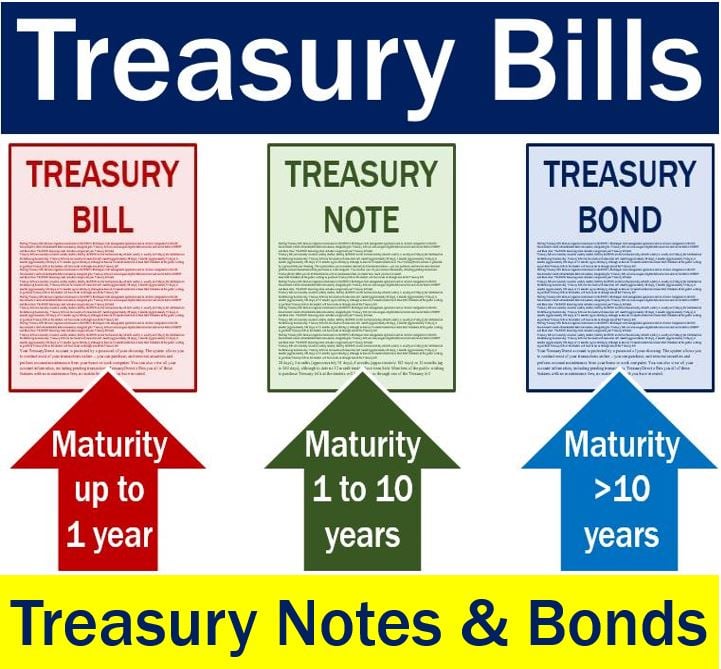
What are treasury bills? Definition and meaning - Market Business News
To “pay off” these bills, notes, and bonds, the federal government merely returns the dollars from accounts that are wholly owned by depositors. The government never uses those dollars; it merely stores them, meaning it did not borrow the money.

Treasury bonds have historically been some of the most reliable investments out there and, as a result, have typically carried low yields.

In other words: Because you can be very confident that the U.S. government will pay you back at the end of the term, you know that your investment is safe, but you also don’t stand to make much on the risk.

And while U.S. Treasury bonds remain very safe investments, the traditional view would say that the recent uptick in yields means investors are pricing just a bit more risk into those purchases.

It really means:

  1. The Fed arbitrarily has raised the prime interest rate and/or
  2. Other investments carry low enough risk and/or are profitable enough to warrant switching over and/or
  3. A potential investor wishes to make a sale and retrieve so many dollars the private markets couldn’t handle without causing significant price movement (This can be true of government purchases).
  4. Or, a significant depositor (like China et al.) has decided to switch investments.

For example, the yield on 10-year Treasury bonds—a key benchmark that helps determine the rates of mortgages, student loans, and more—hit a 16-year-high of 5 percent late in October, though it has fallen a bit since then.

By no coincidence, the prime rate was last reconsidered on November 1, 2023. The Federal Open Market Committee voted to keep the target range for the fed funds rate at 5.25% – 5.50%. Therefore, the United States Prime Rate remains at 8.50%.

In short: Buyers will demand higher yields to make riskier investments.

That’s why the 10-year U.S. Treasury bond yield peaked at 5 percent, while a 10-year Russian bond comes with a yield north of 12 percent. (As an aside, there’s something cool and quite libertarian about all this: Governments must answer to the market.

It costs the Russian government more to borrow funds simply because investors are less confident that Russia won’t stiff them a decade from now.)

The U.S. government does not “answer to the market” the way a private bond issuer must.

The government arbitrarily sets the prime rate at any place it pleases, usually with an eye toward inflation. 

Because the federal government is Monetarily Sovereign, it doesn’t need to set interest rates for its own financial reasons. It can pay any interest rate with equal ease. 

Eric Boehm, the author of the article, seems ignorant of a Monetarily Sovereign government’s bonds from a private sector bond issuer.

Sadly, you can go on government websites that will tell you the government borrows and taxes to fund spending. This is wrong and results from ignorance and/or intent to deceive. Unlike you and me, the federal government has no need for any sort of income.

Why would a government, that has the infinite ability to create dollars, borrow dollars? It wouldn’t. As for taxes, the federal purpose is not to acquire spending funds but to:

  1. Control the economy by taxing what the government wishes to discourage and by giving tax breaks to whom the government wishes to reward
  2. Create assured demand by requiring taxes to be paid in dollars.
  3. At the direction of the rich, to fool the populace into accepting cuts to benefits and tax increases. both of which widen the income/wealth/power Gap between the rich and the rest. This is one way the rich become richer.

Quote from former Fed Chairman Ben Bernanke when he was on 60 Minutes:
Scott Pelley: Is that tax money that the Fed is spending?
Ben Bernanke: It’s not tax money… We simply use the computer to mark up the size of the account.

So, what could be causing investors to price higher risk into U.S. Treasury bonds right now? Yellen says it results from a strong economy and the sense that interest rates will remain higher for a longer-than-expected period.

But that seems to ignore the 300-pound gorilla in the room—or, rather, the $33 trillion mountain of IOUs threatening to bury the Treasury building and the U.S. economy.

Nonsense. That $33 Trillion is the most recent culmination of 84 years’ worth of deficits, beginning with a federal “debt” of $40 Billion in 1939.

Not once, in all those 84 years, has the misnamed “debt” buried the Treasury building or the U.S. economy.

On the contrary, deficits add growth dollars to the economy while the lack of deficits leads to recessions.

Declining deficits lead to recessions (vertical gray bars), which are cured by increasing deficits.


It seems more likely that investors are looking at the trajectory of federal budget deficits and the national debt and are now hedging their bets ever so slightly to account for the possibility of a first-ever federal default.

If there ever is a default, it will not be because the infinitely survivable federal “debt” is so large, but rather because an infinitely ignorant Congress arbitrarily has decided to enforce the infinitely stupid debt ceiling. 

Moody’s, one of the world’s “big three” credit rating services, added a significant data point in favor of that conclusion on Friday when it lowered the federal government’s credit outlook from “stable” to “negative.”

As long as boobs like Marjorie Taylor Greene and Mike Johnson run the House of Representatives, I would put the risk of something stupid at nearly 100%

The change reflects Moody’s belief that “downside risks to the nation’s fiscal strength have increased ‘and may no longer be fully offset by the sovereign’s unique credit strengths,'” The Wall Street Journal reported.

Moody’s calculates that interest payments on the national debt will consume over a quarter of federal tax revenue by 2033, up from just 9 percent last year.

The “national debt” consumes nothing. 

Unlike private sector (including state/local government) interest payments, federal interest payments do not burden our Monetarily Sovereign government. It could pay any amount of interest simply by tapping computer keys.

Need to make a $1 Billion interest payment? No problem for the federal government. What about a $100 Trillion payment? Still no problem.

The only thing that exceeds the government’s infinite ability to pay any financial obligation is the infinite ignorance of those who don’t understand Monetary Sovereignty. 

The announcement from Moody’s comes just three months after another of the primary credit rating services downgraded the federal government’s rating from “AAA” to “AA+” in August.

The change made Friday by Moody’s is not a rating downgrade but signals that one could be coming soon.

Rating downgrades never came during significant deficit growth but only when Congress politically debated whether it wished to pay its bills.

The political party that doesn’t hold the Presidency always tries to prevent economic growth by cutting the federal spending that grows the economy, all in the name of “fiscal prudence.”

That way, they can criticize the President for lack of economic growth and hope to fool a naive voting public.

Moody’s could hardly be clearer in saying how America’s mix of political dysfunction and its increasingly unwieldy debt could trigger that future downgrade.

Forget the “unwieldy pile of debt. The downgrade is 100% based on the debt ceiling and Congress’s willingness (not ability) to pay.

“Without effective fiscal policy measures to reduce government spending or increase revenues, Moody’s expects that the US’s fiscal deficits will remain very large, significantly weakening debt affordability,” Moody’s said in Friday’s announcement.

The above sentence is wrong. The so-called “debt” (that is not a debt of the U.S. government) is infinitely affordable. 

Alan Greenspan: “A government cannot become insolvent with respect to obligations in its own currency.”

“Continued political polarization within U.S. Congress raises the risk that successive governments will not be able to reach consensus on a fiscal plan to slow the decline in debt affordability.”

The polarization is entirely political. It has nothing to do with “debt affordability.” I suspect Eric Boehm knows this and simply is being paid to spread the bullsh*t. 

Yet, in Washington, that announcement was greeted by a chorus of federal officials (and their mouthpieces) denying reality yet again.

White House Press Secretary Karine Jean-Pierre said in a statement that the outlook change from Moody’s was “yet another consequence of congressional Republican extremism and dysfunction.”

True.

Yellen, on Monday, said she “disagrees” with Moody’s decision and claimed the Biden administration is “completely committed to a credible and sustainable fiscal path.”

I don’t know what “credible” means in this context, but the fiscal path is infinitely sustainable.

That’s even though the federal budget deficit doubled over the past year. That’s despite the White House’s request for more spending—which would require more borrowing—in ongoing budget negotiations.

More bullsh*t from Boehm. The federal government, unlike state/local governments, never borrows dollars. It creates all its spending dollars, ad hoc.

Alan Greenspan: “There is nothing to prevent the federal government from creating as much money as it wants and paying it to somebody.”

And now, we finally come to the real reason for all the lies. 

And that’s despite President Joe Biden’s utter unwillingness to engage with the problems facing America’s entitlement programs, drive much of the unsustainable future deficits.

There it is, where the Libertarians and the Republicans agree: Cut benefits to those who are not rich.

Both parties have sold their souls to the rich. You’ll notice no mention of raising taxes on the rich and no mention of eliminating the tax loopholes that allow billionaires like Donald Trump to pay less in taxes than you do.

No, the Libertarians and the Republicans want the money to come from the elderly on Social Security and from the sick on Medicare and Medicaid.

They claim it’s those poor lazy freeloaders who are taking all the money. 

In Yellen’s view, then, increased bond yields do not reflect increasing concern from investors about the fiscal state of the federal government, and growing federal budget deficits are a “sustainable fiscal path.”

Neither claim makes much sense.

On the Fence - Girlicity Girlicity
Boehm says Janet Yellen “may turn out to be right” about a statement that “makes no sense.”

Wrong, Eric. Both claims are correct.

She may turn out to be right, but this comes off as a lot of politically motivated gaslighting.

Huh? “Neither claim makes much sense,” but “She may turn out to be right”?

Poor Eric, he stands firmly with his legs planted on both sides of the fence. 

Americans would be wise to keep in mind that the sky is still blue and gravity still pulls you toward the center of the Earth, no matter how many federal officials might claim otherwise.

Americans would be wiser to keep in mind that 84 years of politically motivated bullsh*t warnings about our “unsustainable” federal debt, have proven wrong, wrong, wrong.

Sadly, that has not stopped Boehm et al from taking paychecks to spread it thick and wide.

If you wish to contact Boehm, you can write to his employer at: Reason Foundation, 1630 Connecticut Ave NW, Suite 600, Washington, DC 20009, or call them at (202) 986-0916, or even tweet him at @EricBoehm87.

Couldn’t hurt. Might help. 

Rodger Malcolm Mitchell
Monetary Sovereignty

Twitter: @rodgermitchell Search #monetarysovereignty
Facebook: Rodger Malcolm Mitchell

……………………………………………………………………..

The Sole Purpose of Government Is to Improve and Protect the Lives of the People.

MONETARY SOVEREIGNTY

A better way to budget federal spending: The only sensible way.

Infinity is a big number. It’s so big you can’t even visualize it, much less count it.
Night Sky Images | Free HD Backgrounds, PNGs, Vectors & Templates - rawpixel
The federal government has more dollars than there are atoms in the universe.
Infinity is bigger than all the atoms in all the molecules in all the dust grains in the entire universe, which is estimated to be 10^82 — that’s 1 with 82 zeros behind it — way bigger. It’s bigger than a googol, which is 10^100, which is one followed by one hundred zeros. Infinity is bigger than a centillion, which is one followed by six hundred zeros, and bigger even than a googolplex, ten^googol. I mention these staggering numbers, all of which are far smaller than infinity, to give you an idea of the U.S. federal government’s capability, which is this: The U.S. government can create infinite U.S. dollars any time it chooses, merely by deciding to do so.

Ben Bernanke, former Federal Reserve Chairman: “The U.S. government has a technology, called a printing press (or, today, its electronic equivalent), that allows it to produce as many U.S. dollars as it wishes at essentially no cost.”

Scott Pelley (60 Minutes): Is that tax money that the Fed is spending? Ben Bernanke: It’s not tax money… We simply use the computer to mark up the size of the account.

Statement from the St. Louis Fed: “As the sole manufacturer of dollars, whose debt is denominated in dollars, the U.S. government can never become insolvent, i.e., unable to pay its bills. In this sense, the government is not dependent on credit markets to remain operational.”

Given that infinite capability, the U.S. government cannot run short of dollars, no matter how many it spends, how little it taxes, or how big its deficits are. Even if the federal government levied zero taxes, it could continue spending forever (the same as infinity, but on a time scale). And what is true for the U.S. government also is true for any agency of the U.S. government. The Army, Navy, Marines, Air Force, Space Force, the Senate, the House, the White House, the Supreme Court, Medicare, Social Security, and all the other 1000+ agencies of the federal government — none of them can run short of dollars unless that is the desire of the President and Congress. So why do we concern ourselves with meaningless concepts such as federal deficits, debt, and borrowing when determining how much to spend on various projects? Why do we talk about “affordability” and “sustainability”? Everything is affordable and sustainable for an entity with access to infinite (more than a googolplex) dollars, and there never is a reason to borrow. With affordability, sustainability, and borrowing off the table, what criteria should the government use to plan expenditures? Need and effect are the only criteria that have a purpose. Take any federal agency, for instance, the House of Representatives: How much money does the House need to run most efficiently, and what are the overall effects of giving them that money? Or think about America’s healthcare. How much money would a comprehensive, no-deductible Medicare plan covering every man, woman, and child in America need, and what would be the overall effect of providing that money? The U.S. government can “afford” and “sustain” any numbers you can mention without either borrowing or taxing. Just press those computer keys Ben Bernanke mentioned. Social Security for All: How much money is needed to eliminate poverty, hunger, homelessness, and most crime in America? Develop a number and press those computer keys. Or education: How much money is needed to provide everyone with the education they desire, whether it be high school, college, advanced degree, or research facility? There are no financial limitations. So, what are the limitations? Planning, know-how, and labor. We need to know how to spend those unlimited dollars to achieve our goals, and we need enough educated labor to make it all happen. Despite the bleating and moaning about deficits and debt, money truly is no object. We can do it all, and now, with AI (Artificial Intelligence), our capabilities have expanded massively. We really can create a paradise on earth. Of course, when all objections have been satisfied, we come to the last refuge of the debt worriers: Inflation. They tell you that if the government spends “too much,” we’ll have inflation. That is what many people have been taught to believe, despite one small fact: Historically, there is no relationship between federal spending and inflation.
In the massive inflation years of the late 1970s, federal spending ranged between $300 Billion and $700 Billion annually.
In the massive inflation years of the late 1970s, federal spending ranged between $300 Billion and $700 Billion annually. In the 1980s, while inflation dropped to 2% and below, federal spending kept rising, reaching a high of $6 Trillion annually, still with low inflation. Then suddenly came the COVID shortages, and just as suddenly, inflation rose to 8%+. Now, as federal spending continues at massive levels and shortages decline, inflation, too is coming down. The reason: Inflation, far from being a result of federal spending, is the result of national shortages, most often shortages of oil and/or food. The famous Zimbabwe inflation was caused by a food shortage. The government took farmland from farmers and gave it to non-farmers. Government spending was an inept follow-up to the already existing inflation. Had the government spent to aid production and acquisition of food, there would have been no inflation. Argentina: Food, clothing, and, surprisingly, energy shortages caused by the Russia/Ukraine war. America: COVID-caused shortages of oil, food, shipping, computer parts, metals, lumber, labor, and other essentials. Before COVID, inflation was near zero despite massive federal spending for many years. Then came COVID, and its shortages caused inflation to hit double digits. SUMMARY Congress, the media, and even economists worry about government spending when they should worry about private sector needs. That is the fundamental purpose of government — to provide the private sector with what the private sector needs. Worrying about spending is a reasonable approach for households, businesses, and local governments, all monetarily non-sovereign. They do not have the infinite ability to create dollars. They can, and often do, run short of money. They require taxes and borrowing to remain solvent. By contrast, this approach is wrongheaded for our Monetarily Sovereign federal government, which can create money and needs neither taxes nor borrowing to remain solvent. As I write this, the federal government is about to shut down over worries, not about economic needs but about federal spending, the exact opposite of what the government should consider. The Republicans have forgotten about needs. The Democrats consider needs but are hypnotized by the false analogies with household finances. The situation today resembles a billionaire refusing a life-saving cancer medicine because it costs $1 per year. Nonsensical. I look forward to the day when people understand that federal money is an unlimited resource. If used correctly, it will solve most problems facing this nation and create a paradise on earth. Rodger Malcolm Mitchell Monetary Sovereignty Twitter: @rodgermitchell Search #monetarysovereignty Facebook: Rodger Malcolm Mitchell

……………………………………………………………………..

The Sole Purpose of Government Is to Improve and Protect the Lives of the People.

MONETARY SOVEREIGNTY

Does your neighbor understand the close relationship between federal deficits and economic growth? Do you?

Does your neighbor understand the close relationship between federal deficits and economic growth? Do you?

I’m unsure whether to laugh or cry when I read about how the “federal debt” is too high and “unsustainable.” It is amazing how few people seem to understand that Gross Domestic Product growth (economic growth) relies on federal deficit and “debt” growth.

The two are intertwined, with economic growth being the outcome of “federal debt” and deficit growth.

I put “federal debt” in quotes because it isn’t federal, and it isn’t debt. It’s deposits in T-security accounts owned by the depositors, not the federal government.

These accounts resemble bank safe deposit boxes in that the contents remain the property of the depositors, the bank never touches them, and they are not the bank’s debts. 

Similarly, the contents of T-security accounts remain the property of depositors; the federal government never touches them, and they are not the federal government’s debts.

The purpose of T-securities is not to provide spending funds to the federal government (which already has infinite spending funds) but to provide a safe, interest-paying storage place for unused dollars. This stabilizes the demand for the dollar.

Here is a graph demonstrating the close relationship between deficit spending and economic growth.

Federal deficits and economic growth go hand-in-hand.

The lines parallel because of this formula:

Gross Domestic Product = Federal Spending + Non-federal Spending + Net Exports.

Increases in Federal Spending directly increase economic growth (GDP), but they also increase Non-federal spending by adding dollars to the private sector.

Thus, federal deficit spending is absolutely no-kidding-around necessary for economic growth.

The economy can’t grow without the supply of money growing. The following graph shows the nearly identical tracks of GDP (blue) and both the broad money supply measure (M3) and a narrower money supply measure (purple).

Federal deficit spending grows the supply of money and, thus, the economy.

Economic growth (blue) parallels the M2 (purple) money supply measure and the M3 (green) money supply measure.

If you wonder whether economic growth is necessary, consider that the combination of inflation and population growth requires more money just to break even, making a $0 deficit recessionary.

The reality is that even small, insufficient deficit growth has led lead to inflations, which is demonstrated by the following graph:

Every recession begins after a period of declining deficits.

Even when “federal debt” growth is above zero, it can lead to recessions (vertical gray bars) when the rate of growth declines. 

Recessions are cured by increases in the “federal debt” growth rate.

When your neighbor claims the “federal debt” and deficit are too high and demands a reduction, here’s what he unknowingly (perhaps) is asking for:

U.S. depressions come on the heels of federal surpluses.

1804-1812: U. S. Federal Debt reduced 48%. Depression began 1807.
1817-1821: U. S. Federal Debt reduced 29%. Depression began 1819.
1823-1836: U. S. Federal Debt reduced 99%. Depression began 1837.
1852-1857: U. S. Federal Debt reduced 59%. Depression began 1857.
1867-1873: U. S. Federal Debt reduced 27%. Depression began 1873.
1880-1893: U. S. Federal Debt reduced 57%. Depression began 1893.
1920-1930: U. S. Federal Debt reduced 36%. Depression began 1929.
1997-2001: U. S. Federal Debt reduced 15%. Recession began 2001.

Every depression in U.S. history has been caused by federal deficit reductions (“Federal debt” is the net total of federal deficits because that is how “federal debt” is wrongly defined.)

Does your neighbor understand that in demanding “debt” cuts, he is demanding a depression? Do you?

If you don’t understand it, I can’t blame you. You’ve received wrong information from all sides, even from trusted sources. Consider this startlingly inaccurate information from Investopedia:

What Is Austerity?

Austerity refers to a set of economic policies a government implements to control public sector debt. Governments put austerity measures in place when their public debt is so large that the risk of default or the inability to service the required payments on its obligations becomes a real possibility.

The U.S. government has the unlimited ability to create U.S. dollars. So, large deficits never have and never will force the U.S. federal government to default.

The only way the government can default is if Congress and the President simply decide not to pay what they owe, for instance, because of the extraordinarily foolish “debt ceiling.” 

This misguided event could occur even when deficits are small; the size of deficits is irrelevant to the government’s ability to pay what it owes.

The goal of austerity is to improve a government’s financial health.

Austerity never improves the financial health of a Monetarily Sovereign government, i.e., the U.S. government’s infinite ability to create its sovereign currency.

Austerity always worsens the financial health of an economy. Always. 

Default risk can spiral out of control quickly. As an individual, company, or country slips further into debt, lenders will charge a higher rate of return for future loans, making it more difficult for the borrower to raise capital.

Here,  Investopedia demonstrates abject ignorance about economics. Individuals and companies are monetarily non-sovereign. The U.S. federal government is Monetarily Sovereign. The two are as different as black and white, and Investopedia doesn’t understand it.

If you and your neighbor are confused, that is the reason. You receive bad information from trusted sources.

Individuals and companies use dollars but do not have the unlimited ability to create dollars. You can run short of dollars. You may need to borrow dollars.

By contrast, the U.S. federal government cannot unintentionally run short of dollars. It has the infinite ability to create dollars. Even if the U.S. government didn’t collect a penny in taxes, it and all its agencies could continue spending forever. Congress and the President merely must vote to make that happen. 

Alan Greenspan: “A government cannot become insolvent with respect to obligations in its own currency. There is nothing to prevent the federal government from creating as much money as it wants and paying it to somebody. The United States can pay any debt it has because we can always print the money to do that.”

That is why the Supreme Court, Congress, the White House, the Military, Medicare, and Social Security — all federal agencies — cannot run short of dollars unless Congress and the President want them to.

For the above reasons, the federal government never borrows dollars. It creates, ad hoc, all the dollars it ever needs.

While T-bills, T-notes, and T-bonds include the words “bills,” “notes,” and “bonds” — terms often associated with borrowing — T-securities are not borrowing. They are deposits by depositors into their own accounts.

Imagine putting dollars into your bank safe deposit box. The bank has not borrowed those dollars. It only has provided a storage place to deposit things of value. Those things of value are not federal debt. The government does not owe them to you.

When a T-security reaches maturity, the federal government merely returns your dollars to you. It’s a simple transfer of your dollars from one of your accounts to another of your accounts — from your T-security account to your checking account.

If the federal government wished, it could reduce the “federal debt” to $0 simply by returning all your dollars currently residing in your T-security accounts. This would not be a financial burden on the government.

Finally, interest rates on T-securities are not determined by the private sector. They are set by the Federal Reserve in its attempts to control inflation.

Everywhere you turn, some “expert” wrongly conflates “federal debt” with private debt. It’s as wrong as conflating “giving someone the bird” (handing him a parrot) with the same words meaning “showing your middle finger.”

Federal government finances have nothing in common with personal, business, or state/local government finances.

Perhaps you understand this, and maybe even your neighbor does, too. But why do America’s “experts,” the media, the politicians, and the university economists act so gosh darned ignorant about elementary facts?

I suspect the operative word is “act.” Too many of them have been bribed by the rich, who run America, to make you believe the government can’t afford to give you benefits.

You are told that Social Security, Medicare, Medicaid, and all other social benefit programs must be cut, and your taxes must be increased. It’s all a lie, told to widen the income/wealth/power Gap between the rich and you. This is how the rich grow richer.

Did you know all this? If you do, have you complained to your Senator and Representative? It’s not too late. Or you can simply pay the additional FICA and do with less Medicare and Social Security. It’s what the rich hope, sucker.


Rodger Malcolm Mitchell
Monetary Sovereignty

Twitter: @rodgermitchell Search #monetarysovereignty
Facebook: Rodger Malcolm Mitchell

……………………………………………………………………..

The Sole Purpose of Government Is to Improve and Protect the Lives of the People.

MONETARY SOVEREIGNTY

Free Speech, Free Media, and Reality Compete

Despite (or perhaps because of) our many sources of information, we Americans are ill-informed, often unable to separate truth from obvious fiction, and we make terrible decisions that negatively affect our lives. Millions of us:
  1. Refuse vaccination, despite the clear facts that refusal costs lives — the lives of the unvaccinated and the lives of those who contact the unvaccinated.
  2. Believe the most recent Presidential election was stolen, despite massive evidence and at least 62 lawsuits before Republican and Democratic judges showing that it was not.
  3. Believe human-caused global warming is a “Chinese hoax.”
  4. Take illegal drugs despite all the evidence of what drugs do to users and their friends and families.
  5. Smoke cigarettes, despite all the evidence of the wreckage tobacco use causes.
  6. Own guns despite the evidence that when you own a gun, your odds of being shot go way up.
  7. Think the federal debt is “unsustainable,” the same claim being made 84 years ago when the debt was $40 Billion, and every year after that, with the debt now $30 Trillion.
  8. Not understanding the difference between federal finance and personal finance, think a nation that created its sovereign currency from thin air, repeatedly created more of that currency and often changed the value of that currency somehow can run short of the currency it created unless taxes are increased.
  9. Believe the life of a fetus is more important than the life of a mother.
  10. Believe that downplaying COVID, being a compulsive liar, paying a $25 million fine for cheating students, paying a $2 million penalty for cheating on taxes, cheating multiple times with prostitutes on three wives, as President, rewarding the rich and punishing the poor, fostering bigotry against gays, non-Christians, and immigrants, being indicted 4 separate times (91 counts), expressing admiration for dictators Vladimir Putin, Kim Jong-un, Viktor Orban, and Rodrigo Duterte,  repeatedly having mental lapses that include thinking Barack Obama is President and World War II is yet to be fought, encouraging people to attend COVID-causing events, and organizing, encouraging, refusing to stop the attempted coup of the U.S. government, bragging his followers are so stupid they would vote for him even if he shot someone on 5th Ave., and publicly vilifying those moral souls who attempt to follow the rule of law — believe those are desirable traits for President of the United States.
In the vein of the American public believing utter nonsense, I give you this excellent article by Margaret Sullivan:
Margaret Sullivan

The public doesn’t understand the risks of a Trump victory. That’s the media’s fault.

Margaret Sullivan With democracy in the balance, the press must relay the crucial importance of this election and the dangers of a Trump win.

Thu 9 Nov 2023 06.11 EST

Whatever doubts you may have about public-opinion polls, one recent example should not be dismissed.

Yes, that poll – the one from Siena College and the New York Times that sent chills down many a spine. It showed Donald Trump winning the presidential election by significant margins over Joe Biden in several swing states, the places most likely to decide the presidential election next year.

The poll, of course, is only one snapshot and it has been criticized, but it still tells a cautionary tale – especially when paired with the certainty that Trump, if elected, will quickly move toward making the United States an authoritarian regime.

Add in Biden’s low approval ratings, despite his accomplishments, and you come to an unavoidable conclusion: the news media needs to do its job better.

The press must get across to American citizens the crucial importance of this election and the dangers of a Trump win. They don’t need to surrender their journalistic independence to do so or be “in the tank” for Biden or anyone else.

It’s now clearer than ever that Trump, if elected, will use the federal government to go after his political rivals and critics, even deploying the military toward that end. His allies are hatching plans to invoke the Insurrection Act on day one.

The US  then “would resemble a banana republic”, a University of Virginia law professor told the Washington Post when it revealed these schemes. Almost as troubling, two New York Times stories outlined Trump’s autocratic plans to put loyal lawyers in key posts and limit the independence of federal agencies.

The press generally is not doing an adequate job of communicating those realities.

Instead, journalists have emphasized Joe Biden’s age and Trump’s “freewheeling” style. They blame the public’s attitudes on “polarization”, as if they themselves have no role. And, of course, they make the election about the horse race – rather than what would happen a few lengths after the finish line.

Here’s what must be hammered home: Trump cannot be re-elected if you want the United States to be a place where elections decide outcomes, where voting rights matter, and where politicians don’t baselessly prosecute their adversaries.

When Americans do understand how politics affects their lives, they vote accordingly. We have seen that play out with respect to abortion rights in Ohio, Virginia, Wisconsin and beyond. On that issue, voters clearly get that well-established rights have been ripped away, and they have reacted with force.

“Women don’t want to die for Mike Johnson’s religious beliefs,” as Vanity Fair’s Molly Jong-Fast said on MSNBC, referring to the theocratic House speaker.

Abortion rights is a visceral issue. It’s personal and immediate.

Trump’s threats to democracy? That’s a harder story to tell. Harder than “Joe Biden is old”. Harder than: “Gosh, America is so polarized.”

Journalists need to figure out a way to communicate it – clearly and memorably.

It was great to see the digging that went into that Washington Post story about Trump and his allies plotting a post-election power grab. But it was all too telling to see this wording in its subhead: “Critics have called the ideas under consideration dangerous and unconstitutional.”

So others think it’s fine, right? That suggests that both sides have a valid point of view on whether democracy matters.

Deploying the military to crush protests is radical. So is putting your cronies and yes men in charge of justice. These moves would sound a death knell for American democracy. They are not just another illustration of Trump’s “brash” personality.

We need a lot more stories like the ones the Post and the Times did – not just in these elite, paywalled outlets but on the nightly news, on cable TV, in local newspapers and on radio broadcasts. We need a lot less pussyfooting in the wording.

Every news organization should be reporting on this with far more vigor – and repetition – than they do about Biden being 80 years old.

It’s the media’s responsibility to grab American voters by the lapels, not just to nod to the topic politely from time to time.

Polls can be wrong, and it’s foolish to overstate their importance, especially a year away from the election, but if more citizens truly understood the stakes, there would be no real contest between these candidates.

The Guardian’s David Smith laid out the contrast: “Since Biden took office the US economy has added a record 14m jobs while his list of legislative accomplishments has earned comparisons with those of Franklin Roosevelt and Lyndon Johnson … Trump, meanwhile, is facing 91 criminal indictments in Atlanta, Miami, New York and Washington DC, some of which relate to an attempt to overthrow the US government.”

So what can the press do differently? Here are a few suggestions.

Report more – much more – about what Trump would do, post-election. Ask voters directly whether they are comfortable with those plans, and report on that. Display these stories prominently, and then do it again soon.

Use direct language, not couched in scaredy-cat false equivalence, about the dangers of a second Trump presidency.

Pin down Republicans about whether they support Trump’s lies and autocratic plans, as ABC News’s George Stephanopoulos did in grilling the House majority leader Steve Scalise about whether the 2020 election was stolen. He pushed relentlessly, finally saying: “I just want an answer to the question, yes or no?” When Scalise kept sidestepping, Stephanopoulos soon cut off the interview.

Those ideas are just a start. Newsroom leaders should be getting their staffs together to brainstorm how to do it. Right now.

With the election less than a year away, there’s no time to waste in getting the truth across.

Most Americans vote with their guts, not with their brains. They have neither the time nor the inclination to learn the facts, and instead grope blindly for a feeling. That is how the dictators of the world get elected. They pose as strong saviors who will protect the nation from dangers, real or imagined. But once in office, they create new threats far worse than any that may have troubled the voting public. Once the public allows the dictators to get a foot in the door, dictators, having rid the nation of those who tell the truth, are impossible to dislodge without massive bloodshed and destruction. This lesson has been given throughout history but seldom is learned. For 200+ years, America was a remarkable exception. But now, we are on the brink of making the same mistake so many nations, small and large, made and now endure. We are on the verge of allowing a dictator to rule us. “It couldn’t happen here” has been replaced by, “It’s about to happen here.” If you value an America ruled by law and not by a tyrant, please send Ms. Sullivan’s article to as many people as you can. Rodger Malcolm Mitchell Monetary Sovereignty Twitter: @rodgermitchell Search #monetarysovereignty Facebook: Rodger Malcolm Mitchell

……………………………………………………………………..

The Sole Purpose of Government Is to Improve and Protect the Lives of the People.

MONETARY SOVEREIGNTY