Are you planning to vote for the end of Medicare and Social Security? These people are.

The Libertarians (also known as the Republican Party) want to cancel Medicare and Social Security under the guise of fiscal prudence and courage. The right wing has created a fake “debt crisis” and then invented a non-solution that requires exactly what they deny they want: The end of Medicare and Social Security. (See: Congressional Republicans Want Big Cuts to Social Security) Although Congress is accustomed to misleading statements and outright lies, nowhere are the lies piled deeper than the discussions of Medicare’s and Social Security’s impending “insolvency.” Let’s get something straight. The US government, being Monetarily Sovereign, cannot become insolvent. It has the infinite ability to create U.S. dollars. This means no agency of the U.S. government can become insolvent unless Congress and the President vote for insolvency. Look at this list of federal departments and agencies that cannot run short of money unless Congress and the President vote for insolvency. The list runs alphabetically from the U.S. AbilityOne Commission to the Woodrow Wilson International Center for Scholars. There are 15 executive departments in the United States federal government, each of which is headed by a Cabinet member appointed by the President. The following is a list of the 15 executive departments:

Department of Agriculture Department of Commerce Department of Defense Department of Education Department of Energy Department of Health and Human Services Department of Homeland Security Department of Housing and Urban Development Department of the Interior Department of Justice Department of Labor Department of State Department of Transportation Department of the Treasury Department of Veterans Affairs

In addition to these departments, there are over 430 federal agencies in the United States, including 9 executive offices, 259 executive department sub-agencies and bureaus, 66 independent agencies, 42 boards, commissions, and committees, and 11 quasi-official agencies. Not one of the departments, agencies, executive offices, sub-agencies, bureaus, boards, commissions, committees, and quasi-official agencies can or will run short of dollars unless that is what Congress and the President want. Who says so? How about:

Former Federal Reserve Chairman Alan Greenspan said: “A government cannot become insolvent with respect to obligations in its own currency. There is nothing to prevent the federal government from creating as much money as it wants and paying it to somebody. The United States can pay any debt it has because we can always print the money to do that.”

Ben Bernanke: “The U.S. government has a technology, called a printing press (or, today, its electronic equivalent), that allows it to produce as many U.S. dollars as it wishes at essentially no cost.” Scott Pelley: Is that tax money that the Fed is spending? Ben Bernanke: It’s not tax money… We simply use the computer to mark up the size of the account.

Not many people realize that while state/local taxes pay for state/local spending, federal taxes pay for nothing. Rather than funding federal spending, the sole purposes of federal taxes are:
  1. To control the economy by taxing what the federal government wishes to discourage and by giving tax breaks to what the federal government wishes to reward,
  2. To assure demand for the U.S. dollar by requiring dollars to be used in paying taxes and
  3. To fool the public into believing some benefits are unsustainable unless taxes are raised, which reduces benefits.

Statement from the St. Louis Fed: “As the sole manufacturer of dollars, whose debt is denominated in dollars, the U.S. government can never become insolvent, i.e., unable to pay its bills. In this sense, the government is not dependent on credit markets to remain operational.”

Anyone who claims a federal “debt crisis” is ignorant about, or lying about, federal finances. There is no federal debt crisis. The Libertarians and their alter egos, the Republicans, are doing their best to provide you with false information. Here is a Libertarian article that could have been written by the Republicans:

Congress Is Trying To Avoid Taking Responsibility for the Debt Crisis It Created A fiscal commission might be a good idea, but it’s also the ultimate expression of Congress’ irresponsibility. ERIC BOEHM | 11.29.2023 2:30 PM

It’s inaccurate to say that no one in Congress wants to talk about the national debt and the federal government’s deteriorating fiscal condition.

How can the federal government, which as you’ve just read, has the infinite ability to create dollars, have a deteriorating fiscal condition”? It can’t. It’s like claiming the world’s oceans have a deteriorating liquid condition, or the universe has a deteriorating atomic condition. The lie about “deteriorating fiscal condition” forms the basis for the rest of the lies.

Indeed, during Wednesday morning’s meeting of the House Budget Committee, there was a lot of talk about exactly that.

“Runaway deficit-spending and our unsustainable national debt threatens not only our economy, but our national security, our way of life, our leadership in the world, and everything good about America’s influence,” said Rep. Jodey Arrington (R–Texas), the committee’s chairman.

Rep. Jodey Arrington either is stupendously ignorant or stupendously lying. The phrase “unsustainable national debt” consists of three words, all three of which are lies.
  1. “Unsustainable”: Interestingly, this word never is explained by those who use it incessantly. I suspect it means something like this: Federal finances are like personal finances. If your expenses are larger than your income, eventually, you won’t be able to pay your bills, so your debt will be “unsustainable.”The problem is that the federal government is Monetarily Sovereign while you are monetarily non-sovereign, which is totally different. You can run short of money. The federal government cannot.
  2. “National” This has to do with Treasury Securities, which indeed are national or federal. The federal government is the sole authority to issue T-bills, T-notes, and T-bonds. However, the owner of those T-bills, T-notes, and T-bonds is not the federal government. When someone or some nation buys a T-security, their dollars go into their T-security account. Those dollars remain the property of the buyer.They never are owned by the federal government. When the T-security reaches maturity, the dollars are returned to their owner. Think of a bank safe-deposit box. The bank never owns the contents. It holds them for safekeeping and returns the contents to the owner. The government’s storage of unused dollars for safekeeping, stabilizes the dollar.
  3. “Debt” relates to the mistaken claim that T-securities represent borrowing. But our Monetarily Sovereign government, with its infinite ability to create dollars, never borrows dollars. The only dollars the federal government ever owes are the dollars it uses to pay for things. Those dollars are paid in a timely fashion by a government that has the infinite ability to create dollars. There is no long-term buildup of federal “debt.”

He pointed to the Congressional Budget Office (CBO) projections showing that America’s debt, as a share of the size of the nation’s economy, is now as large as it was at the end of the Second World War—and that interest payments on the debt will soon cost more than the entire military budget.

The above paragraph refers to the infamous and much-misunderstood Debt/GDP ratio. It is a meaningless ratio that tells nothing and predicts nothing about a Monetarily Sovereign nation’s finances. A high or low ratio does not indicate solvency, growth, or any other financial factor. It is entirely useless. The so-called “Debt” (that isn’t a real debt) is the net total of all T-securities purchased and still outstanding for the past 10 years. They are not a burden on the federal government, which merely returns the dollars it holds for the owners when the security matures. By contrast, GDP is a one-year (or less) total of America’s (not just the federal government’s) spending. The formula for GDP is:

GDP = Federal Spending + Non-federal Spending + Net Exports

Comparing federal “Debt” to GDP is worse than comparing your 10-year income to the federal government’s spending this week: It is meaningless. The sole purpose of this comparison is to fool you into believing the federal government is running short of the dollars it has the infinite ability to create.

What’s missing, however, is any sense that Congress is willing to turn those words into action. Just look at the premise of Wednesday’s hearing: “Examining the need for a fiscal commission.”

Yes, it was a meeting about possibly forming a committee to discuss perhaps doing something to address the problem. In fact, it was the second such committee hearing in front of the House Budget Committee within the past few weeks.

It seems like there ought to be a more direct way to address this. , say, if a committee already existed within Congress was charged with handling budgetary issues. A House Budget Committee, perhaps.

But instead of using Wednesday’s meeting to seek consensus on how to solve the federal government’s budgetary problems, lawmakers debated a series of bills that aim to let Congress offload that responsibility to a special commission.

Unlike you, me, local governments, and businesses, the federal government’s only true “budgetary problem” is to decide where it wishes to spend its infinite hoard of dollars. While you et al. must worry about the availability of dollars, the federal government has no such constraints. It creates dollars by spending dollars. This is the process:
  1. When the federal government buys something and receives an invoice, it sends to the seller’s bank instructions (not dollars), instructing the bank to increase the balance in the seller’s checking account.
  2. When the bank does as instructed, new dollars are created and added to the M2 money supply measure.
  3. The instructions then are approved by the Federal Reserve, an agency of the federal government.
In short, the federal government creates dollars by spending dollars, and this creation is approved by the Federal Reserve, an agency of the federal government. The federal government creates the laws that approve its money-creation process. Being Monetarily Sovereign, the federal government can create any money-related laws it wishes, which is why no federal agency can run short of dollars unless the federal government wants it to run short. Federal agencies are not supported by federal taxes; they are supported by federal money creation. Medicare and Social Security can run short of dollars only if that is what Congress and the President want.

What that commission would look like and how its recommendations would be handled will depend on which proposal (if any of them) eventually becomes law—and even that seems somewhat unlikely, with Democrats voicing their opposition to the idea throughout Wednesday’s hearing.

To be fair, there are plenty of good arguments for why a fiscal commission might be the best way for Congress to fix the mess that it has made. It is an idea that’s certainly worthy of being considered, even if the whole exercise seems a little bit over-engineered.

All this blah, blah, blah is meant to disguise one simple fact: The rich, who run the U.S.  government, want to cut benefits for the middle and lower-income groups. Here is why:
  1. “Rich” is a comparative. A man owning a million dollars is rich if everyone else has a thousand dollars. But a man owning a million dollars is poor if everyone else has a hundred million dollars. During the Great Depression, anyone earning $20,000 a year was rich. Today, that salary would mark him as poor.
  2. To become richer requires widening the income/wealth/power Gap below you and narrowing the Gap above you.
  3. The rich always want to be richer, i.e.,  to widen the Gap below them.
  4. Because Social Security, Medicare, Obamacare, and all aid to the poor help narrow the Gap between the rich and the rest, the rich repeatedly try to eliminate all such benefits (while giving tax loopholes to the rich).
  5. Under the guise of fiscal responsibility, the right-wing makes unending efforts to cut the federal deficit spending that benefits those who are not rich (while continuing to run deficits that benefit the rich).

Romina Boccia, director of budget and entitlement policy at the Cato Institute, argues persuasively in her Substack that a fiscal commission is the best way to overcome the political hurdles that prevent Congress from taking meaningful action on borrowing and entitlement costs (which are driving a sizable portion of future deficits).

And there it is, the true purpose of a “fiscal commission” is to cut spending on so-called “entitlements” (i.e. Medicare and Social Security.) All the lies about Social Security and Medicare “trust funds” running short of dollars are to make you compliant with the Republican effort to make you poorer and the rich, richer. What you may not realize, these so called “trust funds” aren’t even trust funds.  To quote from the Peter G. Peterson Foundation web site:
A federal trust fund is an accounting mechanism used by the federal government to track earmarked receipts (money designated for a specific purpose or program) and corresponding expenditures. The largest and best-known trust funds finance Social Security, portions of Medicarehighways and mass transit, and pensions for government employees. Federal trust funds bear little resemblance to their private-sector counterparts, and therefore the name can be misleading. A “trust fund” implies a secure source of funding. However, a federal trust fund is simply an accounting mechanism used to track inflows and outflows for specific programs. In private-sector trust funds, receipts are deposited and assets are held and invested by trustees on behalf of the stated beneficiaries. In federal trust funds, the federal government does not set aside the receipts or invest them in private assets. Rather, the receipts are recorded as accounting credits in the trust funds, and then combined with other receipts that the Treasury collects and spends. Further, the federal government owns the accounts and can, by changing the law, unilaterally alter the purposes of the accounts and raise or lower collections and expenditures.
Thus, the federal government can do whatever it wishes with the “trust funds.” It can add to them, subtract from them, or change them from the wrongly presumed mission of supporting federal expenditures. At the click of a computer key or the passage of a law, the balance in the federal “trust funds” could be changed to $100 trillion or $0, and neither would affect taxpayers. Thus, the notion that any federal “trust funds” are, as the right wing claims, “in trouble,” is a lie, unless “trouble” comes from those who don’t wish you to understand the differences between the private sector’s real trust funds vs. the federal government’s phony “trust funds.”

Boccia’s preferred solution would allow the commission’s proposals to be “self-executing unless Congress objects,” meaning that legislators would have the “political cover to vocally object to reforms that will create inevitable winners and losers, without re-election concerns undermining an outcome that’s in the best interest of the nation.”

This would be the Republican’s way of saying, “Don’t blame us for cutting your Social Security. It was the commission that did it.”

It’s probably true that Congress itself is the biggest hurdle to managing the federal government’s fiscal situation. Unfortunately, that’s also the biggest reason to be skeptical: any decisions made by a fiscal commission will only be as good as Congress’ willingness to abide by them.

President Obama, of all people, tried this with the notorious Simpson/Bowles Commission, which made exactly the recommendations expected of it. Fortunately, America learned the plot, and the commission’s recommendations never were implemented. The commission’s recommendations included increasing the Social Security retirement age, cuts to military, benefit, and domestic spending, restricting or eliminating certain tax credits and deductions, and increasing the federal gasoline tax. The Simpson-Bowles proposal would have cut entitlement and social safety net programs, including Social Security and Medicare, which was opposed by critics on the left, such as Democratic Representative Jan Schakowsky (a Commission member) and economist Paul Krugman.

There’s no secret knowledge about reducing deficits that will only be unlocked by bringing together a collection of legislators and private sector experts, which is what most of the bills to create a commission propose doing.

Federal deficit spending is necessary for economic growth. Deficit reduction leads to recessions, which then are cured by deficit increases.
When federal deficits decline (red line). We have recessions (vertical gray bars), which are cured by increases in federal deficits.
One would think that repeatedly seeing the same effect — nine consecutive recessions caused by deficit reduction, 9 successive recessions cured by deficit increases — our leaders eventually would realize that far from being a bad thing, federal deficits are necessary. The ignorant have been claiming for more than 80 years that the federal budget is “unsustainable” and a “ticking time bomb.” Read a list of some such claims here. In all those years, much to the consternation of the ignorant, the ticking time bomb never has exploded.

Congress should hold hearings, invite experts to share their views, draft proposals, vet those ideas through the committee process, and then put the resulting bills on the House floor for a full vote.

Shielding Congress from the electoral consequences of making poor fiscal decisions doesn’t seem to improve budget-making quality. We need Congress to be held more accountable for this mess.

No, we need our leaders to be held accountable for disseminating the lie that federal deficits are harmful. Here is what happens when we ignore the fundamental truth that federal deficits are a blessing, not a curse: Every depression in U.S. history began with a reversal of federal deficit creation:

1804-1812: U. S. Federal Debt reduced 48%. Depression began 1807. 1817-1821: U. S. Federal Debt reduced 29%. Depression began 1819. 1823-1836: U. S. Federal Debt reduced 99%. Depression began 1837. 1852-1857: U. S. Federal Debt reduced 59%. Depression began 1857. 1867-1873: U. S. Federal Debt reduced 27%. Depression began 1873. 1880-1893: U. S. Federal Debt reduced 57%. Depression began 1893. 1920-1930: U. S. Federal Debt reduced 36%. Depression began 1929. 1997-2001: U. S. Federal Debt reduced 15%. Recession began 2001.

Here is what should be done: Step 1. Call it what it really is. Rather than talking about a federal “debt,” we should talk about the economy’s income. The misnamed “debt” is income for the economy. It’s money flowing from the infinitely wealthy federal government into the economy that needs and uses the money for growth. Step 2. Rather than instituting a commission to cut private sector income, thus causing recessions and depressions, America should create a plan to improve the lives of our people. Use the infinite money-creation power of the federal government to:
  • Fund public education about the benefits of Monetary Sovereignty
  • Fund a comprehensive, no-deductible Medicare for every man, woman, and child in America.
  •  for the homeless
  • Fund college for everyone in America who wants an advanced degree.
  • Fund Social Security benefits for every man, woman, and child in America.
  • Eliminate FICA, which funds nothing but is America’s most regressive tax.
  • Fund various research projects, including medical, physical, psychological, and environmental.
  • Fund long-term care
  • Fund housing
  • Fund childcare for working families.
And fund all the other projects that would benefit the public and narrow the Gap between the rich and the rest.

A $33 trillion national debt didn’t come crashing out of the sky like an asteroid that couldn’t be avoided.

“No responsible leader can look at the rapid deterioration of our balance sheet, the CBO projection of these unsustainable deficits, and the long-term unfunded liabilities of our nation and not feel compelled to intervene and change course,” Arrington said Wednesday.

He’s right, but that only draws a line under the contradiction. A responsible Congress would be working on a serious plan to get the deficit under control. Instead, the Budget Committee is working on proposals to avoid doing that.

The article ends with ignorance and lies. Contrary to the above statements, the facts are:
  1. The federal government’s balance sheet is not “deteriorating.”
  2. Deficits are necessary, not “unsustainable.”
  3. All federal liabilities are funded by the federal government’s infinite ability to create sovereign currency.
Finally, if you vote for the right-wing here is a letter you may wish to send to your children and grandchildren:

Dear Loved Ones

I sincerely apologize for electing people who fouled your water, your earth, and your air, cut Social Security, cut Medicare, cut Obamacare, increased your taxes, lied about COVID and vaccinations, and did nothing to improve the lives of all (except the rich, who were well rewarded).

I also apologize for electing a Hitler clone who admitted he would arrest everyone disagreeing with him and give all the nation’s wealth to those who already are wealthy.

I could claim ignorance, but to be honest, I was warned about what would happen. I guess I yielded to my hatred of blacks, browns, yellows, reds, Jews, Muslims, women, the poor, immigrants, and gays. 

I should have learned about Monetary Sovereignty, but I was so busy denying the danger of guns and the attempted coup I had neither the time nor the inclination to learn anything.

Perhaps you will be wiser.

I hope you will forgive me for the miserable, ignorant, hate-filled world I have left for you.

But at least the very rich are very happy.

  Rodger Malcolm Mitchell Monetary Sovereignty Twitter: @rodgermitchell Search #monetarysovereignty Facebook: Rodger Malcolm Mitchell

……………………………………………………………………..

The Sole Purpose of Government Is to Improve and Protect the Lives of the People.

MONETARY SOVEREIGNTY
What you know about our “open” border is completely wrong.

“It ain’t what you don’t know that gets you in trouble. It’s what you know for sure that just ain’t so.” That quote is widely known to come from Mark Twain. But he may not be the author. Ironically, his ownership is one of the many things some people know for sure that quite possibly ain’t so. This blog is at mythfighter.com because it aims to dispel claims most people know that just ain’t so. Regular readers recognize some of these “just ain’t so” beliefs:
  1. For our Monetarily Sovereign government, continuing to run federal deficits is unsustainable.
  2. The federal government’s finances are similar to personal finances.
  3. The government should have a balanced budget.
  4. “Excessive” federal spending causes inflation.
  5. The solution to inflation is to raise interest rates, cut spending, and/or increase taxes.
  6. The federal government spends taxpayers’ money.
  7. Social Security and Medicare benefits are paid for by trust accounts.
  8. Social Security and Medicare will run short of money without benefit cuts or tax increases.
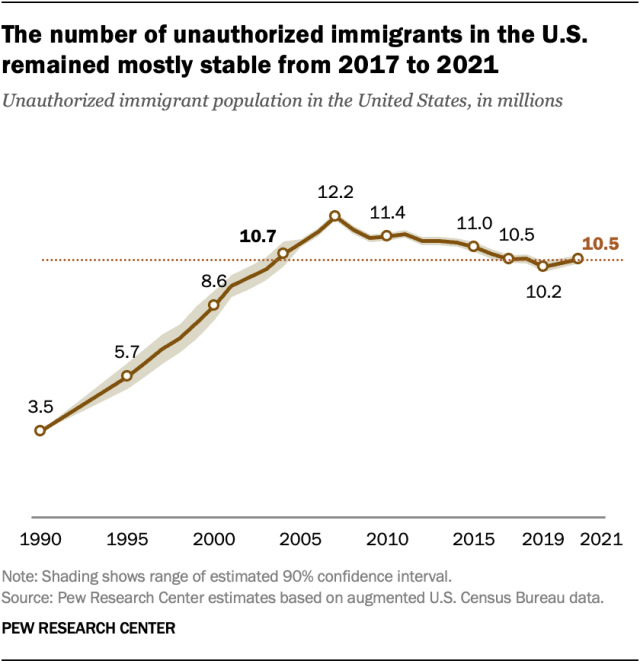
You’ve read and heard these beliefs perhaps for your entire life. You may believe them ardently. You and your friends may discuss them frequently. No one doubts them. Yet, they are wrong. Not even one of them is true. And I’m not talking about slightly wrong, or wrong because of some technicality. They all are fundamentally wrong, diametrically wrong. Wrong in every way that something can be wrong. Look through this blog to see the proofs of how wrong those beliefs are. Today’s blog discusses yet another set of wrong beliefs I’ve seldom touched on. Until now. They have to do with immigration.A line chart showing that the number of unauthorized immigrants in the U.S. remained mostly stable from 2017 to 2021. The false beliefs begin with this chart, which few people would have predicted. The alarmist rhetoric, mainly from the Republicans, may have made you believe that America is swamped with undocumented immigrants, especially since President Biden took over in 2021. But, according to Britannica ProOrg, the percentage of undocumented immigrants vs. total population has hardly budged in many years:
Percentage of US population undocumented immigrants

2022 3.5%;  2021 3.1%;  2020 ?*; 2019 3.5%;  2018 3.5%;  2017 3.5%; 2016 3.3%;  2015 3.4%;  2014 3.5%; 2013 3.6%;  2012 3.6%;  2011 3.7%; 2010 3.8%;  2009 3.5%;  2008 3.8%; 2007 3.9%;  2006 3.9%;  2005 3.5% *Unable to calculate estimate due to COVID-19 pandemic complications with the 2020 census.

Here’s what a population expert has found:

How Migration Really Works review: Prepare to have your mind changed Hein de Haas’s decades-long study of global migration should leave you rethinking what you thought you knew about this most divisive subject. by Simon Ings, 8 November 2023

Everyone who starts geographer Hein de Haas’s How Migration Really Works will have opinions about migration – few will finish with their preconceptions intact.

Drawing on three decades of research from his time at the University of Oxford and the University of Amsterdam, de Haas shows that everything we know about migration is wrong.

This isn’t because migration is an especially complex matter but because economic and political interests, on both the left and the right, have lost sight of the evidence – that is when they haven’t actively misrepresented it.

De Haas explores trends in global migration patterns, examines the impacts of migration on both destination and origin societies, and closes with a series of fairly devastating takedowns of popular ideas.

The problem runs deep. Take the frequently quoted figures released by the United Nations High Commissioner for Refugees (UNHCR), which “seem” to show that the global total of displaced people increased nearly 50-fold from 1.8 million in 1951 to 100 million in 2022.

What explains this shocking rise? Globalisation? War? Climate change? Issues with the statistics?

“What appears to be an unprecedented increase in refugee numbers,” de Haas explains, “is, in reality, a statistical artifact caused by the inclusion of populations and countries previously excluded from displacement statistics.”

UNHCR’s current figures are now truly global. But, its 1951 baseline figure was drawn from a database covering just 21 countries.

It is the direction of migration after the second world war that some in Western nations have found so disconcerting. The numbers have hardly changed.

At any time, around 3 percent of the world’s population are migrants. A tenth of those are refugees.

The figure for unsolicited border crossings (de Haas refuses to use the term “illegal crossings,” as it doesn’t capture the legal position outlined in the UN Refugee Convention) fluctuates erratically, depending on labor demand in destination countries and conflict in origin countries, but the underlying number remains stubbornly consistent.

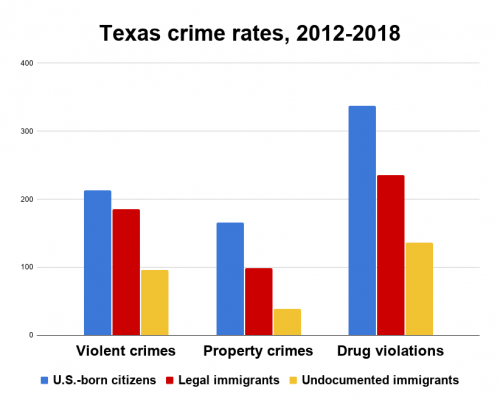
People go where jobs are available, and they flee turmoil. In short, people come to where they can work, contribute to an economy, and raise their children safely. They are not troublemakers. Quite the opposite. Immigrants are less likely to break the law than are citizens. This graph shows results in Texas

If migration levels are stable, historically, why all the emotion?

De Haas pulls no punches: “Although they may advocate very different solutions, politicians from left to right, climate activist and nativist groups, humanitarian NGOs and refugee organizations and media have all bought into the idea that the current era is one of a migration crisis.”

That this results in staggeringly wrong-headed policy-making comes as no surprise – witnessed massive US investment in border enforcement since the late 1980s.

This writes de Haas, has “turned a largely circular flow of Mexican workers going back and forth to California and Texas into an 11-million-strong population of permanently settled families living all across the United States”. They stay because it is too costly in every sense to keep moving.

Think about it. Strong borders keep undocumented immigrants from returning home. They fear they will not be able to return — a classic example of a law accomplishing exactly the opposite of its stated intention.

Catastrophizing migration also has a cultural impact. In host nations, nightmare migration scenarios are peddled to tickle every political palate.

An international cabal runs people smuggling. (No evidence.) The mafia are trafficking young women for sex. (No evidence.) Migration flows mainly from the poorer southern hemisphere to the wealthy north. (Wrong.)

Migration lifts all boats. (No. It overwhelmingly benefits the already affluent.) Where is the scenario that credits migrants themselves with connections, ambitions, foresight, agency, or even intelligence?

Politicians, especially on the right, describe migrants in the most negative terms as a criminal hoard invading America and planning to destroy our nation. The facts are quite the opposite:

The Secure Communities Program is pitched as a way to deport criminals before they can commit more crimes in the United States

But at least two independent studies suggest Secure Communities didn’t affect crime rates, according to  UW–Madison sociology professor Michael Light , despite deporting more than 200,000 people in its first four years.

“If the plan was to make communities safer, to reduce the likelihood of, say, a felony violent assault in these communities through deportation, it did not deliver on that promise,” Light says.

“Our results help us understand why that is. The population of people we deported simply was not a unique criminal risk. Removing them isn’t going to make you all that safer.”

While the new study can’t describe why undocumented immigrants commit fewer crimes, it’s a common finding that first generation immigrants tend to be less crime-prone — and undocumented immigrants are, almost by definition, first-generation immigrants.

(“Illegal immigrants are 44 percent less likely to be incarcerated than natives. Legal immigrants are 69 percent less likely to be incarcerated than natives. Legal and illegal immigrants are underrepresented in the incarcerated population while natives are overrepresented.” The Cato Institute)

Light believes there are many reasons to expect a lower crime rate among undocumented immigrants.

“They have a tremendous incentive to avoid criminal wrongdoing.

The greatest fear among undocumented immigrants is getting in legal trouble that leads to deportation,” says Light, whose work is supported by the National Science Foundation and National Institute of Justice.

Another factor at work may be that immigration, especially illegal entry into the U.S., is not easy. It attracts people with particular motives. 

“There’s lots of opportunity to commit crimes in Mexico and Venezuela and other places people are emigrating from,” Light says.

“The argument is that many people who want to immigrate are selected on attributes like ambition to achieve, to find economic opportunities, and those types of things aren’t very highly correlated with having a criminal propensity.”

Criminals are people who have less fear of the law than do those who resist any impulse to commit a crime. The traitors who invaded the Capitol on January 6, and tried to destroy America’s democracy, did not fear the law. They believed they would not be arrested and were confident they would not be deported. They were not undocumented immigrants. They were home-grown from right wing MAGA extremist groups like the Oath Keepers, Proud Boys, and Three Percenters.

How Migration Really Works is a carefully evidenced critique of a political culture that would rather use migration as a domestic passion-play than treat it as an ordinary and governable part of civil life.

To be pro and anti immigration is to miss the point entirely. You wouldn’t ask an economist whether they are for or against the economy, would you?

We are constantly told we need “a big conversation” about immigration. I am rereading this book (something crabbed reviewers never normally do).

Until I am done, I am going to keep my big mouth shut.

Simon Ings is a critic and writer based in London

SUMMARY As of this date, the book is not yet available to the public, but several things are clear.
  1. Far from being a threat, immigrants are an asset to America, as they always have been. Part of America’s strength comes from immigrants, the world’s most motivated people. By accepting immigrants, we receive those who are motivated to pull up roots in order to make better lives for themselves and their families, and in doing so, improve the nation that gives them refuge and opportunity. In short, immigrants to America are the best their former nations have to offer.
  2. Immigrants are less likely to be lawbreakers than are citizens.
  3. America needs the immigrant workforce, especially for seasonal work or for jobs citizens don’t want.
  4. The anti-immigrant rhetoric is based on bigoted, Trumpian fearmongering, not on facts.
Rodger Malcolm Mitchell Monetary Sovereignty Twitter: @rodgermitchell Search #monetarysovereignty Facebook: Rodger Malcolm Mitchell

……………………………………………………………………..

The Sole Purpose of Government Is to Improve and Protect the Lives of the People.

MONETARY SOVEREIGNTY

A doctor asks for recognition of Monetary Sovereignty — except he may not know it.

Here is a letter from a doctor, a cardiologist, who begs the U.S. government to understand Monetary Sovereignty. But, he may not know it. He may not know that the U.S. federal government is Monetarily Sovereign, so it never can run short of its sovereign currency, the U.S. dollar. He may not know that despite the common but mistaken, bleating about the federal debt and deficits, the U.S. has, and always will have, plenty of money to pay any bills, foreseeable and unforeseeable. Present the federal government with a billion-dollar invoice, and it could pay it in full today. Make that invoice a trillion dollars or a hundred trillion. Same thing. He may not know that even if the federal government also stopped collecting income tax dollars, FICA tax dollars, tariff dollars, student loan dollars, and all the other dollars it now receives, the government still could spend forever. Poor stressed young doctor showing his empty pockets Stock Photo | Adobe Stock Even without collecting any money, the Monetarily Sovereign U.S. government could pay any obligation denominated in dollars. Creating massive deficits does not affect the federal government’s ability to pay its creditors. The doctor may not know that federal deficits don’t cause inflation (Inflation is caused by shortages of crucial goods and services, most often oil and food.) In short, the doctor may not know that the U.S. government is infinitely wealthy, and that federal spending is necessary to grow the economy. And no, this has nothing to do with government ownership of the Mississippi River, the Rocky Mountains, the 200-mile Exclusive Economic Zone (EEZ), Lake Michigan, or the Statue of Liberty. It has to do with the fact that a Monetarily Sovereign nation has the infinite ability to create its own sovereign currency. This truth has been recognized by at least two respected Chairmen of the Federal Reserve, by a spokesperson for the St. Louis Federal Bank, by the head of the European Union, and by those of us who recognize the power of Monetary Sovereignty:

Alan Greenspan: “A government cannot become insolvent with respect to obligations in its own currency. There is nothing to prevent the federal government from creating as much money as it wants and paying it to somebody. The United States can pay any debt it has because we can always print the money to do that.”

Ben Bernanke: “The U.S. government has a technology, called a printing press (or, today, its electronic equivalent), that allows it to produce as many U.S. dollars as it wishes at essentially no cost.”

Scott Pelley: Is that tax money that the Fed is spending? Ben Bernanke: It’s not tax money… We simply use the computer to mark up the size of the account.

Statement from the St. Louis Fed: “As the sole manufacturer of dollars, whose debt is denominated in dollars, the U.S. government can never become insolvent, i.e., unable to pay its bills. In this sense, the government is not dependent on credit markets to remain operational.”

Question: I am wondering: can the ECB ever run out of money? Mario Draghi, President of the Monetarily Sovereign ECB: “Technically, no. We cannot run out of money.”

Mentally juxtapose the above facts about Monetarily Sovereign money issuers with these facts:

The US healthcare industry is experiencing a severe shortage of workers at every level, which has been worsened by the COVID-19 pandemic.

According to the American Hospital Association, the industry will face a shortage of up to 124,000 physicians by 2033. 

Meanwhile, it will need to hire at least 200,000 nurses a year to meet rising demands.

A study by consulting firm Mercer projected that the US would face significant healthcare worker shortages in the coming decade.

By 2025, the firm forecasts a shortage of more than 400,000 home health aides and 29,400 nurse practitioners

133 Hospital Waiting Room Crowd Stock Photos - Free & Royalty-Free Stock Photos from Dreamstime
Sick, and waiting for a doctor.

A major factor is demographics: People are living longer, requiring more medical attention as they do, while members of the aging healthcare workforce are starting to retire faster than they can be replaced.

Other reasons include burnout(overworked employees are leaving the profession at an accelerating rate); the rise in chronic conditions such as diabetes, heart disease, cancer, and Alzheimer’s disease (leading to overextended staff at hospitals and long-term care facilities); and the nation’s inability to produce enough doctors and nurses to meet growing demand (partly because of faculty shortages at nursing and medical schools).

Shortages of certain kinds of healthcare practitioners, such as nurses and certified nursing assistants, are also due to the relatively low compensation levels, relatively high job demands, and education requirements in those fields.

In summary:
  1. Our Monetarily Sovereign federal government has infinite dollars and infinite control over the value of its sovereign currency.
  2. There is an increasingly severe shortage of doctors, nurses, other healthcare workers, and hospitals.
Does putting # numbers 1 and 2 together give you any ideas? Now read the doctor’s letter:

The Broken Medicare System Is Forcing Physicians Out — Yet another physician pay cut will prevent timely access to care by Rick W. Snyder II, a cardiologist.  November 20, 2023 In any career, 25 years of dedicated work is much to let go of. In medicine, it amounts to hundreds of patient relationships and the blood, sweat, and tears that go into starting and maintaining a practice.

Yet, after all that time, one of my physician colleagues recently had to let go of her beloved private practice — not by choice and not without tears for her dear, elderly Medicare patients who now face fewer options for care.

Her story is, unfortunately not unique.

Physicians and their patients have suffered through more than 2 decades of uncertainty caused by precarious Medicare funding.

We’ve seen how these cuts have forced unwanted changes in medical practices. While their practices stay open, the Medicare system underpays our nation’s physicians to the point that some are forced to make difficult decisions about which patients they can care for.

Eventually, when these practices barely have their heads above water, that “next round of cuts” proves to be the last straw.

Like clockwork, another Medicare physician payment cut is on the horizon for January.

Why does an infinitely wealthy government cut payments to doctors, particularly when there is a growing shortage of doctors? Who is at fault for this ridiculous situation?

I’m afraid the day is near — if not already here — that there will not be enough physicians to care for Medicare patients.

Physicians who participate in the program are forced to do more with less, which leaves no good choices. The situation hinders our ability as physicians to provide the complex, quality care these elderly and sometimes disabled patients need and prevents us from seeing as many Medicare patients as we would like.

Furthermore, it contributes to burnout and moral distress because we can’t do what we swore an oath to do: to put our patients first.

As president of the Texas Medical Association (TMA), I hear concerns from our physician members as they face ongoing practice viability challenges.

“If this additional [Medicare] payment cut goes through, in the midst of inflation and COVID causing rising costs for staff salaries and benefits, I would have no choice but to stop caring for these patients,” a worried physician shared with TMA.

“We are dying,” said another. “I can’t even keep a full staff. All the doctors I have referred patients to are leaving or gone.”

“I’m terrified for what this will mean for my elderly patients and their access to care,” yet another concerned doctor said.

“The mental stress of making ends meet is not good for patient care,” another colleague warned.

Not only is this system unsustainable for our nation’s physicians, but it’s also unfairly stacked against them.

It’s the same system that concurrently pays hospital-based clinics more for some of the same services an independent community physician provides. On top of that, Medicare helps hospitals cover uncompensated care.

I’m not saying hospitals don’t deserve to be paid for what they do. But when independent physician practices get swallowed up by a hospital or bought out by another entity just to survive, the cost of care can increase, creating ripple effects on our economy.

This kind of rapid consolidation is rampant in our healthcare system, partly because of payment incentives like those in Medicare.

“Our practice is already shutting its clinic doors as we instead focus on being a purely hospital-based practice due to already meager reimbursement,” another worried Texas physician shared with TMA.

“We simply cannot afford the overhead. Ongoing cuts to [Medicare] physician reimbursement not only hurt us — the physicians trying to provide the best quality care to our patients — but it ultimately hurts the patients and their loved ones suffering from life-altering conditions.”

“I barely scrape through making payrolls every pay period. Any more [Medicare] reimbursement [cuts are] going to put me and thousands of physicians like me underwater and force us to shut down or join [a private] equity company or [insurer-owned] clinics who put their wallets ahead of patient care,” said another frustrated physician.

We should be preserving independent medicine and patient choice — not undermining it. It’s time for Congress to address the root of the problem.

Solutions

The first simple step physicians and other healthcare professionals can take is to advocate for Congress to enact laws directed at paying physicians fairly for services provided to Medicare patients.

At a minimum, that entails pay that keeps pace with inflation. Like other industries’ labor costs are tied to the Consumer Price Index (CPI).

But even a tie to the CPI won’t cure the growing shortage of doctors. America needs more doctors, not just the same number.

Medicare physician payments should at least be tied to a similar physician practice cost inflation measure, the Medicare Economic Index (MEI).

Several physician members of Congress are leading the charge on such a reform with a bipartisan House bill that behooves support: H.R. 2474, the Strengthening Medicare for Patients and Providers Act.

The legislation’s centerpiece is an annual, inflation-based Medicare physician payment update based on the full MEI.

Our current predicament is tied to the fact that Medicare physician payments haven’t even come close to keeping up with inflation over more than 20 years.

Since 2001, Medicare physician payments have lagged 26% behind inflation while hospital and other health industry payments have kept pace, according to the American Medical Association. Over the same period, the CPI for physician services in U.S. cities increased by 65%.

Just think about that: What would you say if you worked more than 20 years with no raise and pay cuts to boot? I know what my colleagues across Texas are saying:

“If [another cut is] enacted, our [Medicare] reimbursement rate will be lower than what we received in 2012,” one physician calculated.

Another said, “My Medicare reimbursement, factoring for inflation, is less than half of what it was in 1998.”

The frustration and the effect of Medicare payment cuts on physician practice viability are real. Likewise, access to care concerns for Medicare patients is therefore very real, too.

Don’t let a broken Medicare system break the backbone of the healthcare system for our most vulnerable patients.

Rick W. Snyder II, MD, opens in a new tab or window is a cardiologist and president of the Texas Medical Association.

Who is at fault for the cuts to doctor’s reimbursement, when funding should be increased dramatically to support the need for more doctors?
  1. Congress and the President, particularly the Libertarians and the Republicans, both of which care more about federal government money than the health of Americans.
  2. The American people have not questioned why the finances of the Monetarily Sovereign government take precedence over the finances of the monetarily non-sovereign public.
For more than 30 years, those few who understand Monetary Sovereignty have been explaining why an infinitely wealthy, Monetarily Sovereign government has the infinite ability and the moral obligation to fund certain services to the public, including:
  1. Education
  2. Health
  3. Shelter
  4. The environment
  5. Science
  6. Energy
  7. Elderly support
This does not imply government ownership (aka “socialism”) but rather, government funding of the private sector. The federal government already provides some funding for all these services, just not enough. The shortfall in funding results from the wrongheaded belief that federal funding is “unsustainable.” This is despite all the evidence that the federal government can “sustain” any level of spending. The government could provide a generous, comprehensive, no-deductible Medicare for every man, woman, and child in America. There should be no need for people to guess about whether they should buy a Medicare supplement policy, “A” through “N”, or whether to buy one of a dozen different Part D plans. All medical contingencies should and could be covered for everyone. And there should be no need for doctors and other healthcare workers to struggle financially, a struggle that leads to shortages in all areas of medical care. These people (along with teachers) should be among the best compensated of all Americans. The federal government has the wherewithal to assure that happens. The federal government could fund all education K through 16+ without collecting a penny in taxes. Homelessness never should become a financial necessity. Clean air, water, and land should be available to all. Scientists, who make the discoveries that improve our lives, should not be forced to beg universities for funding. The elderly should not need to struggle, financially. Dr. Snyder was forced by circumstance to write his letter. That is a disgrace to America. It is a disgrace that Libertarians and Republicans, and to a lesser degree Democrats, allow America’s rich to dictate impoverishing terms. If it were up to right-leaning politicians and the right-leaning public, we would have no Medicare, no “Obamacare,” no public schools, and no renewable energy. Poverty, homelessness, and starvation would be even more rampant than now. Our air, water, and land would be dirtier. Climate change will become unbearable. We would return to the times of royalty, where a handful of people lived utopian lives and the rest of use wallowed in misery. All who claim federal deficit spending is “unsustainable” or that “government is the problem,” fall into just two categories.
  1. The Liars, who do the bidding of the very rich and/or
  2. The Economically Ignorant, who were taught that federal finances are like personal finances and who haven’t been shown the facts.
There are no other alternatives. I suspect Dr. Snyder falls into category # 2. Shame on the liars of category #1 for destroying the American dream. Rodger Malcolm Mitchell Monetary Sovereignty Twitter: @rodgermitchell Search #monetarysovereignty Facebook: Rodger Malcolm Mitchell

……………………………………………………………………..

The Sole Purpose of Government Is to Improve and Protect the Lives of the People.

MONETARY SOVEREIGNTY

Believe it or not, the government lies to you.

I’m sure you will find this difficult to believe, but the U.S. government lies to you about many things, this time about its finances. The following is from the government Bureau of the Fiscal Service:

Executive Summary of the Fiscal Year 2022 Financial Report of the U.S. Government An Unsustainable Fiscal Path An important purpose of this Financial Report is to help citizens understand current fiscal policy and the importance and magnitude of policy reforms necessary to make it sustainable.

A sustainable fiscal policy is defined as one where the ratio of debt held by the public to GDP (the debt-to-GDP ratio) is stable or declining over the long term.

That is the definition of a “sustainable fiscal policy??? Who in the government invented such a definition? First, the debt/GDP ratio is a ridiculous, meaningless number with zero analytical or predictive power. A high ratio says nothing. A low ratio says nothing. A rising or declining ratio says nothing. The Debt/GDP ratio is a classic Apples/Oranges measure. GDP (Gross Domestic Product) is an annual, usually one-year measure of productivity. Debt is a decade-long measure of net deposits. GDP begins every year at 0. Debt is cumulative. Mathematically, it’s a silly fraction, no better than butterflies/butter churns. But it gets worse:

DEBT/GDP RATIOS BY COUNTRY

Countries with the Highest Debt-to-GDP Ratios (%) Venezuela — 350% Japan — 266% Sudan — 259% Greece — 206% Lebanon — 172% Cabo Verde — 157% Italy — 156% Libya — 155% Portugal — 134% Singapore — 131% Bahrain — 128% United States — 128%

Countries with the Lowest Debt-to-GDP Ratios (%) Brunei — 3.2% Afghanistan — 7.8% Kuwait — 11.5% Congo (Dem. Rep.) — 15.2% Eswatini — 15.5% Burundi — 15.9% Palestine — 16.4% Russia — 17.8% Botswana — 18.2% Estonia — 18.2%t

Do the above ratios tell you anything about whether a government’s fiscal policy is “sustainable”? Is Russia’s economy more “sustainable” than Japan’s and the US’s? Then there is this graph. What does it tell you about sustainability (whatever that supposedly means)?
Gross Federal Debt / DGP is red. GDP is dark blue. Real (inflation-adjusted) GDP is light blue.
The debt/GDP ratio rose during World War II. Then, for about 35 years, it declined until 1980, when it began to rise. In 1996, the ratio had a 5-year decline, after which it grew until 2020 and a short decline. Meanwhile, GDP has had relatively steady growth. So, what did the debt/GDP ratio tell you about the economy? What did it predict? What did the ratio say about “sustainability”? Nothing.

GDP measures the size of the nation’s economy in terms of the total value of all final goods and services that are produced in a year.

Considering financial results relative to GDP is a useful indicator of the economy’s capacity to sustain the government’s many programs.

I keep reading and rereading that phrase, “the economy’s capacity to sustain the government’s many programs. “ I can’t visualize what it means. Does it mean the government is running out of money (which, for a Monetarily Sovereign government is impossible)?

Former Federal Reserve Chairman Alan Greenspan: “There is nothing to prevent the federal government from creating as much money as it wants and paying it to somebody.” 

Does it mean the government doesn’t have enough people to run its programs? (Just hire enough people.) Or what? World War II tested the government’s “capacity to sustain many programs.” It merely spent more money, hired more people, and sustained very nicely, thank you. Since then, despite repeated claims that the federal debt is a ticking time bomb,” and much to the consternation of the debt Henny Penny crowd, the economy keeps growing and remaining healthy. Even COVID was only a short-term setback for the U.S. economy.

This report presents data, including debt, as a percent of GDP to help readers assess whether current fiscal policy is sustainable. The debt-to-GDP ratio was approximately 97 percent at the end of FY 2022, down from roughly 100 percent at the end of FY 2021.

The long-term fiscal projections in this report are based on the same economic and demographic assumptions that underlie the SOSI.

The Statement of Social Insurance (SOSI) presents the projected actuarial present value of the estimated future revenue and estimated future expenditures of the Social Security, Medicare, Railroad Retirement, and Black Lung social insurance programs which are administered by the SSA, HHS, RRB, and DOL, respectively. In short, the government is comparing probable expenses of these social programs with projected revenue — mostly tax receipts. There’s one small problem with that comparison. The federal government’s finances are nothing like the finances of monetarily non-sovereign entities like you, me, businesses, and local governments, which require income to pay bills. The federal government requires, and indeed uses, no income to pay its bills. Being Monetarily Sovereign, it creates new dollars every time it pays a creditor. In fact, paying creditors is how the federal government creates dollars.

To pay a bill, the government sends instructions (not dollars) to the creditor’s bank. The instructions are in the form of a check or wire, telling the bank to increase the balance in the creditor’s checking account (“Pay to the order of”).

When the bank does as instructed, new dollars are created and added to the M2 money supply measure.

Thus, even if the federal government received $0 taxes and any other revenue, it could continue spending forever simply by sending instructions to banks.

The current fiscal path is unsustainable.

To determine if current fiscal policy is sustainable, the projections based on the assumptions discussed in the Financial Report assume current policy will continue indefinitely.

The projections are therefore neither forecasts nor predictions.

Nevertheless, the projections demonstrate that policy changes need to be enacted for the actual financial outcomes to differ from those projected.

I don’t know what the above paragraphs are supposed to mean, but I’ll take a guess. See if you agree with this translation:

“The government can’t keep increasing deficits the way it has been for the past eighty years. We don’t know why, but it simply can’t.

“Although this isn’t a forecast or a prediction (if there is any difference between the two), something has to change, just because we say so.”

If there is another meaning, please let me know.

The debt-to-GDP ratio ratio was approximately 97 percent at the end of FY 2022. Under current policy and based on this report’s assumptions, it is projected to reach 566 percent by 2097.

The projected continuous rise of the debt-to-GDP ratio indicates that current policy is unsustainable.

Let’s return to the Debt/GDP graph. In 1974, the Debt/GDP ratio was 23%. By 2022, 48 years later, the ratio was 97%, a 4.217-fold increase. The government forecasts and predicts (Oops, supposedly it isn’t a forecast or a prediction) — let’s say it’s a WAG (wild ass guess) that by 2097, which is 75 years later, the ratio will be 566, which represents a 5.8% increase from the 97% of 2022. In short, we had a 4.217-fold increase in 48 years, and the WAG is for a 5.8-fold increase in 75 years. And that is supposed to be “unsustainable.” Except . . . Except the Treasury’s WAG is that future ratio growth proportionately will be less than the past ratio growth. Apparently, Wild Ass Guesses aren’t as accurate as they used to be. Not that it matters because, as we have seen, Debt/GDP for a Monetarily Sovereign entity is meaningless. Federal “debt” isn’t federal, and it isn’t debt. It’s deposits into T-security accounts that are wholly owned by the depositors and never invaded by the federal government. That’s right. The government doesn’t own or even touch those dollars. They belong to depositors. The government merely holds them in safe keeping, like it holds whatever is in your bank safe deposit box. To “pay off” the misnamed “debt,” the government merely returns the depositor’s’ dollars to the depositors. It does that every day. Think about it. Do you really think the government of China would turn over ownership of billions of their dollars to U.S. government usage? In summary, the Treasury supports the lie that the growing “Federal Debt/ GDP is in some way “unsustainable,” without ever saying what they mean by “unsustainable.” There never has been a time when the U.S. government has not been able to “sustain” (whatever that means) its “debt” (whatever that means). So why the lies? For much of the government, it’s pure ignorance. The people writing this stuff simply do not understand Monetary Sovereignty. But for some, it’s malevolence, paid for by the rich who run America. “Rich” is a comparative. There are two ways to become richer: Get more for yourself or make those below you have less. A millionaire is rich if everyone else has a thousand dollars. But a millionaire is poor if everyone else has a billion dollars. It’s the income/wealth/power Gap that determines whether you are rich or poor. Cutting the Debt/GDP ratio requires cuts to such programs as Social Security, Medicare, and/or other benefits for those who aren’t rich. Or it requires increases in FICA and income taxes — the taxes that most affect the not-rich. You seldom hear recommendations to reduce the tax loopholes enjoyed by the rich. By impoverishing the middle and the poor, the rich make themselves richer. So, they bribe the media, the politicians, and the university economists to tell you your benefits must be cut and your taxes increased because “the current policy is unsustainable.” They rely on the public’s ignorance about Monetary Sovereignty, and so far, that has worked. Rodger Malcolm Mitchell Monetary Sovereignty Twitter: @rodgermitchell Search #monetarysovereignty Facebook: Rodger Malcolm Mitchell

……………………………………………………………………..

The Sole Purpose of Government Is to Improve and Protect the Lives of the People.

MONETARY SOVEREIGNTY