As America begins its descent into hell.

In the 1930s, the German people began their descent into hell.
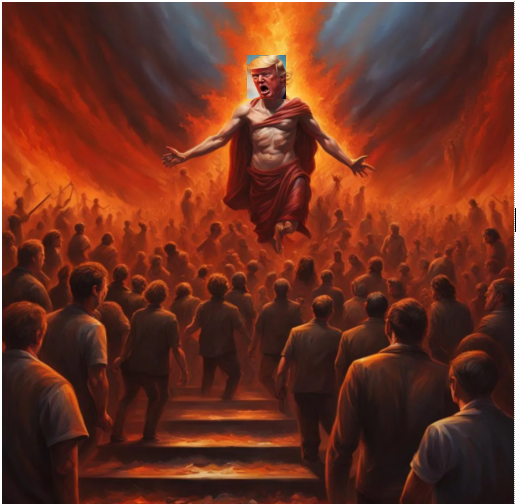
America’s descent into hell

Led by Adolf Hitler, the entire nation went mad with fear and hatred.

The systematic murder of Jews and other “undesirables” — i.e., anyone but white Christian Germans — was only an example of the horrors visited upon those people by . . . by the people themselves.

Hitler led, and the people followed, unquestioning, as though he were a god. 

None of his crimes were criticized; all were excused. In fact, Hitler’s criminality made him even more revered by the great mass of Germans.

Morality, sympathy, and empathy disappeared beneath a fist of iron. Hatred and cruelty were admired. 

The excuse, if there can be one, was the onerous economic conditions forced upon the German people by the winners of World War I. Hyperinflation and unemployment swept the nation. The people starved.

They desperately wanted a savior; Hitler gave them the promises they craved.

Never mind that his promises were smoke from hellfires. The people learned too late.

Germany gave economic excuses; where are America’s excuses? Our economy thrives like no other.

Now it is 2024. America. Inflation is dropping,

Poverty has declined since 2012, temporarily interrupted by the COVID-19 recession. 

Unemployment is near historic lows.

Contrary to popular imagination, the immigrants coming over our southern border benefit America.

They are much less likely to commit crimes than American citizens.

And they fill important job availabilities– the lowest, drudgery, stoop-labor, low-education jobs few American citizens seem to want.


Before and after COVID, unemployment has been near historic lows

America is not perfect. No nation is, nor ever has been.

We still have people who have grasped the short end of the stick — the impoverished, the sick who have no insurance.

We still have targets of bigotry, perhaps more now than in recent years.

We still have homelessness.

We still have the “tempest-tost” we welcomed with the Statue of Liberty.
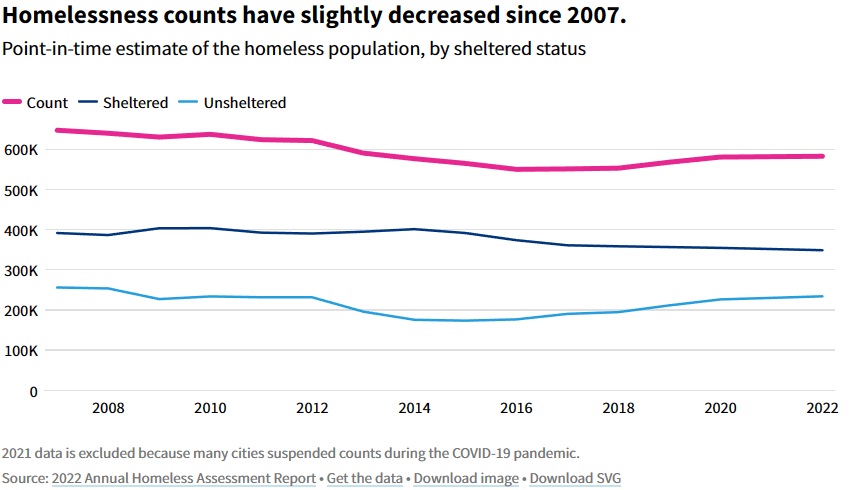
Homelessness is lower than it was ten years ago.

But there is nothing to indicate the American people should feel the desperation that leads to abandoning the great American experiment in democracy.

There is nothing to indicate we now should praise criminality.

There is nothing that says an entire religion — Christian Evangelism — should desert traditional Christian morality and blindly follow a man who rejects everything Evangelism always has stood for.

Yet, here we are:


THE WEEK, January 16,2024
The prospect of a second Trump term is terrifying for many reasons, said David French, but what I dread most is how his reelection would accelerate the ongoing cultural transformation of red America in towns like mine in Tennessee.

Trump is the most culturally influential person – revered far more than any pastor, politician, coach, or celebrity.

My fellow Christian evangelicals treat Trump as a prophet with his followers due to emulating their cult leader’s grievance-filled extremism and boorish behavior.

The result is a religious movement steeped in fanaticism but stripped of virtue.

American Evangelicals no longer think a politician’s personal and public morality matter.

In fact, Trumpism has led to a wave of what has been dubbed “vice signaling,” in which Trump‘s core supporters convey their tribal allegiance by being deliberately rude, transgressive, or otherwise unpleasant just to demonstrate how little they care about conventional moral norms.

Many now justify threats of violence and actual violence against Trump’s opponents and are described by friends and family as “lost.”

A Trump win in 2024 would absolutely convince countless Americans that virtue is for suckers and vice is the key to victory.

Before Trump, if I had told you that the number of contributions to a politician’s election campaign was directly proportional to the number of criminal indictments he received and lawsuits he lost, you would have laughed at the ridiculousness.

Before Trump, if I had told you that a jury fined a candidate millions of dollars for sexual abuse, and the candidate’s followers loved him more, especially when he continued the abuse after the verdict, you would have been shocked.

Jan. 26, 2024: Trump-Carroll Defamation Trial Jury Orders Trump to Pay Carroll $83.3 Million for Defamation The jury found Donald J. Trump had acted maliciously in persistently attacking E. Jean Carroll. He was found liable last year for sexually abusing her. 

Before Trump, if I had told you the candidate and his party that most railed against undocumented immigrants has been telling Congress to vote against laws that would stop those immigrants, you would have scoffed, but:

For weeks, a legislative package that addresses security on the United States’ southern border and provides funding for Ukraine and other allies has been in negotiations in the Senate.

It looks like that bill is now DOA after presumptive Republican presidential nominee Donald Trump told senators in January to sink it because he wants to campaign on those issues.

Soon after, several lawmakers confirmed that Trump wanted the bill dropped.

Many Republican and Democratic legislators publicly reacted to his request to toss the bill, with some openly defying the former POTUS’s request.

Before Trump, if I had told you a former President plotted a coup against America and, when the coup was underway, refused to do anything to stop it, you would have said, “He’s a traitor.”

But not only did it happen, but disgustingly, it increased the adoration of his pseudo-patriotic cult followers.

US District Judge Royce Lamberth — whom conservative icon Ronald Reagan appointed to the federal bench in 1987— gave an ominous warning Thursday about the threat historical revisionism surrounding the January 6 insurrection poses to democracy.

According to NBC News, Judge Lamberth said he was “shocked” by comments made by some elected officials that dismissed or downplayed the violent siege of the US Capitol in 2021.

He said that those “preposterous” comments about the Capitol riot “could presage further danger to our country.”

“In my thirty-seven years on the bench, I cannot recall a time when such meritless justifications of criminal activity have gone mainstream. I have been dismayed to see distortions and outright falsehoods seep into the public consciousness.” 

“I have been shocked to watch some public figures try to rewrite history, claiming rioters behaved ‘in an orderly fashion’ like ordinary tourists, or martyrizing convicted January 6 defendants as ‘political prisoners’ or even, incredibly, ‘hostages.'”

 The Republican National Committee even passed a resolution a year after the attack, calling the deadly riot that killed five police officers and injured hundreds of others “legitimate political discourse.”

Before Trump, if I had told you a former president who had sworn to uphold the Constitution would deliberately defy the Constitution, what would you have said?

Trump calls for “all willing states” to deploy National Guard troops to Texas.
Amid Texas’ ongoing, dangerous, and flatly unconstitutional fight with the federal government over deadly razor wire installments along the US-Mexico border, called for “all willing States to deploy their [national] guards to Texas to prevent the entry of Illegals, and to remove them back across the Border.”

Border enforcement is the federal government’s business. Gov. Greg Abbott’s high-stakes game of chicken is only worsening an incredibly challenging situation. Trump’s call for state troops to rise up against the Biden administration is a direct and profoundly unsettling assault on the rule of law.

Beans Battles: Goya, the Trumps, and the Power of Food - Fabio Parasecoli
It’s illegal for a federal employee to promote a product. Would anyone like to buy some classified documents? My friend Putin? China? Anyone?

Before Trump, if I had told you the President of the United States defied the Constitution by accepting millions of dollars from China, Saudi Arabia, and Qatar, what would have been your reaction?

Donald Trump admitted he did receive money from foreign governments, such as China, while he was president, as his business was providing a “service” for them.

The U.S. Constitution’s foreign emoluments clause prohibits federal officials from accepting money or gifts from foreign governments without permission from Congress.

During his first two years as president, four businesses owned by Trump received around $7.8 million from 20 countries during his time in office, including at least $5.5 million from China.

The report was released amid House Republicans’ attempts to impeach President Joe Biden over allegations he benefited from his son Hunter Biden’s foreign dealings while in office, despite no evidence to back up the claims.

Although Trump continually accuses the Democrats of “weaponizing” the Justice Department, it is Trump’s Republicans who have spent many months fruitlessly trying to invent evidence against President Biden for doing precisely what Trump admitted he did.

Trump said he plans on retaining his stake in his real estate empire, The Trump Organization if he wins the 2024 election while defending the money he previously received from foreign officials.

“If I have a hotel and somebody comes in from China, that’s a small amount of money. But I was doing services for them, people were staying in these massive hotels, these beautiful hotels—because I have the best hotels and the best clubs, I have great stuff—and they stay there and they pay.

“I don’t get $8 million for doing nothing,” Trump added.

Whether Trump’s hotels are “beautiful” or “have great stuff” is irrelevant. The Constitution prohibits the President from receiving money from foreign nations. Period.

All federal officeholders are forbidden from “accepting money, payments, titles, offices or gifts of any kind “from any king, prince or foreign state” under the Constitution without the consent of Congress. Trump never sought this approval.

Here is a list of illegal payments Trump received from foreign nations: China ($5,572,548), Saudi Arabia ($615,422), Qatar ($465,744), Kuwait ($303,371), India ($282,764), Malaysia ($248,962), Afghanistan ($74,810), Philippines ($465,744), United Arab Emirates ($65,225), Democratic Republic of the Congo ($25,171), Kazakhstan ($23,772), Thailand ($11,340), Self-declared Turkish Republic of Northern Cyprus ($8,800), Mongolia ($8,486), Lebanon ($7,720), Albania ($6,002), Kosovo ($4,950), Latvia ($2,739), Turkey ($1,894), Hungary ($1,011), Cyprus ($590)

Lest you believe Trump is the only criminal in the Republican party, his influence can be seen throughout the right wing.

GOP Rep. Lauren Boebert’s decision to run in the more GOP-friendly 4th Congressional District was front-and-center in the debate, with her rivals for the nomination calling her out as a carpetbagger.

In particular, State Representative Mike Lynch (R) fired back at her after she brought up his DUI arrest by asking her, “Can you give the definition of ‘carpetbagger’ to me?”

According to the Times report, “At one point, candidates were asked to raise their hands if they had ever been arrested. Six of the nine candidates onstage raised their hands to cheers and applause from the audience.

Can you imagine that politicians would be cheered and applauded for being arrested in previous years? In today’s GOP, being arrested is a sign of loyalty to Trump. 

Devil with dollars
Let’s be clear. It always was about the money.

Trent Leisy, a Navy veteran and business owner, high-fived Mr. Lynch and Ms. Boebert while their hands were raised.”

Boebert admitted to having been arrested only once over “a simple traffic violation that was unpaid,” the Times’ Chris Cameron added, “the local news media have reported at least two additional arrests.

In one incident in 2015, Ms. Boebert told police officers who were arresting her that she ‘had friends at Fox News’ and that the arrest would be national news.”

Is it hopeless? Is America doomed to follow Germany, Italy, and so many other nations down the dictatorship rabbit hole?

Or will our innate “Statue-of-Liberty” morality rise again (sometimes at the last moment) and prove to ourselves and to the world that we are not only the finance and military leaders but the moral leaders we believe ourselves to be?

More than 20,000 Christians have signed a petition calling for the boycott of pro-Trump evangelist Franklin Graham’s tour for the U.S.-Mexico border that is set to begin next month.

Faithful America, an organization of Christians supporting social justice causes while opposing “Christian nationalism,” published a petition last November calling on boycotts of Graham’s “God Loves You Frontera Tour.”

The organization is calling on venues hosting the tour to “stand up to Graham’s anti-LGBTQ hate and political violence,” writing that it is “critical that we show the public and the press that Graham’s right-wing ideology doesn’t represent all of Christianity.”

The petition has already received over 20,000 signatures and has a goal of 25,000 signatures.

“Despite the tour’s deceptive name, Graham is a divisive figure who tries to hide a series of deeply hateful messages behind his father’s Christian legacy. His message is not one of Christ-like love but of anti-democracy, anti-LGBTQ, partisan bigotry and harm.”

Are we beginning to come to our senses? Is there still hope for our nation and for our children?

Or have we awakened too late? Is this the end of the UNITED STATES of America?

Has evil defeated us?

Far-right Representative Marjorie Taylor Greene called for a “national divorce” between red and blue states as a means for far-right Republicans to get extreme, conservative policies implemented in red states without having to go through the democratic process.

Updated list of states announcing they stand with/ Texas in border dispute w/ federal government: Florida, Virginia, Georgia, North Dakota, South Dakota, Tennessee, Alabama, Montana, Idaho, Utah, West Virginia, Oklahoma, Nebraska, LouisianaAmericans descend into hell

Have we begun an unstoppable descent into hell?

You tell me.

Rodger Malcolm Mitchell

Monetary Sovereignty

Twitter: @rodgermitchell

Search #monetarysovereignty

Facebook: Rodger Malcolm Mitchell

……………………………………………………………………..

THE SOLE PURPOSE OF GOVERNMENT IS TO IMPROVE AND PROTECT THE LIVES OF THE PEOPLE.
If ignorance contained calories, Senator Marco Rubio (R-FL) would weigh 10 tons.

If ignorance contained calories, Senator Marco Rubio would weigh 10 tons. Here are excerpts from a letter he sent to me.

I recently received response to a letter I sent him asking why a Monetarily Sovereign government was so hesitant to spend U.S. dollars on programs that help Americans.

Thank you for taking the time to express your thoughts regarding spending and the federal budget.

Understanding your views helps me to better represent Florida in the United States Senate, and I appreciate the opportunity to respond.

As of May 20, 2021, the US national debt had reached over $28.3 trillion. This is an unsustainable course that Congress must address.

Immediately, this Senator of the United States shows his ignorance of federal financing.

Being Monetarily Sovereign, the U.S. federal government can “sustain” any financial obligation denominated in its own sovereign currency, the U.S. dollar. As people who do understand federal finance have said:

Former Federal Reserve Chairman Alan Greenspan said: “A government cannot become insolvent with respect to obligations in its own currency. There is nothing to prevent the federal government from creating as much money as it wants and paying it to somebody. The United States can pay any debt it has because we can always print the money to do that.”

Former Federal Reserve Chairman Ben Bernanke: “The U.S. government has a technology, called a printing press (or, today, its electronic equivalent), that allows it to produce as many U.S. dollars as it wishes at essentially no cost. It’s not tax money… We simply use the computer to mark up the size of the account. “

St. Louis Federal Reserve: “As the sole manufacturer of dollars, whose debt is denominated in dollars, the U.S. government can never become insolvent, i.e., unable to pay its bills. In this sense, the government is not dependent on credit markets to remain operational.”

Federal finances are not similar to state/local government, business, or personal finances. Though the same words — “debt,” “deficit,” “owe,” “borrow,” “surplus,” etc., — are used for all types of finances, these words have different meanings, depending on which party’s money is being referenced.

Federal “debt” is not money the federal government owes. It is money the federal government holds for T-security owners. The so-called debt is nothing more that the total of deposits into T-security accounts (T-bills, T-notes, and T-bonds).

Unlike private bills, notes, and bonds, which do represent borrowing, federal bills, notes, and bonds do not. Because the U.S. government has the infinite ability to create U.S. dollars, it never borrows dollars.

T-security accounts are similar to safe-deposit boxes. Their purpose is not to provide the federal government with spending money, of which it already has an infinite supply. Just as a bank never touches the contents of safe deposit boxes and does not owe the depositor anything, the federal government never touches the dollars in T-security accounts, and does not owe the depositor anything.

When the accounts reach maturity, the government simply allows the depositor to reclaim them. This is not a financial burden on the government. It is infinitely “sustainable.”

The purposes of T-securities are:

  1. To provide the public with a a safe place to store unused dollars. This stabilizes the value of dollars.
  2. To help the U.S. government control interest rates by arbitrarily setting the rates for T-securities.

Though the so-called federal “debt” approaches $30 trillion, the U.S. government does not owe $30 trillion. It pays all its bills on time. It is not a “debtor.”

Rather than being called “debt,” those securities should go by their correct term: Deposits.

On February 3, 2021, Senator Cindy Hyde-Smith and I introduced a resolution to enact a balanced budget amendment to the United States Constitution.

“Balanced budget” is a good idea for states, businesses, you, and me, but a horrible idea for the federal government because it limits the amount of money in the private sector (also known as “the economy.”)

Rubio surely knows this, and also knows such an amendment has zero chance of passing. But he wants to fool you into thinking he is financially astute. 

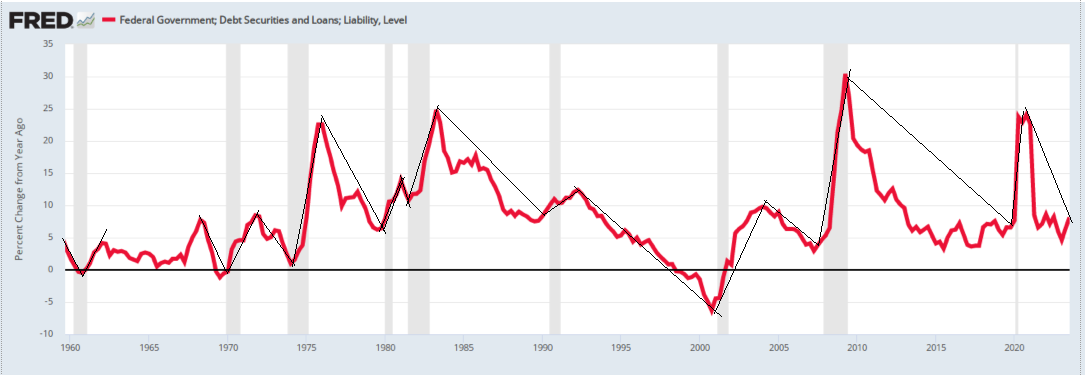
The following graph shows that recessions begin with reduced federal deficits and end when deficits increase. The reason: Federal deficits add growth dollars to the economy.

Diagonal lines show that recessions (vertical gray bars) begin when federal deficits (red line) are reduced. Recessions are cured when federal deficits are increased.

Why are recessions introduced by reduced federal deficits? Because recessions are defined as two consecutive quarters of falling Gross Domestic Product (GDP). And GDP is calculated as follows:

GDP = Federal Spending + N0n-federal Spending + Net Exports

The more spending the greater is GDP. 

The bill has 14 co-sponsors and is referred to the Senate Committee on the Judiciary. On March 4, 2021, Representative Vern Buchanan introduced a companion resolution in the House of Representatives, referred to the House committee and the judiciary.

Thus, we are told that at least 14 Senators are ignorant about federal financing, a shocking indictment of people who each day make decisions about federal spending. Great power + ignorance = tragedy.

A balanced budget is based on common sense principles that should be installed in the US Constitution.

This would force politicians in Washington to do what every family across the United States must do to balance their budgets.

Senator Rubio should have the words “I am ignorant” tattooed on his forehead. A family should spend no more than its income. When the federal government spends no more than its income, the economy cannot grow.

Where would the additional money come from if not from the federal government?

Private banks create dollars by lending, but these dollars must be paid back, plus interest. Paying back loans destroys dollars.

The dollars spent by the federal government need not be paid back. Those are the dollars that grow GDP.

GDP = Federal Spending + Nonfederal Spending – Net Imports.

Because U.S. imports traditionally exceed exports, the federal government must run deficits for GDP to remain level. For GDP growth, the federal government must run deficits.

This would also prevent us from continually passing the bill to the next generation.

There is no bill being “passed to the next generation.” Federal deficit spending passes additional dollars to the next generation. It’s inconceivable that Sen. Rubio does not know this, so one must assume he is lying.

Much of the recent increase in the national debt has come from federal spending related to the COVID-19 pandemic. As you may know, COVID-19 was declared a public health emergency for the United States on January 30, 2020, after the outbreak began in Wuhan, China.

On March 27, 2020, President Trump signed into law the bipartisan act, which was a $2 trillion emergency relief package that, among other things, provides small businesses with direct assistance to stay in business and keep American workers employed.

Think, Sen. Rubio. If federal deficit spending was harmful, why would the federal government deficit spend to fight COVID? Why would the government spend to assist small businesses and keep American workers employed?

As chairman of the Senate committee and small business and enterprise ship last Congress, I included legislation that made $349 billion in forgivable loans to small businesses and nonprofits available through the paycheck protection program.

Here, the Senator who wants a balanced budget boasts about helping pass $349 billion in deficit spending. Does he realize how ignorant that is?

On December 27, 2020, President Trump signed into law an act that provided $1.4 trillion to fund the federal government through September 30, 2021.

While reducing federal spending is one of my top priorities, I believe it was appropriate during the COVID-19 pandemic to help small businesses stay open by providing government assistance.

Does this make any financial sense at all? The people of America were in financial difficulty, so to combat that, the federal government spent more dollars, which, according to the 14 ignorant Senators, put the nation in greater financial difficulty.

It boggles the mind to see that Rubio et al. see no contradiction. Federal spending helps America because it adds dollars to the economy — dollars that do not need to be paid back.

If the federal government ran a balanced budget, the dollars would have to be paid back, at which time America would suffer a depression.

U.S. depressions tend to come on the heels of federal surpluses.

1804-1812: U. S. Federal Debt reduced 48%. Depression began 1807.
1817-1821: U. S. Federal Debt reduced 29%. Depression began 1819.
1823-1836: U. S. Federal Debt reduced 99%. Depression began 1837.
1852-1857: U. S. Federal Debt reduced 59%. Depression began 1857.
1867-1873: U. S. Federal Debt reduced 27%. Depression began 1873.
1880-1893: U. S. Federal Debt reduced 57%. Depression began 1893.
1920-1930: U. S. Federal Debt reduced 36%. Depression began 1929.
1997-2001: U. S. Federal Debt reduced 15%. Recession began 2001.

On March 11, 2021, President Biden signed the American Rescue Plan Act, a $1.9 trillion COVID-19 relief package, into law, unlike previous COVID-19 relief packages. This bill was passed with a solely partisan vote in the Senate.

I did not support that bill as it spent hundreds of billions of dollars on items unrelated to COVID-19 recovery, including bail-out for state and local governments.

It also failed to reopen schools, created welfare programs, and funded ridiculous pet projects like an underground railway in Silicon Valley.

In addition to the wasteful spending enacted by the plan, President Biden has proposed even more wasteful spending in his proposed federal budget. Despite having just spent $1.9 trillion, President Biden has proposed a more than 1.5 trillion federal discretionary budget.

Now that the economy is reopening, Congress must rein in reckless federal spending and prioritize policies that get Americans back to work and help the economy cover.

Totally illogical. The so-called “wasteful spending” was not wasteful. It added growth dollars to GDP. “Prioritize polices that get Americans back to work,” signals that Rubio believes the poor are lazy bums with no aspirations to improve their lives. 

So, if you give the poor and middle classes any financial aid, they simply will stop working. That is the claim of the idle rich as they lounge on their yachts.

Today, the economy is healthy and growing. Inflation is dropping. Interest rates will fall, all because of the “wasteful spending.”

While Sen. Rubio may disagree with the projects being funded, there is no such thing as federal wasteful spending. Federal spending adds growth dollars to the economy. It creates jobs and helps businesses.

Imagine the federal government spending a billion dollars to dig a hole and fill it in. Is that wasteful? No, because it would employ people and aid businesses.

It also would cost federal taxpayers nothing because, contrary to popular myth, federal taxes do not fund federal spending. The federal government pays all its bills by creating new dollars ad hoc. It does not use tax dollars. It does not “live within its means.” It cannot run short of dollars, even if it collected $0 taxes.

 Federal taxes are destroyed upon receipt.  (State/local tax dollars go into private banks and are not destroyed.)

You pay your federal taxes with dollars from your checking account. Those dollars are part of the M2 money supply measure. But when they reach the U.S. Treasury, they no longer are part of any money supply measure. They are effectively destroyed. 

The public can be excused for its ignorance about federal financing. We, the people, rely on our political representatives to understand. That’s why we vote for them. So, for Senators to be so ignorant about federal finance is a disgrace.

Example: Because of such ignorance, Medicare woefully lacks coverage. It doesn’t pay for Health care costs for spouses and dependents, deductibles and co-payments, long-term hospitalization, dental, non-medically necessary vision and hearing, non-medically necessary foot care, nursing home care, international medical care, and cosmetic surgery.

Why?

The federal government has infinite dollars, which it creates by pressing computer keys. Why does Medicare not pay for many things?

Let’s say your father is a billionaire, and you ask him to pay your dental bill. Would you refuse? The federal government, which has far more money than a billionaire, refuses. Why?

Because Senators like Rubio spread the disinformation that the government must live within its means and that taxpayers fund federal spending — both are lies.

Consider colorectal cancer. Each year, over 150,000 Americans are diagnosed with colon cancer. It’s the fourth-leading cause of cancer in the United States and the second-leading cause of cancer-related deaths.

Clinical guidelines recommend colon cancer screening begin at age 45 for people at average risk. Screening should begin sooner for anyone with a family history or other risk factors. One would think the infinitely rich federal government would do everything possible to detect, treat, and cure colon cancer.

But no. If during a screening, your doctor finds and removes a polyp or other tissue, you pay 15% of the Medicare-Approved Amount for your doctor’s services. In a hospital outpatient setting or ambulatory surgical center, you also pay the facility a 15% coinsurance amount.

For many people, those 15% charges are a financial hardship. Why must you pay anything?

Why are there Medicare deductibles? Why are there co-payments? Why is long-term hospitalization not covered? Why aren’t reading glasses covered? Why aren’t nursing homes covered?

Ignorance.

The U.S. government is infinitely rich — far richer than anyone who has lived. Yet, Sen. Rubio et al. claim that federal spending is “unsustainable” and the government should run a “balanced budget.”

The sole mission of any government is to protect and improve the people’s lives. Being Monetarily Sovereign, the U.S. government can easily afford to protect and enhance your life.”

–Comprehensive, no-deductible health care insurance for every man, woman, and child in America

–Social Security for every person in America, with unique benefits for the elderly

–Extend free education from grades K-12 to K-16+

The rich don’t want it because they want the rest of us to be desperate. They want a workforce that will accept low-pay, low-benefit jobs, hoping we won’t outlive our money somehow.

Sen. Rubio, of course, has no such worries. He expects you to vote for his health and retirement security, not yours.


Rodger Malcolm Mitchell

Monetary Sovereignty

Twitter: @rodgermitchell

Search #monetarysovereignty

Facebook: Rodger Malcolm Mitchell

……………………………………………………………………..

THE SOLE PURPOSE OF GOVERNMENT IS TO IMPROVE AND PROTECT THE LIVES OF THE PEOPLE.
Have you heard of “True Cost Accounting”?

An article in the December 2, 2023 New Scientist Magazine has me puzzled.

The article deals with “True Cost Accounting” (TCA), which attempts to account for all the costs associated with the creation of products and services. Most importantly, this includes environmental costs.

While I sympathize with the desire to identify environmental problems and solve environmental needs, I question whether TCA helps or hurts that mission.

Here are some excerpts from that article:

How counting the true cost of cheap food could make a better world,  Graham Lawton

What we pay for food and other goods doesn’t reflect the environmental and social damage they cause. But a radical new approach to economics could change that. By Graham Lawton, 28 November 2023

IN THESE difficult times, it seems utterly bananas to say that food is underpriced. In the UK, average grocery bills have risen by more than 12 per cent in the past year. But it is.

The price tags on food are way lower – by about two-thirds – than what they would be if we were paying the full cost. Don’t worry, though, there are plans to sort this out.

In reality, we already pay the true price, it is just that most of it is stealthily hidden from us. “We pay overall four times for our food,” says Alexander Müller at the sustainability think tank TMG in Berlin.

First, we pay at the checkout.

Then we pay for the health, environmental and social costs of producing that food, mostly though taxes.

Uh oh. My antennae go up when I see the word “taxes.”

Though taxes indeed are a cost to the public, they are not the result of health, environmental or social problems.

The U.S. and UK governments, unlike city, state and county governments, are Monetarily Sovereign (MS). That means they both (and other MS) governments have the infinite ability to create money.

They never unintentionally can run short of their own sovereign currency.

Former Federal Reserve Chairman, Ben Bernanke: “The U.S. government has a technology, called a printing press (or, today, its electronic equivalent), that allows it to produce as many U.S. dollars as it wishes at essentially no cost.”

For that reason, “we” don’t pay for health, environmental, and social costs via taxes. Our central government’s taxes pay for nothing. In fact, U.S. federal taxes are destroyed upon receipt.

One purpose of government taxes is to help our central government control the economy by discouraging what the government doesn’t like and by rewarding what the government likes.

Taxes also assure demand for the U.S. dollar by requiring dollars to be used for tax payments.

And that’s it. Though local taxes fund local government spending, U.S. and UK government taxes do not fund any spending.  

Even if those central governments stopped levying taxes, they still could continue spending indefinitely.

These costs are “externalities” – things that are treated as free even though they aren’t, such as the environmental damage caused by farming or the health costs of obesity.

Right now, producers ignore them and let the rest of us pick up the bill.

What constitutes “the bill” and exactly who are “the rest of us.”? If the soot particles from a coal-fired furnace make you sick, how would you measure the cost? Is your sickness, in of itself, considered a cost, and if so, can it be measured in dollars?

Perhaps, under certain circumstances:

1. You become sick enough to require medical care, the cost for which is borne by you, your insurance company, or the government.

2. You need to stay home from work, which is a cost to your company. If you are docked for being out of work, you bear the cost.

3. Your productivity is affected, which is a cost to the economy as well as your company.

4. You require medicines and healthcare, which are counted as sales to healthcare providers and pharmaceutical companies.

5. And, of course, there is the emotional cost, the lifespan cost, and the lifestyle cost, which are difficult to measure in dollars.

But why would you need to measure the costs? It’s like measuring the cost of being shot in the head. You simply want to avoid it. Are you going to ask, “How much would a grazing wound cost me vs. a direct shot?”

Is belching smoke into the air OK if it only sickens ten percent of the population? 

Economists and accountants have been working on a system called true cost accounting (TCA), which aims to internalize these externalities and upend decades of economic orthodoxy.

For decades, economic success or failure has been measured in purely financial terms. Consider the global yardstick of economic progress, gross domestic product (GDP) – the value of all the goods and services produced in a country.

The concept became the internationally accepted indicator of economic success after the second world war. If GDP grows, the economy is deemed to be healthy, and GDP growth has long been an overriding priority of most governments.

Is the implication that in a healthy economy there’s no need to save the air and water from pollution? Should we worry about pollution only when GDP is down?

GDP contains some glaring absurdities. For example, it omits services provided by the state, such as healthcare.

Really? The formula in the U.S. is:

GDP = Federal Spending + Nonfederal Spending + Net Exports

Every service provided by the government (including state/local governments) is paid for by government spending, which by formula, is part of GDP.

Unpaid work also doesn’t count, even though it often displaces activities that, if paid for, would.

That’s true. If you mow your own lawn, and as a favor mow your neighbor’s lawn, GDP doesn’t reflect either mowing. But, there is a time and effort cost that can’t be measured.

Car accidents boost GDP because they stimulate economic activity in the insurance and repair sectors. Waste contributes to GDP as long as the discarded stuff was bought with money.

Here, the implication is that we worry about car accidents and waste only if they impact GDP. Therefore, to take action against car accidents and waste, we first must measure their social cost as part of an overall economic scale. Huh?

Worst of all, GDP keeps many aspects of economic activity entirely off the books – the aforementioned externalities, which the Organization for Economic Co-operation and Development defines as “situations when the effect of production or consumption of goods and services imposes costs or benefits on others which are not reflected in the prices charged“.

Natural capital, such as trees, is invisible to the GDP system until it is destroyed and turned into products. Ditto environmental degradation, which largely doesn’t attract any financial penalties in calculations of GDP.

In fact, deforestation and pollution can positively contribute to GDP if they generate economic activity. Health and social problems caused by industry are also swept under the carpet, even though somebody will eventually have to pay for them.

Sorry to keep interrupting the narrative, but the implication remains that taking action against deforestation and pollution requires the costs of these problems be part of GDP or a similar measure.

When we buy stuff – food, clothes, energy and so on – the price we pay often fails to reflect the full cost of producing, consuming and disposing of those goods and services across their entire life cycle.

The price of a tank of petrol, for example, doesn’t include the cost of dealing with climate change and the air pollution caused by its combustion products.

The price of a pair of jeans doesn’t reflect the social cost of producing them in a sweatshop and the environmental cost of growing the cotton, transporting the jeans halfway around the world and managing the landfill they will probably end up in.

The price of food doesn’t reflect the social cost of low agricultural wages, the environmental cost of soil erosion, water and pesticide use, and the health costs of obesity and other diet-related conditions.

These externalities are arguably one of the main causes of our myriad environmental and social problems. “Destruction of biodiversity costs nothing, therefore, let’s destroy it,” says Müller, who is a former assistant director-general of the Food and Agriculture Organization of the United Nations (FAO).

“Polluting the atmosphere with CO2 has no cost immediately. These ignored real costs are leading to a global crisis.”

In today’s economy, companies can deplete natural resources, pollute the environment, drive down wages and create harmful products, safe in the knowledge that they will reap the rewards while taxpayers pick up the tab.

True for monetarily non-sovereign governments; not true for Monetarily Sovereign governments, which pay for everything by spending newly created dollars.

This is what is known as “privatized profits and socialized losses”, according to Lauren Baker at the Global Alliance for the Future of Food in Washington DC.

Indeed, companies are incentivised to do so, as those that are more successful at externalising their costs will be more profitable, more competitive and better at raising capital for more of the same, says Baker.

This is where TCA comes in. It aims to capture all of the pluses and minuses that arise from economic activity, not just raw profit and loss. That means tallying up the cost of the environmental, human health and social harms (or benefits) of production and adding them to the balance sheet.

Here is where ignorance of Monetary Sovereignty begins to take its toll.

The spending by MS government is free to taxpayers. If you live in the U.S., the UK, or other MS nations, not one penny of your taxes are spent by your government. Your governments could eliminate tax collection as still spend whatever they wish.

But you do pay for goods and services. So, if environmental costs become business costs, that will increase the price of goods and services, which you will pay. 

In short, if the government pays it costs you nothing. If business pays, you pay.

This is not to say that business should be allowed to pollute at will, and let the government clean it up. The government has the power to pass laws that prohibit degrading the ecology. 

But putting the cost of polluting on business’s balance sheets actually gives tacit approval to pollute so long as polluting is cheaper than not polluting.

Until recently, that was almost impossible. But years of progress on methodologies such as life cycle assessment, which tallies the full social, environmental and economic impact of products from cradle to grave, have made TCA tractable.

Life cycle assessment has been in development for 50 years, but, until now, has been largely non-monetary. TCA is a way of converting life cycle assessment into cold, hard cash, says Ulrike Eberle at sustainability consultancy Corsus in Hamburg, Germany.

Some food companies have embraced it to reduce their negative impacts on society and the environment. One example is Dutch chocolatier Tony’s Chocolonely, which aims to charge the “true price” of its products (see: “Shopping with true costs”).

In essence, Tony’s Chocolonely tells you how much extra you should pay for its products that are having a negative impact on society. Think about that, for a moment.

Insurers are increasingly interested in TCA to assess their clients’ future exposure to climate change and environmental breakdown, says Baker, and financial advisers use it to help socially and environmentally conscious investors.

Translation: TCA will open the door to every business, large or small, being sued for legally polluting the air, water, or land.

Now realize that you yourself pollute the air, water, and land by breathing, creating garbage, having children, and . . . well, existing. So do businesses. 

In short, TCA could become the attorneys’ family enrichment and retirement program, with everybody suing every other body for damaging the environment, based on TCA’s estimates.

It is also attracting interest from other sectors, notably clothing and aquaculture, she says. But TCA must spread further and wider. “The concept needs to be applied to everybody, to all economic activities,” says Müller.

And since all activities are economic, TCA would be applied to you and your family. (Now, what shall I do about my baby’s full diapers?”)

Right now, consumers spend a total of around $9 trillion a year on food. But if they paid for the externalities, that bill would rise to $29 trillion.

Who could resist such a wonderful program?

Around $10 trillion of the extra is the health costs from diet-related cancers, diabetes and cardiovascular disease; most of the rest is from fixing environmental damage. “Cheap food is very expensive if you consider the externalities,” says Müller.

Hendriks emphasizes that the $20 trillion extra cost is only a rough estimate, and also that it is incomplete.

Actually, TCA always will be a rough, incomplete estimate, filled with personal biases.

“It doesn’t include social externalities, such as underpayment of wages and child labour,” she says.

Nor does it include the health costs from obesity, though some of these will be captured by the three conditions in the analysis. When all this is factored in, that vast underpayment is likely to rise even higher.

Encouraging overweight (define?) people sue food companies for selling products that contain calories — what a cheerful future. 

Does that mean we need to pay more for food? This is a misunderstanding that dogs the TCA movement – that it will push up prices at the checkout. “People say, ‘You with your TCA, you want to make food even more expensive’,” says Müller.

“That’s nonsense. We are applying the ‘polluter pays’ principle.”

That means the agribusiness and food companies would foot the bill, incentivizing them to change their business practices so as not to go into the red.

If agribusinesses somehow determine what “the bill” is and are forced to pay it, won’t they simply have to raise prices? The $20 trillion cost doesn’t magically disappear.

Detractors who bleat about hard-pressed consumers having to pay more are simply defending the status quo so they can continue to externalise their costs, says Müller.

See, it’s like this. People who don’t want to pay more for what they buy are “bleating.” 

And in any case, consumers are already paying – or will pay in the future – for those externalities. “Even today, we pay for it,” he says. “Maybe future generations pay for it.

Other regions pay for it, or a combination of everything. It is not that true cost accounting is inventing costs. We are only identifying already existing costs.”

No, you’re not just identifying existing costs. You are arbitrarily defining and assigning costs under the cloak of “do-gooderism.” 

Let’s stop to address some realities:

1. If agribusiness and food companies would foot the bill” that would be part of GDP. It has nothing to do with TCA. That merely has to do with passing laws that charge polluters for cleaning up pollution.

2. That’s the easy part. The hard part is measuring the negative life effect of any industry. What is the TCA effect on one person living one year less than he would have if he had not been breathing certain toxins that are 50% not natural and are spread by thousands of different companies.

Specifically, who is responsible for that and by how much?

Redirecting harmful subsidies would soften the blow. The world currently subsidises agriculture to the tune of $600 billion a year, says Müller, most of which props up unsustainable practices, such as factory farming and excessive use of pesticides.

That money should be redirected to pay for the industry’s externalities, he says.

3. But what is the cost of reduced food production? The cost of starvation? If we eliminate factory farming we will have to use other forms of farming (aka “alternative farming), which includes such efforts as:

-Organic farming, , -Permaculture, -Hydroponics -Agroforestry

All involve more immediate direct production costs along with scarcities due to lower output. This will increase the price of foods and hunger. 

Of course, we aren’t going to transition to a TCA world overnight. “I’m lobbying for a phased approach: try to gain friends, try to win some companies who can benefit from true cost accounting,” says Müller.

It’s difficult to see how companies benefit from true cost accounting. The environment will benefit from ecologically sound practices, but the program will have to be funded by Monetarily Sovereign governments.

(Monetarily Sovereign governments like the U.S. and UK, can spend without taxing. Monetarily non-sovereign governments — Germany, France, Italy et al — would have to increase taxes to fund the ecological effort. So, if food prices were not raised, taxes would be.)

“Otherwise, you’re looking like people who have crazy ideas and will never be successful.”

That is exactly what I see.

Dutch supermarket chain Albert Heijn has launched a True Pricing trial in the coffee bars of three of its To Go supermarkets, to raise awareness about the hidden costs associated with products.

During the trials, grocery shoppers in Groningen, Wageningen and Zaandam are offered the option of paying the normal price, or the so-called “real price.”

The “real price” includes the social and environmental costs throughout the product chain, such as CO2 emissions, consumption of water, use of raw materials and working conditions. 

At some shops, the prices reflect the true cost of making the products.

Translation: Customers of Albert Heijn are given a choice. Pay Albert Heijn more for a product that creates social environmental costs or pay less for the same product. Who could resist such an offer.

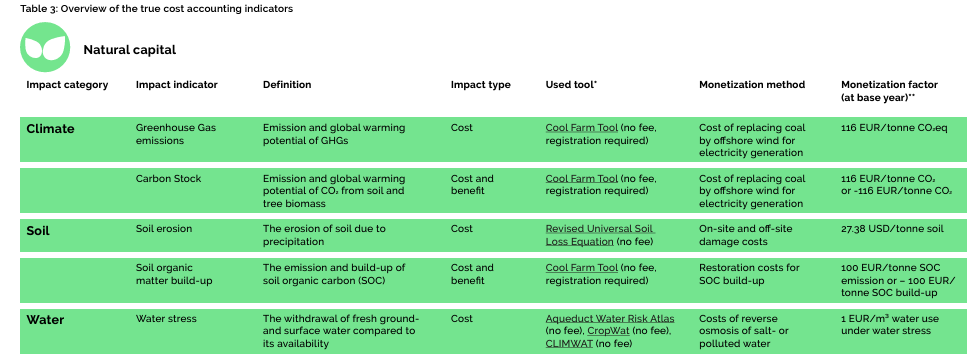
Then we come to the way in which the “True Price” is calculated. Go to The True Cost Accounting Agrifood Handbook for that.  You will find thousands of cost estimates each of which has an impact on TCA. Here is a partial list of notations:

– Collection and adoption of impacts and respective indicators/ metrics: Over 100 indicators and metrics from existing approaches were collected in order to select or create formulars/models to qualitatively assess the impact of agri-food products.

– Identify monetization method and factor corresponding to the indicators: For each indicator a suitable monetization approach was chosen with the preference for prevention cost approach. For the estimation of the true cost of food and agricultural product’s impact, monetization factors were assigned to each indicator in line with the chosen approach. A wide range of monetization approaches and factors exist – those here provided represent one option for monetization estimates.

-Testing: The indicator and the collection of the respective data were tested in two iterative pilot phases and were adjusted according to the feedback and lessons learned. Table 3 provides a summary of the final indicators. Some of the tested indicators (e.g. health impacts from pesticide ingestion) were not included in the final list of indictors because of insufficient performance during the piloting (e.g. lack of accurate impact modelling, insufficient proof of causality).

  For instance, on page 25 you will find this. It contains examples of the millions of calculations to be made:

It is as near to a black box as anyone ever will find. So many arbitrary values, weights and opinions are baked into the process, that TCA makes the calculation of original GDP look precise.

(Our) friends might be companies that have adopted a circular economy approach, where everything is reused, and can showcase their environmental credentials via TCA.

I’ve not seen a company “where everything can be reused.” Does “everything” include shipping, heating, hiring, marketing, etc. — all the things a company does to exist?

Or they might be firms that want to assess their future risks and take pre-emptive action, perhaps on the assumption that consumers will increasingly punish companies engaged in environmentally destructive activities, or that their assets will become less valued as the world transitions away from unsustainability.

Wishful thinking that seldom becomes widespread. There may be some limited cases where consumers are willing to pay a higher price for the ecology, but generally, price, quality, and availability rule.

“I think most of them have realized that they will have to do it sooner or later,” says Müller.

When it comes to increasing costs with no profit results, businesses usually choose “later” rather than “sooner.”

It probably would lead to a finger-pointing contest, with everyone denying culpability.

For example, who is responsible for internal combustion engine air pollution — the farmer driving the tractor? The engine manufacturer. The oil processor? The gas station? The boat owner that brought the oil to the processor? The company making the gas pump?  The pipeline company? The steel mill that rolled the pipe. Etc., etc., etc.

And what is the cost of air pollution? How are the various pollutants evaluated and calculated?

But getting from where we are now to where we need to be will be difficult. “Right now, we have a lot of people on the starting line,” says Baker, “but the short-term incentives aren’t there and you really are penalized in the market right now if you’re an early adopter.”

There needs to be legislation, she says, to force companies to move towards TCA.

Yes, it’s a government job. but rather than forcing companies to increase their own costs, the government must reward companies for adopting ecologically sound management.

In any event the whole process seems like a “do this really difficult thing before we even begin to attempt that other difficult thing.”

Personally, I would immediately, not delay, work on that “other difficult thing” (where feasible, legislating against polluting activities, plus federal government paying for prevention and cures.)

What Is a Rube Goldberg Machine? | Wonderopolis
Rube Goldberg and I want a cup of environmentally friendly coffee and cream, so first we must invent replacements for the coffee tree and the cow.

Expanded government financial support for adopting solar panels is one example of what would be needed.

There also needs to be institutional backing, and it is coming. At last year’s COP27 climate summit in Egypt, Máximo Torero, the chief economist at the FAO, threw his organization’s weight behind TCA.

“FAO is taking this extremely seriously,” he said. “It’s a huge challenge, and we are afraid, like many of you, but we are going to overcome our fear and we are going to do this.”

That could be a catalyst for real change, says Müller. “We will have it in the heart of policies, we will have a debate about the concept. Then the field is prepared for in-depth discussion.”

The drive to internalize externalities seems to be catching on more widely too. The way GDP is calculated changes every 15 years; the next iteration, in 2025, will reportedly include measures of sustainability and well-being.

As you saw with the The True Cost Accounting Agrifood Handbook, sustainability and especially, well-being, are quantified.

Quantified well-being? I question whether it can be done with any meaning.  Combining life expectancy with lifestyle, happiness, health and other well-being factors seems to be a fool’s errand. 

The transition to TCA will be a long, hard slog, however. “The construction of GDP took many, many centuries,” says Müller.

Overturning such entrenched economic orthodoxy is a tough ask. But if we recognize GDP for what it is, the transition will be easier, he says. “GDP is a social construction. It’s not a natural law like the speed of light, it’s an agreement in society.”

It’s not clear why every life experience must be combined into one number. GDP is difficult because of change, but it’s an understandable concept. Blending the emotional with the financial seems a step too far.

In Amsterdam, a pioneering supermarket displays two different prices for its goods. One is the market price, as you would see in regular supermarkets. The other is the “true price”, which factors in the environmental, health and social costs of the creation, consumption and disposal of the product.

Unsurprisingly, the true price is always higher than the market price. Customers can choose which price to pay: if they opt for the true price, the premium goes to environmental and social causes.

In the True Price Supermarket, which opened in 2020, bananas are sold at either the market price of €2.79 per kilo or the true price of €2.94 per kilo – a measly extra 15 cents per kilo to cover the social costs of low-wage farming and impacts on land, water and climate.

But some products have a much bigger mark-up: a hot chocolate rises from €2.79 to €3.70 because of the real price of cocoa and milk.

These premiums reflect the true cost of these products, as evaluated by a methodology called true cost accounting. Even though making the consumer pay the “true price” isn’t the actual goal of this accounting method, the movement is spreading.

True Cost Accounting is a bad idea. It attempts to quantify what cannot be quantified — numerical changes to what affects people emotionally and physically.

Work to accomplish TCA could delay what really needs to be done: Government support for ecologically sound farming, manufacturing, marketing, and research practices.

A Monetarily Sovereign government could set and fund any ground rules it chooses. The most important step requires answering one question: Given infinite money, what should be done to save the world for future generations.

The U.S., UK, and several other governments have infinite supplies of their own sovereign currencies. There remains only the need for these governments to do what needs to be done and/or to reward the private sector for doing them.

When money is no object, there is no need to wait for impossible precision. Spend the money to do the research, fund cleaning the air, water, earth, and do whatever is necessary to help the ecology.

That could begin tomorrow, without the busywork dithering required to reinvent GDP.

And that is the whole point of this post.


Rodger Malcolm Mitchell
Monetary Sovereignty

Twitter: @rodgermitchell Search #monetarysovereignty
Facebook: Rodger Malcolm Mitchell

……………………………………………………………………..

The Sole Purpose of Government Is to Improve and Protect the Lives of the People.

MONETARY SOVEREIGNTY

Here we go again. The rich can hardly wait to widen the Gap

The U.S. Supreme Court requests $90.4 million ($2.7 million for mandatory expenses and $87.7 million for discretionary costs) in FY 2020 for the Salaries and Expenses account.

For fiscal year 2013, it will cost an estimated $5.9 billion to operate Congress and the rest of the legislative branch.

The gap between the rich and the poor destroys the possibility of economic growth | by сергей лукин | Medium
The wider the income/wealth/power Gap between the rich and the rest, the richer they are.

Projected four-year costs of Biden’s White House payroll could top $200 million.

The FY2023 defense budget request will exceed $773 billion, according to the House Armed Services Committee chairman. By 9 March 2022, a bipartisan agreement on a $782 billion defense budget had been reached, thus avoiding a government shutdown.

Per Wikipedia:

As of 10 March 2023, the presidential budget request for the fiscal year 2024 was $842 billion.

In January 2023, Treasury Secretary Janet Yellen announced the US government would hit its $31.4 trillion debt ceiling on 19 January 2023; the date on which the US government would no longer be able to use extraordinary measures such as issuance of Treasury securities is estimated to be in June 2023.

On 3 June 2023, the debt ceiling was suspended until 2025. The $886 billion National Defense Authorization Act (NDAA) faces reconciliation of the House and Senate bills after passing both houses on 27 July 2023; the conferees must be chosen next.

As of September 2023, a Continuing Resolution was needed to prevent a Government shutdown. A shutdown was avoided on 30 September for 45 days (until 17 November 2023), with the passage of the NDAA  on 14 December 2023.

The Senate will next undertake negotiations on supplemental spending for 2024.

The Supreme Court wants $90.4 million; Congress votes and poof! The money appears. Congress wants $5.9 billion to operate. It votes, and the money is created.

The White House wants $200 million, which will be available as soon as Congress votes. The military wanted $773 billion but decided it needed $782 billion. Congress made a bipartisan agreement, and the money became available. Congress also suspended the debt ceiling and passed a new NDAA.

Congress will discuss supplemental spending in 2024.

Notice anything missing? Nowhere is there a discussion about “Where will the money come from?”

Congress votes; the President signs. And the money appears. It’s the way all federal spending is handled. The money doesn’t come from anywhere. It appears at the touch of a computer key.

Now compare that to this:

The total cost of the Social Security program for the year 2022 was $1.244 trillion, or about 5.2% of U.S. GDP.  Medicare spending grew 8.4% to $900.8 billion in 2021.

Raising the Social Security age? Ron DeSantis said no, and Haley said yes.

To raise Social Security’s retirement age or not — that was the question, and the only two Republican presidential candidates at CNN’s debate on Wednesday did not agree on the answer.

Florida’s governor, Ron DeSantis, said, at least for now, he would not raise the retirement age for Social Security. In contrast, former South Carolina governor Nikki Haley said she would for younger constituents.

“We have to keep our promises to seniors, but we also can’t keep our heads in the sand,” she said. “Social Security is on a path toward insolvency.

“If nothing is done to fix the problem, the trust funds that support the program are expected to run out of money in about a decade; at this point, beneficiaries will see a cut to their checks every month.

“Congress has never let Social Security falter, but legislators have yet to decide how to repair the program.”

Do you wonder why the SCOTUS, Congress, the White House, and the military budgets are handled simply by the House and Senate passing bills and the President signing?

Why does no one ask, “Where will the money come from?” when Congress passes a “Continuing Resolution.”

Do you wonder how the so-called federal “debt” could rise from $300 billion in 1970 to $29 trillion in 2023, and there is seldom talk about the federal government being insolvent? It can’t. Not now, not ever.

Instead, the worry is about two federal agencies, Social Security and Medicare, going bankrupt.

The federal government cannot become insolvent. As former Federal Reserve Chairman Alan Greenspan said, “There is nothing to prevent the federal government from creating as much money as it wants and paying it to somebody.”

And if the federal government can’t unintentionally become insolvent, none of its agencies unintentionally can become insolvent.

Potential solutions include increasing the retirement age, raising taxes, eliminating the income cap for high-earning individuals, or combining those and other proposals.

The real solution is for Congress to create a bill that allocates more money to Social Security and Medicare and for the President to sign it. Period.

The current Full Retirement Age, or FRA, is 67 for people born in 1960 and later.

The last time the FRA was raised was in 1983, from 65 to 67, which resulted in a 13% benefit cut. Moving the FRA from 67 to 70, as some have proposed in recent years, would “effectively cut currently scheduled benefits by nearly 20%,” according to the Center on Budget and Policy Priorities.

The federal government can “create as much money as it wants. You can’t. So why do the politicians, the media, and even many economists worry that Social Security and Medicare will run short of dollars but don’t seem to fear that you will run short?

When beneficiaries claim Social Security benefits before their FRA, they receive a permanently reduced benefit. Raising the age could make those cuts feel even deeper.

Lower- and middle-income individuals would be worse off than their higher-earning counterparts, partly because they rely on Social Security more heavily and have not seen the same life expectancy increases as those with higher incomes, the CBPP said.

This isn’t the first time Haley has made her pitch to reform the Social Security program.

Tell it like it is, Haley. It’s not “reform.” It’s a benefit cut. You want to cut federal benefits going to the people who need it most, the poor and middle classes.

Under Haley’s proposal, younger Americans, such as those in their 20s, would have a higher retirement age, while older Americans near claiming age would see no change made.

Haley also noted DeSantis has voted to increase the retirement age for Social Security in the past. The Florida governor voted for proposals that included changes to Medicare and Social Security eligibility and full retirement ages in the early 2010s. However, he has said that his position “had shifted in more recent times,” according to Factcheck.org.

DeSantis said now is not the time to make any changes to the retirement age for Social Security. “The problem is, now, life expectancy is going down, so I don’t see how you can raise the retirement age when life expectancy is collapsing,” he said.

The Florida governor also said the cost of living, including prices for groceries and rent, is “through the roof,” and the cost-of-living adjustment under Social Security isn’t enough to cover those increases.

“I’m not going to mess with seniors’ benefits.” To that, Haley argued Florida is one of the hot spots for inflation.

When asked what the new retirement age would be or if workers in their 20s should plan on working until they’re 70, the former governor did not have a specific answer but did say they should expect an increase in the age.

“We have to start looking at how to get out of this,” she said during the debate. “We want to make sure everyone was promised and gets it, but we also want to ensure our kids have something when they get it too.

She wants to ensure everyone gets what was promised — by unnecessarily cutting benefits?

Social Security and Medicare cannot be insolvent unless Congress wants it to happen. Why would Congress want it? Because they are bribed by the rich.

The rich grow richer only by widening the income/wealth/power Gap below them. To widen the Gap, the rich must get more for themselves or make those below them have less.

That is why cutting Social Security benefits makes the rich richer. It widens the income/wealth/power Gap between them and us.

To make you compliant and willing to have your benefits cut, the rich bribe your critical sources of information: The politicians, the media, and the economists.

The rich bribe the politicians with campaign contributions plus promises of lucrative employment. The rich bribe the media with ownership and advertising dollars. The rich bribe the university economists with university donations and promises of employment at think tanks.

The rich even use the word “socialism” to discourage federal support for Social Security and Medicare. It is a lie. Socialism is government ownership and control, not merely funding. The VA hospital is socialism; a fully funded Medicare is not.

The other false claim that the rich use to discourage benefits is the false claim that federal spending causes inflation.

The cause of every inflation in history is not interest rates being too low, which is why raising rates doesn’t cure inflation. In fact, raising interest rates makes things more expensive. It is inflationary. The cause of inflation always is shortages of critical goods and services, most often oil and food. The cure for inflation is more government spending to increase the public’s access to the scarcities causing inflation.

Finally, some feel it’s “unfair” to benefit those who don’t pay for them. If federal support is “unfair,” what about all those tax loopholes available to the rich but not everyone else. All taxes are unfair in some way, with the regressive FICA tax being the least fair of all.

There are so many excuses for not giving you benefits: “Unaffordable,” “unsustainable,” “unfair” — all false, all promulgated to widen the Gap.

This is not to say that all politicians, media, and economists intentionally lie. A great many of them (most?) have been indoctrinated just like the public and sincerely believe that federal taxes fund federal spending and that Social Security and Medicare can become insolvent.

And that is the problem. The false belief is so ingrained that it’s difficult to dislodge. But the world is not flat, and even Einstein was wrong about quantum mechanics. That is how we progress.

SUMMARY

Neither Medicare nor Social Security can become insolvent unless Congress and the President want them to. They are agencies of a Monetarily Sovereign government that has the infinite ability to create U.S. dollars.

Even without collecting a penny in taxes, the federal government could continue spending forever. The sole purposes of federal taxes are not to fund spending but to control the economy, assure demand for the dollar, and to convince the public that dollars for benefits are scarce. ) City, county, and state governments are monetarily non-sovereign, so they need and use tax dollars to fund spending.

The U.S. government is controlled by the rich, who grow richer by widening the income/wealth/power Gap between them and those below. Falsely claiming that Medicare and Social Security benefits are unaffordable and unsustainable helps justify cutting benefits to those who are not rich, thereby widening the Gap.

Federal funding of Medicare and Social Security would not be “socialism,” the other epithet the wealthy use to discourage benefits.

Federal spending does not cause inflation, and federal support of benefits to those who don’t pay for them is not “unfair”. The federal government can, without collecting taxes, fund a comprehensive, no-deductible Medicare for people of all ages and a Social Security that provides a living wage.

Rodger Malcolm Mitchell Monetary Sovereignty

Twitter: @rodgermitchell Search #monetarysovereignty Facebook: Rodger Malcolm Mitchell

……………………………………………………………………..

The Sole Purpose of Government Is to Improve and Protect the Lives of the People.

MONETARY SOVEREIGNTY