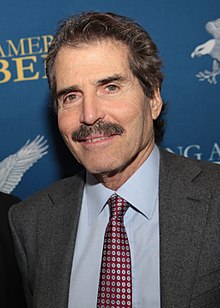
Today’s irony: John Stossel authored a book titled, “Myths, Lies, and Downright Stupidity.”
He also is a Libertarianand worked for Fox News, both of which explain much, the former explaining ignorance about Monetary Sovereignty and the latter explaining reluctance to speak the facts.
Here is an article he wrote:
Our Government is Now So Deep in Debt that Taxpayers Must Spend $1 Trillion a Year Just In Interest
In a recent video, libertarian pundit John Stossel delves into the alarming state of America’s national debt.
Stossel highlights a staggering reality: taxpayers now must shell out $1 trillionannually just to cover the interest on the federal debt.
This figure surpasses even the country’s defense spending, underscoring the severity of the fiscal crisis.
What should be alarming to anyone who has trusted Stossel’s claims is that he displays abject ignorance of Monetary Sovereignty.
The federal ‘debt” is not debt as you know it, and taxpayers do not owe it. The misnamed “debt” is the total of deposits into Treasury Security accounts (T-bills, T-notes, T-bonds).
Those federal bills, notes, and bonds are nothing like the private sectorbills, notes, and bonds. They merely are depositsinto accounts that are wholly owned by the depositors.
The U.S. federal government is Monetarily Sovereign—i.e., it has the infinite ability to create its sovereign currency, the U.S. dollar, at the touch of a computer key.
It has no need to borrow dollars from anyone, and indeed, it never does borrow dollars.
The government does not owe the dollars held in Treasury Security accounts for the simple reason it never takes ownership of those dollars.
The accounts resemble safe deposit boxes in that the government merely holds the dollars for safekeeping and returns them to the owners, plus interest, upon maturity.
Thus, the purpose of T-securities is not to provide spending funds for the government, which already has infinite spending funds. The purposes are:
To provide a safe storage place for unused dollars, safer than any bank. Because dollars are so vital to world trade, safe storage for billions of unused dollars is vital to stabilize the value of all currencies.
To help the Federal Reserve control interest rates by providing a “floor” interest rate, above which all lending is determined.
Again, the important fact that Stossel misses: The federal government does not borrow U.S. dollars. Who says so? How about:
Former Federal Reserve Chairman Alan Greenspan: “There is nothing to prevent the federal government from creating as much money as it wantsand paying it to somebody.”
Former Federal Reserve Chairman Ben Bernanke: “The U.S. government has a technology, called a printing press (or, today, its electronic equivalent), that allows it to produce as many U.S. dollars as it wishesat essentially no cost. It’s not tax money… We simply use the computer to mark up the size of the account.
Statement from the St. Louis Fed: “As the sole manufacturer of dollars, whose debt is denominated in dollars, the U.S. government can never become insolvent, i.e., unable to pay its bills. In this sense, the government is not dependent on credit markets to remain operational.”
All of this is true because the U.S. is Monetarily Sovereign. This is not just true of the U.S. government. Other entities are Monetarily Sovereign. For example, the European Union is sovereign over the euro:
Former President of the European Central Bank Mario Draghi: (ECB): “We cannot run out of money.”
So, any thinking person would ask themselves, if the U.S. federal government can produce as many dollars as it wishes, why would it ever borrow dollars? It doesn’t.
When President Richard Nixon divorced the U.S. from gold in 1971, the final limitation on the government’s ability to create money by pressing computer keys was lifted.
Seemingly, John Stossel either is clueless about Monetary Sovereignty, or being a Libertarian, he doesn’t want youto know about it. So, he writes misinformation or disinformation, depending on motive.
Stossel starts by lamenting the depth of America’s debt, which has reached unprecedented levels. He notes that the annual interest payments on this debt have ballooned to $1 trillion.
Those interest payments, which are not a burden on U.S. taxpayers and are created at virtually no cost to the government, help grow the U.S. economy.
The reason: A growing economy requires a growing money supply. Net federal spending (spending minus taxes) adds growth dollars to the economy.
Gross Domestic Product = Federal Spending + Nonfederal Spending + Net Imports
The above formula demonstrates the crucial role federal spending plays in economic growth.
Reduce federal spending, and you reduce GDP unless, somehow, Nonfederal Spending increases dramatically.
However, adding fewer federal dollars to the economy decreases Nonfederal Spending. If federal spending decreased, we would need a massive increase in Net Exports for GDP to increase.
Economic growth requires federal spending growth.
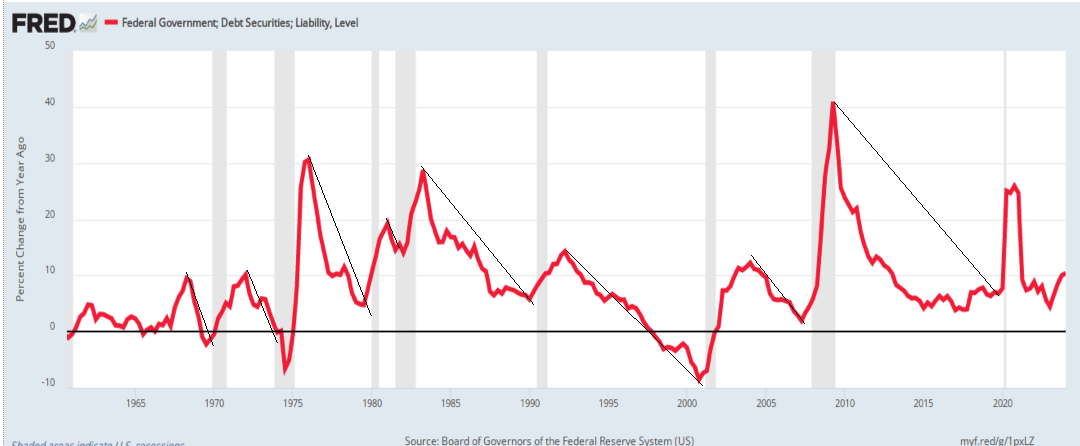
Declines (black diagonal lines) in federal “debt” growth (red) lead to recessions (vertical gray bars), which are cured by increased “debt” growth.
You’ve seen it time and again. We go into a recession, so what does the government do? It increases deficit spending to get us out of the recession.
It always amazes me that people easily accept the fact that federal deficit spending can cure a recession but fail to see that it can also prevent one.
As soon as our deficit spending cures a recession, what do we do? At the behest of the Stossels of the world, we again begin to cut deficit spending because it carries the word “deficit,” which increases the “debt” (which isn’t federal and isn’t debt).
It isn’t federal because the money is owned by the depositors, not by the federal government. It isn’t debt because the federal government doesn’t owe the money; it merely stores it for the owners.
Imagine your team is losing a baseball game. You know you need to score net runs (more runs than the opposition) to win. So you score net runs and begin to win.
The owner of this storage facility didn’t borrow bicycles and a scooter from this customer. They are not part of the facility owner’s debt.
But because you’re ahead, you decide you no longer need to score net runs until you start losing again.
Call that Libertarianism (or “Stosselism”)
This enormous sum not only hampers the nation’s financial flexibility but also threatens its long-term economic stability.
Stossel is confused by the word “debt.”
Imagine you own a self-storage facility, and someone stashes some bicycles in it.
Your financial flexibility wouldn’t be threatened.
And if they gave you more bicycles to put in your storage facility, your financial flexibility still wouldn’t be threatened.
And if they said, “You owe me all those bicycles,” you would say, “They’re yours. Take them out.”
That is exactly how T-bills, T-notes, and T-bonds work. The federal government stores depositors’ money but doesn’t own it. Depositors can have it back without any burden on the government or on taxpayers.
Stossel warns that this unsustainable path will “cripple our future,” yet politicians seem more focused on increasing spending rather than addressing the debt issue.
And there it is again, that word the Libertarians love to use: “Unsustainable.” Except for one problem: They never explain why the federal government can’t “sustain” a so-called “debt” that has been growing since 1940 when it was first called a “ticking time bomb.”
Since 1940, that “time bomb” has been “ticking” year after year while America’s economy grows stronger and stronger.
“Gimme a break”
Stossel criticizes politicians from both major parties for their contradictory statements and actions regarding the national debt.
While some politicians claim to have reduced the deficit, the reality is starkly different.
The debt continues to rise, now increasing by $1 trillion every 100 days.
This disconnect between rhetoric and reality is a significant concern for Stossel, who highlights the bipartisan nature of this fiscal irresponsibility.
The only “disconnect between rhetoric and reality” is Stossel’s claim.
Reflecting on past events, Stossel recalls the bipartisan support for the largest stimulus bill in U.S. history, passed during the early stages of the COVID-19 pandemic.
The stimulus bill did exactly what it was supposed to do. It added the dollars that cured shortages, reduced COVID-19 inflation, ended a recession, and led to today’s growing economy.
This legislation saw overwhelming approval in the Senate, demonstrating a rare moment of unity.
However, Stossel points out that the bill included numerous expenditures that lacked direct relevance to the pandemic, such as funding for NPR and the Kennedy Center.
This, he argues, exemplifies the government’s tendency to spend lavishly without considering the long-term fiscal implications.
Is Stossel saying it was wise to spend economic stimulus money to cure COVID but not to spend money that aids independent news broadcasts? What exactly is he arguing against? COVID dollars are OK, but non-COVID dollars are bad?
Addressing potential solutions, Stossel discusses the commonly proposed ideas of raising taxes on the wealthy or printing more money.
He dismisses these options as insufficient or harmful.
Taxing billionaires, he explains, would only cover a fraction of the debt, while printing more money – a concept embraced by proponents of Modern Monetary Theory – risks severe inflation.
He cites historical examples, including Zimbabwe and 1920s Germany, where unchecked money printing led to economic disasters.
Again, Stossel parrots common (but wrong) beliefs.
A price increase in any one product can come from an increase in demand for that product or from a sudden shortageof that product.
But inflation is an increase in prices for virtually all products and services.
Historically, government spending can’t cause a general increase in demand. When the government increases spending on Social Security, Medicare, and the military (the three largest balance sheet items), this doesn’t suddenly result in increased demand for virtually all products and services.
All inflations in history have been caused by shortages of critical goods and services, most often oil and food.
The current inflation was not caused by increased demand. There was no sudden increase in demand.
What was sudden? COVID. The current inflation was caused by COVID-related shortagesof oil, food, shipping, steel, wood, computer chips, labor, and many other products and services.
The price of oil affects the prices of virtually all other products and services. Historically, oil shortages parallel inflation.
Zimbabwe’s inflation was not caused by currency printing. The Zimbabwe government took land from farmers and gave it to people who didn’t know how to farm. The predictable result was food shortages, which caused Zimbabwe’s hyperinflation.
The Zimbabwe government’s misguided response was to print currency. The correct response would have been to spend money on increased food production while obtaining and distributing food.
The infamous German hyperinflation was caused by a complex series of events, beginning with Germany’s WWI war reparation payments that caused shortages of goods.
Using German hyperinflation as an example of what could happen in America demonstrates Stossel’s superficiality and ignorance of economic history.
German government deficit spending actually increased massively as the inflation ended (partly thanks to the end of the international gold standard) to fund the greatest war machine the world ever had known.
Stossel outlines the grim alternatives facing the U.S.: defaulting on the debt or continuing on the current path.
Defaulting would devastate the savings of everyone who invested in America and wouldn’t solve the underlying problems. Continuing on the current trajectory, however, only deepens the debt, making eventual solutions more painful and disruptive.
Federal “debt” (deposits) increased from about $43 billion in 1940 to about $33 trillion today, an 82,400% increase.
If, in 1940, someone had told Stossell the federal “debt” (deposits) would increase 82,400 percent in the next 84 years, he would have predicted inflations, recession, depression, stagflation, and every other calamity you could imagine.
Yet here we are, with the world’s most successful economy, powerful growth, and full employment. (Now we must reduce the income/wealth/power Gap between the rich and the rest.)
Despite the severity of the debt crisis, Stossel notes that politicians rarely take meaningful action. They talk about reducing the deficit and debt but fail to implement substantial changes.
He cites past presidents who have acknowledged the problem without delivering effective solutions, leading to the doubling of the national debt under recent administrations.
Someone, please tell Stossel that Clinton actually did reduce the federal debt. The result is shown below.
Debt reduction requires the federal government to run a surplus, that is, to take dollars out of the economy.Stossel should learn how reducing the “debt” works in the real world.
Here is the result of every “debt” reduction since 1804:
1804-1812: U. S. Federal Debt reduced 48%. Depression began 1807. 1817-1821: U. S. Federal Debt reduced 29%. Depression began 1819. 1823-1836: U. S. Federal Debt reduced 99%. Depression began 1837. 1852-1857: U. S. Federal Debt reduced 59%. Depression began 1857. 1867-1873: U. S. Federal Debt reduced 27%. Depression began 1873. 1880-1893: U. S. Federal Debt reduced 57%. Depression began 1893. 1920-1930: U. S. Federal Debt reduced 36%. Depression began 1929. 1997-2001: U. S. Federal Debt reduced 15%. Recession began 2001.
Only one period of federal surplus (“debt” reduction) has occurred since 1940, and it caused a recession.
Stossel emphasizes the importance of cutting government spending or at least slowing its growth. He criticizes the current political climate, where both major parties seem more interested in spending increases rather than fiscal restraint.
Why does Stossel want to slow growth? He’s a Libertarian. That is the only answer I can give.
This lack of willingness to address the debt issue leaves the country on a path towards economic instability and potential bankruptcy.
Oh, really. Here is what someone knowledgeable says:
Alan Greenspan:“A government cannot become insolvent with respect to obligations in its own currency.”
People in the comments shared their thoughts on this situation: “The average person had no clue how bad of shape we’re in. Politicians have ruined this once great nation.
“Ruined our once great nation”?? Does this look like it has been ruined?
The above graph shows the real (inflation-adjusted) per capita growth of America’s Gross Domestic Product (blue line). That is solid per-person growth, not the “ruined” nation that Stossel claims.
The red line shows the federal “debt” (deposits) over the same period. As they have grown, so has GDP.
Another commenter added: “Our economy is struggling with uncertainties, housing issues, foreclosures, global fluctuations, and the pandemic aftermath, causing instability.
Rising inflation, sluggish growth, and trade disruptions need urgent attention from all sectors to restore stability and stimulate growth.”
Who exactly was this “other commenter”? Donald Trump? Fox News?
When exactly did any nation not have “uncertainties, housing issues, foreclosures, trade disruptions, instability, and global fluctuations”? It’s called reality.
COVID-related inflation is not rising; it’s falling. Growth certainly is not sluggish. And what “trade disruptions” have been caused by federal deficit spending? Stossel never says, preferring to bleat meaningless generalities.
In concluding his video, Stossel urges viewers to share and spread awareness about the national debt crisis. He believes that increasing public awareness is crucial to pressuring politicians to take necessary actions.
The $1 trillion annual interest payment is a clear indicator of the urgent need for fiscal responsibility and sustainable economic policies.
The $1 trillion interest payment indicates that the federal government has no trouble pumping growth dollars into the economy.
What do you think? What specific steps can the government take to reduce the national debt without compromising essential services?
How can the public hold politicians accountable for their fiscal policies and spending decisions? What are the long-term economic consequences if the national debt continues to grow at the current rate?
These are good questions for which Stossel has no answers. How would he cut federal deficit spending without cutting Medicare, Social Security, the military, and the thousands of other programs the government funds?
If the national “debt” (deposits) continue to grow at the current rate, the economy probably will continue to grow at the current rate.
Nursing Shortage: There is an urgent need to hire at least 200,000 nurses each year to meet rising demands and replace retiring nurses. Among support personnel, a shortage of home health aides is most acute.
Overall Health Workforce: The health care industry employed 16.3 million people in 2022, making it the largest employment sector in the U.S.
Despite this, there is still a shortage, with a projected need for 1.1 million new registered nurses across the U.S. to address retirements and the growing demand.
Impact of COVID-19: An estimated 1.5 million health care jobs were lost in the first two months of the pandemic. Although many of those jobs have since returned, health care employment remains below pre-pandemic levels.
Patient Safety Concerns: Staffing shortages are now the nation’s top patient safety concern, leading to longer wait times and even patients being turned away in life-threatening emergencies.
This shortage is affecting various levels of healthcare provision, from hospitals to private practices, and is a major concern for the future of healthcare services in the country.
So, the title question is, Why Doesn’t the Federal Government Do This? (I’ll tell you the answer.)
A majority of medical students at Johns Hopkins University are set to receive free tuition after the school received a $1 billion gift from Bloomberg Philanthropies, making Hopkins the latest medical school to go tuition free because of a large donation.
Hopkins said Monday that students from families earning under $300,000 would receive free tuition starting in the fall.
And, of course, free tuition isn’t enough for many families, so:
Students whose families earn as much as $175,000 will have their living expenses covered.
The school estimates nearly two-thirds of its students would qualify for either of the benefits.
A growing number of philanthropists and medical schools are pushing to make education free for aspiring doctors and reduce the financial barriers that can deter them.
Another financial barrier often is overlooked. Many families rely on their young people to quit school and get jobs to help support the family.
The federal government should pay students a salary so parents would not be tempted to dissuade students from attending college.
Buoyed by donations, the Albert Einstein College of Medicine and the medical schools at New York University and Columbia University have given their students free tuition or scholarships if they have financial need.
Also, Kaiser Permanente Bernard J. Tyson School of Medicine Waived all tuition and fees for students entering between the fall of 2020 and 2025.
Cleveland Clinic Lerner College of Medicine at Case Western Universityoffers full scholarships to all admitted students, to name a couple more.
The schools mentioned are all well-known and prestigious institutions within the United States. They have national and often international reputations for excellence in medical education and research.
Donors to such institutions tend to receive significant recognition for their contributions. America needs much more help than wealthy donors seeking applause can provide.
The cost of medical school has kept aspiring doctors out of the field, where they can graduate with hundreds of thousands of dollars in debt.
The student loan program is one of the most shortsighted, economically ignorant inventions the federal government ever has created.
It forces monetarily non-sovereign (meaning, limited dollars) students, to pay dollars to the Monetarily Sovereign (having unlimited dollars) federal government.
It’s a perfect plan if you want to discourage young people from attending college.
By offering financial freedom to more students, schools can give medical students the flexibility to choose jobs in important but lower-paying fields like internal medical and pediatrics.
Billionaire Michael Bloomberg’s philanthropic organization said Monday that the U.S. has a shortage of medical professionals yet the cost of attending school for these jobs is often too high.
“By reducing the financial barriers to these essential fields, we can free more students to pursue careers they’re passionate about,” he said.
Bloomberg has used his philanthropic organization, Bloomberg Philanthropies, to donate billions to several causes including public health, the environment and improving city governments.
Hopkins said Bloomberg’s donation would also be used to expand financial aid for nursing and public-health graduate students, in addition to graduate students in other fields.
“This new scholarship formula will ensure the most talented aspiring doctors representing the broadest and deepest range of socioeconomic and geographic backgrounds have the opportunity to graduate debt-free,” Hopkins said.
No, it doesn’t assure that at all.
It assures the relative handful of aspiring doctors, who can afford not to have any income for the next few years, will be relieved of many college costs.
And as vital as healthcare is, what about all the other specialties that are short of practitioners?
Every year, the US will need about 400,000 new engineers.
Yet the next-generation skill sets that those engineers will require are sorely lacking, presenting the alarming possibility that nearly one in three engineering roles will remain unfilled each year through at least 2030.
This persistent talent gap risks short-circuiting the progress of several essential industries.
It may also seriously inhibit various US government initiatives intended to boost the economy and US competitiveness, such as the 2022 Build Back Better Act (BBBA) and the 2022 Chips and Science Act.
We also are short of trained people in Information Technology (cybersecurity experts, data scientists, and software developers) and Teaching, particularly in STEM (Science, Technology, Engineering, Mathematics) subjects and special education.
Of course, this doesn’t include our shortages in trades not ordinarily associated with colleges but still requiring training: Electricians, plumbers, welders, HVAC technicians, truck drivers and logistics coordinators, agricultural workers, and skilled manufacturing workers who can operate complex machinery and robotics.
America relies on the private sector to pay for all this schooling and training.
Our state universities and colleges, for instance, are largely funded by the private sector, either through local and state taxes or private contributions and endowments.
All suffer from one common problem: Affordability.
1. Potential workers cannot afford to take the time and pay the costs involved in formalized training, whether in a college, university, or specialized school.
2. The private sector cannot afford to pay students and trainees for their time and costs involved in receiving training.
3. Schools and other training facilities cannot afford to provide their serviceswithout remuneration.
The federal government suffers no such limitations. It can:
1. Pay students salaries and personal expense allowances for attending schools and training facilities.
2. Remunerate students for their education and training costs
3. Remunerate educational and training facilities to provide their services without charge.
The private sector (which does not have unlimited funds) already does some of this—just not enough.
Sixty years ago, the company that employed me paid my tuition to Northwestern University for my MBA. They didn’t pay for my books, transportation, or time (night school), and I was locked into that company for the 3 years I attended, but it’s what a monetarily non-sovereign company chose to do.
The presumptive goal of government is to protect and improve people’s lives. Funding training and education is an important step in accomplishing that mission.
Why is funding left to the monetarily non-sovereign private sector?
Why are you forced to pay local taxes for grades K-12—taxes that, in most places, are insufficient to fund excellent schooling—when the Monetarily Sovereign federal government could easily fund higher teacher salaries and better facilities without charging you a penny in taxes?
The Lesson
Yes, it’s commendable that Mr. Bloomberg, in exchange for tax breaks and accolades, will provide a vanishingly tiny support for what the nation needs.
But why do we need to rely on the Bloombergs of the world when the money is there, waiting for the populace and our leaders to acknowledge its need and availability?
The tax breaks already demonstrate the government’s willingness and ability to fund about one-third of the support at Mr. Bloomberg’s whim.
There is no financial reason why the federal government cannot provide the entire nation with everything that Mr. Bloomberg provides to a select few.
What is the real reason it already is not happening? There are two reasons:
The ignorance of the populace who have been brainwashed into believing that federal finances are like personal finances, and can’t afford to fund what America needs.
The rich, who run America, do not want benefits that would narrow the income/wealth/power Gapbetween the rich and the rest.
Ignorance is the most expensive thing we can buy, yet each day, we pay mightily for another dollop of ignorance and allow the federal government to cry, “Poor.”
The federal government has announced a federal rulemaking proposal that would extend Medicare coverage to include in-home dialysis for patients with acute kidney injury.
The Centers for Medicare & Medicaid Services (CMS) said it had issued a proposed rule that would update payment rates and policies of the End-Stage Renal Disease (ESRD) Prospective Payment System (PPS) for 2025.
Besides increasing overall expenditures in 2025 on the ESRD payment system by 2.2 percent, or around $170 million, the update includes a proposal to increase patient options for dialysis treatment for Medicare beneficiaries with acute kidney injury.
Contrary to popular misinformation and disinformation, Medicare is not funded by the Federal Insurance Contributions Act (aka “FICA” or payroll tax).
No federal taxes fund federal spending. All federal taxes are destroyed upon receipt by the federal government.
Taxes begin in the M2 money supply measure, but when they reach the Treasury, they are absorbed into the Treasury’s infinite money supply. Effectively, they are destroyed:
When “x” is any amount of federal taxes and ∞ is infinity, ∞ + x = ∞.
“x” disappears.
Medicare “A” and “B” supposedly are funded differently — “A” by FICA and “B” by the government and by recipients. I say “supposedly” because here is how both are funded:
1. Each month, the federal government sends instructions (not dollars) to health providers’ banks, instructing the banks to increase the size of the providers’ checking accounts by a specific amount (i.e., “Pay to the order of . . .” ).
2. The instant the bank does as instructed new dollars are created and added to the M2 money supply measure.No dollars are subtracted from any corresponding money supply measure.
That is the primary way the government creates net dollars — by instructing banks to increase checking accounts.
3. The banks’ books are balanced,and new dollars created, by clearing the government’s instructions through another part of the government, the Federal Reserve.
Compare the above to the way monetarily non-sovereign state and local governments (and businesses, you and I) pay our bills:
Like the federal government, we send instructions (checks or wires) to creditors’ banks. The difference is that in clearing your instructions, the Fed sends instructions to our banks, telling them to subtract dollars from our accounts.
When monetarily non-sovereign entities pay creditors, no net dollars are created. M2 rises when the creditors’ bank increases balances, and M2 falls when our bank decreases our balances.
Thus, the overall money supply grows when the government pays for things, not when the private sector pays for things. The money supply shrinks when the private sector pays the government for things.
A growing money supply leads to a growing GDP, while a shrinking money supply leads to recessions and depressions.
For 2025, CMS is proposing to allow Medicare beneficiaries with acute kidney injury to receive dialysis at home.
The agency also proposes that dialysis facilities be allowed to bill Medicare for training patients with acute kidney injury to perform in-home dialysis.
The agency also plans to update the payment rate for acute kidney injury dialysis to $273.20, which is the same as the base rate for regular dialysis.
For in-center hemodialysis,which is typically done three times a week, the annual cost was reported to be approximately $72,000 to $88,000, which could translate to about $250 to $350 per session.
Peritoneal dialysis, often done at home, might be slightly less expensive, with annual costs around $53,000 to $65,000, equating to roughly $145 to $180 per day.
The proposal represents a significant shift in CMS policy as, under current Medicare rules, only in-center dialysisis covered for beneficiaries with acute kidney injury who are not hospitalized.
CMS said in the announcement that dialysis-dependent patients with acute kidney injury have the potential to recover kidney function and avoid long-term dialysis.
The agency added that providing such beneficiaries with more flexible treatment options like in-home dialysis would encourage more frequent dialysis at lower ultrafiltration rates, supporting recovery of kidney function in patients with acute kidney injury.
If the rule is ultimately adopted, Medicare coverage of home dialysis will be available to both patients with acute kidney injury as well as end-stage renal disease.
Given that federal spending costs you nothing, and stimulates economic growth, there is no reason why Medicare has been slow to cover in-home dialysis.
Specifically, CMS said that its proposal would increase the base rate to $273.20 in 2025 from $271.02 in 2024, incorporating a 1.8 percent market basket percentage increase adjusted for productivity.
The agency estimates that the updates would increase the total payments to all ESRD facilities next year by 2.2 percent compared to 2024. Hospital-based ESRD facilities are projected to see a 3.9 percent increase in total payments while freestanding facilities will see a total payment increase of 2.1 percent.
CMS is also proposing updates to the policy of handling unusually high costs, or outliers, in providing kidney dialysis services.
It wants to include more specialty drugs and biological products in the list of services considered for extra cost adjustments. These are items that were or would have been included in the composite rate prior to the establishment of the current ESRD payment system.
The agency is also proposing technical changes to how it calculates the extra cost amounts, which consist of the outlier services fixed-dollar loss (FDL) amounts and the Medicare allowable payment (MAP) amounts, in order to better match current data and costs.
The oft-quoted objection to federal spending is that it causes inflation. The arguments are shown in green:
1. When the government spends more, it can increase the overall demand for goods and services in the economy. If the production capacity doesn’t keep up with this increased demand, prices may rise.
Further, in a capitalist economy, increased demand is met by increased capacity.
2. Increased government spending can also raise the cost of production by increasing demand for resources, which can lead to higher prices for consumers.
However, increased demand for resources is widely inflationary for only one resource: Oil.
Further, oil prices are less subjet to supply and demand than to prices determined by major oil suppliers OPEC, Russia, and the U.S.
3. To finance spending, the government might borrow money, which can influence the interest rates. If the Federal Reserve purchases these securities, it increases the money supply, which can devalue the currency and lead to inflation.
However, the U.S. government, being Monetarily Sovereign, does not borrow dollars. While higher interest rates are inflationary, they are not caused by market forces. They are caused by the Fed’s strange belief that higher rates lower prices.
The government has the infinite ability to spend, which increases the money supply — while also increasing the ability to produce.
4. If businesses and consumers expect that government spending will lead to inflation, they may adjust their behavior accordingly, such as by raising prices or wages, which can create a self-fulfilling prophecy.
However, in a capitalist economy, excessive profits quickly are met with price cutting.
SUMMARY
It is far better for the economy and for individuals if the government funds things rather than the monetarily non-sovereign, private sector paying.
This not only applies to Medicare but also to Social Security and to everything currently tax-funded by city, county, and state governments. Consider the implications.
Free, comprehensive medical and health support for all age and income groups.
Generous Social Security benefits for all age and income groups. (Yes, the rich, too. This is to avoid needless paperwork and investigations.)
Free college for everyone who wants it.
Funding for all the sciences.
Funding for infrastructure, including infrastructure now funded by cities, counties, and states.
This article from the July 6, 2024, Florida Sun Sentinel speaks for itself.
Textbook authors told climate change references must be cut to get Florida’s OK
The directive appears similar to requirements the state imposed on math and social studies textbooks said to include “critical race theory” and “social justice” material
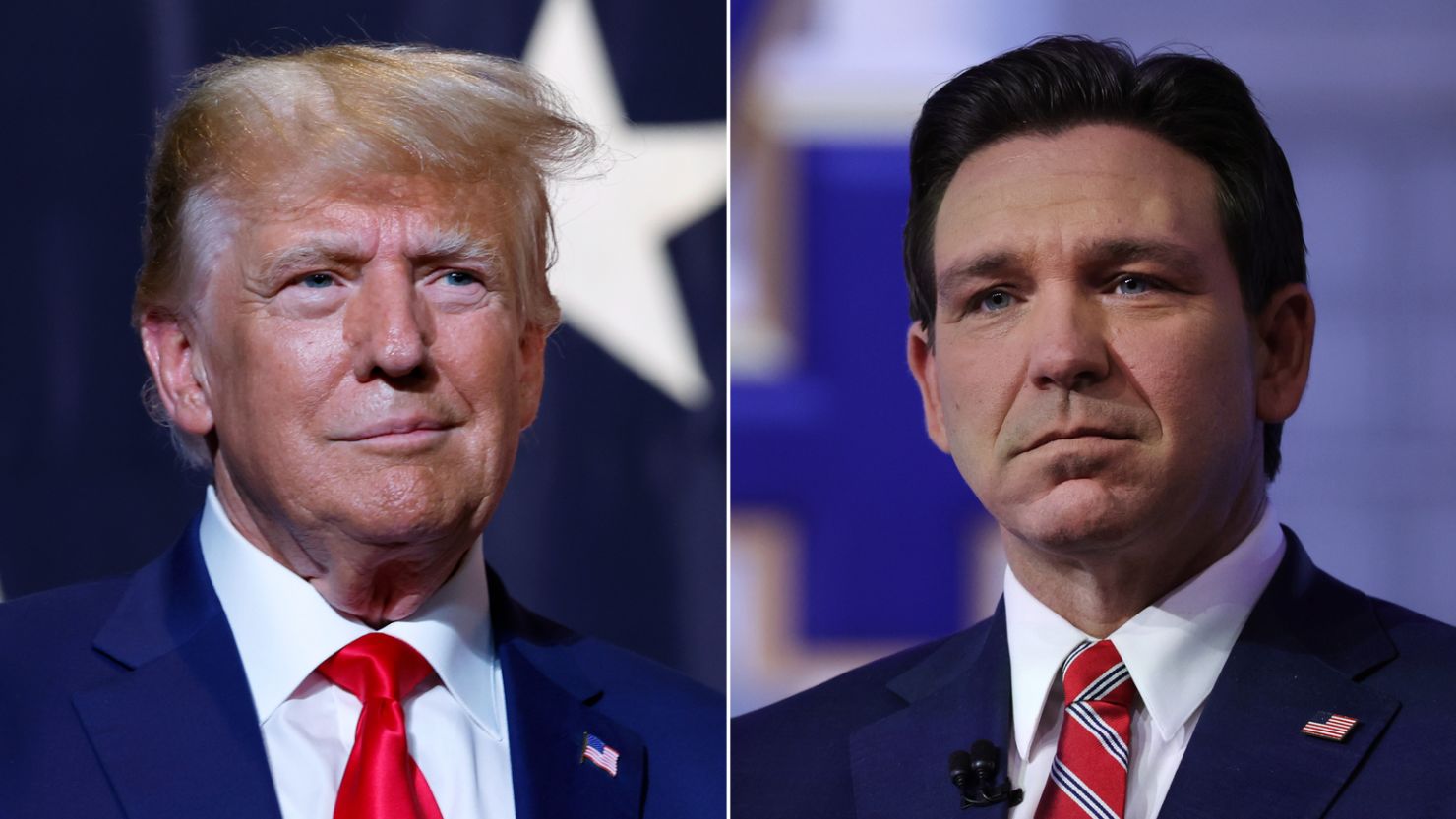
Donald Trump, Ron DeSantis: Burn or delete
By LESLIE POSTAL | lpostal@orlandosentinel.com |July 5, 2024 at 5:36 p.m.
Textbook authors were told last month that some references to “climate change” must be removed from science books before they could be accepted for use in Florida’s public schools, according to two of those authors.
A high school biology book also had to add citations to back up statements that “human activity” caused climate change and cut a “political statement” urging governments to take action to stop climate change, said Ken Miller, the co-author of that textbook and a professor emeritus of biology at Brown University.
Both Miller and a second author who asked not to be identified told the Orlando Sentinel they learned of the state-directed changes from their publishers, who received phone calls in June from state officials.
Miller, also president of the board of the National Center for Science Education, said the phrase “climate change” was not removed from his high school biology text, which he assumed happened because climate change is mentioned in Florida’s academic standards for biology courses.
But according to his publisher, a 90-page section on climate change was removed from its high school chemistry textbook and the phrase was removed from middle school science books, he said.
The other author said he was told Florida wanted publishers to remove “extraneous information” not listed in state standards.
“They asked to take out phrases such as climate change,”he added.
The actions seemed to echo Florida’s previous rejection of math and social studies textbooks that state officials claimed include passages of “indoctrination” and “ideological rhetoric.”
And they fall in line with the views of many GOP leaders, who question both the existence of climate change and the contributions of human activities to the problem, despite a broad scientific consensus that human-caused climate change is transforming the earth’s environment.
In May, Gov. Ron DeSantis signed a bill that stripped the phrase “climate change” from much of Florida law, reversing 16 years of state policy and, critics said, undermining Florida’s support of renewable and clean energy.
The bill did not address public education nor the state’s science standards, which were adopted in 2008 and spell out what students should learn in science instruction from kindergarten through 12th grade.
But SB 1645 altered Florida’s energy policy, removing the goal of recognizing and addressing “the potential of global climate change,” Senate staff wrote in an analysis of the bill.
DeSantis has said the new legislation, passed by Florida’s Republican-dominated Legislature, was “restoring sanity in our approach to energy and rejecting the agenda of the radical green zealots.”
The Florida Department of Education did not respond this week to a request for comment about the science books nor to earlier questions in May and June about when its approved list of science textbooks for elementary, middle and high school science classes would be released.
Florida’s school districts use the list to purchase books for their schools and had been told the state would release the science list in April.
Late Tuesday, the department posted the list on its website. Miller’s and the other author’s books were among those approved. The texts have not yet been printed so the Sentinel was unable to review them.
But there are no textbooks for high school environmental science classes on the approved list, though three companies submitted bids to supply books for that class, according to documents on the department’s website. Course material for that subject typically includes significant discussion of climate change.
“How do you write an environmental science book to appease people who are opposed to climate change?” asked a school district science supervisor, who is involved in science textbook adoption for her district. She asked not to be identified for fear of job repercussions.
She and other educators, the textbook authors and science advocates said the state’s actions will rob students of a deeper understanding of global warming even as it impacts their state and communities through longer and hotter heat waves, more ferocious storms and sea level rise.
Florida had already earned a D —and was among the five lowest-ranked states in the country — in a 2020 study that graded the states on how their public school science standards addressed climate change, said Glenn Branch, deputy director of the center for science education, which was a partner in the study.
Excising the phrase from science textbooks will “make Florida climate education even worse than it is,” Branch said. “These ill-considered actions are going to cheat Florida students.”
Branch said it was especially troubling the decision seemed based on “ideological grounds” and ignored the “rock solid” science that has documented climate change and its impacts.
Brandon Haught teaches environmental science at a Volusia County high school and was active in efforts to include evolution — another controversial science topic — in the standards adopted 16 years ago.
His ninth graders know almost nothing about climate change because it is not taught in the lower grades, he said. He spends at least a week on the topic but is covering only “the basics,” he said.
Florida students need more information on the subject not less, he added. “Florida is one of the most impacted by the impacts of climate change, and oh my goodness Gov DeSantis, why?”
The state’s push to get publishers to remove “climate change” from some science books seems similar to its actions in 2022 and 2023 when it rejected some math and social studies textbooks publishers wanted to sell in Florida.
In those cases, the department announced it had rejected textbooks in press releases that claimed the books contained “critical race theory” and “social justice”topics, which were prohibited by state laws and rules. Some of those textbooks were later approved after the publishers made changes.
In contrast, the list of approved science books was posted to the department’s website without an accompanying press release.
Judging from past practice, science textbooks that were rejected, such as those for environmental science, could later be approved if they were altered to meet Florida’s requirements.
Some school districts, including those in Orange and Seminole counties, were poised to buy new science books as soon as the state list was released.
But districts can continue to use older books for a while, and some districts now may not purchase new science books immediately because the list was released months later than expected.
There were 146 textbooks submitted for consideration.
About 75 books from a total of about 10 publishers were approved for middle and high school classes, with four publishers also approved to provide science books for kindergarten-to-fifth-grade classes, according to documents on the department’s website.
Textbooks can be rejected for failing to match Florida’s standards or failing to provide content that is accurate, among many other issues.
Science textbook publishers were told in advance to keep “critical race theory,” “social emotional learning” and other “unsolicited strategies” out of their textbooks.
However, the “rubric” used to evaluate the books made no mention of “climate change.”
The Sentinel could not reach for comment the three publishers — Cengage Learning, McGraw Hill and Savvas Learning Company — that submitted environmental science books that did not make the approved list posted Tuesday.I publish this article for you, without comment.
The rise in book censorship across the United States is reminiscent of the fascist tendencies throughout history.
While book banners and censorship supporters paint their concerns as specific to contemporary issues, it’s a common way to consolidate power.
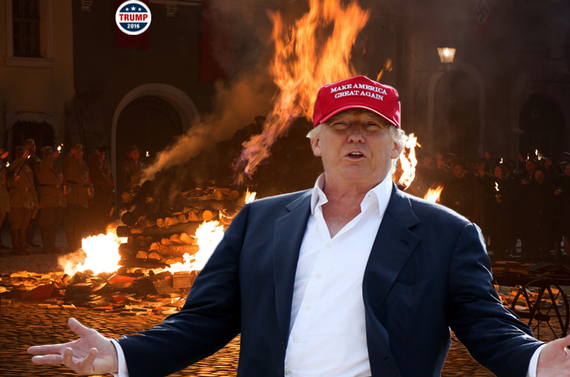
The history of Nazi book burning is one of the most obvious antecedents to the censorship of books in the U.S.
Book burning began shortly after the Nazi Party took control over the government: “Beginning on May 10, 1933, Nazi-dominated student groups carried out public burnings of books they claimed were “un-German.”
The book burnings took place in 34 university towns and cities.
Works of prominent Jewish, liberal, and leftist writers ended up in the bonfires.”
With these ideas came the need to define what was German and what was not. Exclusion is necessary to create an enclosed nation.
Part of the rhetoric of German nationalism was that all true Germans were Christian.
Some German nationalists believed Jews could assimilate only if they converted. German Jewish people disagreed and fought for equal recognition under German law.
Gabriel Riesser, a prominent Jewish activist during the first half of the 19th century, argued that the Jewish people’s participation in the army validated their German identity, not their faith.
The German poet Heinrich Heine wrote with chilling clairvoyance, “where one burns books, one will soon burn people.”
Although Germany was officially unified in 1871, chaos and power-grabs in the form of nationalistic fervor were quick to dominate the country.
Taking the time to separate German and un-German texts (even if a number of them originated in Germany) also allowed the Party to define the enemy.
The un-German forces defined by the Party were texts from Jewish writers, socialist writing, anything democratic, or foreign authors.
On May 6, 1933, the first book-burning action took place. The Institute of Sexology was targeted by German students.
The library of the Institute collected over 20,000 texts about intersexuality, homosexuality, and transgender people.
Magnus Hirschfeld, the founder of the Institute, also performed the first gender confirmation surgery on Dora Richter, who died in 1933 and was most likely killed in the chaos of the book burning action.
This initial step was part of the Nazi Party’s mission to ban all “deviant” sexuality.
The fact that state governments are choosing schools to start the book bans is also deliberate. The Nazi Party exerted control over universities and children through the Hitler Youth program in order to raise compliantly racist Germans.
American schools filled with students with no knowledge of the Middle Passage, the Jim Crow era, or internment camps will pay no attention to the erosion of protections for marginalized people under federal or state law.
If they know nothing about discrimination, they can’t fight it.
They’re also fed a false narrative of American exceptionalism, similar to the narratives of German purity that drove the book burnings.
Th(is) could even preface a future in which students learn very little about the lead-up to the Holocaust and fail to recognize the signs of dictatorial cultural power.










 #Monetary Sovereignty - Mitchell