Inertia and the American oil tanker

An oil tanker can measure up to 1300 feet (400 meters) in length and carry 550000 DWT (dead weight tonnage), making them the behemoths of the seas. Because of their mass, tankers have large inertia. seawise giant oil tanker A loaded supertanker could take as much as 4 to 8 kilometers and 15 minutes to come to a complete stop and has a turning diameter of about 2 kilometers. The U.S. economy is the ULT (ultra-large tanker) of the world’s economies. It takes time to get up to speed and time to slow down. Keep that in mind as you read excerpts from the following article:

The Biden Economy and How It Could Be Fixed, By Andrew F. Puzder Businessman and Author, The Capitalist Comeback: The Trump Boom and the Left’s Plot to Stop It

The following is adapted from a talk delivered on February 22, 2023, at a Hillsdale College National Leadership Seminar in Indian Wells, California.

Just about everybody on Wall Street knows, despite what you read in the financial press, that the Biden administration’s economic policies are driving our economy into a recessionary ditch.

This is the mark of the conspiracy theorist. He claims “just about everybody on Wall Street knows this,” but the “financial press” doesn’t. One wonders who constitutes the “everybody” and where “everybody on Wall Street” gets its information if not from the financial press. Fox News, perhaps?

In a recent Wall Street Journal survey of 23 large financial institutions that do business directly with the Federal Reserve, 16 predicted a recession in 2023 and two predicted a recession in 2024, while only five predicted that we would avoid a recession.

A recession is predictable because the Fed wrongly follows a recessionary policy to reduce inflation. Unfortunately, a recession is not the opposite of inflation, as the term “stagflation” indicates. Curing inflation should not require causing a recession.

A recession is defined, traditionally, as two consecutive quarters of negative economic growth. At least it was defined that way before the financial press redefined it prior to the 2022 midterms, ensuring that despite two consecutive quarters of negative growth, President Biden’s policies couldn’t be labeled recessionary.

But regardless of the definition, this negative growth meant declining standards of living, fewer job opportunities, lower wages, and increased poverty for the American people. 

“Fewer job opportunities”? Unemployment is near historic lows.
Puzder complains about “fewer job opportunities” under Biden when the unemployment rate is near a low not seen since the 1950s — and lower than during the Trump administration.

The hard economic times we are experiencing are especially striking as they come on the heels of the Trump boom, which opened our eyes again to American economic potential when we have low taxes, reduced regulation, and a bountiful supply of domestic energy.

Low taxes (but only for the rich), reduced regulation (of the rich and of the banks that caused the last recession and went bust this year), and a bountiful supply of energy (thanks to alternative energy, which Trump hates, along with a compliant OPEC and no Russia/Ukraine war).
“Hard times”? Annual change in Gross Domestic Product (red) and real (allowing for inflation) GDB (blue). Trump was President during the years 2017 through 2020. Biden became President in 2021.

Everybody, particularly minority and low-wage earners, reaped the benefits in the Trump years of abundant job opportunities, increasing wages, historic highs in family income, and historic lows in rates of poverty and unemployment.

It’s difficult to say that low-wage earners benefited from Trump’s tax cut for the rich. Comparing the economic times under Biden vs. Trump, one sees that Biden’s time was better regarding lower unemployment and greater real GDP growth.

Turning the clock ahead, since March 2021, two months after Biden took office and began reversing Trump’s economic policies, the Consumer Price Index—the average in prices paid by consumers for goods and services, by which inflation is commonly measured—has surged. And it continues to surge. 

Granted, the Federal Reserve has to take some of the blame. It failed to react in a timely manner when inflation started to set in.

(Similar to the way Trump failed to react timely to COVID).

Coming out of the pandemic, we knew two things. First, we knew the federal government handed out $5 trillion during the pandemic, and people had minimal opportunity to spend it since they weren’t traveling, eating out, going shopping, etc. So in 2021, Americans had a lot of cash.

The second thing we knew coming out of the pandemic was that fewer people were working.

The result was a low supply of goods.

“Fewer people working”? Yes, during Trump’s COVID recession. The number of workers is now greater than ever and is rapidly increasing.

Excess demand and low supply: this was the situation when Biden took office in 2021. And as any student of elementary economics knows, when demand exceeds supply, you get inflation.

The emphasis had been on low supply when Trump left office, partly due to Trump’s denial of COVID and the resulting millions of workers hospitalized and dying. Had he encouraged masking and vaxxing, the supply situation would have been less difficult.

Isn’t it pretty obvious what should be done in that situation? You should adopt policies that juice supply and avoid adopting policies that juice demand.

Partly right. All inflations are caused by shortages of critical goods and services, most often oil and food. To cure inflations without causing a recession, the federal government must use its infinite financial power to increase the availability, i.e., the supply, of those goods and services. Raising interest rates, which the Fed has done and still is doing, indicates an attempt to use a recession to cure inflation. Puzder, like all right-wingers, hates to help the middle classes and the poor financially. Helping the rich with tax cuts seems to be fine. Were we not to have “policies that juice demand” (i.e., not give people spending money), we would make the same mistake the Fed is making: Attempting to use a recession as a cure for inflation.

Instead, the Biden administration proceeded to do the exact opposite.

Despite the solid-block refusal by the GOP to cooperate in anything that could help Democrats and the economy and the recalcitrance of Democrat Senators Sinema and Manchi, the Biden administrate managed to accomplish a surprising amount.

1) $1.2 trillion infrastructure package 2) $1.9 trillion COVID relief deal 3) Highest appointment of federal judges since Reagan 4) Halt on federal executions 5) Rejoined the international Paris Climate Accord 6) Mandated converting the federal fleet to zero-emission vehicles. 7) Support for transgender service members. 8) Reduced unemployment. 9) Strengthened QUAD, alliance U.S., India, Australia, and Japan. 10) Student loan debt relief 11) Used the Russia/Ukraine war to strengthen NATO, which Trump tried to weaken. 12) Imposed crippling sanctions on Russia 13) Fought Saudi’s oil price increases by releasing 180 million barrels of oil from the country’s Strategic Oil Reserves. 14) Pardoned people convicted of a federal marijuana charge 15) Respect for Marriage Act 16) Prevented the rail strike and gave workers a significant raise. 17) Passed Government Funding Bill 18) Got us out of Afghanistan, ending years of American deaths. 19) Expanded healthcare. 20))Defended Obamacare

Although the pandemic recession was the shortest recession on record, the economic chaos it created was incredible. And as Milton Friedman said in 1964, the deeper the recession, the greater the recovery.

A little more than a month into the Biden presidency, on a totally partisan basis, the Democrats in Congress passed and Biden signed a $1.9 trillion spending bill they called “The American Rescue Plan.”

Yes, it was “totally partisan” because the Republicans refused to aid financially-challenged Americans.

This so-called rescue plan handed out more cash to American consumers, further increasing demand, and discouraging work, further decreasing supply. That this economic suicide.

The so-called “economic suicide” helped prevent a recession or a depression. As far as “discouraging work,” the number of workers today is greater than ever in our history and is rapidly increasing, as the above graph shows. It is vogue in right-wing circles to claim that the middle classes and the poor have no aspirations, so if you give them money, they won’t work. Perhaps, the right-wingers have no desire to make an effort, so they believe sloth is universal. Still, most people prefer to work for more income than unemployment compensation provides. Today’s shortages, and the resultant inflation, are not due to a lack of workers. Today’s inflation is due to oil shortages, which impact every industry. OPEC and the Russian invasion of Ukraine are primarily responsible. Biden ordered the release of 50 million barrels of oil from the Strategic Petroleum Reserve on November 30, 2022, 60 million barrels on March 1, and 180 million on March 31.

Larry Summers, who served as Secretary of the Treasury under President Clinton and as head of the Council of Economic Advisors under President Obama—a former president of Harvard and a well-respected liberal economist—called this the least responsible economic policy in 40 years.

Quoting Larry Summers on economic policy is like quoting Donald Trump on marriage fidelity. If you would like to learn more about Summers, who is the classic example of the Peter Principle, see here.

With wage growth unable to keep up with inflation, savings melting like an ice cube in the summer sun, and credit card debt rising to historic highs, we’re facing higher interest rates, declining job opportunities, and increasing economic pain for American families.

The above is false. Real (inflation-adjusted) wages went down after the recession (in the two years between the 2nd quarter of 2020 and the 2nd quarter of 2022). Before and after that, real wages have risen, and are rising again at the latest report, and are well higher than in pre-COVID years. Since the year 2000, real wages have exceeded inflation.
Real (inflation-adjusted) wages are higher than they were before COVID. They fell because of COVID and have begun to rise again.
Higher interest rates are due to the Fed’s mistaken belief that the current inflation was caused by low interest rates and will be cured by high interest rates. All inflations are caused by shortages (most often shortages of oil or food), and all are cured by eliminating the shortages. Oil shortages (reflected in oil prices) parallel inflation. Today’s inflation is due to COVID shortages of many goods and services, primarily oil. Job opportunities are not declining; they are high and rising. Savings are “melting” because, as Puzder himself said, the government had pumped dollars into people’s pockets, and they could not spend them. Now they are spending them.

So is there anything the Biden administration could do?

To repeat, inflation is the result of demand exceeding supply. The Federal Reserve, with its hikes in interest rates, is trying to drive down demand. But if it has to drive demand all the way down to where supply is right now, it’s going to cause incredible misery for the American people.

This is precisely what the Fed is doing: Trying to use a recession as a cure for inflation.

So from an economic standpoint, if the Biden administration wanted to lessen the misery and hasten recovery, it would do whatever it could to increase supply. And there are two areas where it could have a significant positive impact on the supply side: the cost of energy and the cost of labor.

Energy and labor impact virtually everything in our economy. Thousands of products have a petroleum component, and even those that don’t have to be delivered, which requires oil and gas. And you can’t build, manufacture, deliver, or install anything without labor—labor affects the price of everything.

So if your goal were to fight inflation, you would implement policies to drive down energy and labor costs.

True. Raising interest rates does not drive down energy and labor costs. Sadly, the Fed, Congress, and the President don’t understand that.

Biden has advanced this goal as president by, among other things, killing oil pipeline projects, failing to grant oil leases, failing to approve drilling permits, and limiting the ability of energy companies to obtain financing.

He has done everything in his power to reduce America’s domestic energy production, cripple our energy sector, and increase our dependence on expensive foreign oil.

Except none of those things has affected today’s supply of oil. The effect may be felt several years later, but today’s inflation has nothing to do with oil pipeline projects, leases, drilling permits, or financing. Releasing those millions of barrels from storage helped. Still, OPEC and Russia have cut way back on supplies, and there is nothing that Biden can do about that — other than to encourage other alternatives. Against the usual pushback by the GOP, the Dems have encouraged, with direct financial support and tax breaks, alternative energy sources — wind, solar, moving water, geothermal, and nuclear. Ultimately, this will do more than oil pipelines to alleviate oil energy shortages while saving us from global warming.

The cost of labor has also continued to surge. The increase in wages that Biden crows about is normally a good thing. But it makes no economic sense to ignore the impact of inflation on the value of wages.

It is simply a fact that workers are better off if inflation is up two percent and their wages are up three percent than if inflation is up six percent and their wages are up five percent. They are making more money in the second case, but the money is worth less. 

All true, except for one small fact. Not only are wages up, but real wages are up.

Why are labor costs surging? Very simply—we have all seen the “help wanted” signs outside businesses all over America—it’s because employers can’t find workers.

Two years after the pandemic ended, there are still 2.8 million workers missing from the labor force. Why? A recent study headed by University of Chicago economist Casey Mulligan, “Paying Americans Not to Work,” found that in 24 states, unemployment benefits and Obamacare subsidies for a family of four with no one working are equal to or above national median household income.

Cute. He compares national medium income vs. total unemployment benefits and Obamacare, and with a family of four, and with no one working in 24 states. It takes real mathematical twisting to make such a meaningless comparison.

Clients: ESG is a Millstone Around My Neck – 4 Ways You Can Help - The BTI Consulting Group
FICA is a millstone around the neck of the American economy.

In other words, two years after the pandemic, we’re still paying people not to work at a time when businesses and our economy desperately need workers.

To the right-wing mind, helping people who don’t have jobs is “paying Americans not to work,” as though people are satisfied with the starvation wage of unemployment compensation. In any event, the notion that people are not working is outdated. As the above graph shows, more people are working, and unemployment is lower than in several decades. The right-wing cure for inflation is to give tax breaks to the rich while cutting back on benefits to the middle and the poor. An immediate way to encourage higher net salaries without punishing employers or the so-called “paying American’s not to work” is to eliminate the FICA tax. Contrary to popular belief, FICA does not fund Medicare or Social Security. It doesn’t fund anything. Those FICA dollars from your paycheck (your employer figures his cost of FICA when deciding what to pay you) are paid from checking accounts. The dollars in checking accounts are part of the M2 money supply measure. When your dollars reach the U.S. Treasury, they suddenly no longer exist in any money supply measure. They effectively are destroyed. The federal government creates new dollars to pay for Medicare and Social Security. Eliminating FICA would provide higher net salaries to all salaried workers, making jobs more remunerative, especially for lower-salaried workers.

The bottom line is this: to address inflation and avoid a deep recession, Biden should, first, tell American bankers, asset managers, bureaucrats, and environmentalists to get out of the way of the energy industry because America needs oil now.

Translation: “Don’t worry about global warming. We’ll leave that problem to our children and grandchildren.”

Second, he should work with Congress to reduce or eliminate the work-discouraging programs that are keeping able-bodied Americans out of the workforce.

We should not cut programs for those who need assistance, but we should reduce benefits for those who are able to work but are choosing not to work. With abundant energy and a vibrant workforce, we could make significant headway against inflation and quickly improve the lives of the American people.

Translation: “Cut unemployment compensation. Make families so desperate they will accept any crap job offered. But by all means, don’t cut the tax dodges available to the rich.”

This isn’t rocket science. But let’s be realistic. The problem isn’t that the policymakers in the Biden administration don’t understand the basic principles of economics.

The goal animating current policy is the transformation of America’s economy and our way of life in accordance with a Leftist political agenda, using so-called emergencies like climate change as a rationale.

Translation: “So-called climate change isn’t real. It’s a Chinese hoax, as Donald Trump says. Pay no attention to the scientists who tell you climate change will destroy life as we know it. Listen to experts like Trump and Puzder.”

Americans need to open their eyes to the fact that our elected leaders across the political spectrum understand clearly what policies will lead to prosperity and freedom for the American people but that only some of those leaders consider prosperity and freedom the goal. We need more of them.

Agreed. Sadly, none of those leaders seem to be Republicans. While the Republicans have focused on defending Trump and his false claims of a stolen election, the Dems have tried to overcome GOP objections to any economy-building program. The GOP feeling is that the worse they can make the economy, the easier it is to blame it on Biden and the Dems. Despite headwinds from the GOP and even a couple of Dems, the party has managed to accelerate the oil tanker that is the American economy. Now, if only they could get rid of that useless, cursed FICA and educate themselves about the realities of Monetarily Sovereign finance, what a wonderful world this could be. Rodger Malcolm Mitchell Monetary Sovereignty Twitter: @rodgermitchell Search #monetarysovereignty Facebook: Rodger Malcolm Mitchell

……………………………………………………………………..

The Sole Purpose of Government Is to Improve and Protect the Lives of the People.

MONETARY SOVEREIGNTY

How the GOP is killing (Yes, literally) America

This is not hyperbole. The Republican party literally is killing Americans.

Column: America’s decline in life expectancy speaks volumes about our problems
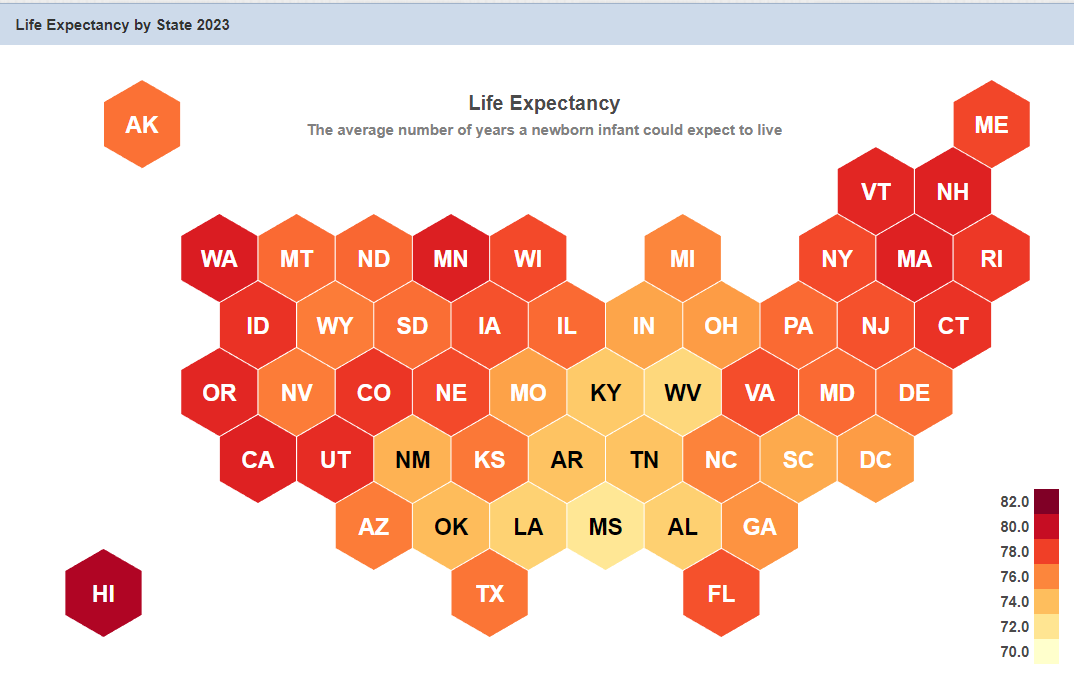
U.S. average life expectancies are lowest in the Southeast, highest on the West Coast and the Northeast. But why?(Jeremy Ney / American Inequality), BY MICHAEL HILTZIK, BUSINESS COLUMNIST, APRIL 5, 2023 5 AM PT

Years of widening economic inequality, compounded by the pandemic and political storm and stress, have given Americans the impression that the country is on the wrong track. Now there’s empirical data to show just how far the country has run off the rails: Life expectancies have been falling.

The Centers for Disease Control and Prevention reported last year that life expectancy at birth fell in 2021 to its lowest level since 1996, a decline of nearly a year on average from 2020. That was after a decline by 1.8 years from 2019 to 2020, producing the worst two-year decline since 1921-23.

These figures open a window on a set of pathologies unique to America among developed countries.

America is seeing the greatest gap in life expectancy across regions in the last 40 years.

COVID-19 is the most obvious and convenient culprit, both for the absolute decline in life expectancy and the divergence between the experiences of the U.S. and its economic peers.

Most developed countries have begun to recover the longevity losses they experienced during the pandemic; thus far, there’s scant evidence that the U.S. is following the trend.

The U.S. suffered a greater rise in mortality and premature deaths than its peer countries during the pandemic years of 2019-21, according to the Peterson-Kaiser Family Foundation Health System Tracker.

Remember how initially President Donald Trump denied the severity of COVID, and said it would “just go away.” He lied. It didn’t.

His public attitude led to Republicans refusing masks, refusing vaccination, chasing fake cures like  hydroxychloroquine, and foolishly gathering in crowds that spread the infection.

Loyalty to Trump over America demanded a cavalier attitude about contagion and healthcare.

“COVID-19 has erased two decades of life expectancy growth in the U.S., whereas the average life expectancy for comparable countries has decreased only marginally, to 2018 levels,” the Health System Tracker found.

That may not be surprising. Few developed countries other than the U.S. turned COVID and anti-pandemic options into political issues, converting such proven treatments as vaccines into partisan litmus tests.

Hundreds of thousands (!) of Americans died needlessly because of Trump’s lies and the Republican party’s obsequence.

Even now, in 2023, more than 90,000 Americans per year die from COVID. The vast majority of deaths  could have been prevented by vaccination.

A CDC chart showing COVID deaths in the US by vaccination status over a photo of a syringe drawing from a vial.
Unvaccinated people were 6.1 times more likely than fully vaccinated people to test positive for COVID-19 and 11.3 times more likely to die from it.

The GOP ignored warnings from legitimate sources like Dr. Anthony Fauci, who ironically, now is being vilified for not claiming the COVID virus came from a Chinese lab.

Blaming the Chinese for all our ills is a familiar Trumpian coverup tactic

Rather than blaming Trump for his role in causing the lethal spread of COVID, the GOP blames Fauci, who repeatedly warned about the dangers of the disease. Such is the GOP mentality.

But COVID is far from the only explanation for America’s dismal trend line.

The pandemic accounted for about half the decline in life expectancy, according to the CDC. “Unintentional injuries,” a category that includes drug overdoses, contributed an additional 16%, followed by heart disease (4.1%), chronic liver disease and cirrhosis (3%) and suicide (2.1%).

Those factors are connected to economic policies and systems, development agendas, social norms, social policies, racism, climate change and political systems.

All of the above are denied and/or exacerbated by the Republican party.

The GOP is the party that wishes to cut Medicare, Medicaid, and Social Security benefits, increase FICA taxes on salaried workers, eliminate the Affordable Care Act (Obamacare), reduce the Child Tax Credit, cut the SNAP (food stamp) program, and reduce unemployment compensation.

As an overall goal, the GOP does everything possible to make the poor poorer and the rich richer.

The GOP values dollars over human life, so any Democratic effort to reduce air or water pollution, increase benefits to the poor, or to reduce gun violence, is met by GOP resistance.

Americans with the shortest life expectancies “tend to have the most poverty, face the most food insecurity, and have less or no access to healthcare,” Robert H. Shmerling of Harvard Medical School wrote in October.

“Additionally, groups with lower life expectancy tend to have higher-risk jobs that can’t be performed virtually, live in more crowded settings, and have less access to vaccination, which increases the risk of becoming sick with or dying of COVID-19.”

The most important governing factor is economics,observes Jeremy Ney, an expert in graphically displaying social and economic disparities.

“There’s a really strong relationship between life expectancy and income,” Ney told me. “Income is tied in with a lot of other things, like your ability to afford healthcare, your housing security, your distance from a toxic chemical site, things like that.”

“America is seeing the greatest gap in life expectancy across regions in the last 40 years,” Ney says.

America’s life expectancy is falling behind its international peers, including all high-income countries and Japan.  China’s life expectancy outstripped the U.S. in 2020.

That tells only part of the story. The lowest average life expectancies are seen in the states of the Southeast (the so-called “red states): South Carolina, Oklahoma, Arkansas, Tennessee, Kentucky, Alabama, Louisiana, West Virginia and Mississippi all had average life expectancies from birth of less than 75 years. 

The highest life expectancies were generally in states on the West Coast, the northern Midwest and the Northeast. Hawaii ranks first at 80.7, followed by Washington, Minnesota, California, New Hampshire and Massachusetts, all with average life expectancies of 79 or higher.

These geographical disparities aren’t artifacts of pure geography or demographics; they’re the consequences of policy decisions at the state level.

On average, the citizens of solid Republican states have the shortest lives. This is not a coincidence.

Of the 20 states with the worst life expectancies, eight are among the 12 that have not implemented Medicaid expansion under the Affordable Care Act.

The consequences of this obstinate Republican-driven resistance to a program whose expense is more than 90% covered by the federal government include closures of rural hospitals and high rates of uninsured residents.

In 1995, U.S. life expectancy was about six months less than those of high-income countries; by 2020 it was about three years, according to the World Bank.

In 1995, the U.S. had a commanding lead over China, which was about 5 1/2 years behind the U.S.; China then roared ahead, outstripping the U.S. in 2020, when its average life expectancy clocked in at 78.08 years, compared with America’s 77.28.

Read this article: The Child Tax Credit is our greatest antipoverty program. Why is Congress letting it wither?

— The enhanced credit, enacted in March 2021 as part of the American Rescue Plan, the government’s pandemic relief package, reduced the child poverty rate by about 30%, keeping as many as 3.7 million children out of poverty by the end of that year.

— When the enhancements expired in January, the child poverty rate spiked to 17% from 12.1%, plunging 3.7 million children back under the poverty line. 

When one examines the factors exerting the greatest influence on longevity, the issue comes sharply into focus.

“Inequality in America is about so much more than income,” Ney says. “It’s healthcare and housing and education and taxes and race and gender and location.

Life-expectancy inequality in America is tied up in all these very different factors. “

At this moment, the quest for solutions appears to be moving in reverse. Consider the Supreme Court’s 2022 decision in Dobbs vs. Jackson Women’s Health Organization, which overturned nearly half a century of federal safeguards of abortion rights and has opened the door to punitive attacks on women’s reproductive health care in dozens of states.

Even before Dobbs, health outcomes in Mississippi, the state whose antiabortion statute led to the decision, were “abysmal for both women and children,” the dissent by Justices Stephen Breyer, Sonia Sotomayor and Elena Kagan observed.

“Mississippi has the highest infant mortality rate in the country, and some of the highest rates for preterm birth, low birthweight, cesarean section, and maternal death,” they wrote. “It is approximately 75 times more dangerous for a woman in the state to carry a pregnancy to term than to have an abortion.”

Not only do red states refuse to participate in ACA (which gives each state a financial profit), but they actively try to prevent their citizens from avoiding illness.

State seeks to ban mask, COVID testing rules by businesses A House committee Monday approved a bill that would prohibit businesses from requiring people to wear masks or take COVID-19 tests to enter their facilities. By Ryan Dailey News Service of Florida

TALLAHASSEE — A House committee on Monday approved a bill that would prohibit businesses and government agencies from requiring people to take COVID-19 tests or wear masks to enter their facilities, with the measure’s sponsor calling such mandates “discriminatory practices.”

The proposal would build on prohibitions passed by the Florida Legislature earlier in the pandemic regarding health measures such as vaccination requirements, which are top priorities of Gov. Ron DeSantis.

The Republican-dominated committee approved the bill (HB 1013) in a 12-5 vote Monday, with Democrats decrying its potential impact on private companies.

“The keyword is private. Private businesses have the right to make their own decisions,” Rep. Marie Woodson, D-Hollywood, said before voting against the proposal.

The measure also would impose similar prohibitions on educational institutions, including provisions that would bar institutions from requiring COVID-19 tests or imposing mask requirements.

Under the bill, educational institutions also could face $5,000 fines for violations.

Then we move from the cruel and misguided to the absolute crazy:

The measure also would would require healthcare practitioners to “obtain the informed consent” of a patient or their legal representative before prescribing any medications to treat coronavirus.

Under the bill, informed consent would include an “explanation of alternative medications” for treating COVID-19 and the “relative advantages, disadvantages, and risks” associated with those drugs.

A House staff analysis of the measure included Hydroxychloroquine, Ivermectin, Methanol and herbal medicines as examples of such “alternative” medications.

Use of drugs such as Hydroxychloroquine and Ivermectin sparked nationwide debates during the pandemic, with DeSantis in 2020 backing the state’s bulk purchase of Hydroxychloroquine, despite research that showed it didn’t work on the coronavirus.

Under the 2021 laws, Florida private-sector workers can avoid vaccination requirements if they provide medical reasons, religious reasons or can demonstrate “COVID-19 immunity.”

In short, the Republican party discourages vaccination but encourages Hydroxychloroquine. 

Lawmakers in 2021 also barred government agencies from requiring workers to be vaccinated and reinforced a law known as the “Parents’ Bill of Rights” that banned student mask and vaccination requirements in public schools.

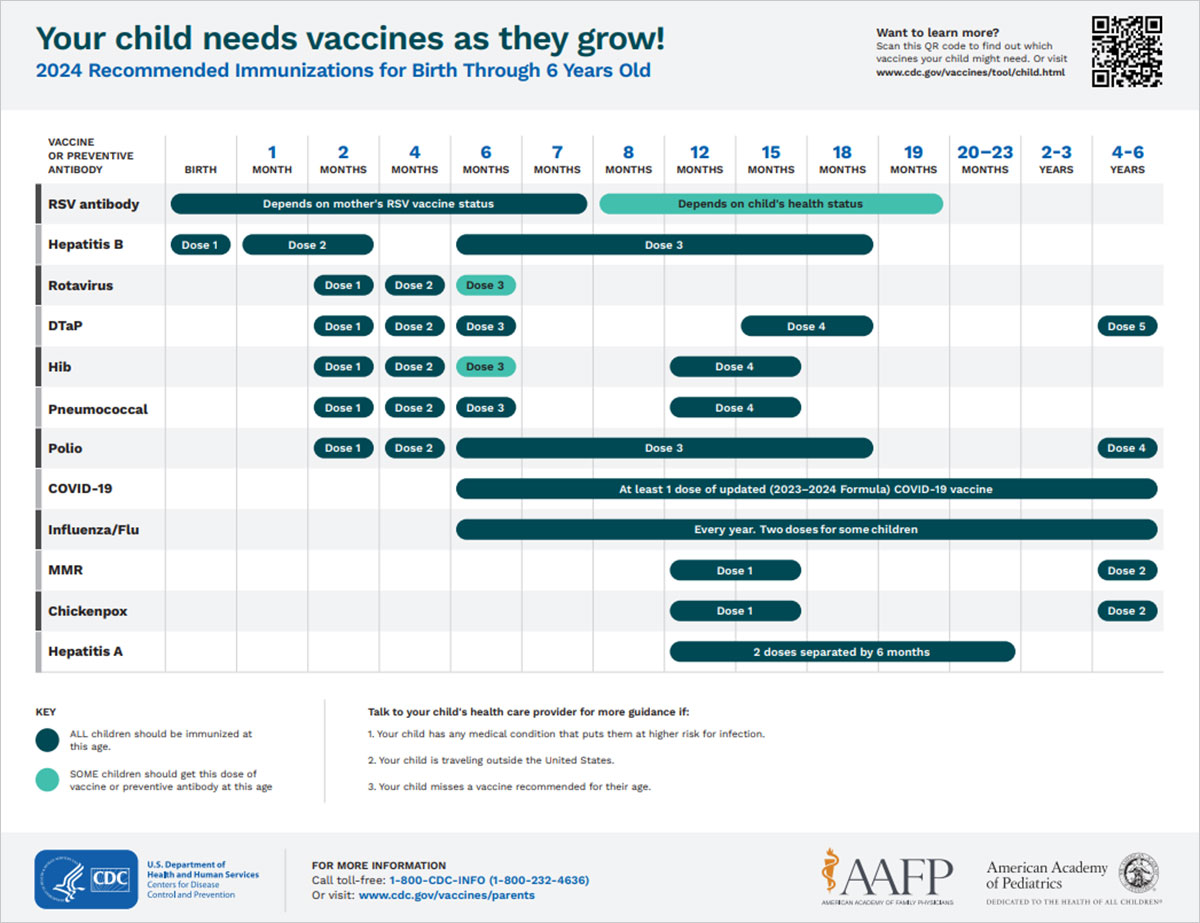
Mandatory vaccination in schools has helped prevent the transmission of childhood diseases, many of which are potentially fatal.Easy-to-read child schedule


Easy-to-read teen schedule

Somehow, refusing vaccination has become a test of one’s loyalty to Donald Trump (who has had all his vaccinations) and to the Republican Party.

To avoid being branded a RINO (Republican In Name Only), one is expected to refuse vaccination on the basis of “freedom,” fake articles about the dangers of vaccination, or manliness.

The GOP has become the “We want you to die young” party. Its followers are paying the price.

In summary, richer people live longer than poorer people, and the GOP is devoted to widening the Gap between the rich and the rest.

In addition to denying the results of elections they lose, the GOP denies science, healthcare, poverty, and via gerrymandering, denies the will of the people. It even attempted a coup, a denial of the people’s voting rights.

In a clear case of “you get what you vote for,” the GOP counts millions of poor people among its voters. And yet, they are the ones who suffer from their vote.

At its core the appeal of the GOP is hatred for, and fear of, the poor, blacks, browns, yellows, reds, gays, Jews, Muslims, foreigners, and the educated. 

Rodger Malcolm Mitchell
Monetary Sovereignty

Twitter: @rodgermitchell Search #monetarysovereignty
Facebook: Rodger Malcolm Mitchell

……………………………………………………………………..

The Sole Purpose of Government Is to Improve and Protect the Lives of the People.

MONETARY SOVEREIGNTY
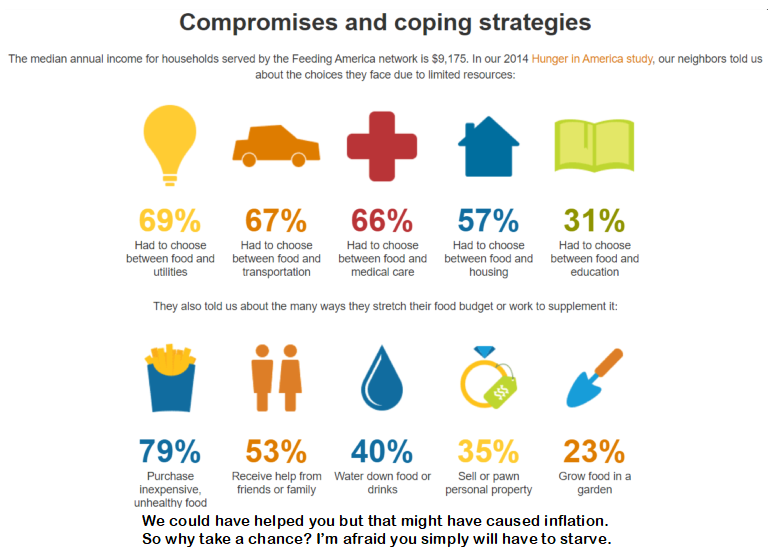
#1. Inflation or #2. Sickness, Recession, Poverty. Choose #1 or #2. Yes, seriously.

It’s a real question. If you had to choose between #1. Inflation or #2. Sickness, A Recession, A Depression, Poverty, Illiteracy, Starvation, Homelessness, Crime and some other bad stuff I could mention, would you chose #1 or #2?

It may sound like a no-brainer, and perhaps it is in the literal sense of “no brain,” because the vast majority of Americans claim they would rather experience #2 rather than #1.

Do you agree that you would prefer to experience sickness, a recession,  a depression, poverty, illiteracy, Starvation, Homelessness, Crime, etc. than to experience inflation?

Let’s begin with the generally uncontested fact that the federal government created the laws that created the U.S. dollar. Because  the federal government can create any laws it wishes, it can create as many dollars as it wishes, and cannot unintentionally run short of dollars. The experts agree:

Former Fed Chairman, Alan Greenspan: “The United States can pay any debt it has because we can always print the money to do that.”

Former Fed Chairman, Ben Bernanke: “The U.S. government has a technology, called a printing press (or, today, its electronic equivalent), that allows it to produce as many U.S. dollars as it wishes at essentially no cost.”

We could add to the discussion the fact that federal deficit spending does not cause inflation, which we have proved here and here and dozens of other places on this blog.

We could insist that shortages cause inflations, and those shortages can be cured by federal deficit spending. Thus, we can show that rather than causing inflations, federal deficit spending can cure inflations.

What Does Drowning Look Like?
Sorry, but spending money on lifeguards and floatation devices would have caused inflation.

But, wait. Why struggle against a tide of misinformation? Let’s assume, for the sake of argument, that federal deficit spending does indeed, cause inflation.

It’s what most Americans believe.

Because the federal government can’t run short of its own sovereign currency, it could risk inflation by using that currency to pay for:

  1. Comprehensive, generous Medicare insurance for every man, woman, and child in America
  2. Generous Social  Security benefits for every man, woman, and child in America, regardless of age, income, or wealth
  3. All costs of education from K-12 and beyond, including advanced degrees from top universities
  4. Rent and other housing subsidies, for all.
  5. A healthful diet for all Americans
  6. Subsidies for all states, counties, cities, and villages, so that none of them would have to levy taxes.
  7. Ending the FICA deduction from salaries
  8. Expanded research in all the sciences: Mathematics, Biology, Botany, Social Sciences, Philosophy, Geology, Physics, Chemistry, Astronomy, and all the other sciences not mentioned.

The purpose of such spending would be to improve and extend the lives of humans and the other living creatures with whom we share the earth.

The government has the ability to fund all of #1 through #8. But many people wrongly object, “But that would cause inflation.”

If those people were correct, and that spending would cause inflation, it only would mean they have chosen a lesser life rather than experience inflation.

They have chosen sickness rather than health, poverty instead of affluence, taxation rather than being tax-free, homelessness rather than sheltered, stagnancy rather than advancement, and ignorance rather than knowledge, all for the fear of inflation.

Would you rather suffer from incurable, painful disease than suffer from inflation? Would you rather risk being impoverished and homeless than to risk inflation? Would you prefer that your children be unable to attend the best colleges having the best resources money can buy, just so you don’t see prices rise?

Would you rather the type of research that amazed you with the Internet, cell phones, artificial intelligence, moon landings, etc. be discontinued for lack of funds, just so inflation can be avoided?

Would you prefer that America default on its debts by enforcing a debt ceiling? Would you rather that the federal government cease to improve our military?

Would you rather see the government do nothing to prevent or cure recessions and depressions, just because the cure – federal deficit spending – might cause inflation?

In summary, even if we admit the belief, just for the sake of argument, that federal spending causes inflation, we are left with very unsavory alternatives.

Think about it. Do you really believe that the possibility, or even the false probability, that federal deficit spending could cause inflation is more important than all of the things federal money could buy?

  Rodger Malcolm Mitchell Monetary Sovereignty Twitter: @rodgermitchell Search #monetarysovereignty Facebook: Rodger Malcolm Mitchell

……………………………………………………………………..

The Sole Purpose of Government Is to Improve and Protect the Lives of the People.

MONETARY SOVEREIGNTY
The only 3 possible solutions to the entitlements crisis — no, make that 3 fake solutions + 1 real solution.

You often hear about the “entitlements crisis. Here is what it is and the 3 solutions — no, make that the 3 fake solutions + the one real solution.

In US Economics, what is the Entitlement Crisis? Erin J. Hill, Last Modified Date: February 28, 2023 The United States entitlement crisis refers to the deficit between what programs such as Social Security and Medicare will require in comparison to how much funding is available.

Men: We have three solutions to your situation. Man: How about taking the rope off my neck. Men: Hmm, never thought of that one.
 
Immediately, Erin J. Hill starts on the wrong foot when she talks about “how much funding is available.” The U.S. federal government uniquely is Monetarily Sovereign. It created the first dollars from thin air by passing laws it created from thin air. So long as the federal government can pass laws, it can pass laws that create dollars.

(Former Federal Reserve Chairman Alan Greenspan: “There is nothing to prevent the federal government from creating as much money as it wants and paying it to somebody.”)

This means that the cost of these programs will be more than what is in the federal budget.

There is nothing to prevent the U.S. federal government from increasing what is in the federal budget enough to pay for all the entitlements, twice over.

Government officials have not yet discovered a long-term solution for the issue, although some have suggested raising taxes on certain goods and making some government programs harder to be accepted into.

Those are the two fake solutions to the manufactured crisis, raise taxes and cut benefits. Both solutions would impoverish the middle- and lower-income groups by widening the income/wealth/power Gap between the rich and the rest. Here is the third fake solution:

The third rail Republicans can’t stop touching By Natalie Allison Social Security and Medicare are wildly popular. So why do GOP Senate candidates keep talking about privatizing them?

For two decades, campaign after campaign, Republican politicians have floated the idea of privatizing government entitlement programs including Social Security and Medicare. And campaign after campaign — from Paul Ryan to George W. Bush — it’s been a loser.

But for some reason, they keep trying. The latest is Don Bolduc, New Hampshire’s GOP Senate nominee, who advocated privatizing Medicare during a campaign town hall in early August, according to a recording of the event obtained by POLITICO.

In a statement, Bolduc spokesperson Jimmy Thompson walked back Bolduc’s comments, saying the candidate now opposes privatizing Medicare, Medicaid and Social Security.

“Having served 10 tours of combat in Afghanistan, General Bolduc relies on his health care from the VA,” Thompson said in an email. “He knows first-hand how important its services are to veterans, and he believes that every American who is eligible should be able to rely on the benefits they have paid into it, including Medicare, Medicaid and Social Security.”

Having wilted from the political heat, Bolduc retreated to his military service for shelter. But he wrongly said people should rely on the benefits they have paid into it.

What people have paid may be politically relevant, as President Franklin D. Roosevelt claimed, but it is not financially relevant. Those FICA dollars are destroyed upon receipt by the U.S. Treasury.

FICA payments are made with M2 money-supply dollars. When they reach the Treasury, they cease to be part of any money supply. They disappear into the government’s infinite money-creation system. Infinity + FICA dollars = infinity.

(President Roosevelt, the originator of Social Security: “We put those payroll contributions there so as to give the contributors a legal, moral, and political right to collect their pensions. With those taxes in there, no damn politician can ever scrap my Social Security program.”)

FICA does not exist for financial reasons. It is all psychological. The government neither needs nor uses those dollars, but FICA makes people feel they are entitled to the benefits.

All entitlement benefits are paid the same way every federal obligation is paid: By the ad hoc creation of new dollars.

Even if all FICA collections ended (as they should), the federal government could continue funding entitlements, forever.

The 3 “solutions” are especially supported by the rich-loving GOP. Sadly, the Democrats agree that “something must be done} about the crisis, though their solutions involve raising taxes or cutting benefits, either of which would recess the economy and widen the Gap between the rich and the rest.

Most agree that the entitlement crisis is a result of poor government budgeting and overzealous spending.

No, the crisis is not due to budgeting and spending. It is an artificially manufactured crisis based on to failure to understand Monetary Sovereignty and the federal government’s infinite ability to pay for things with U.S. dollars.

(Former Federal Reserve Chairman, Ben Bernanke: “The U.S. government has a technology, called a printing press (or, today, its electronic equivalent), that allows it to produce as many U.S. dollars as it wishes at essentially no cost.”)

Programs like Medicaid have been expanded, and overspending is a large issue within the government. This has resulted in a much higher national debt.

These factors, combined with the housing crisis and government bailouts may result in some programs being downsized or cut altogether.

Overspending is a non-issue for a government that pays for everything with dollars it creates at will. The so-called “national debt” is not even a debt. It is the total of deposits into T-security accounts, which resemble safe deposit boxes. The depositors in those accounts are not lenders. They are owners. The government never touches the deposits which remain the property of the depositors. To pay off the so-called debt, the federal government merely returns the deposits, plus interest, which the government has the infinite ability to do. The sole purpose of those deposits is not to provide the government with spending money. The purpose is to provide a safe, interest-paying place for dollar-users to store currently unused dollars. This stabilizes the dollar by making it safer to own.

As Baby Boomers get older, many expect the Medicare program to be placed under heavy financial stress.

Baby Boomers expect this because that is what they have been (falsely) told.

Some studies have shown that if the entitlement crisis is not remedied soon, in 15 years the only programs that will be able to be funded will be Social Security, Medicare, Medicaid, federal employee retirement, and interest on the national debt.

Other programs would have to be cut or funded through deficit spending.

No federal programs ever need to be cancelled for the government’s lack of money. The federal government never lacks money. Federal deficit spending not only is beneficial (It adds dollars to the economy), but it is necessary for economic growth. When deficit spending is absent, we have depressions:

Fact: U.S. depressions tend to come on the heels of federal surpluses.

1804-1812: U. S. Federal Debt reduced 48%. Depression began 1807. 1817-1821: U. S. Federal Debt reduced 29%. Depression began 1819. 1823-1836: U. S. Federal Debt reduced 99%. Depression began 1837. 1852-1857: U. S. Federal Debt reduced 59%. Depression began 1857. 1867-1873: U. S. Federal Debt reduced 27%. Depression began 1873. 1880-1893: U. S. Federal Debt reduced 57%. Depression began 1893. 1920-1930: U. S. Federal Debt reduced 36%. Depression began 1929. 1997-2001: U. S. Federal Debt reduced 15%. Recession began 2001.

Even when federal deficit spending exists, but in too-small amounts, we have recessions:
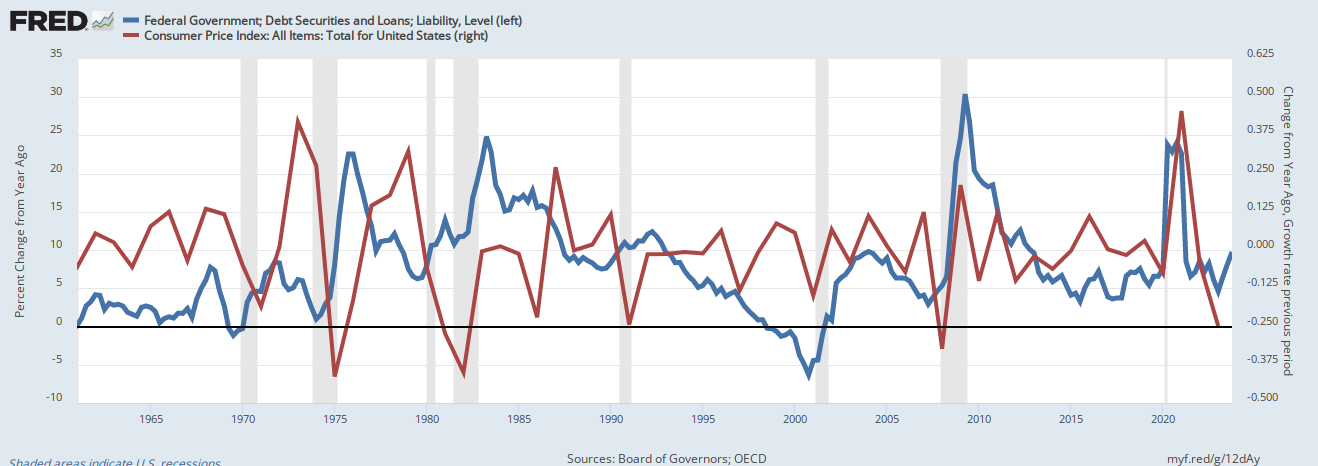
Reductions in federal debt growth lead to inflation
When federal deficit growth (blue line) declines, we have recessions (vertical gray bars) which are cured by increased federal deficit spending.

One of the primary reasons for the entitlement crisis happening in this time frame is that roughly 78 million baby boomers will reach retirement age during this time period.

The primary reason for the “entitlement crisis” is people being told there is a crisis, when the so-called crisis is an invention of the rich. They want to grow richer by widening the Gap between the rich and the rest. This widening can be accomplished by reducing the net income of the rest. The government easily could fund entitlement programs, not just for the 78 million baby boomers, but for every man, woman, and child in America.

While many agree that the entitlement crisis is a huge issue facing the American economy, others believe that the issue has been blown out of proportion.

It hasn’t been blown out of proportion. It doesn’t even exist. It is pure fiction.

Some even go so far as to say that it is a sham used to raise taxes and scare the public out of their money.

I’ll say it. It is a sham used to raise taxes and to scare the public out of their money. Pure and simple.

There is no debate, however, on the United States economy being in a tough position. In order to stop a crisis, either now or further in the future, changes need to be made to remedy government spending.

Raising taxes to pre tax-cut rates would also allow more breathing room, along with downsizing many government programs.

The author restates the pitifully wrong “solutions” to the non-problem of federal insolvency.

(Alan Greenspan: “A government cannot become insolvent with respect to obligations in its own currency.”)

Deficit growth declined before the recession. Increased deficit growth cured the recession.

If nothing is done and lawmakers continue to turn a blind eye, the coming economic crisis may bear many similarities to the one which started in 2007.

The recession of 2007 was caused by reduced deficit growth from 2003 through 2007. It was cured by increased deficit growth from 2007 through 2009.

Fortunately, the problems at hand are not insurmountable, and changes in Social Security and Medicare can be made so that both programs can be sustainable.

These changes need to be implemented sooner rather than later, though, before it’s too late.

The “changes” lead us to the 4th, the real solution: The federal government should eliminate all FICA taxes and should fund:
  1. Comprehensive, no-deductible Medicare for every, man woman and child in America.
  2. Social Security benefits for every man, woman, and child in America, regardless of age, income, or wealth
  3. School for grades K-12 + graduate levels for everyone who wants it.
That one tax cut and those three easily affordable benefits would enrich America far beyond current myopic visions. They permanently would eliminate the crippling and false financial equivalence between our Monetarily Sovereign U.S. government and the monetarily non-sovereign states, counties, cities, businesses, euro nations and people.

Scott Pelley: Is that tax money that the Fed is spending? Ben Bernanke: It’s not tax money… We simply use the computer to mark up the size of the account.

And finally, lest you believe the myth that federal spending causes inflation, it’s just that: a myth.
There is no relationship between changes in federal debt (blue) and changes in the consumer price index (red).
Ofttimes, the simplest solutions are the best solutions. Rodger Malcolm Mitchell Monetary Sovereignty Twitter: @rodgermitchell Search #monetarysovereignty Facebook: Rodger Malcolm Mitchell

……………………………………………………………………..

The Sole Purpose of Government Is to Improve and Protect the Lives of the People.

MONETARY SOVEREIGNTY