The world’s shortest course in economics. Give it to someone who is telling you fake facts.

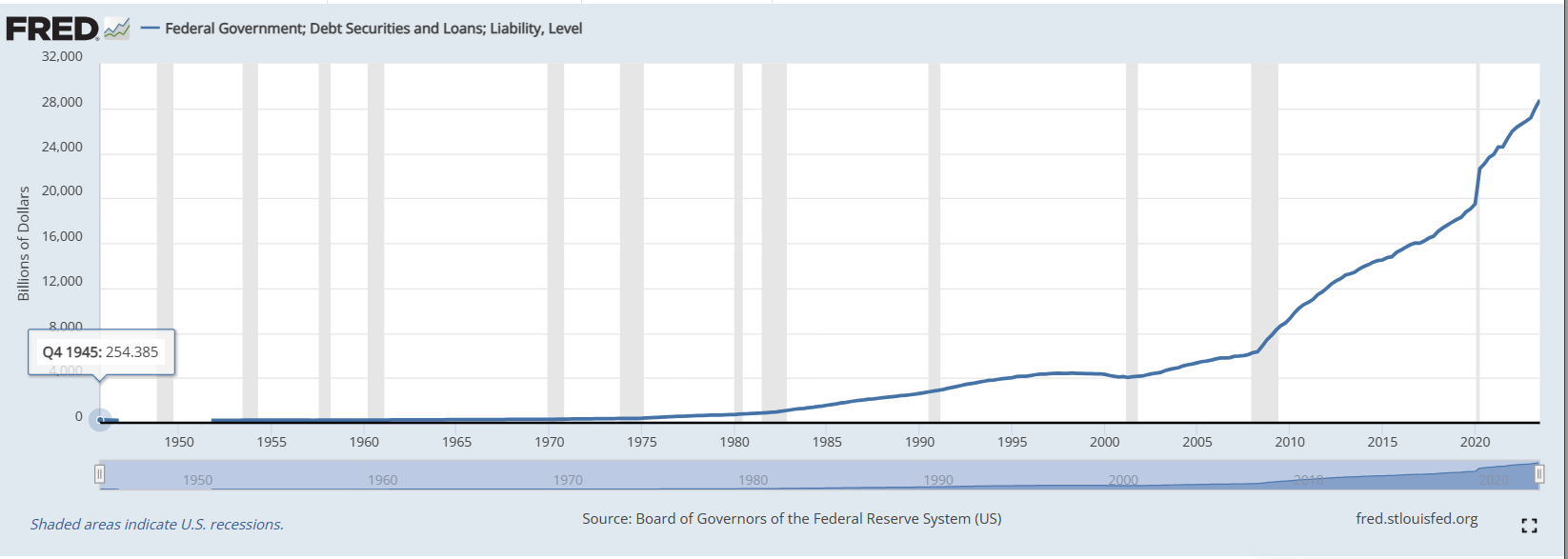
You probably don’t engage in extensive economic research. What you know about our economy mainly comes from what the media, politicians, economists and your peers tell you. Sadly, much of what they tell you is wrong. Some pundit, perhaps Mark Twain or Will Rogers, reportedly said, “It ain’t what you don’t know that gets you into trouble. It’s what you know for sure that just ain’t so.”Fact Or Fake? How To Fact-Check Online Articles - LearnSafe If you are in the majority, you know for sure the federal debt is too high, federal taxes fund federal spending, Social Security and Medicare are near insolvency, the federal government should run a balanced budget, Federal spending causes inflation, raising interest rates fights inflation, and the federal government is deeply in debt. And not one of them is true. They all “just ain’t so.” Not even close. Here is the reality: 1. Unlike state/local governments and the American people, the U.S. government is Monetarily Sovereign. In the 1780s, the government created the first U.S. dollars from thin air by passing laws, which it also created from thin air. The federal government’s infinite ability to create laws gives it the infinite ability to create its sovereign currency, the U.S. dollar. 2. The government continues to create U.S. dollars from thin air, by pressing computer keys. The government has the unique ability to create as many U.S.  dollars as it wishes.

(Ben Bernanke: “The U.S. government has a technology, called a printing press — or, today, its electronic equivalent — that allows it to produce as many U.S. dollars as it wishes at essentially no cost.”)

Thus, the federal government cannot run short of dollars unless it wishes to. Even if the federal government collected zero taxes, it could continue spending, forever. 3. The federal government never borrows dollars.

(Statement from the St. Louis Fed: “The U.S. government is not dependent on credit markets to remain operational.”)

The deposits into T-security accounts (T-bills, T-notes, T-bonds), mistakenly referred to as “debt,” neither are owned nor owed by the federal government. The deposits are owned by the depositors and never used by the federal government. Upon maturity, these deposits are returned to their owners, which is not a financial burden on the federal government. It is a simple money transfer like a transfer from your savings account to your checking account. 4. Federal taxes do not fund federal spending. Tax dollars are paid out of accounts that are part of the M1 money supply measure. When they reach the Treasury, they cease to be part of any money supply measure, thus federal tax dollars effectively are destroyed upon receipt by the Treasury. 5. The purposes of federal taxes are:

A. To control the economy by taxing what the government wishes to discourage and by giving tax breaks to what the government wishes to reward.

B. To assure demand for the U.S. dollar by requiring taxes to be paid in dollars.

C. To foster the myth that such benefits as Social Security, Medicare, poverty aids, etc. are limited by tax collections. This myth is funded and propagated by the rich to widen the income/wealth/power Gap between the rich and the rest. Widening the Gap makes the rich richer and the rest, poorer.

6. To propagate the myth of potential Federal insolvency, the rich bribe these sources of information:

A. The media are bribed via advertising dollars and ownership.

B. The politicians are bribed via campaign contributions and promises of lucrative employment after leaving office.

C. The university economists are bribed via donations to universities and promises of lucrative employment in think tanks and other enterprises.

5. State/local governments, euro nation governments, businesses, and people are monetarily non-sovereign. They can, and often do, run short of U.S. dollars. They do not have the infinite ability to create dollars. Thus, state/local taxes fund state/local spending. Equivalences between personal finances and federal finances are misleading. 6. Scarcity makes prices rise. Inflation is a general increase in prices. Federal deficit spending does not cause inflation. All inflations are caused by scarcities of crucial goods and services, most often energy and food. Today’s inflation resulted from COVID-caused scarcities of oil, food, shipping, computer chips, labor, metals, lumber, and other goods and services. Contrary to popular wisdom, “excessive” federal spending did not cause the scarcity of these goods and services, so is not responsible for inflation. 7. Increased federal spending cures inflations by aiding the acquisition, production, and distribution of scarce resources. 8. High interest rates have a contradictory effect on inflation. They strengthen the value of the dollar, which means fewer dollars are needed to purchase goods and services. And high rates force the federal government to pump more growth dollars into the economy. But interest is added to the costs of all goods and services, so high rates exacerbate inflation. On balance, curing scarcities, not cutting federal spending, or raising interest rates, cures inflations. Rodger Malcolm Mitchell Monetary Sovereignty Twitter: @rodgermitchell Search #monetarysovereignty Facebook: Rodger Malcolm Mitchell

……………………………………………………………………..

The Sole Purpose of Government Is to Improve and Protect the Lives of the People.

MONETARY SOVEREIGNTY

It figured: New Speaker Johnson’s first act is to propose austerity. Anyone surprised?

With a new House Speaker who is an extreme right-winger, a leader in attempts to overturn the election, and who justifies everything by his conversations with God, you could only expect idiocy.

Johnson has not disappointed.

He even receives plaudits from Libertarian Eric Boehm, further evidence of his woolyheadedness.

Here are some excerpts from Reason.com, aka “Nonsense.com.”

New Speaker Mike Johnson’s First Good Idea: A Debt Commission A debt commission won’t solve any of the federal government’s fiscal problems, but it’s the first step toward taking them seriously. ERIC BOEHM | 10.27.2023 1:10 PM

Just moments after picking up the gavel, newly elected Speaker of the House Mike Johnson (R–La.) endorsed an idea that manages to be both eye-roll-inducing and really important.

“The greatest threat to our national security is our nation’s debt,” Johnson said during his first speech from the speaker’s dais in the House chamber.

It isn’t the most stupid comment any politician ever has made, but it’s right up there with “Global warming is a Chinese hoax” and “COVID is like the common cold. It’ll just go away.”

Not only does the statement omit Russia and China as threats to our national security, but says the national debt is more to be feared. Johnson won’t tell you:

  1. It isn’t “national.” It’s T-securities owned by private citizens and by governments.
  2. It isn’t even “debt.” It’s deposits into accounts wholly owned by the above-mentioned private citizens and governments, not by the U.S. government. The federal government, which never borrows U.S. dollars, neither needs nor even touches those deposits.
  3. It isn’t a threat to anything or anyone. It’s just deposits easily paid back by simply returning the deposits. That is how the federal government always pays back T-security deposits.

“We know this is not going to be an easy task, and tough decisions will have to be made, but the consequences—if we don’t act now—are unbearable.”

What exactly are the “unbearable consequences”? Johnson, like all the other debt nuts, never says, probably because there are zero consequences to the government accepting deposits into T-security accounts. Zero.

There are consequences to large deficits, from which the “national debt” evolves, but those are good consequences, including economic growth and more benefits to Americans (health, infrastructure, military security, etc.) Federal deficit spending grows GDP.

Then, Johnson promised to “establish a bipartisan debt commission to begin working on this crisis immediately.”

This is, in some ways, a pretty silly idea. After all, Johnson is the newly elected leader of Congress, a group of elected officials from two political parties with the constitutionally granted power to control the federal government’s fiscal policies like borrowing and spending.

Congress is, quite literally, a bipartisan commission tasked with managing the debt.

Within Congress, there’s also a Budget Committee, which is, of course, a bipartisan group of lawmakers tasked even more explicitly with determining how much the government can afford to spend, what it should spend tax revenue on, and when there’s been too much borrowing.

Anyone who understands Monetary Sovereignty knows that the federal government’s ability to “afford to spend” is infinite.

Ben Bernanke: “The U.S. government has a technology, called a printing press (or, today, its electronic equivalent), that allows it to produce as many U.S. dollars as it wishes at essentially no cost.”

So, yes, the very notion of a new and special bipartisan commission that’s going to do the thing Congress is already supposed to be doing is a little funny and more than a little redundant.

And yet, it’s obvious that something new has to be tried. “In the time it will take me to deliver this speech, we’ll go up another $20 million in debt. It’s unsustainable,” Johnson pointed out on Wednesday—and it wasn’t a very long speech.

And there’s the favorite word of the debt nuts: “Unsustainable.”

Why is it unsustainable? The debt nuts never say. The so-called, misnamed “debt” (deposits) has been growing for over 80 years, and still, we sustain it.

“Unsustainable” falls into the same category as “unbearable consequences.” It’s a frightening term that has no basis in reality.

Even if it were a debt (which it isn’t), our Monetarily Sovereign government services any obligation of any size simply by creating dollars, which it has the infinite ability to do.

And no, the “debt” doesn’t cause inflation, recession, depression, crime, poverty, or disease. About the only thing the debt-that-isn’t-debt causes is muddle-brained thinking by Libertarians and other debt nuts.

As an oft-given reminder to our readers, here is what happens when the “debt” is reduced by cutting deficits and running surpluses:

1804-1812: U. S. Federal Debt reduced 48%. Depression began 1807

1817-1821: U. S. Federal Debt reduced 29%. Depression began 1819

1823-1836: U. S. Federal Debt reduced 99%. Depression began 1837

1852-1857: U. S. Federal Debt reduced 59%. Depression began 1857

1867-1873: U. S. Federal Debt reduced 27%. Depression began 1873

1880-1893: U. S. Federal Debt reduced 57%. Depression began 1893

1920-1930: U. S. Federal Debt reduced 36%. Depression began 1929

1997-2001: U. S. Federal Debt reduced 15%. Recession began 2001.

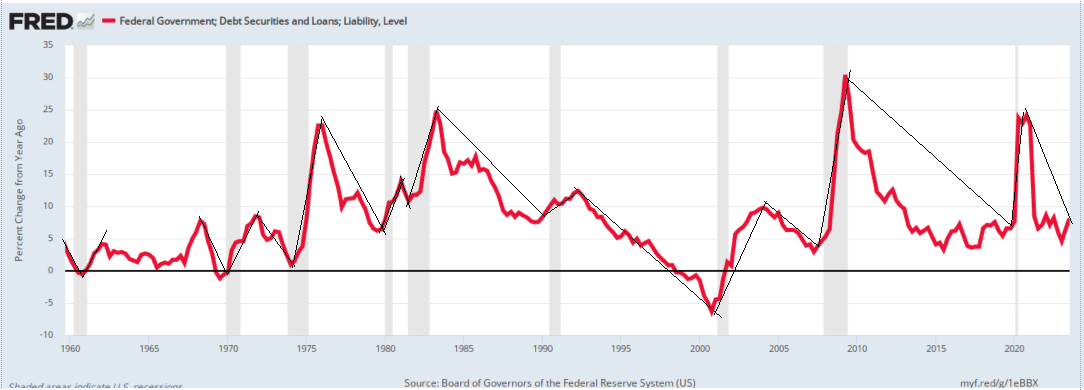
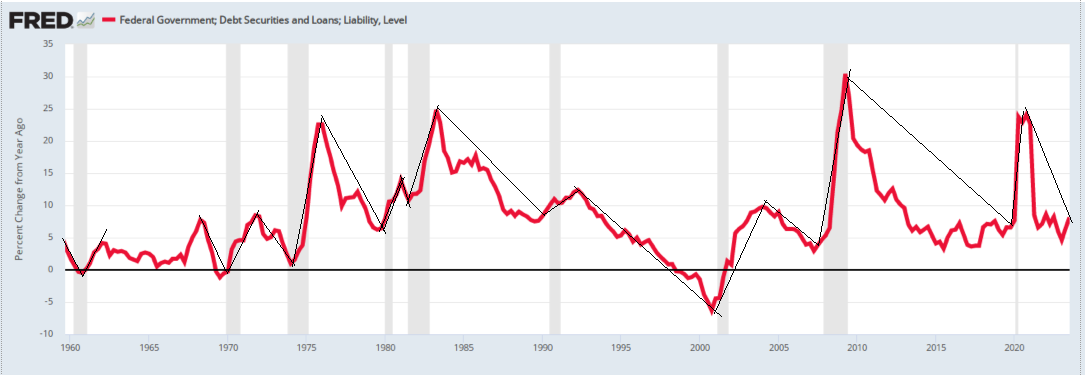
The above happens when the federal deficit is eliminated and becomes a federal surplus. And this is what happens when the federal deficit simply is reduced, not eliminated.

The red line is the annual change in the federal deficit. Vertical gray bars are recessions. Recessions occur when federal deficits decline because economic growth requires a growing money supply. Recessions are cured by increased federal deficits.

Economic growth, by its definition, requires the economy to have more money. When the federal government isn’t adding dollars by running deficits or even adding too few dollars by adding too-small deficits, we have recessions.

What can a bipartisan commission on the debt accomplish? The Committee for a Responsible Federal Budget (CRFB), which has been advocating for such a commission, argues that special congressional task forces can focus discussions, generate greater public awareness of major issues, and create the opportunity for lawmakers to put all ideas on the table.

You can’t discuss “issues” and “ideas” when the starting point is, “All deficits and debt are bad.” It’s like discussing ideas for curing thirst when your starting point is, “Water is bad for you.”

In 1983, for example, Social Security was approaching insolvency—a problem that sounds familiar today—when a commission of congressional leaders and presidential appointees worked out a series of potential fixes. Afterward, Congress enacted many of those reforms, making Social Security solvent for another five decades.

Social Security, being an agency of the U.S. federal government, is as solvent as the government itself, i.e., infinitely solvent. The so-called insolvency comes from the lie that FICA funds Social Security.

Alan Greenspan: “A government cannot become insolvent with respect to obligations in its own currency.”

FICA funds nothing. All FICA dollars originate in the M2 money supply measure. When they reach the Treasury, they cease to be part of any money supply measure because the Treasury has infinite dollars.

Thus, FICA dollars effectively are destroyed. No federal agency can go bankrupt unless Congress and the President want it to go bankrupt.

That includes such agencies as the White House, Congress, the Supreme Court, and the military branches. The so-called reforms meant making Americans pay more and receive less.

It’s like solving the hunger problem by making poor Americans pay more for less food and calling that a “reform.”

More recently, there was the National Commission on Fiscal Responsibility and Reform, formed by President Barack Obama in the aftermath of the 2008 recession. It produced a plan that could have reduced the debt by $4 trillion over 10 years by raising taxes, cutting spending, and selling off federal property.

Translation: Obama’s plan would have taken dollars from the economy, given them to the federal government that doesn’t need them, and plunged America into a recession if we were lucky, but more likely a depression.

Even though most of those proposals were never enacted, the CRFB points hopefully to the fact that 11 of the 18 commission members supported the final recommendations, including five Republicans and five Democrats.

It is sad that 11 of the 18 commission members either were ignorant of economics or deliberately hoped for a recession or depression.

The idea for another commission on the deficit has been kicking around for a few years but has recently gained steam. The moderate lawmakers in the bipartisan Problem Solvers Caucus have endorsed the idea.

Polling by the Peter G. Peterson Foundation, which advocates for balancing the budget, shows that majorities of both Republican and Democratic voters support the formation of a commission.

As history shows, a balanced budget may be necessary for monetarily non-sovereign entities like cities, counties, states, businesses, and individuals; it unnecessarily will cause recessions and depressions in Monetarily Sovereign nations.

How would it work? Reps. Bill Huizenga (R–Mich.) and Scott Peters (D–Calif.) have introduced a bill to establish a 16-member commission that would include four experts from outside Congress (to be appointed by party leaders from both the House and Senate).

The commission’s recommendations would receive priority consideration by Congress and would be scheduled for a final vote during the lame-duck session after the 2024 election.

The problem is the commission, no doubt, will be as ignorant as Congress. Obama had his commission. Fortunately, its recommendations did not become law, so we avoided the depression.

That timing reveals something about the real reason why members of Congress like this sort of idea: because it allows them to avoid accountability for doing the thing they’re supposed to be doing in the first place.

It allows Congress to avoid economic facts and to do the bidding of the very rich, who grow when federal benefits to the poor are reduced. This widens the Gap between the rich and the rest, making the rich richer.

Recall what Johnson said on Wednesday: this will be a process that requires “tough decisions.” There’s nothing all that complicated about balancing the federal budget.

Members of Congress don’t need notable experts or a bipartisan commission to tell them that closing the deficit will require raising taxes or cutting spending (or some combination of the two). That’s literally all there is to it.

A prime measurement of the economy is the Gross Domestic Product. Raising taxes and/or cutting spending reduces the amount of money in the economy, which, by mathematical definition, reduces GDP.

A reduction in GDP is known as a “recession” or a “depression.” That’s literally all there is to it.

But those decisions become tough because politicians know that voters don’t like having their taxes raised. They also know that cutting even the most useless and wasteful government spending will spur outrage from whatever particular interest group benefits from it.

Imagine that. Voters don’t like money being taken out of their pockets. Who would have guessed that?

In the end, the right way to think about a bipartisan commission on the debt is as a sort of political suicide pact.

No, a commission to lower the debt or balance the budget is an economic suicide pact.

It means that members of both parties are committed to, at the very least, proposing ideas for balancing the budget—and that, in turn, should limit some of the partisan screeching that makes it so hard for Congress to make these decisions under normal circumstances.

Why do they assume that balancing the federal budget should be a goal? There is zero evidence that a balanced federal budget benefits the nation, the government, or anyone.

How about a commission to propose ideas for improving the lives of Americans? 

Both sides will have to take responsibility for ending the government’s addiction to borrowing.

The article began with a lie (The greatest threat to our national security is our nation’s debt”), and now it ends with a lie (“The government’s addiction to borrowing”). The U.S. federal government does not borrow.

Statement from the St. Louis Fed: “As the sole manufacturer of dollars, whose debt is denominated in dollars, the U.S. government can never become insolvent, i.e., unable to pay its bills. In this sense, the government is not dependent on credit markets to remain operational.

Will it work? Probably not, but nothing else seems more promising right now. Johnson’s got his work cut out, but this is a worthwhile effort.

If this indeed is Johnson’s goal, he will be remembered as the most ignorant, traitorous, damaging Speaker in American history — a man who tried to overturn our democracy and now hopes to cause America’s first depression since 1929.

Rodger Malcolm Mitchell

Monetary Sovereignty

Twitter: @rodgermitchell Search #monetarysovereignty

Facebook: Rodger Malcolm Mitchell

……………………………………………………………………..

The Sole Purpose of Government Is to Improve and Protect the Lives of the People.

MONETARY SOVEREIGNTY

Why is medical care unaffordable for so many Americans?

We’ll begin with a few facts:
  1. The U.S. federal government is Monetarily Sovereign (See: Monetary Sovereignty.)  It created the first U.S. dollars from thin air, and it retains the unlimited ability to create more U.S. dollars. The government never unintentionally can run short of U.S. dollars. Even if all federal tax collections ended, the federal government could continue spending forever.
  2. State and local governments are monetarily non-sovereign. They can and often do run short of dollars.
  3. Because the U.S. government cannot run short of dollars, it has no need for tax dollars. In fact, it destroys all tax dollars upon receipt at the Treasury. (See: “Does the Federal Government Really Destroy Your Tax Dollars?“) Taxes are paid with dollars from the M2 money supply, and when they reach the Treasury, they cease to exist in any money supply measure. Thus, the federal government does not spend taxpayers’ dollars.
  4. By contrast, state/local governments do need and spend taxpayers’ dollars.
  5. Contrary to popular wisdom, federal spending does not cause inflation. Inflation always is caused by shortages of critical goods and services, usually oil, food, and labor. (See: “Cause of Inflation.”) Inflations can be cured by additional government spending to cure shortages.
  6. Federal deficit spending is necessary for economic growth. The greater the spending, the greater the growth. (See: “Four Reasons Why Federal Deficits Are Absolutely Necessary.“)
Keep those facts in mind as you read excerpts from the following article:New Oxfam Poll: Most Americans Believe We Should Help Working Poor |  HuffPost Impact

The Commonwealth Fund Health Care Affordability Survey, fielded for the first time in 2023, asked U.S. adults with health insurance, and those without, about their ability to afford their health care — whether costs prevented them from getting care, whether provider bills left them with medical debt, and how these problems affected their lives.

Many Americans have inadequate coverage that’s led to delayed or forgone care, significant medical debt, and worsening health problems.

While having health insurance is always better than not having it, the survey findings challenge the implicit assumption that health insurance in the United States buys affordable access to care.

Difficulties affording care are experienced by people in employer, marketplace, and individual market plans, as well as people enrolled in Medicaid and Medicare.

Private insurance is burdened by the profit motive, which restricts the number and amount of benefits offered. However the federal government has no profit motive and has the unlimited ability to create dollars. So why is Medicare inadequate?

For the survey, our analysis focuses on 6,121 working-age respondents, those 19 to 64. 

Survey Highlights

    • Large shares of insured working-age adults surveyed said it was very or somewhat difficult to afford their health care: 43 percent of those with employer coverage, 57 percent with marketplace or individual-market plans, 45 percent with Medicaid, and 51 percent with Medicare.
    • Many insured adults said they or a family member had delayed or skipped needed health care or prescription drugs because they couldn’t afford it in the past 12 months: 29 percent of those with employer coverage, 37 percent covered by marketplace or individual-market plans, 39 percent enrolled in Medicaid, and 42 percent with Medicare.
    • Cost-driven delays in getting care or missed care made people sicker. Fifty-four percent of people with employer coverage who reported delaying or forgoing care because of costs said a health problem of theirs or a family member got worse because of it, as did 61 percent in marketplace or individual-market plans, 60 percent with Medicaid, and 63 percent with Medicare.
    • Insurance coverage didn’t prevent people from incurring medical debt.Thirty percent of adults with employer coverage were paying off debt from medical or dental care, as were 33 percent of those in marketplace or individual-market plans, 21 percent with Medicaid, and 33 percent with Medicare.
    • Medical debt leads many people to delay or avoid getting care or filling prescriptions: more than one-third (34%) of people with medical debt are in employer plans, 39 percent in the marketplace or individual-market plans, 31 percent in Medicaid, and 32 percent in Medicare.
Healthcare insurance, whether private or government-funded, is inadequate. Given the fact that the federal government has infinite dollars, why are so many Americans suffering with too-costly-but-inadequate insurance? Medicare, for instance, is far less than comprehensive. Why does Medicare have Part A, Part B, Part C, and Part D, each with different options and costs? Why not simply a Medicare that covers everything for everyone at no cost? What Medicare Doesn't Cover Why, if the federal government has infinite money, are these expenses not covered, and why are there deductibles and added costs to complete coverages? You have been told, falsely, that the federal government is like state/local governments, business, you and me, in being monetarily non-sovereign. You have been told falsely, that the federal government spends taxpayers’ dollars and can run short of dollars. You have been told, falsely, that to provide benefits, the federal government must levy taxes and spend taxpayers’ money. It’s all a lie.

Alan Greenspan: “A government cannot become insolvent with respect to obligations in its own currency. There is nothing to prevent the federal government from creating as much money as it wants and paying it to somebody. The United States can pay any debt it has because we can always print the money to do that.”

Quote from former Fed Chairman Ben Bernanke when he was on 60 Minutes: Scott Pelley: Is that tax money that the Fed is spending? Ben Bernanke: “It’s not tax money… We simply use the computer to mark up the size of the account. The U.S. government has a technology, called a printing press (or, today, its electronic equivalent), that allows it to produce as many U.S. dollars as it wishes at essentially no cost.”

Statement from the St. Louis Fed: “As the sole manufacturer of dollars, whose debt is denominated in dollars, the U.S. government can never become insolvent, i.e., unable to pay its bills. In this sense, the government is not dependent on credit markets to remain operational.”

The U.S. government is not the only Monetarily Sovereign entity. For example:

Press Conference: Mario Draghi, President of the ECB, 9 January 2014 Question: I am wondering: can the ECB ever run out of money? Mario Draghi: Technically, no. We cannot run out of money.

Given its infinite money supply, why does the federal government not provide free, comprehensive, no-deductible insurance to every man, woman, and child in America? Why must you, as an American, risk bankruptcy, sickness, and death because your insurance is inadequate? What is the Big Lie? The Big Lie is the claim that federal taxes fund federal spending. To pay its bills, the federal government creates new dollars ad hoc by tapping computer keys. Whenever you read an article claiming the federal government is “spending taxpayers’ dollars; it is a lie. State and local governments spend taxpayers’ dollars; the federal government does not. Why are you being lied to, and where are the lies coming from? The lies are coming from the healthcare insurance industry, the media, the economists, and the politicians. It’s easy to understand why the insurance industry lies about the federal government’s not funding healthcare insurance: The profit motive. The insurance industry does not want to lose the huge profits in selling healthcare coverage. But why do the media, economists, and politicians lie? Because they are bribed. The media are bribed by advertising dollars and by ownership. The economists are bribed by university contributions and by promises of lucrative jobs in “think tanks.” The politicians are bribed by campaign contributions and by promises of lucrative jobs with industry. Who is doing the bribing? The very rich? Why are the rich bribing? Gap psychology says people grow richer and more powerful by widening the Gap between them and those below them in any income/wealth/power measure. That is the primary way the rich make themselves more affluent. How do the rich widen the Gap below them? They get more for themselves, but importantly, they make sure those below them get less. They use their influence to reduce the federal benefits paid to those less wealthy. The rich disseminate the lie that Medicare and Social Security are running short of dollars, so benefits must be reduced, and taxes must be increased (See: “Starve the Poor.”) What should be done? First, the useless, harmful FICA tax should be eliminated. Like all federal taxes, it funds nothing. Worse, it punishes the low-income worker and widens the Gap between the rich and the rest. Second, the federal government should pay for free, comprehensive Medicare for All, with no limits and no deductions. One free plan for everyone; no Part A, B, C, D. No Medicaid. No “Donut holes.” No Medicare Advantage plans. The public must learn that federal spending is beneficial, and it costs nothing. The more the federal government spends on healthcare, the more the overall economy will grow and prosper. Ignorance is the weapon used by the rich to dominate the rest. That is the reason medical services are unaffordable for so many Americans. Rodger Malcolm Mitchell Monetary Sovereignty Twitter: @rodgermitchell Search #monetarysovereignty Facebook: Rodger Malcolm Mitchell

……………………………………………………………………..

The Sole Purpose of Government Is to Improve and Protect the Lives of the People.

MONETARY SOVEREIGNTY

Four reasons why federal deficits are absolutely necessary for economic growth

Every day, U.S. dollars are created by federal government spending and by private sector lending.

And every day, dollars are destroyed by federal taxing and by private sector loan repayment.

Because private sector loans eventually are repaid, they do not permanently add dollars to the economy. By contrast, federal spending seldom is balanced by federal taxes — the government runs deficits almost every year — and those deficit dollars not offset by taxes, are permanently added to the economy.

Thus, federal deficits are the primary way dollars are permanently added to the economy.

The trajectory of Gross Domestic Product (GDP – red) parallels the M2 money supply trajectory.

America’s population is growing, and we have inflation every year. Further, our imports generally exceed our exports, so dollars leave the economy.

Just to remain level on a real (inflation-adjusted) per capita basis, our economy requires a growing supply of dollars:

GDP = Federal Spending + Nonfederal Spending + Net Exports

Mathematically, the economy (GDP) can’t grow unless the money supply increases. Without federal deficit spending, both “Federal Spending” and “Nonfederal Spending” would decrease, and “Net Exports” already is below zero.

In summary, the federal government must grow GDP to account for:

    1. Inflation: According to the Bureau of Labor Statistics consumer price index, the average inflation rate of the US dollar between 1970 and today was 3.98% per year. This means that today’s prices are 7.93 times as high as average prices since 1970. So far, in 2023, the inflation rate has been about 8%. The Federal Reserve aims for 2% inflation.
    2. Population growth: According to the United Nations, the population of the United States in 1970 was 205,052,174. As of 2023, the population of the United States is estimated to be 339,996,563. Therefore, the population of the United States today is approximately 65.8% higher than in 1970. The current population of U.S. in 2023 is 339,996,563, a 0.5% increase from 2022 or about 2 million more people.
    3. Net imports: According to the World Bank, the U.S. trade balance for 2021 was $ 861.71B, a 37.32% increase from 2020.
    4. Economic growth. Just to achieve zero economic growth, the U.S. government must run deficits that overcome Inflation, Population growth, and Net imports of $861B. For economic growth, the federal government must run additional deficits.
Federal deficits add growth dollars to the economy. Federal taxes take growth dollars away from the economy.

There are various ways to calculate how much the federal deficit needs to be to achieve economic growth.

Here is a genuinely rough estimate, only as an example. The most recent GDP increase was $414 Billion.

That increase was achieved with a $1.7 Trillion deficit and $861 Billion Net Imports. This left about $839 Billion in the economy.

At 8% inflation, achieving the same level of GDP growth, Population Growth, and Net Imports would require a federal deficit of (108% x 1.7 Trillion) $1.8 Trillion.

Again, this is just “back of the envelope” stuff, leaving out many variables. It’s only to demonstrate one fact: Deficits are necessary for economic growth. Period.

$10 trillion in added debt shows ‘Bush and Trump tax cuts broke our modern tax structure’ Jon Queally, Common Dreams, October 22, 2023, 7:05AM ET $10 trillion in added debt shows ‘Bush and Trump tax cuts broke our modern tax structure.’

The “modern tax structure” is broken, but not because of “added debt.” It’s broken because the purpose of federal taxes differs from the purpose of state/local taxes.

Federal taxes do not fund federal spending. Our Monetarily Sovereign government funds its spending by creating new dollars ad hoc.

No tax dollars are used. Taxes are paid with dollars from the M2 money supply measure. But when they reach the Treasury, they disappear from any money supply measure. The Treasury has infinite dollars; no measure exists.

Federal tax dollars effectively are destroyed upon receipt.

Today, federal taxes have two explicit purposes and one hidden purpose.

        • Federal taxes help the government control the economy by taxing what the government wishes to discourage and giving tax breaks to what the government wishes to reward.
        • Federal taxes also assure demand for the U.S. dollar by requiring dollars to be paid for all tax obligations.
        • The hidden purpose is to enrich the wealthy by widening the income/wealth/power Gap between the rich and the rest of us. The tax structure contains tax loopholes not available to the rest of us. These were put there via political bribes from the rich.

The U.S. Treasury Department on Friday released new figures related to the 2023 budget that showed a troubling drop in the nation’s tax revenue compared to GDP — a measure that fell to 16.5% despite a growing economy — and an annual deficit increase that essentially doubled from the previous year.

This above is an oblique reference to the meaningless Federal debt/GDP ratio. It is a ratio that compares two unrelated measures. Federal “debt” is nothing like actual debt. It is deposits into Treasury Security accounts (T-bills, T-notes, T-bonds). 

These accounts are held by the government but are owned by the depositors (the buyers of those T-securities). The government never uses those dollars other than to add interest.

Upon maturity, the government merely transfers the dollars from the depositors’ T-security accounts to the depositors’ checking accounts. It is a simple asset transfer like moving dollars from your savings account to your checking account. 

This so-called “debt” is not a financial burden on anyone — not on the government or on taxpayers. 

The purpose of those accounts is not to provide spending money to the government. Rather, they are a safe place to store unused dollars, which stabilizes the dollar and helps provide demand for the dollar.

The other side of the Debt/GDP ratio, GDP, is total spending in America. It is not related in any way to deposits into T-security accounts.

The Debt/GDP ratio predicts nothing. It measures nothing. The ratio does not indicate the federal government’s ability to pay its bills, an infinite ability. The federal government cannot run short of dollars. Not now. Not ever.

The ratio does not indicate the economy’s health, which is characterized by such measures as inflation, employment, unemployment, GDP growth, healthcare, etc.

Look at any list comparing the ratio among the world’s various nations, and you will not be able to discern anything about those nations. For example:

Countries with the Highest Debt-to-GDP Ratios (%) Venezuela — 350% Japan — 266% Sudan — 259% Greece — 206% Lebanon — 172% Cabo Verde — 157% Italy — 156% Libya — 155% Portugal — 134% Singapore — 131% Bahrain — 128% United States — 128%

Countries with the Lowest Debt-to-GDP Ratios (%) are Brunei — 3.2%, Afghanistan — 7.8%, Kuwait — 11.5%, Congo (Dem. Rep.) — 15.2%, Eswatini — 15.5%, Burundi — 15.9% Palestine — 16.4% Russia — 17.8% Botswana — 18.2% Estonia — 18.2%

As you can see, the debt/GDP ratios tell you nothing about the economies of any country. Low ratios mean nothing. High ratios mean nothing.

Similarly, tax revenue/GDP means nothing. Yet the author, Jon Queally, finds it “troubling.”

That ratio tells you nothing about the government’s ability to pay its bills (which, again, is infinite). It tells you nothing about the current or future health of the economy. 

The only thing this ratio tells you is how many dollars the government is taking from the private sector compared to spending in the private sector. While Queally is concerned about the ratio being too low, he really should be concerned about it being too high.

Taking money from the economy is recessionary. The higher the tax revenue/GDP ratio, the fewer growth dollars remain in the economy. In finding the reduced ratio “troubling,” Queally has it all backwards, which is typical for people who do not understand Monetary Sovereignty.

It is far more troubling that economists find a meaningless ratio “troubling,” 

“The deficit unexpectedly jumped this year to roughly $2 trillion.”

Bobby Kogan, senior director for federal budget policy at the Center for American Progress, has argued repeatedly that growing deficits in recent years have a clear and singular chief cause: Republican tax cuts that benefit mainly the wealthy and profitable corporations.

Federal deficits add growth dollars to the economy. The bigger the deficit, the more GDP growth.

The problem arises not because the deficits are too large but rather because they benefit the very rich by narrowing the income/wealth/power Gap between the rich and the rest.

The solution is not to levy more taxes on the general public or to reduce federal spending, both recessionary. The solution is to narrow the Gap by taxing the rich more and the rest of us less.

The first step should be to eliminate the FICA tax. It is America’s most regressive tax, punishing low-level salaried people the most.

Despite claims that FICA funds Medicare and Social Security, it does nothing of the sort. Medicare and Social Security benefits are funded by federal government money creation. If FICA were eliminated, this would have no effect on the government’s infinite ability to pay benefits.

Like all tax dollars, those FICA dollars are destroyed upon receipt by the U.S. Treasury.

In response to the Treasury figures released Friday, Kogan said that “roughly 75%” of the surge in the deficit and the debt ratio, the amount of federal debt relative to the overall size of the economy, was due to revenue decreases resulting from GOP-approved tax cuts over recent decades. “

Of the remaining 25%,” he said, “more than half” was higher interest payments on the debt related to Federal Reserve policy.

Federal tax cuts and federal interest payments both add growth dollars to GDP. It is hard to explain why anyone would wish to take more dollars from the private sector and give them to the Monetarily Sovereign federal government.

“We have a revenue problem due to tax cuts,” said Kogan, pointing to the major tax laws enacted under the administrations of George W. Bush and Donald Trump. “

The Bush and Trump tax cuts broke our modern tax structure. Revenue is significantly lower and no longer grows much with the economy.”

Is it possible for an economist to be too ignorant to understand that taxes take dollars out of the economy, which is recessionary?

And he offered this visualization about a growing debt ratio:

“The point I want to make again and again and again is that, relative to the last time CBO was projecting stable debt/GDP, spending is down, not up,” Kogan said in a tweet Friday night. “

It’s lower revenue that’s 100% responsible for the change in debt projections. If you take away nothing else, leave with this point.”

This truly is beyond ignorant. Kogan claims taking money from the economy is good for the economy, while adding dollars to the economy is bad for the economy.

In a detailed analysis produced in March, Kogan explained that, “If not for the Bush tax cuts and their extensions — as well as the Trump tax cuts — revenues would be on track to keep pace with spending indefinitely, and the debt ratio (debt as a percentage of the economy) would be declining.

It’s difficult to understand how a thinking human could claim that taking dollars from the monetarily non-sovereign private sector and giving them to the Monetarily Sovereign federal government somehow is good for America.

Shall we now apply leeches to cure anemia? Same ignorance.

Instead, these tax cuts have added $10 trillion to the debt since their enactment and are responsible for 57 percent of the increase in the debt ratio since 2001, and more than 90 percent of the increase in the debt ratio if the one-time costs of bills responding to COVID-19 and the Great Recession are excluded.

As we have shown, the debt/GDP ratio is meaningless.  And as for the federal “debt,” it isn’t even debt. It is deposits into Treasury Security accounts, which more than anything, resemble safe deposit boxes.

The federal government does not spend the dollars in T-bill, T-note, and T-bond accounts. The government never touches those dollars, all of which are the property of the depositors.

Those so-called deposits are not a debt burden on the federal government. As each account reaches maturity, the dollars in the accounts are returned to their depositors.

It’s a simple asset exchange from the depositor’s T-security account to the depositor’s checking account.

Just as with deposits into safe deposit boxes, the contents of T-security accounts are not owed or owned by the federal government.

“Tax giveaways for the wealthy are continuing to starve the federal government of needed revenue: those passed by former Presidents Trump and Bush have added $10 trillion to the debt and account for 57 percent of the increase in the debt-to-GDP ratio since 2001,” read the statement.

“If not for those tax cuts, U.S. debt would be declining as a share of the economy.”

It is not possible to “starve the federal government” of dollars. It creates all the dollars it needs, at the touch of a computer key.

Kogan has no idea what Monetary Sovereignty means. He seems to think federal finances are like personal finances.

Whitehouse, who chairs the Senate Budget Committee, said the dip in federal revenue and growth in the overall deficit both have the same primary cause: GOP fealty to the wealthy individuals and powerful corporations that bankroll their campaigns.

GOP “fealty to the wealthy individuals” is well known. The only people more ignorant that those who worry about the meaningless Debt/GDP ratio are the middle- and lower-income people who vote for the party that tries to cheat them every day.

“In their blind loyalty to their mega-donors, Republicans’ fixation on giant tax cuts for billionaires has created a revenue problem that is driving up our national debt,” Whitehouse said Friday night.

“Even as federal spending fell over the last year relative to the size of the economy, the deficit increased because Republicans have rigged the tax code so that big corporations and the wealthy can avoid paying their fair share.”

The “giant tax cuts for billionaires” is not a federal debt problem. The debt is no problem at all.

The tax cut for billionaires is a Gap problem. The wider the Gap between the rich and the rest, the wealthier and more powerful the rich become and the poorer and more powerless the rest of us become.

Offering a solution, Whitehouse said, “Fixing our corrupted tax code and cracking down on wealthy tax cheats would help bring down the deficit.

It would also ensure teachers and firefighters don’t pay higher tax rates than billionaires, level the playing field for small businesses, and promote a stronger economy for all.”

The goal is not to “bring down the federal deficit.” The deficit enriches the economy. The goal is to narrow the Gap between the rich and the rest.

None of the latest figures — those showing that tax cuts have injured revenues and therefore spiked deficits and increased debt — should be a surprise.

Tax cuts reduce federal revenues. Federal revenues come out of the economy. Tax cuts enrich the economy. Is this so hard to understand? Growing GDP requires growing the money supply.

In 2018, shortly after the Trump tax cuts were signed into law, a Congressional Budget Office report predicted precisely this result: that revenues would plummet; annual deficits would grow; and not even the promise of economic growth made by Republicans to justify the giveaway would be enough to make up the difference in the budget.

“The CBO’s latest report exposes the scam behind the rosy rhetoric from Republicans that their tax bill would pay for itself,” Sen. Chuck Schumer (D-N.Y.), and now Senate Majority Leader, said at the time.

“Republicans racked up the national debt by giving tax breaks to their billionaire buddies, and now they want everyone else to pay for them.”

The Republicans lie; the Democrats lie. The media lie. The politicians lie. The economists lie. They all tell the Big Lie that federal spending is funded by federal taxes.

The purpose of the Big Lie is to make you believe the federal government cannot afford to give you benefits unless taxes are increased.

The plan is to make you ignorant so you will not demand increases in Medicare and Social Security benefits, poverty aids, infrastructure aids, and all the other benefits that supposedly are “unaffordable.”

For all the empty promises and howling from the GOP and their allied deficit hawks, the economic prescription they forced through Congress has resulted in an annual deficit of more than double, all while demanding the nation’s poorest and most vulnerable pay the price by demanding key social programs—including food aid, education budgets, unemployment benefits, and housing assistance — be slashed.

And being ignorant about federal finances, many of the “poor and most vulnerable” keep voting for Republicans.

Meanwhile, the GOP majority in the U.S. House — with or without a Speaker currently holding the gavel — still has plans to extend the Trump tax cuts if given half a chance.

In May, a CBO analysis of that pending legislation found that such an extension would add an additional $3.5 trillion to the national debt.

In other words, it would add 3,5 trillion growth dollars to the economy.

“Republicans racked up the national debt by giving tax breaks to their billionaire buddies, and now they want everyone else to pay for them,” Whitehouse said at the time.

“It is one of life’s great enigmas that Republicans can keep a straight face while they simultaneously cite the deficit to extort massive spending cuts to critical programs and support a bill that would blow up deficits to extend trillions in tax cuts for the people who need them the least.”

It’s one of life’s great mysteries why people who author articles about economics fail to understand that federal taxes remove growth dollars from the economy, federal deficit spending adds growth dollars to the economy, and the federal government never can run short of dollars but the economy can..

Rodger Malcolm Mitchell
Monetary Sovereignty

Twitter: @rodgermitchell Search #monetarysovereignty
Facebook: Rodger Malcolm Mitchell

……………………………………………………………………..

The Sole Purpose of Government Is to Improve and Protect the Lives of the People.

MONETARY SOVEREIGNTY