This article (except for the photos) appeared in the April 28, 2024, issue of the South Florida Sun Sentinal. It contains medical questions of vital interest to every woman and man.
If you want accurate answers to these medical questions, your first call should not be to your doctor. Your first call should be to your attorney.
If that sounds outrageous, you’ll have the opportunity to change it in November.
Or ladies, you can simply leave your body in the hands of the politicians.
Abortion law raising frantic questions By Cindy Krischer Goodman, South Florida Sun Sentinel
On May 1, reproductive care in Florida will change. Anyone more than six weeks pregnant will be prohibited by law from getting an abortion.
Obstetricians who work privately, or on a hospital staff, already are fielding questions from patients, while also trying to understand the effect on their practices.
A wrong call could lead to criminal charges —for a patient or a doctor.
There are exceptions to the new abortion law. A woman in Florida can get an abortion after six weeks if two physicians certify, in writing, that it is necessary to save her life or to prevent serious injury.
Also, abortions will be allowed through 15 weeks if the pregnancy is caused by rape or incest.
“Our religious beliefs disapprove of abortions. We don’t care about your beliefs. Our religious beliefs Trump your beliefs.”
In those cases, the woman has to show documentation such as a medical record, restraining order or a police report.
For the last two years, abortion has been legal in Florida through 15 weeks. Florida lawmakers put that restriction into effect after the U.S. Supreme Court in June 2022 overturned Roe v. Wade, which had protected the right to have an abortion.
Before that, abortions were legal in Florida through 24 weeks.
In Florida, a waiting period is in effect, too. Anyone who wants an abortion has to wait 24 hours after an initial doctor’s visit before returning to undergo a procedure.
Over the next few months, the nuances of the new six-week ban will play out. Women who face complications during pregnancy will face new challenges. Here are some of the medical questions women are asking:
Q. How will six weeks be calculated? A. Florida measures gestational age from the last menstrual period. So, for women who have consistency in their periods — every 28 days — it would be two weeks after a missed period. But as doctors point out, not every woman is consistent.
“A lot of women have cycle that vary from 21 to 35 days,” said Dr. Cecilia Grande, a Miami OB-GYN with FemWell Group Health. “Some will skip a month, and that’s just normal for them.”
OB-GYNs will do ultrasounds to help figure out how many weeks the gestational duration is in the pregnancy, and then try to confirm the results with the dating by last menstrual period. During the scan, a sonographer takes specific measurements of the pregnancy.
“Ultrasound dating is not exact,” Grande said.” You have no idea how difficult this will be for doctors to measure.”
Q. What are the early signs of pregnancy that might be noticeable in six weeks? A. Lots of people in early pregnancy will have cramping and light vaginal bleeding, symptoms that might be confused with having a period. They also may have symptoms that include nausea, tender or swollen breasts, a late period, feeling tired, feeling bloated, frequent urination, and mood swings.
“However, especially very early on, you may be pregnant without experiencing any of these symptoms,” said Dr. Robyn Schickler, chief medical officer of Planned Parenthood of Southwest and Central Florida.
“Every pregnancy is different, too. Some do not have any symptoms at all in the first trimester and may have no idea they are pregnant until later in the pregnancy.
Some people have irregular periods and so they don’t miss a period,” she said.
Q. How many weeks into pregnancy do women test for abnormalities? And what will happen now if one is discovered? A. “The first set of testing we can do is a blood test, which is a genetic test that happens around 10 weeks into pregnancy,” said Dr. Chelsea Daniels, a fellow with Physicians for Reproductive Health and an abortion provider in South Florida. “That screens for the most common chromosomal abnormalities. A scan for anatomical abnormalities happen at 18-22 weeks.”
If there is an abnormality, the law says the only exception to the six-week ban is if it’s “fatal fetal abnormality,” or if an abortion is necessary to save a mother’s life.
Q. What happens when a woman miscarries? Can a health professional still perform a D&C? A. Dilation and curettage (D&C) is a surgical procedure to remove tissue from inside the uterus after a miscarriage or abortion. Health care professionals perform D&Cs to prevent infection or heavy bleeding.
Dr. Shavonne Ramsey Coleman, a South Florida obstetrician with the Ob Hospitalist Group, said if the woman has miscarried, a D&C is legal even with the six-week ban. “If the fetus is deceased, then there’s nothing viable.”
Q. What happens if a sonogram reveals a fetus no longer has a heartbeat or has a condition from which it will die before birth? A. In 2022, there were 1,523 stillbirths in Florida, fetuses that no longer had a heartbeat after 20 weeks’ gestation. Even with the change in law, a doctor can still induce a women to deliver immediately if the baby no longer is alive.
However, if the fetus is alive and two physicians have certified in writing that in reasonable medical judgment, the fetus has a fatal fetal abnormality, the pregnancy may be terminated.
There’s a caveat though. The bill that created the six-week ban includes language requiring that the pregnancy must not have “progressed to the third trimester,” which could be interpreted to mean that abortions for fatal fetal abnormalities are banned after 27 weeks.
A full-term birth is 40 weeks.
Q. What are provider concerns and how does the six-week ban change physician-patient interaction? A. “The biggest concern from a provider’s perspective is caring for a patient and being criminalized, or having to share private medical data with law enforcement,” said Dr. Ramsey Coleman, who belongs to a national network of obstetricians that work exclusively in hospitals.
“That’s some of the the challenges that colleagues have experienced in Texas that we are concerned about in Florida.”
Another concern, she said, is that pregnant women who arrive at a hospital won’t be forthcoming with doctors. “We are concerned we won’t get a true history because the patient doesn’t to want to tell us the real story of what happened to them and why they’re in their situation. So it makes caring for patients harder.
You’re trying to piece together a story to figure out how to take care of a patient. And in the meantime, they can decompensate and really take a bad turn.
So I think those are some of the challenges that we are already experiencing and fear we will be experiencing even more.”
Dr. Grande, the Miami OB-GYN, says she will be having more conversations with patients about birth control, something she has been doing after the 15-week ban took effect.
“I am spending more time describing all the forms of contraception and informing patients about changes in the abortion law,” she said. “I tell them if the condom breaks, you need to know about emergency contraception”
Q. What might need to change with the six-week ban when it comes to birth control? A. “I probably see at least a handful of patients or more per clinic day that become pregnant while on birth control,” said Dr. Schickler with Planned Parenthood.
“Though we have very effective forms of birth control, not everything is 100%. In addition, these very effective forms of birth control can be completely inaccessible for many patients due to high cost.”
The effectiveness can depend on the type of birth control a person is using, she said.
“Risk of pregnancy is higher if a patient misses pills, or if a condom breaks,” she said “We see patients on all sorts of birth control that may become pregnant, simply because nothing is 100%.”
Doctors say they will be more proactive in suggesting patients take emergency contraception if they have had unprotected sex.
Often called the morning-after pill, emergency contraceptive pills are available over the counter and can be taken up to five days after having unprotected sex.
With the six-week ban forcing women to be more aware, Schickler advises: “Track your menstrual cycle (to the best of your ability) and take a pregnancy test immediately after you miss a period.
For patients who have irregular periods, consider taking a pregnancy test once a monthto be safe.”
We’d like to help you, but you’ll have to suffer until we’re sure we can prove to a judge that your situation is life-threatening.
Q. What are the gray areas in obstetric care that may emerge after May 1? A. It will be up to doctors to interpret the new law, and that can lead to denied care, Schickler said.
“These laws tie our hands and put us in a position where we can’t just look at providing care from a medical perspective; now we have to consider it legally as well,” she explained.
What happens when a membrane ruptures and there is bleeding, or when a pregnant woman leaks amniotic fluid, asks Grande, the Miami obstetrician.
“We previously would have sped up the natural process to force a delivery of the baby to avoid sepsis (infection) for the mother,” she said.
“Now the new law will lead to a delay of care. The doctor will wait to intervene until the situation is life-threatening.”
Daniels says another gray area like will be around the definition of a birth defect that would be fatal to a fetus and therefore qualify as an exception to the abortion law.
“That’s very difficult to medically interpret,” she said. “Does it mean that a pregnancy after birth couldn’t survive for an hour, two hours, 24 hours?
It’s very difficult to define. … doctors will be forced to make challenging decisions in the best interest of their patients, but on an unstable foundation.”
Q. What is the law regarding medication abortion in Florida? A. Medication abortions are the most popular form and typically use a combination or two drugs to end a pregnancy.
Florida law requires anyone who obtains a medication abortion to take the first pill in person with a healthcare provider.
The FDA has approved the two-drug regimen for pregnancies up to 10 weeks.
But it’s possible after May 1, Florida women will turn to the internet to order abortion pills, either illegally or through telemedicine appointments with out-of-state doctors, who can prescribe them due to “shield laws” that protect the medical providers from out-of-state prosecution.
The pills are widely considered safe to use up to about 10 weeks.
Florida clinics can still offer follow-up exams to those who obtained the abortion pills online, but they would have to direct a woman out of state if there still is fetal cardiac activity and gestation is greater than six weeks.
“Medication abortions are safe and extremely effective, especially in early pregnancy,” Daniels notes. “If someone were to need to go to a clinic, it would be rare.”
Sun Sentinel health reporter Cindy Goodman can be reached at cgoodman@sunsentinel.com.
Women: Again, if you feel you need, or even might need, an abortion, until the November elections, your body will be in the hands of the politicians.
In November, you, with he help of your doctor, will have the opportunity to take control over your body, that is, if you want it.
Or, you can just leave it to the Republican politicians to decide what is best for you.
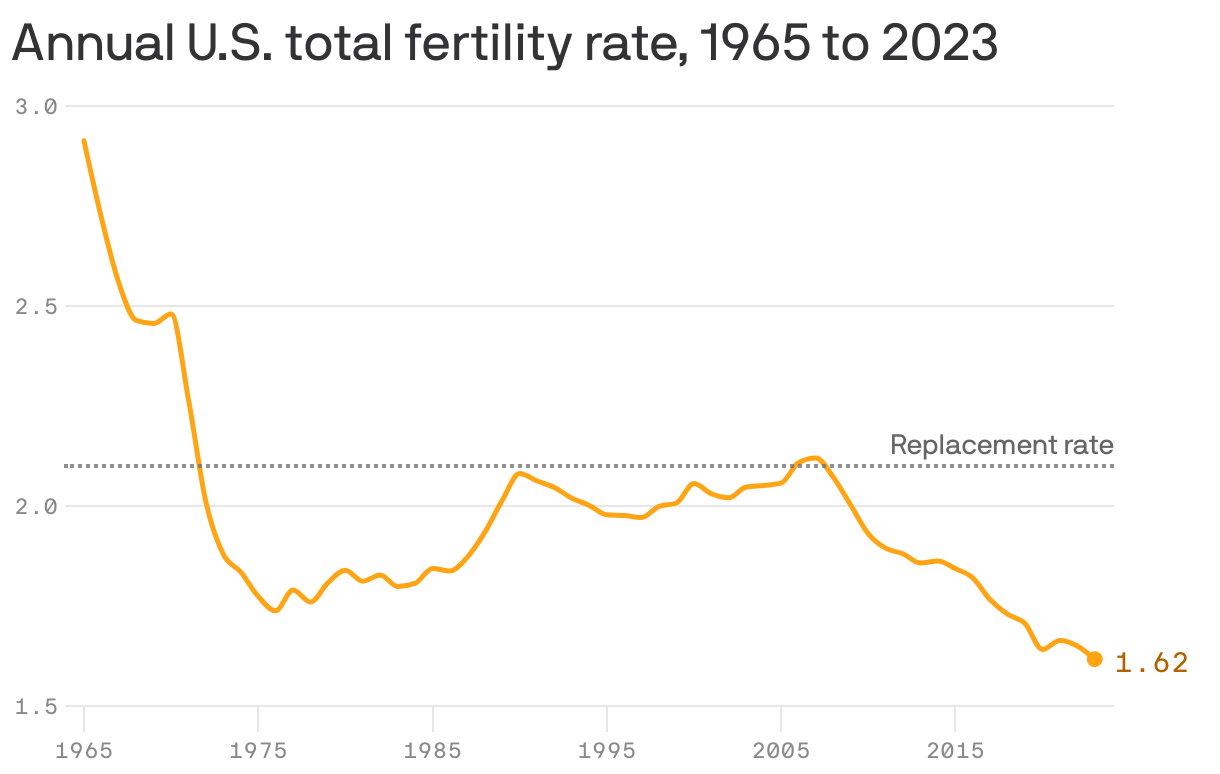
Look at this graph of our dropping fertility rate. We Americans are dying faster than replacements can be born.
You might be surprised to learn that Americans believe immigration is one of the most important issues facing the nation.
But, it’s not too little immigration that is of concern; it’s too much immigration.
One would think we would understand that the nation’s economy needs more workers, not fewer.
After all, we see repeated articles falsely claiming Social Security and Medicare are running into crises because fewer young working people are supporting more older, retired people who collect Social Security.
And these older people tend to collect more Medicare, too.
Although the notion that workers’ FICA payments fund SS and Medicare is wrong, it’s commonly believed, so why the common antipathy to immigration?
Some would say that immigrants take jobs from citizens, but clearly that is not the case.
If it were, we wouldn’t worry about SS and Medicare losing funding because we lack FICA payments.
Undocumented mmigrants pay FICA, and the more young immigrants (the vast majority are young), the more FICA is collected.
Further, being young, they use less Social Security and less Medicare than the average American.
It’s not the lack of documentation that bothers Americans.
Much of the problem is the vast misinformation being spread by the right-wing “news” media.
They claim immigrants are criminals, rapists, murderers, lazy, non-working takers, etc. — i.e. generally lawless people whose very presence ruins neighborhoods.
None of it is true.
Statistically, immigrants are less likely to commit crimes than native-born Americans.
And they surely are not lazy. They take the meanest, toughest jobs native-born Americans refuse.
Immigrants are less prone to committing crimes than are U.S. citizens, and they do pay taxes.
They take back-breaking jobs U.S. citizens don’t want, and their buying increases consumer demand, which in turn increases the number of available jobs in America, lowering our unemployment rate.
So why are they despised by some, especially by Republicans?
Like all dictators, Donald Trump needs scapegoats. Hitler had Jews. Trump has immigrants.
He has made the fear and loathing of immigrant families a fundamental part of the MAGA movement.
There even are Republicans who wish to unconstitutionally eliminate birthright citizenship and to deport “Dreamers,” children whose only crime was to have been brought to America undocumented.
Dreamers are the good young people America needs. Many know no other country than America and no language other than English.
But Trump has parlayed lies and fear into a distinctly unAmerican bigoted mass hatred of brown-skinned people.
To solve the self-made “crisis,” we must acknowledge several things.
Immigrants are people. They are men, women, and children desperate for a better life. They have made an often dangerous, often fatal, journey, willing to work for America just to flee the crime, corruption, and hatred in their native lands.
In this way, they resemble our own ancestors, who came here to escape the poverty and bigotry of Europe and Asia and contributed to building America.
The difference is that our ancestors were welcomed across the border, while today, we try to close the border. It’s not as though America is too crowded for them. We have plenty of room.
It’s because we have forgotten our roots and now have adopted an “I’ve not mine; to hell with you,” unAmerican attitude stirred up by a hate-mongering, Hitlerian psychopath.
Immigrants risk the dangers of illegal immigration simply because we have made legal immigration so difficult. We spend money on walls and guards rather than spending the same money on prompt and legal hearings to admit the good people and reject only the bad.
The poem inscribed on the statue of Liberty has been turned into a sad joke.
America’s new reaction to things we don’t like or understand seems to veer toward cruelty and punishment rather than humane solutions.
We prefer to lock up juvenile criminals (and then, when they are released, give them guns) rather than curing the poverty that instigates crime.
Reduce poverty (which the right-wing invariably rejects as “coddling the lazy”), and crime is greatly reduced.
Similarly, we prefer to deport, then deport again, and then again, rather than make the immigration process easier for the goodpeople and difficult only for the bad minority.
Today,mostlawfulmeans of entering the country take years because of overwhelmed immigration agencies,rising levels of global migration and a limit on the number of certain visas, all of which have culminated in amassivebacklog of people trying to get to the U.S.
Around 9 million people are awaiting green cards, and those wait times have skyrocketed from just a few months to years, possibly decades, according to the Cato Institute and other researchers.
In 1991, only 3% of preference immigrants, or those seeking visas through family members already in the U.S., had to wait more than 10 years. By 2018, 27% of applicants experienced that wait time.
None of this is necessary or beneficial. America has the resources to create a fast, accurate system for importing valuable working families to build America.
America needs more good people, yet we reject thousands every year. It’s self-harming, verging on suicide.
We can blame immigrants. We can blame Trump. But the fault is ours for following his crazed lead and for not understanding our own history and growth.
There are lessons aplenty. Look at WWII Germany and Italy. Look at Russia. Look at North Korea. They followed fear-peddling, hate-mongering, bigoted leaders down to hell.
Can you understand the irony of an anti-immigration program claiming it will “make America great again” when it was immigrants who made America great?
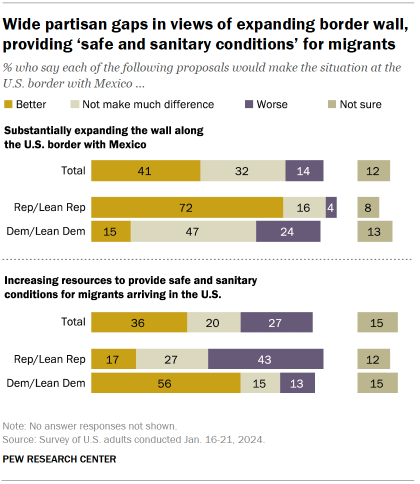
“Build the wall,” is not a call for greatness. It is a siren call of ignorance.
Learn.
Rodger Malcolm Mitchell
Monetary SovereigntyTwitter: @rodgermitchellSearch #monetarysovereigntyFacebook: Rodger Malcolm Mitchell
……………………………………………………………………..
The Sole Purpose of Government Is to Improve and Protect the Lives of the People.
In our previous discussions, we’ve introduced you to Gap Psychology, a concept that fuels the desire to widen the income/wealth/power Gap below and to narrow the Gap above.
This psychological phenomenon not only perpetuates social disparities but also has dire implications for our environment.
The very rich want wide Gaps because, without Gaps, no one would be rich. We all would be the same. The wider the Gaps, the richer the rich, and the poorer the poor, i.e., “inequality.”
The rich are a major cause of global warming.
Wide Gaps negatively affect poverty, health and longevity, education, housing, law and crime, war, leadership, ownership, bigotry, supply and demand, taxation, GDP, international relations, scientific advancement, the environment, human motivation and well-being, and virtually every other issue in our lives.
The rich bribe our thought leaders to tell us wide Gaps are just and necessary, a result of innate superiority and hard work — that the rich and the poor have earned their places.
The rich bribe the media through ownership and advertising dollars.
They bribe economists through university endowments and jobs in think tanks. They bribe politicians through campaign contributions and promises of jobs in the industry.
The rich try to convince us that federal benefits are unaffordable and unsustainable, but we have the power to demand these benefits and make a significant change in narrowing the Gap and protecting the environment.
It’s part of the Big Lie that taxpayers fund such benefits as Medicare, Social Security, poverty aids, college loan forgiveness, and other benefits to the middle- and lower-income groups. (No mention is made of taxpayers funding tax breaks for the rich.)
But in a Monetarily Sovereign government like ours, taxpayers fund nothing. (Taxpayers do fund monetarily non-sovereign state and local government spending.)
All federal spending is funded by federal government money creation, ad hoc. Federal tax dollars, unlike state/local government tax dollars, are destroyed upon receipt.
The sole purposes of federal taxes are:
To control the economy by taxing what the government wishes to discourage and by giving tax breaks to what the government wishes to reward.
To assure demand for the U.S. dollar by requiring taxes be paid in dollars.
Here are excerpts from a NewScientist Magazine article describing another problem caused by the Gap, aka “inequality”:
Inequality is a major obstacle to sustainability. The super-rich are an environmental horror story that we can’t ignore. By Graham Lawton
According to the United Nations Environment Programme, the average greenhouse gas emissions of someone in the richest 10 per cent of global society are around 20 times the average of someone in the poorest 50 per cent.
Research by Oxfam and the Stockholm Environment Institute found the world’s richest 1 per cent collectively emit the same as the poorest two-thirds.
A new book by Ingrid Robeyns puts this in stark personal terms. In Limitarianism: The case against extreme wealth, she calculates that to get to net zero, the average per capita carbon footprint needs to be 2 tonnes a year. The European average is 8 tonnes.
The top 1 per cent emit over 100 tonnes, with billionaires emitting a mind-blowing 8000 tonnes, mostly through the use of private jets and superyachts.
There are very few billionaires, but their consumption is only part of the equation. Huge inequality is bad for everyone – and the planet.
In a recent webinar about the book, Pickett said: “What The Spirit Level showed was that economic inequality, specifically income inequality, was related to a whole range of different problems: health problems, issues to do with human capital development, such as educational attainment and social mobility, and everything to do with relationships.
The crucial point is that inequality seems to affect almost all of society.” In the years since 2009, the evidence for this has only grown stronger.
As for the environment, inequality isn’t just bad for the obvious reasons.
A recent paper in Nature Climate Change makes a compelling case that inequality is a major obstacle to sustainability, because people at the lower end of the income spectrum don’t have the resources – money and time – to make the necessary lifestyle changes.
Not only does inequality limit people’s opportunities to make sustainable choices, it also drives unsustainable consumption at lower income levels.
Humans are hardwired for “social evaluative threat” – anxiety about how we are seen by others.
This threat induces a type of stress called status anxiety. Subconsciously, we are all evaluating where we stand in the economic pecking order and trying to climb to the next rung, or at least not slide down.
One of the easiest ways to alleviate status anxiety is conspicuous consumption.
The cause for “status anxiety” is “Gap Psychology.” You can read more about Gap Psychology here, here, here, and many places elsewhere in this blog.
In any society, the poorest people have the highest levels of status anxiety and the richest the least. But here’s the rub: in more unequal societies, status anxiety is higher across the board.
One study found that in the most equal societies, the poorest have a status anxiety score of 2.2 out of 5, as judged by their degree of agreement with questions such as “others look down on me because of my job situation or income”.
The richest score about 1.8. In the most unequal societies, the scores are 2.7 and 2.1. In other words, the richest people in very unequal societies have roughly the same level of status anxiety as the poorest in more equal ones.
How do people respond to status anxiety? In part by consuming high-status goods.
Multiple research projects have found that people living in highly unequal parts of the US tend to spend more on swanky cars and designer clothes, which have a very large carbon footprint.
“Status competition driving consumerism upward is a huge obstacle to moving towards sustainability,” said Wilkinson in the webinar with Pickett.
Many Western societies are still tolerating, or even encouraging, eye-watering levels of inequality.
But they also underestimate the obscene wealth held by a few people who emit more than just greenhouse gases. It is a tough argument to make, but it has to be made.
Louboutin shoes: Affordable. Saving the world: Unaffordable.
As Wilkinson said: “We cannot solve the environmental crisis without solving the inequality crisis.”
Gap Psychology dictates that the last thing the rich want is to solve the inequality crisis. It’s what makes them rich.
That is why they bribe the media, politicians, and the economists to tell you various forms of the Big Lie in economics, including such lies as:
Social Security and Medicare will run short of money because fewer workers are supporting more older people.
To prevent Social Security and Medicare from running short of money, FICA must be increased and/or benefits must be reduced.
The federal deficit and debt are unaffordable and unsustainable.
Taxpayers pay for federal spending.
Comprehensive, no-deductible Medicare for All, Social Security for All, increased poverty aids, free college for all who want it, and other benefits for the middle- and lower-income groups are unaffordable.
All of the above are untrue. They could not exist without the active counter messaging by your information sources.
They want you to believe the Big Lie that the finances of our Monetarily Sovereign government are the same as your personal finances.
The federal government not only can afford to fund all of the benefits to you, while also funding the efforts to counter global warming.
The rich want you to believe that either global warming doesn’t exist, or if it exists, the costs to end it are too great for the government to fund, or for taxpayers to fund. All lies.
The government has the infinite ability to fund anything, without collecting a penny in taxes. To admit that, your information sources also would have to admit paying for your benefits also are affordable.
But that would narrow the Gap and make the rich less rich.
The sole benefits the rich allow are the tax breaks that only they can access. Those supposedly are “affordable” and “sustainable.”
Meanwhile, life on earth is threatened as the climate becomes less survivable. Eventually, the rich will discover that they need to support more equality for them to remain rich.
But that may be too late to save the world.
There’s still time to contact your Congressperson, tell them you are quite aware that the federal government can create infinite money without taxing or borrowing, and can provide far more benefits than it currently does.
Tell them the Gap is not sustainable, and the rich may have the money, but not the votes. Demand federal benefits for those who are not rich.
Rodger Malcolm Mitchell
Monetary SovereigntyTwitter: @rodgermitchellSearch #monetarysovereigntyFacebook: Rodger Malcolm Mitchell
……………………………………………………………………..
The Sole Purpose of Government Is to Improve and Protect the Lives of the People.
Debt is an obligation that requires one party, the debtor, to pay money or otherwise withheld from another party, the creditor. Debt may be owed by a sovereign state , country, local government, company, or individual.
Loans, bonds, notes, and mortgages are all types of debt.
Here is what an AI (Artificial Intelligence) says about federal debt. Read it, keeping in mind that the Monetarily Sovereign U.S. government has the infinite ability to create its own sovereign currency.
As we will discuss, the so-called federal debt isn’t debt and it isn’t federal.
The U.S. government never, unintentionally, can run short of U.S. dollars:
The federal debt of the United States is the total national debt owed by the federal government to Treasury security holders.
It encompasses the accumulated borrowing and the associated interest owed to investors who purchased these securities.
Federal debt is the same as national debt?? Immediately we arrive at confusion because “national” debt can include the debt of the non-federal (private) sector, i.e., the total of mortgages, car loans, business loans, etc., and state/county/city debt.
Because the federal government is Monetarily Sovereign and the other entities are monetarily non-sovereign, one rightly should assume that federal debt should be treated differently.
Let’s break it down further:
Federal Deficits:
Federal deficits occur when the government spends more money than it collects in revenue during a fiscal year. To cover these deficits, the government borrows money by issuing Treasury bonds, bills, and other securities.
These deficits contribute to the overall national debt because they represent the accumulated borrowing over time.
Treasury Securities:
Treasury securities are financial instruments issued by the U.S. Department of the Treasury to raise funds for government operations.
These securities are issued to the public and other entities, including individuals, corporations, state or local governments, foreign governments, and other non-federal entities.
Federal Debt Held by the Public:
The federal debt held by the public consists of securities held outside the government. It includes:
Interest-bearing marketable securities: These are marketable Treasury securities (bills, notes, bonds, TIPS, and FRN) held by various entities.
Interest-bearing nonmarketable securities: These include Government Account Series held by fiduciary and certain deposit funds, foreign series, state and local government series, domestic series, and savings bonds.
Non-interest-bearing marketable and nonmarketable securities: These include matured and other types of securities.
The total federal debt held by the public is calculated based on face value less net unamortized premiums and discounts, including accrued interest.
The federal debt represents the total outstanding obligationsowed by the U.S. government, including both deficits and the issuance of Treasury securities. It reflects the financial position of the government and its ability to meet its obligations.
That is generally what most people believe. It is wrong on several counts.
First, the federal debt does not “reflect the financial position of the government and its ability to meet its obligations.The federal government has the infinite ability to meet its obligations.
Deficit reductions (red line) result in recessions (vertical gray bars), which are cured by deficit increases.Even the COVID recession of 2020 was cured by the increase in federal spending — the so-called “debt” — that year.
Read it again while again keeping in mind the Monetarily Sovereign U.S. government has the infinite ability to create its own sovereign currency. It never, unintentionally, can run short of U.S. dollars.
Now ask yourself: Why would the federal government borrow dollars? The answer: It doesn’t.
Notice the definitions of federal debt encompass two completely different things:
The total of federal deficits, i.e. the net total difference between what the government has spent and what it has received in taxes.
The total of Treasury Security accounts.
1. Total Federal of Deficits: In most years, the federal government spends more than it receives in taxes. This is called a “deficit.” Over the years these deficits total to what is called the “federal debt.”
All forms of debt require at least one debtor and at least one creditor. But with regard to federal deficits, who is the debtor and who is the creditor, and what is owed?
A quick response might be that the government is the debtor, and those supplying the government with goods and services would be the creditors. But that quick response would be wrong.
Although the federal “debt” is upwards of $30 trillion, the federal government does not owe its suppliers $30 trillion. They all have been paid.
Clearly, the total of deficits is not federal debt. There are no creditors, no debtor, and nothing is owed.
2. The Total of Treasury Security Accounts: Are they “federal debt”? If so, how and why did the “debt” occur.
Look back at the definitions: The Treasury Securities are bills, notes, and bonds, issued by the federal government to raise funds for government operations.
A “bill” is a request for payment of money owed, or the piece of paper on which it is written. In the private sector, a bill is created by a creditor and sent to a debtor as a demand for payment. The way most people understand it.
But federal terminology is diametrically different. Here, the “debtor” (the government) creates and issues the T-bill and the creditor buys it, as though it were a bond.
Consider a dollar bill. It is not a request for payment by a creditor, but rather a document created by the debtor — the federal government, which owes the holder one dollar. The dollar bill itself is not the dollar. It is an IOU for a dollar.
The dollar is just a number in the federal government’s financial books.
You cannot see, feel, smell, or taste a dollar. It has no form or substance. If someone asked you what does the number “five” look like would your answer be: “5,” or “V,” or “(2+3);” or the binary “101,” or “√25.”
Although you can describe a five dollar bill, you cannot say what five dollars look like. Dollars result from laws, and again, no one can say what a law looks like. Like dollars, laws are just concepts, not physical entities.
That fact that dollars are not physical gives the federal government the infinite ability to create them just by pressing computer keys.
But that’s a minor, though confusing, semantic issue. The major, and even more confusing, semantic question: Why does a Monetarily Sovereign entity, having the infinite ability to create dollars, ever borrow dollars?
As two former Chairmen of the Federal Reserve have said:
Alan Greenspan:“A government cannot become insolvent with respect to obligations in its own currency. There is nothing to prevent the federal government from creating as much money as it wants and paying it to somebody. The United States can pay any debt it has because we can always print the money to do that.”
Ben Bernanke: “The U.S. government has a technology, called a printing press (or, today, its electronic equivalent), that allows it to produce as many U.S. dollars as it wishes at essentially no cost.”
Question: If the U.S. government cannot become insolvent, can create as much money as it wants, and can pay any debt, why does it borrow dollars? Why does it pay interest when it can produce as many dollars as it wishes at essentially no cost?
Answer: It doesn’t borrow, and the interest is produced at no cost.
Because of words like “bill,” “note.” and “bond,” many people, including even economists, believe these represent federal borrowing and debt.
They do not. The federal government never borrows dollars.It creates all the dollars it needs by spending dollars. Spending is how the government creates new dollars. The process is:
When an agency of the federal government pays an invoice (a bill) from a creditor, it sends instructions (not dollars) to the creditor’s bank. The instructions may be in the form of a check or a wire (“Pay to the order of ____”)
The bank obeys the instructions by increasing the balance in the creditor’s checking account. At that instant, new dollars are created and added to the M2 money supply measure.
The bank balances its books by informing the Federal Reserve of the instructions, which debits the government’s account.
At no time are any physical dollars exchanged because there are no physical dollars. It’s all numbers in bookkeeping accounts.
But what is the purpose of those T-security accounts? They have two purposes, neither of which is to provide spending money for the government:
A. To provide a safe place to store unused dollars, which stabilizes the dollar. Because dollars have no physical existence, they can’t be stored in a box and watched. So, it is especially important that large, unused sums be kept on trusted books
No books are more trusted with dollars than the U.S. government’s.
B. To help the Fed control interest rates. Because T-securities are known to be safe, the interest paid by federal storage sets a floor for all private sector interest rates.
T-security accounts resemble bank safe deposit boxes in that the contents are not owed to the depositors and not used by the bank. They are not federal in that the contents of the accounts are wholly owned by the depostors. The federal government never touches those dollars.
Just as they are not debts, they also are not federal. To close an account, the bank and the government simply return the contents to their owners, the depositors. The government does not owe the money because it never takes ownership of the money.
Why then, does the federal government need to lend rather than give money (for instance, student loans) or need to collect taxes.
It doesn’t.
The federal government could forgive all student loans and continue spending forever, all without collecting a single penny in taxes. It could accomplish this simply by creating dollars.
Some claim that “excessive” federal deficit spending would cause inflation. That claim is false; the reasons are described here. While a government response to inflation may be to print currency, the cause of all inflations has been shortages of critical goods and services.
The most recent inflation was caused not by federal spending, which had been go on for many years, but by new, COVID-relaed shortages of oil, food, computer chips, lumber, paper, shipping, steel, and many other products, and labor.
While state/local taxes and borrowing help monetarily non-sovereign government pay for things, the purpose of federal taxes is not to pay for things but rather:
To control the economy by taxing what the government wishes to discourage and by giving tax breaks to what the government wishes to reward.
To support demand for the U.S. dollar by requiring taxes be paid in dollars.
But the biggest, unofficial reason for taxes is to support the myth that federal debt is paid by taxes, and that taxes are necessary to fund spending. It’s a myth promulgated by the people who really run America, the rich.
They are rich because of the income/wealth/power Gap between the rich and the rest. The wider the Gap, the richer they are.
The debt/taxation myth limits the federal spending that supports the middle- and the lower-income groups, but allows for the federal tax breaks that are given to the rich. Contrary to popular belief, federal taxation widens the Gap between the rich and the rest, making the rich richer.
Without the debt/taxation myth we could fund free, comprehensive, no-deductible Medicare for every man, woman, and child in America, no-FICA Social Security for everyone, an end to poverty in America, free college for everyone who wants it, and many other benefits (free public transportation, housing support, local infrastructure improvements, lower local taxes, etc.) all of which are of no interest to the rich.
Donald Trump didn’t pay less taxes than you paid the past ten years, not just because he cheated, but also because, being rich, he took advantage of the tax breaks that you can’t.
Tax breaks are financially the same to the federal government as such benefits as Social Security and Medicare, the difference being there is no financial limit put on tax breaks while the benefits are limited by tax collections.
SUMMARY
Unlike state/local governments, businesses, you and me, the federal government is Monetarily Sovereign. It cannot unintentionally run short of dollars. It can pay any financial obligation immediately.
The federal government and its taxpayers are not burdened by federal debt. The federal government does not borrow dollars. It creates dollars ad hoc, by spending.
People have complained about the fictional “federal debt” since 1940, calling it a “ticking time bomb.”yet after all these years the ticking time bomb hasn’t exploded. In that time, the “federal debt” rose from $40 billion to $30 trillion, the economy is healthy, the government is paying its bills, and all the scare stories have proved to be false.
The federal debt, whether it be the total of deficits or the total of T-securities, neither is federal nor debt. It is not a burden on taxpayers nor on the federal government. It doesn’t cause inflation or recession.
Deficit spending is necessary to grow the economy and attempts to reduce deficit spending have caused causes recessions and depressions.
Accepting deposits into T-bill, note, and bond accounts does not constitute borrowing or debt, for a Monetarily Sovereign entity never borrows its own sovereign currency.
It’s not debt if there is nothing owed, nothing borrowed, no creditors, no debtors, an no payment burden.


 And these older people tend to collect more Medicare, too.
Although
And these older people tend to collect more Medicare, too.
Although 




 #Monetary Sovereignty - Mitchell