Imagine you were in charge of the advanced mathematics department at a university. You would be expected at least to understand arithmetic.
Similarly, if you were the Secretary of the U.S. Treasury, Chair of the Federal Reserve, or President of the United States, you should understand what former Chairs seem to know, i.e., the difference between a Monetarily Sovereign entity and a monetarily non-sovereign one.
It’s that basic.
Alan Greenspan:“A government cannot become insolvent with respect to obligations in its own currency. There is nothing to prevent the federal government from creating as much money as it wants and paying it to somebody. The United States can pay any debt it has because we can always print the money to do that.”
Ben Bernanke:“The U.S. government has a technology, called a printing press (or, today, its electronic equivalent), that allows it to produce as many U.S. dollars as it wishes at essentially no cost.”
Alas, we are not so fortunate with our leadership’s knowledge:
In 2016, (former President) Trumpsaid he could pay down the national debt, then about $19 trillion, “over a period of eight years” by renegotiating trade deals and spurring economic growth.
In 2018, he said, “We have $21 trillion in debt. When this [the 2017 tax cut] really kicks in, we’ll start paying off that debt like it’s water.
I’ve decided that what we successfully have done for the past 84 years, to build the world’s greatest economy, is unsustainable.
“Because of Tariffs we will be able to start paying down large amounts of the $21 trillion in debt that has been accumulated, much by the Obama Administration.”
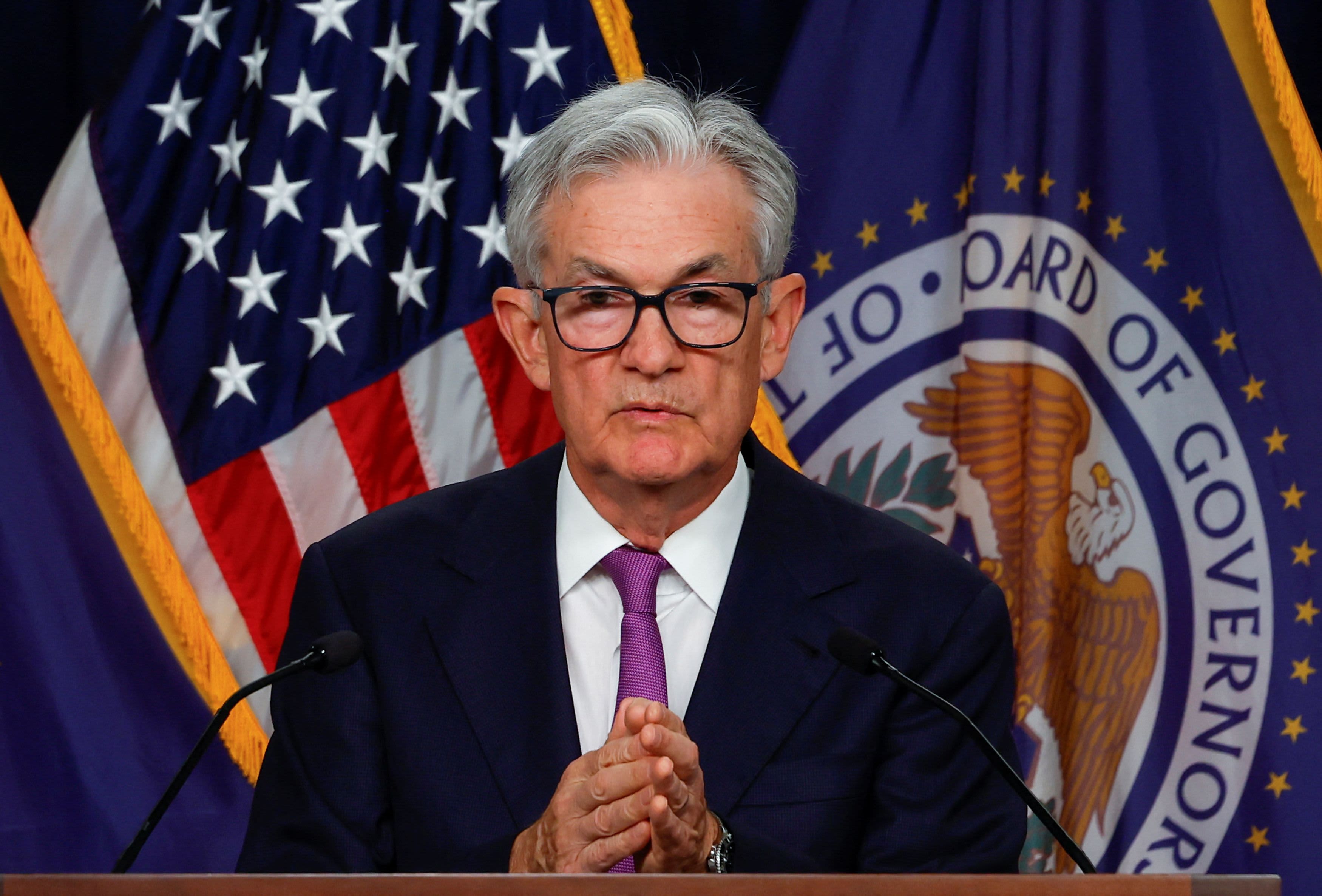
He urged policymakers to prioritize fiscal sustainability, warning that running large deficits during good economic times cannot continue indefinitely.“
In the longer run, we’ll have to do something sooner or later, and sooner will be better than later,” he added.
Notice that Powell uses the favorite word of debt fear-mongers: “Unsustainable.” (See here and in many other posts on this blog). Despite false claims since 1940 that the debt and deficits are “unsustainable,” we have sustained it.
The debt fear-mongers never learn from experience.
In 2022, President Biden said, “My Treasury Department is planning to pay down the national debt this quarter, which never happened under my predecessor.”
Every U.S. depression has come on the heels of federal surpluses.
1804-1812: U. S. Federal Debt reduced 48%. Depression began 1807. 1817-1821: U. S. Federal Debt reduced 29%. Depression began 1819. 1823-1836: U. S. Federal Debt reduced 99%. Depression began 1837. 1852-1857: U. S. Federal Debt reduced 59%. Depression began 1857. 1867-1873: U. S. Federal Debt reduced 27%. Depression began 1873. 1880-1893: U. S. Federal Debt reduced 57%. Depression began 1893. 1920-1930: U. S. Federal Debt reduced 36%. Depression began 1929. 1997-2001: U. S. Federal Debt reduced 15%. Recession began 2001.
Treasury Secretary Janet Yellen agrees that the federal debt is too high, but when a simple, non-recession solution was presented to her, she preferred austerity, i.e., the mathematical certainty of a recession or depression.
The solution demonstrated the federal government’s total sovereignty over the U.S. dollar:
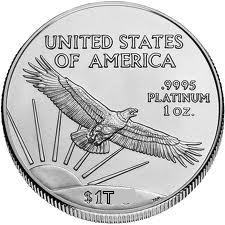
Legislation enacted in 2001 allows the treasury to mint platinum coins of any value without congressional approval.Under that law, the coin’s value could be anything, but it would have to be platinum, not gold or silver, nickel, bronze or copper, which are under Congress’ control.
President Joe Biden could order Treasury Secretary Janet Yellen to have a coin with the value of $1 trillion be minted and deposited into the Treasury, giving the government an extra trillion dollars to cover debts and prevent default.
The idea was floated before in 2011 when the government faced another debt ceiling crisis. Former President Barack Obama said in 2017, on the podcast “Pod Save America,” that he and his advisers discussed use of a trillion dollar coin as a safety valve.
“There were all kind of wacky ideas about how potentially you could …. have this massive coin.” Obama said in the 2017 interview. “I mean … it was some primitive — it was like out of the Stone Age or something and I pictured rolling in some coin.”
Thus, as usual, President Obama demonstrated his abject ignorance about federal finance. Remember, he was the one who created the Simpson/Bowles Commission that labored to create these recommendations:
Reduce the deficit by $4 trillion over ten years
Cap government spending at 21% of GDP
Reduce discretionary spending to 2008 levels, adjusted for inflation
Raise the retirement age and reduce Social Security benefits
Reduce Medicare benefits.
Fortunately, none of this was done; otherwise, we would have had the worst depression since the Great Depression. However, it reflects Obama’s economic ignorance (or intent?).
Getting back to the platinum coin solution to the debt ceiling idiocy:
Treasury Secretary Janet Yellen said Tuesday in an interview with CNBC that she is “opposed” to the idea, and doesn’t believe it should be considered seriously.
“It’s really a gimmick and what’s necessary is for Congress to show that the world can count on America paying its debts,” Yellen said Tuesday on CNBC’s “Squawk Box”.
And there you have it. Janet Yellen, Secretary of the U.S. Treasury, thinks there is a danger the Monetarily Sovereign U.S. government might not be able to “pay its debts” unless something is done about the federal debt (which isn’t federal and isn’t debt.
Yellen also raised concerns about how using a trillion dollar coin would affect trust in and independence of the Federal Reserve and treasury.
“The platinum coin is equivalent to asking the Federal Reserve to print money to cover deficits that Congress is unwilling to cover by issuing debt, it compromises the independence of the Fed conflating monetary and fiscal policy, and instead of showing that Congress and the administration can be trusted to pay, to pay the country’s bills, it really does the opposite,” Yellen said.
OMG, Secretary of the Treasury Yellen just gets worse and worse. She doesn’t seem to realize that U.S. dollars are debt, and every debt requires collateral.
The collateral for U.S. dollars is the full faith and credit of the United States government. This may sound nebulous to some, but it actually involves certain, specific, and valuable guarantees, among which are:
The government will accept only U.S. currency in payment of debts to the government
It unfailingly will pay all its dollar debts with U.S. dollars and will not default
It will force all your domestic creditors to accept U.S. dollars if you offer them to satisfy your debt.
It will not require domestic creditors to accept any other money
It will take action to protect the value of the dollar.
It will maintain a market for U.S. currency
It will continue to use U.S. currency and will not change to another currency.
All forms of U.S. currency will be reciprocal, that is five $1 bills always will equal one $5 bill and vice versa.
Yellen doesn’t want the Fed to print money. Yet, her signature is on Federal Reserve Notes!~
As economist Hyman Minsky said, “A government that can issue Treasury bills can issue dollar bills.”
Look at the dollar bill in your wallet. At the top, it says, “Federal Reserve Note“, and it is signed by — that’s right — the Secretary of the Treasury and the Treasurer.
Janet Yellen complains that “the platinum coin is equivalent to asking the Federal Reserve to print money,” while she has her signature on dollar bills, which are Federal Reserve Notes!
Many experts are unsure about what the economic effects of the move would be given that it is unprecedented.
But experts cite concerns about inflation, saying that creating more money would weaken the value of existing money circulating in the economy.
We have been “creating more money” for 84 years. In some years, inflation was above the Fed’s target. In other years, it was below. Just before COVID, inflation was quite low. Then COVID created shortages and, thus, inflation.
A “gimmick” too simple for our leaders. They prefer the insanity of the debt ceiling.
The platinum coin’s economic effects would relieve uncertainty about the extraordinarily ignorant Debt Limit. Economies don’t like uncertainty because it hinders investment in the future.
That would mean that existing dollars would have less buying power, which could affect American consumers.
I wonder why America hasn’t suffered that fate so far. Perhaps because it isn’t real??
Still, some Democratic lawmakers backed the idea. House Speaker Nancy Pelosi said that Rep. Jerod Nadler, D-N.Y., brought up the coin during a closed policy meeting last week as one of other “options” to prevent government default without congressional action.
And in case you miss your daily dose of debt fear-mongering about something that never happens, here’s a bit more.
US National Debt Hits $35 Trillion Milestone
In a historic fiscal milestone for the federal government, the national debt rose to $35 trillion for the first time, according to the latest Treasury Department data. Current debt levels are equal to $105,000 per person and $266,000 per U.S. household.
Washington accumulated $1 trillion in debt in less than seven months. Over the past year, the national debt has spiked by nearly $2.35 trillion, an average of about $6.4 billion per day.
The immense growth of red ink flooding the nation’s capital has captured the attention of public policymakers. Federal Reserve Chair Jerome Powell in February conceded that the federal government is “on an unsustainable fiscal path.”
Two of the big three credit agencies downgraded their outlook on the U.S. debt, citing fiscal deterioration, persistent debt ceiling negotiations, and ballooning interest payments. When these updates were released last year, the White House disagreed with the firms’ outlooks.
The two credit agencies referred to are likely Fitch Ratings and Moody’s. Fitch recently downgraded the U.S. government’s credit rating from AAA to AA+ while Moody’s has changed its outlook on U.S. debt to negative.
It’s ironic that two companies should downgrade the U.S. dollar. If the U.S. fails to pay it’s bills, not only will the dollar be worthless, but so will every business on earth, including Fitch and Moody’s.
But Yellen doesn’t want a simple solution to the crazy Debt limit, because “it’s a gimmick” that might (but almost sure will not) cause some inflation.
Economists told the Daily Caller News Foundation that persistent government spending under the Biden administration propped up U.S. economic growth in the second quarter of 2023.
Real gross domestic product (GDP) grew 2.8% in the second quarter of 2024, far higher than economists’ expectations of 2.1%,
However, a significant portion of the recorded growth in the quarter was driven by government spending, both directly through a rise in government expenditures and indirectly through growth in sectors that benefit heavily from taxpayer dollars.
Apparently, some economists believe that when the government spends, it is not true economic growth, but when the private sector spends, that is true growth.
However, exactly the opposite is true. When the government spends, new stimulus growth dollars are created and added to the economy. By contrast, when the private sector spends, dollars are just moved from one hand to another.
Private sector spending that is not financed by borrowing creates no money.
“Government spending has played a large role in much of the economic growth seen over the past few years,” Peter Earle, a senior economist at the American Institute for Economic Research, told the DCNF.
Government spending supposedly is bad because it adds dollars to the economy. It’s also supposedly bad because it just redistributes existing dollars. Huh??
“The problem with that, of course, is that government spending is redistribution: taxing certain citizens or floating more trillions of dollars in debt to send those dollars to other citizens.
It’s not innovative entrepreneurship or other productive commercial undertakings.”
Peter Earle has it exactly backward. Federal spending is done with newly created money, not with tax money.
The crazy part of Earle’s comment is that the debt fear-mongers take both sides of the same issue.
They claim that federal deficit spending adds to the money supply, and so, is inflationary.
Then they claim federal deficit spending is redistribution — i.e., doesn’t add to the money supply.
And they ardently believe both opposing statements.
E.J. Antoni, a research fellow at the Heritage Foundation’s Grover M. Hermann Center for the Federal Budget, told the DCNF that even the increase in consumer spending, which totaled 2.3% in the second quarter — up from 1.5% in the previous quarter — was also partially driven by government expenditures.
That is exactly what federal spending is supposed to do. It puts spending money into consumers’ pockets. Why that is a bad thing is beyond all comprehension.
“Government purchases do not include all of government spending. When the government takes money from one person and gives it to another in the form of welfare, for example, it gets counted as consumer spending,” Antoni told the DCNF.
Trust the extreme right wing to come up with nonsense opposing welfare. No comments opposing the tax breaks given to the wealthy, however.
In any event, the federal government doesn’t give tax money to anyone. It destroys all the tax dollars it receives and creates new dollars to pay its bills.
“Currently, about $4.2 trillion of annual consumer spending is government transfers, illustrating how total government spending is much larger than the GDP report indicates.”
No federal spending is “transfers;” all state/local government spending is “transfers.”
That’s the difference between Monetary Sovereignty and monetary non-sovereignty. The former creates new dollars to pay its bills, while the latter uses borrowed money and taxes.
“What were the big things that contributed to the GDP number? You have a big increase in health care spending, which is consistent with all the jobs we’ve seen in health care, and a lot of that is paid for by government,” Faulkender told the DCNF.
“You have money going into transportation investment, which is deficit-funded [Inflation Reduction Act] money [and] you had the increase in government spending.”
Healthcare spending was responsible for approximately 16% of GDP growth in the second quarter, according to the BEA. In 2022, government sources accounted for just over 45% of healthcare spending, according to the Congressional Research Service.
The healthcare industry has also underpinned recent U.S. job gains, accounting for 49,000 of the 206,000 nonfarm payroll jobs added in June, and approximately 29% of all jobs added in the last twelve months, according to the Federal Reserve Bank of St. Louis (FRED).
In short, the government is spending heavily on transportation and healthcare, which in addition to helping people be healthy and get around, is creating jobs in these fields.
Is that supposed to be a problem?
“All — or nearly all — the apparent growth in the economy has really just been pulling future growth forward to today, at the expense of future growth,” Antoni told the DCNF. “It’s like when a consumer goes deeply into credit card debt to get a higher standard of living today, only to be drowning in debt payments tomorrow.”
No, Mr. Antoni, federal finances are not like personal finances. Not one word of the above paragraph is true. And really, how does today’s growth pull growth from tomorrow? It is nonsensical.
The federal government has been “drowning” in so-called “debt” since 1940, and here has been the result of all that deficit spending:
Real (inflation adjusted) GDP per person has moved up, up, up.
Americans as a group, are wealthier in real terms than ever. If this is what our government “drowning in debt” produces, please toss me in the pool.
The trick is to narrow the Gap between the rich and the rest, which the debt worriers seem to forget when they talk about cutting benefits and increasing taxes.
SUMMARY
Everything in economics eventually devolves to understanding Monetary Sovereignty. Our leaders either don’t understand the difference between Monetary Sovereignty and monetary non-sovereignty, or they don’t want you to understand.
In the latter category are those who want to widen the income/wealth/power Gap between the rich and you.
There are other examples, but listing them would be wasteful — of your time and mine.
I looked online for claims about federal government wasteful spending. Here are a few of the hundreds I found:
Camo Uniforms for the Afghan Army: The Pentagon spent $28 million on camouflage uniforms for the Afghan National Army that were unsuitable for the desert environment.
Hipster Anti-Smoking Campaign: The National Institutes of Health spent $5 million on a campaign targeting hipsters to stop smoking, including paying them to blog about quitting.
Quail Cocaine Study: Over $500,000 was spent to study how cocaine affects the sexual behavior of Japanese quails.
Hamster Fights: More than $3 million was spent on research involving hamster fights to study aggression1.
Solar Panels for Veterans Affairs: The Department of Veterans Affairs spent $8 million on solar panels that were never used.
The Federal Register–every member of Congress automatically receives a new copy every day, at a $1 million annual cost, even though the contents are available for free online.
I could waste time listing dozens more, but these alone “waste” about $45.5 million a year, which is sufficient to outrage a Congress that voted for these expenditures and the media, which wasted time writing about them, but only on slow news days.
Before I comment further, perhaps we should try to agree on something fundamental: What is “waste”?
I suggest waste is anything that costs significantly more than its benefits over any agreed-upon period.
For instance, let me start with the gross basics: When a bear poops in the woods, is that poop considered waste?
No, because it costs the bear nothing and benefits the forest by providing growth nutrients.
Based on that definition, are the above examples of waste truly waste, or are they more like that cost-free, beneficial bear poop?
This is not a dollar. It is a bearer instrument saying the bearer owns a dollar. The dollar itself is just a number in an account.
Let’s assume there was no benefit to those cameo uniforms, anti-smoking campaigns, quail cocaine studies, etc.
Did they fall under the costs-more-than-its-benefits criterion for waste?
I say, “No.”
Every one of them took dollars from a federal government that has the infinite ability to create unlimited dollars at the touch of a computer key.
So the cost was negligible — perhaps similar to the bear’s cost in expending the effort to squat.
As former Fed Chairman Ben Bernanke said, “The U.S. government has a technology, called a printing press (or, today, its electronic equivalent), that allows it to produce as many U.S. dollars as it wishes at essentially no cost.”
But what was the benefit? Every one of those endeavors added dollars to the Gross Domestic Product.
Not only did they grow the economy as a whole, but they benefitted specific individuals. Businesses employed people to create those uniforms, the solar panels, and the printed federal register.
People were paid dollars to run the hamster and cocaine studies.
Those people used their newly earned dollars to buy things from other businesses with employees. The new money flowed through the economy, benefiting thousands and then thousands more.
It is quite possible that down the line, you yourself might have received dollars that began with the quail cocaine study.
Should he be afraid to waste sand?
One might object, “Taxpayer dollars were spent. The money came from somewhere.”
In reality, not one dollar, not even one cent, of taxpayer money was spent.
The federal government (unlike state and local governments) pays all its bills with newly created dollars.
Like the first U.S. dollars, created from thin air in 1794, and all subsequent trillions of dollars, the dollars that paid for “wasteful” federal spending were created at no cost, from thin air.
Here’s how it’s done now:
To pay an invoice, the federal government creates instructions (not dollars) from thin air. The instructions are in the form of a check or wire.
The instructions tell the creditor’s bank to increase the balance in the creditor’s checking account (“Pay to the order of _____.”)
The bank obeys those instructions by pressing computer keys. The instant the bank presses those keys, new dollars appear out of thin air and are added to the M2 money supply.
The instructions then are passed to the Federal Reserve which first “clears” them by tallying them against the government’s checking account ( Treasury General Account).
Finally, the creditor’s bank is informed that the check has cleared so it can balance its books.
Everything is just numbers in accounts based on instructions and laws. So long as the federal government can create laws, it can create instructions and dollars. The government has no limits other than the self-imposed.
Many people don’t understand that all dollars are just numbers in accounts. There are no physical dollars. Even a dollar bill is not a dollar. It is the title to a dollar. Just as a house title is not a house, and a car title is not a car, a dollar bill is not a dollar. It is a bearer instrument saying, in essence, “The bearer of this bill is the owner of a dollar.”
Eventually, that paper instrument will be shredded, but dollars, having been created from thin air, are immortal until someone pays off a debt somewhere in the world, at which time dollars will be destroyed.
In summary, all dollars are digital entries—numbers, nothing else. There are no physical dollars. The federal government controls all those entries by passing laws.
To talk about federal waste is akin to saying that the federal government wastes numbers. It’s like worrying that the federal government will run short of the number “seven.”
The federal government can pass a law saying that the Social Security “Trust Fund” now has an additional ten trillion dollars, and those dollars would instantly exist.
It is illogical to claim that the federal government wastes the dollars it has the infinite ability to create. You cannot waste what is available in unlimited quantities.
The real federal waste comes not from faulty spending but from failure to use resources infinitely available.The real waste comes from statements like these:
The Social Security Trust Fund will run out of money in (year).
FICA funds Social Security and Medicare.
Federal trust funds pay for (program).
The Medicare Trust Fund will run out of money in (year).
The debt ceiling is a prudent way to (_____).
The federal government should live within its means.
The federal debt is too high.
The federal deficit is too high.
The federal debt or deficit is unsustainable.
Government spending causes inflation
The federal government can’t afford to pay for (program).
Federal taxes fund federal spending.
Federal funding of (program) is a waste of money
Federal funding of (program) is a waste of taxpayer money.
Federal benefits for (program) must be cut or taxes increased.
The federal government should lend, not give, money to (anyone or anything).
Federal finances are like personal, business, or local government finances
Not one of these commonly heard statements is correct. Not one.
They all mark the writer or speaker as ignorant about our government’s Monetary Sovereignty or as wanting to widen the income/wealth/power Gap between the rich and the rest.
When you read about federal government waste, remember this: When a Monetarily Sovereign government, having unlimited funds, doesn’t spend to feed the hungry, house the poor, or protect its people, that is the worst possible waste, the waste of the government’s power to do good.
Rodger Malcolm Mitchell
Monetary SovereigntyTwitter: @rodgermitchellSearch #monetarysovereigntyFacebook: Rodger Malcolm Mitchell;MUCK RACK: https://muckrack.com/rodger-malcolm-mitchell; https://www.academia.edu/
……………………………………………………………………..
The Sole Purpose of Government Is to Improve and Protect the Lives of the People.
A reader of this blog is concerned about some people’s difficulty understanding Monetary Sovereignty (MS) and asks whether there is some way to present it so that the public can more readily understand it.
Of course, I’ve been attempting to do this for the past twenty-five years, with statements so simple that some economists tell me, “It’s not that simple.”
One risks omitting important details when they simplify an inherently complex subject.
The federal government can be viewed as a combination of Congress, the President, and the Federal Reserve. That combination can be compared to the Bank in the Game MONOPOLY, which, by rule and like the government, cannot run short of dollars.
If you skim through this blog, you will find repeated attempts at simplification.
I have concluded that any failures may be due to different ways of believing.
When I am contacted by someone who understands MS, the communication is cool and data-based. By contrast, I generally receive heat when I receive word from someone who doesn’t get it.
That’s natural, I thought. What is there to be angry about when you agree?
Months ago, I had another thought. It seemed to me that compassion is soft-spoken, while bigotry is angry.
Followers of Biden and now Harris seem to deal thoughtfully with facts, while followers of Trump seem to focus on passion, anger, and conspiracy theories.
Why?
Partly because bigotry is fear and fear is hatred, and those emotions lead to anger.
There is no calm reasoning with a bigoted MAGA who is shouting Fox News and QAnon lies
But I now believe it’s something even more than that. It is because admitting you have been wrong is too painful, even when the admission is secretly in your own mind.
It isn’t that Monetary Sovereignty is complex. It’s dead simple:
The federal government never can run short of its own sovereign currency.
Prices increase when products become scarce.
Raising interest rates increases business costs, which are reflected in price increases.
Deficit spending adds growth dollars to the economy.
Is that too complex for the average person? I think not.
Why do some people feel Monetary Sovereign is difficult to understand? It’s easy to understand, but it’s difficult to believe when you have been subject to many years of brainwashing.
And therein lies the difference.
I’ve spent years trying to help people understand Monetary Sovereignty when their problem is not one of understanding but of believing. That is a much more difficult problem; Reciting the facts won’t solve it.
The MAGAs despise facts. They love conspiracy theories.
When you know you have truth and facts on your side, you might be frustrated by those who blindly accept “alternative facts,” as right-winger Kellyanne Conway famously expressed in defending Sean Spicer’s lies.
You may be frustrated, but not spit-in-your-face, physically-attack-Congress frustrated.
The gun-toting, hate-mongering MAGAs spew vitriol because they know they are wrong. They know Trump is lying to them, taking them for suckers, using them for his own personal gain, and secretly sneering at their ignorance when he’s not on stage.
(“I could shoot someone on 5th Ave. and not lose any followers.” Are those the words of a man who respects his followers’ intelligence?)
So they are angry at being seen as dupes, especially in their own eyes.
They will double down against the obvious and do anything to build a barrier between reality and their foolishness.
They will cover their gullibility with bluster and blindness.
“Wha, wha, I won’t listen to you. I cover my eyes and ears. Your words can’t hurt me.”
To maintain their belief in what they know to be nonsense, they join a mob, scream loudly or even silently, and let the noise in their head cover the truth and their emotion to cover their shame.
Thus, they allow pure belief and worship to wash over them without the burden of honest evaluation.
Hatred and anger are their only defense.
But it is exhausting. As the harsh glare of reality reveals, Trump’s armor is rusty. Each day, more people see the emperor has no clothes.
There stands before them is a befuddled, pitiful, failing old man, mouthing the same lies and insults that no longer fool even the most naive,
He is an often bankrupt business failure, an often losing political failure, an often adulterous marriage failure, an often indicted and convicted moral failure, and a son not even respected by his own late father.
The thrill is gone.
The crowds thin.
Those few who remain look around in embarrassment at their own naivete.
At last, it ends, not with a bang but with a whimper.
Rodger Malcolm Mitchell
Monetary SovereigntyTwitter: @rodgermitchellSearch #monetarysovereigntyFacebook: Rodger Malcolm Mitchell;MUCK RACK: https://muckrack.com/rodger-malcolm-mitchell; https://www.academia.edu/
……………………………………………………………………..
The Sole Purpose of Government Is to Improve and Protect the Lives of the People.
If an astronomer criticized a “star” for a bad performance, or a geologist confused a river bank with a savings bank, you might think they were addled. But in the world of economics, such word misuse and confusion is normal, even defended, and possibly intentional.
In this post, I’ll give you some words commonly misused by economics “experts,” who may or may not (you can decide) try to mislead:
1. Federal “BORROWING”: Typical misleading usage: “How does the federal government borrow money?.”
Would you lend me some sand?
The U.S. federal government is Monetarily Sovereign.
It has the infinite ability to create its sovereign currency, the U.S. dollar.
For an entity having such power, borrowing dollars would be ridiculous, akin to someone in the Sahara borrowing sand.
And indeed, the U.S. government does not borrow dollars.
Yet some people falsely claim the government borrows dollars from them when they invest in Treasury bonds.
Borrowing occurs when some entity — person, business, government, etc. — needs something it does not have. But the U.S. government creates all the dollars it needs.
By the very act of spending and paying for things, the U.S. government creates dollars.
As former Fed Chairman Alan Greenspan said, “There is nothing to prevent the federal government from creating as much money as it wants and paying it to somebody.” (During a hearing before the House Budget Committee on March 2, 2005.)
We will say more about Treasury bonds later in this post.
2. Federal “DEBT”: Typical misleading usage: “The national debt is composed of distinct types of debt, similar to an individual whose debt may consist of a mortgage, car loan, and credit cards. The different types of debt include non-marketable or marketable securities and whether it is debt held by the public or debt held by the government itself (known as intragovernmental). Simply put, the national debt is similar to a person using a credit card for purchases and not paying off the full balance each month.”
Immediately, we see that the author (an employee of the U.S. Treasury Department!) either does not understand or doesn’t want you to understand the difference between a Monetarily Sovereign entity (the U.S. government) and a monetarily non-sovereign entity (states, counties, cities, businesses, you, and me).
Federal finances are the antithesis of private finances, and for a federal employee to say that federal debt is “similar to” individual debt is beyond the pale.
The misnamed “debt” merely is the total of deposits into T-security accounts the purpose of which is not to provide spending money for a Monetarily Sovereign government that already has infinite money.
The government’s purpose of T-security accounts is to provide a safe storage place for dollar users who are not currently spending all their dollars (e.g., China, etc.) and to help the Fed control interest rates—in short, to help stabilize the dollar, not to obtain more dollars.
As for the credit card analogy, it is false on many fronts, one of which is that the U.S. government pays in full for everything it buys. It does not use credit markets to pay for anything.
Statement from the St. Louis Fed: “As the sole manufacturer of dollars, whose debt is denominated in dollars, the U.S. government can never become insolvent, i.e., unable to pay its bills. In this sense, the government is not dependent on credit markets to remain operational.” (You can find it in their publication titled “Why Health Care Matters and the Current Debt Does Not” from October 2011.)
3. Federal “BOND”: Typical misleading usage: “Proceeds from the sale of these bonds are used to repay outstanding U.S. debt.” (Copilot AI).
Federal debt is the total of federal bills, notes, and bonds, so the government cannot use bonds to repay “debt.” Saying an entity with unlimited funds can use debt to repay debtis a double oxymoron that only an economist could believe.
First, if you have infinite funds available to you, you don’t need help paying off debt, and you certainly don’t take on more debt to pay off existing debt.
Today, the federal government could pay off 100% of the debt (T-bills, T-bonds, T-notes) by crediting the depositors’ checking accounts. This could be done at the touch of a computer key.
In the private sector, a bond is evidence of a loanto a borrower. Since the federal government (unlike state and local governments) does not borrow, the word “bond” should more appropriately be replaced by the word “deposits.”
Federal T-NOTES and T-BILLS refer to deposits of shorter maturity than T-bonds.
As if that level of confusion wasn’t sufficient for those who call themselves “economists,” the paper receipts in your pocket are called “dollar bills” and “Federal Reserve notes.”
Those paper things should be called “titles,” for that is what they are—bearer documents showing that the bearer owns a certain number of dollars.
Just as a car title is not a car and a house title is not a house, a dollar bill is not a dollar. It is a title or a certificate demonstrating ownership.
4. Federal DEFICIT: Typical misleading usage: “The U.S. budget deficit is the amount the federal government spends annually more than it receives in revenue during that period.”
Technically, the word is correct, but it’s misleading for two reasons.
First, there is no financial connection between federal spending and federal receipts. The government pays for all its spending by creating new dollars ad hoc. The government does not spend tax dollars or use any other dollars it receives.
Even if the federal government collected zero taxes, it could continue spending and paying for things forever.
Alan Greenspan: “The United States can pay any debt it has because we can always print the money to do that.”
Second, the word “deficit” has pejorative connotations that fool the public into believing it should be reduced. Precisely, the opposite is true.
When the “deficit” is reduced, or worse yet, when the government runs a surplus, we have recessions and depressions.
You can see the reason by this formula: Gross Domestic Product (GDP) = Federal Spending + Nonfederal Spending + Net Exports.
When the government runs a surplus, it takes dollars out of the economy, reducing GDP and causing a recession or depression. When the government runs a deficit, it adds growth dollars to the economy.
If economists wished to avoid public confusion, they would say, “The economy had an income of $_____,” rather than,”The government ran a deficit of _____.”
5. “BUDGET DEFICIT”: Typical misleading usage: “The budget deficit should be compared to the country’s ability to pay it back. That ability is measured by dividing the deficit by gross domestic product (GDP).”
This is one of the craziest concepts you will ever encounter. I assume the writer was trying to differentiate between “deficit” and “budget deficit,” so he/she invented a nonsensical definition.
The federal “budget” is just a prediction of how much money will come in and how much will go out. A “budget deficit” means that more went out and/or less came in than predicted.
A wrong prediction says nothing about the nation’s ability to pay for anything.
Now, let’s get to reality: The federal government’s ability to “pay it back” (whatever “it” may be) is not related to GDP.The deficit/GDP ratio only estimates what part of GDP is Federal Spending and what part is Non-federal spending and Net Exports.
I say “estimates” because GDP is a spending measure, not a deficit spending measure, so federal income is not considered. That said, if income (mostly taxes) increases, nonfederal spending will be forced to decrease. That’s where the money comes from.
All three terms contribute to GDP. So how does the fraction show the “country’s ability to pay it back” (again, whatever “it” is)?
It doesn’t. The U.S. federal government, being Monetarily Sovereign, can pay for anything that costs dollars. If you sent a legitimate invoice for a thousand trillion dollars to the federal government, it could pay it today without batting an eye.
Ben Bernanke: “The U.S. government has a technology, called a printing press (or, today, its electronic equivalent), that allows it to produce as many U.S. dollars as it wishes at essentially no cost.”
I suspect the writer was confusing deficit/GDP with Debt/GDP, another commonly referenced fraction that says nothing about the federal government’s ability to pay for anything.
It, too, is a useless fraction that describes nothing, predicts nothing, and evaluates nothing. Look at this list of national debt/GDP ratios, and you will not be able to discern anything about a nation’s financial health. The ratios tell you nothing.
When you hear or read about someone concerned about the debt/GDP or deficit/GDP fraction, that person spreads false information. They might as well be talking about the number of fairies dancing on the head of a pin.
6. “The federal government OWES“: Typical usage: “Who does the U.S. owe $31.4 trillion?”
Supposedly, the government owes the depositors in Treasury Security accounts those T-bills, T-notes, and T-bond we’ve discussed.
If those were real debts that were owed, the money would be used by the government, the supposed “borrower.” But it isn’t. The money is safely tucked away in T-security accounts, the contents of which remain wholly owned by the depositors.
Just as a bank doesn’t owe the contents of its safe deposit box to depositors, neither does the government owe the contents of T-security accounts.
Those dollars belong to the depositors, who retrieve them when the government sends them the contents of the accounts. This is not a financial burden for the federal government.
Again, even if the government owed that money, it has the infinite ability to create it.
7. “Spend taxpayers’ money.” Typical misleading usage: “Social security is the government’s single largest expense and where 22% of tax dollars go.”
As is irritatingly common, the article’s author seems to lack understanding of the differences between the Monetarily Sovereign federal government and the monetarily nonsovereign state and local governments.
Because state/local governments do not have the infinite ability to create U.S. dollars, they must use tax dollars or borrowed money to pay their bills. The federal government has the infinite ability to create dollars, so it does not use tax dollars for anything.
March 12, 2009 quotes from 60 Minutes:
Scott Pelley: Is that tax money that the Fed is spending?
Ben Bernanke: It’s not tax money… We simply use the computer to mark up the size of the account.
The federal government destroys all the tax dollars it receives. Taxpayers take tax dollars from their checking accounts—the private sector’s M2 money supply measure—and when the dollars reach the Treasury, they cease to be part of any money supply measure.
They effectively are destroyed.
As we said earlier, even if the federal government collected $0 taxes, it could continue spending, forever. The purpose of federal taxes is to control the economy by taxing what the government wishes to discourage and by giving tax breaks to what the government wishes to reward.
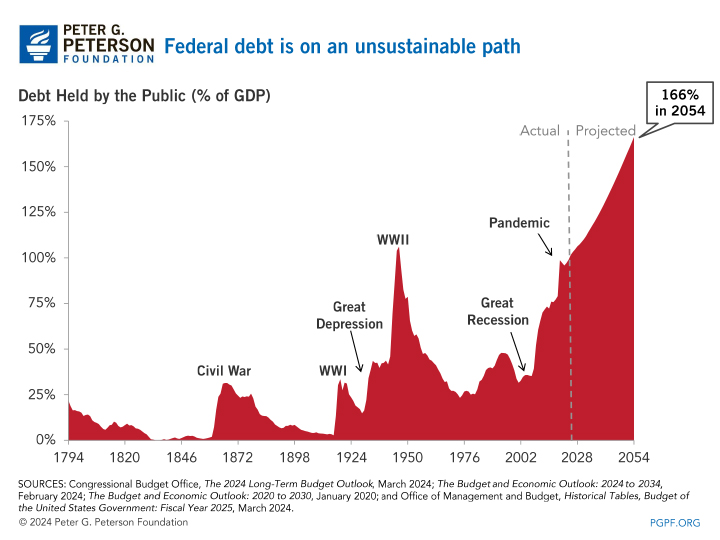
This graph is misleading. It is based on the useless Debt/GDP fraction, and it provides no reason why the growth since 1794 has now become “unsustainable.”
Today’s tax laws help the rich become richer by widening the income/wealth/power Gap between the rich and the rest.
8. The use of the word, “unsustainable.” Typical misleading usage: The national debt will rise substantially over the coming decades.
There may be no word more commonly used by those who, by ignorance or intent, give you false information about federal finances than “unsustainable.”
This word generally is used as a replacement for evidence and proof.
Yes, the so-called “debt” will grow, which is a good thing. The only way our economy, i.e. our GDP, can grow is for the government to pump more dollars into it than it takes out.
But what evidence shows that this growth is “unsustainable”? There is none.
Federal “debt.” still sustainable.
We have “sustained” growth in the federal “debt” (cumulatively, the economic surplus) almost every year for the past 84 years.
In that time, the government ran a surplus (an economic deficit) only during the Clinton presidency, and that outflow of dollars caused a recession.
9. The federal government must “live within its means.”: Typical misleading usage: In an April 13, 2011 speech, President Barack Obama said, “We have to live within our means. We have to reduce our deficit, and we have to get back on a path that will allow us to pay down our debt.”
Obama was many good things, but his knowledge of economics was woefully lacking. Paying down the debt would cause a depression.
Every U.S. depression has been associated with federal surpluses.
1804-1812: U. S. Federal Debt reduced 48%. Depression began 1807.
1817-1821: U. S. Federal Debt reduced 29%. Depression began 1819.
1823-1836: U. S. Federal Debt reduced 99%. Depression began 1837.
1852-1857: U. S. Federal Debt reduced 59%. Depression began 1857.
1867-1873: U. S. Federal Debt reduced 27%. Depression began 1873.
1880-1893: U. S. Federal Debt reduced 57%. Depression began 1893.
1920-1930: U. S. Federal Debt reduced 36%. Depression began 1929.
1997-2001: U. S. Federal Debt reduced 15%. Recession began 2001.
The reason is simple algebra. Federal surpluses are economic deficits. They subtract dollars from GDP, and by formula, when you subtract dollars, the economy shrinks, which is the definition of a depression.
Living within one’s “means” describes a person whose income is sufficient to pay for his spending. However, the federal government’s finances are different from personal finances.
The federal government does not use income to pay for spending. It creates new dollars for that purpose. So the government has no “means” to live within, or more accurately, it has infinite means.
SUMMARY
No scientist should use contronyms and homographs without making sure confusion doesn’t result.
Yet economists do it repeatedly. The words “borrow, debt, deficit, owe, and bond” mean something different when referring to Monetarily Sovereign vs. monetarily nonsovereign entities.
Federal “debt” is not the debt most people understand. The federal government does not borrow dollars, and Treasury bonds are unlike corporate bonds. A federal deficit is an economic surplus, and the U.S. government does not owe anyone dollars, nor does it spend taxpayers’ dollars.
The government has no “means” to live within, and federal spending is infinitely sustainable.
These words have repeatedly been used to confuse the public and make false points. If you are confused, that is exactly what those at the upper level of income, wealth, and power want you to be.
Rodger Malcolm Mitchell
Monetary SovereigntyTwitter: @rodgermitchellSearch #monetarysovereigntyFacebook: Rodger Malcolm Mitchell;MUCK RACK: https://muckrack.com/rodger-malcolm-mitchell; https://www.academia.edu/
……………………………………………………………………..
The Sole Purpose of Government Is to Improve and Protect the Lives of the People.






 So they are angry at being seen as dupes, especially in their own eyes.
They will double down against the obvious and do anything to build a barrier between reality and their foolishness.
They will cover their gullibility with bluster and blindness.
“Wha, wha, I won’t listen to you. I cover my eyes and ears. Your words can’t hurt me.”
To maintain their belief in what they know to be nonsense, they join a mob, scream loudly or even silently, and let the noise in their head cover the truth and their emotion to cover their shame.
Thus, they allow pure belief and worship to wash over them without the burden of honest evaluation.
Hatred and anger are their only defense.
But it is exhausting. As the harsh glare of reality reveals, Trump’s armor is rusty. Each day, more people see the emperor has no clothes.
So they are angry at being seen as dupes, especially in their own eyes.
They will double down against the obvious and do anything to build a barrier between reality and their foolishness.
They will cover their gullibility with bluster and blindness.
“Wha, wha, I won’t listen to you. I cover my eyes and ears. Your words can’t hurt me.”
To maintain their belief in what they know to be nonsense, they join a mob, scream loudly or even silently, and let the noise in their head cover the truth and their emotion to cover their shame.
Thus, they allow pure belief and worship to wash over them without the burden of honest evaluation.
Hatred and anger are their only defense.
But it is exhausting. As the harsh glare of reality reveals, Trump’s armor is rusty. Each day, more people see the emperor has no clothes. There stands before them is a befuddled, pitiful, failing old man, mouthing the same lies and insults that no longer fool even the most naive,
He is an often bankrupt business failure, an often losing political failure, an often adulterous marriage failure, an often indicted and convicted moral failure, and a son not even respected by his own late father.
The thrill is gone.
The crowds thin.
Those few who remain look around in embarrassment at their own naivete.
At last, it ends, not with a bang but with a whimper.
Rodger Malcolm Mitchell
There stands before them is a befuddled, pitiful, failing old man, mouthing the same lies and insults that no longer fool even the most naive,
He is an often bankrupt business failure, an often losing political failure, an often adulterous marriage failure, an often indicted and convicted moral failure, and a son not even respected by his own late father.
The thrill is gone.
The crowds thin.
Those few who remain look around in embarrassment at their own naivete.
At last, it ends, not with a bang but with a whimper.
Rodger Malcolm Mitchell


 #Monetary Sovereignty - Mitchell