Everything: Gravity, Change and the Glass Hammer

Metaphysics has a bad reputation.

The mere mention of it brings forth images of wild-eyed psychopaths explaining with pseudo-scientific jargon, how alien species have been hovering over Area 51, causing COVID with a space ray while turning our children into insects.
What is most likely going on in Area 51? Chris Nichols Explains | Department of History

The term “metaphysics” is generally interpreted to include topics that, due to their generality, lie beyond the realm of physics and its focus on empirical observation.

If something purported to be scientific yet “beyond the realm of physics,” it certainly is worthy of doubt. Yet, it is a prime source for creative thinking that yields accepted scientific findings.

Here are excerpts from an article in a respected scientific magazine, New Science.

How metaphysics probes hidden assumptions to make sense of reality All of us hold metaphysical beliefs, whether we realise it or not. Learning to question them is spurring progress on some of the hardest questions in physics

By Daniel Cossins, 23 June 2025

“A lot of people think it’s a complete waste of time,” says philosopher Stephen Mumford at the University of Durham, UK, author of Metaphysics: A very short introduction. “They think it’s all just arguing over pointless questions, like, classically, how many angels could dance on the head of a pin?”

It isn’t difficult to see why. Classical metaphysics – the term comes from the Greek “meta”, meaning beyond – does ponder some bizarre-sounding questions. What is a table, for instance? What form of existence do colours have?

In addition, it does so through reasoning alone, with tools such as “reductio ad absurdum” – a mode of argumentation that seeks to prove a claim by deriving an absurdity from its denial. It is a far cry from the empirical knowledge scientists pursue through observation and experiment.

But the idea that metaphysics is all just abstract theorising with no basis in reality is a misconception, says Mumford: “Metaphysics is about the fundamental structure of reality beyond the appearances. It’s about that part of reality that can’t be known empirically.”

Indeed, as modern science has expanded its reach into territories that were once seen as the purview of metaphysics, such as the nature of consciousness or the meaning of quantum mechanics, it has become increasingly clear that one can’t succeed without the other.

“In many cases, metaphysical beliefs are the fundamental bedrock upon which empirical knowledge is built,” says Mumford.

Take causation – the idea that effects have causes – which we all believe despite the fact that causal connections aren’t observable. “Basically, the whole of science is premised on this metaphysical notion of causation,” he says.

These days, scientists routinely grapple with all manner of other concepts that are deeply infused with the metaphysical. From chemical elements, space and time to the concept of species and the laws of nature themselves – plus loads more.

From the many worlds interpretation to panpsychism, theories of reality often sound absurd. Here’s how you can figure out which ones to take seriously

We have a choice, says Mumford. We can either scrutinise our metaphysical beliefs for their coherence or ignore them. “But in the latter case, we’re just assuming them unreflectively,” he says.

One of the most striking cases in which science and metaphysics collide is quantum mechanics, which describes the world of atoms and particles. It is a hugely successful scientific theory, yet when grappling with its meaning, physicists must confront metaphysical questions, like how we should interpret quantum superpositions, the apparent ability of a quantum system to exist in multiple states simultaneously.

Here, all we have are competing interpretations of what is actually going on that won’t submit to experimental testing, and it is becoming clear that progress will be impossible without confronting our hidden assumptions. 

“In the end, you can’t do physics without metaphysics,” says Eric Cavalcanti at Griffith University in Brisbane, Australia. 

In light of my previous metaphysical explorations concerning concepts like “free will,” “consciousness,” “space,” “dark energy,” and “time,” I humbly present to you “Everything: Gravity, Change, and the Glass Hammer.”

The “glass hammer” is my analogy for something unthinkable yet transparent — something that one might dismiss on first thought, and then think, “Wait a second. What if . . . “

Have you ever wondered, “What is everything made of?

You know that things are made of molecules, which are made of atoms. Atoms consist of electrons, neutrons, and protons, with protons being made of quarks. You feel confident in all that. But what is the fundamental substance of all these components?

Even more basic particles? Pure energy? Strings? Rings? Information? They all have been suggested by physicists, philosophers, and dreamers.

The peculiarities of quantum mechanics, which assert that a single object can exist in multiple locations at the same time, communicate faster than the speed of light, and that merely knowing something can influence that very thing, raise intriguing questions. These counterintuitive claims seem to pave the way for even more surprising concepts.

So here is one.

Perhaps the more interesting question isn’t about what everything is made of, but rather what influences everything. In other words, what is the universal cause behind every effect that exists everywhere? Is there one. A myriad?

I can visualize two concepts that seem to meet the test of universal cause: Gravity and Change. They are everywhere and they affect everything.

GRAVITY

Gravity seems to act like a force, but it isn’t a force. It’s the structure of space itself. Gravity creates space paths that tell mass where to move. Even in the absence of mass still exists. That curve—that geometry—is the substrate of everything else.

No particle escapes gravity. No field ignores it. No galaxy forms without it. No clock ticks unless space has shape. No place in the universe is devoid of gravity. It may not only be what things are made of so much as what gives things the property of existence.

CHANGE

Change also is what everything experiences. Just as gravity is everything, change is everywhere.

Nothing comes into existence without change. A thought is a change in the brain. Time is change ordered into sequence. Causality is change linked with explanation. Consciousness is the process of change, sensed. Quantum entanglement is a change expressed through correlation.

Change isn’t a side effect. It’s the “engine” of existence. Without change, there’s no becoming, no interaction, no perception, no event.

Without change, gravity is just fixed geometry. Without gravity, change is an empty promise.

But can change exist as a separate entity? It seems counterintuitive. If the universe were completely empty, could there be change?

THE FOUNDATION BENEATH THE FOUNDATION

Here’s a possibility: The Gravity Field is the “universal structure.” The Change Field is the “universal animator,” Everything else—particles, thoughts, time—is how structure responds to activity and how activity shapes structure.

So when we ask, “What is everything made of?”, the answer cannot be a specific thing. It must be a principle, a relation, or a rule so fundamental that it precedes any other occurrence.

That’s why the search for the ultimate answer always becomes metaphysical—not because it’s mystical, but because it has to reach below the level where “physics” even begins.

GRAVITY IS EVERYTHING If your search for universality includes parsimony—building the most complexity from the fewest tools—this is a strong starting point: Gravity shapes the possible. Change generates the actual.

Everything else just rides the line following them.

Visualize this: At or just before the singularity explosion you know as the “Big Bang—perhaps one Planck second before time as we know it—the first thing to exist was the change field.
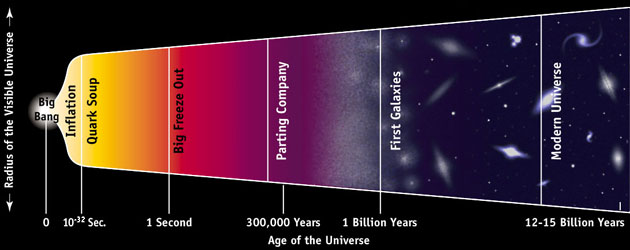
Big Bang Theory
How BIG was the area to the left of the Big Bang? WHAT did it consist of? WHY did the Big Bang happen?

Not matter, not energy, not even space, but the pure relational fact that something will not be the same from one moment to the next.

From this primordial flicker, the gravity field emerges as the first structure builder, the first geometry, the first form that gives shape to change.

Gravity doesn’t push or pull in the usual sense; it sculpts. It tells the changing “what” where to go. All else—particles, forces, time, space, and even consciousness—arise as complex echoes of that foundational field pairing: Change as cause, Gravity as form.

From the overlap of two fields, two metaphysical primitives merge, and the entire universe unfolds.

Can you see it? Before anything—before time, space, matter, or energy—there was only stillness. A frozen singularity, timeless and changeless, containing no structure, no motion, no direction.

Without the Change field, nothing happens. Without Gravity, nothing holds. Together, they animate the universe. Perhaps, like the graviton, there’s a hypothetical particle—a “chronon”—not just measuring Change, but enabling it. Without it, the cosmos remains a blank slate.

We come to the hard problem of imagining how Change could be a standalone. How could Change exist before there is any THING that can change?

But I see Change as not an inevitable part of existence. I can imagine that singularity, or whatever it was, existing for millennia without Change. I can visualize the possibility of an electron that never changes until something gives it “permission” or the “command” to change.

I can imagine change as a field that, when combined with the gravity field, initiates the evolution of the universe.

AN ANALOGY

We often picture the Big Bang as an explosion—a furious, fiery instant when the universe bursts into being. But what if it wasn’t an explosion at all? What if it was an intersection?

Not of matter, or even energy—but of two fundamental, pre-physical fields: one representing change, and the other, structure—what we now call gravity.

Imagine a universe before time. Not a moment before, but a condition without motion, without process—only potential.

In this frozen realm, two great fields exist. One, the Gravity Field, shaped but inert, a vast topology of possible forms. The other, the Change Field, is dynamic in nature but without a canvas to act upon.

Separately, neither produces reality. But at the instant they intersect, time begins. The coupling of change with structure triggers motion, energy, and evolution—a cosmos.

To visualize this, consider a simple metaphor: The moire pattern.

The Big Bang: Watch an illustration of how the Gravity Field and the Change Field could merge to form the rapidly expanding universe.

When the patterns exist separately, they do nothing. But move them even slightly, and the most astounding patterns suddenly emerge. Watch how the patterns change faster than the merger itself.

In fact, through time, the pattern moves faster and faster. Does that remind you of dark energy?

In a similar way, the intersection of the Change Field and Gravity Fields may have emerged across an entire volume of proto-space instantaneously. From within the universe, it would appear to expand faster than light—not because anything traveled superluminally, but because the rules of existence themselves had shifted.

It explains how the universe could expand faster than light, while containing light.

There was no “before” the intersection because time had not yet been written into the structure. The Big Bang was not a fireball—it was the first place geometry was set in motion.

What followed—particles, forces, even consciousness—may be the natural unfolding of that single event: the moment change met gravity and the universe became real.

Sometimes, metaphysics is necessary to explain what physics cannot. You may need to squint or rely on your peripheral vision to see it. (See: New Scientist Magazine: How metaphysics probes hidden assumptions to make sense of reality)

Metaphysical speculation is a good creative exercise as long as you don’t go too far down the rabbit hole. But, of course, this leaves open the question, “What is too far down?”

An object being in two places at the same time? You, changing an object simply by knowing it? Instant communication over a distance of light years?

Rodger Malcolm Mitchell

Monetary Sovereignty

Twitter: @rodgermitchell

Search #monetarysovereignty

Facebook: Rodger Malcolm Mitchell;

MUCK RACK: https://muckrack.com/rodger-malcolm-mitchell;

https://www.academia.edu/

……………………………………………………………………..

A Government’s Sole Purpose is to Improve and Protect The People’s Lives.

MONETARY SOVEREIGNTY

The federal debt myth

You may have thought that the federal debt is too high and should be reduced. Right? Who could blame you after the Republican Party struggled mightily — and as usual, failed — to reduce the debt with its “Big Beautiful Bill.”

Why the struggle? Why the failure. Because it was a BIG LIE.

In 1940, the federal debt was approximately $40 billion, and the debt-to-GDP ratio was around 40%. Self-proclaimed experts called it a “ticking time bomb.”

Today, the federal debt is about #36.2 trillion, (that’s trillion, with a “t”) and the ratio is triple what it was then, and the economy is bigger and stronger than ever in our history.

So what happened to the “ticking time bomb”? Right, it was a BIG LIE.

But even now, you encounter articles like this one:

How Much Debt Does the US Have?

About $36.2 trillion as of May 2025.

OMG! The government owes $36.2 trillion. How will it ever pay it back. We’re all doomed.

Except for two details the scare article conveniently skips:

  1. Unlike you and me, and unlike state and local governments, our federal government is Monetarily Sovereign. It has the infinite ability to pay for anything in dollars. Even if it doesn’t collect a single penny in taxes, it could continue spending forever — even double or triple its spending — and pay all its bill on time.
  2. Federal “debt” is another word for “dollars.” Really. 

The misnamed federal “debt” is the total of Treasury bills, notes, and bonds outstanding. Those words — bills, notes, and bonds — usually signify debt in the private sector (you and me).

However, in the federal sector, they have quite a different meaning.

Look at that dollar BILL in your pocket. See what it is? It’s a FEDERAL RESERVE NOTEIt’s money.

This is a Federal Reserve Note. It’s identical to a Treasury Note, except that it doesn’t pay interest; however, it’s more liquid.

When you buy a Treasury BILL, NOTE, or BOND, not only do you increase the federal “debt,” but you buy money. You literally exchange your federal money for other federal money.

You give the government some money, and the government gives you some money, along with a promise to pay you some interest — in money. It’s an even exchange that is complicated only by the misuse of the word “debt.”

That dollar bill is backed by the full faith and credit of the United States government. It’s even signed by the Treasurer and the Secretary of the United States Treasury.

The T-bill you bought with that dollar bill also is backed by the full faith and credit of the United States government, just like a dollar. 

How Treasury Bills Work | HowStuffWorks
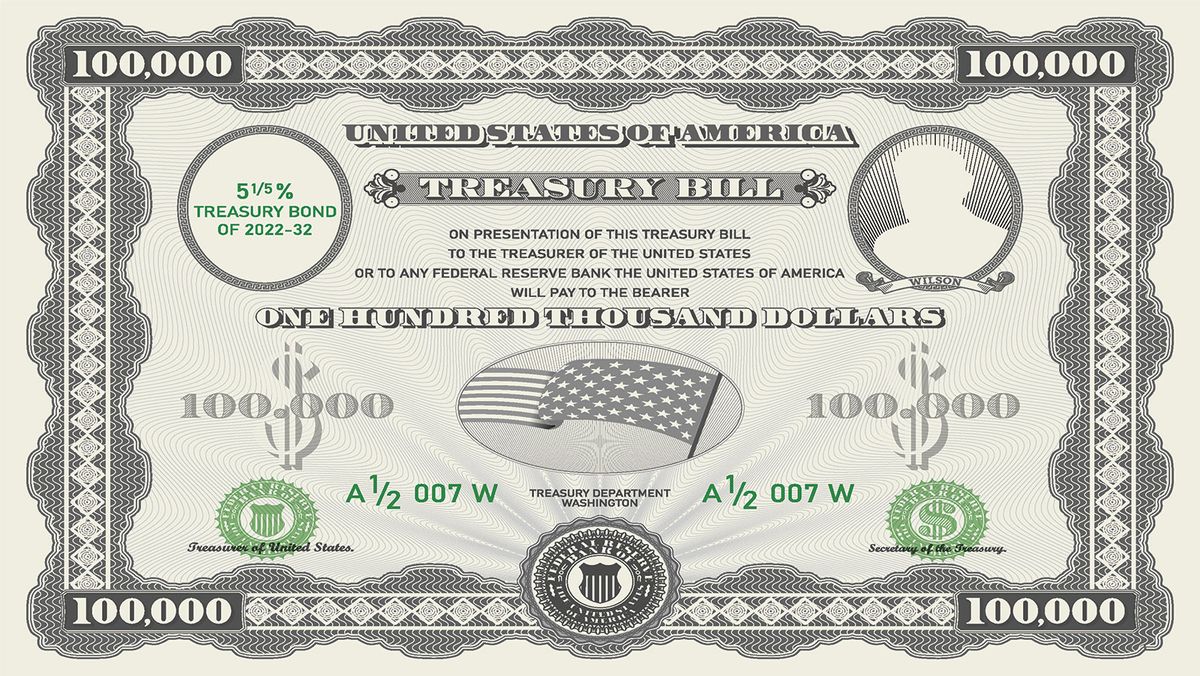
Up to 1980, you could buy a T-bill that looked like this. It too, was the same as dollar bills. The one pictured above was worth $100 thousand, but like a $1 bill, it was guaranteed by the full faith and credit of the United States government.

With regard to safety, obligations, and every other factor you can name, there are only three differences between a U.S. dollar and a T-bill.

  1. The T-bill pays interest; the dollar doesn’t.
  2. The T-bill matures, meaning it stops paying interest at a certain point in time. The dollar never matures since it does not pay interest.
  3. The dollar is more liquid, meaning it’s easier to use when making payments.

So when debt worriers warn about the size of the federal debt, they are actually saying that the U.S. economy is too rich. It has too much money. 

Despite all the inferences, this misnamed “debt” is not a burden on the government, nor is it a burden on you. The greater the “debt” the more dollars the economy has. A growing economy requires a growing amount of money (debt). Here is the proof:

Gross Domestic Product = Net Federal Spending + Net Non-federal Spending + Net Exports.

The federal government borrows money when its spending and investments cannot be funded by federal revenue alone; this debt enables the government to pay for programs and services when funds aren’t immediately available.

Consider how absurd the above statement is. Federal debt is identical to federal dollars. A Monetarily Sovereign government, which can immediately create Treasury bills, can also immediately create dollars. They are the same. 

When the federal government spends more money than it brings in through taxes and other revenue sources, a budget deficit occurs.

To cover the deficit, it borrows money by selling bonds and other securities.

If the government borrows dollars to cover the deficit, where do the lenders get the dollars? Answer: The government can create dollars as easily as it can create “debt.” Treasury notes and Federal Reserve notes are functionally the same. They both are financial obligations of the federal government.

Generally, the federal debt is an accumulation of budget deficits over time. The federal debt in the most recent month of data, May 2025, was $36.2 trillion. This is 2% higher than in May 2024 and up 31% from 2019, before the COVID-19 pandemic.

Translation: There were 2% more dollars in May 2025 than in May 2024. Is this supposed to be worrisome?

Dividing the total debt by the population of the US reveals the per-person debt, or the average amount of debt for each person. This makes it easier to compare debt levels between different countries or time periods, since it accounts for changes in population size.

It also leads to the false perception that somehow you, or other taxpayers, “owe” the debt. You don’t. Nobody does. The more federal debt there is, the more money there is.

Per-person debt has increased at an average rate of 5% per year since 2001. As of 2024 — the last year for which there is population data — the federal debt was equivalent to $106K per-person, for a total of $36.2 trillion.

Translation: There are 106K dollars per person in America. So???

Another way to understand a country’s debt is to compare it with its gross domestic product (GDP). GDP, broadly speaking, is a measure of the value of an economy.

Analyzing the debt in context of GDP makes it easier to track the debt alongside changes in economy and inflation, allowing for comparisons of the debt over time; it can also indicate a country’s ability to repay its debt.

Now we get to the absolute lie, also known as THE BIG LIE. There is zero — ZERO — relationship between GDP and a country’s ability to pay its debts. 

The U.S. federal government has never defaulted on its debt due to a lack of financial capacity. As the sovereign issuer of the U.S. dollar, it cannot run out of money in the same way a household or business can. 

The problem is that people with ill intent like to confuse the use of the word “debt.” 

Federal debt is the total of deficits, the difference between taxes and spending. The government “owes” money on that kind of debt as much as it “owes” money on the dollars in circulation i.e., nothing.

The other kind of debt occurs when a buyer doesn’t immediately pay for goods and services but instead owes payment. The federal government always has and will continue to pay for everything in a timely manner. It never is late and never fails to pay.

By mixing the variations on the word “debt,” ignorant or malevolent writers cause unnecessary concern, which leads to bad policy.

An example of poor policy is the notorious “debt ceiling,” a law that, if followed, would require the federal government to default on its obligations and not pay for what it has already contracted to pay for.

The true purpose of this law is to enrich the wealthy by making benefits to the poor appear to be unaffordable.

When debt reaches 100% of a nation’s GDP, it indicates that the country owes about as much as its economy generates annually.

“The country” does not owe the federal debt. No one does. It is not debt. It is dollars. The bigger the “debt,” the wealthier the country, because that debt is just another word for “dollars.”

The nation’s debt as a percentage of GDP first surpassed 100% in Q4 of 2012. It remained relatively stable until Q2 of 2020, when it decreased while spending increased. It reached 133% of GDP by the end of Q3. As of Q1 2025, the debt as a percentage of GDP was 121%.

In short, the total amount of dollars is greater than the total value of production. So???

The government has to pay interest on its debts, the same way individuals pay interest on credit card bills, mortgages, and car payments. Interest payments aren’t fixed, and change based on the size of the debt and current interest rates.

Finally, we get to the BIG LIE  regarding interest. When the federal government pays interest, it injects growth dollars into the economy. The more interest it pays, the more growth dollars.

That interest costs you nothing. Taxpayers do not pay for federal interest. The government creates interest dollars the same way it pays for everything else: It passes laws.

As long as the U.S. federal government does not run out of laws, it will not run out of dollars. Tell that to the next person who complains about the size of the so-called, misnamed federal debt.

Rodger Malcolm Mitchell

Monetary Sovereignty

Twitter: @rodgermitchell

Search #monetarysovereignty

Facebook: Rodger Malcolm Mitchell;

MUCK RACK: https://muckrack.com/rodger-malcolm-mitchell;

https://www.academia.edu/

……………………………………………………………………..

A Government’s Sole Purpose is to Improve and Protect The People’s Lives.

MONETARY SOVEREIGNTY
A visual metaphor for space, gravity, and dark energy

Because you like to think, imagine, visualize, and perhaps solve . . .

Dark energy is often described as one of the great mysteries of modern cosmology. It appears to be driving the accelerated expansion of the universe, but no one knows what it actually is.

Why doesn’t it clump? Why don’t we feel its effects locally? Why does it seem to oppose gravity?

These questions persist largely because of a hidden assumption: that gravity is the only large-scale curvature shaping the cosmos, and that its effects should simply add up.

The more mass, the greater the pull, the greater the slowdown. But the universe isn’t slowing. It’s accelerating.

In general relativity, gravity isn’t a force. It’s the shape of space. Mass is said to curve space, and objects move along the paths defined by that curvature—known as geodesics.

When the curvature is concave (like a bowl), geodesics converge. When it’s convex (like a dome), they diverge.

In this picture, gravity’s seeming “pull” is just motion along inward-bending field lines. There’s no pulling—just falling into curves. What we call attraction is a form of concave geometry.

Now consider dark energy. It doesn’t attract. It doesn’t bind. It doesn’t even register locally. But it causes everything far apart to become farther apart faster. That’s not a push—it’s a change in global geometry. The geodesics are bending outward. Dark energy, in this sense, is not a force. It’s convex curvature on the largest scales.

Here’s a way to visualize the problem. Imagine standing in a valley halfway up a mountain. Locally, the landscape is sloped inward—you’re surrounded by concavity. That’s gravity. But when viewed from above, you’re clearly in the outward-facing slope of a mountain—a convex curve. That’s dark energy.

We measure gravity in solar systems and galaxies, where it dominates. Its concave geometry overwhelms everything else. But when we look across billions of light-years—between galaxy clusters—we begin to see the larger, convex shape: space itself is stretching.

This makes dark energy nearly impossible to isolate locally. It’s like trying to detect Earth’s curvature while standing in a ditch. The local dip masks the larger shape.

In molecular biology, protein folding determines function. A single molecule can behave in radically different ways depending on how it’s folded. Geometry creates behavior.

What if the same is true for spacetime?

Concave folds may produce behaviors we interpret as “attraction.” Convex folds may produce “repulsion.” Field lines aren’t forces—they’re guidance structures.

And when space folds in different ways, it produces different relational outcomes between objects: pull, push, bind, scatter.

This kind of geometric reasoning already appears in quantum field theory. The strong nuclear force, for instance, has both attractive and repulsive geometries depending on distance.

There’s nothing strange about a field shifting behavior based on shape and scale.

It’s important to distinguish visualization from explanation. A photo of a flower is not a flower. Analogies can help us think clearly—or mislead us. However, when used with care, they offer profound insight.

The mistake may not be in our math, but in our mental model. We’ve been trying to interpret the universe through the lens of forces—things that push and pull.

But space doesn’t push or pull. It guides. And that guidance depends on how it’s shaped.

Gravity is not inherently attractive; it’s a concave shaping of space that brings paths together. Dark energy may be a convex shaping, spreading paths apart over vast scales.

Locally, gravity dominates. Universally, dark energy emerges. We can’t detect dark energy near us because we’re inside a gravitational valley—yet we’re also halfway up a cosmic mountain.

Shape is function. Like proteins, spacetime may express different “forces” through different geometric configurations.

So perhaps the real mystery is not dark energy at all. Perhaps the mystery is why we ever expected the universe to behave like a sum of forces—rather than a living landscape of evolving, folded geometry.

A thought: Is it possible that, like the strong nuclear force, which has both attractive and repulsive geometries depending on distance, “dark energy” is a model for gravity at a longer distance?

Fruitlessly, we search for the graviton, the hypothetical elementary particle that mediates the force of gravitational interaction. Equally fruitlessly, we search for Dark Sector Mediators.

Janus: God of All Beginnings - Benicia Magazine
Janus

There may be no mediators of gravitational or dark energy. It could be that gravity and dark energy are two sides of the same fundamental coin, shaping everything in the universe.

If we ask, what is the fundamental “substance” from which all matter and energy are made, one candidate might be gravity and its opposite, dark energy.

Gravity is the Janus of reality—one face curving space inward, the other bending time outward.

One face pulls galaxies together; the other drives them apart. One wears the mask of gravity, the other, of dark energy.

Both faces arise from the same unseen geometry but show us opposite illusions: attraction and repulsion.

We search for the graviton on one side and, perhaps, the “repulson” on the other—neither particle found, yet both shaping the cosmos.

Rodger Malcolm Mitchell

Monetary Sovereignty

Twitter: @rodgermitchell

Search #monetarysovereignty

Facebook: Rodger Malcolm Mitchell;

MUCK RACK: https://muckrack.com/rodger-malcolm-mitchell;

https://www.academia.edu/

……………………………………………………………………..

A Government’s Sole Purpose is to Improve and Protect The People’s Lives.

MONETARY SOVEREIGNTY

The people get it wrong because the “experts” deceive them.

You can’t blame the public for not understanding economics when economists themselves struggle to comprehend it.

Here are excerpts from two articles that demonstrate the incredible ignorance (or perhaps, intentional misleadingness) from people who should (or perhaps do) know better.

The first is from Paul Krugman, who is billed as having won the Nobel Prize (He didn’t. It was the Nobel Memorial Prize in Economic Sciences, officially the Sveriges Riksbank Prize in Economic Sciences in Memory of Alfred Nobel ).

The following article ran July 3, 2025.
Trump’s Big Beautiful Debt Bomb

The budget bill is both devastatingly cruel and deeply irresponsible Paul Krugman, Jul 03, 2025 Do readers remember the debt panic of the early Obama years? For a while scare stories about national debt dominated discussion in the media and inside the Beltway.

I got a lot of grief at the time for bucking that consensus, urging people to relax about government debt. The United States, I argued, had lots of “fiscal space” — ability to run up debt without losing investor confidence — so it should focus instead on the importance of restoring full employment, which required running substantial deficits.

So far, so good. He was right to tell people to “relax about government debt.”

His argument, though, about “fiscal space” is troubling, because it  hints that there are times when we don’t have “fiscal space, and should worry about government debt (which isn’t government and isn’t debt.)

The money is owned by the public, not by the government, and resides in Treasury Security deposits. If it were debt, the government would own the money and owe it to the creditors.

Depositing dollars into an account that you own — dollars you always own and the government never touches — does not create “government debt.” (Think of a safe deposit box, and you will have a better understanding of Treasury Securities accounts.)

These days, however, many though not all of the people who were screaming about debt back then have gone quiet. Funny how that happens when there’s a Republican in the White House.

Republicans scream about benefits for the poor and taxes on the rich. Funny how “solutions” to the debt always seem to involve cuts to Medicaid, Medicare, Social Security, food stamps, childcare, and other benefits enjoyed by those who are not rich.

You never hear about the elimination of tax loopholes that benefit the rich.

Yet there is much more reason to be worried about debt now than there was then. On one side, there’s no longer any good economic reason to be running large deficits.

That statement is utterly wrong, diametrically wrong, even more wrong than the notion that Krugman won a real Nobel Prize.

The reasons to run large deficits never change and are quite obvious:

  1. Being Monetarily Sovereign, the government can run any size deficits at no cost to anyone — not to you, not to me, and not even to Paul Krugman. All deficit spending is funded not by taxes, but by the creation of new money, which the federal government can do endlessly.
  2. The formula for economic growth clearly shows why the government must run deficits. Gross Domestic Product = Federal Spending + Nonfederal Spending + Net Exports. Government deficits fund both bolded terms in the equation.
  3. Every depression in U.S. history has resulted from the lack of federal deficits (aka “surpluses.”)
  4. Almost all recessions have resulted from deficits that were too small, and all have been cured by increased deficit spending.
Here is the evidence:
Changes in Gross Domestic Product closely parallel changes in “federal debt.” Recessions are preceded by reduced “debt” growth and are cured by increased “debt” growth.
Every depression in U.S. history has followed years of federal surpluses:

1804-1812: U. S. Federal Debt reduced 48%. Depression began 1807.

1817-1821: U. S. Federal Debt reduced 29%. Depression began 1819.

1823-1836: U. S. Federal Debt reduced 99%. Depression began 1837.

1852-1857: U. S. Federal Debt reduced 59%. Depression began 1857.

1867-1873: U. S. Federal Debt reduced 27%. Depression began 1873.

1880-1893: U. S. Federal Debt reduced 57%. Depression began 1893.

1920-1930: U. S. Federal Debt reduced 36%. Depression began 1929.

1997-2001: U. S. Federal Debt reduced 15%. Recession began 2001.

On the other, America has changed in ways that have greatly reduced our fiscal space, our ability to get away with a high level of debt.
There is nothing to “get away with.” Not only is the “federal debt” not federal or debt, but running deficits is necessary. What we can’t afford to do is not to run deficits.
And the One Big Beautiful Bill Act, which just passed the Senate and will probably pass the House, will make things even worse.
It is one of the worst bills ever to pass Congress and the President, but not because it causes deficits. That’s the good part. The bad part is that the entire bill is devoted to taking money from the low- and middle-income groups and giving it to the very rich.
Why was I relatively relaxed about debt back in the day? Largely because history tells us that advanced nations can normally run up large debts without experiencing crises of confidence that send interest rates soaring.

Look, for example, at the debt history of the UK, which ran up huge debts relative to GDP during the Napoleonic Wars and the two world wars without losing investor confidence:

Why are advanced countries normally able to pull this off?

Not all advanced countries — only those that are Monetarily Sovereign, like the UK. The euro nations, many of which could be called “advanced” (France, Germany, Italy, et al), cannot run up large debts without experiencing crises of confidence.

However, the Monetarily Sovereign European Union (EU) can incur any amount of debt it wishes without problems. It has the infinite ability to create euros.

First, they’re normally run by serious people, who don’t try to govern on the basis of crackpot economic doctrines and will take responsible action if necessary to stabilize their nations’ debt.
“Serious people”? Do you know what that means? I don’t.
Second, they’re competent: They have strong administrative states that can collect a lot of tax revenue if necessary. The United States collects 25 percent of GDP in taxes, but could collect much more if it chose. Some European nations collect more than 40 percent.
This is utterly wrong:
  1. While state and local taxes do pay for state and local government spending, federal (Monetarily Sovereign) spending is not funded by taxes. Even if the U.S. federal government collected no taxes, it could continue spending indefinitely. Amazingly, the Nobel winner seems not to understand the differences between Monetary Sovereignty and monetary non-sovereignty.
  2. Not only does federal tax collection not fund federal spending, but it reduces GDP by reducing non-federal spending. Federal tax collections are anti-growth.
These factors normally lead investors to give advanced countries the benefit of the doubt, even when they run big deficits. That is, investors assume that the people running these countries will take action to rein in debt once the emergency justifying deficits ends, and that they will be able to take effective action because they have effective governance.
No, smart investors know that Monetarily Sovereign nations easily can fund deficit spending by creating their sovereign currencies.

It isn’t emergencies that justify deficits; it’s economic growth that makes deficits necessary.

And what is the “effective action” Krugman is talking about? In the 65 years since 1960, there has been only one short period when America failed to run a deficit — 1998-2001 — and that caused the recession of 2001.

And, as usual, the recession was cured by — you guessed it — deficit spending.

Reductions in deficit growth (red line) lead to recessions (represented by gray vertical bars). Recessions are cured by increased deficit spending. The reason: Federal deficits, which never are funded by taxes, increase the supply of growth dollars in the economy, at no cost to anyone.
And that’s why I was a deficit dove in, say, 2011. America needed to run substantial deficits to recover from the 2008 financial crisis.

But I didn’t think this would cause trouble down the road, because we were a serious country run by serious people, easily able to do what was necessary to stabilize the debt once the economic emergency was past.

Again, with the “serious” business? Serious people would understand Monetary Sovereignty.
  1. We didn’t “stabilize the debt.” We ran “substantial deficits to recover”, i.e., to grow the economy, after the 2008 financial crisis. (Why we should wait for a financial crisis to grow the economy, never is explained.)
  2. We ran larger deficits than ever, which coincided with substantial GDP growth and low inflation.
But that, as I said, was then.

Right now we are running big budget deficits even though we aren’t fighting a war, facing high unemployment, or dealing with a pandemic. We should be taking action to bring those deficits down.

Why? What is the supposed harm that deficits are causing? There is none. Why turn off the engines when the plane is flying well?

Instead, Republicans have rammed through the One Big Beautiful Bill Act, which will add trillions to the deficit even as it causes mass misery.

I think he means “adding trillions to the debt,” but either way, this is one of the few good parts of the Bill — deficit spending to add growth dollars to the private sector.

The bad part is that not only with the rich get more money, but the poor will get less. When an economy widens the Gap between the rich and the rest, there always is much suffering among the millions while a few thousand prosper.

Money aside, the way Congress was bullied into passing that bill and the lies used to sell it show that we are no longer a serious country run by serious people.

Republicans are using transparently dishonest accounting to hide just how much they’re adding to debt — hey, we aren’t really cutting taxes, just extending tax cuts that were scheduled to expire.

And they’re also claiming that the OBBBA’s tax cuts (the ones that they say aren’t really happening) will generate a miraculous surge in economic growth.

If there were real tax cuts they would, in fact, stimulate economic growth. But Trump’s tariffs will hurt the economy in two ways:
  1. Tariffs are taxes that remove dollars from the economy. We Americans pay Trump’s tariffs out of our pockets. Foreigners do not pay our taxes. Trump is hitting us on the head with a tariff hammer, to punish them.
  2. Tariffs also are inflationary, affecting the prices of all products, even those not directly subject to a tariff.
I’ve had my differences with the Committee for a Responsible Federal Budget, but it’s an honest, highly competent think tank, and its (appropriately) incredulous analysis of Trump officials’ economic projections is titled “CEA’s fantastical economic assumptions.”

The CRFB is honest and competent if you agree with their endless calls to cut benefits to the middle- and lower-income groups as a way to grow the economy. Otherwise, one might think they are a group of wealthy individuals catering to the greed of other wealthy individuals.

Add in Trump’s bizarro claims about what his tariffs will achieve. Again, do we look like a serious country run by serious people?

Moreover, mass deportation and incarceration of immigrants, aside from being a civil liberties nightmare, will inflict severe economic damage and significantly worsen our debt position.

Totally agree. Is this the same Donald Trump whose party complains Americans are not having enough children to support a growing economy — so he’s sending away immigrants who do the work and pay taxes, but receive few benefits??? Absolutely senseless.

Finally, how long will we have an effective government that can collect taxes when necessary? Elon Musk’s DOGE failed to find significant amounts of waste, fraud and abuse, but it did degrade the functioning of the federal government and demoralize hundreds of thousands of civil servants.
Like little puppets, the Republicans mouth the phrase “waste, fraud and abuse.” It’s always exactly the same — “waste, fraud, and abuse.” Never, “fraud, abuse, and waste.” Never “abuse, waste, and fraud.”

Always exactly the same words, which not only are symptoms of rehearsed madness but have also been proven untrue.

Republicans have done all they can to eviscerate the IRS and make tax evasion great again. Even if control of the government is eventually returned to people who want to govern the country rather than pillage it, it will take years to recover competence in taxing faith in America.

I don’t mourn for the IRS. Federal taxes pay for nothing at all. The sole purposes of federal taxes are:

  1. To control the economy by taxing what the government wishes to discourage and by rewarding what the government wishes to encourage.
  2. To assure demand for the U.S. dollar by requiring taxes be paid in dollarsl
  3. To widen the Gap between the rich and the rest by providing tax loopholes only the rich can crawl through, allowing them to pay a lower percentage of their incomes than the rest of us do.

Get it? Federal taxes don’t fund federal spending.

But I don’t think they fully realize, even now, that the risk of a U.S. debt crisis is vastly higher now than it was when Republicans were yelling about Obama’s deficits.

There was no “debt crisis” then. There is no “debt crisis” now.

The issue is that we have a dangerous, hateful criminal as President, a group of unethical supporters in Congress and the Supreme Court, and a sufficient number of misinformed voters to enable it.

And then there was this article:

Here Are House GOP Holdouts’ Objections to Senate-Passed Megabill

A concern of conservative Republicans is that the bill adds to both the national debt and deficit,Jackson Richman,Josep h Lord, Nathan Worcester,  7/2/2025

WASHINGTON—House Republicans appear stuck on July 2 when it comes to advancing President Donald Trump’s One Big Beautiful Bill Act.

House Republicans are working overtime to bring their ideologically-divided caucus—split between moderates and conservatives who often want opposing outcomes—on board with the mammoth bill. With Republicans controlling 220 seats to Democrats’ 212, House Speaker Mike Johnson (R-La.) can spare no more than three defections.

Here are some of the biggest unresolved divisions in the bill.

Pricetag

Many conservatives have expressed concerns about the bill’s impact on the national debt as well as the deficit.

“The changes the Senate made to the House passed Beautiful Bill, including unacceptable increases to the national debt and the deficit, are going to make passage in the House difficult,” Rep. Marlin Stutzman (R-Ind.) wrote on X.

Mathematically, they are talking about “unacceptable increases in Gross Domestic Product.” Crazy or ignorant? You decide.

The conservative Freedom Caucus said in an X post on June 30: “The Senate’s version adds $651 billion to the deficit—and that’s before interest costs, which nearly double the total. That’s not fiscal responsibility. It’s not what we agreed to.”

It is not “fiscally responsible” to assume federal financing is the same as personal financing. How are people so ignorant of economics elected to Congress?

Rep. Ralph Norman (R-S.C.), a caucus member, told The Epoch Times on July 1 that he would vote against the legislation. Norman and other fiscal hawks have called for at least $2 trillion in spending cuts, while the bill delivers $1.5 trillion in cuts.

Translation: Norman and other fiscal hawks have called for at least $2 trillion in cuts to economic growth.

There are also concerns about the Congressional Budget Office’s (CBO) prediction of a $3.2 trillion deficit increase under the bill.

Translation: There are also concerns about the Congressional Budget Office’s (CBO) prediction of a $3.2 trillion increase in Gross Domestic Product

Rep. Jeff Van Drew (R-N.J.) took a different perspective.

“People are going to have more money to spend, the economy is going to do well, and people are going to be happy,” Van Drew told reporters.

OMG! Is Van Drew the only member of Congress who understands that federal deficits put money into people’s pockets?

Johnson and Trump have argued that the bill will reduce the deficit by kindling economic growth and have criticized the CBO numbers for relying on a lower growth rate .

Translation: Johnson and Trump have argued that the bill will reduce the deficit by increasing taxes, which somehow will grow the economy.

Cut Provisions

Rep. Chip Roy (R-Texas), who also voted against advancing the bill through the House Rules Committee, posted on X that the Senate eliminated provisions passed in the House version of the legislation

This included getting rid of “provisions to terminate the ‘green new scam’ subsidies in the House bill,” removing “key provisions we put in the bill to stop illegal aliens from getting Medicaid,” and eliminating “key provisions we put in the bill to stop taxpayer funding of transgender surgeries.”

Translation: The government should spend fewer growth dollars to cut global warming and healthcare, but don’t cut tax loopholes for the rich.

The Freedom Caucus document alleges that the Senate watered down a House provision to cut waste, fraud, and abuse from the Supplemental Nutrition Assistance Program (SNAP), which issues food stamps, as “it fails to prevent blue states from gerrymandering counties and cities to get around the work requirements.”

There are those words again, in the exact order, as spoken by zombie puppets: “Waste, fraud, and abuse,” which DOGE failed to find.

Translation: Cut the food stamps that save children in blue states from starvation, because they help Democrats.

Medicaid While the Freedom Caucus sought deep Medicaid cuts, this is a concern for moderates such as Rep. Don Bacon (R-Neb.). The Senate cut Medicaid by more than $1 trillion, while the House version cut it by $800 billion. Both figures are over the span of a decade.

Translation. Rep. Don Bacon is concerned about health, but he will vote for the bill because Trump told him to.

In a June 24 letter to Senate Majority Leader John Thune (R-S.D.), a group of moderates wrote that the “House’s approach reflects a more pragmatic and compassionate standard.”

Translation: To Republicans, “pragmatic and compassionate” means cut healthcare, but a bit less.

They also wrote that they are “concerned about rushed implementation timelines, penalties for expansion states, changes to the community engagement requirements for adults with dependents, and cuts to emergency Medicaid funding” as “these changes would place additional burdens on hospitals already stretched thin by legal and moral obligations to provide care.”

Translation: Yes, cut all those benefits to the poor; just do it slower, until after the midterm elections.

Rep. Dusty Johnson (R-S.D.), a leader in the moderate Main Street Caucus, said he and many other moderates had, nevertheless, had their concerns assuaged by their meeting with Trump.

Asked about the meeting, Johnson said Trump “and particularly [Centers for Medicare & Medicaid Services Administrator] Dr. [Mehmet] Oz did a good job of working through some of the specifics.”

“The president is the best closer in the business, and he got a lot of members to ‘Yes’ in that meeting,” he said.

Translation: “Concerns assuaged by Trump” means “he won’t campaign against me or put up a competing candidate.”

Rep. John McGuire (R-Va.), a supporter of the bill, said that Republicans’ changes to the currently “unsustainable” program will ensure that it’s “available for people who need it for future generations.”

Translation: McGuire falsely claims the government can run short of dollars, so we have to cut benefits to the poor while giving the rich more tax loopholes. And please don’t ask us to cut tax loopholes. Why do you think we cut IRS staffing?

Rep. Greg Murphy (R-N.C.) told reporters: “We’re going after waste, fraud, and abuse. People shouldn’t be on the system who are not eligible.

“Waste, fraud, and abuse,” again. All rich people are eligible. The people who do the actual labor are not eligible.

Additionally, an issue with the bill, according to the document, is that it does not phase out quick enough the green credits under the Inflation Reduction Act as it “guts the benefit by including a last-minute carveout for projects that ‘begin construction’ a year after enactment, which will create a race to do the minimum 5 percent construction spending to lock in subsidies well past 2027.”

Translation: Those Democrats will sneak in measures to reduce global warming if we don’t phase out benefits for those who pollute less. Anyway, global warming doesn’t exist, and if it does exist it isn’t a threat to the rich, so why should we care?

Finally, an issue with the bill, according to the document, is that it includes $50 billion for rural hospitals—which they call a “slush fund”—and a “100 percent tax deduction for meal expenses on Alaskan fishing boats, and special lower thresholds for waivers for Alaska for SNAP work requirements and state cost share requirements, even after giving them a blanket waiver through 2028.”

Translation: “How awful. How can we increase benefits for the rich if we help rural hospitals, provide deductions for meal expenses on fishing boats, and make it easier for starving children to get food?”

I don’t blame the Republicans or even Trump for this monstrosity of a bill — a bill that will sicken and starve millions of innocent people.

I blame the ignorant, cruel, un-American voters, who carry their bigotry and hatreds into the voting booth with them. They think the rich Republicans will protect America from the black, brown, yellow, gay, poor, lazy, non-Christian foreigners who are “trying to take over.”

The MAGA version of the Statue of Liberty doesn’t carry the welcoming torch of freedom. She gives the middle finger to all those self-proclaimed “good Christians,” who actually are polar opposites of Christ.

Ironically, poetically, the red-state voters who are not wealthy will suffer the most. I do not feel sympathy for them. They will receive what they deserve. deserve.

I feel bad for their children, who will be harmed by the wanton cruelty foisted upon them by their parents.

Rodger Malcolm Mitchell

Monetary Sovereignty

Twitter: @rodgermitchell

Search #monetarysovereignty

Facebook: Rodger Malcolm Mitchell;

MUCK RACK: https://muckrack.com/rodger-malcolm-mitchell;

https://www.academia.edu/

……………………………………………………………………..

A Government’s Sole Purpose is to Improve and Protect The People’s Lives.

MONETARY SOVEREIGNTY