I don’t know what I’m doing, but does it matter? They’re my toys and I can do whatever I want. I only listen to kids who tell me I’m smart.
Donald Trump uses “on-again, off-again, up, down, sideways” tariffs to reward nations that suck up to him and to punish those that don’t.
This demonstrates that he either is ignorant of economics or simply doesn’t care.
Seemingly, someone he trusts has told him that tariffs give him absolute power, and if there is one thing Trump craves, it’s that — perhaps power even over money.
In his ignorance of economics, he falsely claims that the economy is doing well, so interest rates should be lowered, a step typically taken to stimulate a lagging economy.
Meanwhile, the sole purpose of tariffs is to increase import prices, which is inflationary.
Trump’s advisors are afraid to tell him those facts, lest they be terminated.
You can expect to hear from “trusted sources” that inflation isn’t bad because the price of yachts just went down a penny, and that is the only measure you, the public, will be allowed to see.
After firing Erika McEntarfer, the head of the Bureau of Labor Statistics (BLS), Trump hired Dr. E.J. Antoni, chief economist at the conservative Heritage Foundation, as the next BLS Commissioner.
Antoni contributes to the notorious, ultraconservative Project 2025 and has proposed significant changes to how data is reported, including suspending monthly job reports in favor of quarterly ones.
That way, there will be fewer instances of bad news to lie about.
You can be sure those quarterly reports will show inflation low, unemployment low, job creation high, and Trump’s shoes as the best-licked in Presidential history.
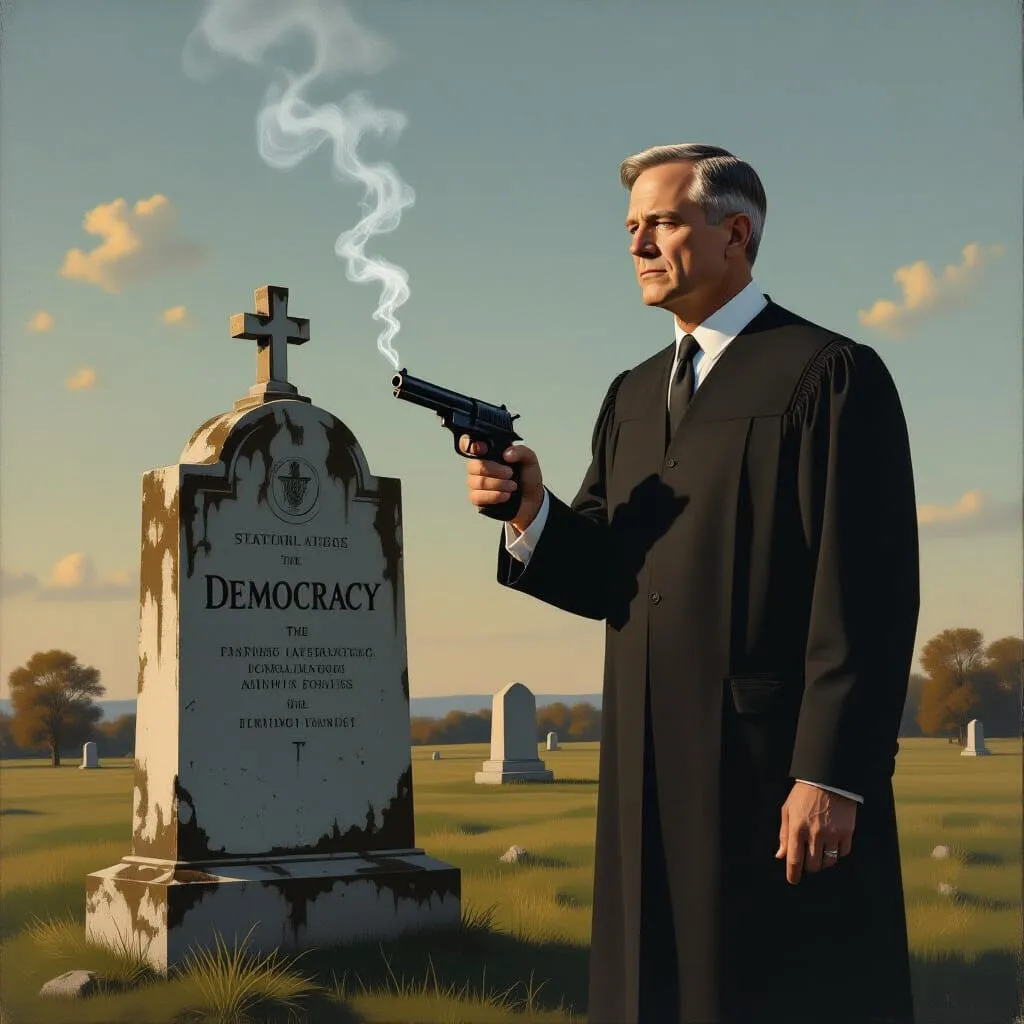
Americans died fighting against rule by a king, but we conservatives want to be ruled by an iron hand. If that means destroying democracy, we are proud to do so. I will be remembered for firing the first bullets.
America was born fighting against a monarch who had unlimited power.
The Constitution is a document primarily designed to limit the power of government.
Thatfreedom from arbitrary rule is the basis for American democracy.
It is why each government branch—the Executive, the Legislative, and the Judicial—is supposed to function as a check, so that no branch (particularly the Executive) is allowed unfettered influence.
Sadly, while today’s Executive branch craves absolute power, the Judicial branch is only too willing to grant it, and as a result, the Legislative branch has lost all its meaning and purpose.
The primary goals of our craven Senate and House are to secure re-election and re-election again, having become mere rubber stamps for the Executive branch.
The majority of the Supreme Court has expressed admiration for an “Imperial presidency,” which grants near absolute power to the President, exactly what the Revolutionary War and the subsequent Constitution were supposed to prevent.
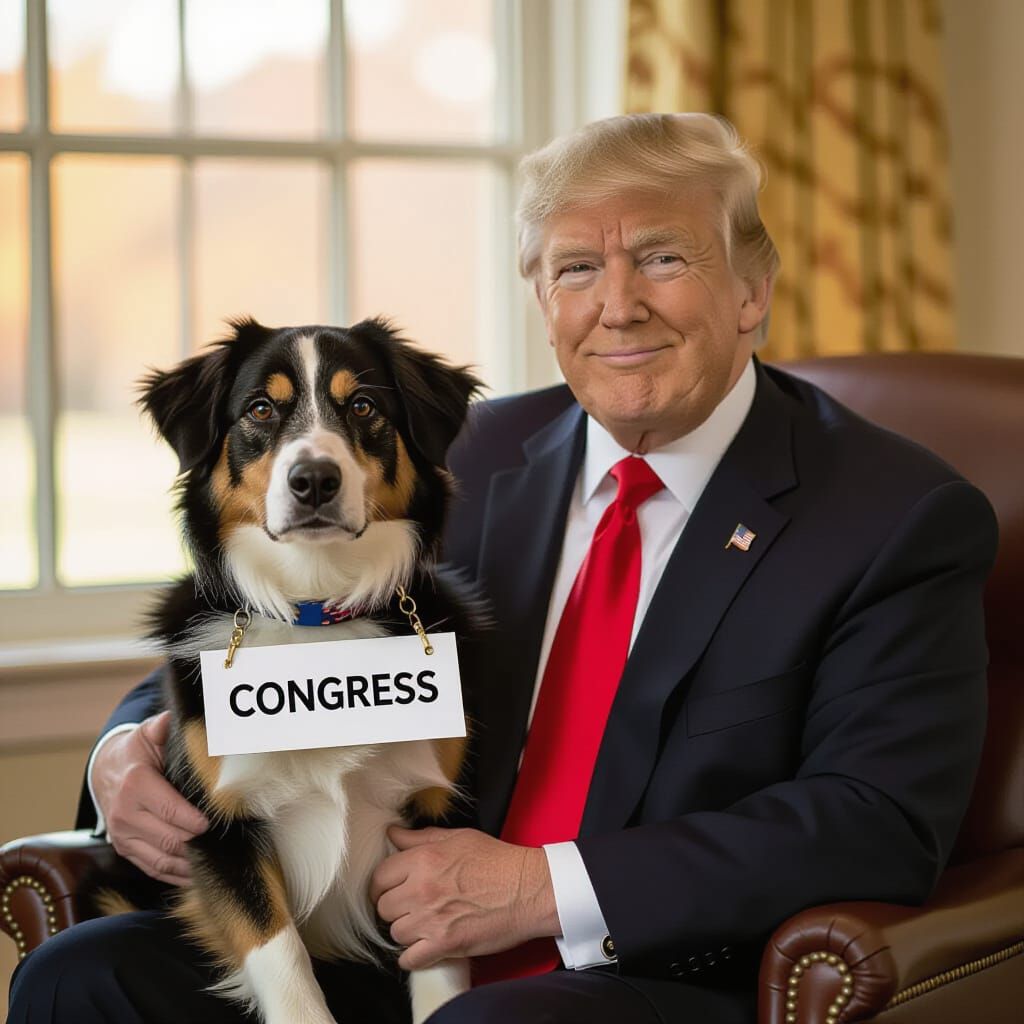
Every President should have a lapdog like this. He’s pretty useless, but if I toss him a bone, he’ll do exactly as I say. If he doesn’t, I’ll shoot him like Kristi Noem.
A case in point is the lack of due process granted to immigrants.
Currently, all the President needs to do is claim (without evidence) that any individual or group of individuals is a threat to the United States.
That person or group can not only be deported, but first be sent to a hell-hole prison.
If that isn’t bad enough, the person can be separated from their children and then sent to a nation with which they have no history.
Any normal human would consider these clear violations of:
The 5th Amendment, which says no person shall “be deprived of life, liberty, or property, without due process of law.” (applies to the federal government)
The 14th Amendment, which repeats that protection against the states: “nor shall any State deprive any person of life, liberty, or property, without due process of law.”
And the 8th Amendment, which prohibits “cruel and unusual punishments,” along with excessive bail and excessive fines.
However, our three branches have chosen recently to ignore the clear wording of the Constitution. (The irony of self-proclaimed “originalist” conservatives ignoring clear wording cannot be overstated.)
Thus, the American democracy our ancestors pledged “our Lives, our Fortunes, and our sacred Honor,” now teeters on the brink.
Was it all for nothing?
The upcoming elections will provide an answer to that question. In the voting booth, your vote, no matter how unethically gerrymandered, remains secret. You will have the chance to vote for democracy without fear of punishment from a king.
Economic analysts generally agree that under Biden, the U.S. experienced one of the strongest post-recession recoveries in modern history, particularly in job creation and inclusive labor market outcomes, while inflation decreased from its pandemic-related highs.
And then came. . .
DEPRESSION DONALD
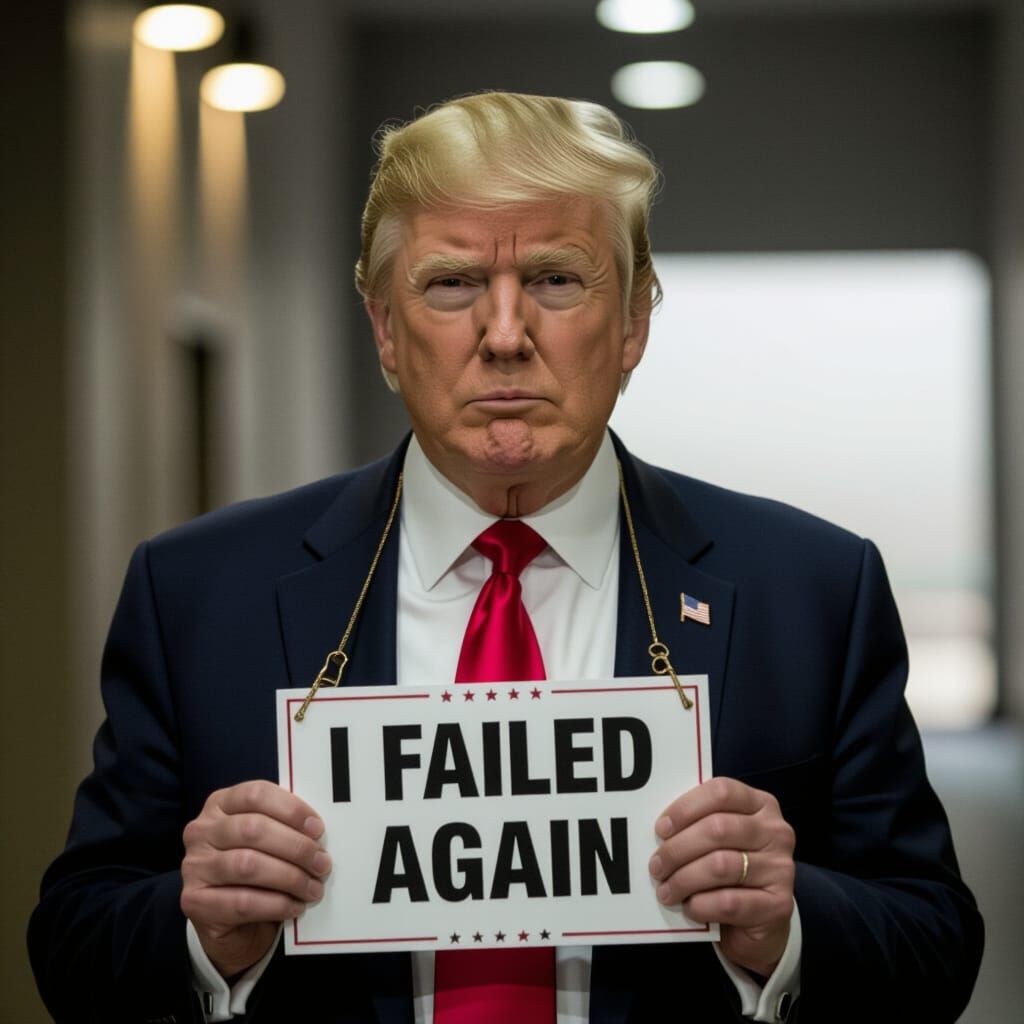
“I know how to fail: Trump Taj Mahal, Trump Plaza, Trump Castle, Trump Marina, Trump World’s Fair, Trump Entertainment Resorts, Trump Airlines, Trump Steaks, Trump Vodka, Trump Mortgage, GoTrump.com, Trump: The Game, Trump Magazine, Trump Ice, Trump Network, Trump University, Donald J. Trump Foundation, Trump Links Bronx, attempted coup, three marriages, repeated adultery, criminally convicted. I’m doing the same thing to America.”
As Trump’s fluctuating, at-whim tariffs and cruel deportations take effect, the impending recession in America seems increasingly certain. We only can hope it all results in a recession rather than a full-blown depression.
The issue is not solely Trump, though he is the instigator. A cowardly Republican Congress and a morally compromised Supreme Court are complicit in America’s certain decline. And when political and religious leadership loses all sense of decency, we the people follow.
The fascism, the at-will deportations, the criminal incompetence of Trump and his hires and thugish associates, the pardons of lawbreakers, along with Trump’s own criminality, the bigotry, hate-mongering and overall lack of morality, all add up to a formerly great nation in decline.
There was a time when Americans wondered how Germans could have supported a fascist psychopath like Adolf Hitler. Now, we wonder no more. The only difference is that Hitler was smarter than Trump is, and he hired smarter people than Trump has.
But ultimately, as the dictator becomes increasingly unstable and those around him fear speaking out, the government descends into criminal chaos. Even if decency ever prevails, this process may take a long time, as seen in Russia, North Korea, China, Cuba, and other dictatorships.
It is possible that Trump’s poor health and the absence of qualified individuals to succeed him could be our salvation.
Global Government Debt Surges Past $97 Trillion Mark The tariffs, initially a cause of concern for financial markets, are now being viewed as a crucial element of Washington’s financial stability.
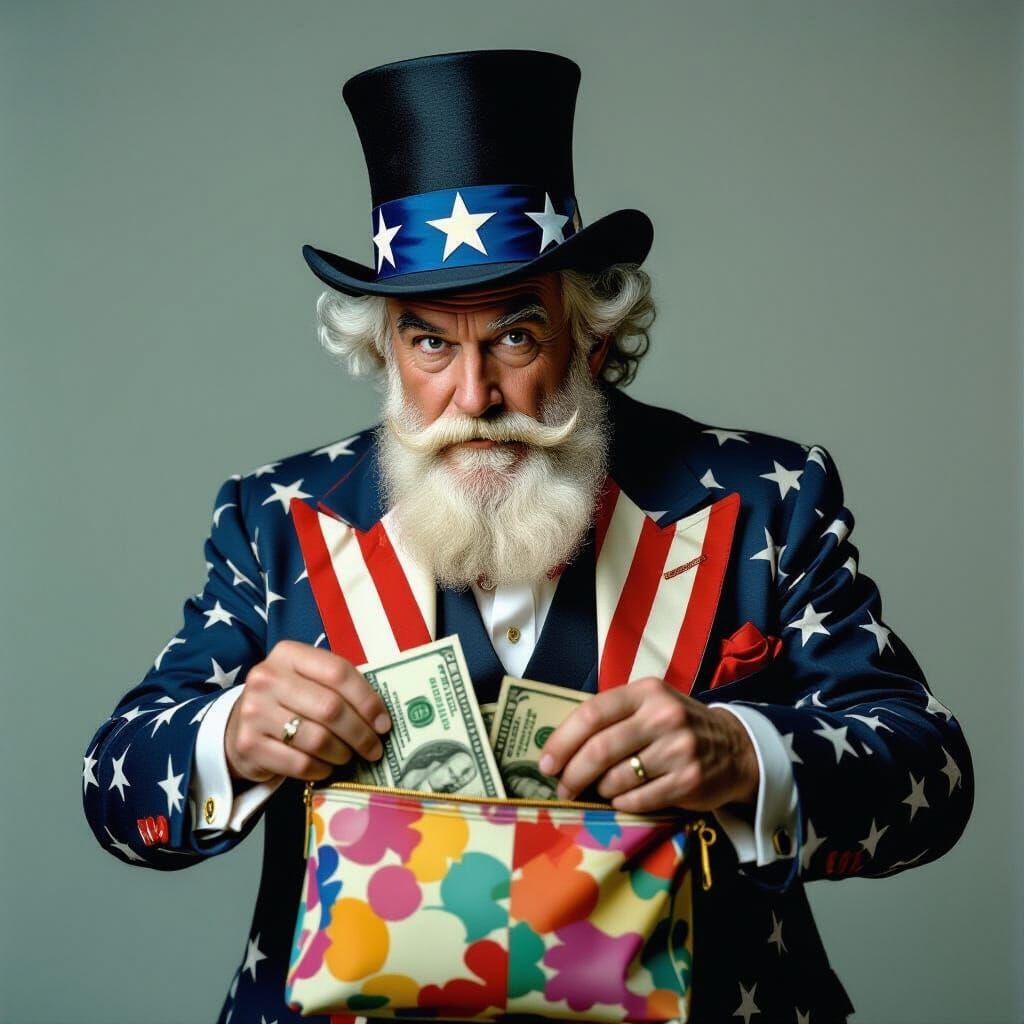
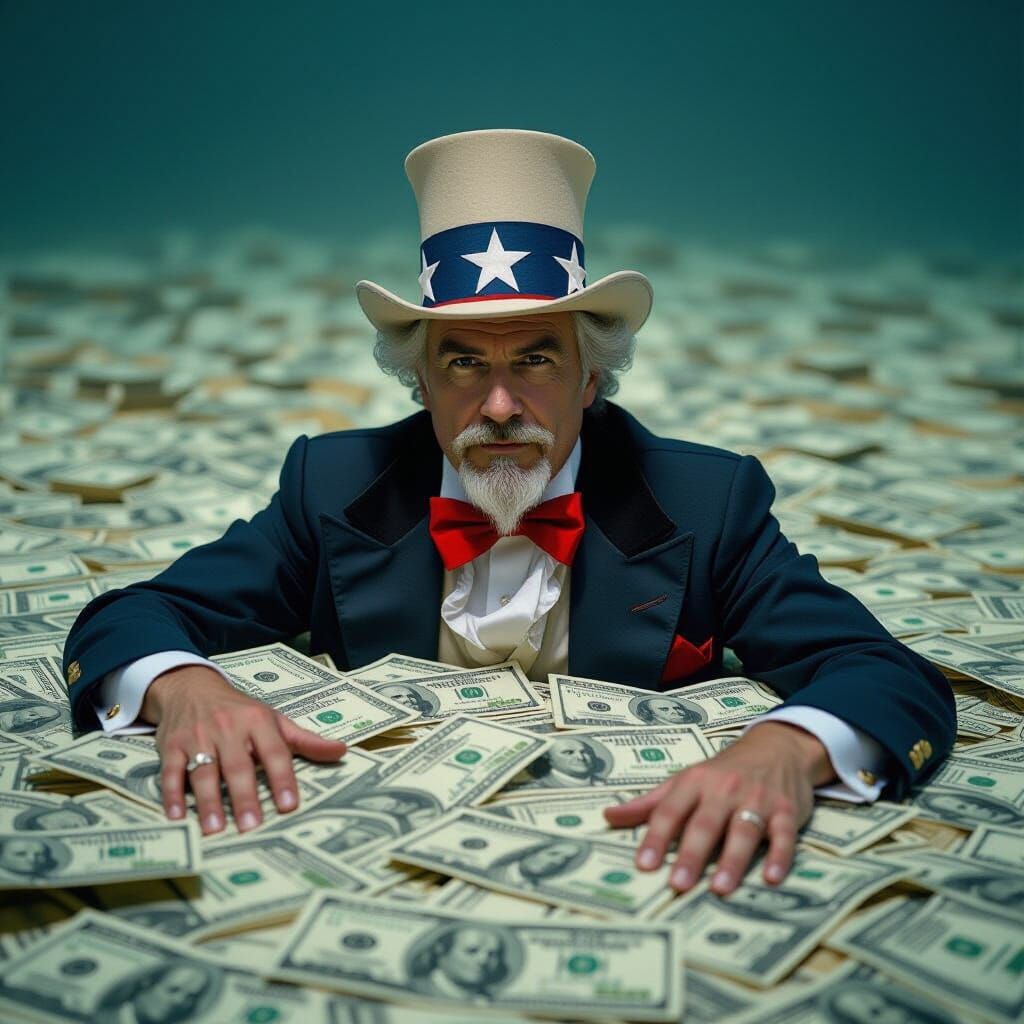
I’ll just take a bunch of these. I need them more than you do. Trust me.
This shift in perspective has helped the U.S. avoid the worst of the recent government bond market sell-off, reported The Washington Post.
As government debt continues to rise in developed economies like the U.K., France, and Japan, investors are seeking higher yields on long-term bonds issued by these countries.
Notice that the article lumps together three nations, two of which are Monetarily Sovereign and one of which (France) is monetarily non-sovereign.
Grouping the finances of those three nations is like serving the same menu to a carnivore and a vegetarian.
France does not have a sovereign currency. It uses the euro, over which it has scant control. France can run short of euros.
The U.K. and Japan have sovereign currencies. They cannot run short of their currencies.
In fact, the article makes no mention of Monetary Sovereignty, though that is the single most important factor to consider when determining appropriate spending.
Global government debt has surged past $97 trillion—double its 2010 level—driven by pandemic-related spending and recovery measures, outpacing corporate and household borrowing, according to the Institute of International Finance.
Despite the U.S. public debt reaching a record $30 trillion, investors have remained relatively optimistic about U.S. treasuries. The yield on the 30-year Treasury bond briefly neared 5% this week but has risen far less than shorter-term government securities.
Gosh, I don’t know how I ever will pay my debts.
A key factor is the Congressional Budget Office’s forecast that tariffs will generate about $3.3 trillion over the next decade, helping ease worries about an otherwise fragile fiscal outlook.
Translation: A key factor is the Congressional Budget Office’s forecast that federal taxes will generate about $3.3 trillion, the bulk of this revenue coming from U.S. consumers.
The so-called “financial boon” means that a nation (the U.S.) that has infinite dollars (because it’s Monetarily Sovereign) will receive money (it neither uses nor needs) from its economy (which both needs and uses money).
The article’s author, Namrata Sen, terms taking dollars from the economy (which is what taxes do), as a “financial boon.” Why?
Because when the government sends more dollars into the economy than the economy sends to the government, this wrongly is called a federal “deficit,” and the total of “deficits” is “public debt.”
We more accurately should call it an economic “boon” or private sector “income.”
Tariffs Seen As Key To Easing US Fiscal Concerns The tariffs have managed to reassure investors, with the U.S. economy’s robust performance and the potential for a Federal Reserve interest rate cut further bolstering the appeal of U.S. treasuries.
Somehow, increased taxes (aka “tariffs”) have “reassured investors” that . . . what? The United States Government, having the infinite ability to create dollars, will be able to pay its dollar-denominated bills?
Does this make any sense?
I’m going to help American business by taking dollars from consumers. How’s that for a plan?
Priya Misra, a bond portfolio manager at J.P. Morgan Asset Management, stated, “The U.S. is outperforming because actually our [budget] deficit is marginally better with tariffs. Forget the economic justification of tariffs. It is raising a lot of revenue.”
“Marginally better” seems to describe the federal government sending fewer dollars into the economy than it takes out of the economy. How is that “better”?
Moreover, investors seem assured that the president would invoke alternative legal powers to reinstate any overturned tariffs, ensuring that revenue from import duties continues to flow into government coffers, opined Evan Brown, from UBS Asset Management.
Mr. Brown celebrates tariffs, which are taxes on imports — taxes paid by American buyers — flowing into government “coffers” (which do not exist).
Because the government can create as many dollars as it wants by pressing computer keys, it does not have or need any “coffers.” It pays all its bills by generating new dollars as needed.
Former Federal Reserve Chairman Alan Greenspan: “A government cannot become insolvent with respect to obligations in its own currency. There is nothing to prevent the federal government from creating as much money as it wants and paying it to somebody. The United States can pay any debt it has because we can always print the money to do that.”
Fake Trade Deficits
There are so-called “trade deficits” that actually are equivalent exchanges. They work like this:
Foreign nations send us products that require the expenditure of their precious labor and materials. In exchange, we send them dollars that we create by pressing a few computer keys. Who has the better deal?
Consider even private sector purchases, where you are the buyer. Unlike the federal government, you can’t create dollars by pressing computer keys.
When you “trade” with your local grocer, do you think of it as running a trade deficit? Should you pay a tax to make your groceries more expensive, so that you will be forced to buy less?
The Better Alternative
The claimed purpose of tariffs is to make imports more expensive so that Americans will prefer to purchase locally produced goods.
Is that what you want — to pay higher prices?
If the goal is to support local businesses, there is a better way. Instead of the government taking money from your pockets by increasing import prices, how about the government supporting local businesses and putting dollars into your pockets?
Here are examples of federal support for American businesses – support that unlike tariffs costs American consumers nothing.
1. Corn, wheat, soybean, cotton, and rice farmers receive direct payments, amd crop insurance subsidies. 2. Dairy and sugar industries also benefit from price guarantees 3. Oil, gas, and coal producers have long received tax breaks (like depletion allowances) and infrastructure support. 4. Solar and wind companies benefit from production tax credits, investment tax credits, and loan guarantees. Tesla and other EV makers get tax credits and grants. 5. Nuclear power has been subsidized through federal research, loan guarantees, and waste management programs. 6. Airlines received large subsidies during COVID (the CARES Act) and occasionally after crises (post-9/11). 7. GM and Chrysler received bailouts during the 2008–2009 financial crisis. Shipping & railroads: Subsidized through federal infrastructure spending and grants. 8. Big banks received massive bailouts in 2008–2009 (TARP program). 9, Federal Reserve liquidity programs benefit financial institutions during downturns. 10. Defense contractors (Lockheed Martin, Boeing, Raytheon, etc.) receive tens of billions annually in contracts—effectively subsidies. 11. Semiconductor industry—CHIPS and Science Act (2022) provides $52B in subsidies to companies like Intel, TSMC, Samsung. 12. Drug companies receive NIH research funding, purchase guarantees (e.g., COVID vaccines for Pfizer, Moderna, J&J), and Medicare/Medicaid reimbursements that keep sectors afloat. 13. Tax deductions for mortgage interest and real estate depreciation benefit landlords and developers. 14. The fishing industry receives subsidies for boat fuel and fleet modernization. 15. The telecommunication industry receives rural broadband subsidies
In short, nearly every major sector of the economy has federal support at some point. Keep in mind: Federal spending costs taxpayers nothing. The government does not spend tax dollars.
One ot the two purposes of federal taxes is to control the economy by giving tax breaks to what the government wishes to encourage. (The other purpose is to assure demand for the U.S. dollar.)
Supporting American businesses through this approach is much more effective than using tariffs, and it costs nothing.
The Only Way to Prevent/Cure the Coming Recession (or Depression)
As Trump’s inconsistent tariff policy and harsh deportation policy take effect, we will have a recession, but more probably a depression.
To prevent that unnecessary disaster, the federal government should:
Teach Americans that federal deficits and debt are necessary and beneficial to the economy, are not paid for by taxpayers, and do not threaten federal solvency.
The purpose of federal taxes is not to provide the government with funds for spending, but to regulate the economy and support American businesses.
United Airlines’ frequent flyer deficit in 2024 was $298 million, bringing the total frequent flyer debt to $7,441 billion. This is a ticking time bomb.
The $7.4 billion in frequent flyer debt is yet another stunning reminder of the terrible state of United’s finances. Spending miles and receiving miles are woefully out of balance – to the tune of nearly $3 million annually and rising – and instead of addressing this imbalance, United keeps choosing to make things worse.
Except this is all nonsense.
It’s a lift from an August 12, 2025, article by the Committee for a Responsible Federal Budget (CRFB), which is a regular fountain of nonsense. Here is precisely what the CRFB article said.
“The gross national debt hitting $37 trillion is yet another stunning reminder of the terrible state of federal finances. Spending and revenue are woefully out of balance – to the tune of nearly $2 trillion annually and rising – and instead of addressing this imbalance, Congress keeps choosing to make things worse.”
There are direct parallels between United Airlines’ frequent flyer miles and U.S. federal deficits and debt:
1. Infinite Issuer
United: Can issue as many miles as it wants. There is no operational limit.
Federal Government: Can issue as many dollars as it wants. There is no operational limit.
(Federal Reserve Chairman Ben Bernanke: “The U.S. government has a technology, called a printing press or, today, its electronic equivalent, that allows it to produce as many U.S. dollars as it wishes at essentially no cost.”)
Neither needs to “get” miles or dollars before creating them. Dollars and mileage credits are not physical; they both are nothing more than bookkeeping notations.
2. Deferred Redemption (a.k.a. “Debt”)
United: When miles are awarded but not yet redeemed, they show up as a liability (“deferred revenue”) — in 2024, that was $7.441 billion.
Federal Government: When the Treasury spends more than it taxes, the difference (the so-called “debt”) is really just outstanding government securities — promises to accept back the dollars it created in the first place. Both a dollar bill and a T-bill are dollar-denominated obligations of a government that can make an infinite number of dollars.
In both cases, these “debts” are just obligations to honor the thing the issuer itself controls.
3. Deficit as Ongoing Flow
United: Each year, miles created exceed miles redeemed — a “miles deficit.” But that’s precisely what keeps the program alive and attractive. If miles were never made in excess, the system could not function.
Imagine what would happen if United were to demand that its customers give back more miles than they received — similar to the federal government running a surplus. The entire system would collapse, just as the economy collapses when the government runs a surplus.
Depressions and Recessions Begin With Federal Surpluses
1804–1812 48% 1807 Depression began in 1807
1817–1821 29% 1819 Depression began in 1819
1823–1836 99% 1837 Depression began in 1837
1852–1857 59% 1857 Depression began in 1857
1867–1873 27% 1873 Depression began in 1873
1880–1893 57% 1893 Depression began in 1893
1920–1930 36% 1929 Depression began in 1929
1947–1948 3.6% 1949 Recession began in 1949
1969–1970 3.4% 1970 Recession began in 1970
1997–2001 15% 2001 Recession began in 2001
Federal Government: Each year, dollars spent typically exceed taxes collected — a “fiscal deficit.” But that’s precisely what keeps the private economy supplied with net financial assets. Without it, economic growth stagnates, and we experience recessions or depressions.
4, Control over Rules and Laws
United has complete control over all the rules about the use of its mileage credits.
The federal government has complete control over all the laws about the use of dollars.
5. Not a Threat
United’s miles: Nobody worries that a growing balance of unredeemed miles will bankrupt the airline. In fact, the mileage program is the airline’s largest profit center. (The airline loses money on flights.)
Redemption is completely under United’s control; it determines how mileage points are used, and predictable breakage occurs. Additionally, United can always issue more points if it wishes.
Federal “debt”: Likewise, it’s not a threat to the U.S. government. The federal government has the infinite ability to pay debts, interests or any other financial obligation denominated in dollars. The danger comes only from artificial limits (e.g., debt ceiling politics), not from the mechanics of issuing dollars.
IN SUMMARY
United’s “mileage debt” is not a financial danger to United. It is a profit center. Likewise, the federal “debt” is not a financial danger to the government. It is a profit center for the economy.
United’s mileage program and the government’s deficits are artifacts of accounting terminology, not solvency constraints. Both have minimal cost and are highly profitable — the former for the airline and the latter for the economy.
The danger isn’t in the numbers—it’s in the myths we build around them.United Airlines’ mileage program and federal finances. United has an infinite supply of mileage credits; the government has an endless supply of dollars. The supply of mileage credits and dollars is entirely controlled by their issuer.



 #Monetary Sovereignty - Mitchell