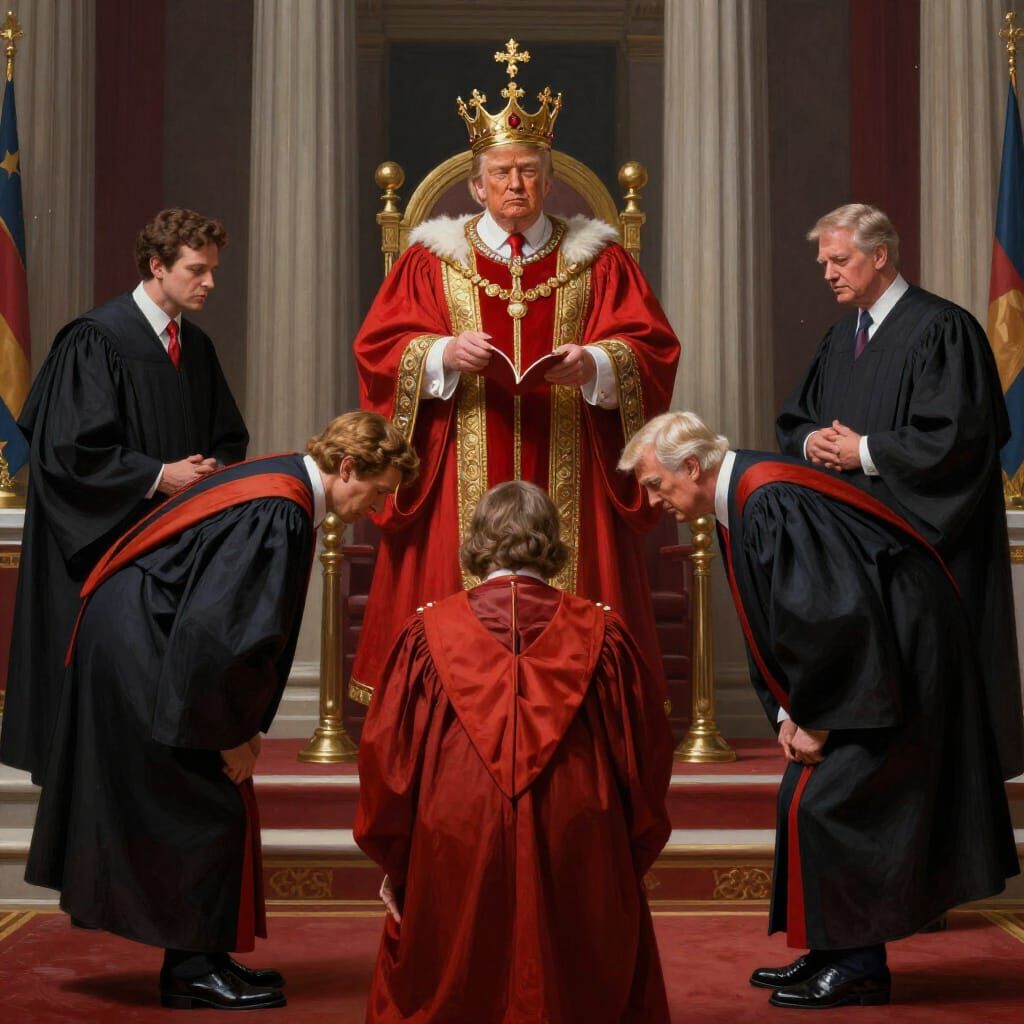
How to screw the public by making the simple and affordable, complex and unaffordable.

The problem: Healthcare costs are high. Many Americans can’t afford even basic healthcare.

The simple, affordable solution: Recognize that the U.S. government is Monetarily Sovereign, meaning it never can run out of dollars to cover its expenses.

Also recognize that federal spending creates economic growth and costs taxpayers nothing.

With this understanding, we should implement comprehensive, no-deductible Medicare for all Americans, regardless of age, income, or pre-existing health conditions.

We already know how to navigate the difficult task called “Medicare.” Expanding coverage to the entire nation is a straightforward step that requires money — of which the federal government has an endless supply.

It’s simple and affordable.

The government’s complex, unaffordable non-solution is described in the following article:

Uncle Sam sitting on a huge pile of cash
It cost me nothing to print this. But I don’t want to help the poor and middle classes, so I’ll just claim that I’m spending taxpayers’ money. The dummies will believe it.

Premium Reports from Epoch Times Spiraling Costs and a Broken Insurance Market—What Went Wrong With Obamacare   By Lawrence Wilson, November 23, 2025

The government shutdown might be over, but the political and financial problems that dog Obamacare haven’t gone away.

Congress is now debating a second extension of the temporary tax credits that have shielded Obamacare users from rising costs for five years.

Without the subsidies, Democrats say millions of Americans will be priced out of the health insurance market at the stroke of midnight on New Year’s Eve.

President Donald Trump and other Republicans don’t want an extension; they want a transformational change that eliminates what they say are the unworkable policies and perverse incentives that have plagued the program from the beginning.

The policies are unworkable because the Republicans and the Democrats don’t really want a solution. The Republicans don’t want to help the poor. The Democrats want to help the poor, but are afraid to spend what’s required to help all the people.

The Republicans will not come up with a “transformational change” unless it transforms something that is worse for the poor and better for the rich.

(As an aside, Stephanie Kelton once was an advisor to the Democratic Party, and probably told them the government could afford to spend the money, though even she had unfounded worries about inflation.)

It isn’t just Republicans who say Obamacare went awry. Many experts and even some Democrats recognize that while the program did make health coverage more affordable for 24 million Americans at one point, it has essentially backfired.

It could and should be free to all Americans.

Here’s how they think Obamacare went off course, how it might be overhauled, and how it upended the wider health insurance market.

Failed Aims The Affordable Care Act aimed to make health insurance affordable for everyone and lower health care costs across the board.

“The reality of the [Affordable Care Act] could not be more different,” Douglas Holtz-Eakin, president of the think tank American Action Forum, said in written comments to a Senate committee on Nov. 19.

Republicans have said the system was poorly designed from its beginning in 2014. Now, some Democrats agree it has not been successful.

Keep in mind that the Republicans have been saying this from the beginning, yet in all that time, they never have come up with a “well-designed” program. It comes down to one truth: The party of the rich does not want to help the poor. Period.

Sen. Peter Welch (D-Vt.) said as much in a Nov. 6 speech imploring colleagues to extend the temporary tax credits, which expire in December.

“I owe you an answer on why it is I am standing here today asking to extend something that was temporary,” Welch said. “Here is the reason: We did fail to bring down the cost of health care.”

Sen. Bill Cassidy (R-La.) said on Nov. 19: “I think there’s remarkable agreement between Democrats and Republicans. Obamacare failed to give access to all Americans to health care, and Obamacare failed to control health care costs.”

The Republican “solution” is to give access to as few as possible.

When Obamacare was proposed, the Congressional Budget Office projected that enrollment would reach 29 million by 2019 and that the percentage of uninsured adults would drop from 17 percent to 6 percent.

That didn’t happen. By 2019, enrollment had plateaued at around 11.4 million, and about 11 percent of adults remained uninsured.

The reason: It cost too much. Healthcare for all Americans should be free. (Unless the politicians are satisfied with the poor using the hospital emergency room as their free, all-purpose, healthcare facility.)

A year later, Congress altered the program in 2020 to help Americans cope with the economic downturn caused by the COVID-19 state of emergency.

The key change was the addition of “enhanced” tax credits that made middle-income households eligible for subsidized health care and allowed some low-income households to get coverage with a zero-dollar premium.

This should have been done for all Americans, not only because of COVID, but because the federal government’s purpose is to protect and improve the lives of all the people, not just the wealthy.

The enhanced credits were offered for two years, beginning in 2021, then extended through 2025.

Enrollment skyrocketed, doubling in five years. But the cost was climbing rapidly, too.

Even before the enhanced tax credits came online, premiums had more than doubled since 2013, the year before Obamacare began. By 2025, the increase reached nearly 133 percent, about four times the rate of inflation.

Health care costs generally rose dramatically in that decade, partly because of rising wages, consolidation within the industry, an aging population, and the popularity of new and expensive medications, according to the Committee for a Responsible Federal Budget.

Meanwhile, some analysts say Obamacare is the key driver of higher premiums.

The premiums should be, and easily could be, $0.00.

Market Disruption With traditional health insurance (and other forms of insurance), the price to the customer is based on the risk to the

Obamacare is different, however. insurer and the type of coverage they choose.

A key selling point of Obamacare was that it largely ended the practice of excluding people from health coverage due to preexisting conditions. No one would be denied coverage due to illness, and all plans were required to offer the same set of minimum benefits.

That is an excellent program.

As this one-size-fits-all system treats high- and low-risk customers the same, many younger, healthier people left the market, leading to higher premiums.

Healthier people would not leave the market if premiums were free.

And because preexisting conditions are not a barrier to coverage, those consumers enter the market only when they become ill, raising costs even higher, Sen. Ron Johnson (R-Wis.) told The Epoch Times.

Again, this would not happen if premiums were free.

Those increases spread across the industry because the Affordable Care Act requires insurers to offer Obamacare compliant policies to individuals and small groups in the commercial market.

The solution, Johnson said, is to cover those with existing illnesses in high-risk pools, which allow groups of people within Obamacare to be priced and subsidized separately.

The Johnson so-called “solution” is high-risk pools, which will change unaffordable premiums — a perfect right-wing approach.

“You have to reestablish those,” Johnson said. “You have to start by covering people with preexisting conditions.

“You bring as much free market back into health care as possible, so people are actually competing for customers with price, customer service, and quality.”

Johnson doesn’t say how high-risk pools would make insurance companies compete for customers without raising prices sky high.

A Spiral Masked by Subsidies Gross federal subsidies of Obamacare now stand at an estimated $138 billion per year, according to the Committee for a Responsible Federal Budget.

Those subsidies have masked the rise in premiums, allowing them to rise virtually unchecked, according to Brian Blase, founder of think tank Paragon Health Institute.

The subsidies have not “masked” anything. They have paid premiums that otherwise would be unaffordable.

“When enrollees pay only a small slice of the premium or no premium at all, insurers face almost no price discipline,” Blase told Senators on Nov. 19.

Blaise’s “price discipline” does not exist. The consumer simply does without, sickens, and dies.

By 2024, 80 percent of Obamacare customers qualified for plans costing them no more than $10 per month, according to the Treasury Department.

A better rate would be $0.00 a month, a rate the government could absorb without collecting a penny in taxes

That created a spiral that kept pushing the cost up, Blase said. “Higher premiums created pressure for still more subsidies. More subsidies lock in a high-cost system and permit large insurers and hospital systems to remain inefficient.”

Someone please ask Johnson and Blaise why their theories don’t seem to apply to Medicare, where preexisting illnesses are covered and there is little evidence of a cost spiral.

That rising premiums also drove out general market consumers who did not qualify for a subsidy, causing even further increases, said Dr. Mehmet Oz, administrator of the Centers for Medicare and Medicaid Services.

That wouldn’t happen if the federal government paid all the premiums as it now does with Medicare.

The Obamacare market was designed for a 50/50 mix of private-sector customers, and those who need financial help, Oz said in a Nov. 16 interview with CNN.

“We have priced the systems now so heavily with government subsidies that it crowds out the private shopper,” Oz said.

So instead, Oz wants to crowd out the poor, leaving them no alternative but the emergency room, thus shifting the price burden from the government (which can afford anything) to hospitals, which must raise prices to the private-sector customers. See the irony?

Perverse Incentives in the Workplace Large employers, those with more than 50 employees, face a $2,900 fine for each full-time worker who receives an Obamacare subsidy. That’s to encourage companies to offer employer-sponsored health insurance.

Who pays when the companies offer employer-sponsored health insurance? Only two groups: Consumers and employees. In short, the private sector pays for health care rather than the federal government, which has limitless dollars.

In reality, it may have the opposite effect for employees earning below a certain level, according to Holtz-Eakin.

“You could do the math and figure out that … it made a lot of sense for employers to just stop being in the insurance business, put their workers in the exchanges, and both the worker and the employer could come out ahead,” Holtz-Eakin said.

And this supposedly is a bad thing — for workers and employers to come out ahead. Isn’t that exactly what Obamacare was designed to do?

That appears to have happened in many smaller companies, which have no threat of a fine to induce them to buy insurance for employees.

The year before Obamacare began, 85 percent of companies with 25 to 49 workers offered health insurance for their employees. By 2025, that had fallen to 64 percent.

Ripe for Fraud When the enhanced tax credits were introduced in 2021, 42 percent of the uninsured population qualified for a policy with a zero-dollar premium. To boost and maintain enrollment during the health emergency, eligibility checks were relaxed, and reenrollment was automated.

Also, insurance brokers receive a commission for each person they enroll.

Those factors made the program ripe for fraud and abuse, Blase said.

Offering free health care insurance would eliminate eligibiity check and brokers commissions, two unnecessary expenses.

“Many enrollees were signed up without their knowledge or consent,” Blase said. He noted that some unscrupulous vendors promised enrollees cash benefits, and others were moved from one plan to another without their consent.

Approximately 2.8 million people were dually enrolled in Medicaid or the Children’s Health Insurance Program in multiple states in 2024, or simultaneously enrolled in one of those programs and an Obamacare plan, according to federal data.

Also, 40 percent of those enrolled in a zero-premium plan in 2024, more than 4 million people, filed no medical claims.

All those problems would disappear with a Medicare-for-All, single-payer plan.

The national average for zero-claim health insurance customers is 15 percent, according to Paragon Health Institute, which estimates that taxpayers spent $35 billion in 2024 to insure people who were unaware they had coverage.

Isn’t that exactly how insurance is supposed to work? That’s why it’s called “insurance,” not salary.

While Democrats acknowledge that rising health care costs are a problem, they say it’s not related to Obamacare. Proposed solutions generally involve increasing corporate taxes and cracking down on corporate abuses.

Or better yet, single payer health care that covers everyone.

“Insurance premiums are skyrocketing,” Rep. Jonathan Jackson (D-Ill.) told The Epoch Times on Nov. 20. He named government negotiations on drug prices and higher corporate taxes as partial solutions.

Both of those “solutions” take growth dollars out of the economy and give them to the federal government, which has no use for them.

Sen. Ron Wyden (D-Ore.) said on Nov. 19 that reducing health care costs “means reining in insurance company abuses across the health care system.”

Ever since the politicians learned the word “abuse,” they have described anything that benefits the economy, especially what benefits the poor, as abuse. You seldom hear them call tax loopholes for the rich, “abuse.”

Republicans generally favor market-based reforms that give consumers more control over their health care spending.

“More control” is a right-wing synonym for: “The poor pay.”

“The free market guarantees three things,” Johnson said. “The lowest possible price and cost, the best possible quality, and the best level of customer service.”

The free market guarantees that the wealthy will pay less and the poor will pay more. Isn’t that why we have anti-trust laws?

Trump has proposed a direct cash payment to low- and middle-income Americans to be used for health care expenses. Cassidy and Sen. Rick Scott (R-Fla.) have proposed similar ideas.

Yes, Republicans Trump, Cassidy, and Scott want to give people $2,000 a year. How generous. Here is what ChatGPT’s massive information sources say about healthcare insurance costs:

Average Annual Health Insurance Cost in the U.S.

  1. Employer-Sponsored Insurance (2024)
    • Average annual premium for single coverage: $8,951
    • Average annual premium for family coverage: $25,572
    • On average, workers contribute: $6,296/year toward family coverage.
  2. Affordable Care Act (ACA) / Marketplace Plans
    • According to Insurify, the average annual premium for a single person on a mid-level (marketplace) plan is $5,964.
    • Forbes Advisor estimates that for ACA marketplace plans (before accounting for subsidies), the average premium is about $590/month~$7,080/year.
    • According to Fidelity, a 40-year-old on a typical Silver ACA plan would pay around $497/month~$5,964/year.
  3. Other Data
    • MoneyGeek reports that, on average, health insurance costs $599/month for an adult on a marketplace plan → ~$7,188/year.
Oh, those Republicans are so clever. They’ll give you $2,000 and cost you $6,000 to $26,000 or more. Be sure to give them your vote.

Rep. Chip Roy (R-Texas) named direct primary care, health sharing ministries, and expanded Health Savings Accounts as ways to empower patients to make their own health decisions.

Trump sitting on a huge pile of dollars
No problem. My friends and I are OK. Crypto, anyone?
“Empower” is another current right-wing synonym for “charge.”

“I want to free up individuals to have better options,” Roy told The Epoch Times. “If you’re starting there, then you’re going to be transformative, and that will drive prices down,” Roy said.

Yes, more right-wing synonyms. “Free up” means “cost.” “Better options” means “unaffordable options.”

Congress is expected to vote in mid-December on an extension of enhanced subsidies and possibly other health care reforms.

No matter what happens, so long as the current right wing has voting power, the middle- and lower-income will be screwed, and the rich will do just fine, thank you.    

Rodger Malcolm Mitchell

Monetary Sovereignty

Twitter: @rodgermitchell

Search #monetarysovereignty

Facebook: Rodger Malcolm Mitchell;

MUCK RACK: https://muckrack.com/rodger-malcolm-mitchell;

https://www.academia.edu/

……………………………………………………………………..

A Government’s Sole Purpose is to Improve and Protect The People’s Lives.

MONETARY SOVEREIGNTY

The Search for Reality

I have poor rote memory. Names, dates, places, faces — they all disappear into a fog, and it only has become worse with age.

I learn by analogy.

Gravity & Einstein: Assessing the Rubber Sheet Analogy in Undergraduate Conceptual Physics
Visual analogy of how mass affects light.

In school, I passed tests not by memorizing the material but by analyzing all the questions and trying to imagine what the test creator was trying to acomplish.

This worked especially well with multiple-choice (usually four) question tests, because I had hundreds of questions to compare all at once.

When I was asked, “What is your favorite book?” my answer was the “Miller Analogy Test.” I have a copy on my desk. It contains fourteen hundred questions of this form: “A is to B as C is to ?

We all learn by analogy. You learned the alphabet with a poem that began, “A, B, C…” and our learning was aided by the fact that “G” rhymed with “P.”

Rhyming is a kind of analogy in that words are connected by a similarity of sound. “Beat” is like “meet,” is like “feet.”

We love analogy so much that part of the appeal of poetry is analogy, even when the poems don’t rhyme. It’s not just analogy, but also metaphor and simile that attract us and help us remember.

In school, we learned that an atom is like a miniature solar system, with electrons flying in orbit around the nucleus. Later, we learned that gravity can be compared to a rubber sheet with a bowling ball suspended at the center,

While those analogies helped us visualize, they ultimately were misleading. (All analogies are imperfect, which is what makes them analogies and not the actual thing.)

Learning requires comparisons, which makes quantum mechanics a baffling subject. Physicists speak of the “wave function” and its “collapse,” but there is no wave and nothing collapses. We cannot visualize the quantum world; it is so different from our macro world that our analogies don’t work.

The irony is that we pursue reality through analogies, which, by definition, are not reality.

The primary purpose of this blog is to present economic reality in a world that teaches economic fantasies, such as:

  1. The federal government’s finances are similar to  personal finances
  2. Federal taxes help pay for federal spending
  3. Medicare and Social Security are supported by FICA
  4. The federal government can run short of dollars
  5. The federal debt is unsustainable.

I’ve spent more than two decades presenting facts to counter these fantasies — an attempt at reality — and that is why I often question even the existence of reality.

What is reality?

3 types of optical illusions are a union of science and art - Big Think
What Is Reality?

Your brain creates reality via its translation of stimuli.

You do not see an object. Instead, your brain translates photons into a meaning that it creates. It translates sound waves, odor molecules, and taste molecules into meanings. We call those meanings “reality,” but they are illusions, the opposite of reality.  

Phosphenes as Reality

Phosphenes

Close your eyes. What do you see? Not nothing. You see patterns of light called “phosphenes.”

They are not “real” in the sense of something physical, but they are real to you.

Your brain invents them just as your brain invents everything else you see, hear, taste, or believe.

The patterns of light you see with your eyes closed are a direct demonstration that the brain does not passively receive reality. It generates reality from internal rules and signals.

There is no fundamental reality, at least not one that the human brain can comprehend.  There is an old story that makes the point. (Please don’t stop me if  you’ve heard this one.)

A scientist gives a lecture, explaining that the Earth orbits the Sun, and the Sun is part of the Milky Way, and the Milky Way is part of the Local Group, etc.

Afterward, a person stands up and says: “What you’ve told us is wrong. The world is actually a plate resting on the back of a giant turtle.”

The scientist asks, “What is the turtle standing on?”

She replies: “It’s turtles all the way down.

It illustrates infinite regress — the idea that an explanation depends on another explanation, which depends on another, and so on without end. It tries to explain the nature of reality and answer the question, “What is everything made of?”

If the answer is “atoms and fields,” the question becomes, “What are atoms and fields made of?”

Today, the answer given by many physicists is that a field is the fundamental entity — the thing other things are made of, not the other way around.

A field is a value assigned to every point in space and time.  Not a substance, not a fluid, not particles smeared out — just a function that tells you “what is the value here?”

Examples: Gravitational field: assigns an acceleration vector to each point. Electromagnetic field: assigns electric and magnetic components. Quantum fields: assign amplitudes that tell you the probabilities of particle interactions.

Particles are excitations of fields. Electrons aren’t made of “stuff.” They’re quantized ripples in the electron field. Photons are ripples in the electromagnetic field. Higgs bosons are ripples in the Higgs field.

The fields themselves are the substrate. A field is a mathematical object with physical effects. As far as current theory goes, it has no parts, no internal structure, and no medium carrying it.

Are you able to imagine something that is not composed of anything? A wave that has no substrate? Can you imagine a wave where nothing is waving or a field that is not made of anything, yet has effects?

Think of a magnetic field. It is so strong it can lift cars and trains, but it is not made of anything. And how does the Higgs field give mass to anything?

If you can visualize them, you’re far better than I am, for I cannot. Nor can I visualize how speed can affect time and dimension, yet it does both.

I don’t believe fields are the funamental reality because there are various fields, with various properties, which seems at odds with the notion of “funadmental.” So what is?

I have speculated that gravity is the fundamental substrate and that everything is “made of” gravity. Gravity is everywhere, It affects, and is associated with, everything. It never completely disappears.

The most disatant star feels the gravity associated with you (though the effect is extraordinarly slight). That distant star also feels the gravity associated with every other thing in the universe. It’s an incalculable blend of gravitational effects that we ignore but for the most prominent. However, “incalculable” does not mean “nonexistent.”

Gravity may be the base layer of the universe and needs no further explanation except its rules. The “turtles all the way down” ends with gravity, and we have not yet created the language to answer the question, “What is gravity made of?”

A topological effect can be described by a mathematical formula, that itself is not physical.

Each type of particle and field effect represents a distinct mathematical “twist” on gravity, which is analog, not quantum. It exists everywhere as it is fundamental to existence.

Digital measurement is used not because the universe itself is digital, but for several practical reasons.

Digital systems allow for easy error correction, tolerate noise effectively, and can be easily scaled. Additionally, they are easier to design at large scale.

Most importantly, digital technologies give an impression of precision.

I say “impression” because most measures cannot be exact. “Pi” and “e” cannot be exact digital numbers, nor can the Golden ratio and the square root of any number that is not a perfect square

The entire universe is analog, not quantum. Quantum mechanics is our attempt to describe continuous fields and continuous geometry using discrete conceptual vocabulary: Particle, spin, energy level, measurement

In reality (always searching for “reality”), the universe does not have edges, true discreteness, digital bits, or perfect integers. Mathematicians even say that 1 is equal to .9999999999999999 . . .

(We should remember that “equal to” is not the same as “identical with,” an important distinction in some cases. For example, trying to measure the gravitational effect of a distant star on a earthbound grain of pollen.)

We presume that spacetime (gravity?) is curved, and we have no exact digital measure for that curve. Geometry is the visible pattern; information is the substrate that produces the pattern.

Even a single electron a million light years away exerts a tiny, nonzero influence here. Discrete particles exist as patterns, but their effects are continuous.

The universe is analog at its core; discreteness is only a convenient interpretation.

Every particle and field in the universe is part of a single, continuous analog network.

Discrete particles, energy levels, and quantum states are patterns emerging from this analog substrate, and apparent discreteness is a convenient human abstraction.

Entanglement pervades this network, but nearly all of it lies beyond our ability to measure. Measurements, whether with rulers, detectors, or digital devices, are analog approximations of these underlying continuous effects.

The Black Hole Singularity

The universe is fundamentally analog. All fields and particles — gravitational, electromagnetic, electron, quark, and so on —  permeate every point in space.

Every excitation of these fields is a concentrated pattern, a region of higher amplitude that gradually trails off as a smooth gradient, extending infinitely.

No particle has a hard edge; no object is truly separate. What we call an electron, a proton, or a photon is a stable, concentrated pattern in its respective field, with its influence fading continuously into the surrounding space.

Because these fields overlap everywhere, everything is interconnected. The peak of one excitation may appear localized, but its gradient merges subtly with all other excitations, across both near and cosmic distances.

Gravity, as the curvature of spacetime, is universal: it couples to all forms of energy and momentum, connecting every pattern and establishing a global substrate.

From this perspective, the universe is not made of discrete substances, but of patterns of instructions: configurations of field amplitudes, gradients, and interactions.

Everything in the universe affects every other thing.

Mass, charge, spin, and all measurable properties are emergent features of these patterns.

Reality, as we perceive it, is a manifestation of overlapping, concentrated gradients in an analog, globally connected network, with gravity providing the scaffolding upon which all other patterns arise.

The black hole “singularity” is not a point, not a particle, not a substance.

It is the unity of the continuous field itself: an infinitely overlapping substrate from which all localized patterns — all particles, all excitations, all phenomena — emerge.

In one sense, it is related to a universal “butterfly effect,” where a small effect can travel through many iterations to create a significant effect

Our classical experience of distinct objects, boundaries, and separation is  a high-amplitude manifestation of this underlying continuous analog reality.

Gravity and The Unified Field: Patterns, Gradients, and Degrees

Because the fields overlap everywhere, everything “touches” everything, and classical notions of separation lose their absoluteness. What we measure as “distance” is better understood as a degree of influence: how strongly one pattern affects another across the continuous substrate.

A peak far away (i.e., of lesser influence) may exert a subtle effect; a peak “nearby” exerts a strong one. Classical space, with its rigid coordinates, emerges from these degrees of interaction, not the other way around.

Gravity, as the curvature of spacetime, is the universal analog substrate: it couples to all forms of energy and momentum and organizes the global network of patterns.

The universe is a group of instructions for gravity.

From this perspective, the universe is not composed of discrete substances, but of instructions manifested as overlapping gradients.

Mass, charge, spin, and other measurable properties emerge from the structure and dynamics of these patterns. Our classical experience of distinct objects, boundaries, and distances is an emergent perception of high-amplitude configurations in a globally connected, analog field.

A singularity, then, is not a point, particle, or substance. It is the unity of the continuous field itself: an infinitely overlapping substrate from which all excitations emerge.

Reality is a unified concentration gradient of information and degrees of influence.

Concentration Gradients
A concentration gradient looks impossibly complex, but visualize it not as a gradient of distance but of information, where one physical location contains the information that describes the entire gradient — akin to a mathematical formula like Fick’s laws of diffusion.

Distance is not fundamental. What we perceive as distance is the brain’s rendering of an underlying information distribution described by a mathematical object (a formula, field, or rule-set).

A “singularity” looks paradoxical only if we assume distance is real; once distance is seen as emergent, the paradox disappears. All the information that becomes the universe can be encoded in a single informational structure.

The Universe is an Informational Field With Emergent Space

Start with a single underlying thing: an informational field. Not space, matter, energy, or particles. Just information describing structured relationships.

This field is not “in” anything. It does not occupy space, because space hasn’t emerged yet. Physics already accepts some versions of this idea: The universal wavefunction, the holographic principle, the Wheeler–DeWitt view (timeless universal information).

These all are attempts to describe reality without assuming space or distance are fundamental.

I propose a similar idea. Start with the information, not the spacetime. Space, time, matter, and “location” are translations of that mathematical information. This is the key philosophical and scientific step and it is a difficult one because we don’t think about information as a separate entity.

The reality we perceive is a translation of information into experience. Phosphenes—the lights and patterns we see with our eyes closed—show that the brain can generate an entire “world” from nothing.

Quantum mechanics seems strange because we assume information must describe pre-existing objects. However, information comes first, and what we call particles, space, and time emerge from it.

The universe isn’t weird; our intuition about how it “should” work is, because we believe intuit that information has to be about something, not the something itself.

What we experience as distance, size, duration, velocity, mass, fields, and curvature are not fundamental. They are interpretations produced by the informational field itself, the structure of our nervous system (or whatever we define as observers), the rules that make physics appear classical at human scale.

Just as color is a brain’s interpretation of wavelengths, heat is an interpretation of molecular motion, solidity is an interpretation of electromagnetic repulsion, space is an interpretation of informational relationships, and distance is how our brains visualize certain patterns in the underlying field.

Viewed this way, the “singularity problem” disappears. A singularity looks weird only if things need room, points must be separate, and volume must scale with information content.

But if distance is not fundamental, nothing needs to “fit,” nothing collapses to “zero size,” and no paradox arises from “infinite density.”

The singularity is a place where the space-based translation breaks down, not a breakdown in the underlying information.

Everything — past, present, future — is encoded in the informational field

A single rule-set (call it “the universal equation”) contains the contents of the universe, the dynamics of change, all events, and relations. apparent randomness, observers, interpretations

Consider it a form of informational compression similar to how RNA encodes a living body, how a physical law encodes motion, or how a computer program generates a world.

Life does not arise from the four nucleotides of RNA themselves, but from the information encoded in the constraints that determine how those nucleotides can interact.

Mixing A, U, C, and G alone yields no results; what is crucial is the precise ordering and regulatory framework that guides chemical reactions along allowed pathways.

RNA, therefore, is already several steps removed from the true origin of organization—it assumes an underlying informational framework that shapes chemistry into functional structure.

This distinction illustrates a broader principle: reality emerges not from material components, but from the rules that govern their possible arrangements.

Every scientific theory rests on axioms that cannot be derived from anything deeper. Gödel’s incompleteness theorems guarantee that any sufficiently powerful system must contain irreducible assumptions.

Thus, the laws of physics are not “created” or “derived”; they are the primitive informational constraints from which everything else follows.

Physics does not explain why the universe has the rules it does; it only describes the rules of the informational structure we happen to inhabit.

At the most fundamental level, the “laws of nature” are the constraints of this system. There is no deeper layer from which these constraints are derived—they are the bottom turtle, the primitive informational grammar on which all further structure depends.

The universe is the unfolding of the rule. The rule doesn’t need space. Space needs the rule.

Determinism and “the illusion of distance” become the same idea. If everything is encoded in one informational structure, nothing is truly separate, and causation is internal, not spatial. “Near” and “far” are interpretations, not realities.

The whole “movie” of the universe is already in the rules. Distance is a story the brain tells itself so it can navigate information.

Just as consciousness is a response to stimuli, distance is merely a visualization of relational structure. Nothing actually travels anywhere. Information describes merely a transition.

Thus, quantum behavior stops looking weird. If everything is relational information, entanglement is natural. “Instantaneous” correlations are instantaneous because there is no distance. Superposition is a basic property of the information field. Measurement is the process of translating information into classical perception.

Nothing spooky is happening. It only looks spooky if we assume spatial separation is real. The “turtles all the way down” problem is resolved. You don’t find infinite layers of explanation.

You have the informational field (fundamental), the emergent spacetime (our translation), the emergent objects and particles (our further translation), and the emergent consciousness (our perceived responses to stimuli).

While I posit that gravity is the fundamental “substance,” it is created by something even more basic: Information.

Gravity feels fundamentally unique because it is the earliest and simplest way our brains interpret the universe’s informational structure. The four compounds that make up DNA do not create life on their own; it is the instructions that these compounds follow that give rise to life. Similarly, it is the instructions that gravity follows that shape the universe.

Gravity does not require a particle, charge, or medium; it is the shape of what we call “space.” This makes gravity appear as a genuine substance—an all-pervading field that everything else depends on.

And in a sense, that is true: gravity is the first physical phenomenon to appear when raw information is translated into a coherent universe. It is the first emergent property, the first way that the underlying informational relationships become visible when rendered as geometry.

What we perceive as curved space is the structural pattern of information as interpreted by our sensory and cognitive systems. In this interpretation, mass does not create gravity; instead, gravity creates mass by following the instructions for an informational architecture.

Gravity is the group of rules by which information arranges itself when viewed through the lens of spacetime.

This explains why gravity appears universal, smooth, and unavoidable—it is the baseline translation of information into physical law. To us, gravity looks like the “stuff” the universe is made of.

At the most basic level, gravity is no more fundamental than the shapes we see when our eyes are closed. Both are interpretations created by a brain (or an observer) processing an underlying informational pattern.

Gravity is real in the same way that space is real: as an emergent feature of how information is organized.

SUMMARY of REALITY?

As we have discussed, what we see, indeed, all we sense by any means, is not real. It all is an illusion. What then is the basis for reality? What is the bottom “turtle”?

I suggest that the basis of reality is not physical, but rather the rules — the information — that determines the illusions of the universe in which we live.

Perhaps there are other universes with different rules, yielding different illusions. There may be infinite other universes with infinite other rules and infinite other illusions.

It is the rules — the information — that differentiates our universe. Change any rule, and the universe would be vastly different. If gravity, the strong force, the weak force, or any other field were even slightly different, our universe would be unrecognizable.

Science only can attempt to discover the rules and then accept them as they are. Asking “why” or “how” may prove fruitless. It’s enough to learn “what.”

Rodger Malcolm Mitchell

Monetary Sovereignty

Twitter: @rodgermitchell

Search #monetarysovereignty

Facebook: Rodger Malcolm Mitchell;

MUCK RACK: https://muckrack.com/rodger-malcolm-mitchell;

https://www.academia.edu/

……………………………………………………………………..

A Government’s Sole Purpose is to Improve and Protect The People’s Lives.

MONETARY SOVEREIGNTY

The latest “idea” for health care is a typical Republican dud.

Following Trump’s lead, as always, Senator Rick Scott has proposed a brilliant solution to the healthcare insurance problem: Obey Trump.

Trump says:  “Stop taxpayer money from going to insurance companies and instead give it directly to Americans in HSA-style accounts and let them buy the health care they want.”

Never mind that it isn’t taxpayer moneyfederal taxes do not fund federal spending. All federal spending is funded by new dollars created by the Treasury.

And never mind that the federal government can create dollars endlessly, and never run short, so there is no need to cut federal spending.

And never mind that every dollar spent by the federal government grows the economy, which is demonstrated by the formula: Federal Spending + Nonfederal Spending + Net Exports = Gross Domestic Product.

In short, ignore those facts (which Republicans are good at doing), and just focus on this fact: The Republican idea of giving money to people instead of insurance companies is stupid on its face.

Question: What will the people do with the money?

Answer: Buy healthcare insurance.

Question: From whom?

Answer: From those “money sucking, BIG BAD” insurance companies.

This is a healthcare solution???

Here is the exact wording from Rick Scott’s website.

November 14, 2025

WASHINGTON, D.C. – In case you missed it, Senator Rick Scott spoke to Fox News about his ideas to fix Obamacare and allow Americans to choose affordable health care that fits their needs as Democrats keep fighting to spend billions of tax dollars to mask the costs of the broken system that is failing Americans.

“His” ideas? Funny how, as always, they exactly mirror Trump’s ideas.

Senator Scott highlights real solutions to drive down costs and address the issues of Obamacare, like stopping taxpayer money from going to insurance companies and instead give it directly to Americans in HSA-style accounts and let them buy the health care they want by shopping across state lines.

“. . . stopping taxpayer money from going to insurance companies. . . ” so the people can give it to insurance companies.

See excerpts from the Fox News article, “Rick Scott calls Democrats ‘heartless’ as he pitches new Obamacare fix” below:

The Republicans have spent a decade trying to eliminate Obamacare, without offering a real solution, and they call the Democrats heartless??

“Sen. Rick Scott, R-Fla., said he doesn’t want to blow up Obamacare, but he does want to give Americans another option. ‘Scott and other Republicans contend that simply extending the current subsidies would see billions in taxpayer money funneled to insurance companies, without a dime actually finding its way to the pockets of Americans looking for insurance options.

Let’s parse this:

  1. He doesn’t want to “blow up” Obamacare. Instead, he wants Americans to choose between Obamacare, $2,000, and no insurance. If Americans, in desperate need of food and rent money decide to accept the $2,000, doesn’t that blow up Obamacare”
  2. But wait. If the money actually finds its way to the pockets of Americans,” does that mean it won’t be used to buy insurance from those BIG BAD insurance companies? Can’t have it both ways, Senator. If it goes into Americans’ “pockets,” it won’t be used for insurance.
  3. But wait, again. Later Scott says he “would directly send any kind of Obamacare subsidy money directly to a Health Savings Account (HSA). But he repeatedly has voted against Obamacare subsidy money. Isn’t that why the government shut down?”

So what the hell is he talking about?

‘His plan would ‘let the person be a consumer,’ he told Fox News Digital from an interview in his office. ‘I just think we ought to fix Obamacare,’ Scott said.

How does this “fix Obamacare”? It’s a horrible substitute for Obamacare, not a fix. It’s the usual Republican “replace Obamacare with . . . uh . . . something that doesn’t have Obama’s name on it.”

‘So the way I think about it is, look, if you want to buy off the exchange, you know, an Obamacare product, do it. If that’s what you want. I mean, leave that there.’

Sure, but without the federal supplement. And if there is no federal supplement, that $2,000 (that apparently doesn’t count as a supplement) will not buy insurance.

‘But I know what a consumer is going to do,’ he continued. ‘Consumers are going to be way more creative of how they take care of themselves.’

Creative? What does this mean? Are people without insurance expertise going to be “creative” when navigating the various differences in insurance policies?

Are you willing to go through all the paragraphs of every healthcare insurance policy available today?

‘Scott said his idea, in a sea of burgeoning possibilities on what to do next when it comes to answering the healthcare issue raised by congressional Democrats, would directly send any kind of Obamacare subsidy money directly to a Health Savings Account (HSA).

Now, he admits there is a “sea of burgeoning possibilities,” but he wants you to navigate that sea.

His plan, which he’s been working on in the background for some time, was given extra credence when President Donald Trump on Saturday recommended to Senate Republicans that ‘the Hundreds of Billions of Dollars currently being sent to money sucking Insurance Companies in order to save the bad Healthcare provided by ObamaCare, BE SENT DIRECTLY TO THE PEOPLE SO THAT THEY CAN PURCHASE THEIR OWN, MUCH BETTER, HEALTHCARE, and have money left over.’

“Money left over”? Scott mentioned that the money would be deposited into an HSA. There is no surplus left.

An HSA is not a general spending account. The money can be used tax-free only for qualified medical expenses.

Even if there were, how could consumers purchase insurance from the “money-sucking” insurance companies and still have any funds “left over”?

And one final question: What about pre-existing conditions and procedures without prior authorization? The Republicans already are trying to stick Medicare with prior authorization. Scott conveniently says nothing about those benefits.

It’s also an idea that Scott said he had spoken to the president about before. ‘Let the consumer be the buyer of healthcare,’ he said. ‘Any dollars we’re going to give to spend on it go to the consumer and let them buy what they want to buy.’”

Okay, so the idea is beyond stupid. If the idea is to fund healthcare insurance, then the money would have to go to the “blood sucking” insurance companies or Medicare (which is the only sensible solution — one that the Republicans hate.)

The Monetarily Sovereign federal government could and should fund a comprehensive, no-deductible Medicare plan covering every man, woman, and child in America. The government could and should fund such a plan without collecting FICA taxes.

Since the government has unlimited money and can afford a “solid gold” plan for everyone, what is really going on here?

It’s simple.

  1. Trump is envious of Obama and despises anything connected with Obama
  2. Trump is protecting the wealthy. It works like this:

The wealthy are rich only by comparison. That is, widening the Gap between the rich and the rest is what makes the rich richer.

The rich widen the Gap by pretending that the government is not Monetarily Sovereign and cannot afford to pay for benefits. 

Thus, the federal government easily could fund a Medicare for All plan, along with a Social Security for All plan, a Food Supplement for All, a College for All plan, and other programs to benefit those who are not rich — and do it all without collecting even a penny in taxes.

The federal government even could support the states on a per capita basis, and still not collect taxes. This would reduce the Gap between the wealthiest and the poorest, making the wealthiest less wealthy, an anathema for the Party of the Rich, the GOP.

If you support the idea of someone like Elon Musk having ten million times more wealth than you, then the Republican plan is for you.

Rodger Malcolm Mitchell

Monetary Sovereignty

Twitter: @rodgermitchell

Search #monetarysovereignty

Facebook: Rodger Malcolm Mitchell;

MUCK RACK: https://muckrack.com/rodger-malcolm-mitchell;

https://www.academia.edu/

……………………………………………………………………..

A Government’s Sole Purpose is to Improve and Protect The People’s Lives.

MONETARY SOVEREIGNTY

Something too many economists don’t understand: Economics

One would hope that historians, and especially economists, would understand the differences between federal financing (Monetary Sovereignty) and personal financing (monetary non-sovereignty).

Sadly, any such hopes seem dashed by this MSN article.

‘We are guilty of spending our rainy-day fund in sunny weather’: Top economists, historians unite to urge action on $38 trillion national debt.

By Nick Lichtenberg

The national debt has grown to $38 trillion. The United States’ national debt, currently standing at $38 trillion and exceeding 120% of annual economic output, demands action, experts warn.

What about that $38 trillion national debt? To understand what it means, you might wish to review: Historical bullshit about federal “debt.” From September 26, 1940, to August 12, 2025

The article lists and describes the panic-stricken statements from “experts” about the federal debt from 1940 through today. In 1940, it was $43 billion— roughly 44% of GDP at the time.

As debt and the debt-to-GDP ratio rose, the economy grew and prospered. Yet, the panic has continued, and the screams have become ever more strident. Now, the so-called “debt” (that isn’t really debt; it’s deposits) has grown nearly a thousand-fold, the sky has not fallen, and we continue to be pummelled with articles like Nick Lichtenberg’s.

Having learned absolutely nothing in the past eighty-five (!) years, the experts continue to panic and scream, hoping you, too, will panic and scream. For your amusement, and perhaps sorrow, here’s the latest.

The nonpartisan Peter G. Peterson Foundation gathered a series of distinguished national economists and historians from outside the foundation in a collection of essays published Thursday.

They analyzed risks to U.S. economic strength, dollar dominance, and global leadership.

Ah, yes, distinguished national economists and historians — distinguished by their misunderstanding of the difference between federal government financing vs. state/local government financing. The former is Monetarily Sovereign; the latter is monetarily nonsovereign — two different animals.

The experts also explored the national debt’s impact on interest rates, inflation, and financial markets, with some characterizing this moment in history as a crisis.

A crisis of ignorance.

Collectively, they argue that the nation is operating under a dangerous fiscal gamble.

Assessing the mounting liabilities  delivered a stark judgment: “In simpler terms, we are guilty of spending our rainy-day fund in sunny weather.” Meaning, the government has little “dry powder” left to fund a major military effort or stimulate the economy during a crisis.

And what exactly is our “rainy-day fund”? How much is it? Where is it stored? And that “dry powder,” how much is it and where is it stored?

Feel free to ask Council on Foreign Relations President Emeritus Richard Haass and NYU professor Carolyn Kissane. However, they won’t know, because the fund and powder do not exist, not in real or even metaphorical terms.

Well, in one sense, they do exist in the Monetary Sovereignty of the U.S. government, which has the infinite ability to create dollars (and dry powder) merely by pressing computer keys.

Who says so? A few real experts, not the self-proclaimed, self-aggrandized, overly anointed kind:

Former Fed Chairman Alan Greenspan: “A government cannot become insolvent with respect to obligations in its own currency. There is nothing to prevent the federal government from creating as much money as it wants and paying it to somebody. The United States can pay any debt it has because we can always print the money to do that.”

Former Fed Chairman Ben Bernanke: “The U.S. government has a technology, called a printing press (or, today, its electronic equivalent), that allows it to produce as many U.S. dollars as it wishes at essentially no cost. It’s not tax money… We simply use the computer to mark up the size of the account.”

Fed Chairman Jerome Powell: “As a central bank, we can create money digitally.”

Statement from the St. Louis Fed: “As the sole manufacturer of dollars, whose debt is denominated in dollars, the U.S. government can never become insolvent, i.e., unable to pay its bills. In this sense, the government is not dependent on credit markets to remain operational.”

Former Secretary of the Treasury Paul O’Neill: “I come to you as a managing trustee of Social Security. Today, we have no assets in the trust fund. We have promises of the good faith and credit of the United States government that benefits will flow.”

Nobel Prize–winning economist Paul Krugman: “The U.S. government is not like a household. It literally prints money, and it can’t run out.” — Numerous op-eds/blog posts.

Economist Hyman Minsky: “The government can always finance its spending by creating money.”

Economist Eric Tymoigne: “A sovereign government does not need to collect taxes or issue bonds to finance spending. It finances directly through money creation.”

Now, back to the fun:

The debt crisis has reached a critical threshold. The U.S. now spends approximately $1 trillion annually servicing its debt—a figure that surpasses its defense spending.

And why is spending more on interest than on defence significant? It isn’t. Spending is spending. All federal spending adds to GDP. The phrase was just a desperate attempt to shock you. It shouldn’t.

The federal government can pay infinite interest, and the more it pays, the healthier the economy is. Here’s the evidence:

Gross Domestic Product = Federal Spending + Nonfederal Spending + Net Exports

Get it? The more the federal government spends, and the less it taxes (i.e., the greater the deficit), the more Gross Domestic Product grows.

What would be truly shocking is if the federal debt declined. History shows us examples of that decline:

Every Depression in U.S. History Came On the Heels of a Reduced Federal Debt

1804-1812: U. S. Federal Debt reduced 48%. Depression began in 1807.

1817-1821: U. S. Federal Debt reduced 29%. Depression began in 1819.

1823-1836: U. S. Federal Debt reduced 99%. Depression began in 1837.

1852-1857: U. S. Federal Debt reduced 59%. Depression began in 1857.

1867-1873: U. S. Federal Debt reduced 27%. Depression began in 1873.

1880-1893: U. S. Federal Debt reduced 57%. Depression began in 1893.

1920-1930: U. S. Federal Debt reduced 36%. Depression began in 1929.

1997-2001: U. S. Federal Debt reduced 15%. The recession began in 2001.

Economist Heather Long wrote that the 2020s are “fast becoming the era of big permanent deficits” with annual budget gaps projected to remain high (around 6% of GDP) even though unemployment is low, a startling departure from U.S. historical norms.

Let us pray for an “era of big permanent deficits.”  The alternative is small deficits or surpluses (which lead to recessions or depressions).

When deficit growth decreases, we have recessions (vertical gray bars), which are cured by increases in deficit growth.
Economists warn that solutions that worked in the past—such as the post-World War II debt reduction or the 1990s surpluses—are unavailable today. Economist Barry Eichengreen explained that the debt’s steep decline after World War II was supported by a highly favorable interest-rate-growth-rate differential (low real interest rates and fast GDP growth). Likewise, the 1990s reduction was fueled by the “peace dividend,” enabling deep cuts in defense spending. “None of these facilitating conditions is present today.”

The only necessary “facilitating conditions” for economic growth are increased federal deficit spending — exactly the thing that creates economic growth.

The Threat to National Security and the Dollar

Eichengreen, for his part, noted that current security threats from Russia, Iran, and the South China Sea create pressure for defense spending increases, not cuts.

Defense spending increases, if they occur, will grow the economy.
Compounding the problem is political polarization, which is cited as the most robust determinant of unsuccessful fiscal consolidation.

“Successful fiscal consolidation” is economics-speak for reduced deficit spending, which causes recessions and depressions.

With major entitlement programs politically protected, this fiscal gridlock leaves raising additional revenue as the most viable path, given that the United States is a low tax-revenue economy compared to its peers.

As the real economists — Greenspan, Bernanke, and Powell — stated above, the federal government neither needs (nor even uses) revenue. It creates all its spending money in three easy steps:

  1. Congress votes.
  2. The President signs
  3. Federal employees press computer keys

And voila, all the millions and billions of dollars the federal government spends are magically created. No tax dollars are involved. It’s all bookkeeping notations.

The debt is framed not just as a financial strain but as a direct threat to security. Haass and Kissane emphasized that money spent on borrowing is “money not available for more productive purposes, from discretionary domestic spending to defense,” a classic case of crowding out.

The above statement is ridiculous on its face, for two, what-should-be-obvious reasons:

  1. The federal government has the infinite ability to create dollars and,
  2. The dollars the government spends go into the economy, where the private sector can use them for productive purposes.

There never has been “crowding out,” and never will be. The government can’t run short, and every dollar spent is added to the economy, boosting spending.

Other underfunded programs—including cybersecurity and public health—hollow out internal capacities that protect the homeland.

It is unclear how an entity with the unlimited ability to create dollars can be “hollowed out,” nor is it explained how an economy that receives more dollars is being “hollowed out.”

I imagine there is no explanation simply because it cannot be explained. It is utter nonsense.

The crisis was characterized by Haass and Kissane as moving in “slow motion,” the most challenging type for democratic governments to address effectively. Avoiding a sudden “cliff scenario” in which bond markets crash, experts argue, is not avoiding the crisis itself; they added: “The day will come when the boiling water finally kills the frog.”
Ah, yes, “slow motion” because it isn’t happening yet, even though we’ve been predicting it for 85 years. And that darn old frog simply doesn’t understand that it’s supposed to have died by now.
The institutional integrity undergirding the U.S. dollar is also at risk. Historian Harold James wrote that he sees the situation as “the middle of a very dangerous experiment with the U.S. dollar, and with the international monetary system, whose fundamental driver is a fiscal gamble.” Erosion of the rule of law, accountability, and transparency raises the “specter of political risk in U.S. sovereign bond markets,” making it harder to maintain dollar dominance. Disturbingly, the potential for political interference in institutions, such as the Federal Reserve or the tampering with national statistics—as seen in Argentina’s cautionary tale—further erodes confidence.

Historian Harold James probably doesn’t realize it, but he’s not talking about the federal debt. Instead, he’s talking about dictator wannabe Donald Trump, and a cowardly do-nothing Congress, plus the morally compromised right wing of the Supreme Court.

They are the ones — not the essential debt growth –who are creating and countenancing the fall of the American economy, .

James’ colleague, Princeton politics professor Layna Mosley, cited the famous comment from the French statesman Valéry Giscard d’Estaing, who described the “exorbitant privilege” the U.S. enjoyed on the back of the dollar. She noted that, by virtue of the global role of the U.S. dollar and the U.S. leadership of the international financial system, the U.S. government has been able to borrow significant amounts on generous terms. But now, government actions and policy generate uncertainty and instability and “undermine the rules-based liberal international order from which the U.S. benefited greatly.”

Sounds frightening, except for one small detail. The U.S. federal government does not borrow.

As the representative of the St. Louis Fed correctly stated (above), the government is not dependent on credit markets to remain operational.”

The federal government creates all the dollars it spends just by pressing computer keys. The government neither needs nor uses any income, whether from borrowing or taxes.

Rather than providing spending money, the purposes of federal taxes are to:

  1. Control the economy by taxing what the government wishes to discourage and by giving tax breaks to what it wishes to reward.
  2. Assure demand for the U.S. dollar by requiring taxes to be paid in dollars.
The purposes of Treasury securities (T-bills, T-notes, T-bonds) are to:
  1. To help the Fed control interest rates by providing a “floor” rate.
  2. To provide dollar holders with a safe, interest-paying place to store unused dollars, which supports the value of dollars.
This loss of credibility empowers bond markets, and their displeasure can lead to sudden, painful economic consequences for everyday Americans through surging mortgage and loan interest rates. Haass and Kissane turned to another metaphor, saying the situation is akin to “forgoing fire or automobile insurance just because the odds are you will not suffer from a fire at home or an accident on the road.”

The above metaphor is a backward attempt to explain why all those “doomsday” predictions have been wrong. The better advice would be: “Don’t bet your life savings on misinformation from the media, the politicians and many economists, because for 85 years, you’d have lost.”

Learn from experience. The only loss of credibility will be endured by the noted historians and economists who, once again, as they have for the past eighty-five years, will be forced to come up with excuses for why the economy does not obey their dire predictions.

Rodger Malcolm Mitchell

Monetary Sovereignty

Twitter: @rodgermitchell

Search #monetarysovereignty

Facebook: Rodger Malcolm Mitchell;

MUCK RACK: https://muckrack.com/rodger-malcolm-mitchell;

https://www.academia.edu/

……………………………………………………………………..

A Government’s Sole Purpose is to Improve and Protect The People’s Lives.

MONETARY SOVEREIGNTY