How do Americans benefit from federal taxing of businesses?

Your visceral reaction to the following article may be anger that a wealthy corporation allegedly cheated on its taxes. You may be glad they were caught and now might have to pay the government $29 billion, plus penalties.

Or, perhaps not.

How a Maneuver in Puerto Rico Led to a $29 Billion Tax Bill for Microsoft
In the largest audit in U.S. history, the IRS rejected Microsoft’s attempts to channel profits to a small factory in Puerto Rico that burned Windows software onto CDs. by Paul Kiel, Oct. 13, 2023

A multiyear campaign to slash the IRS budget has left it understaffed and on the defensive. That’s been good news for tax cheats, the rich, and big corporations — but not for the poor.

What does “but not for the poor” mean? In what way are the poor harmed by Microsoft’s alleged cheating on its taxes? Let’s see if we can find the answer.

ProPublica is a nonprofit newsroom that investigates abuses of power. Sign up to receive our biggest stories as soon as they’re published.

In a long-awaited development, the largest audit in the history of the IRS has finally taken its next step. On Wednesday, Microsoft announced that the agency had notified the company that it owes $28.9 billion in back taxes, plus penalties and interest.

The case is epic not only in dollars but in scope. As ProPublica reported in an in-depth narrative in 2020, the IRS saw the case as a chance to prove the agency’s effectiveness.

Often cowed by the prospect of facing off against corporations with endless resources, the IRS set out to be bolder and more aggressive. It took the unusual step of hiring a corporate law firm to represent the agency, which incensed Microsoft. The company, along with others in its industry, responded by rallying allies in Congress to rein in the IRS.

In 2005, ProPublica wrote Microsoft “sold its most valuable possession — its intellectual property — to an 85-person factory it owned in a small Puerto Rican city.” Having struck a favorable tax deal with Puerto Rico, Microsoft then channeled its profits to the facility.

But earlier that same year, the IRS had set up a new unit to audit intra-company deals that sent U.S. profits to tax havens — deals that were especially common among tech companies like Google, Facebook, and Apple.

By the time ProPublica published its story on the audit in 2020, the two sides had sued each other, and one case had long been stuck in court. Almost three years after the last motions in the case, a ruling finally came down.

The judge sided with the IRS, writing, “The Court finds itself unable to escape the conclusion that a significant purpose, if not the sole purpose, of Microsoft’s transactions was to avoid or evade federal income tax.” He agreed with the IRS’ characterization of the deal as a tax shelter.

He wrote that the $29 billion that the IRS was seeking covered 2004 to 2013. He asserted, however, that the total, were the IRS to ultimately prevail, would be reduced by about $10 billion in taxes that Microsoft has already paid on its overseas profits.

A major feature of President Donald Trump’s 2017 tax bill was a requirement that companies repatriate those profits, though they paid a special, low tax rate when they did. Microsoft had stored up $142 billion in offshore profits by 2017.

The IRS attorneys who worked on the case believed it to be, by far, the largest U.S. audit ever, and the amount the IRS is seeking from Microsoft is several times larger than in any other publicly disclosed audit in the agency’s history. 

The case, in a way, is the last, great vestige of the IRS before it was gutted by budget cuts throughout the 2010s and corporate audits plummeted.

While the recent infusion of billions from the Inflation Reduction Act will allow the agency to rebuild itself in the coming years, the Microsoft case shows the fruit of those efforts could take a long, long time to reap.

Who are you rooting for, Microsoft or the IRS?

Consider these facts:

Congress’s “gutting” of the IRS left it struggling to prosecute big, money-rich firms for tax fraud because such effort requires huge manpower and many years of effort — neither of which has been affordable.

So, the IRS had to focus its efforts on smaller fish, like you and me, while the whales got away with paying at much lower rates.

Donald Trump, for example, paid $500 a year in taxes. Compare that with what you paid.

To be fair, much of his savings came from favorable tax laws rather than the tax cheating Microsoft allegedly did.

Either way, Congress has allowed the rich to pay a lower % of their income in taxes than the rest.

All tax dollars paid to the Federal government are destroyed upon receipt by the Treasury. (See: Does the U.S. Treasury really destroy your tax dollars? The Monopoly® answer. )

Federal taxes do not fund federal spending. The government pays all its bills by creating new dollars ad hoc.

Alan Greenspan: “The United States can pay any debt it has because we can always print the money to do that.”

Ben Bernanke: “The U.S. government has a technology, called a printing press (or, today, its electronic equivalent), that allows it to produce as many U.S. dollars as it wishes at essentially no cost.”

Federal taxes take dollars from the private sector, which impoverishes the economy. Federal deficits enrich the economy and facilitate economic growth.

If Microsoft pays the government the $29 billion claimed by the IRS, this will take $29 billion from the economy but do nothing to help the federal government pay its bills.

The government will not need to raise taxes to “make up” for the loss of $29 billion.

When ProPublica said that understaffing the IRS was good news for tax cheats “but not for the poor,” they could have meant two different things:

  • The government would be short of funds to pay benefits to the poor or
  • The IRS could focus on the poor, allowing the rich to skate.

The former is wrong. The federal government has infinite funds to pay for anything. The latter is correct, and the real purpose of understaffing the IRS is to make it easier for the rich to cheat on their taxes.

Why does the federal government collect taxes if it neither needs nor uses the dollars?

  1. To control the economy by discouraging what the government doesn’t like and giving tax breaks to what the government wishes to reward.
  2. To create demand for the U.S. dollar by requiring taxes to be paid in dollars.
  3. To help the rich become more prosperous by widening the income/wealth/power Gap between the rich and the rest.

What should be done?

Unlike state and local governments, the federal government is Monetarily Sovereign, meaning it has the infinite ability to create its sovereign currency, the U.S. dollar. It never unintentionally can run short of dollars.

Therefore, the sole legitimate purposes of federal taxes are numbers 1. and 2 above. The general public should not be subject to payroll (FICA) taxes or income taxes, as these only take growth dollars from the economy and do not fund anything.

Contrary to popular myth, FICA does not pay for Social Security or Medicare. The federal government creates the dollars to pay for these programs, just as it does for Congress, the President, the Supreme Court, the Military, and every other federal agency.

Because no public purpose is served by extracting dollars from America’s businesses, company profits should not be taxed.

One could theorize that taxing profits encourages corporations to invest in growth, but we’ve seen scant evidence that businesses are not already motivated to grow.

It’s doubtful that taking tax dollars from a business aids business growth.

The third purpose of federal taxes should be to lift the middle- and lower-income groups by taxing the rich more to narrow the Gap between the rich and the rest.

This would require eliminating the myriad tax breaks and loopholes afforded to the rich re-defining “income” to include every kind of wealth increase while dramatically increasing the lowest amount of income that could be taxed.



Where in America does the worst gun violence occur?

The Republican Party’s primary talking point regarding guns is that although cities run by Democrats have strong gun laws, they are riven with gun violence, proving that gun laws don’t work and have negative results.

As with so many right-wing conspiracy theories readily believed by MAGAs, this one is disputed by facts:

Instead of passing stronger gun laws, Republican leaders are choosing to weaponize the issue for political gain by using misinformation to stoke fears of “Democrat-controlled” cities.

In 2022, for example, after a shooter took the lives of 19 children and two teachers at Robb Elementary School in Uvalde, Texas, Gov. Greg Abbott (R-TX) claimed that gun violence in the cities of New York, Los Angeles, and Chicago is evidence that tougher gun laws are “not a real solution.”

Similarly, despite evidence that New York City actually has relatively low rates of gun violence when controlling for its size, in April 2023, Rep. Jim Jordan (R-OH) used his powers as the House Judiciary Committee chair to hold a field hearing on violent crime in Manhattan.

The purpose: To disrepute Manhattan District Attorney Alvin Bragg after Bragg brought charges against former President Donald Trump.

These examples demonstrate a larger coordinated effort by conservatives to make violent crime a “Democrat” issue while at the same time diverting attention from their own public safety failures to address gun violence, including neglecting to make it harder for individuals with violent intentions to obtain a gun.

Cities in blue states, based on how a state voted in the 2020 presidential election, are consistently safer from guns than cities in red states, regardless of which party is represented in city leadership.

From 2018 to 2021, red-state cities experienced larger increases in gun violence rates than blue-state cities. In 2023, blue-state cities are experiencing larger declines in gun violence rates than red-state cities.

Not only do blue-state cities on average experience lower rates of gun violence in each year of the study, but now, gun violence rates appear to be decreasing faster on average in these cities than in red-state cities.

Put simply, the data do not back up the blame-game politics of Republican lawmakers such as Texas Gov. Abbott and Rep. Jordan.

Gun violence is not a problem unique to large American cities. Rural communities, particularly in red states, are experiencing some of the highest rates of gun violence in the United States.

For example, from 2016 to 2020, 13 of the 20 U.S. counties with the most gun homicides per capita were rural.

None of the above should surprise any thinking person. The notion that giving every person permission to carry high-powered guns in public somehow is safer than restricting gun ownership is ridiculous.

By what logic does arming everyone with high-powered, semi-automatic, or automatic weapons make you safer?

A criminal is more likely to shoot you if you point a gun at him than if you don’t or if you shoot and miss.

Are you going to be able to shoot first when a “bad guy” confronts you on the street or even in your home? Will you instantly know your legal rights so you don’t go to jail for shooting first?

Yes, laws against some people carrying some types of guns won’t prevent all criminals from carrying any gun, just as laws against fraud don’t stop all fraud, and laws against assault and battery don’t stop all assault and battery.

It is people’s nature that some will break laws.

But does that mean we should eliminate all laws because some people break them?

Shall we eliminate laws against child rape because some adults rape children despite the laws? To borrow a phrase from the gun lobby, “If we outlaw speeding, only the speeders will speed.” 

We have many laws. Thick books filled with laws. And many of them are broken. But shall we burn all the law books?

Shall we not outlaw speeding because some people still will break the law and speed? Shall we not criminalize fraud because someone might break the law and create a fake university that bilks students. 

Shall we not have laws against tax fraud because someone will break that law by creating a fake foundation? Shall we not have laws against rape because some people will ignore the law and attack a woman?

Is the reason not to prevent some people from packing guns the fact that some people will break the law? Ah, but guns. Guns are somehow different. Guns only kill and maim. So, shall we not have laws outlawing certain guns or people carrying a gun because laws don’t work.

We outlaw drugs to prevent people from unintentionally committing suicide with drugs, yet guns constitute a significant suicide device, even more than being a murder device. But guns are “different.”

Red states have experienced higher murder rates than blue states every year from 2000 to 2020.

And the difference is not driven by gun violence happening disproportionately in large cities. Even when the largest cities in each red state are removed from the analysis, the overall murder rate is still percent higher than in blue states across that entire period.

From 2015 to 2022, cities in blues states saw an average gun homicide rate of 7.23 per 100,000 residents. In red-states cities, that rate was 11.1 per 100,000 residents—53 percent higher than the rate in blue-state cities.

Cities in states that voted for Joe Biden in the 2020 election consistently have the lowest rates of gun violence per 100,000 residents.

New York had only the 218th-highest rate of firearm-involved homicides per 100,000 residents. Similarly, Los Angeles was the 151st-ranked city, and 34 cities had higher rates of gun violence than Chicago.

While some leaders want to cherry-pick these three cities based on the media attention they garner as examples of failed policies to reduce gun violence, the reality is that seven of the top 10 cities regarding gun violence rates are in red states, not blue.

Although the gun-lovers claim the blue states have “strong” gun laws, the reality is that compared to the days before District of Columbia v. Heller, today’s laws are weak.

Heller was the case where the right-wing Supreme Court — the self-described”originalists” — decided the original 13 words of the 2nd Amendment didn’t mean what they clearly said (about a “well-regulated militia.”)

The originalist Supreme Court not only eliminated the “militia” but also eliminated the “well-regulated.” True originalists are left to wonder what those words originally meant. 

So that is the question for all originalists: What exactly did the Founding Fathers mean by “well-regulated,” and what did they mean by “militia.”

Today’s laws have been watered down to near meaninglessness. Today, any nut can carry almost any gun anywhere except in court.

(Why not in court? Because guns are too dangerous in court, though not too dangerous anywhere else.)

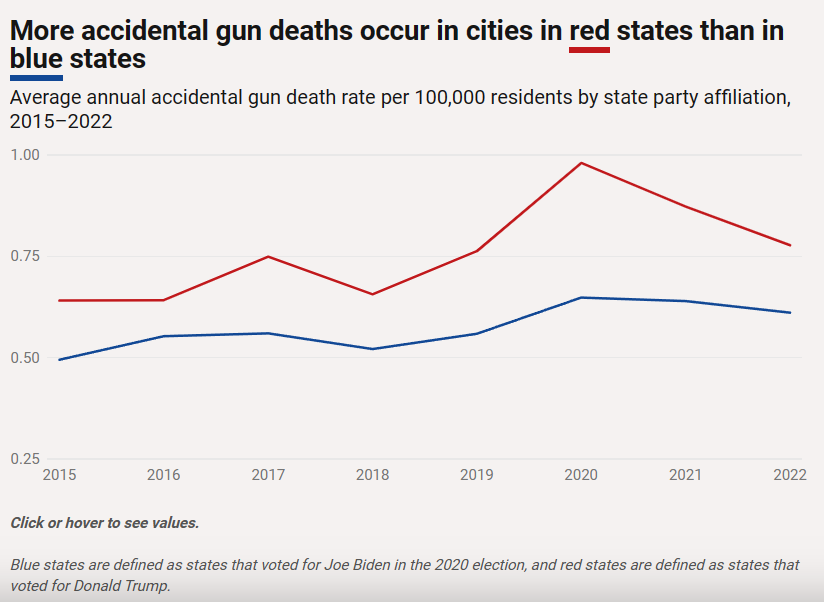
In each year from 2016 to 2022, cities in red states had higher population-adjusted rates of accidental gun deaths than cities in blue states.

Not only are guns used for murder and suicide, they also cause accidental deaths. Having a gun in your house or carrying one in the street greatly increases the chances you will die by gunshot.

In 2022, for example, cities in red states experienced 27 percent more accidental shootings, on average, than cities in blue states. These data suggest that the difference between these cities is not just a crime problem; it’s a gun problem.

In each year from 2016 to 2022, cities in red states had higher population-adjusted rates of accidental gun deaths than cities in blue states.

Cities in states that voted for President Joe Biden in the 2020 election have consistently lower rates of accidental deaths due to firearms.

From 2019 to 2021, the United States experienced the largest two-year increase in homicides ever recorded by the Centers for Disease Control and Prevention—and it was almost entirely driven by gun homicides.

This alarming statistic forces gun violence to the center of every public safety conversation. How policymakers have responded to this hard truth is telling.

States such as Oregon, New Jersey, and 19 others—of which 15 were blue states—plus Washington D.C., passed a combined 91 gun safety bills in 2022 alone.

Notably, the Giffords Law Center to Prevent Gun Violence’s annual state scorecard rankings show states with the strongest gun laws consistently have the lowest rates of gun violence.

Despite this strong association, conservative politicians continue pushing the narrative that gun violence is worsening in cities in blue states. However, the data do not support this claim. In the 300 most populous U.S. cities, from 2018 to the peak of gun violence in 2021, red-state cities, on average, saw their rates of gun homicides increase by 27 percent more than in blue-state cities.

Among the 300 most populous U.S. cities, cities in blue states have seen a 14.9 percent decrease in year-to-date gun homicides after adjusting for population. In red-state cities, the drop is only 3.7 percent.

Blue cities are statistically different from red cities regarding commonly used socioeconomic indicators: population size, poverty rate, income inequality, and racial diversity.

This means that comparing all blue cities with all red cities does not allow for meaningful conclusions about gun violence trends because it is not an apples-to-apples comparison.

On the other hand, when comparing blue cities in blue states with blue cities in red states, there are no statistically significant differences in these same indicators, which provides a better comparison.

Using this as the basis for deeper analysis, the trend does not change; cities in blue states are safer than their peers in red states, regardless of the affiliation of the mayor.

Using mayoral party affiliation as a proxy for political association, analysis of the 100 most populous cities in the United States reveals that blue cities in blue states are safer than blue cities in red states, and, similarly, red cities in blue states are safer than red cities in red states. 

Conservative legislatures have pursued codifying additional preemption statutes in direct response to actions taken by city officials.

Regarding firearms, preemption laws take authority away from local elected leaders and police chiefs to pass and implement laws that regulate the possession, transfer, sale, ownership, and transportation of firearms, among other regulatory policies.

This has been a particular issue for local officials seeking to confront gun violence in their communities. Some 45 states—both red and blue—have preemption laws on the books that explicitly bar local governments from passing firearm-related ordinances in some form.

Only Hawaii, New York, Massachusetts, Connecticut, and New Jersey do not explicitly preempt firearm regulations. Notably, these states had five of the six lowest gun death rates in 2022.

The consequences of these laws are devastating. Preemption statutes can threaten public safety by ignoring local variations, hindering enforcement agencies, and denying innovation in gun violence prevention strategies.

Preemption laws leave local officials and communities vulnerable. For example, state supreme courts ruled that colleges in Colorado, Utah, and Oregon could not set gun policies and, therefore had no authority to restrict the carrying of guns on their campuses.

Chicago is surrounded by states with some of the weakest gun laws.

As a result, Chicago is under constant stress from guns flowing into the city.

Case in point: Westforth Sports Inc., located just 10 miles from Illinois’ border, in the red state of Indiana, has been tied to 850 crime guns recovered in Chicago from 2013 to 2016, making it the “third-largest federally licensed source of crime guns in the Chicago area.”

Westforth Sports is only one example of a much more systemic problem: gun trafficking from states with weak gun laws to states with stronger gun laws.

City officials can work only with the tools they are given. Unable to pass local gun laws, city officials are forced to fight gun violence caused on them by red states.

Conservative lawmakers and pundits wage misinformation campaigns that prioritize stoking fear over promoting gun safety. 

The data reject the false and divisive narrative on which Republicans have spent millions. This political fracture means a growing divide regarding gun laws and public safety. If policymakers in this country were serious about ending the gun violence epidemic, they should promote stronger gun laws, not fear. 

SUMMARY

Guns are machines designed to kill and wound, which they do in three ways: Murders, accidents, and suicides.

Anything proven to be that deadly and so often used for all three purposes should be, as our Founding Fathers said, “well-regulated” and have the supervision of a legal group; the founders suggested a militia.

The right-wing dominated Supreme Court belies its “originalist” claims and ignores what the Founding Fathers said in plain English.

The myth that Democrat-run cities are hotbeds of murder, despite strict anti-gun laws, simply is wrong — a lie told to fog the truth that wherever there are guns, there is death.

Their laws neither are “tough” nor are the cities hotbeds of crime.

Where are gun murders, accidents, and suicides most prevalent? Red states and red cities, where the gun danger deniers live.

Sadly, the right wing of the Supreme Court and Congress has proven not only to be immoral on several counts, even criminal, and are subservient to the gun lobby. 

The Republicans claim that even without the 2nd Amendment, gun laws don’t work and that if we make ownership of guns illegal, only criminals will have guns. That is a tautology, but the concept implies all laws are useless.

We are a nation of laws. Laws make us civilized. All laws are broken by some people, and all laws restrict us in some way, yet we rely on laws to make us free.

Rodger Malcolm Mitchell
Monetary Sovereignty

Twitter: @rodgermitchell Search #monetarysovereignty
Facebook: Rodger Malcolm Mitchell

……………………………………………………………………..

The Sole Purpose of Government Is to Improve and Protect the Lives of the People.

MONETARY SOVEREIGNTY

Beating Russia by tapping computer keys

Russia, as it has been governed for the past few decades, is an enemy of America and America’s allies. It has a long history of aggression. The North Atlantic Treaty Organization was formed with Russia’s aggressions in mind. Ukraine is only the latest in Russia’s many attempts to rule over its neighbors. Two years ago, if anyone had said we dramatically could degrade Russia’s military capabilities without losing a single American soldier and without costing America’s taxpayers a single penny, the vast majority of Americans — including the Republican Party — would have been all in. For the past 20 months, that is precisely what has happened. In February 2024, Russia invaded Ukraine, and to the world’s — especially Vladimir Putin’s — surprise, Ukraine fought back. In the succeeding months, Ukraine has killed many of Russia’s best soldiers — and some not so “best” — and destroyed many of Russia’s military weaponry, including guns, bullets, tanks, planes, and even some ships.
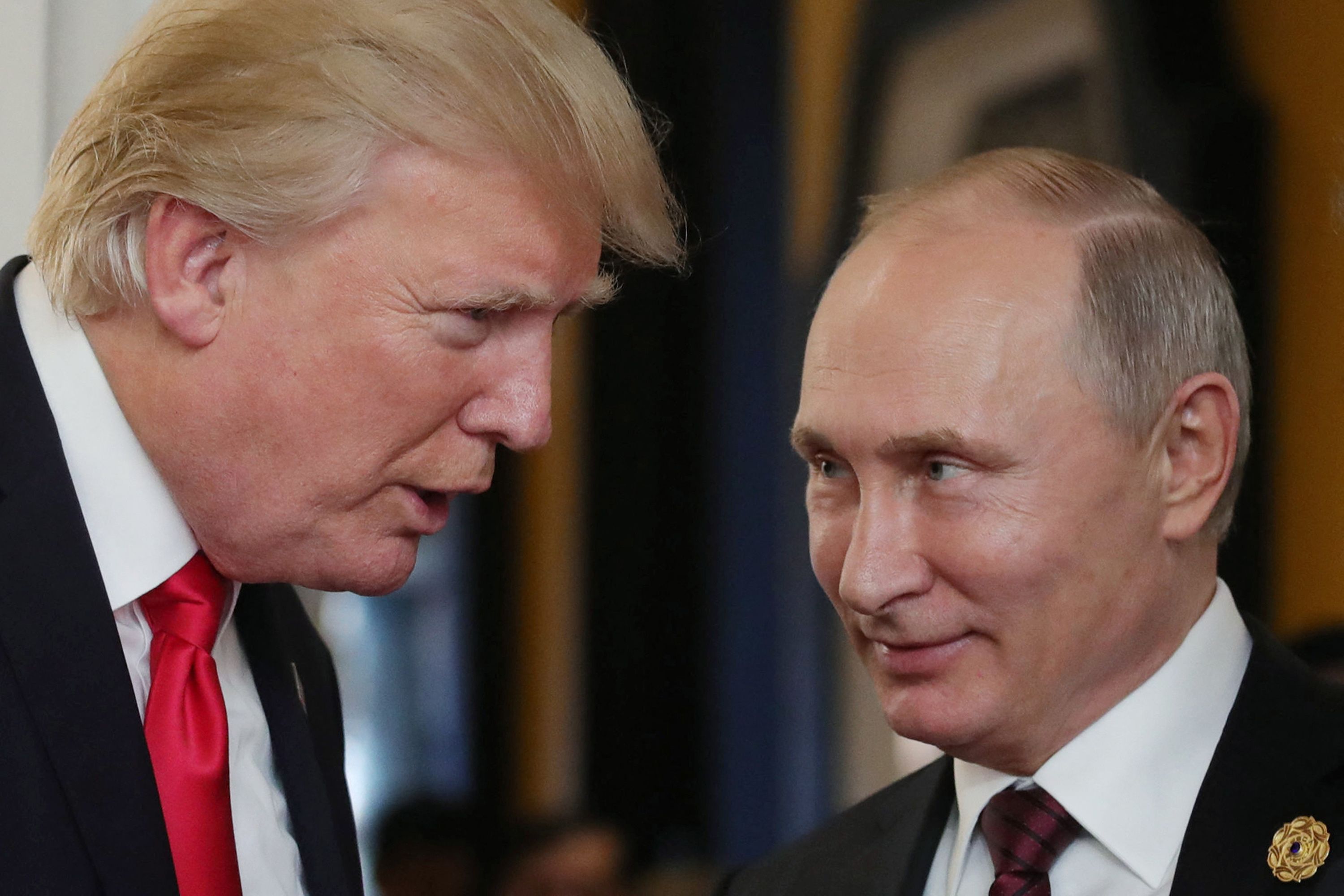
Trump has been on Putin's side in Ukraine's long struggle against Russian aggression | CNN Politics
If Russia takes over Ukraine and then begins to move on Norway (its next target), and our weakness emboldens China to act militarily, and American soldiers are sent overseas to die, the right-wing finger-pointing and bleating will blame the “libs.”
The degradation is happening much faster than Russia’s ability to restock. Not a single American soldier has been wounded or killed. Perhaps more importantly, considering the current discourse, no tax dollars were taken from American pockets to accomplish this, which is this post’s central point.

WAR IN UKRAINE Has aid for Ukraine peaked? Some fear what’s happening By Steven Erlanger The New York Times

WARSAW, Poland — Clearly anxious, President Volodymyr Zelenskyy of Ukraine went in person last week to see NATO defense ministers in Brussels, worried that the war between Israel and Hamas will divert attention — and needed weapons — from Ukraine’s long and bloody struggle against the Russian invasion.

American and NATO officials moved to reassure Zelenskyy, pledging another $2 billion in immediate military aid.

But even before the war in the Mideast began, there was a strong sense in Europe, watching Washington, that the world had reached “peak Ukraine” — that support for Ukraine’s fight against Russia’s invasion would never again be as high as it was a few months ago.

The new run for the White House by former President Donald Trump is shaking confidence that Washington will continue large-scale support for Ukraine. But the concern, Europeans say, is larger than Trump and extends to much of his Republican Party, which has made cutting support for Ukraine a litmus test of conservative credibility.

Even in Europe, Ukraine is an increasingly divisive issue.

Voters in Slovakia handed a victory to Robert Fico, a former prime minister sympathetic to Russia. A vicious election campaign in Poland, one of Ukraine’s staunchest allies, has emphasized strains with Ukraine. A far-right opposed to aiding Ukraine’s war effort has surged in Germany, where Chancellor Olaf Scholz is struggling to win voters over to his call for a stronger military.

“There’s less pushback against the anti-Ukrainian stuff already out there,” said Toomas Hendrik Ilves, the former president of Estonia, mentioning the Republican right wing and influential voices like Elon Musk.

“Europe cannot replace the United States,” he said, even as it proposes more aid. “Certainly, we can do more, but the United States is something indispensable for the support to Ukraine.”

That same day, President Vladimir Putin of Russia said that without Western aid, Ukraine could not survive more than a week.

Meanwhile, Ukrainian officials reported intense combat as Russian forces relentlessly assaulted the eastern Ukrainian city of Avdiivka for a fifth consecutive day Saturday. Around 1,600 civilians remain within the city, a stark contrast to its prewar population of about 31,000.

Why Republicans Oppose Aid to Ukraine This is former GOP US Rep. Adam Kinzinger’s opinion:

The Trump effect. The former president so dominates the party’s consciousness that his doubts about Ukraine aid have enormously affected Republicans.

Before Donald Trump, Republicans did not abandon a fight for a strategic partner’s democracy, handing a potential victory to Russian President Vladimir Putin. We were the warriors of the Cold War who brought about the collapse of the Soviet Union.

With Trump, who has embraced Putin, some Republicans are learning to let go of America’s role as the bulwark of democracy and freedom. These Republicans are choosing, instead, the tragic isolationism of those who opposed joining the fight against Hitler.

There are several theories about why Trump consistently has been Putin’s ally. Most have to do with finances, a potential Trump Tower Moscow, and/or incriminating evidence against Trump Putin may hold. The notion that Trump followers, who use the word “communist” as an all-purpose insult, should follow a man who loves Putin (and Kim) can only be evidence of MAGA cultish insanity.

Back then, radio priest Charles Coughlin had a powerful voice among do-nothings. Today, they find comfort on Fox News.

Trump has framed his position in a way typical of his petty approach to policy. He said he would threaten to halt war funding to get documents from the federal investigation into the business dealings of President Joe Biden’s son, Hunter.

The US should “refuse to authorize a single additional shipment of our depleted weapons stockpiles,” Trump said last month, until “the FBI, DOJ, and IRS hand over” evidence in congressional Republicans’ Biden family investigation. He also has said the US should prioritize school safety over Ukraine aid.

The idea that, somehow, school safety and Hunter Biden should have anything to do with helping Ukraine is, on the surface, absurd.

But when faced with Trump’s absurd ideas, MAGAs mindlessly fall in line.

In July, 70 House Republicans voted to cut off Kyiv entirely.

This number is not enough to change things, but the opponents come from the party’s extreme right wing, which plays an outsized role in primaries. This power means candidates are being pressured to join the anti-aid crowd.

Gone is the party of Reagan, which was steadfast in its stand against tyranny. In its place is rising a GOP that seems immune to the world’s need for American leadership and uninterested in the suffering of a country we should aid until the fight ends.

Then there is another reason Republicans oppose aid for Ukraine

Why the GOP Extremists Oppose Ukraine The budget fight was about vice signaling, not spending. By Tom Nichols, The Atlantic

It’s Not About the Money Some $6 billion of aid to Ukraine was removed from the budget, a temporary casualty of the near shutdown.

Republicans are trying to cloak their opposition to military and humanitarian assistance to Ukraine in a lot of codswallop about oversight and budget discipline. But the opposition to aid for Ukraine among Republican extremists on the Hill is not about money.

Most congressional Republicans are in favor of helping Ukraine.

The extremists warned Joe Biden last month that they would oppose additional assistance to Kyiv. The list is a roster of shame, including the new America Firsters in the Senate (J. D. Vance, Rand Paul, Mike Lee, and Tommy Tuberville among them) and the grotesque caucus-within-a-caucus of some of the most unhinged and weirdest members of the House, including Clay Higgins, Harriet Hageman, Andy Biggs, Anna Paulina Luna, and that titan of probity and prudence, Paul Gosar.

And let us not forget the battling ladies, Marjorie Taylor Greene and Lauren Boebert, who only agree on one issue: Allowing Ukraine to die under the Russian bear’s claws.

The drumbeat of propaganda from these members and their “amen” chorus in the right-wing media is having an effect: For the first time, most Republicans now support aid reductions. Fortunately, Americans overall are still holding firm in their support for Ukraine in its fight against Russian imperialism.

First, foreign aid is always an easy hot button for the know-nothing right to push. Most Americans have no idea how much the United States spends on foreign aid, and they grossly overestimate how much goes to such programs.

Most Americans think it’s about 25 percent of the U.S. budget and want it reduced to about 10 percent. Their wish is already granted: It’s about 1 percent.

They also do not understand that most foreign assistance is not a cash handout: Money is spent to buy weapons, food, and other products made in America, which we then ship to other nations.

Instead, many Americans think of assistance—mistakenly—as bags of untraceable money handed to foreigners to do with as they will, which is why opportunists such as Ron DeSantis (who once supported aid to Ukraine) try to exploit provocative terms such as blank check to describe helping Ukraine. DeSantis knows better; so do other Republican leaders.

What the American public doesn’t know, and what the politicians don’t want them to know, is that federal spending costs taxpayers nothing. Tax dollars do not fund federal spending. Our government is Monetarily Sovereign, meaning it has the infinite ability to create its sovereign currency, the U.S. dollar. The U.S. government never unintentionally can run short of dollars. Never. The real purpose of federal taxes is not to provide spending funds to the government. Rather, taxes help the government control the economy by taxing what the government wishes to discourage and by giving tax breaks to what the government wishes to reward. Unlike taxes paid to monetarily non-sovereign state and local governments, dollars paid to the federal government are destroyed upon receipt. Those tax payment checks you write come from what is known as the M1 money supply measure. But the instant they reach the U.S. Treasury, they cease to be part of any money supply measure. (There is no measure for Treasury money because of that infinite ability to create dollars.) They simply disappear from any measure. To pay its bills, the government creates all new dollars ad hoc. No tax dollars were used. Even if the government collected $0 in taxes, it could continue supporting Ukraine and every other federal project forever.

Most Americans recognize the immense threat that Russia’s war of conquest poses to our allies, global peace, and the security of the United States.

Republicans once stood at the forefront of opposition to Kremlin aggression—Ronald Reagan’s steadfast opposition to Moscow was one of the reasons I was a young GOP voter in the 1980s—but now the party is saddled with a group of shortsighted appeasers, buttressed by a squad of right-wing cranks, who would doom tens of millions of innocent people to Russian President Vladimir Putin’s butchery just to own the libs.

Also, we should not ignore a nauseating truth about the extremist caucus within the GOP: Some genuinely admire Putin and what he has created in Russia.

Tucker Carlson, after all, didn’t get taken off the air for supporting Putin in ways that would have made Cold War Soviet propagandists blush; he got canned only after a defamation lawsuit from an election machine company.

These GOP extremists have swallowed the gargantuan lie that Putin is a godly defender of white Christian Europe against the decadent West and its legions of militant drag queens. 

Finally, some Republicans oppose aid to Ukraine because of the more general and bizarre countercultural obsession that has seized the American right: Whatever most of their fellow citizens approve of, they must oppose, or else they risk losing their precious claims to being an embattled minority.

If they were to support aid to Ukraine, how would they be different from everyone else, and especially from Biden?

How would they mark their tribal loyalty if they crossed party lines to oppose a dictator—while supporting a wannabe dictator of their own?

 As a commenter on social media said to me today, if liberals were opposed to aiding the Ukrainian war effort, “the GOP would shut down the government to ensure aid, and you’d see Ukrainian flags waving on the back of pickups.”

SUMMARY The famously anti-communist MAGAs refuse to continue helping Ukraine against communist Russia because Putin-loving Trump tells them to refuse. As their excuse, they falsely claim the money can be used elsewhere even though:
  1. The U.S. has infinite dollars.
  2. Ukraine spending costs taxpayers nothing.
  3. The vast majority of aid is spent right here in America, helping American industry and military readiness.
This is another example of how Donald Trump, a liar and traitor to America, by every measure liars and traitors are measured, has damaged and continues to harm our nation. Yet, all the blame cannot be put on his shoulders. Much should be shared by the ignorance and bigotry of Trump’s MAGA-lemming followers who will believe any damn-fool thing he says, no matter how crazy and damaging. These people think that waving a flag makes them patriots and hatred keeps them safe. They are the same senseless organisms who claim anti-abortion is “pro-life” while they vote against aid to impoverished mothers and children. But if Russia takes over Ukraine and then begins to move on Norway (its next target), and our weakness emboldens China to act militarily, and American soldiers are sent overseas to die, the right-wing finger-pointing and bleating will blame the “libs.” Rodger Malcolm Mitchell Monetary Sovereignty Twitter: @rodgermitchell Search #monetarysovereignty Facebook: Rodger Malcolm Mitchell

……………………………………………………………………..

The Sole Purpose of Government Is to Improve and Protect the Lives of the People.

MONETARY SOVEREIGNTY

OK, it’s a dumb question, but I’m not too proud to ask.

Richard Feynman famously said, “I think I can safely say that nobody understands quantum mechanics.”

He was one of the most brilliant physicists who ever lived, having written many accepted theories and hypotheses about quantum mechanics.

So, if Richard Feynman doesn’t understand it, I sure don’t. That’s why I don’t feel bad about not understanding yet another scientific mystery. (No, not women, enigmas that men never will understand). I’m referring to dark energy.

“Dark energy” is the name given to some unknown thing that seems to be making the universe expand at an accelerating rate.

It’s called “dark” because no one knows what it is. It’s called “energy” because it moves the universe.

If you think moving a car, a truck, or a train requires energy, think of moving the entire universe.

The mystery goes something like this. In the beginning of the universe, there was something possibly resembling an explosion called the “Big Bang,” where, in a short time, the universe went from something very tiny to something orders of magnitude bigger.

That took great energy because it had to overcome gravity and inertia.

However, it did overcome gravity, which led to an even greater mystery. In our experience, gravity eventually wins. Throw a ball into the air, and it will begin to slow and eventually fall back. Same with a bullet.

If you have a powerful enough gun, the bullet even can escape earth’s gravity and go on forever. But — and this is the important part — the bullet will begin fast, and as it rises, it will slow down.

Even though gravity weakens with distance, it will have taken energy from the bullet. Going fast enough, the bullet even may escape the earth’s gravity, but it always will slow down unless it receives additional bursts of energy.

For that reason, scientists had thought that after the “Big Bang,” the universe’s expansion would slow, perhaps after many billions of years, and even begin to reverse because of gravity and start coming back together in a “Big Crunch.”

Imagine the surprise when measurements seem to show that not only was the expansion not slowing, but it was speeding.

There seemed to be some repulsive force that overcomes gravity at greater distances.

While gravity declines with distance, the effect of “dark energy” seems to increase with distance. No one ever had seen such a force.

This is being studied by great minds with far more knowledge about the subject than I have, so with a dash of humility and a dollop of trepidation, I ask whether any of my readers can comment on this question: Every effect I’ve heard of seems to increase with decreasing distance. Gravity and magnetism are examples.

So, is it possible that so-called dark energy merely is gravity from other universes?

How might surrounding universes affect our universe?

There has been much speculation about the possible existence of multiple universes. No proof of other universes exists, but for the moment, let’s say they might.

And if they do, they might have gravity, just like ours does.

And if they have gravity, that gravity might extend beyond the “borders” of the other universes, affecting adjacent universes.

And, if all those aforementioned “mights” exist, how would we know? What would be the effect on our universe by surrounding universes?

Could there be a gravitational effect whereby all universes would expand faster through time, as they pulled on each other?

Could our expanding-faster universe be evidence of multiple universes?

If you know anyone who is expert in these matters, please ask them to comment on this post.

I will be the first to admit I know even less about the subject than your loud-mouth neighbor knows about Monetary Sovereignty.

The difference is, unlike your loud-mouth neighbor, I recognize my ignorance, and wish to learn. Any thoughts?

Rodger Malcolm Mitchell

Monetary Sovereignty Twitter: @rodgermitchell

Search #monetarysovereignty Facebook: Rodger Malcolm Mitchell

……………………………………………………………………..

The Sole Purpose of Government Is to Improve and Protect the Lives of the People.

MONETARY SOVEREIGNTY