What would you think if you received the following urgent notice?
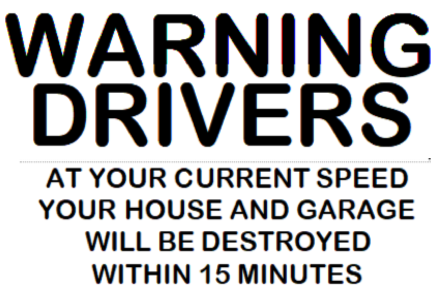
YOU WILL VIOLENTLY CRASH THROUGH THE DOORS AND CONTINUE THROUGH THE BACK WALL, DESTROYING EVERYTHING IN YOUR PATH.Would you think, “That is the silliest thing I have ever seen”?Would you say to yourself, “I will simply slow down, come to a stop, open the doors, glide slowly in, and close the doors behind me? What’s the problem?”
No, you wouldn’t, at least not if you were to believe a ridiculous warning article published repeatedly, for years and years, by the Committee for a Responsible Federal Budget (CRFB) and by other self-appointed experts.
Here are excerpts from my least favorite liars—least favorite because they seem to have the ears of many in Congress while explaining why you should have less Social Security and more taxes — the fearmongering CRFB.
And what makes me even angrier. The public, especially those who need Social Security more and can afford tax increases less, believe the lies being promulgated by the rich — and do nothing. Or they don’t believe the lies, and still do nothing.
We believe that the federal government is running short of money, so please sheer us. Then eat us.
The Social Security and Medicare Trustees released their annual reports today on the financial status of the Social Security and Medicare programs over the next 75 years.
The latest Social Security projections show that the program is quickly approaching insolvency and highlight the need for trust fund solutions sooner rather than later to prevent across-the-board benefit cuts or abrupt changes to tax or benefit levels.
In other words, Social Security, which is 100% funded and controlled by the Federal Government,will run out of funds unless the Government adds dollars to the program, which it easily could do at the touch of a computer key. Crazy.
Before we detail the lies, here are the truths.
The U.S. Federal Government is Monetarily Sovereign. You can look it up here. The shorthand version is that it never can run short of dollars unintentionally. Even if it didn’t collect a single penny in taxes, it could continue spending forever—even at ten times the current rate.The government also has absolute control over the dollar’s value (i.e., inflation) and has arbitrarily changed the value many times. -1792: The Coinage Act of 1792 established a bimetallic standard, setting the dollar’s value at 371.25 grains of silver or 24.75 grains of gold, with a gold-to-silver ratio of 15:1. -1834: The Coinage Act of 1834 changed the gold-to-silver ratio to 16:1 by reducing the weight of gold coins. 1873: The Coinage Act of 1873 effectively demonetized silver, ending the bimetallic standard and making gold the sole standard. -1933: President Franklin D. Roosevelt took the U.S. off the gold standard domestically, allowing the dollar to float against gold. =1971: President Richard Nixon ended the dollar’s international convertibility into gold, marking the end of the Bretton Woods system and the transition to a floating value system.
Because the Federal Government cannot run short of dollars, no agency of the Federal Government can run short of dollars unless that is what Congress and the President want.
Social Security and Medicare are federal government agencies. As with all federal agencies, their expenses are paid not by taxes but by federal dollar creation. Here is the process:
The creditor’s invoice is approved by the federal agency, which has been told by the federal government how much it could approve.
Payment is made, not by dollars, but by instructions (check or wire), telling the creditor’s bank to increase the balance in the creditor’s checking account. This creates new dollars (no tax dollars are used), which are added to the M2 money supply measure.
To balance its books, the bank obtains approval of the transaction from the Federal Reserve, which has been told by Congress how much to approve.
Yes, they’re going to have us for dinner, but it’s way too much trouble to protest. Bah, bah, bah.
Returning to the CRFB article:
Social Security is approaching insolvency. Under current law, Social Security cannot guarantee full benefits to current retirees.
Note the words “current law.”
Nothing prevents the federal government from changing any law, which it does thousands of times each year.
Essentially, the CRFB says, “Your car will crash into your garage door unless you put on the brakes and/or open the door, which you do every evening when you come home.”
The Trustees project the Social Security Old-Age and Survivors Insurance (OASI) trust fund will deplete its reserves by 2033, when today’s 58-year-olds reach the full retirement age and today’s youngest retirees turn 71.
First, the so-called “Trust Fund” isn’t a trust fund. It’s just a bookkeeping line item:
A “trust fund” implies a secure source of funding. However, a federal trust fund is simply a bookkeeping mechanism used to track inflows and outflows for specific programs.
In private-sectortrust funds, receipts are deposited and assets are held and invested by trustees on behalf of the stated beneficiaries.
In federal trust funds, the federal government does not set aside the receipts or invest them in private assets.
Rather, the receipts are recorded as accounting credits in the trust funds and then combined with other receipts that the Treasury collects and spends.
Second, the federal government owns the accounts and can unilaterally alter their purposes and raise or lower collections and expenditures by changing the law.
Thus, Congress could solve the insolvency “problem” simply by passing a rule and clicking a computer key. The government does not need to collect a single tax penny or cut benefits.
It’s a fake problem.
Returning to the misleading CRFB scare article:
Upon insolvency, all beneficiaries will face a 21 percent across-the-board benefit cut. Including the Disability Insurance (SSDI) trust fund, the theoretically combined trust funds will be insolvent by 2035 and beneficiaries would face a 17 percent cut.
Right, and tonight, when you return home, you will crash into your garage door, unless you park in the street — or, you simply could touch the brakes and open the door.
Social Security faces large and rising imbalances. According to the Trustees, Social Security will run cash deficits of $3 trillion over the next decade, the equivalent of 2.3 percent of taxable payroll or 0.8 percent of Gross Domestic Product (GDP).
Annual deficits will grow to 3.4 percent of payroll (1.2 percent of GDP) by 2050 and 4.6 percent of payroll (1.6 percent of GDP) by 2098. Social Security’s 75-year actuarial imbalance totals 3.5 percent of payroll, which is over 1.2 percent of GDP or nearly $24 trillion in present value terms.
Gee, you mean the federal government really can’t run short of dollars? Nobody told us that. Bah, bah, bah
All of the above is meaningless for a Monetarily Sovereign government agency, although it would be correct for monetarily non-sovereign state/local government agencies.
In short, the CRFB, whether by intent or ignorance, confuses Monetarily Sovereign problems with monetarily non-sovereign problems. It’s like telling you that eating a piece of chocolate is dangerous for you because it happens to be dangerous for dogs. Such is the ignorance being promulgated.
The nonsense continues:
Social Security’s finances have improved from last year but remain perilous. Its 75-year solvency gap was reduced from 3.61 to 3.50 percent of payroll due to stronger-than-expected economic performance and fewer expected disability applicants, partially offset by lower expected birth rates in future years.
Time is running out to save Social Security. Policymakers have only a few years left to restore solvency to the program, and the longer they wait, the larger and more costly the necessary adjustments will be.
Acting sooner allows more policy options to be considered, allows for more gradual phase in, and gives employees and employers time to plan.
What the CRFB really means by “time to plan” is “time to raise taxes and/or cut benefits, two wholly unnecessary options.
Who wants such terrible options? The rich, because those options will make the rich richer by widening the income/wealth/power Gap between the rich and the rest.
Cutting Social Security benefits and/or raising FICA taxes scarcely affect the rich, but they affect you, by making the rich richer. The CRFB is shilling for the rich at your expense.
The idiocy goes on and on:
Social Security’s retirement program is only nine years from insolvency, and action must be taken soon to prevent an across-the-board benefit cut for many current and future beneficiaries.
The action that “must be taken” is for the federal government simply to put dollars into the fake “trust fund.” Better yet, the government could eliminate the fake “trust fund” and just pay for Social Security the same way it pays for Congress’s salaries: By voting and budgeting.
Best yet, the federal government could and should provide generous Social Security benefits to every man, woman, and child in America (aka Universal Basic Income) and stop lying to the public.
The Trustees project the Social Security Old-Age and Survivors’ Insurance (OASI) trust fund will deplete its reservesby 2033; the SSDI trust fund is in much stronger shape and will remain solvent over the next 75 years. On a theoretically combined basis – assuming revenue is reallocated between the trust funds – Social Security will become insolvent by 2035.
Upon insolvency of the OASI fund, all retirees – regardless of age, income, or need – will face a 21 percent across-the-board benefit cut,which will grow to 31 percent by the end of the 75-year projection window. We previously estimated that a typical couple retiring in the year of insolvency would face a $17,400 cut in their annual benefits.
On a combined basis, insolvency would lead to a 17 percent initial cut, growing to 27 percent by the end of the window.
Everyone says we must be shorn and eaten, so it must be so. We care, but it’s too much trouble to protest.
The article goes on and on interminably, quoting misleading facts and figures and presenting ridiculous graphs, all designed to make you believe the federal government is running short of the dollars it creates every day from thin air.
We used to be sheep, but we decided it was too much trouble to do anything about . . . .
I won’t bore you with the rest, partly because I can’t handle the nauseating lies, and you shouldn’t be forced to.
IN SUMMARY
Suppose you decide it is too much trouble to protest to your Congressperson and/or even believe the lies. In that case, your benefits will be cut — unnecessarily, your taxes will be increased — unnecessarily — and you will only have yourself to blame.
If you’re angry that your favorite team’s quarterback throws to the wrong jersey color and your favorite singer wasn’t nominated for a Grammy, save some of that emotion for the fact that you are being royally screwed by the people you just voted for, and you aren’t doing a damn thing about it.
While Trump’s and the Republican ascendency in power may be a disaster for American democracy, such as it is, a few tiny glimmers of financial sunlight peek through the darkness.
For the purposes of this post, we’ll ignore the astounding parallels between Trump and Hitler while focusing on the few near-term benefits.
Here are a few excerpts from an article in USA TODAY:
Stocks soared on news of Trump’s election. Bonds sank. Here’s why. Story by Daniel de Visé, As Donald Trump emerged victorious in the presidential election Wednesday, stock prices soared. As the stock market rose, the bond market fell. Stocks roared to record highs Wednesday in the wake of news of Trump’s triumph, signaling an end to the uncertainty of the election cycle and, perhaps, a vote of confidence in his plans for the national economy, some economists said. On the same day, the yield on 10-year Treasury bonds rose to 4.479%, a four-month high. A higher bond yield means a declining bond market: Bond prices fall as yields rise. While stock traders rejoiced, bond traders voiced unease with Trump’s fiscal plans. Trump campaigned on a promise to keep taxes low.
It will be great news for the economy if he keeps that promise. Federal taxes are recessive. They remove dollars from the private sector and transfer them to the federal government, where they are destroyed.
Taxes are paid with dollars from the M2 money supply measure. When they reach the Treasury, they cease to be part of any money supply measure. Effectively, they are destroyed. Destroying M2 dollars is recessive.
Because the federal government can infinitely create dollars at the touch of a computer key, a money supply measure of federal dollars would make no sense.
No matter how many tax dollars you send to the federal government, the federal money supply measure will always be the same: infinite. That is because the U.S. government, unlike state and local governments, is Monetarily Sovereign.
It is 100% impossible for the federal government to unintentionally run short of its own sovereign currency, the dollars it created from thin air in the early 1800s.
Former Fed Chairman Alan Greenspan: “A government cannot become insolvent with respect to obligations in its own currency. There is nothing to prevent the federal government from creating as much money as it wants and paying it to somebody. The United States can pay any debt it has because we can always print the money to do that.”
He also proposed sweeping tariffs on imported goods.
This will be bad news for the economy. Import tariffs are federal taxes. Like all other federal taxes, they are paid with M2 dollars that are destroyed when they reach the Treasury. Destroying dollars is recessive.
Economic growth is measured by Gross Domestic Product (GDP). GDP=Federal Spending + Non-Federal Spending – Net Imports. GDP growth requires money supply growth.
Worse, tariffs increase consumer prices, which means they add to inflation.
Even worse, tariffs invite retaliatory tariffs. They also reduce exports, which are part of the Gross Domestic Product.
Economists predict a widening deficit in Trump presidency Economists warn that Trump’s plans to preserve and extend tax cuts will widen the federal budget deficit,which stands at $1.8 trillion.
Contrary to popular wisdom, widening the federal budget deficit is good news for the economy. It means the government is pouring more growth dollars into the economy than it is taking out.
Deficits are the net amount of growth dollars the federal government adds to the economy. The federal debt is the net total of all previous deficits, i.e. the net total of all growth dollars the federal government has added to the economy.
Tariffs, meanwhile, could reignite inflation, which the Federal Reserve has battled to cool.
To summarize, import tariffs have two bad outcomes: They increase inflation and remove growth dollars from the economy.
Their ostensible purpose is to protect U.S. industry. A far wiser approach would be to cut federal taxes on businesses and support designated businesses with federal cash and favorable laws.
One example is federal farm subsidies, which boost farm profits without increasing consumer costs.
For bond investors, those worries translate to rising yields. The yield is the interest rate, the amount investors expect to receive in exchange for lending money: in this case, to the federal government.
Technical point: Because the federal government has the infinite ability to create dollars, it never borrows dollars. Though corporate bonds do represent corporate borrowing, federal bonds do not represent federal borrowing. The same word has two different meanings.
These bonds represent dollars deposited into T-bond accounts for safekeeping. The government never touches the money; it remains the property of the depositor. The purpose is to provide a save place for money holders to keep unused dollars.
The Chinese, for example, would be loath to store their billions of unused dollars in private banks.
In the current economic cycle, bond investors “might perceive there to be more risk of holding U.S. debt if there’s not an eye on a plan for reducing spending.
False. There is no spending-related risk for storing dollars in T-security accounts. The dollars always are 100% safe. This is diametrically the opposite with private sector bonds, which do suffer repayment risk.
The 10-year Treasury bond is considered a benchmark in the bond market. The yield on those bonds “began to climb weeks ago, as investors anticipated a Trump win,” The New York Times reported, “and on Wednesday, the yield on 10-year Treasury notes jumped as much 0.2 percentage points, a huge move in that market.”
This all was mere speculation, having nothing to do with real risk. Bond traders anticipated that other bond traders would think there was more risk, so they acted accordingly. It was a lemming-like approach to trading — trying to do what everyone else was going to do, before they did it.
When deficit growth decreases, we have recessions (vertical gray bars) which are cured by deficit growth increases. The reason: A growing economy requires a growing supply of money.Long-term bond yields are rising because “many investors expect that the federal government under Trump will maintain high deficit spending,” according to Bankrate, the personal finance site.
The federal government could double or triple its spending without accepting one additional dollar in deposits. Federal spending is not contingent on non-existent federal “borrowing.”
In a broader sense, bond investors worry that “we’re living beyond our means in the United States, and we have been for a very long time,” said Todd Jablonski, global head of multi-asset investing for Principal Asset Management.
This is utter nonsense. The U.S. federal government has infinite “means.” It cannot run short of dollars.
Former Fed Chairman Ben Bernanke: “The U.S. government has a technology, called a printing press (or, today, its electronic equivalent), that allows it to produce as many U.S. dollars as it wishes at essentially no cost. It’s not tax money… We simply use the computer to mark up the size of the account.”
Over the long term, Jablonski said, investors “fear that the United States’s creditworthiness is not as impeccable as it was once considered to be.” As the federal deficit grows, investors take on greater risk, and they expect to be paid a higher interest rate for loaning money to the government.
That is absolutely untrue. In 1940, when the federal debt (deposits) totaled only $400 Billion, pundits called it a “ticking time bomb.”
Exactly the same language has been used every year since. Today, after 84 years of hand-wringing, the pundits still make the same claim about our $30 Trillion debt, and we are no closer to insolvency than we were then.
This is part of the Big Lie in economics, where even respected economists continue to make the same “Earth-is-flat.” statements.
Perhaps it is taught in high schools or discussed over drinks. I can’t say, but it seldom is questioned. Strange.
If you would like to watch economists stutter, ask them:
“If federal deficits are bad, why do we run deficits to cure recessions?”
Neither Trump nor Democratic presidential candidate Kamala Harris offered a convincing plan to reduce the deficit on the campaign trail, economists said.
Politicians don’t reduce the deficit because it involves two steps—both economically bad: tax increases and/or spending reduction. Both are recessionary.
Harris promised to raise taxes on the wealthiest Americans and corporations as a source of new revenue.
Raising taxes on the wealthiest Americans has some value, but not for revenue generation. The beneficial purpose would be to narrow the income/wealth/power Gap between the rich and the rest.
Trump, by contrast, pledged to extend and even deepen his previous tax cuts. Trump has made a case that economic growth and job creation would naturally boost revenue.
Trump is correct on both counts. Deepening tax cuts benefits the economy, though he probably would again deepen them for the rich, thereby widening the income/wealth/power Gap, a terrible outcome.
Depending on the details, revenue might be boosted, but that would be bad for the economy.
The bond market may not be convinced. “If there’s a Republican sweep of House, Senate and the presidency, I expect the bond market to be wobbly,” said Jeremy Siegel, finance professor at the Wharton School of the University of Pennsylvania, speaking to CNBC on Election Day.
Yes, the bond market might be “wobbly” (whatever that means), not for functional reasons, ut rather because the Jeremy Siegels of the world predict wobbliness.
In Summary:
The federal government is uniquely Monetarily Sovereign over the U.S. dollar. It cannot unintentionally run short of dollars.
The federal government does not borrow dollars or owe so-called “debt.” The dollars deposited in T-security accounts are wholly owned by depositors, whom the government pays merely by returning their dollars.
The purpose of federal bonds is not to provide the government with spending money. The purpose is to provide a safe place for dollar holders to store unused dollars. This stabilized the value of the dollar.
Federal deficit spending and “debt” are not a burden on the government or taxpayers, nor are they a risk to depositors.
Economic growth requires federal deficit spending, which adds growth dollars. When deficits are too low, we have recessions, which are cured by increased deficits.
The following outlines what may be typical of Republican healthcare:
Surgeon General Dr. Joseph Ladapo announced Florida would be the first state to recommend against COVID-19 vaccines for healthy children. Ladapo has made it clear he believes the science behind COVID-19 recommendations from the U.S. Centers for Disease Control and Preventions is lacking.
Studies show how big a difference theCOVID vaccines can make.
Those who are unvaccinated are 11 times more likely to diefrom COVID-19 compared to those are vaccinated, according to recent data from the Centers from Disease Control and Prevention.
Unvaccinated people are also about four and a half times more likely to get COVID and over 10 times more likely to be hospitalized.
He also appeared with and praised America’s Frontline Doctors, a group of pro-Trump health care workers that has spreadmisinformation about the pandemic.
———————————————-
The evidence overwhelmingly supports the safety and efficacy of COVID-19 vaccinations for healthy children. Here are some key points:
Safety: Large-scale studies and continuous monitoring have shown that COVID-19 vaccines are safe for children. Serious adverse events are rare, and the benefits of vaccination far outweigh the risks.
Efficacy: Vaccines have been shown to be effective in preventing COVID-19 infections, hospitalizations, and severe outcomes in children. For example, the Pfizer-BioNTech vaccine was found to be 100% effective in preventing COVID-19 in children aged 12-15.
While there are rare cases of adverse events, such as myocarditis, the overall risk remains very low compared to the benefits of vaccination. The CDC and other health organizations continue to recommend vaccination for children to protect their health and prevent the spread of COVID-19.
NIH Study: A study by the National Institutes of Health (NIH) estimated that COVID-19 vaccinations prevented up to 140,000 deaths in the U.S. by May 2021. The study highlighted the vital role of vaccines in saving lives and controlling the pandemic1.
Oxford Study: Researchers at the University of Oxford found that COVID-19 vaccines significantly reduce the severity of illness in vaccinated individuals. The study showed a reduction in harmful inflammatory responses to the virus, which are associated with severe disease.
BMJ Study: A countrywide study in Scotland found that vaccination was 90% effective in preventing deaths caused by the Delta variant of COVID-19. This study analyzed over 114,000 cases of SARS-CoV-2 infection.
Long COVID Study: A study published in The New England Journal of Medicine found that COVID-19 vaccinations played a key role in reducing the risk of Long COVID. The study showed that the risk of developing Long COVID dropped significantly among vaccinated individuals.
Embalmers and funeral home workers say they are noticing an increase in unusual blood clots among the deceased.
Some of them, without evidence, are attributing it to the COVID-19 vaccines.
One of the claims comes from an article titled “Embalmers finding ‘strange clots’ in jabbed people” and published by NewsWars, a website run by Alex Jones that has a history of spreading fake news and conspiracy theories.
“I actually pulled this long, fibrous-looking clot out prior to embalming … . At the front end of it, it looks like a normal blood clot, but that white fibrous-looking stuff just isn’t normal,” Alabama embalmer Richard Hirschman was quoted in the article as saying.
Hirschman added that “my gut is telling me” it’s caused by the vaccine.
Hirschman shared similar claims on the “Dr. Jane Ruby Show,” and with PolitiFact when we contacted him.
John O’Looney of Milton Keynes Family Funeral Services based in the United Kingdom made similar claims to InfoWars, another conspiracy-oriented website run by Jones, suggesting that “the experimental shot” could be to blame.







 #Monetary Sovereignty - Mitchell