This article discusses the “religious” right’s planned efforts to reduce federal debt by cutting healthcare for low-income individuals and the disabled, while diverting funds to wealthy individuals.
Is taking from the poor and giving to the rich what Jesus would do?
Taking money from the poor and giving it to the rich is the worst blasphemy and the path to hell.Revealed: The GOP’s ‘draconian’ strategy to cut Medicaid as Trump returnsREUTERS/Anna Rose LaydenPhil Galewitz, KFF Health News, January 13, 2025Under President Joe Biden, Medicaid enrollment hit a record high, and the uninsured rate reached a record low.Donald Trump’s return to the White House and a GOP-controlled Senate and House of Representatives are expected to change that.Republicans in Washington say they plan to use funding cuts and regulatory changes to dramatically shrink Medicaid, the nearly $900-billion-a-year government health insurance program that, along with the related Children’s Health Insurance Program, serves about 79 million mostly low-income or disabled Americans.The proposals include rolling back the Affordable Care Act’s expansion of Medicaid, which over the last 11 years added about 20 million low-income adultsto its rolls. Trump has said he wants to drastically cut government spending, which may be necessary for Republicans to extend 2017 tax cuts that expire at the end of this year.
There are two problems with this notion:
There is no need to cut federal spending. Our Monetarily Sovereignfederal government cannot run short of dollars. It has the unlimited ability to create new dollars, simply by touching computer keys. The federal debt never is a burden on the government or on taxpayers.
The Trump tax cuts primarily benefit the rich. Trump literally wishes to take from the poor and give to the rich.
The Republicans plan to take healthcare dollars from the poor or disabled and give those dollars to the rich.
Trump made little mention of Medicaid during the 2024 campaign. The first Trump administration approved work requirements in several states, though only Arkansas implemented theirs before a federal judge said it violated the law.
The “work requirements” rule assumes the poor or disabled are malingerers, who would rather stay home and live in poverty than work. It is the sneering, superior attitude of those who have much toward those who have little.
House Budget Committee Chair Jodey Arrington (R-Texas) told KFF Health News that Medicaid and other federal entitlement programs need major changes to help cut the federal debt. “Without them, we will watch this country sadly enter into fiscal collapse.”
Conservatives have been preaching this false narrative about fiscal collapse since 1940. (See: “Historical BULLSHIT. Claims the Federal Debt Is a “Ticking Time Bomb”: From Sept. 26, 1940 to October 10, 2024″)
In 1940, the federal debt was $40 billion. Eightyfive years later, has risen to $35 trillion, and the economy is healthier than ever. No “fiscal collapse” in sight.
Rep. Chip Roy (R-Texas), a member of the Budget Committee, said Congress needs to explore cutting federal spending on Medicaid.“You need wholesale reform on the health care front, which can include undoing a lot of the damage being done by the ACA and Obamacare,” Roy said. “Frankly, we could end up providing better service if we do it the right way.”
For eight years, Republican party has promised a “better” version of ACA. They use the word “reform” to describe cutting benefits.
Trump has long talked about making the ACA less expensive, but the question is less expensive for whom?
Of course it will. Ironically, the poor voted for Trump.
“Medicaid is an obvious target for huge cuts,” said Joan Alker, executive director of Georgetown University’s Center for Children and Families. “An existential fight about Medicaid’s future likely lies ahead.”Medicaid, which turns 60 in July, is nearing the end of a disruptive period, after COVID pandemic-era coverage protections expired in 2023 and all enrollees had to prove they still qualified. The unwinding’s disruptions could pale in comparison to what happens in the next four years, said Matt Salo, former executive director and founder of the National Association of Medicaid Directors. “What we are going to see is an even bigger seismic shift in who Medicaid covers and how it operates,” he said.But Salo said any efforts to shrink the program will face pushback.“A lot of powerful entities — state governments, managed-care organizations, long-term care providers, and everyone under the sun who wants to do well by doing good — wants to see Medicaid work efficiently and be adequately funded,” he said. “And they will be highly motivated to push back on something they see as draconian cuts, because it could affect their business model.”The GOP is looking at several tactics to reduce the size of Medicaid: Shifting to block grants. Switching to annual block grants could lower federal funding for states to operate the program while giving states more discretion over how to spend the money.
There is no magic to block grants. Money for Medicaid must come from somewhere. The federal government, being Monetarily Sovereign, has the infinite ability to create dollars without levying taxes.
The monetarily non-sovereign states do not have this power. Who should pay, the infinitely rich federal government or the perpetually strapped states?
If giving block grants saves the federal government money, what will the states do? Answer: Cut Medicaid. They will have no options because they will have less money to work with.
Currently, the government matches a certain percentage of state spending each year with no cap. Republican presidents since Ronald Reagan have sought to block-grant Medicaid with no success. Arrington said he favors ending the open-ended federal funding to states and replacing it with a set annual amount based on how many people each state has in the program.
The sole purposes are to force the states and state taxpayers to pay more, and ultimately, to force the poor and disabled to receive less care.
The poor or disabled either will have to do without health care, or somehow buy coverage from private insurance companies, owned and managed by the rich. Either way, the rich win and the poor lose — the perfect Republican formula.
Cutting ACA Medicaid funding. The ACA provided financing to cover, through Medicaid, Americans with incomes up to 138% of the federal poverty level, or $20,783 for an individual last year. The federal government pays 90% of the cost for adults covered through the law’s Medicaid expansion, which 40 states and Washington, D.C., have adopted.
Even with the federal government paying 90% of the cost, ten Republican states have opted out of the ACA expansion. In the 10 states that didn’t expand Medicaid, 1.6M can’t afford health insurance. The majority of residents in this coverage gap are people of color, an analysis found.
The governors of the 10 states that didn’t expand Medicaid flushed billions of their own taxpayers’ dollars down the toilet.
Opting out has cost the states billions of dollars, not only in federal dollars, but in savings:
Expanding eligibility allows states to cut spending in other parts of their Medicaid programs.
It allows states to cut spending outside of Medicaid — particularly on state-funded health services for the uninsured.
Finally, expansion may increase state revenues due to taxes related to Medicaid expansion or taxes on the increased economic activity it triggers.
A report from the Commonwealth Fund estimated that states not expanding Medicaid could collectively have lost out on more than $7 billion in 2020 alone.
Nine of those ten states voted for Trump in the past election. The lesson: You get what you vote for.
During the first Trump term, federal courts ruled that Medicaid law doesn’t allow coverage to be conditioned on enrollees’ working or seeking jobs. But the GOP may try again. “If we can get strict work requirements on able-bodied adults, that can be a huge cost savings by itself,” Rep. Tom McClintock (R-Calif.) told KFF Health News. Because most Medicaid enrollees already work, go to school, or serve as caregivers, critics say such a requirement would simply add red tape to obtaining coverage, with little impact on employment.If the GOP’s plans to shrink Medicaid are realized, Democrats and health experts say low-income people forced to buy private insurance would face challenges paying monthly premiums and the large copayments and deductibles common to commercial plans that typically don’t exist in Medicaid.He said the GOP will look to scale back Medicaid to its “traditional” populations of children, pregnant women, and people with disabilities. “We need to rebalance the program that most people think is underperforming,” he said. Most Americans, including large majorities of both Republicans and Democrats, view the program favorably, according to polls.
The Constitution prohibits the government from supporting or opposing any religion.
Christians (e.g., Evangelicals, Baptists, Pentecostals, Later Day Saints, Jehovah’s Witnesses) are known for their proselytizing efforts. Others (e.g., Judaism, Hinduism, Buddhism, Shinto) are not.
The question becomes: Is a display of one or more versions of the Ten Commandments a form of support and proselytizing or merely education?
Is this art or religion? Should it hang in any government-funded place?Imagine you are a Supreme Court Justice. I would very much like your opinion regarding:
Can something titled “The Ten Commandments” exist outside religion as purely secular?
Should the government support teaching religious concepts purely as an educational exercise?
Is there a bright line between religious and secular teaching that allows for teaching religious concepts?
Would a secular course about “The life and teachings of Christ, Moses, and God” be allowed in a secular class.”
In a public school class, do atheists have the right to teach that God does not exist? Should the words and beliefs of Siddhartha Gautama (the Buddha), or the words of Vedas, Upanishads, Mahabharata, Ramayana, or the words of Allah and prophet Muhammed be taught?
How can we ensure that a secular approach to teaching about religions does not turn into the promotion of a single religion’s beliefs?
Should displays of religious-themed artwork be allowed in a secular class? What about an art history class?
Is this art or religion? Should it be displayed in any government-funded place?
The following article appeared in the Florida Sun-Sentinel.
More Christianity in classrooms?
Trump’s victory may embolden efforts by lawmakers on right
Text of the Ten Commandments is posted with other documents June 20 at the Georgia Capitol in Atlanta. John Bazemore/APBy Moriah Balingit, Associated Press
What is the “10 Commandments”? The above picture is shown in the article.
It is similar to the Protestant version of the “10 Commandments” because of the “graven image” line. The Catholic version does not mention graven images. There are other versions. It’s not clear whether others will be posted in the Georgia Capital.
WASHINGTON — Conservative lawmakers across the country are pushing to introduce more Christianity to public school classrooms, testing the separation of church and state by inserting Bible references into reading lessons and requiring teachers to post the Ten Commandments.
The efforts come as President-elect Donald Trump prepares to take office pledging to champion the First Amendment right to pray and read the Bible in school, practices that are already allowed as long as they are not government sponsored.
While the federal government is explicitly barred from directing states on what to teach, Trump can indirectly influence what is taught in public schools and his election may embolden state-level activists.Trump and his fellow Republicans support school choice, hoping to expand the practice of using taxpayer-funded vouchers to help parents send their children to religious schools.
Technically, federal spending is not taxpayer-funded. As Monetary Sovereignty teaches, federal spending is funded by federal money creation.
That said, what would you, as a SCOTUS justice, say about federal funding of vouchers for religious schools?
What about federal funding of secular schools that include one religious class? What about tax breaksfor private schools that include one religious course?
What are your thoughts on the Pledge of Allegiance that young students often recite (sometimes getting the words wrong)? While it may not genuinely foster “allegiance,” it still seems to hold significance for some lawmakers.
“I pledge allegiance to the Flag of the United States of America, and to the Republic for which it stands, one Nation under God, indivisible, with liberty and justice for all.”
It would be noteworthy to find even one person whose patriotism has been strengthened by this pledge. Yet, despite its lack of usefulness, it effectively excludes those who do not believe in God or who have a different understanding of divinity.
As a SCOTUS Justice, what is your opinion?
There is a push to incorporate more Christianity into the mainstream public schools that serve the overwhelming majority of students, including those of other faiths.
And with the help of judicial appointees from Trump’s first presidential term, courts have begun to bless the notion of more religion in the public sphere, including in schools.Trump’s Jewish family. Are they concerned? Are Trump, SCOTUS, MAGA concerned? Is anyone?
“The effect of even Trump being the president-elect, let alone the president again, is Christian nationalists are emboldened like never before,” said Rachel Laser, the president and CEO of Americans United for Separation of Church and State.
One wonders what Trump’s Jewish daughter, Ivanka, and his Jewish grandchildren, Arabella, Joseph, and Theodore Kushner, think about all this Christian nationalism.
Large numbers of Americans believe the founders intended the U.S. to be a Christian nation.
A smaller group, part of a movement widely called Christian nationalism, champions a fusion of American and Christian identity and believes the U.S. has a mandate to build a Christian society.
Many historians argue the opposite, claiming the framers created the United States as an alternative to European monarchies with official state churches and oppression of religious minorities.
Efforts to introduce more Christianity into classrooms have taken hold in several states.In Louisiana, Republicans passed a law requiring every public school classroom to post the Ten Commandments. In Texas, officials approved a curriculum intertwining language arts with biblical lessons. And in Oklahoma, the state superintendent of education has called for lessons to incorporate the Bible from grades 5 through 12, a requirement schools have declined to follow.
Utah state lawmakers designated the Ten Commandments a historical document, in the same category as the Declaration of Independence and the Constitution, so teachers could post it in their classrooms. And attorneys general from 17 GOP-led states recently filed a brief supporting Louisiana’s Ten Commandments mandate.
Schools are allowed — and even encouraged — to teach about religion and to expose students to religious texts. But some say the new measures are indoctrinating students, not educating them.
Some states have allowed teachers to use videos from Prager U, a nonprofit founded by a conservative talk show host, despite criticism that the videos positively highlight the spread of Christianity and include Christian nationalist talking points.
Trump commissioned the 1776 Project. It was panned by historians and scholars who said it credited Christianity for many of the positive turns in U.S. history without mentioning the religion’s role in perpetuating slavery, for example.
The project was developed into a curriculum and is now taught in a network of publicly funded charter schools supported. It also has influenced state standards in South Dakota.
Challenges to some state measures are now working their way through the courts, which have grown friendlier to religious interests thanks to Trump’s judicial appointments.
In 2022, a football coach was fired for praying with players at midfield after a game. The high court said a public school can’t restrict an employee’s religious activity just because it could be construed as an endorsement of religion, reversing a five-decade precedent.
In God’s name
“Could be construed” as an endorsement without actually being an endorsement? Who does the construing? What if a student construed it as an endorsement?
The ruling could pave the way for conservatives to introduce more Christianityin public schools, said Derek Black, a law professor at the University of South Carolina. “Donald Trump’s judicial appointees have emboldened states” to test the separation of church and state, he said.
Joseph Davis of Becket, a public interest law firm focused on religious freedom that is defending Louisiana over its Ten Commandments mandate said the Supreme Court has endorsed the idea that “it’s OK to have religious expression in the public spaces,” Davis said, “and that we should sort of expect that … if it’s a big part of our history.”
But critics say some measures to introduce more historical references to Christianity in classrooms have taken things too far, inserting biblical references gratuitously, while erasing the role Christianity played in justifying atrocities perpetuated by Americans, like genocide of Native people and slavery.
The background for the “separation of church and state” is based on history. A theocracy, where religious leaders wield governmental power, inevitably suppresses dissent by claiming divine authority. Questioning the government becomes tantamount to questioning the divine.
The Inquisition and the Puritan witch trials are instances where religious authority was used to justify persecution and maintain control. (Ironically, Trump often claims his criminal trials were “witch trials.”)
Part of American history anti-woke wishes to deny. It was approved by SCOTUS.
The separation of church and state is a foundational concept that protects religious liberty for all, not just a few.
Ironically, again, the governments that now wish to include Christian teaching in publicly funded places also wish to ban a related concept called “woke.”
Woke culture emphasizes the importance of addressing and rectifying social injustices, including systemic racism, sexism, and other forms of discrimination.
“Woke” advocates for equal rights and opportunities for all individuals, regardless of their background, and promotes inclusivity in various aspects of society.
It encourages individuals, especially those from privileged backgrounds, to support marginalized groups.
If Jesus were to speak on the concept of being “woke,” it’s likely that His message would focus on the same empathy, justice, and love for all individuals, regardless of their background or circumstances that woke does.
“Woke” would seem to be identical to the values expressed by Jesus and most religions.
Yet, the most pious Christians oppose “woke” because they feel it is overly sensitive, divisive, excessive in political correctness, and most importantly, critical of white-supported slavery.
The Christian right interprets “religious freedom” as meaning freedom for Christians to rule America.
How would you, as a SCOTUS judge, interpret “Congress shall make no law respecting an establishment of religion, or prohibiting the free exercise thereof”?
In the next four years, interpretations of that simple sentence may become the most influential decisions by SCOTUS for America’s future democracy.
If you are a regular reader of this blog, you know:
The U.S. federal government is Monetarily Sovereign. It has the infinite ability to create its sovereign currency, the U.S. dollar. It never can run short of dollars.
It can pay any financial obligation regardless of size, without levying taxes, merely by touching computer keys.
Contrary to popular belief, federal spending is financed by creating new money rather than taxpayer funds. When federal taxes are collected, they are effectively destroyed. Federal “debt” does not represent a financial burden on the federal government or taxpayers.
Federal spending does not cause inflation. Shortages of critical goods and services— usually food, water, and employees — cause inflation. Federal spending cures inflation when it addresses these shortages,
Please keep these facts in mind as we discuss excerpts from an article in the January-February edition of the AARP Bulletin:
By Howard Zucker*: WHERE HAVE ALL THE DOCTORS GONE?“How can I find a doctor who can help me?” As a physician, I get this question from friends and family all the time. And for most of my professional life, I was able to refer them to a medical colleague; a simple phone call was all it took to get someone an appointment within a reasonable amount of time.But no longer.The average wait for new patients to see a physician is 26 days, and that’s for mostly healthy people. In a medical emergency, the situation can become even more frightening: Twenty-two percent of acutely ill patients 65 or older who sought medical attention had to wait six days or more for an appointment, according to a 2021 survey by the Commonwealth Fund.This is a crisis. And it’s a crisis that’s getting worse, rapidly.“The backbone of our health care system, private practice, is on the brink of collapse,” warns Clarel Antoine, M.D., professor of obstetrics and gynecology at New York City’s NYU Grossman School of Medicine. “The nearly 70 million Americans on Medicare, many with chronic conditions, can expect longer waiting times for medical care.”Although there were some 835,000 practicing doctors in America in 2023, according to the U.S. Bureau of Labor Statistics, we are currently experiencing a shortage because demand exceeds supply.The current shortage of physicians, combined with a number of other factors, has placed such an intense strain on doctors that many in the medical field are choosing to switch professions or simply retire early. And despite efforts by the Association of American Medical Colleges (AAMC) to graduate more doctors, those efforts simply can’t keep up with the drain.Why don’t we have enough doctors?In 1980, a U.S. government report concluded that American teaching hospitals were graduating too many medical students. It predicted a surplus of 70,000 physicians by 1990, an alarming statistic. In response, medical schools established what became a 25-year moratorium on increasing class size, enforced by the AAMC and the American Medical Association (AMA).Yet there was a significant flaw to that initial report: It failed to account for the nation’s rising population, which is now 110 million more than it was 45 years ago. By 2005, as the population grew and the potential for a severe physician shortage emerged, the AAMC and AMA reversed their recommendation, and in the past 20 years, more and more young people have trained to be doctors.Yet despite the more than 97,900 students in medical school, 38,000 in osteopathic school, and 162,000 doctors currently in residencies and fellowships, the AAMC predicts a shortage of up to 86,000 physicians by 2036. By then, it projects that the U.S. population will have risen 8.4 percent since 2021. The population of those over 65 will increase by 34 percent, while the number of people 75 and older will increase by 55 percent.“Medical education is a long journey, and even though medical school enrollment has risen, we need more residency positions [where med school graduates get hands-on training], which requires increased government support,” says David Skorton, M.D., president of the AAMC.It’s not just that we don’t have enough doctors. Part of the problem may be that we don’t have enough of the right kind of doctors.Becoming a doctor is expensive: The average medical student emerges with roughly $235,000 in debt.
There is no reason for this. Our Monetarily Sovereign federal government easily could fund medical school education for everyone who wanted one without collecting a penny in taxes.
Now consider that the average primary care physician (PCP) in internal medicine, geriatrics, pediatrics or family medicine makes about $250,000 to $275,000 a year.
Not nearly enough to pay off his/her loans.
Becoming a PCP just isn’t financially feasible for most recent graduates. Two-thirds of newly minted doctors are choosing to become specialists, which allows them to earn salaries upwards of twice what a primary care doctor can make.“Primary care physicians are undervalued by government and insurance companies, and that is reflected in decreased compensation,” says Isaac Opole, M.D., president of the American College of Physicians. “It makes the field unattractive to medical students.”Yet it is the PCP who provides the annual checkups that may detect problems early on, and who serves as the gatekeeper for referrals to specialists. Many people with private insurance, as well as those enrolled in Affordable Care Act plans, are required to see a PCP before they can access specialists in a majority of fields.And while many med students are choosing to go into specialty care, others opt not to become physicians at all. Indeed, more than 50 percent of medical students and residents surveyed preferred to pursue careers that do not involve direct patient care, such as research or teaching, according to a 2023 report from Elsevier Health. One in 4 contemplate dropping out of medical school altogether, citing overwork, financial stress and mental health concerns.In a study published in 2019, parts of chromosomes that shorten with age eroded six times faster than average for doctors in their first year of training after medical school; researchers attributed the accelerated aging to the doctors’ stress levels.Your doctor has too many patients and not enough time.Why your doctor doesn’t have time for youMany doctors dreamed of medicine as a profession from early childhood. In past generations, it was common to see physicians practicing long past the age when they could retire. Yet a recent AMA survey found that 1 in 5 doctors were hoping to find a way out of medicine in the next two years. Among those 55 or older, that figure was 1 in 2. Why?Part of what’s driving this is the growing trend of private equity firms and corporations, such as CVS Health and Amazon, purchasing hospitals and private practices. One major medical group, with about 90,000 doctors in some 2,000 locations across the country, has spent billions of dollars acquiring physician-owned practices, home health centers and surgical centers. This past April, the Physician Advocacy Institute reported that just shy of 80 percent of all doctors were employed by hospitals or corporations, up 200 percent in just over 10 years.Typically, when for-profit firms acquire practices, they approach these acquisitions utilizing a profit-based strategy. What does that look like?Corporate entities now govern doctors’ allotted time with patients, often allowing just 15 minutes per visit, a situation that isn’t healthy for either the doctor or the patient. “They control every aspect of a doctor’s professional life, and it’s all about the money,” one doctor told me. A 2024 JAMA Internal Medicine report said that 61 percent of doctors surveyed found private equity ownership unfavorable for health care.For every hour seeing patients, the average doctor now spends two hours doing administrative tasks, according to the AMA. A primary driver of paperwork: the electronic health record, or EHR.Your doctor is drowning in work.“The EHR is the bane of existence for every doctor in the country,” says Opole. The EHR was designed to eliminate a paper-based tracking system and make patients’ health records easier for various health professionals to access. But in practice, doctors say, its primary focus is documenting for regulators and billing for insurers. To handle rising administrative demands, doctors have begun cutting back on office hours, resulting in even less time available to see patients. A 2023 Mayo Clinic study noted that 40 percent of doctors it surveyed intended to reduce their work hours in the coming 12 months.
The federal government could and should fund non-medical, administrative support help for doctors without collecting a penny in taxes.
“The doctor-patient relationship requires time to establish a trust, which comes with patients sharing stories of their life with you as it relates to their health,” John Dooley, M.D., an internist in private practice in Washington, D.C., shared with me one evening while driving home at 9:30 p.m. from a grueling day of work. “That doesn’t happen if you only give them 15 minutes.”Every physician told me they are burned out. Simply put, they are being asked by the business world that owns their practices to do medicine, at times, in ways they view as not in the patient’s best interest. Meanwhile, those who cling to their independent practices are finding it impossible to hold on given the financial pressures on them.
The government could pay doctors more. After all, one good doctor is worth more to America than a score of Elon Musks.
Yet another troubling trend: More than 300 doctors now die every year from suicide, a rate twice that of the general population.“We take highly intelligent people with a calling, put them in a demanding and often hostile work environment without any reasonable labor protections, and they cannot even meet their basic needs,” says Pam Wible, M.D., who runs suicide-prevention workshops for physicians. “They can find themselves on the path to taking their own life.”At a recent visit, my own primary care doctor, Paul Arias, M.D., shared that “the pandemic drove many doctors into retirement; others became ill and required disability and, sadly, some died. For those who remain, many fight daily with insurance companies to get approvals for a patient’s labs or procedure. It’s exhausting. Corporate America has taken over medicine.”
And yet, the Republican Party wants to privatize Medicare so that insurance companies can make more money and provide worse service.
To increase revenue, reduce paperwork and regain control of their lives, more and more doctors are choosing concierge medicine, a system in which patients pay a yearly out-of-pocket fee in exchange for longer visits and shorter wait times. Costs can range from $2,000 to $10,000 annually, though some practices have upfront prices that are markedly higher. And since most Americans don’t have the financial resources to pay such high and nonreimbursable fees, this further drains the pool of doctors available, especially to older people on fixed incomes.
There were more of us, but they died waiting for an appointment.
I have a concierge doctor. My previous doctor served more than 2,500 patients. Wait times were long, but visits were short.
My concierge doctor has about 500 patients.
I can see her on a moment’s notice, and we spend at least a half-hour discussing my medical situation, often far more than a half-hour.
She knows me far better than my previous doctor ever could.
Concierge is the private sector’s solution to the federal government’s failure to do what it could easily do: Pay doctors more and pay for their non-medical assistance.
It’s not a good solution, however, because if protects only those who can afford the service fee.
It reminds me of the private sector’s poor solution to Medicare’s failure to fund everything medical: Medicare Advantage.
This partially private-sector-funded program is famous for requiring advance notice of medical procedures, dramatically reducing the number of procedures authorized.
Americans suffer needlessly when medical service is restricted by the ability to pay and the profit motive. It is disgraceful that America, which could afford the best medical care, has mediocre to poor care.
“There is a perfect storm coming,” says Bruce Scott, M.D., president of the AMA, “with increased patient complexity, decreased reimbursements and increased demand for prior authorizations from the insurance company. The combination of these makes it increasingly difficult for physicians to accept new patients and, in some cases, even keep their doors open. We can’t afford to lose even one more doctor.”
And now the real embarrassment: Advice on how to jump the line:
To ensure you get the care you need:
Become friends with the nurses or schedulers in the doctor’s office. Learn their names and make sure they know yours. They can let you know if a cancellation has occurred and keep your name on a waiting list.
Schedule your next appointment while you are at your current one. That’s your best shot at securing a spot on the calendar.
Make sure to fill out all health forms online in advance of your visit. You may have only the smallest of windows to talk with a provider, so make sure you’ve provided as much information as possible to maximize your time in the doctor’s office.
Ask about telehealth options. If the physician’s practice cannot see you in the office, speak with the scheduler to see if a telehealth visit is possible. In surveys, about 87 percent of doctors reported using telemedicine, but only 37 percent of adult patients had taken advantage of it within the previous 12 months, according to CDC data.
Or ask if one of your doctor’s colleagues or another provider in the practice can see you.
Ask your doctor for a referral — and to reach out on your behalf. If your doctor is retiring, moving or turning to concierge medicine, and following them is not an option, ask them for a referral. If they can recommend someone else in their group, even better — that comes with the advantage of your medical records being readily available.
And always check to see if that new physician accepts your insurance, including Medicare.
Ask your insurance company for a list of names of physicians. If you are on Medicare, go to Medicare.gov and click on the Providers & Services tab to find and compare doctors by location. You may want to consider a physician who is not geographically convenient to your home but who meets your other needs.
Don’t be shy about going to urgent care or the ER if necessary. In many cases it’s better to get someone to look at you today than to wait weeks for your regular doctor.
Monitor your health at home. Learn more about home care devices that can help to detect important changes in your health, such as a blood glucose monitor, pulse oximeter (to measure oxygen levels), blood pressure monitor, or electrocardiogram (ECG) to track heart rhythms. Calling a doctor’s office to report a change in a vital sign can speed up an appointment, give you some worthwhile reassurance — or urge you to get to an emergency room.
Do some research. Use the internet wisely. Physician reviews may not be particularly helpful, as they are not only subjective but often filled with complaints; satisfied customers are less likely to post reviews. What is useful, however, are a physician’s board certification, specialty training, insurance plans and hospital affiliations.
*Howard Zucker is board-certified in six medical specialties. He has served as U.S. deputy assistant secretary of health, New York State commissioner of health, assistant director-general of the World Health Organization, and as a deputy director at the Centers for Disease Control and Prevention.
Those eleven suggestions just “shuffle the deck. They do not improve overall care. Jumping the line doesn’t make the line shorter.
America has become so wedded to the false notion that the private sector is always superior to the government we tend to forget some important points:
Government workers are no different from private sector workers. Some are smart, hard workers; some are not. As groups, they are the same
The federal government has the infinite ability to risk money for unprofitable research and development. Only the federal government could have funded putting a man on the moon, and it continues to fund work by private companies like SpaceX.
Government spending adds to economic growth. The formula for Gross Domestic Product is: GDP=Federal Spending+Non-federal spending+Net Exports.
The profit motive causes some of the worst aspects of America’s healthcare system, like unreasonable refusals to pay medical claims.
Sadly, our political leaders act as though federal money is limited. So currently, Millions of Americans suffer and die too early because Congress does not understand Monetary Sovereignty.
Here is what a knowledgeable and caring Congress would do with the infinite dollars it has available to spend without levying taxes.
Offer a free, comprehensive, no-deductible Medicare plan to every person in America, regardless of age or income. It would support every aspect of healthcare, including dental, eye, exercise, and personal training. There would no longer be different plans because one plan would cover everything.*
Fund free education and training for everyone who wants to become a doctor or nurse.
Fund research and development of medications and treatments for all diseases, including rare diseases that otherwise may be unprofitable for pharmaceutical companies.
In exchange for federal support, pharmaceutical companies would receive limited patent protection on medicines.
Federal support for doctors so that the concierge system no longer would be financially attractive.
Days 91-150: These are called “lifetime reserve days,” and you pay a higher daily coinsurance of $838 per day. You have 60 lifetime reserve days that can be used during your lifetime.
After 150 days: You are responsible for all costs.
To see the dozens of medically related problems and procedures Medicare doesn’t cover, see here.
Why doesn’t Medicare cover the above, especially when some are covered by Medicare Advantage and some private insurers? The answer: To save money.But Medicare, as a federal agency, doesn’t need to save money. It is funded by the federal government (not by FICA), which has infinite money. This is a clear example of our Monetarily Sovereign federal government pretending it is monetarily non-sovereign.
SUMMARY
Not only is the US short of doctors and nurses, but astoundingly:
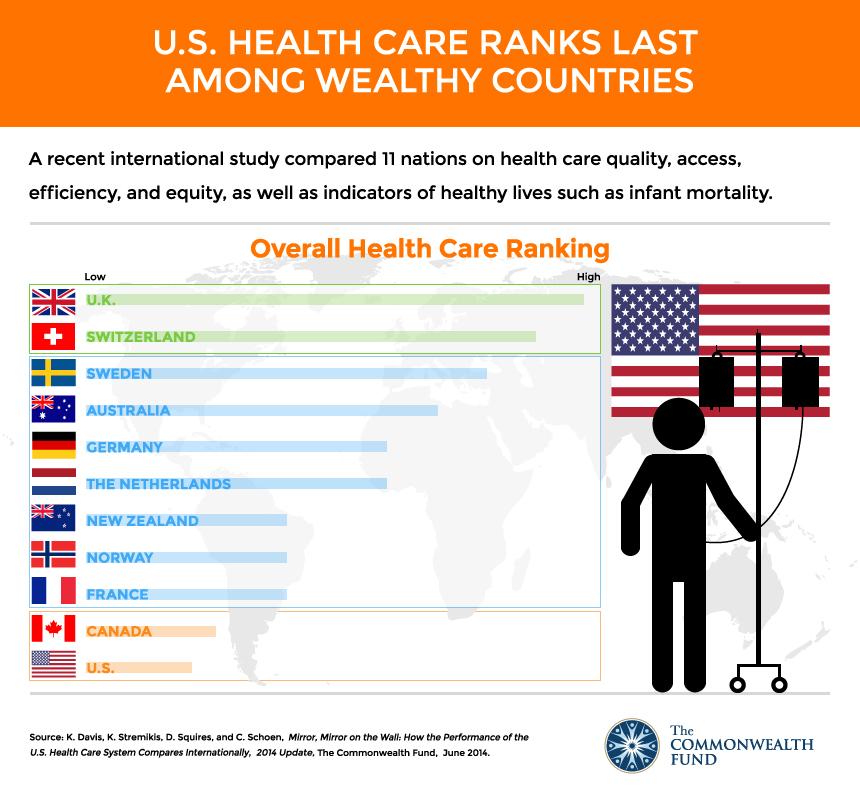
U.S. ranks last in health care compared with nine other high-income countries, report finds.People in the U.S. die the youngest and experience the most avoidable deaths, despite spending much more on health care.The U.S. ranks as the worst performer among 10 developed nations in critical areas of health care, including preventing deaths, access (mainly because of high cost) and guaranteeing quality treatment for everyone, regardless of gender, income or geographic location, according to thereport, published Thursday by The Commonwealth Fund, an independent research group. The researchers looked at how the U.S. compared with nine other countries: Australia, Canada, France, Germany, the Netherlands, New Zealand, Sweden, Switzerland and the United Kingdom. Each country was graded on five categories: access to care, care process, administrative efficiency, equity and health outcomes.
The Trump administration’s solution to the problem is to fire as many government workers as possible (Elon Musk’s Department of Government Efficiency (DOGE)) to save the government money, not to save the public money or to improve health care for the populace.
The puzzle is, can something be too simple to be believed?
In the mid-19th century, Dr. Ignaz Semmelweis discovered that washing hands with a chlorinated lime solution could significantly reduce the incidence of puerperal fever (childbed fever) among women in maternity wards.
Despite his compelling evidence and efforts to convince his colleagues, many doctors ridiculed him and refused to adopt his practices.
From Wikipedia:
Ignaz Philipp Semmelweis was a Hungarian physician and scientist who was an early pioneer of antiseptic procedures and was described as the “savior of mothers.”Postpartum infection, also known as puerperal fever or childbed fever, consists of any bacterial infection of the reproductive tract following birth, and in the 19th century was common and often fatal. Semmelweis discovered that the incidence of infection could be drastically reduced by requiring healthcare workers in obstetrical clinics to disinfect their hands. In 1847, he proposed hand washing with chlorinated lime solutions at Vienna General Hospital’s First Obstetrical Clinic, where doctors’ wards had three times the mortality of midwives’ wards. The maternal mortality rate dropped from 18% to less than 2%, and he published a book of his findings, Etiology, Concept and Prophylaxis of Childbed Fever, in 1861.Despite his research, Semmelweis’s observations conflicted with the established scientific and medical opinionsof the time, and his ideas were rejected by the medical community. He could offer no theoretical explanation for his findings of reduced mortality due to hand-washing, and some doctors were offended at the suggestion that they should wash their hands and mocked him for it. In 1865, the increasingly outspoken Semmelweis allegedly suffered a nervous breakdown and was committed to an asylum by his colleagues. In the asylum, he was beaten by the guards. He died 14 days later from a gangrenous wound on his right hand that may have been caused by the beating.
I hope I won’t be similarly confined because, for 25 years, I have struggled to explain what seems to me to be the simple concepts of Monetary Sovereignty.
The question: Is Monetary Sovereignty so simple, so obvious, that you believe “it can’t be that easy‘? (It is.) Or, “if it were that simple, someone else would have thought of it.” (Others have.)
Or, “that’s not what schools, economists, and the media teach.” (That’s the problem.)
Here are three simple facts about our economy.
1. Money is not a physical thing. Gold, silver, and paper are not money, but they can represent money.
A dollar bill is a title to a dollar, not a dollar itself.All forms of money merely are bookkeeping entries. For example, a $10 gold coin is just a title to $10. The coin always is worth exactly $10as money, though it may be worth thousands as barter. As money, that gold coin is worth neither more nor less than a $10 paper bill or the $10 on your checking account bank statement.Thus, money is just government-approved numbers on a statement.The U.S. government has the infinite ability to create these bookkeeping entries simply by pressing computer keys. 2. A government having the infinite ability to create, spend, and control a specific currencyis sovereign over that money and it is called “Monetarily Sovereign.”The governments of the U.S., Japan, the UK, Canada, and Australia are examples of Monetary Sovereignty over their respective currencies.
Alan Greenspan: “There is nothing to prevent the federal government from creating as much money as it wants and paying it to somebody.”
The governments of Italy, France, Germany, and Greece are monetarily non-sovereign. They do not have their own sovereign currencies. Instead, they use the euro, over which the European Union (EU) is sovereign. These nations can run short of euros, while the EU cannot. The nations rely on taxes; the EU needs no taxes.The Monetarily Sovereign U.S. government cannot unintentionally run short of its money. Given a creditor’s demand for a million, or a billion, or a trillion trillion dollars, the U.S. government could pay immediately, without collecting a single penny in taxes.What does that tell you about federal debt? Just as the U.S, cannot unintentionally run short of dollars, the EU cannot run short of euros.Contrast with any monetarily non-sovereign entities — euro nations, businesses or people — which do not have the infinite ability to pay bills and can run short of whatever currency they are using.3. Government spending of its Monetarily Sovereign currency is not inflationary. Historically, all inflation is supply-based — i.e, shortage(s) of critical assets, usually oil and/or food — not demand-based. While government spending can increase demand for specific products, this doesn’t cause inflation, which is an overallincrease in the prices of almost all products.
These three fundamentals seem simple and straightforward. Yet, for perhaps 25 years, I have failed to help most people understand them.
#1 confuses those who mistakenly believe the pieces of green-printed paper in their wallet are actual dollars, not just titles to dollars.
#2 is vaguely understood except by all those who believe federal finances are the same as personal finances..
#3 is denied outright by those whose vision of supply and demand makes them believe excessive demand caused inflation rather than a lack of supply.
To help people understand, I have given examples of the Monopoly game, which can be played without physical paper “money”—just a balance sheet—and that, by rule, the Bank (a corollary for the federal government) cannot run short of money.
I have presented graphs demonstrating how inflations are closely related to oil costs, not to federal spending.
I have presented graphs showing that recessions occur immediately after reductions in federal deficit spending growth and are cured by increased federal deficit spending growth.
I have shown that every depression in U.S. history has come shortly after the federal government reduced deficit spending.
1804-1812: U. S. Federal Debt reduced 48%. Depression began 1807.
1817-1821: U. S. Federal Debt reduced 29%. Depression began 1819.
1823-1836: U. S. Federal Debt reduced 99%. Depression began 1837.
1852-1857: U. S. Federal Debt reduced 59%. Depression began 1857.
1867-1873: U. S. Federal Debt reduced 27%. Depression began 1873.
1880-1893: U. S. Federal Debt reduced 57%. Depression began 1893.
1920-1930: U. S. Federal Debt reduced 36%. Depression began 1929.
1997-2001: U. S. Federal Debt reduced 15%. Recession began 2001.
I have published articles by thought leaders from 1940 to today who falsely claimed that the federal debt is a ticking time bomb. During those 84 years, the debt grew from $40 billion to $30 trillion, yet this so-called “debt bomb” never exploded.
I encounter articles daily discussing the dangers of federal debt and deficits. Currently, Congress is struggling with the absurd federal debt limit, which ignores the government’s unlimited capacity to meet its financial obligations.
Even this morning, I read again about how federal agencies like Social Security and Medicare are in danger of running short of money, though Congress could supply all the funds needed just by voting.
Every day, dollars are deducted unnecessarily from paychecks to “pay for ” some federal expense when, in fact, federal taxes pay for nothing. The federal government already has infinite dollars.
Think. With infinite dollars, why would it need taxes? A simple question with a simple answer, yet most people are stumped by it
The sole purposes of federal taxes are:
1. To control the economy by taxing what the government wishes to discourage and by giving tax breaks to what the government wishes to reward and
2. To assure demand for the dollar by requiring taxes to be paid in dollars.
3. To help the rich become more affluent by providing tax breaks not available to the rest of us.
The wealthy promote the idea of “small government,” not because they genuinely believe the unfounded claim that “government is the problem,” but because they recognize that government establishes regulations they prefer to avoid.
These regulations regarding clean air, clean water, food safety, and fair treatment by banks and businesses hinder the wealthy’s relentless pursuit of power and wealth, often at the expense of the rest of society.
Most Congresspeople understand all these points but continue disseminating disinformation for political reasons. (Wealthy political donors pay a lower percentage of their incomes than the rest of us, so useless tax collections widen the Gap between the rich and us. The Gap makes them rich; we all would be the same without it.)
Sadly, while the rich don’t want us to understand, most of us blindly follow their lead, just as the unfortunate pregnant women followed the fatal lead of mid-19th century doctors.
Through the years, I have provided examples, data, and proofs. At the same time, again, some disingenuous Congressperson, deceptive economist, misleading writer, or uninformed friend assures you that Social Security and Medicare will become insolvent without tax increases or benefit cuts.
Monetary Sovereignty is not complicated. It’s not, as they say, “rocket science.” It’s dead simple.
However, I do not know how to help the populace understand what will benefit them.
Consider the suggestion: “Eliminate FICA.” Is that too difficult to contemplate, or is it too easy to believe?
What is the psychology of the millions who cannot accept the often-proven fact that the federal government has infinite money while accepting the never-proven nonsense that a Presidential election was stolen?
Would you be outraged if your local car dealer tried to overcharge you or if your favorite football team refused to honor your tickets? Where is your passion against paying thousands of dollars in unnecessary taxes? Where is your anger about billionaire Trump paying far less taxes (almost nothing, actually) than you do?
Why aren’t you frothing at the mouth about your doctor bills when the federal government could and should fund comprehensive, no-deductible Medicare for every man, woman, and child in Americawithout collecting a penny in taxes?
Why aren’t you screaming on the phone about proposed cuts to Social Security?
If you heard about a billionaire who refuses to give his infant child enough money for medical care, would you be outraged? Well, the government is a multiple trillionaire, and you are its child. Get outraged.
If I can’t convince people to make meager efforts to contact their Congresspeople about something that will save them many thousands of dollars and their health, improve their lives and their children’s lives, all at no cost, what is the purpose of reason?
You’ve gone through the effort of reading this far. Why not make it meaningful? Call your Senator and Representative. Today. Now.
“Why not” is the puzzle.
Rodger Malcolm Mitchell
Monetary SovereigntyTwitter: @rodgermitchellSearch #monetarysovereigntyFacebook: Rodger Malcolm Mitchell;MUCK RACK: https://muckrack.com/rodger-malcolm-mitchell; https://www.academia.edu/
……………………………………………………………………..
The Sole Purpose of Government Is to Improve and Protect the Lives of the People.











 #Monetary Sovereignty - Mitchell