THE END OF THE AMERICAN EXPERIMENT
#Monetary Sovereignty – Mitchell
Economics, Money and Debt
THE END OF THE AMERICAN EXPERIMENT
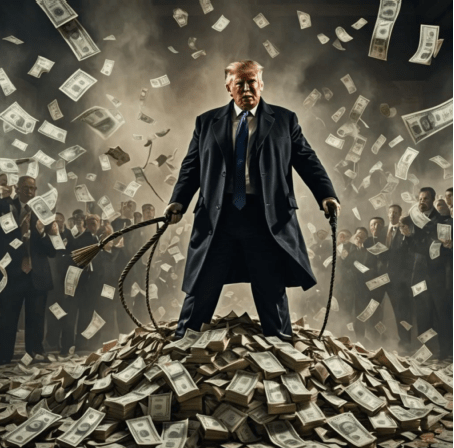
We also predict that the people who voted for Trump will deny it within two years. It’s already beginning.
CHAT GPT: A crucial distinction between Monetary Sovereignty (MS) and Modern Monetary Theory (MMT): The MS model holds that inflation is not primarily caused by excessive federal spending, as some traditional economic theories might suggest. Instead, MS argues that inflation is generally driven by shortages of key resources, such as Oil, food, shipping, raw materials, and labor. MS’s Rodger Malcolm Mitchell asserts that prices increase when key goods or resources become scarce—due to supply chain disruptions, natural disasters, geopolitical factors, or other bottlenecks—leading to inflation. The price increases are a natural response to the scarcity of goods and services rather than an overabundance of money or federal spending. Interestingly, Mitchell argues that federal spending can help cure inflation, but only when that spending alleviates resource shortages. For example: Government spending can increase the availability of scarce resources, such as investing in energy infrastructure (e.g., renewable energy sources), food production, transportation networks, or manufacturing capacity. By directing spending to increase supply, the government can reduce the constraints that cause inflation in the first place. MMT generally views inflation as the result of too much money in circulation relative to the economy’s productive capacity. According to MMT, the government must balance its spending with the available resources (labor, capital, etc.), and excessive government spending could lead to inflation if it exceeds the economy’s ability to produce. The Zimbabwean hyperinflation crisis is often misunderstood in the context of the traditional view of inflation. In fact, the case of Zimbabwe illustrates Monetary Sovereignty (MS) principles quite well and highlights how resource scarcity (not just printing money) can drive inflation. The land reform program in Zimbabwe, particularly in the early 2000s, led to the forced redistribution of land from white farmers to Black Zimbabweans. Many of the new land recipients had little experience in commercial farming, leading to a collapse in agricultural production, especially food crops. This food shortage was a key driver of the economy’s inflationary pressures. As basic food staples became scarcer, prices skyrocketed, leading to the classic symptoms of hyperinflation. The government responded to the economic crisis by printing more money to finance its expenditures, such as paying public sector workers and funding other projects. This led to the devaluation of the currency and worsening inflation, which spiraled out of control. However, traditional economic analysis often blames currency printing as the sole cause of inflation. The government’s money creation exacerbated the situation but wasn’t the root cause. The actual driver was the scarcity of food, which caused demand-pull inflation (more money chasing fewer goods) and cost-push inflation (rising production costs due to shortages). The Monetary Sovereignty approach would argue that the government should have spent money to address the food shortage by helping farmers improve production, securing food imports, or providing subsidies to reduce food prices. By resolving food scarcity, inflation could have been mitigated and controlled. If the Zimbabwean government had used its control over its currency and focused on producing or importing food rather than printing money as a catch-all solution, inflation could have been reduced, and the country could have avoided the worst hyperinflation. The Monetary Sovereignty model suggests that the government can effectively use its monetary power to respond to shortages. If Zimbabwe had directed its spending toward increasing food production and resolving supply-side constraints (such as infrastructure, farming skills, and food security), inflation could have been curbed without the need for drastic currency printing. This example illustrates how inflation is not always caused by excessive government spending or money creation but rather by the scarcity of key resources essential for economic stability. In such cases, targeted government spending to alleviate resource shortages can help resolve inflationary pressures.While MS and MMT agree that inflation occurs when demand exceeds supply, the question of the fundamental cause remains. Does increased government spending increase demand and cause inflation? Or do certain factors — weather, disease, strikes, legislation, etc. — reduce supply to cause inflation? In Zimbabwe, the fundamental cause was reduced supply, resulting in government currency printing. It can be argued that America’s most recent inflation was caused by COVID-related shortages of oil, food, shipping, labor, metals, wood, computer chips, and virtually every other supply source.
GRAPH I

The COVID-19 pandemic provides another important example of inflation being driven largely by supply-side shortages rather than simply an excess of money creation. The inflationary pressures seen in the wake of the pandemic were not caused by massive money creation during the pandemic but rather by a series of supply-side shocks that disrupted global supply chains and reduced the availability of key goods and services. The pandemic caused widespread disruptions to supply chains. Factories shut down, shipping routes were interrupted, and workers became unavailable due to illness or lockdowns. These disruptions made producing and distributing goods more complex, creating scarcity in many sectors. Shipping costs also skyrocketed, with container shortages and delays affecting the global movement of goods. As a result, the cost of goods increased significantly due to increased production costs and shipping costs. The pandemic caused significant labor shortages, especially in agriculture, manufacturing, retail, and healthcare industries. In many cases, workers had to stay home due to illness, quarantine measures, or childcare needs, while others left their jobs in search of better pay or conditions. These labor shortages reduced the supply of goods and services, which also contributed to higher prices as businesses struggled to maintain production and service levels. Prior to the pandemic, central banks (especially the Federal Reserve) had already undertaken massive money creation through quantitative easing and low interest rates, trying to stimulate the economy after the 2008 financial crisis. This led to a substantial increase in the money supply (in the form of bank reserves), but we didn’t see the inflationary spike that many had predicted. In fact, despite these high levels of money creation, inflation remained relatively low because the economy was still underperforming in terms of demand, and plenty of idle resources (like unemployed workers) kept inflation in check. However, COVID-19 changed the dynamics: The money supply wasn’t the primary driver of inflation during the pandemic. The money was already in the system, and inflation didn’t surge until the COVID-related supply shocks started to hit. The inflation we saw during and after the pandemic was caused by disruptions in the supply of key goods—like food, energy, and raw materials—along with labor shortages, not an excess of money. According to Rodger Malcolm Mitchell’s Monetary Sovereignty model, the inflation we saw was caused by resource shortages, not excessive government spending or money creation. Federal spending and money creation during the pandemic were responses to the economic collapse caused by the shutdowns. Governments around the world increased spending to support workers and businesses, but this spending did not directly cause inflation. If the U.S. government (or any sovereign nation) had spent its resources on addressing the supply shortages—for example, by improving manufacturing capacity, addressing supply chain issues, and incentivizing workers to return to work—this could have helped mitigate inflation. Summary: The COVID-19 inflation crisis mirrors what happened in Zimbabwe, where inflation was driven by scarcity of key resources (not just excessive money creation). In both cases, the real cause of inflation was resource shortages—whether in food, labor, or manufacturing—and not the amount of money in circulation.The Zimbabwe and COVID inflations were not unique. Historically, they were typical of inflations because they were caused by shortages, especially oil and food shortages, not by the money supply. Here is a comparison of America’s money supply vs. inflation.
GRAPH II

GRAPH III

GRAPH IV

GRAPH V

……………………………………………………………………..
The Sole Purpose of Government Is to Improve and Protect the Lives of the People.
MONETARY SOVEREIGNTY
WITHIN TWO YEARS, THE PEOPLE WHO VOTED FOR TRUMP WILL DENY IT. BY THEN IT MAY BE TOO LATE.
First, he’ll deport the criminals. Then, the innocent but undocumented. Then, the birthright citizens and the Dreamers. Then, everyone who criticizes Trump. Hitler never stops.DOD Working on Guantanamo (Trump’s Auschwitz) White House press secretary Karoline Leavitt confirmed that the Department of Defense (DOD) is working on increasing the bed capacity at the U.S. Guantanamo Bay Naval Base in Cuba for housing illegal immigrants arrested by U.S. Immigration and Customs Enforcement (ICE) agents.The cost of finding, arresting, transporting, feeding, and housing the immigrants will be enormous, not to mention the economic cost of losing that many workers and consumers. Many are parents of young children. What will become of those children? WHAT WILL BECOME OF THOSE CHILDREN? Meanwhile, Trump is trying to cancel the student lunch program because of the cost. Plenty of money to catch, feed, and shelter Guantanamo, but not enough to feed innocent school children.The action will allow the United States to use Guantanamo in its “full capacity to provide critical extra detention space for high-priority criminal illegals” because U.S. immigration officials continue to make more arrests across the country, she said. Earlier this week, Trump said in a memorandum that he is instructing the DOD to prepare Guantanamo to detain illegal immigrants with criminal records. In a speech at the White House, he said the facility at Guantanamo will hold 30,000 individuals, whom he described as the “worst criminal illegal aliens threatening the American people.”
WHAT KIND OF NATION APPROVES OF CRUELTY TO CHILDREN?
“This will double our capacity immediately,” he said, adding that Guantanamo is a “tough” place to escape from. The detention facility at Guantanamo Bay was set up in 2002 by President George W. Bush to detain foreign militant suspects following the Sept. 11, 2001, terror attacks on the United States. There are 15 detainees left in the prison. Trump’s predecessors, Presidents Barack Obama and Joe Biden, sought to shut down the Guantanamo prison and were only able to reduce its inmate population, but Trump has said he would keep it open. Leavitt said that 97 percent of people who were deported from the United States in recent days “had a removal order from the previous administration that the previous administration refused to act on” and that the Trump administration is “following the law.”Absolute guarantee: Trump soon will begin removing all undocumented immigrants–not just criminals– and shipping them to Auschwitz. MAGAs laugh. Does America’s cruelty never end? Rodger Malcolm Mitchell Monetary Sovereignty Twitter: @rodgermitchell Search #monetarysovereignty Facebook: Rodger Malcolm Mitchell; MUCK RACK: https://muckrack.com/rodger-malcolm-mitchell; https://www.academia.edu/
……………………………………………………………………..
The Sole Purpose of Government Is to Improve and Protect the Lives of the People.
MONETARY SOVEREIGNTY
 #Monetary Sovereignty - Mitchell