BACKGROUND
The federalgovernment, being Monetarily Sovereign has infinite money. It neither needs nor uses tax dollars. It never can run short of dollars.
The U.S. federal government has infinite dollars.
Contrary to popular wisdom, federal taxpayers do not fund federal spending.
Instead, the government creates new dollars, ad hoc, every time it pays a bill.
The economy does not have infinite money and needs a continual input of dollars to grow.
Gross Domestic Product, (GDP) a measure of spending, also is a measure of growth.
Federal deficit spending provides that continual input, without which we would have recessions and depressions.
Libertarianism is not the most ignorant idea on the planet. Trumpism surely wins the gold medal in that contest.
But Libertarianism’s endless insistence that a gigantic nation should have a small government and that every expenditure always, always, always is too large puts them in the running for at least a bronze or perhaps even a silver medal.
Here is their latest bit of humor masquerading as fiscal prudence.
This latest expense is yet more evidence that sweeping student loan forgiveness will end up doing considerable economic harm. by Emma Camp | 10.14.2022 1:30 PM
While the incredible costs of the Biden administration’s federal student loan forgiveness plan are widely known, yet another expense of the program is stirring controversy: maintaining the online application for loan forgiveness is expected to cost nearly $100 million annually.
This latest expense—not included in the Congressional Budget Office’s recent estimate of the program’s cost to taxpayers—is yet more evidence that sweeping student loan forgiveness will end up doing considerable economic harm.
Why will adding $100 million stimulus dollars do “considerable economic harm”? Ms. Camp never explains why or what that “harm” is.
Federal deficit spending is precisely what the government does to prevent and cure recessions. But Libertarians never acknowledge the facts that stare them in the face.
Contrary to popular wisdom, the Great Depression of 1929 was not caused by the stock market crash. Nor was it caused by bank failures. Nor was it caused by Smoot-Hawley. Nor was it caused by drought. Nor was it caused by speculation.
The Great Recession of 2008 was caused by insufficient deficit spending and years of federal surpluses, which took dollars out of the economy.
1804-1812: U. S. Federal Debt reduced 48%. Depression began 1807.
1817-1821: U. S. Federal Debt reduced 29%. Depression began 1819.
1823-1836: U. S. Federal Debt reduced 99%. Depression began 1837.
1852-1857: U. S. Federal Debt reduced 59%. Depression began 1857.
1867-1873: U. S. Federal Debt reduced 27%. Depression began 1873.
1880-1893: U. S. Federal Debt reduced 57%. Depression began 1893.
1920-1930: U. S. Federal Debt reduced 36%. Depression began 1929.
1997-2001: U. S. Federal Debt reduced 15%. Recession began 2001.
Eventually, the Great Depression was cured by more deficit spending. Libertarians are oblivious to those facts.
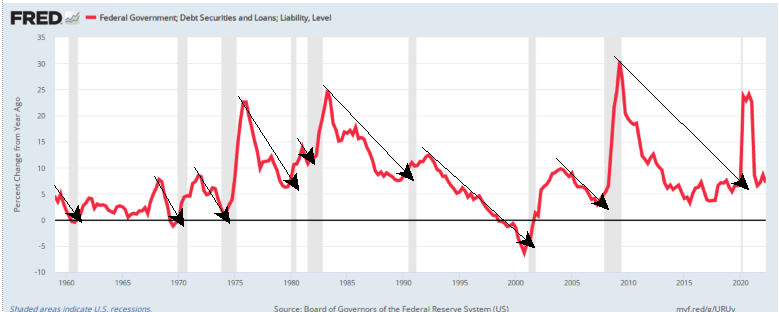
Every recession (vertical gray bar) is immediately preceded by a federal deficit spending growth reduction.
It doesn’t take a genius to see this.
All Spending + Net Exports = GDP. GDP is a measure of our economy. It also is a measure of spending.
Spending relies on dollars. On average, more dollars = more spending. Add dollars to an economy, and GDP will increase.
Federal deficits add dollars to the economy.
Therefore, federal deficits increase GDP and prevent/cure recessions and depressions.
In August, President Joe Biden announced a sweeping federal student loan forgiveness plan.
Under the proposal, most borrowers making under $125,000 annually and married couples making less than $250,000 would receive $10,000 each in loan forgiveness.
For borrowers who received a Pell Grant, forgiveness is increased to $20,000.
The program stands to be wildly expensive, with recent estimates from the Congressional Budget Office predicting that its cost will be $400 billion.
Translation: The program will pump 400 billion growth dollars into the economy. (The program would fail to remove 400 billion dollars from the economy.)
However, as the Biden administration gears up to formally release the online application for loan forgiveness, other large costs are also becoming clear.
Documents submitted by the Education Department to the Office of Management and Budget show that the department estimates it will cost $99,900,000 per year to maintain the application and the program’s associated communications through March 2024.
According to the Department of Education, these costs are “related to development of website forms, servicer processing, borrower support, paper form processing and communications related to this effort.”
Translation: The program will also fail to remove an additional 99,900,000 growth dollars annually from the economy.
While the current estimate for application maintenance and support is high, there is reason for concern that the cost will come to exceed that.
For example, the ill-fated HealthCare.gov website was originally estimated to cost $93.7 million—yet it eventually grew to cost taxpayers over $2 billion.
Translation: The HealthCare.gov website pumped 2 billion growth dollars into the economy and cost taxpayers nothing.
The Big Lie in economics is that federal taxes pay for federal spending. While state/local taxes pay for state/local government spending, federal taxes pay for nothing. They are destroyed upon receipt.
All taxes are paid from checking accounts, the dollars which are part of the M2 money supply.
Dollars paid to state/local governments are deposited into banks and remain in the M2 money supply.
But tax dollars paid to the U.S. Treasury disappear from any money supply measure. There is no money supply measure of dollars held by the federal government.
The reason: Unlike state/local governments, the federal government has infinite dollars. It is Monetarily Sovereign. It creates dollars at will.
Former Fed Chairman Ben Bernanke: “The U.S. government has a technology, called a printing press (or, today, its electronic equivalent), that allows it to produce as many U.S. dollars as it wishes at essentially no cost.”
Your federal tax dollars leave the M2 money supply and disappear into the infinity of the Federal government’s unlimited ability to create new dollars. That is how the federal government pays all its bills: By creating new dollars, ad hoc, not by using tax dollars.
Considering that the Biden administration already appears to be lowballing the cost of student loan forgiveness, estimating that federal student loan forgiveness will only cost $240 billion over the next decade, there is reason to worry that it is underestimating the cost of maintaining its application website as well.
Translation: There is reason to believe the program will pump even more than 240 billion growth dollars into the economy over the next decade.
This problem could have been avoided if student loan forgiveness had been enacted through the legislative process rather than by executive fiat.
Translation: The growth dollars wouldn’t have been provided by a Senate hamstrung by Republicans, who hate giving money to anyone but the very rich. So Biden had to do it via executive fiat.
The staggering price the Biden administration places on upkeep for the student loan forgiveness application is yet more evidence of the true, bloated nature of the policy. It should come as no surprise that student loan forgiveness will be riddled with extra costs—costs that will no doubt be pushed onto taxpayers.
Translation: The cost of upkeep is more evidence of the actual benefits of the policy.
Student loan forgiveness will provide additional growth spending that will cost taxpayers nothing but benefit college students and the entire economy.
SUMMARY
The federal government is Monetarily Sovereign. It uniquely has the unlimited ability to create U.S. dollars.
Federal deficit spending is necessary to prevent and cure recessions and depressions. It costs federal taxpayers nothing. Federal taxes are destroyed upon receipt by the Treasury. To pay for goods and services, the federal government creates new dollars ad hoc.
Federal deficit spending does not cause inflation, and if used to purchase and disseminate scarce goods and services, federal deficit spending can cure inflation.
Reducing students’ loan costs not only helps the students and America’s educational competitiveness but stimulates the economy,
Rodger Malcolm Mitchell
Monetary SovereigntyTwitter: @rodgermitchellSearch #monetarysovereigntyFacebook: Rodger Malcolm Mitchell
……………………………………………………………………..
Government’s Sole Purpose is to Improve and Protect the People’s Lives.
I come from Chicago, and so am, by DNA, a Bears fan.
We Bears fans often ask, “Given that they repeatedly have high draft choices, why are their teams so bad, year after year?” (Cleveland Browns fans can empathize.)
The answer can be stated in two words: Bad leadership. And that also answers the title question, “Why is inflation so hard to defeat?” Bad leadership.
Here are quotes from the Committee for a Responsible Federal Budget (CRFB), which usually parrots the propaganda of the very rich:
Inflation is currently surging at the fastest rate in more than four decades, with the Consumer Price Index (CPI) up 8.2 percent over the past year and Personal Consumption Expenditure (PCE) price index up 6.2.
By comparison, the Federal Reserve (“the Fed”) generally targets 2 percent annual PCE inflation.
In general, the federal government has two types of tools available to fight inflation. Monetary policy, conducted by the Federal Reserve, can raise interest rates.
Or fiscal policy, controlled by the Congress and President, can adjust taxes and spending.
Immediately, they limit possible tools to those that impact the “not-rich” and widen the Gap between the rich and the rest. It’s known as “Gap Psychology,” the human desire to widen the income/wealth/power Gap below you and to narrow it above you.
“Raise Interest Rates” Impacts homebuyers who seek mortgages.
Adjust Taxes: “Adjust” is a disingenuous word for “raise.” When taxes are raised, the rule always includes exceptions and loopholes for the rich, not for the rest of us.
Adjust Spending: Here, “adjust” means “cut.” Deceptively, the CRFB uses one word to mean two opposite things.
When federal spending is cut, benefits to the middle and the poor always suffer. The false “need” to cut spending will be reflected in the Big Lie in economics that Social Security and Medicare are “running short of dollars” and that all aids to the poor, students, renters, etc., are “unaffordable.” Utter nonsense.
Specifically, Congress and the President can use their tools to assist the Federal Reserve in its efforts to fight inflation. Using fiscal policy in this situation can:
Ensure all federal actions are rowing in the same direction;
Reduce recessionary pressures and support stronger economic growth;
Diversify and limit the economic pain from inflation-reducing actions; and
Reduce the budgetary cost of fighting inflation.
The CRFB wants everyone to “row in the same direction.” Lovely words. But it also wants to “support stronger economic growth” and “limit economic pain” while raising taxes and cutting spending.
What the CRFB means by “rowing in the same direction.”
It is impossible to support economic growth and limit economic pain while raising federal taxes and cutting federal spending. Absolutely, 100% impossible.
Federal Reserve in fighting inflation. Through deficit-reducing tax and spending changes, they can help temper demand, boost supply, and directly or indirectly lower prices in the economy.
Translation of the above sentence: “By taking dollars out of the economy, they can take dollars from consumers, reduce supply, and drive the economy into a recession.
Congress and the President should act soon to pass legislation that helps fight inflation on all of these fronts.
Key to any legislation will be deficit reduction, which 55 of the nation’s top economists and budget experts recently explained is one tool in helping to ease inflationary pressures.
Translation: “55 of the nation’s top economists say to ease inflation, we must plunge the economy into a recession. (And never mind about stagflation, which we have no idea how to fight.) This is known as “austerity,” which was attempted in the euro nations. [From the Harvard Business Review, September 28, 2018]:
Eurozone governments – especially those in struggling Southern European countries (Spain, Greece, or Portugal) – switched dramatically towards austerity in the years 2010-2014.
Most experts now agree that these policies had such damaging and persistent negative effects on growth that they were self-defeating.
Governments were reducing spending in order to bring their debt levels under control. But GDP fell so much that . . . debt became even less sustainable than before the austerity measures were implemented.
Consider that euro nations are monetarily non-sovereign, like you and me. Their debt is like my debt and yours. We are not Monetarily Sovereign, so we don’t have the unlimited ability to create dollars.
They had to cut debt because the Monetarily Sovereign EU wouldn’t support them. The Monetarily Sovereign U.S. doesn’t and shouldn’t cut “debt” (which isn’t real debt) or deficits, and there is no reason for the U.S. to undergo the horrors of austerity.
But that is exactly what the “55 top economists” recommend.
At a minimum, Congress and the President should stop adding to the deficits, so that fiscal policy is not worsening inflation.
Translation: “At a minimum, Congress and the President should stop adding dollars to the private sector so that a recession is assured.”
In addition to helping contain inflation, thoughtful deficit reduction can also help to grow the economy, reduce geopolitical risks, improve fairness and efficiency of the budget and tax code, and put the national debt on a more sustainable path.
Translation: “In addition to helping cause a recession, mindless deficit reduction can also help to shrink the economy, exacerbate geopolitical risks, have no effect on the fairness and efficiency of the budget and tax code, and put the nation on a path to a recession or depression.
When federal debt growth (green line) shrinks, we have recessions (vertical gray bars), which are cured by federal debt growth increases.
Inflation in the United States has been elevated for 22 months and shows few signs of abating.
High inflation originated from a mismatch between total demand and supply in the economy – largely as a result of constraints from the COVID-19 pandemic and an aggressive fiscal and monetary policy response.
Translation: Inflation has been growing because COVID caused reductions in the supply of oil, food, computer chips, shipping, labor, and other goods and services. The resultant scarcities caused prices to rise.
The Federal Reserve has already begun to act, raising interest rates by three percentage points since March of 2022, beginning to shrink its balance sheet, and signaling further tightening – with rates headed toward 4.6 percent by the end of 2023 – until inflation is brought under control.
Translation: The Federal Reserve’s massive interest rate increases have done nothing to increase the supplies of oil, food, etc., so they have done nothing to cure inflation.
Economists believe that monetary policy should play the lead role in stabilizing the economy because of the Federal Reserve’s ability to act quickly and effectively to adjust interest rates, using its technical expertise and political insulation to balance competing priorities.
In this case, the Fed can expeditiously and gradually raise interest rates and shrink its balance sheet – based on real-time data – to encourage savings, discourage large purchases, and reduce wealth-driven consumption.
And as we can see, the Fed’s expeditious and gradual interest rate raise has cured inflation. Oh, it hasn’t because it does nothing to remedy shortages?
Would someone please tell the CRFB and the 55 top economists? And by the way, “Encourage savings, discourage large purchases, and reduce wealth-driven consumption” describes a recession.
Yet even as the Fed is better equipped to bring down inflation, doing so is not without its challenges.
Higher interest rates put upward pressure on the unemployment rate and can also lead to financial instability – especially when rates are increased well above the long-term neutral rate (believed to be 2.5 to 3.0 percent).
Indeed, some recent research suggests the inverse relationship between inflation and unemployment described under the Phillips curve might be particularly strong now, suggesting a high “sacrifice ratio” whereby reductions in inflation require large increases in unemployment.
The CRFB has it all backward. High prices don’t cause unemployment. Unemployment occurs because shortages of goods and services discourage hiring. You don’t hire more people when you can’t produce, ship, or service.
In acting alone to fight inflation, there is a substantial risk and perhaps likelihood the Fed’s actions will spur an economic recession.
Finally, one factual statement from the CRFB. More than a “substantial risk. It borders on certainty.
The Federal Reserve has only a limited set of tools to fight inflation, which work by boosting interest rates.
While generally effective in reducing inflation, higher interest rates can also impose substantial pain on the housing and labor markets, reduce investments that promote long-term growth, and take a long time to affect the economy.
Translation: Replace the word “effective” with “ineffective and economically harmful.” The rest of the sentence is correct.
For these and other reasons, economists and policymakers have long supported supplementing monetary policy with fiscal stimulus to fight recessions.
Elemendorf and Furman, for example, argue policymakers should sometimes use fiscal policy even though monetary policy is superior.
Fiscal stimulus (i.e., federal deficit spending) always (not “sometimes”) is necessary. It should be targeted toward reducing shortages: More federal spending to aid oil exploration and production, to aid and encourage food production, and to encourage hiring.
The first step: The FICA tax should be eliminated, a monumental and useless drag on the economy. The federal government neither needs nor even uses FICA dollars for anything. It destroys them upon receipt.
When FICA dollars are sent to the Treasury, they come from the nation’s M1 money supply measure. But when they reach the Treasury, they cease to be part of any money supply measure. They effectively are destroyed.
There is no measure for the government’s money supply because the government has infinite money.
Specifically, spending increases and tax cuts work to boost demand in the near term, while high levels of projected deficits and debt can boost inflation expectations.
One standard measure of an economy is Gross Domestic Product (GDP). It is a measure of spending. The CRFB admits that federal spending increases will increase GDP.
And what will federal spending decreasesdo? Right, they will decrease GDP.
“Recession” is a decline in GDP for two or more quarters, and a depression is a decline in GDP for two or more years. Unwittingly, the CRFB and the 55 top economists have admitted recommending a recession or depression as the cure for inflation.
This is especially true if markets believe the government will attempt to inflate away a portion of its debt.
The notion of the federal government inflating away its debt is nonsense on several levels.
I. The federal government’s “debt” is nothing like personal or local government debt. It’s deposits into privately owned T-security accounts, which the government pays off upon maturity simply by returning the dollars.
The government neither uses nor even touches those dollars. You, as a depositor, own them.
The government spends using dollars newly created, ad hoc. The federal government never can run short of its sovereign currency.
II. Inflation does not affect the government’s ability to return the dollars in T-security accounts. Federal interest rate increases affect the number of dollars in those accounts, but the number does not affect the government’s ability to return those dollars.
No matter how large the “debt” (that isn’t a debt), the government just returns the dollars. It’s like a safe deposit box. No matter the value, the contents belong to you, and the Bank simply returns them.
III. The CRFB’s comments demonstrate their confusion between federal (Monetarily Sovereign) debt vs. state government and personal (monetarily non–sovereign) debt.
It’s the classic case of using one word with two unrelated meanings.
Personal debt comes from borrowing, wherein the borrower needs the dollars for some use. Federal “debt” comes from the federal government’s desire to stabilize the dollar by providing a safe haven for unused dollars.
The government neither needs nor uses those dollars. It has the unlimited ability to create dollars for any purpose.
Contrary to popular myth, the U.S. federal government never borrows U.S. dollars. Same reason: It has the infinite ability to create new dollars. Additionally, those T-security accounts help the government control interest rates.
Sadly, the CRFB either doesn’t understand economics or deliberately misleads its readers on behalf of the rich. Their hope might be to discourage the “not-rich” from asking for benefits, thereby increasing the Gap and making the rich comparatively more affluent.
Enacting deficit reduction during a period of high inflation can also help to reassure markets that elected officials are committed to responsible policy and won’t attempt to undermine Federal Reserve tightening in the future should inflation persist.
What can one say about the above nonsense? Deficit reduction (aka subtracting dollars from the economy) during high inflation will assure the markets that elected officials are committed to causing a recession or a depression.
While higher interest rates help to fight inflation, they also increase the risk of a recession by weakening labor markets and threatening financial stability.High interest rates also discourage personal and business investment, which in turn slows long-term income and economic growth.
Right, CRFB, except for the false “help fight inflation” part. But what happened to the CRFB’s “row in the same direction” philosophy?
Following their warning about the risk of recession, the CRFB published many word-salad paragraphs that could be summarized thus: “We should increase deficit spending without increasing deficit spending” and do all that to “stimulate the economy without stimulating the economy.”
Got it?
Of course, they had to finish with the Big Lie in economics that the federal government’s spending is constrained by tax income. Like the Bank in a Monopoly game, the federal government doesn’t need tax dollars. It can create all the new dollars it needs.
Even if all tax collections totaled $0, the federal government could continue spending forever.
Given the risks and threats from deficits and debt, substantial deficit reduction is needed even absent high inflation.
Surging prices makes deficit reduction more necessary and urgent while dramatically reducing any macroeconomic risks associated with near-term deficit reduction.
Wha? Surging prices . . . reduce risks of near-term recession?? Where did that idea come from?
The lie they want you to believe.
It’s almost as wrong-headed as their final paragraph:
Rather than continuing to enact policies that increase deficits and worsen inflationary pressures, Congress and the President should act swiftly to enact deficit-reducing legislation that would help the Federal Reserve fight inflation today, while putting the national debt on a more sustainable pathfor years to come.
So there it is folks. Allowing the world to deposit dollars into T-security accounts is not sustainable because . . . well, no one knows why.
It’s just what the rich want you to believe, so you will be docile and obedient when they tell you they have to cut Social Security, Medicare, ACA, aid to students, assistance to the poor, and, oh yes, raise your taxes.
The rich become more prosperous by widening the Gapbetween the rich and the poor.
Why is inflation so hard to defeat? We Bear fans understand the concept perfectly. Bad leadership.
If you vote, you might get what you want. But if you don’t vote, you definitely will get what other people want.
Today, I heard a Public Broadcasting radio show where young people of voting age were asked why they planned not to vote.
It wasn’t a survey, of course. Only a handful answered. But those answers were interesting.
The students described themselves as some combination of black, brown, gay, female, libertarian, poor, poorly educated, and/or immigrant.
Paraphrasing their answers:
“I don’t see many people like me in Congress.”
“Both parties are bad.”
“They made it too hard to vote
“My vote doesn’t matter.”
“They promise to [cut global warming, lower my taxes, support the poor, build a wall, etc.] but don’t do it.”
MOSTLY OLD, WHITE MEN
1. I don’t see many people like me in Congress.” The natural tendency is for people to vote for people who are like them. Blacks tend to vote for blacks, Cubans for Cubans, Jews for Jews, Texans for Texans, women for women, gays for gays, etc.
I say “tend” because there are massive exceptions. But generally, people believe that people who look like them or are in similar situations also will think like them and vote like them.
It’s almost like fandom. If born in Chicago, you tend to be a Bears fan. And each year, you believe the team will be good.
Then comes the surprise. The Bears stink, and Clarence Thomas, who has spent his life trying to demonstrate he really isn’t black, proves to be no friend of blacks.
The exceptions that prove the rule are all around us. By that rule, Donald Trump and the entire Republican party should receive votes only from white Protestant supremacists. He has demonstrated his loathing for every other group. Yet he received 70+million votes in the past election.
Did all those blacks, browns, yellows, reds, women, gays, Jews, Muslims, immigrants, Mexicans, and people from Central and South America, really not know what he has said about them?
Sadly, those kids who won’t vote, and are waiting for someone like them, seldom will see anyone like them because they don’t vote. If you aren’t considered a serious voter, the political parties won’t put up people like you as candidates.
If you vote, you might get what you want. But if you don’t vote, you definitely will get what other people want.
2. “Both parties are bad.” This generally comes from people who don’t pay much attention to the news and have only a vague idea about what is happening.
Yes, if you are looking for absolute honesty from someone who always agrees with you, both parties are bad. And if you’re waiting for the perfect woman, who always agrees with you, you will stay unmarried and should consider buying a Sheltie.
People are not perfect. People have flaws, politicians as much as anyone. Maybe more. But if your reason for not voting is you’re waiting for absolute truth and perfection, you simply have adopted a convenient excuse for laziness.
The logical thing is to hold your nose and vote for the lesser evil. Before that, you might try to read and find out what each party and each candidate really stands for.
If you vote, you might get what you want. But if you don’t vote, you definitely will get what other people want.
WAITING TO VOTE
3. “They made it too hard to vote.” You have my sympathy if you live in a red state and are black. They are doing everything possible to disenfranchise you.
But election results matter. The winners will control much of your future for 2, 4, or 6 years and beyond.
You work hard for many hours to give yourself and your family a chance for a decent life. Maybe you’ll get it, and perhaps you won’t. But you risk the time and the effort for the possibility.
It’s worth spending part of one day casting your vote to increase the possibility that your candidate will help you to a better life, or at least won’t take away the life you have.
If you’re a woman who might one day need an abortion, you know what I mean.
If you vote, you might get what you want. But if you don’t vote, you definitely will get what other people want.
If you give to charity, your contribution doesn’t matter unless you’re giving millions. So why do you give $10 to a charity that collects millions and wouldn’t notice whether you gave or not? Or to a candidate who collects millions, doesn’t need your contribution, and may not even win?
You do things not because you expect a reward or effect but because you’re part of a community. You help a stranger who asks for directions. You give to a trick-or-treater. You drop money into the bell ringer’s kettle. You help an elderly person carry a package.
You phone a sick friend. You pick up a scrap of paper and throw it in a trash can. You drop a toy into the collection box, not knowing whether a kid will appreciate it.
You brush snow off your neighbor’s car without telling him. You write a good evaluation of a waitress, anonymously.
You do things because you know they are the right things to do, and it makes you feel good to be a positive force, however small.
Your voting could influence others to vote. And if all those people, who felt their individual vote didn’t matter, suddenly followed your lead and voted, you would find yourself part of a vast, difference-making movement that elects someone you prefer.
If you vote, you might get what you want. But if you don’t vote, you definitely will get what other people want.
5. “They promise to [cut global warming, lower my taxes, support the poor, build a wall, etc.] but don’t do it.”
That’s politics. Good politics. Because if one person, or even one political party, could do everything it promises or wants to do, we would call that a dictatorship.
Instead of bemoaning the failure of promises, ask yourself, “Which party, or which candidate, is most likely to try to do what I want?”
If you feel global warming is of prime concern, which party or candidate is more likely to do something about it? Who is more likely to lower your taxes, support the poor, build a wall, or legalize abortion?
Given that all politicians lie, which ones are less addicted to lying?
Adding your vote demonstrates to both parties which issues are most likely to garner votes.
So if you don’t really care about your future, your family’s future, America’s or the world’s future, don’t vote. When someone complains about the government, I always ask, “Did you vote?”
My feeling is if you don’t vote, don’t complain about the situation. If you don’t care enough to vote, why should anyone care about your complaint?
If you vote, you might get what you want. But if you don’t vote, you definitely will get what other people want.







 #Monetary Sovereignty - Mitchell