I have told you why federal deficits are necessary to grow the economy and why they don’t cause inflation. I have told you why interest rate increases are counterproductive in fighting against the shortages that do cause inflation.
And all of the information is completely useless to you because you have no control.
So here is something you can control: Getting the smoothest shave you ever had.
Being closer to 88 than 87 years old, I probably have shaved longer than you have. I began using a shaving brush and soap cup, which generated a nice thick lather but was somewhat of a waste of time.
I graduated to spray cans of Gillette shaving cream, which also generated a thick lather and came in a variety of “flavors” like mint and regular. And there I stayed for decades, until . . . .
. . . . until I thought about it.
The fundamental purpose of shave cream is to lubricate your skin. Sure, it does other things like cooling and “softening” (doubtful), but the primary effect is to make your skin slippery, so the razor will not drag.
Shave cream is the WD-40 of shaving. But WD-40 is not foamy. In fact, I know of no lubricating oil that is foamy.
When I want to lubricate gears, a saw blade, or a screw, I don’t use foam. The only lubrication I’m interested in touches the item itself. But foam is 3-dimensional.
The vast majority of a foam is above the surface. Only a tiny amount actually touches a surface.
So, when you use foam to lubricate your skin, very little of the foam actually touches your skin.
So, it’s lubricating nothing.
As you shave, nearly all of the foam is pushed away and washed away, while clogging the spaces between your razor’s blades.
All of this brings me to a product called, “CREMO SHAVE CREAM.”
Full disclosure. I have no relationship, financial or otherwise to this product.
Let me read from sections of the label:
Many save “creams” and gels are foamy formulas full of air — not the best lubricant. Cremo requires one unusually thin foam-free layer. It’s concentrated against your skin, not in a cloud that gets scraped down the drain.
Cremo Shave Cream is water-activated. Massge an almond-sized dollop onto your wet skin. Less often is the best shave. Add water as needed to keep it slippery.
It works.
It’s fast, smooth, slippery and it leaves my skin as soft as an elderly man’s could be. One hundred percent of that almond-sized dollop lays on your skin, rather than puffing up uselessly.
CREMO itself is inexpensive and because you will use so little, the cost will be negligible.
That is the useful information. Now you can return to the useless economics info, that you probably will doubt anyway. Enjoy.
Reason.com, a mouthpiece for the Libertarian Party, bills itself as “free minds, free markets.” More accurately, it should be called “closed minds, closed markets, and free lies.”
Here is the latest post from Eric Boehm, Reason.com’s economic policy reporter. As expected with Libertarian economic “thought,” it is loaded with wrong inferences, misunderstandings, and/or outright lies.
November’s $249 Billion Federal Budget Deficit Set a Record. Now, Congress Is Preparing To Spend Even More. The government spent $501 billion in November but collected just $252 billion in revenue, meaning that about 50 cents of every dollar spentwere borrowed. ERIC BOEHM | 12.16.2022 1:00 PM
The article comes with the photo and caption shown above.
Boehm doesn’t realize that his photo undermines his claim that “about 50 cents of every dollar spentwere borrowed.”
The photo shows someone (presumably representing the government) creating dollars from thin air using a copy machine. This immediately demonstrates the senselessness of the Libertarian economic claims because it illustrates why the federal government has no need to borrow dollars.
In fact, the government does create dollars from thin air simply by pressing computer keys, so it never borrows dollars.
Boehm claims that T-bills, T-notes, and T-bonds represent borrowed money. Completely false. They represent dollars deposited intoprivately held accounts, similar to safe deposit boxes. The government never touches the contents of those accounts.
The dollars are the property of the depositors, not of the government, and remain inviolate until the accounts mature when the contents are returned to the owners. The dollars never are borrowed or used by the government or by anyone else.
Though those dollars often incorrectly are termed federal “debt,” the government does not owe the money any more than a bank owes the contents of a safe deposit box.
As the St. Louis Federal Reserve Bank has said:
“The U.S. government can never become insolvent, i.e., unable to pay its bills . . . the government is not dependent on credit markets to remain operational.
“Not dependent on credit markets” is government-speak for, “does not borrow.”
Further, even if the T-securities were debt, the federal government pays all its debt by creating new dollars ad hoc. It does this by the simple expedient of passing laws and pressing computer keys, both of which it has the infinite ability to do.
Debt never is a burden on the U.S. government or on taxpayers.
As for those taxes you are forced to pay, they are destroyed upon receipt by the Treasury. You take dollars from your checking account — dollars that are part of the M2 money supply measure — and when they reach the Treasury, they cease to be part of any money supply measure.
There is no measure of the Treasury’s money holdings because the Treasury has infinite money. Thus, your tax dollars disappear, effectively destroyed.
So much for all that talk about falling deficits.
The federal government ran a $249 billion deficit during the month of November—that’s the largest total ever posted for that month, and a staggering $56 billion increase over the deficit from November 2021.
The economy is measured by Gross Domestic Product (GDP). The formula for GDP is:
GDP = Federal Spending + Non-federal spending + Net Exports
Thus, by simple algebra, federal spending always grows the economy. Boehm may not realize that he is complaining about economic growth.
Nearly 50 cents of every dollar spent were borrowed and added to the national debt. That’s utterly unsustainable.
“Unsustainable” is the favorite word of deficit liars, who never explain why any size deficit cannot be sustained.
In what year did the federal “debt” become “unsustainable”?
The gross federal “debt” (deposits) totaled $51 billion in 1940. It now totals about $30 trillion, nearly a 600-fold increase, and here we are, sustaining.
For over 80 years, the debt whiners have claimed the debt is “unsustainable.” Year after year after year, they have been proven wrong, and still, they learn nothing. Truly pitiful.
And now Congress is gearing up to spend even more.
Though the final details of a lame-duck session omnibus bill won’t be known until next week (likely not until just before lawmakers are asked to vote on it), it’s a near certainty that the final agreement will add to this year’s budget deficit and the ballooning national debt.
Translation: The final agreement will add to the budget deficit which will grow GDP.
Congress passed a short-term spending deal on Thursday night to avert a government shutdown and give lawmakers another week to hammer out a more comprehensive deal to fund the government through the end of the current fiscal year.
Where did the dollars to fund the government come from? The government merely created them from thin air by creating laws and pressing computer keys, something they can do forever.
That larger omnibus bill could include billions of dollars in additional military and humanitarian aid for Ukraine, as well as emergency funds for hurricane relief, The Washington Post reports.
The final price tag is likely to be about $1.7 trillion, according to Politico.
That will be $1.7 trillion added to Gross Domestic Product.
Depending on what else ends up in the final version of the end-of-year omnibus, the package will add between $240 billion and $585 billion to this year’s budget deficit, according to an analysis by the Committee for a Responsible Federal Budget (CRFB), a nonprofit that advocates for balancing the books.
It says much about your lack of economics knowledge when you resort to the CRFB for your ideas. Here is what happens when the government balances the books:
1804-1812: U. S. Federal Debt reduced 48%. Depression began 1807. 1817-1821: U. S. Federal Debt reduced 29%. Depression began 1819. 1823-1836: U. S. Federal Debt reduced 99%. Depression began 1837. 1852-1857: U. S. Federal Debt reduced 59%. Depression began 1857. 1867-1873: U. S. Federal Debt reduced 27%. Depression began 1873. 1880-1893: U. S. Federal Debt reduced 57%. Depression began 1893. 1920-1930: U. S. Federal Debt reduced 36%. Depression began 1929. 1997-2001: U. S. Federal Debt reduced 15%. Recession began 2001.
Balancing the books is a good idea for monetarily non-sovereign entities like cities, counties, states, euro nations, businesses, and individuals. They do not have the unlimited ability to create their own sovereign currencies.
In fact, they have no sovereign currencies.
But the U.S. government is Monetarily Sovereign. It can create infinite dollars and the legal ability to make those dollars worth anything it chooses.
Over the 10-year budget window used by the Congressional Budget Office and other number crunchers to assess the federal budget, the damage could exceed $5 trillion.
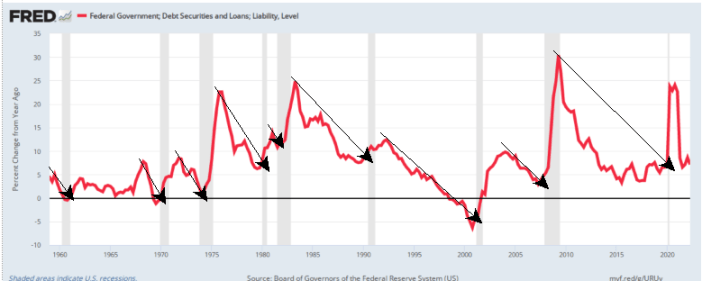
Recessions (vertical gray bars) follow reductions in federal deficit growth.
Translation: Exchange the words “economic growth“ for the term “damage” and you will see the truth.
“Not only would these policies increase deficits, but they would also worsen inflation,” the CRFB warns in its analysis.
“With inflation surging and debt approaching record levels, policymakers should avoid passing costly end-of-year policy changes.”
As always, the CRFB spouts nonsense. Inflation is not caused by or “worsened” by federal deficits. All inflations through history have been caused by shortages of important goods and services.
Changes in federal debt, i,e, deficits (red), do not correspond with changes in inflation (blue).
If federal deficits “worsened inflation,” one would expect the peaks and valleys of the above graph to correspond. They do not.
Inflations are not caused by federal spending. Today’s inflation was caused by COVID-related shortages of oil, food, shipping, lumber, computer chips, labor et al.
For much of the past year, the Biden administration has been touting falling deficit figures as evidence that the economy was picking upand, implicitly, as a signal that government spending could increase without adding to the nation’s tenuous fiscal situation.
If true, that would be incredibly uninformed by the Biden administration.
Mathematically, it is not possible for falling deficit figures to be evidence of growing Gross Domestic Product. That would be like falling food supplies being evidence of growing nutrition.
That was always misleading, as the falling deficit was entirely the result of one-time, emergency COVID-19 spending coming off the books.
The underlying figures showed all along that the deficit situation was continuing to worsen, and that President Joe Biden’s policies were adding trillions of dollars to the deficit over the long term.
Wait, Mr. Boehm. You say emergency COVID-19 spending came off the books, yet now we have inflation. What happened to your claim that increased federal spending causes inflation?
November’s spending and revenue figures should put an end to these silly games. We’re only two months into the fiscal year, but the federal government is now on pace to run a deficit of about $1.9 trillion, which would be the largest nonpandemic budget deficit ever and a huge increase from the $1.38 trillion deficit in the fiscal year that ended on September 30.
That spending has helped reduce the likelihood of a recession, which by the way, is defined as two consecutive quarters of reduced GDP — a reduction which is exactly what you want to do.
A major driver of November’s rapidly expanding deficit was something else that fiscal hawks have been warning about for a while: higher borrowing costs created byhigher interest rates.
The Wall Street Journal notes that the federal government spent 53 percent more on borrowing costs last month than it did in November 2021.
The higher borrowing costs were foolishly and arbitrarily created by the Fed. They do nothing to prevent/cure inflation. They do nothing to cure the shortages that cause inflation.
In fact, higher interest rates exacerbate the shortages and thus, exacerbate inflation. In essence, the Fed is applying leeches to cure anemia.
Higher borrowing costs are not the result of federal deficits. They are the result of Fed ignorance.
The best time to stop borrowing heavily was yesterday (or several years ago), but the second-best time would be today. Instead, Congress is likely to make this problem even worse—again—by continuing to spend like there’s no tomorrow.
SUMMARY
The entire Boehm article is based on commonly held myths. The facts are:
Federal deficits are necessary for economic growth. (That is simple mathematics.)
The U.S. federal government never borrows dollars. (Why would it, given its infinite ability to create dollars).
Reduced federal spending causes recessions and depressions. (Again, this is simple mathematics.)
Inflations are caused by shortages of key goods and services, not by federal spending. (As demonstrated by history).
Inflations are cured by federal spending to acquire and distribute the scarce goods and services. (Again, as demonstrated by history.)
Increasing interest rates does not help prevent or cure inflations.
Increasing interest rates exacerbates the shortages that cause inflations. (That is why raising interest rates is recessionary.)
I recently received an Email from you, which I will quote in its entirety.
Congress has until December 16th to fund the government and avoid a federal shutdown. If they avoid that, they’ll likely have done so with the same tired Washington tactic of promising billions in new deficit-funded spending or tax cuts, driving the national debt even higher.
We have asked Congress not to borrow any new money for the rest of 2022.
With our Debt Fixer interactive tool, you have the opportunity to craft a national budget that puts America on a sustainable fiscal course heading into 2023.
How It Works: The Debt Fixer gives users the opportunity to confront many of the same budget decisions that lawmakers face and to see how those choices affect the debt. You’ll be asked to make decisions on a range of policy options with the goal of stabilizing the debt at 90 percent of Gross Domestic Product (GDP) within ten years and 60 percent of GDP by 2050.
Afterwards, users can share select to share their fiscal choices with Members of Congress and social media. Can you do better than Congress? Give it a try now!
If you’re a teacher and would like to use the Debt Fixer in your class, please let us know by e-mailing debtfixer@crfb.org.
We can provide additional resources for your classroom including guest speakers and a customizable link where you can compare your classes results. If you enjoy Debt Fixer, we encourage you to check out our other interactive resources: Budgeting for the Future, Is It Worth It, and the Social Security Reformer.
Here you’ll be able to test your budget knowledge, compare the costs of proposals and policies, and choose the options to stabilizing the debt at 90 percent of Gross Domestic Product (GDP) for future generations.
I have bolded the following phrases from your Email: “driving the national debt even higher,” “not to borrow,” “not to borrow,” “sustainable fiscal course,” “stabilizing the debt at 90 percent of Gross Domestic Product (GDP), and “stabilizing the debt at 90 percent of Gross Domestic Product (GDP).”
As I suspect you know, the U.S. federal government is Monetarily Sovereign, i.e., it has the infinite ability to create its own sovereign currency, the U.S. dollar. This ability sometimes (incorrectly) is referred to as “printing” dollars.
The infinite ability to “print” dollars means the U.S. government never unintentionally can run short of dollars.
THE CHALLENGE
Given the fact that the U.S. government cannot run short of dollars, I challenge you to answer the following questions:
DRIVING THE NATIONAL DEBT EVEN HIGHER:Given the federal government’s infinite ability to “print” (create) dollars why should anyone be concerned about the size of the “national debt”?
NOT TO BORROW: Given the federal government’s infinite ability to create dollars why should the federal government need to borrow dollars?
DEBT FIXER: Given the federal government’s infinite ability to create dollars, why does the federal debt need fixing?
SUSTAINABLE FISCAL COURSE:Given the federal government’s infinite ability to create dollars, and the fact that it has sustained its fiscal course for the past 80+ years while the federal debt has increased 62,500%, why do you believe it’s current fiscal course suddenly has become unsustainable?
STABILIZING THE FEDERAL DEBT AT 90 PERCENT OF GROSS DOMESTIC PRODUCT (GDP): In what way does the ratio of federal debt / GDP affect the economy?
I have followed your Emails for several years, during which time you repeatedly have voiced the same concerns about federal deficit spending. Yet, you never have answered the above questions.
Here are the facts you continually ignore:
The government’s infinite ability to create dollarsmeans it never needs to be concerned about any debt. It has a greater ability to pay its debts than Elon Musk’s ability to pay a 1 cent debt.
The federal government does not borrow, nor will it ever need to. As the St. Louis Fed reported: ““As the sole manufacturer of dollars, whose debt is denominated in dollars, the U.S. government can never become insolvent, i.e., unable to pay its bills. In this sense, the government is not dependent on credit markets to remain operational.” The U.S. government provides T-security accounts into which other governments and private citizens are allowed to deposit dollars for safekeeping. The purpose of these accounts is not to provide the federal government with dollars, but rather to provide the world with a safe place to store unused dollars. This helps stabilize the dollar. To pay off these deposits, the federal government merely returns the dollars that are in those accounts. Returning existing dollars is no burden on the federal government or on U.S. taxpayers.
The federal debt is not a real debt. It is deposits that are owned by other governments and private citizens. It does not need “fixing.” If the federal government stopped issuing T-securities tomorrow, that would have no effect on the government’s ability to spend dollars and to pay its bills.
The federal government has proved, year after year, that its course is sustainable. Despite a massive increase in the so-called “debt,” the government has no difficulty funding every expenditure.
The ratio of federal “debt” to GDP is economically meaningless. It has no effect on the government’s ability to spend or on inflation, or on any aspect of economic health. GDP dollars do not pay for federal debt. The ratio also is ludicrous because it compares a multiyear figure (debt) to a one-year figure (GDP). One easily could ask, “Why not compare debt to the six-month GDP or the one-month GDP, or even the ten-year GDP?”
There is no relationship between the Debt/GDP ratio (blue) and inflation (red).
There is a strong relationship between reductions in federal debt and recessions or depressions. Most recessions have resulted from periods of declining deficits.
U.S. depressions tend to come on the heels of federal surpluses.
1804-1812: U. S. Federal Debt reduced 48%. Depression began 1807. 1817-1821: U. S. Federal Debt reduced 29%. Depression began 1819. 1823-1836: U. S. Federal Debt reduced 99%. Depression began 1837. 1852-1857: U. S. Federal Debt reduced 59%. Depression began 1857. 1867-1873: U. S. Federal Debt reduced 27%. Depression began 1873. 1880-1893: U. S. Federal Debt reduced 57%. Depression began 1893. 1920-1930: U. S. Federal Debt reduced 36%. Depression began 1929. 1997-2001: U. S. Federal Debt reduced 15%. Recession began 2001.
America’s debt /money supply growth parallels America’s GDP growth
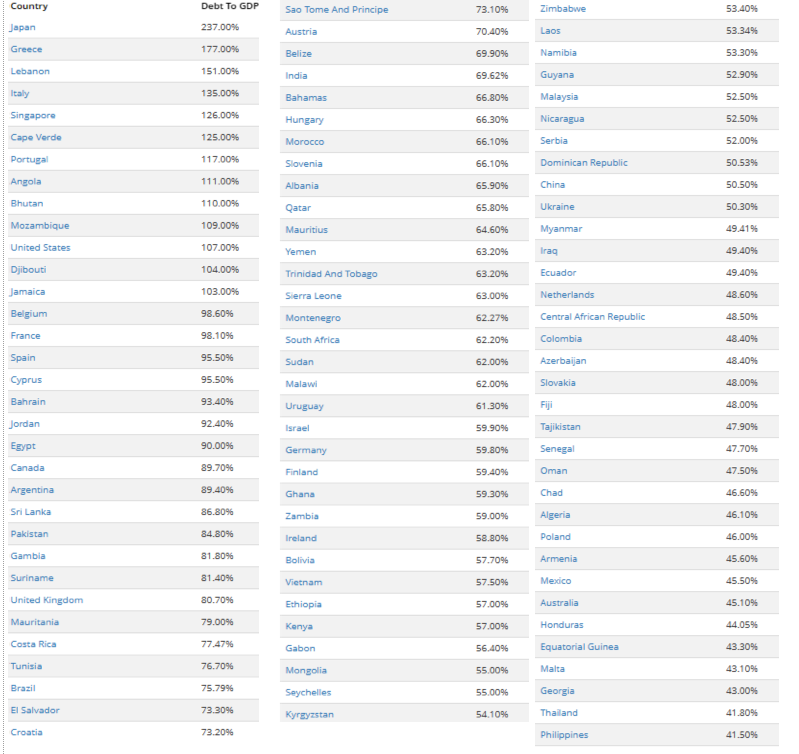
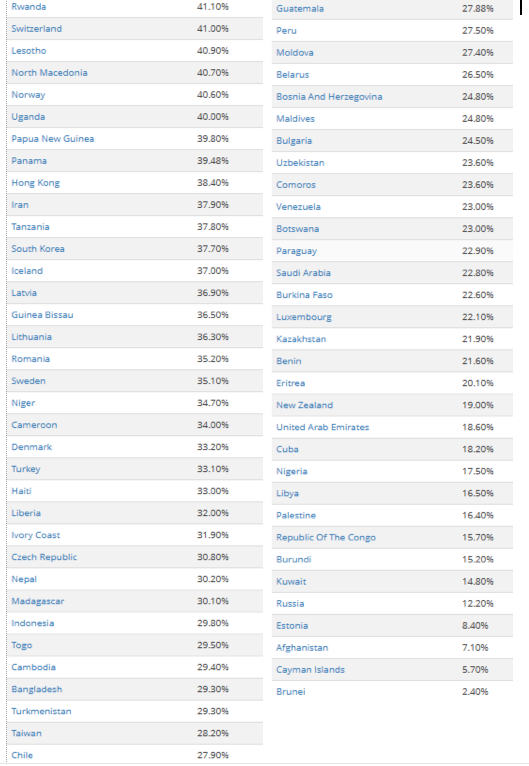
Using the tables below, see if you can determine which economies are “healthiest.”
(You won’t succeed, because the debt/GDP ratios tell you nothing about the health of a nation’s economy:
SUMMARY The CRFB never has and never will accept my challenge. They never will answer the questions, because the true answers would eliminate their reason for existence.
The CRFB is worse than useless. It is harmful to America. I believe they know they are harmful, in which case that would make them traitors.
I believe they are paid by the rich in America to widen the income/wealth/power Gap between the rich and the rest of us, in which case that would make them paid traitors.
I am angry at them. They hurt America.
If you believe they have answers and can meet the challenge, feel free to contact them. I’d be interested in seeing how they try to squirm out of this. Contact Maya MacGuineas at MacGuineas@crfb.org and find her on Twitter @MayaMacGuineas.
If you think I am angry at the CRFB, you’re right. I believe they have done, and continue to do, irreparable harm to America by giving aid and comfort to politicians who vote against benefits.
The claim that Medicare and Social Security can run short of money is absurd, especially so when the federal government, at the touch of a computer key, can provide all the money these agencies need.
The claim that the federal debt is too high also is absurd, when it isn’t even debt and it could be paid off entirely simply by returning the dollars in storage.
Even more absurd is to worry about the debt/GDP ratio, which compares a multi-year figure to a one-year figure, and is indicative or predictive of nothing.
Americans treat elections like sports. I suspect many nations do. We have favorites, not for logical reasons but for the emotion we have applied to them.
I loved Roosevelt because everyone did. What did I know? I was only ten years old when he died. Later, I learned about the SS St. Louis and his not bombing the railroad tracks to the concentration camps. I stopped even liking him.
I liked Truman until I learned about his antisemitic wife. I still like him, but less.
I liked Ike a bit. I felt he was more a politician than a leader, both in the military and as President.
I loved Kennedy until I learned about his private life.
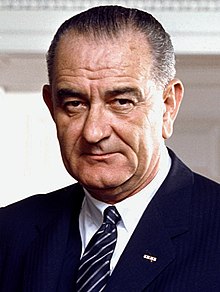
I hated Johnson. Later, when I added up all he accomplished, I decided he was one of the top three Presidents in U.S. history, though Vietnam killed his reputation.
I was ambivalent about Nixon and soon decided he was pretty good. At least he was more intelligent than most. Today, his support for a burglary would have been defended by 100% of the Republican party, and he never would have been forced from office. Back then, the GOP really was the party of law and order.
I thought Ford was weak and later decided he was strong. I think he could have become a fine President, given time.
I hated Jimmy Carter and still do. I like him more for his post-presidential work than for his Presidency.
I loved Reagan, but now I believe he was a phony.
I liked the elder Bush until he foolishly raised taxes after correctly promising not to.
I liked Bill Clinton until I realized his federal surpluses killed the American economy and caused the Bush II recession.
As for Bush II, eh. Eight wasted years. He attempted self-promotion and was terrible at that, too.
I was massively disappointed in Obama. I had thought he cared about the poor, but he was a proponent of federal austerity. I hope his library never gets built.
As for Trump, even before he was elected President, I wrote articles saying he was the 2nd coming of Hitler. Thank heavens he was dumb and lazy, or he would have been Hitler. I hope his library gets built in an underground bunker, where he is forced to live out his miserable life.
Finally, contrary to the pundits and the majority of Americans, I predict Biden will be remembered as one of our most effective Presidents, who despite a fascist GOP, will have accomplished more than any President since Johnson.
Because I’m aware the federal government has infinite money, and federal spending does not cause inflations, I lean more liberal than conservative. It will require a Democratic Congress and President to give us Medicare for All, Social Security for All, College for All, and the end of hunger in America. The Republicans won’t do it.
Before I became a permanent resident of Florida last year, I was a Cubs, Bears, Bulls, Blackhawks fan, but now care nothing for any of them. I still am a fan of Andy Pafko, however, though he stopped playing many, many years ago.
All of this came to mind what a friend told me she was an ardent Republican.
I asked why, and a puzzled look crossed her face. She hadn’t thought about why. Her family had voted Republican for ages.
Again, I asked why, and she had no idea, but said she probably would vote Republican, again.
I was a Cubs fan though the Cubs never did anything for me. So why was I a fan? Because I was a Chicagoan? Sure, but they were terrible, with Andy and without him. What made me scream with delight when they infrequently won, and why was I so blue all those times they lost. How did their wins and losses affect my life?
They didn’t.
Looked at objectively, the Cubs were a terrible team, unworthy of anyone’s adulation. Looked at objectively, the Republicans are an awful party, which does absolutely nothing for the vast majority of Americans. It clearly is the party of the rich, along with being the more immoral and dishonest of the two major parties. Their unwavering support for an obvious traitor is disgusting.
And Donald Trump, who unquestionably is the least honest, least intelligent, least patriotic, most dangerous-to-America of any past President, received over 70 million votes, mostly from people who “always vote Republican.”
There is no logic, but there is a reason: We are programmed to root. We root for our home state and city, our school, our sports teams, our friends and relatives, our company, and our favorite celebrity. But why?
Do other animals root?
Perhaps, as we’re social animals, we gain an evolutionary advantage if a member of our group wins in some way.
Could it be that if you consider yourself a Republican, you sense you have an evolutionary advantage if a Republican wins? That somehow, this strengthens your group, and this makes you safer?
It still begs the question, “Why do you consider yourself a Republican. What has the GOP done for you or those you care about?”
Consider the case of Herschel Walker. He received about half the votes. Half the votes! Do all those people really believe he would have been the better choice for Senator? Do they really want him to be their leader or representative?
We tend to vote for those who are like us. Whites tend to vote for whites; blacks tend to vote for blacks, Hispanic for Hispanics, Jews for Jews, men for men. The list goes on. But Herschel Walker is an immoral, brain-dead, nincompoop, who can’t put together two meaningful sentences.
Does that mean half the voters in Georgia are immoral, brain-dead nincompoops, who can’t put together two meaningful sentences? In what universe does even one intelligent person vote for Herschel Walker to represent the interests of Georgian people?
H. L. Mencken wrote:
“No one in this world, so far as I know—and I have searched the records for years and employed agents to help me—has ever lost money by underestimating the intelligence of the great masses of the plain people.
“Nor has anyone ever lost public office thereby. The mistake that is made always runs the other way. Because the plain people are able to speak and understand, and even, in many cases, to read and write, it is assumed that they have ideas in their heads, and an appetite for more. This assumption is a folly.”
Marjorie Taylor Greene Says, “I Would’ve Led An Armed Jan. 6 Insurrection”
Mencken surely was talking about Donald Trump / Herschel Walker / Greene GOP voters. Right?
I suspect Mencken was wrong. It’s not lack of intelligence; it’s some other force. Plenty of intelligent people vote for Republicans.
I suspect there are several reasons for illogical voting:
You wish for acceptance. If you have one group where you have friends and relatives, you will drift to that group.
Changing groups is hard. Once you have committed to a group, staying with that group takes no effort. It is comfortable. Changing groups requires effort plus the admission you were wrong.
Changing groups requires you to be an alien, which is uncomfortable.
Your status has changed. Perhaps circumstance has made you poorer, but you hate to admit it. So, you stay with your former group. It would be like quitting your country club because you lost money, and no longer can afford the dues.
You aspire to be in a group, so you do the things the group does. You so want to be rich you join a group you can’t afford, so you can be among the rich.
You aren’t actually voting for anyone. You are casting “against” votes, the lesser of two evils.
The sad lesson for both political parties is to put forth candidates whom the voters wish to emulate, not necessarily candidates who will do the better job.
A classic example for the Democrats would be Jack Kennedy, a relatively inexperienced politician who people wished to copy. He was a mediocre President, but he lived an attractive lifestyle. He was loved for his charisma.
Donald Trump seems charismatic to his base, though now that he has proved himself to be a repeated loser, whiner, and criminal, that sheen may be dulling.
It would be a blessing for America if we could prove Mencken wrong, but we are far from there. The votes cast for the likes of Herschel Walker, Marjorie Taylor Greene,, Jim Jordan, and indeed the majority of the Republican Party, leave me doubtful about future voter intelligence and sanity.
And if this post makes you angry, you have proved my point.
Rodger Malcolm Mitchell
Monetary SovereigntyTwitter: @rodgermitchellSearch #monetarysovereigntyFacebook: Rodger Malcolm Mitchell
……………………………………………………………………..
The Sole Purpose of Government Is to Improve and Protect the Lives of the People.





 I hated Johnson. Later, when I added up all he accomplished, I decided he was one of the top three Presidents in U.S. history, though Vietnam killed his reputation.
I was ambivalent about Nixon and soon decided he was pretty good. At least he was more intelligent than most. Today, his support for a burglary would have been defended by 100% of the Republican party, and he never would have been forced from office. Back then, the GOP really was the party of law and order.
I thought Ford was weak and later decided he was strong. I think he could have become a fine President, given time.
I hated Jimmy Carter and still do. I like him more for his post-presidential work than for his Presidency.
I loved Reagan, but now I believe he was a phony.
I liked the elder Bush until he foolishly raised taxes after correctly promising not to.
I liked Bill Clinton until I realized his federal surpluses killed the American economy and caused the Bush II recession.
As for Bush II, eh. Eight wasted years. He attempted self-promotion and was terrible at that, too.
I was massively disappointed in Obama. I had thought he cared about the poor, but he was a proponent of federal austerity. I hope his library never gets built.
As for Trump, even before he was elected President, I wrote articles saying he was the 2nd coming of Hitler. Thank heavens he was dumb and lazy, or he would have been Hitler. I hope his library gets built in an underground bunker, where he is forced to live out his miserable life.
Finally, contrary to the pundits and the majority of Americans, I predict Biden will be remembered as one of our most effective Presidents, who despite a fascist GOP, will have accomplished more than any President since Johnson.
Because I’m aware the federal government has infinite money, and federal spending does not cause inflations, I lean more liberal than conservative. It will require a Democratic Congress and President to give us Medicare for All, Social Security for All, College for All, and the end of hunger in America. The Republicans won’t do it.
Before I became a permanent resident of Florida last year, I was a Cubs, Bears, Bulls, Blackhawks fan, but now care nothing for any of them. I still am a fan of Andy Pafko, however, though he stopped playing many, many years ago.
All of this came to mind what a friend told me she was an ardent Republican.
I asked why, and a puzzled look crossed her face. She hadn’t thought about why. Her family had voted Republican for ages.
Again, I asked why, and she had no idea, but said she probably would vote Republican, again.
I was a Cubs fan though the Cubs never did anything for me. So why was I a fan? Because I was a Chicagoan? Sure, but they were terrible, with Andy and without him. What made me scream with delight when they infrequently won, and why was I so blue all those times they lost. How did their wins and losses affect my life?
They didn’t.
Looked at objectively, the Cubs were a terrible team, unworthy of anyone’s adulation. Looked at objectively, the Republicans are an awful party, which does absolutely nothing for the vast majority of Americans. It clearly is the party of the rich, along with being the more immoral and dishonest of the two major parties. Their unwavering support for an obvious traitor is disgusting.
And Donald Trump, who unquestionably is the least honest, least intelligent, least patriotic, most dangerous-to-America of any past President, received over 70 million votes, mostly from people who “always vote Republican.”
There is no logic, but there is a reason: We are programmed to root. We root for our home state and city, our school, our sports teams, our friends and relatives, our company, and our favorite celebrity. But why?
Do other animals root?
Perhaps, as we’re social animals, we gain an evolutionary advantage if a member of our group wins in some way.
Could it be that if you consider yourself a Republican, you sense you have an evolutionary advantage if a Republican wins? That somehow, this strengthens your group, and this makes you safer?
It still begs the question, “Why do you consider yourself a Republican. What has the GOP done for you or those you care about?”
Consider the case of Herschel Walker. He received about half the votes. Half the votes! Do all those people really believe he would have been the better choice for Senator? Do they really want him to be their leader or representative?
We tend to vote for those who are like us. Whites tend to vote for whites; blacks tend to vote for blacks, Hispanic for Hispanics, Jews for Jews, men for men. The list goes on. But Herschel Walker is an immoral, brain-dead, nincompoop, who can’t put together two meaningful sentences.
Does that mean half the voters in Georgia are immoral, brain-dead nincompoops, who can’t put together two meaningful sentences? In what universe does even one intelligent person vote for Herschel Walker to represent the interests of Georgian people?
H. L. Mencken wrote:
I hated Johnson. Later, when I added up all he accomplished, I decided he was one of the top three Presidents in U.S. history, though Vietnam killed his reputation.
I was ambivalent about Nixon and soon decided he was pretty good. At least he was more intelligent than most. Today, his support for a burglary would have been defended by 100% of the Republican party, and he never would have been forced from office. Back then, the GOP really was the party of law and order.
I thought Ford was weak and later decided he was strong. I think he could have become a fine President, given time.
I hated Jimmy Carter and still do. I like him more for his post-presidential work than for his Presidency.
I loved Reagan, but now I believe he was a phony.
I liked the elder Bush until he foolishly raised taxes after correctly promising not to.
I liked Bill Clinton until I realized his federal surpluses killed the American economy and caused the Bush II recession.
As for Bush II, eh. Eight wasted years. He attempted self-promotion and was terrible at that, too.
I was massively disappointed in Obama. I had thought he cared about the poor, but he was a proponent of federal austerity. I hope his library never gets built.
As for Trump, even before he was elected President, I wrote articles saying he was the 2nd coming of Hitler. Thank heavens he was dumb and lazy, or he would have been Hitler. I hope his library gets built in an underground bunker, where he is forced to live out his miserable life.
Finally, contrary to the pundits and the majority of Americans, I predict Biden will be remembered as one of our most effective Presidents, who despite a fascist GOP, will have accomplished more than any President since Johnson.
Because I’m aware the federal government has infinite money, and federal spending does not cause inflations, I lean more liberal than conservative. It will require a Democratic Congress and President to give us Medicare for All, Social Security for All, College for All, and the end of hunger in America. The Republicans won’t do it.
Before I became a permanent resident of Florida last year, I was a Cubs, Bears, Bulls, Blackhawks fan, but now care nothing for any of them. I still am a fan of Andy Pafko, however, though he stopped playing many, many years ago.
All of this came to mind what a friend told me she was an ardent Republican.
I asked why, and a puzzled look crossed her face. She hadn’t thought about why. Her family had voted Republican for ages.
Again, I asked why, and she had no idea, but said she probably would vote Republican, again.
I was a Cubs fan though the Cubs never did anything for me. So why was I a fan? Because I was a Chicagoan? Sure, but they were terrible, with Andy and without him. What made me scream with delight when they infrequently won, and why was I so blue all those times they lost. How did their wins and losses affect my life?
They didn’t.
Looked at objectively, the Cubs were a terrible team, unworthy of anyone’s adulation. Looked at objectively, the Republicans are an awful party, which does absolutely nothing for the vast majority of Americans. It clearly is the party of the rich, along with being the more immoral and dishonest of the two major parties. Their unwavering support for an obvious traitor is disgusting.
And Donald Trump, who unquestionably is the least honest, least intelligent, least patriotic, most dangerous-to-America of any past President, received over 70 million votes, mostly from people who “always vote Republican.”
There is no logic, but there is a reason: We are programmed to root. We root for our home state and city, our school, our sports teams, our friends and relatives, our company, and our favorite celebrity. But why?
Do other animals root?
Perhaps, as we’re social animals, we gain an evolutionary advantage if a member of our group wins in some way.
Could it be that if you consider yourself a Republican, you sense you have an evolutionary advantage if a Republican wins? That somehow, this strengthens your group, and this makes you safer?
It still begs the question, “Why do you consider yourself a Republican. What has the GOP done for you or those you care about?”
Consider the case of Herschel Walker. He received about half the votes. Half the votes! Do all those people really believe he would have been the better choice for Senator? Do they really want him to be their leader or representative?
We tend to vote for those who are like us. Whites tend to vote for whites; blacks tend to vote for blacks, Hispanic for Hispanics, Jews for Jews, men for men. The list goes on. But Herschel Walker is an immoral, brain-dead, nincompoop, who can’t put together two meaningful sentences.
Does that mean half the voters in Georgia are immoral, brain-dead nincompoops, who can’t put together two meaningful sentences? In what universe does even one intelligent person vote for Herschel Walker to represent the interests of Georgian people?
H. L. Mencken wrote:

 #Monetary Sovereignty - Mitchell