Many economists want poverty never to be cured. Here’s why.

Many economists want poverty never to be cured.

Here’s why: The most crucial question in economics is: “Can the federal government run short of money?”

Most economists will answer something on the order of, “The government always can print more dollars.”

While technically that is not correct — the government prints dollar bills, which are titles to dollars, not dollars in themselves — the concept is correct.

The U.S. federal government cannot unintentionally run short of dollars. With that fundamental truth in mind, logic dictates that:

  1. The U.S. government does not rely on your tax dollars. It simply could “print” all the dollars it spends, and in fact, that is what it does.
  2. Therefore, the U.S. government has no financial need to levy federal taxes.
  3. There is no financial need for the federal government to run a balanced budget.
  4. Federal deficits and debt are not a burden on the federal government or on federal taxpayers
  5. Since the federal government cannot unintentionally run short of dollars, no federal agency can run short of dollars unless the federal government wants that to happen.
  6. Medicare and Social Security are among the hundreds of federal agencies that cannot run short of dollars unless Congress and the President want that result.
  7. The so-called Medicare and Social Security “trust funds” are not real trust funds; they have no financial purpose. The federal government can and does support all federal agencies by creating dollars ad hoc.
  8. Medicare for All, Social Security for All, College Tuition for All, Housing Support for All, Food for All, etc., are well within the federal government’s ability to fund without levying a penny in taxes.

If you can find an error in the above logic, please let me know.

Why, then, does the government collect taxes?

Why does it threaten bankruptcy for Medicare and Social Security?

Why the concern about the federal deficit and debt?

The fundamental financial purpose of federal taxes is to control the economy by taxing what the government wishes to limit and by giving tax breaks to what the government wishes to encourage and reward.

Sadly, the government taxes — i.e., wishes to limit — your income, your healthcare, your retirement, and your other benefits, while it hopes to encourage and reward — i.e., give tax breaks to — the rich and their accumulation of wealth.

That is why the very rich pay a much lower percentage of their income and wealth as taxes than you do.

Donald Trump’s negligible tax payments are but one example.

While the economists generally admit that the federal government cannot become insolvent, they take their lead from the rich, who provide two fallback excuses for not supporting the middle classes and the poor:

Excuse #1: “If we support the middle and the poor by providing health care insurance, retirement insurance, housing aid, food aid, and college aid, the middle and the poor will refuse to work, destroying the economy.”

The tacit claim is that the not-rich are lazy takers who, lacking human aspirations, are not interested in improving their lives via labor but are content to wallow in their own poverty.

Never mind that the poor and middle classes labor much harder than do the rich, who are the real lazy takers.

Excuse #1 is part of the “the poor deserve their poverty, and we rich deserve our wealth” meme.

It is a subset of the white supremacy doctrine — part of the notion that “it was not luck that got us where we are but rather our natural superiority” — part of the “give the poor a few dollars, and they will those dollars to buy drugs and gamble.”

Excuse #2: “Federal spending can cause inflation, which will destroy the economy.”

All inflations are caused by shortages of critical goods and services, which makes sense intuitively and factually.

We can all agree that when something is in short supply, its price rises so that many prices rise when many things are in short supply.

That’s called “inflation.”

Today’s inflation is caused by COVID-related short supplies of oil, food, computer chips, lumber, housing, and labor.

Does federal spending cause these shortages? The reality is that only a very small percentage of federal spending is for the purchase of these things.

The vast majority of federal spending goes to people. Federal dollars for Medicare and other healthcare, Social Security, poverty aids, and even the military comprise nearly all of the federal government’s spending.

Only a tiny percentage goes for the purchase of goods, and even that percentage is largely labor-related.

So, when economists claim that federal spending causes inflation, they really claim that the American people receive too much money.

And further, when people have more money, they spend it on already scarce items, thus causing inflation.

Carried to its logical end, the economists claim that preventing and curing inflation requires impoverishing the middle classes and the poor.

The economists want you to have less money for driving your car, heating your house, buying your food, affording suitable housing, owning a TV, or going to college.

And they want businesses to devote less money to hiring people.

FICA and business-provided healthcare insurance are employment costs discourage hiring while reducing net wages.

Suppose the government did not require employers and employees to pay FICA and did not encourage companies to provide healthcare insurance (via tax deductions and the lack of Medicare for All). In that case, businesses could hire more people at higher net wages.

The entire anti-inflation argument is based on the poor and middle classes receiving poorer health care, food, housing, education, and net wages.

There can be no argument about the federal government’s unlimited ability to create its own sovereign currency. So, you might think the entire Big Lie about federal deficits being “unsustainable” devolves into inflation.

But that Big Lie is just a cover for a more profound lie, based on Gap Psychology, the human desire to widen the income/wealth/power gap below and to narrow the gap above.

The Gap is what makes one rich. Without the Gap, no one would be rich; we all would be equal. And the wider the Gap, the richer the rich.

A man owning a million dollars would be rich if everyone else owned only a thousand dollars, but he would be poor if everyone else owned ten million dollars.

The richer always wish to be more prosperous. They want the Gap below them to grow wider. So, they bribe our sources of information to convince us that the government should not provide Gap-narrowing benefits.

They bribe the media via ownership and advertising dollars. They bribe the politicians via campaign contributions and promises of future employment.

They bribe university economists via university contributions and employment in think tanks, which is why economists never want poverty to be cured.

They like bribes.

Everyone, from layperson to self-described expert, is fed the same Big Lie: “Federal finances are like personal finances.”

That lie includes misleading statements: The federal government should live within its means and run a balanced budget, deficits and debt are unsustainable, federal taxes fund federal spending, and federal expenditures causes inflations.

The facts are:

  1. The federal government, having the infinite ability to create dollars, has no “means” to live within.
  2. Running a balanced federal budget always leads to recessions and depressions
  3. Federal taxes not only don’t fund federal spending but federal tax dollars are destroyed upon receipt by the Treasury.
  4. All inflations are caused by shortages of critical goods and services, usually oil or food.
  5. Federal spending creates economic growth and even can cure inflations by curing shortages.

Here’s the evidence:
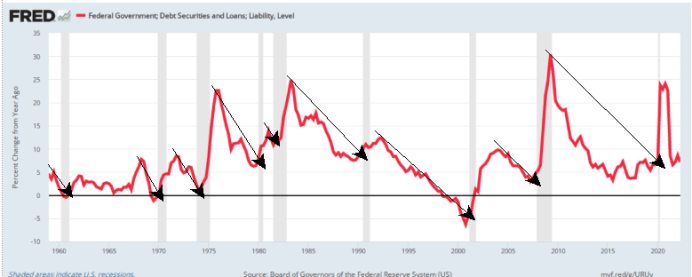
This graph demonstrates that recessions (vertical gray bars) occur not just when federal debt (red) shrinks but even when federal debt doesn’t grow enough.

Here is a list of periods in which the federal debt actually has shrunk:

U.S. depressions tend to come on the heels of federal surpluses.

1804-1812: U. S. Federal Debt reduced 48%. Depression began 1807.

1817-1821: U. S. Federal Debt reduced 29%. Depression began 1819.

1823-1836: U. S. Federal Debt reduced 99%. Depression began 1837.

1852-1857: U. S. Federal Debt reduced 59%. Depression began 1857.

1867-1873: U. S. Federal Debt reduced 27%. Depression began 1873.

1880-1893: U. S. Federal Debt reduced 57%. Depression began 1893.

1920-1930: U. S. Federal Debt reduced 36%. Depression began 1929.

1997-2001: U. S. Federal Debt reduced 15%. Recession began 2001.

A growing economy requires a growing supply of money.

Federal deficits pump money into the private sector, aka “the economy,” and by formula, increase economic growth (GDP=Federal Spending+Non-federal Spending+Net Exports.)

You and everyone else pay federal taxes with dollars taken from the M1 money supply measure  , which includes currency in people’s pockets or the M1 money supply measure  which includes currency that is in people’s pockets or in checking accounts.

There is no money supply measure for the federal government’s dollars because the government has the infinite ability to create dollars.

It has an infinite supply of money.

Former Fed Chairman Alan Greenspan: “A government cannot become insolvent with respect to obligations in its own currency.”

Former Fed Chairman Ben Bernanke: “The U.S. government has a technology, called a printing press (or, today, its electronic equivalent), that allows it to produce as many U.S. dollars as it wishes at essentially no cost.”

Quote from Ben Bernanke when he was on 60 Minutes: Scott Pelley: Is that tax money that the Fed is spending? Ben Bernanke: It’s not tax money… We simply use the computer to mark up the size of the account.

Statement from the St. Louis Fed: “As the sole manufacturer of dollars, whose debt is denominated in dollars, the U.S. government can never become insolvent, i.e., unable to pay its bills. In this sense, the government is not dependent on credit markets to remain operational.”

Thus, all those M1 money supply tax dollars disappear from any money supply measure. They effectively are destroyed.

The federal government creates ad hoc dollars every time it pays for something. And as for the myth that federal deficit spending causes inflation, look at this graph:
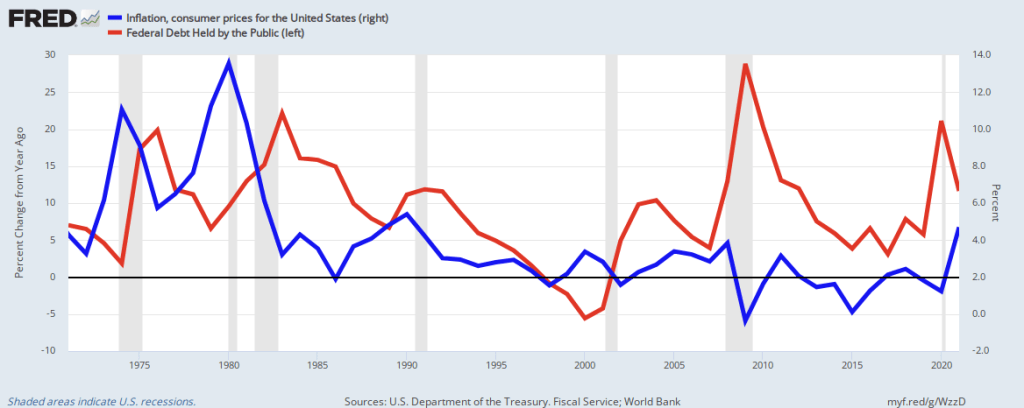
If federal deficit spending caused inflation, the peaks and valleys of the red line (changes in federal debt) would correspond to the peaks and valleys of the blue line (inflation). There is no such correspondence.

If you’re looking for something that does correspond to inflation, look at this graph.

Oil prices (silver) correspond with inflation (blue). Inflations are caused by shortages.

Your major sources of information, the media, politicians, and university economists have been bribed to believe and to disseminate the Big Lie that federal finances resemble personal finances.

In fact, the two could not be more different.

  1. The federal government is Monetarily Sovereign; you, the states, counties, cities, and businesses are monetarily non-sovereign.
  2. The federal government can create unlimited numbers of dollars; you, the states et al, cannot create unlimited dollars
  3. The federal government destroys all the dollars it receives; you do not.
  4. The federal government never unintentionally can be insolvent; you can become insolvent if you do not have sufficient dollars to pay your creditors.
  5. The federal government never borrows dollars; you might have occasion to borrow.

The federal government can cure inflations, not by raising interest rates (which exacerbates shortages), but by spending to alleviate shortages.

For instance: To lower the price of oil, the government could financially support oil exploration and processing, and/or invest in renewable energy.

To lower the price of food, the government could financially support farming and food production R&D.

To ease the price of labor, the government could eliminate the FICA tax while providing Medicare for All (relieving businesses of this financial obligation).

To lower the prices of electronics, the government could invest in computer chips and electronic R&D.

In short, reducing inflation actually requires additional government spending, not less.

Any time you read or hear someone equating federal finances with personal finances, you will know they are lying or ignorant about economics.

Similarly, any time you read or hear someone saying federal debt or deficits are “unsustainable,” they, too are lying or ignorant.

If you have played the board game Monopoly, you know the Bank mimics the federal government in that it cannot run out of money. By rule, the Bank is Monetarily Sovereign.

The players comprise the “economy,” and they do not need to worry about the Bank’s deficits or its debt being “unsustainable.”

The Bank always is able to pay $200 for passing “GO.”

If you find Monetary Sovereignty puzzling, just think of Monopoly. That may help you visualize the reality of the U.S. economy.

The purpose of the Big Lie is to widen the Gaps between richer and poorer, and more specifically, between the very rich and the rest of us.

Economist charlatans never want poverty cured because the cures would reveal their ignorance, deception, and/or their receipt of bribes from the rich.

Rodger Malcolm Mitchell Monetary Sovereignty Twitter: @rodgermitchell Search #monetarysovereignty Facebook: Rodger Malcolm Mitchell

……………………………………………………………………..

The Sole Purpose of Government Is to Improve and Protect the Lives of the People.

MONETARY SOVEREIGNTY

Is it possible for one human being to get so much wrong about our economy?

If someone sets a world record, perhaps they could expect applause. In that vein, let’s give a massive round of applause to Veronique de Rugy, who has set a world record for economic myth dissemination. Her bio reads:

Veronique de Rugy is the George Gibbs Chair in Political Economy and Senior Research Fellow at the Mercatus Center at George Mason University and a nationally syndicated columnist.

Her primary research interests include the US economy, the federal budget, taxation, tax competition, and cronyism.

Her popular weekly columns address economic issues ranging from lessons on creating sustainable economic growth to the implications of government tax and fiscal policies.

She has testified numerous times in front of Congress on the effects of fiscal stimulus, debt and deficits, and regulation on the economy.

Presumably, she believes in using research results to come to her conclusions. Or at least, that is her claim. But what research supports the following nonsense?
WATCH: See How Leeches Can Be A Surgeon's Sidekick | WAMU
The Fed applies leeches to cure anemia. Ms. de Rugy agrees.

Congress and the Federal Reserve Could Be Setting Us Up for Economic Disaster If lawmakers keep spending like are, and if the Fed backs down from taming inflation, then the government may create a perfect storm. VERONIQUE DE RUGY | 12.29.2022 12:20 PM

In the final week of 2022, we Americans can foresee two significant economic risks in 2023. The first one is a probability that the Federal Reserve will get weak-kneed and stop raising interest rates before inflation is truly under control.

The second risk is that Congress will continue to spend and borrow money irresponsibly.

The likely mix of these two hazards would all but ensure that our economic misery lasts much longer than necessary.

At this point in the article, we don’t yet know which “misery” she means, especially since she considers not raising interest rates or increased spending “hazards.” And by the way, the federal government never borrows dollars. It has the infinite ability to create its own sovereign currency, the U.S. dollar. So why would it ever borrow what it has the endless ability to create? If ever it did borrow, it quickly could pay the dollars back simply by creating dollars.

Let’s start with the first risk.

In theory, to tame inflation, the Fed will need to push real interest rates not only high—as it has already done—but higher than the highest rate that the Fed is now targeting, and in fact much higher than most investors can remember.

Substitute the word “myth” for the word “theory,” and you have a correct statement. In the history of the universe, inflation has never been caused by interest rates that were too low. Anyone so devoted to research as Ms. de Rugy claims to be, should know this. I challenge her, or anyone else, to provide an example of inflation caused by low-interest rates or cured by high interest rates. There have been thousands of inflations worldwide, regular inflations and hyperinflations, and eventually, almost all have been cured — but never by raising interest rates. All inflations in history have been caused by shortages of critical goods and services, and those cured were cured only when the shortages were cured. It even is possible for high rates to cause shortages, i.e., cause inflations, by interfering with production. The primary effect of raising interest rates is to reduce demand and supply. These reductions make the de Rugys of the world think that is the way to cure inflation. The reasoning is if demand drops, then people won’t pay higher prices. (If supply decreases, prices will rise, but de Rugy doesn’t consider that.) What de Rugy et al. don’t understand is that recession is another word for reduced supply and demand. GDP = Federal Spending + Non-federal Spending – Net Imports. Thus, reduced spending = recession. In short, de Rugy wants to cure inflation by causing a recession. Not only is that nuts, but it can also lead to stagflation, the worst of all worlds.

Such high rates will have two main effects: popping the stock market and real estate market, along with any other asset bubbles that we’ve witnessed in recent years.

The economic downturn that would follow would increase unemployment rates significantly.

Here she admits she wants to “pop the stock market and real estate market,” aka cause a recession (“economic downturn”, maybe a depression. She also admits she wants to “increase unemployment rates significantly.” Presumably, her employment is secure, so she feels comfortable increasing other people’s unemployment.

On the other hand, if the Fed stops tightening too early, we will continue to suffer high inflation and slower growth.

When is “too early” to begin curing inflation? She never says. And why does tightening (raising interest rates) “too early” lead to more inflation? And why does “too early” cause slower growth when “the right time” doesn’t slow growth? She never explains. Her whole concept is a confusing mess.

The rise in unemployment might be pushed back for a while, but because no inflationary policy can continue forever, it will inevitably arrive.

And the longer we delay its arrival, the worse it will be. Unfortunately, facing such challenges, I worry that Fed Chair Jerome Powell will not make the better (and more complex) choice and hold the line on inflation.

Does anyone understand what the hell she is saying? “Too soon,” “too late,” “hold the line.” What exactly is she suggesting Powell do? It doesn’t matter because her suggestions are so deviant from reality that trying to understand them would be useless.

First, the pressure that he already faces from, for example, Sens. Bernie Sanders (I–Vt.) and Elizabeth Warren (D–Mass.) to stop raising rates will only intensify as the economy slows down and the unemployment rate increases.

Yes, Sanders and Warren are likely to say, “Stop raising rates” when we start sliding into recession, and people lose jobs. To de Rugy, Sanders and Warren are wrong. She apparently wants full foot on the brakes so we can go into complete depression.

Second, as interest rates increase, the amount of interest payments on the government’s debt will grow.

With no money to pay those interest obligations, the Treasury will increase borrowing—a move that will further raise the budget deficit.

This is beyond ignorant. She believes there will come a time when the government runs out of money. This person supposedly specializes in “the US economy, the federal budget, taxation, tax competition, and cronyism.” Incredible. She also believes that the Monetarily Sovereign U.S. government, which has the infinite ability to create U.S. dollars, resorts to borrowing U.S. dollars. What do real experts think?
Alan Greenspan: “A government cannot become insolvent with respect to obligations in its own currency.” Ben Bernanke: “The U.S. government has a technology, called a printing press (or, today, its electronic equivalent), that allows it to produce as many U.S. dollars as it wishes at essentially no cost.” Statement from the St. Louis Fed: “As the sole manufacturer of dollars, whose debt is denominated in dollars, the U.S. government can never become insolvent, i.e., unable to pay its bills. In this sense, the government is not dependent on credit markets to remain operational.”
Get it, Ms. de Rugy? The government cannot become insolvent. It does not borrow dollars (i.e. it does not depend on credit markets). It ca,n produce as many dollars as it wishes. So there never can be a time when, as you said, the government “will have no money to pay those interest obligations.” It always has money, and you should know that.

When complaints about rising deficits become loud, it won’t be long before President Joe Biden’s administration, and others in Congress demand an end to the interest rate hikes.

This practice is called fiscal dominance and it creates a real risk of further fueling inflation.

Never in history has an end to interest rate hikes caused inflation.

Finally, there is the risk that market actors will also pressure the Fed to protect them against losing the inflated wealth they’ve reaped as a result of two decades’ worth of irresponsible monetary policy.

“Irresponsible monetary policy is Ms. de Rugy’s term for a growing economy. By formula, adding dollars to the economy causes an increase in Gross Domestic Product, not inflation.

In fact, as of now Wall Street investors are showing signs that they believe the Fed may soon abandon its policy of high-interest rates to avoid a recession.

It’s hard to blame them because that’s precisely what the Fed has done in the past.

That’s right. In the past, high-interest rates have led to recessions, which is precisely what Ms. de Rugy recommends.

So, will the Fed blink? Politicians aren’t known for doing the right thing when times get hard, and it would be naïve to assume that Fed chairs are immune from this.

Powell, too, is a politician, as he demonstrated with his unwillingness to acknowledge the surging inflation problem—created by the government’s own spending and stimulus—until it was too late. He could surprise us, of course, by courageously enforcing much-needed monetary discipline.

No, no, no. The inflation was NOT created by the government’s spending. The inflation was created by COVID-related shortages of oil, food, transportation, computer chips, lumber, housing, etc. The spending and stimulus prevented a depression.

The second threat comes from politicians in Washington, right and left, doing their best to make the mess caused by the Fed just that much worse.

Indeed, just as the Fed is pushing interest rates sharply higher, irresponsible “leaders” are launching a new “spend and borrow” spree to the tune of $1.7 trillion all wrapped in a reckless end-of-the-year omnibus bill.

The Fed is pushing interest rates higher, which will do nothing to cure the shortages that cause inflation. However, the $1.7 trillion spending bill may defeat inflation if it is directed toward obtaining and distributing the scarce goods and services.

This 4,155-page bill is guaranteed to be inflationary.

No such thing. The bill will not cause inflation. It will grow GDP by $1.7 trillion.

It will make Powell’s job harder and the rate hikes needed to control inflation larger. That will only increase the chance that the Fed will cave to pressure to extend the crisis further into the year 2023.

The Fed may cave to pressure — by raising interest rates and thereby creating more inflation together with a recession.

But that’s assuming the Fed won’t cave to the administration and monetize all that new borrowing, adding more fuel to the inflation fire.

There is no “borrowing” to monetize. The U.S. government does not borrow U.S. dollars. PERIOD.  Contrary to popular misunderstanding, T-bills, T-notes, and T-bonds do not represent federal borrowing. They represent deposits into privately owned accounts. The deposited dollars never are touched by the federal government. They are owned by depositors. The government creates its own dollars each time it pays a bill.

The bottom line is this, people: Grab your antacids because if our leaders don’t start thinking differently, 2023 is likely to be painful.

The above statement is the only correct line in Ms. de Rugy’s entire article. SUMMARY Federal spending increases GDP. The U.S. federal government cannot run short of dollars, so it never borrows dollars. Inflations always are caused by shortages of goods and services and never by federal spending. Government spending does not lead to shortages. Government spending can cure shortages by aiding the production and obtaining of scarce goods and services. Ms. de Rugy simply does not understand economics. She advocates causing a recession to cure inflation, like applying leeches to cure anemia. You are correct if you believe I am angry at Ms. de Rugy. If she does research, she should know that raising interest rates does not cure the shortages that cause inflation. Ms. de Rugy is in a position to promulgate the truth, yet she spreads a lie that harms America. And yes, that makes me angry. It should make you angry, too. Rodger Malcolm Mitchell Monetary Sovereignty Twitter: @rodgermitchell Search #monetarysovereignty Facebook: Rodger Malcolm Mitchell

……………………………………………………………………..

The Sole Purpose of Government Is to Improve and Protect the People’s Lives.

MONETARY SOVEREIGNTY

The secret to perfect gums; white teeth; no flossing

I hated flossing. So, about 40 years ago, I stopped. Yet I have perfect gums and white teeth. Here’s my secret. The purpose of flossing is to remove food particles from between your teeth. The purpose of removing food particles is to eliminate bacteria food. When bacteria eat, they poop acid and feed other bacteria. The acid corrodes the calcium in your teeth, and the poop encourages infection in your gums. So, the key to healthy gums is not merely to remove food particles but to remove bacteria. This is what I do every day. Morning I take a small swig of hydrogen peroxide. I swish it energetically for 30 seconds to remove any traces of food and to kill all the bacteria and viruses that may have accumulated in my mouth. I don’t spit it out. With the peroxide still in my mouth, I put a tiny amount of toothpaste on my bush. I pretend I want the toothpaste tube to last a year. The peroxide + toothpaste will foam heavily, so I don’t want to feel like a rabid dog. I use the smallest amount of paste. I brush my teeth. I make sure to get the inside front of my lower jaw. That’s the area where plaque really accumulates. When I have brushed well, I spit but I don’t rinse. I leave the small remainder of the peroxide/paste to continue doing its work. Evening Before bed, I swish and gargle alcohol-based mouthwash for about 30 seconds. Gargling is important for killing germs at the back of my tongue. It also seems to help me avoid colds, flu and COVID. And that’s it. My teeth gleam. My gums are firm. And I seldom get respiratory diseases. And I never floss. Warning A small percentage of people have a bad reaction from peroxide. If you’re one of those people, stop or use less for a shorter time. Sometimes, the initial irritation disappears as the mouth becomes accustomed to the treatment. Your dentist may not agree with the above. It’s not what dentists learn in school. But the proof will be in the pudding. If it doesn’t work for you, you always can go back to whatever you’ve been doing. Many years ago, my dentist argued against it, but it’s what I’ve done for at least 40 years, and it works for me far better than flossing ever did. My gums are perfect and so are my teeth. I hope it works for you. Rodger Malcolm Mitchell Monetary Sovereignty Twitter: @rodgermitchell Search #monetarysovereignty Facebook: Rodger Malcolm Mitchell

……………………………………………………………………..

The Sole Purpose of Government Is to Improve and Protect the Lives of the People.

MONETARY SOVEREIGNTY
Encouraging the public to commit financial suicide. “Work ’til you drop.”

REASON Magazine is a Libertarian publication that disseminates false information encouraging Americans to vote against their best interests.

Here is another example from this shameful publication.

Congress can reduce the deficit by $7.7 Trillion in 10 Years
The Congressional Budget Office projects that future deficits will explode. But there’s a way out.
VERONIQUE DE RUGY, REASON MAGAZINE

With public debt at an all-time high, the government should do the same.

Immediately, Veronique de Rugy reveals her abject ignorance of economics. She equates federal financing with personal financing.

The two are diametrically different. The federal government is Monetarily Sovereign. It has the unlimited ability to create new dollars. It never can run short of dollars and never can be unable to pay any debts denominated in dollars.

The public is none of those things. It is monetarily non-sovereign. It has a limited ability to create new dollars. It can, and often does, run short of dollars. It can, and often is, unable to pay its debt denominated in dollars.

Yet astoundingly, Veronique says the government “should do the same.” This unforgivable ignorance is responsible for every recession and depression in U.S. history.

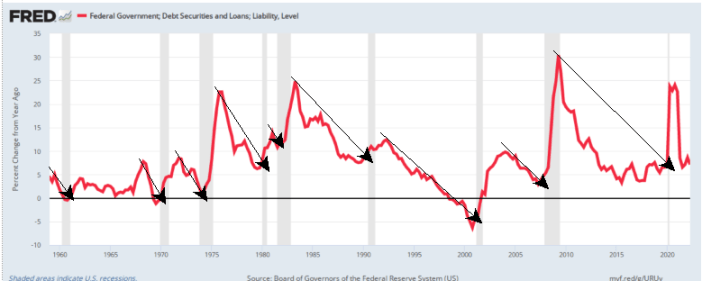
Recessions (gray bars) are caused by reduced debt growth and are cured by increased debt growth. By mathematical formula, Gross Domestic Product growth requires federal spending growth and federal debt growth.

GDP = Federal Spending + Non-federal spending + Net Exports.

This feat isn’t that hard now that the Congressional Budget Office (CBO) has released a series of budget options showing Congress how to do it.

In Libertarian terms, “how to do it” invariably requires reducing benefits to the public — specifically, the part of the public that is not rich.

It’s worth repeating that maintaining spending at the current level is not a viable option.

Given the dramatic increase in annual federal government spending over the next 30 years—from 22.3 percent of GDP to 30.2 percent—combined with federal tax revenues that have remained fairly constant at around 19 percent, CBO projects that future deficits will explode.

It’s forecasted to triple from 3.7 percent of GDP today to 11.1 percent in 2052. Over the next 10 years, primary deficits (deficits excluding interest payment on the debt) amount to $7.7 trillion. Meanwhile, deficits with interest payments total $15.8 trillion—roughly $1.6 trillion a year.

You’ll notice that Veronique never says why maintaining spending is “not a viable option.” All she does is quote large numbers to shock you.

In effect, she claims that Monetary Sovereignty is not a viable option, because it allows the government to create dollars. 

The “not a viable option” claim resembles the “ticking time bomb” claim about the federal debt, that has been wrong for more than 80 years. In that time, the federal debt has grown more than 55,000%, yet the nation survives quite well, thank you.

Sadly, Libertarians refuse to learn from actual experience. They cling to the myth that a Monetarily Sovereign government should impose austerity, despite the repeated and inevitable failures of such a system.

Note, by the way, that half of our future total deficits will be driven by interest payments on the debt. This fact isn’t surprising considering the size of our deficits and the rise in interest rates.

Federal interest payments, which the government has the infinite ability to make, add growth dollars to the economy.

The U.S. federal government daily demonstrates that interest payments pose no burden on a government having the infinite ability to create the dollars with which it makes the payments. And for the same reason, interest payments pose no burden on federal taxpayers.

Given these realities, no one will be surprised that the ratio of debt to GDP, now roughly 100 percent, will, under the most conservative estimations, jump to 110 percent in 10 years.

In the next 30 years it will likely double. More realistically, in 2052 debt as a share of GDP will be 260 percent. And that’s assuming no major recessions or emergencies.

As we have seen here, and other places on this blog, the debt / GDP ratio is meaningless. Neither a low nor a high ratio indicates the health of an economy. The ratio predicts or demonstrates nothing.

Any time you read or hear about the “dangers” of a high debt / GDP ratio, you will know you are reading ignorance and lies.

GDP does not fund debt. Further, GDP is one-year figure while debt is a cumulative-over-many-years figure. No comparability at all.

Low ratios and high ratios can be seen equally among the world’s most and least healthy economies.

Despite these awful numbers, legislators in both parties are currently debating how best to add trillions more to the country’s credit card balance.

The federal government does not have anything comparable to a “credit card balance.” Libertarians use that term to trick you into believing that the federal government is about to go bankrupt. It isn’t and it can’t. 

Many, for instance, want to add a new entitlement program in the form of the extended child tax credit.

The rich hate entitlement programs like Medicare, Medicaid, and Social Security because such programs benefit the poor and the middle, thereby closing the Gap between the rich and the rest.

Libertarians argue for the rich by feigning a brand of frugality that widens the Gap. 

It is in this setting that the CBO published its report on budget options. The two-volume document highlights options for deficit reduction.

One volume details large possible spending reductions while the other lays out small ones—so the options are plenty. They include important reforms of some of the major drivers of future debt: Medicare, Medicaid, and Social Security.

The misnamed “reforms” actually are reductions in benefits to the poor and middle classes. The rich love cutting Medicare, Medicaid, and Social Security, while boosting dollars for the military and cutting taxes on the rich.

And heaven forbid there be a new benefit for the not-rich, extended child tax credit. 

Ms. de Rugy, as a tool of the rich, dishonestly calls these cuts “reforms,” to dissuade you from objecting.

All told, it’s possible to achieve deficit reduction of $7.7 trillion over 10 years.

The mathematics are clear: A deficit reduction of $7.7 trillion will reduce GDP by about $7.7 trillion and lead to a recession if we a lucky, and a depression if we are not.

That’s enough to accomplish what some people mistakenly believe to be out of reach: balancing the budget without raising taxes.

While “balancing the budget” is prudent for people, businesses and local governments, it is a disaster for the federal government. Sadly, Ms. de Rugy, being ignorant of economics, doesn’t understand this.

There are also a few options to simplify the tax code by removing or reducing unfair individual tax deductions and by cutting corporate welfare.

Lest you believe the previous sentence indicates the Libertarians are willing to crack down on the rich, read the next sentence.

For instance, it’s high time for Congress to end tax deductions for employer-paid health insurance. This tax deduction is one of the biggest of what we wrongly call “tax expenditures.”

Get it? First Ms. de Rugy wishes to cut Medicare and Medicaid. Then, to further “balance the budget,” she wishes to cut employer paid health insurance. 

See the pattern? Starve the poor and middle classes to achieve a recession or depression. The very rich couldn’t be happier. They love widening the Gap between the rich and the rest. The wider the Gap, the richer they are.

It’s responsible for many of the gargantuan distortions in the health care market and the resulting enormous rise in health care costs.

The CBO report doesn’t eliminate this deduction; instead, it limits the income and payroll tax exclusion to the 50th percentile of premiums (i.e. annual contributions exceeding $8,900 for individual coverage and $21,600 a year for family coverage).

The savings from this reform alone would reduce the deficit by roughly $900 billion.

Why the limit? Why 50th percentile? No reason other than perhaps it seems more “generous” than eliminating the entire deduction.

A second good option is to cap the federal contribution to state-administered Medicaid programs.

Ah, more cuts to programs that help the poor. Ask Ms. de Rugy why not simply eliminate Social Security, Medicare, Medicaid, and all poverty aids. That would really “balance the budget.”

That federal block grant encourages states to expand the program’s benefits and eligibility standards—unreasonably in some cases—since they don’t have to shoulder the full bill.

CBO estimates that this reform would save $871 billion.

There is no reason for a Monetarily Sovereign nation to save $871 billion of the same dollars it has the infinite ability to create.

Ben Bernanke: “The U.S. government has a technology, called a printing press (or, today, its electronic equivalent), that allows it to produce as many U.S. dollars as it wishes at essentially no cost.”

The states are monetarily non-sovereign and are supported by taxpayers. The federal government is Monetarily Sovereign and is not supported by taxpayers.

To pay its bills, the federal government creates new dollars, ad hoc. All federal tax dollars are destroyed upon receipt by the U.S. Treasury.

Ms. de Rugy wishes unnecessarily to balance the budget by punishing the poorest Americans. One wonders about the kind of person who would recommend such cruelty.

CBO also projects that Uncle Sam could reduce the budget deficit by $121 billion by raising the federal retirement age.

CBO’s option would up this age “from 67 by two months per birth year for workers born between 1962 and 1978.

As a result, for all workers born in 1978 or later, the FRA would be 70.” Considering that seniors today live much longer than in the past and can work for many more years, this reform is a low-hanging fruit.

In yet another disgrace, Ms. de Rugy wishes to cut Social Security by raising the retirement age. This has scant effect on the rich, but would be a hardship for the poor.

Her “solution” involves moving retirement three years away for working people, in short to keep them working ’til they drop.

The rich, of course, can retire at will.

Congress could save another $184 billion by reducing Social Security benefits for high-income earners. I support a move away from an age-based program altogether since seniors are overrepresented in the top income quintile.

Social Security should be transformed into a need-based program (akin to welfare).

Nevertheless, the CBO’s option would be a step in the right direction.

A not-so-clever suggestion by Ms. de Rugy to make Social Security “akin to welfare.” The political right hesitates to cut Social Security directly, but would do it by making it “welfare,” and then cutting welfare.

As right wingers “know,” people accepting welfare are lazy takers, not worthy of help.

Further, with inflation, the need-based option falls ever more heavily on the poor, exactly what REASON wants.

There are so many more options for long-term deficit reduction. All Congress needs is a backbone. Considering the end-of-year spending bill going through Congress right now, I am not holding my breath.

SUMMARY

The article, which appeared in Reason.com, is a breathtaking litany of anti-poor, anti-middle, pro-rich recommendations to widen the Gap between the rich and the rest.

It is disgusting in its ignorance and cruelty, it’s lack of facts and its dissemination of false beliefs.

The sole purpose is to make the rich richer by widening the Gap between them and the rest of us. 

Lacking any recognition of Monetary Sovereignty, the author promulgates the usual right-wing austerity that punishes all but the rich. It is an inexcusable exercise in dishonor and immorality by Ms. de Rugy and her Libertarian accomplices.