The state of being aware of and responsive to one’s surroundings; a person’s awareness or perception of something; the fact of awareness by the mind of itself and the world; the individual awareness of unique thoughts, memories, feelings, sensations, and environments; subjective and unique awareness of oneself and the world around.
Note the repeated use of the word “awareness,” which leads to the question, “What is awareness”?
Here is one answer: In philosophy and psychology, awareness is a perception or knowledge of something.
The concept is often synonymous to consciousness.[2] However, one can be aware of something without being explicitly conscious of it, such as in the case of blindsight.
The states of awareness are also associated with the states of experience so that the structure represented in awareness is mirrored in the structure of experience.
Conscious?
Based on these definitions, is a photon conscious? A stone? A house? A bacterium? A bee? A tree? A fish? A bear? A human in a coma? A sleeping human? An awake human?
Where in the above list do you draw the line between consciousness and non-consciousness?
Scientists have expended prolific efforts searching for the elusive anatomical correlate of consciousness. Yet, the origins of consciousness remain unclear. By Yuhong Dong M.D., Ph.D., Makai Allbert, September 30, 2024
This is part 1 in “Where Does Consciousness Come From?”This series delves into research by renowned medical doctors to explore profound questions about consciousness, existence, and what may lie beyond.
“As a neurosurgeon, I was taught that the brain creates consciousness,” said Dr. Eben Alexander, who wrote in detail about his experiences with consciousness while in a deep coma.
Many doctors and biomedical students may have been taught the same about consciousness. However, scientists are still debating whether that theory holds true.
The more we learn about consciousness, the more we begin to believe that consciousness is not just a brain function.
Imagine a child observing an elephant for the first time. Light reflects off the animal and enters the child’s eyes. Retinal photoreceptors in the back of the eyes convert this light into electrical signals, which travel through the optic nerve to the brain’s cortex. This forms vision or visual consciousness.
How do these electrical signals miraculously transform into a vivid mental image? How do they turn into the child’s thoughts, followed by an emotional reaction—“Wow, the elephant is so big!”
The question of how the brain generates subjective perceptions, including images, feelings, and experiences, was coined by Australian cognitive scientist David Chalmers in 1995 as the “hard problem.”
As it turns out, having a brain may not be a prerequisite for consciousness.
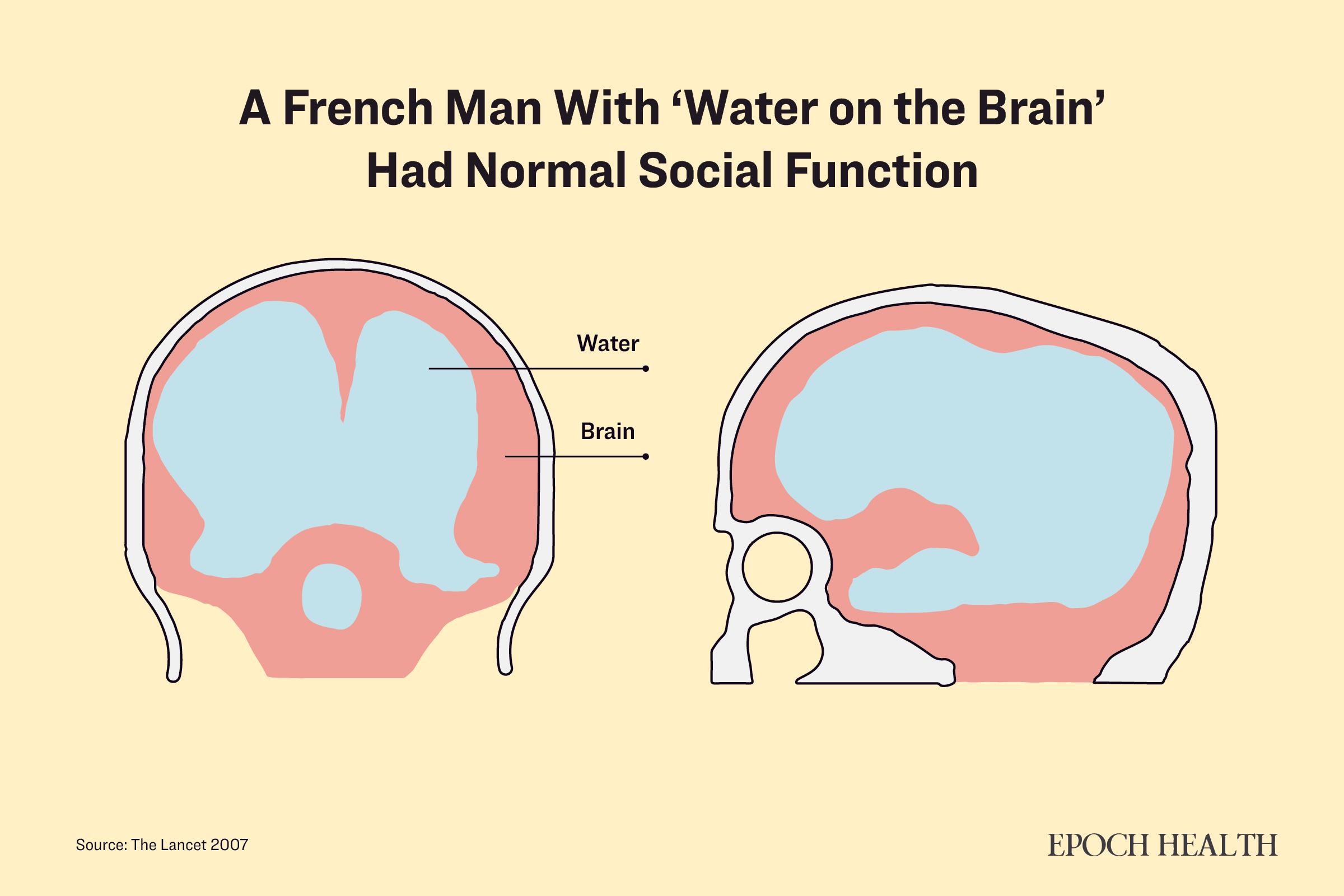
The Lancet recorded a case of a French man diagnosed with postnatal hydrocephalus—excess cerebrospinal fluid on or around the brain—at the age of 6 months.
Despite his condition, he grew up healthy, became a married father of two children, and worked as a civil servant.
When he was 44 years old, he went to the doctor due to a mild weakness in his left leg. The doctors scanned his head thoroughly and discovered that his brain tissue was almost entirely gone.
Most of the space in his skull was filled with fluid, with only a thin sheet of brain tissue.
“The brain was virtually absent,” wrote the lead author of the case study, Dr. Lionel Feuillet, of the Department of Neurology, Hôpital de la Timone in Marseille, France.
The man had been living a normal life and had no problem seeing, feeling, or perceiving things.
The Lancet recorded a case of a French civil servant diagnosed with postnatal hydrocephalus at the age of 6 months. Later, an MRI revealed massive enlargement of the lateral, third, and fourth ventricles, a very thin cortical mantle, and a posterior fossa cyst.
The normal brain cortex is responsible for sense and movement, and the hippocampus is responsible for memory. Hydrocephalus patients lose or have significantly less volume of these brain regions, yet they can still perform related functions.
The eye is a mechanism. We see because automatic chemical, electronic, and mechanical effects create an illusion of sight.
Even without substantial brains, these people can have above-average cognitive function.
Professor John Lorber (1915–1996), a neurologist from the University of Sheffield, analyzed more than 600 cases of children with hydrocephalus. Of those, he found that half of around 60 children with the most severe type of hydrocephalus and cerebral atrophy had an IQ higher than 100 and lived normal lives.
Among them, one university student had excellent grades, a first-class honors degree in mathematics, an IQ of 126, and was socially normal.
This math genius’s brain was only 1 millimeter thick, while an average person’s is usually 4.5 centimeters thick—44 times larger.
“The important thing about Lorber is that he’s done a long series of systematic scanning rather than just dealing with anecdotes.” Patrick Wall (1925–2001), professor of anatomy at University College London, was quoted as saying in an article by Roger Lewin published in Science in 1981 discussing Lorber’s article.
The cases of people without brains challenge the conventional teachings that brain structure is the basis for generating consciousness.
Is our brain—weighing about three pounds, with roughly two billion neurons connected by around 500 trillion synap ases—the real source of consciousness?
Some scientists have proposed that deep and invisible structures in the brain explain normal cognitive function—even with severe hydrocephalus.
These structures may not be easily visible on conventional brain scans or to the naked eye. However, the fact that they are not readily apparent doesn’t mean they don’t exist or aren’t important for brain function.
Here, science begins a strange but typical journey. The belief that the brain is the source of consciousness is ingrained.
When someone who clearly is conscious but has very little brain is examined, the immediate attempt is to save the “consciousness-is-in-the-brain” hypothesis.
So, scientists search for invisible brain structures that account for the phenomenon of consciousness.
It reminds one of the search for invisible connections among entangled quantum particles, with even the great Einstein complaining about “spooky action at a distance.”
We now believe there are no invisible connections among entangled particles, and in the same vein, I suggest there are no invisible brain structures that account for consciousness.
“For hundreds of years neurologists have assumed that all that is dear to them is performed by the cortex, but it may well be that the deep structures in the brain carry out many of the functions assumed to be the sole province of the cortex,” Wall commented in the 1981 article.
Or, it may be no such structures exist.
These unknown deep structures “are undoubtedly important for many functions,” said neurologist Norman Geschwind (1926–1984) from Beth Israel Hospital, affiliated with Harvard University, in the 1981 article.
Furthermore, the deep structures “are almost certainly more important than is currently thought,” said David Bowsher, a professor of neurophysiology at the University of Liverpool in the UK, in the same article.
The source of consciousness may exist in realms we’ve yet to explore. When medical theories can’t solve a mystery, physics might step in with a plot twist—in particular—quantum physics.
Quantum physics, which no human understands, has become the new “dark magic” or the new “God,” explaining all that current science cannot explain.
“To understand consciousness, we can’t just look at the neurons,” Dr. Stuart Hameroff, director of the Center for Consciousness Studies at the University of Arizona, told The Epoch Times.
Even single-celled organisms like paramecium demonstrate purposeful behaviors such as swimming, avoiding obstacles, mating, and, significantly—learning—without having a single synapse or being part of a neural network.
That should be a clue. “Purposeful behaviors” require purpose, and presumably, having a purpose requires some element of consciousness.
According to Hameroff, these intelligent, possibly conscious behaviors are mediated by microtubules inside the paramecium. The same microtubules are found in brain neurons and all animal and plant cells.
Microtubules, as the name suggests, are tiny tubes inside cells. They play essential roles in cell division, movement, and intracellular transport and appear to be the information carriers in neurons.
The proteins that make up microtubules (tubulin) are “the most prevalent or abundant protein in the whole brain,” Hameroff told The Epoch Times. He hypothesizes that microtubules are key players in human consciousness.
Hameroff still fights to preserve some semblance of a brain/consciousness connection. Scientists cannot entirely let go of a belief.
They can only chip away at it until nothing is left, by which time a new generation comes along to say, in essence, “the sun does not revolve around the earth.”
“Because [when] you look inside neurons, you see all these microtubules, and they’re in a periodic lattice, which is perfect for information processing and vibrations,” Hameroff stated.
Due to their properties, microtubules function like antennas. Hameroff says they serve as “quantum devices” to transduce consciousness from a quantum dimension.
British physicist, mathematician, and Nobel Laureate Sir Roger Penrose and Hameroff hypothesized a theory that quantum processes generate consciousness.
Quantum refers to tiny units of energy or matter at a microscopic level. Its unique features can help us understand many things that current science cannot explain.
As does black magic and religion. That, in fact, is the foundation of religion — explaining what science cannot explain.
In simple terms, microtubules act as a bridge between the quantum world and our consciousness. They take quantum signals, amplify them, organize them, and somehow, through processes we don’t fully understand, turn them into the feelings, perceptions, and thoughts that make up our conscious awareness.
Somehow. Somehow. Somehow.
Microtubules can explain bewildering facts about the brain. Hameroff posits that the brains of individuals born with hydrocephalus can adapt as their microtubules control neuroplasticity and reorganize their brain tissue.
“So over time, the microtubules in that brain adapt and rearrange themselves to sustain consciousness and cognition,” he said.
Other scientists are also using alternative quantum theories to explain mental activities. A study published in Physical Review E shows that vibrations in lipid molecules within the myelin sheath can create pairs of quantum-entangled photons.
It suggests that this quantum entanglement may help synchronize brain activity, providing insights into consciousness.
It’s like this. We don’t understand quantum entanglement, and we don’t understand consciousness, so maybe one causes the other.
We also don’t understand God, so perhaps we should throw Him (Her, It) into the mix and completely depart from science.
“Rather than a computer of simple neurons, the brain is a quantum orchestra,” Hameroff described, “Because you have resonances and harmony and solutions over different frequencies, much like you do in music. And [so] I think consciousness is more like music than it is a computation.”
Hey, why not? If we don’t understand microtubules or entangled protons, why not music?
Science is always evolving. The study of consciousness is still an area of active research and debate in neuroscience and philosophy. However, each new discovery opens up new possibilities. As we continue to explore these mysteries, let’s remain curious and open-minded.
Open-minded, but not empty-minded. Tossing out WAGs (Wild Ass Guesses) isn’t exactly science.
Let’s return to what we can agree on. Whatever consciousness is, it relates to sensing stimuli. When in daily parlance we speak of a person not being conscious, the belief is that person is not reacting to stimuli.
He (she, it) can’t see, hear, feel, smell, or taste, or at least not report on any of those senses. But we know an “unconscious” person has processes that continue. Administer an electric shock, and his leg will jump, so at least the muscles in his leg are conscious—probably his entire body.
His body reacts to outside stimuli, though perhaps one tiny portion of his brain doesn’t communicate what we call awareness.
When I am sleeping, the line between awareness and unawareness is blurry. I sense sounds and touch, which is why you can wake me by shouting or shaking me.
Let’s take it down a bit:
I play games, just for the fun of it. Am I conscious?
he question of whether bees are conscious is fascinating. Recent research suggests that bees exhibit behaviors that imply a form of consciousness. For instance, bees can recognize human faces, count, use tools, and even show signs of emotions.
They also demonstrate self-awareness and the ability to learn new tasks.
While bees’ brains are much simpler than human brains, containing about a million neurons compared to our 86 billion3, these complex behaviors indicate that bees might have a rudimentary form of consciousness.
A group of prominent biologists and philosophers announced a new consensus: There’s “a realistic possibility” that insects, octopuses, crustaceans, fish and other overlooked animals experience consciousness.
OK, we’re down to other animals evenparamecium – animal-like protists- which “swim, avoid obstacles, mate, and, significantly—learn—without having a single synapse or being part of a neural network.
What is the commonality among all animals?
They sense. How do we know? Because they react to outside stimuli.
OK, what about plants. Are they conscious?
When I asked the AI Copilot that question, it answered:
While plants exhibit sophisticated behaviors and can respond to their environment in remarkable ways, they do not have brains or nervous systems comparable to those of animals.
Some researchers argue that plants might have a form of “plant cognition,” which allows them to adapt and respond to stimuli in ways that seem intelligent.
For example, plants can send warning signals to other parts of themselves when damaged and produce chemicals to deter predators.
However, most scientists agree that plants do not possess consciousness as we understand it.
There’s that science focus on a brain, or lack thereof, again.
Consciousness typically involves subjective experiences and awareness, which require a complex nervous system and brain.
Because AI simply gathers information, it spews out the old “consciousness-is-in-the-brain” hypothesis, which doesn’t recognize game-playing bees, much less paramecium, those swimming, obstacle-avoiding mating, and learning creatures as being conscious.
Where do they draw the line? Can only humans be conscious? Or, more reasonably, can all living things have some element of consciousness.
What is the common element for human, other animal, and plant consciousness? Reacting to stimuli.
That’s all a “conscious” person does.
When you “see,” photons reflect off objects and pass through the cornea, which refracts the light. The photons then go through the lens, which further focuses the light onto the retina, which contains rods and cones.
These photoreceptors convert light into electrochemical signals that travel along the optic nerve to the visual cortex in the brain, which processes these signals and interprets them as images.
It’s all electro-mechanical. There is no magic. It’s just photons, electrons, protons, neutrons, etc., doing what they are stimulated to do, which gives us an illusion we term “consciousness.”
Where consciousness began
All those electrons, protons, neutrons, etc., were created from pure energy.
All things that exist must have a beginning, so if consciousness exists, where does it begin?
Does it begin with the human brain? With a game–playing, mating insect’s brain. With a brainless paramecium? With a tree sending, receiving, and interpreting signals from other plants and animals?
With a rock that expands, contracts, or moves because of wind, rain, heat, cold, and vibrations? With a photon that responds to other photons and other quantum particles? Where is that bright line between consciousness and non-consciousness?
I submit there is no such line and that searching for it is a fool’s errand based on anthropomorphism, the belief that we are an example for everything.
We may be special or even superior in a few ways, but we are not unique, and consciousness is not a unique attribute of anything.
All we do is react to stimuli, just as everything in the universe does. That is consciousness.
The more sophisticated our reaction, the greater is our consciousness.
This takes us to the Gaia hypothesis, which postulates that the earth and everything on it, organic and inorganic, are one organism, working together to promote and maintain life.
That hypothesis also intimates the earth itself is conscious and has conscious intent.
The Gaia hypothesis posits that the Earth is a self-regulating complex system involving the biosphere, the atmosphere, the hydrospheres and the pedosphere, tightly coupled as an evolving system. The hypothesis contends that this system as a whole, called Gaia, seeks a physical and chemical environment optimal for contemporary life.
The logical inference is that the entire universe is an incredibly complex arrangement in which the unlikely existence of life evolved from energy and quantum particles actually is not only likely but inevitable for a conscious being testing infinite possibilities.
For those of you who consider the complexity of the human brain as being a factor in consciousness, consider the complexity of the entire universe, and the existence of uncountable conscious entities all interacting via particle motion and entanglement.
INTRODUCTION
When we rank the “worst” taxes, we consider those that do the least good and cause the most harm to the American people and the economy.
The U.S. federal government is unique. It is Monetarily Sovereign, unlike state and local governments, businesses, and individuals, which are monetarily non-sovereign.
Federal taxes take dollars from the economy and destroy them. Then, there’s the waste of money in calculating, paying, and collecting taxes, and punishing evaders.
It initially created the U.S. dollar—as many as it arbitrarily chose—and remains the only entity with the infinite ability to create dollars.
The federal government cannot unintentionally run short of dollars. Even if it didn’t collect a penny in taxes, it could continue spending forever.
Thus, no federal government agency can run short of dollars unless that is what the government wants.
Anyone who claims otherwise either is ignorant about federal financing or lying.
Often, you have seen and heard statements indicating the government or certain agencies of the government — Social Security, Medicare, et al. — are about to run out of dollars or that specific proposals — Medicare for All, increased anti-poverty benefits, etc. — are “unaffordable.”
You will encounter questions like, “Who will pay for it?” or “When will the government run out of other people’s money?”
Such statements deceive, intentionally or not.
Sadly, even government employees, media representatives, and economists who should know better repeatedly promulgate disinformation.
Sometimes, you will be treated with honesty, such as the following statements which have been repeated on this blog:
Former Fed Chairman Alan Greenspan:“A government cannot become insolvent with respect to obligations in its own currency. There is nothing to prevent the federal government from creating as much money as it wants and paying it to somebody. The United States can pay any debt it has because we can always print the money to do that.”
Former Fed Chairman Ben Bernanke:“The U.S. government has a technology, called a printing press (or, today, its electronic equivalent), that allows it to produce as many U.S. dollars as it wishes at essentially no cost. It’s not tax money… We simply use the computer to mark up the size of the account.”
Current Fed Chairman Jerome Powell:“As a central bank, we have the ability to create money digitally.”
St. Louis Federal Reserve Bank:“As the sole manufacturer of dollars, whose debt is denominated in dollars, the U.S. government can never become insolvent, i.e., unable to pay its bills. In this sense, the government is not dependent on credit markets to remain operational.”
Different entities are Monetarily Sovereign over other forms of money. For example, the European Central Bank (ECB) is sovereign over the euro:
When asked, “Can the ECB ever run out of money?” Mario Draghi, the ECB president, replied, “No. We cannot run out of money.”The U.S. federal government is Monetarily Sovereign. It cannot run short of U.S. dollars. It has infinite dollars.
Unfortunately, such honesty is rare, and we are more likely to be subjected to misleading statements:
Molly Dahl, the Chief of Long-Term Analysis at the Congressional Budget Office (CBO), recently emphasized to the Senate Budget Committee that Social Security could run out of funds in about eight to nine years if no action is taken.
The Social Security Board of Trustees also projected that the trust funds could be depleted by 2035.
And,
The Medicare Board of Trustees has projected that the trust fund for Medicare Part A, which covers hospital insurance, could be depleted by 2031
Tricia Neuman, the executive director of the Program on Medicare Policy at KFF, has also highlighted the need for action to avoid severe Medicare cuts.
Additionally, Robert Emmet Moffit, co-editor of Modernizing Medicare, has pointed out the financial challenges due to factors like the rising number of older Americans and advanced medical technology.
These “experts” and many others fail to mention that the problems could be eliminated at the stroke of a President’s pen by approving a Congressional bill that would, in essence, say, “The federal government will fully fund All Medicare and Social Security expenses.”
The federal government neither needs nor uses tax dollars to fund anything. All federal tax dollars are destroyed upon receipt. When federal taxes are taken from the public, they begin as checking account dollars in the M2 money supply measure.
When they reach the U.S. Treasury, they suddenly cease to be part of any money supply measure. They simply disappear into the federal government’s infinite supply of money. Infinity plus any number equals infinity.Federal taxes do not provide the federal government with spending money. The government creates new dollars by paying creditors’ bills.
To pay a creditor, the government sends instructions (not dollars) to the creditor’s bank, instructing the bank to increase the balance in the creditor’s checking account. New dollars are added to the M2 money supply measure when the bank does as instructed.
The bank balances its books by clearing the transaction through the Federal Reserve system.
What, then, is the purpose of federal taxes?
Federal taxes assure demand for the U.S. dollar by requiring taxes to be paid in dollars.
Federal taxes allow the federal government to control the economy by taxing what the government wishes to discourage and by giving tax breaks to what the government wishes to reward.
Then, there is the real function of federal taxes: To help the rich become even wealthier by widening the gap between the rich and the rest.
It is the Gap that makes the rich rich. Without the Gap, no one would be rich; we would all be the same. The wider the Gap, the richer. To become richer, one must accomplish two things: gain more wealth for oneself and/or ensure those below have less.
Federal tax laws accomplish the latter by granting tax exceptions for the kinds of income enjoyed by the wealthiest among us. Just one example:
Donald Trump on his federal tax returnsdeclared negative income in 2015, 2016, 2017 and 2020, and that he paid a total of $1,500 in income taxes for the years 2016 and 2017. On their 2020 income tax returns, Trump and his wife Melania paid no federal income taxes and claimed a refund of $5.47 million.
Billionaire Donald Trump paid less income tax than you did from 2015 through 2020. And this is not an exception. It is a fundamental purpose of federal tax laws—the Gap-widening process for which the rich bribe Congress.
THE FOUR WORST TAXES IN AMERICA
Because the federal government neither needs nor uses tax dollars, three of the four worst taxes are federal.
They take dollars from the private sector (also known as “the economy”) and transfer them to the government, where they are destroyed. Mathematically, federal taxes (but not state/local taxes), pay for nothing, reduce Gross Domestic Product, and are recessive.Relative to their income, the poor pay far more in sales taxes than the rich.4. The fourth worst taxes in America are the ones that are not federal: State and local sales taxes. Unlike the federal government, state/local governments are part of the U.S. economy.
They deposit tax dollars into bank accounts, which become part of the M2 money supply measure. Thus, state/local taxes are not mathematically recessive.
However, they are regressive. They negatively affect the rich much less than the rest of us simply because they use a smaller percentage of their income to purchase sales-taxable items.3. The third-worst tax in America is the federal capital gains tax. In theory, this tax could be somewhat beneficial. On the surface, it should tax the rich more than others because they are far more likely to have capital gains.
Further, the higher tax on short-term (one year or less) capital gains should encourage investment above speculation.
The reality is far different. The rich have bribed Congress to include so many exceptions and caveats in this highly complex tax law that the rules allow the rich to escape most if not all, taxation (See Donald Trump).
Though federal tax dollars are destroyed upon receipt, the tax could benefit the economy if it served a practical purpose: Narrowing the Gap between the rich and the rest.
In practice, it does the opposite.
2. The second worst tax in America is the federal tax on Social Security benefits. While the notion that the federal government should provide benefits to the elderly and disabled makes sense, unnecessarily taxing those benefits is senseless and regressive.
The people most in need of Social Security benefits have the least ability to pay taxes on the program’s already meager payments.
Despite having the infinite ability to pay benefits and unnecessarily collecting taxes on benefits, the federal government repeatedly has raised the minimum age for receiving full benefits:
Normal Retirement Age
Year of birth
Age
1937 and prior
65
1938
65 and 2 months
1939
65 and 4 months
1940
65 and 6 months
1941
65 and 8 months
1942
65 and 10 months
1943-54
66
1955
66 and 2 months
1956
66 and 4 months
1957
66 and 6 months
1958
66 and 8 months
1959
66 and 10 months
1960 and later
67
Taxing benefits while raising eligibility ages is unconscionable but perfectly rational for a government that has been bribed to widen the income/wealth/power Gap between the rich and the rest.
1. The worst tax in America is FICA, the Federal Insurance Contributions Act. The federal payroll tax supposedly funds Social Security and Medicare programs. It is deducted from each paycheck and ostensibly provides financial and health care benefits for retirees, disabled Americans, and children.
It does none of those things. Like all federal taxes, it is destroyed upon receipt by the Treasury.
It is designed to impact salaried people in lower-income groups. It is not levied against the type of income the rich most enjoy, such as capital gains, interest, and other “non-income” income.
It is limited to salaries below $168,600. A person earning a million dollars a year would pay almost* the same amount of FICA tax as a person earning $168,000 a year. (*An extra 2% of salaries above $299K) is deducted for Medicare.)
Half of FICA supposedly is paid by businesses, but this is a charade. Businesses consider the cost of FICA when determining salaries, particularly for lower-paid employees. It is the lower-paid employees who ultimately suffer the full burden of FICA.
However, FICA encourages businesses to hire workers as independent contractors liable for their retirement financing. This allows companies financial room to pay higher salaries, giving the illusion of more generous compensation.
FICA and its sister taxes, the self-employment tax on individuals who work for themselves, and FUTA, the Federal Unemployment Tax Act that employers pay for unemployment insurance, are the worst taxes because they are the most regressive. They do the most to widen the Gap between the rich and the rest.
Taxing employment discourages businesses and the economy from employing people, which is exactly the opposite effect one would desire for any government action.
All federal employment taxes could and should be eliminated immediately.SUMMARY
Federal taxes do not fund federal spending. The federal government destroys all the tax dollars it receives.
Further, federal taxes reduce GDP, so they are recessive.
Federal tax laws, as currently written and enforced, are regressive widening the income/wealth/power Gap between the rich and the rest.
However, federal taxes support demand for the U.S. dollar and help the government control the economy by taxing what it wishes to limit and giving tax breaks to what it wishes to encourage.
State and local taxes fund state and local spending. They do not reduce GDP but are often regressive.
All federal taxes should be eliminated except where the government wishes to limitsome activity.
Another means of federal control would be to use federal spending (rather than tax breaks) to support activities the government wishes to encourage.
The federal government could help reduce the regressive nature of state/local taxes by providing per capita aid to all states.
And yes, I know, federal spending supposedly causes inflation. That already has been debunked here, here, here, and elsewhere in this blog. Federal spending prevents and cures inflation when it acquires and distributes the scarcities causing inflation.
Rodger Malcolm Mitchell
Monetary SovereigntyTwitter: @rodgermitchellSearch #monetarysovereigntyFacebook: Rodger Malcolm Mitchell;MUCK RACK: https://muckrack.com/rodger-malcolm-mitchell; https://www.academia.edu/
……………………………………………………………………..
The Sole Purpose of Government Is to Improve and Protect the Lives of the People.
Years ago, I took over a commodity brokerage with an employee who recently had won a chartist competition. A chartist is a securities researcher or trader who analyzes investments based on past market prices and technical indicators.
He had endless historical data and formulas for that data, and based on all that, he predicted the markets.
Despite winning a national competition, his trading proved to be a spectacular failure. While past data told him what had happened, He had no idea why it happened, so his predictions were worthless.
He didn’t understand cause and effect.
In this vein, an article claims to explain the cause of inflation to the last decimal point. Do you believe it?
Increased federal spending helped the economy bounce back during the pandemic, but it also caused a surge in inflation, research reveals. Inflation is difficult to control. Its cause is often even harder to pinpoint.
Yes, if all you have is formulas and you don’t understand how an economy works, the cause is hard to pinpoint. But that doesn’t stop technicians from trying to identify it.
In attempting to understand the 2022 spike in inflation that followed the pandemic, some policymakers — up to and including President Joe Biden — blamed shortages in the supply chain. But a new study shows that federal spending was the cause — significantly so.
“Our research shows mathematically that the overwhelming driver of that burst of inflation in 2022 was federal spending, not the supply chain,” said Mark Kritzman, a senior lecturer at MIT Sloan.
Fascinating that Mr. Kritzman should conclude inflation was caused by spending.
If he were correct, net spending, i.e., the difference between taxes and gross spending, would cause inflation. That is what puts spending dollars into consumers’ pockets.
Net spending, or deficit spending, tells us how much money the federal government adds to the economy after taxes are subtracted.
Here is some data Mr. Kritzman may have overlooked:
No relationship exists between increases and decreases in federal net spending (red) vs. inflation (blue).
Not only does Mr. Kritzman overlook the data showing no correlation between netgovernment spending and inflation, he tries to put mathematical measures on how much total federal spending (ignoring taxes) affects inflation.
In writing “The Determinants of Inflation,” Kritzman and colleagues from State Street developed a new methodology that revealed how certain drivers of inflation changed in importance over time from 1960 to 2022.
In doing so, they found that federal spending was two to three times more important than any other factor causing inflation during 2022.
Specifically, their results showed that:
42% of inflation could be attributed to government spending.
17% could be attributed to inflation expectations — that is, the rate at which consumers expect prices to continue to increase.
14% could be blamed on high interest rates.
When you see those kinds of specific percentages, you should be doubtful, and when you see them attributed to something like “inflation expectations,” you should be incredulous. Does Mr. Kritzman believe he can measure consumer expectations and include that in an equation? Really?
You might have noticed that his results totaled 73%, leaving only 27% for oil shortages—the real cause of inflation.
Oil price changes (green) are closely related to inflation (blue).
The graph shows the essentially parallel tracks of oil prices and inflation. This is no coincidence; oil costs are part of virtually every product and service. In April 2020, OPEC agreed to a historic cut in oil production by 9.7 million barrels per day starting in May 2020.
Despite massive federal net spending after 2015, inflation (blue) remained relatively low until COVID hit in 2020. Then, we had a recession (vertical gray bar), cured by increased federal net spending.
Inflation didn’t begin until April 2020, when OPEC cut oil supplies to raise prices. This reduction in supply led to inflation (green) that is only now being cured as oil prices drop.
Here is a closer look at inflation and oil during COVID:
Crude oil prices rose due to OPEC price control. This caused inflation to increase. Then OPEC lowered prices and inflation followed down.
Kritzman said that using government stimulus money to help the economy rebound during the pandemic made sense, given the unprecedented circumstances. “People really didn’t know if we were going to have a 1930s-type depression, so the government erred on the side of more stimulus than less stimulus,” he said.
“I don’t judge that to be a bad thing to have done, but it did cause this big spike in inflation,” Kritzman said. “What was surprising is not just that [the driver] was federal spending but that it was so overwhelmingly federal spending.”
Wrong. It was overwhelmingly OPEC oil shortages, along with other COVID-related scarcities of food, shipping, metals, lumber, computer chips, labor, and other scarcities, that caused inflation.
Here is how they came to their conclusion:
The authors arrived at their conclusion by using the Mahalanobis distance statistic, which has been used in a range of projects, from measuring turbulence in the financial markets to detecting anomalies in self-driving vehicles.
In their paper, researchers first used a hidden Markov model to identify four regimes of shifting inflation: stable, rising steady, rising volatile, and disinflation.
Then they used the Mahalanobis distance to figure out how eight different economic variables caused the economy to shift between those regimes. The economic variables the authors looked at were producer prices, wages/salaries, personal consumption, inflation expectations, interest rates, the yield curve, the money supply, and federal spending.
Finally, by applying an algorithm to the data from 1960 to 2022, they were able to see how inflation drivers had changed in importance over time. This enabled them to predict the likely path of future inflation — a capability that could potentially be of help to policymakers and investors alike.
The results dispel the notion that the supply chain could be blamed for the 2022 spike in inflation, Kritzman said.
The results may or may not dispel that notion, but they don’t deal with the fact that inflation is caused by shortages of critical goods and services, usually oil and/or food, not federal spending.
Here is their explanatory graph. As you will see, federal deficit spending is not even shown on their graph. Could it be because even they don’t believe it’s a relevant factor?
Examine their graph, and you’ll see a few peculiarities.
The first is that they mix cause and effect: Causes would be Personal Consumption, Interest Rates, Yield Curve, Money Supply, and Federal Spending.
The effects would be Producer Prices, Wages, and Salaries. It’s not clear how one can claim that producer prices cause inflation when they are caused by inflation.
2. If Personal Consumption is only 6.2% at fault, how is Federal Spending given 41% blame for inflation? Was all that inflation caused strictly by the government’s purchases, not by consumer purchases? Unlikely.
3. And if federal deficit spending flooded the economy with money, how did the money supply only increase by 2.9%?
4. Finally, there’s that amorphous “expectations” thing. How was that translated into dollars to reach the precise number 16.9%? If you had inflation expectations, how would you put a number on that?
How would you determine it was 13.9% responsible for changing your consumer buying or business selling prices?
The numbers in the above graph are what I like to call WAGs (Wild Ass Guesses), made to look scientific by applying fake mathematics.
“The narrative at the time was that the cause of inflation was interruptions to the supply chain because of COVID-19,” Kritzman said. “But that didn’t show up in producer prices
In other words, if supplies became scarce, then the prices of those supplies would go up, which we don’t see in our results at that point in time.”
The narrative should have been that all prices went up because of the scarcity of oil, food, shipping, metals, lumber, computer chips, labor, etc. That is the whole point:
We had inflation, not because of “excessive federal spending” but because of COVID-related scarcities.
Guidance for policymakers
The researchers’ findings indicate that the government and the Fed sometimes operate at cross purposes, Kritzman said. When the federal government overstimulates the economy, the Federal Reserve has to delay lowering interest rates.
The data refute the “overstimulates” notion. There was no historical relationship between federal spending and inflation.
“The more overstimulation there is, the more hawkish the Fed has to be to keep inflation under control,” Kritzman said.
Keeping inflation under control is not the Fed’s job. The Fed doesn’t have the tools. It’s Congress’s and the President’s job to prevent and cure the shortages of goods and services that cause inflation.
Taking the same approach that the researchers did, the Federal Reserve might be able to gain a deeper look at “the dynamics that are going on” — not just that inflation is up or down, he said. Instead, it offers insight into how the drivers of inflation change in importance through time.
Yes, sometimes a shortage of oil drives inflation. Other times, it’s a shortage of food, labor, or other production factors.
“I think that the Fed would be well advised to take this methodology and make it operational in how they monitor inflation and other things that they’re interested in,” Kritzman said.
No, Congress and the President should stop avoiding their responsibilities. They should assume control over inflation by preventing and curing shortages.
For example, encouraging and aiding oil drillers and refiners and releasing oil from the Strategic Petroleum Reserve were primary factors in ending the most recent inflation.
The same encouragement and aid should be given to all products and services, the shortages of which cause inflation.
The Wall Street Journal is owned by Rupert Murdoch, who supports 32 times convicted felon Donald Trump. Murdoch also owns extreme right-wing Fox News, which paid an $800 million fine for lying.
Need I say more?
Here are excerpts from an article that appeared in the WSJ. Comments are noted.
Federal Debt Is Soaring. Here’s Why Trump and Harris Aren’t Talking About It. Story by Richard Rubin, richard.rubin@wsj.com
The U.S. isn’t fighting a war, a crisis or a recession. Yet the federal government is borrowing as if it were.
The U.S. federal government is Monetarily Sovereign. It has the unlimited ability to create U.S. dollars:
Alan Greenspan:“There is nothing to prevent the federal government from creating as much money as it wants and paying it to somebody.”
If you owned a money-printing machine and had the unlimited, legal ability to create as many $100 bills as you wanted — at no cost to you — would you ever borrow dollars? Think about it.
The government has that “money-printing machine” and the legal right to create dollars. Why on earth would the government ever borrow dollars? Answer: The U.S. government never borrows dollars. Not ever.
Ben Bernanke: “The U.S. government has a technology, called a printing press (or, today, its electronic equivalent), that allows it to produce as many U.S. dollars as it wishes at essentially no cost.”
The confusion is semantic. In the private sector, the words “bills,” “notes,” and “bonds” denote debt. “Bills” are what you owe in your daily life. Corporate “notes” and “bonds” are evidence of corporate debt.
By contrast, Treasury bills, notes, and bonds have nothing to do with government borrowing. They are deposits into Treasury Security accounts. Depositors, like China, the UK, and private citizens like you, own the money in these accounts; the federal government doesn’t.
The federal government never accesses those dollars for federal spending. It creates new dollars to pay all its bills.
To pay a creditor, the federal government creates instructions in the form of checks or wires. The instructions tell the creditor’s bank to increase the balance in the creditor’s checking account by a certain amount.
At the moment the bank obeys those instructions, new dollars are created and added to the M2 money supply measure.
To pay off the so-called “debt,” the federal government merely returns the depositors’ dollars that already reside in their T-security accounts. (Think of a safe deposit box in which depositors place valuables. The bank doesn’t use those valuables and returns them upon request by the depositors.)
Returning existing dollars is not a financial burden on the government or on federal taxpayers.
The confusion is not only semantic but also arises from the fact that the total of deposits equals the total of federal deficits. This is an anachronism from when the federal government was not wholly sovereign over the dollar and tied itself to silver and gold.
In short, federal “debt” is nothing like personal debt. The federal government is not “in debt.” It pays all its bills timely and in full, and can continue doing so.
Since dollars are a creation of laws, so long as the federal government has the ability to pass laws, it has the ability create dollars.
This year’s budget deficit is on track to top $1.9 trillion, or more than 6% of economic output, a threshold reached only around World War II, the 2008 financial crisis and the Covid-19 pandemic.
Publicly held federal debt—the sum of all deficits—just passed $28 trillion or almost 100% of GDP.
The “debt”/GDP ratio is meaningless. It says nothing about the federal government’s ability to pay. Debt nuts often quote this number to scare you, but it has absolutely no relevance to the federal government’s ability to pay its bills.
If Congress does nothing, the total debt will climb by another $22 trillion through 2034. Interest costs alone are poised to exceed annual defense spending.
These are big numbers but completely meaningless concerning the federal government’s solvency. The misnamed “debt” could be ten times or a hundred times as large, and the federal government easily could continue to pay all its bills.
Even if the government didn’t collect a single penny in taxes and the “debt” was a hundred times larger, it still could continue to pay its bills in full and in a timely manner.
Federal taxes are different from state and local taxes. State and local governments are monetarily non-sovereign. They do not have the unlimited ability to create dollars. They use tax receipts and borrowing to pay their financial obligations.
By contrast, the U.S. federal government does not use tax dollars or borrowing to pay its bills. The purposes of federal taxes are:
To control the economy by taxing what the government wishes to discourage and by giving tax breaks to what the government wishes to reward.
To assure demand for the U.S. dollar by required taxes to be paid in dollars.
Economists and policymakers already worry that the growing debt pile could put upward pressure on interest rates, restraining economic growth, crowding out other priorities and potentially impairing Washington’s ability to borrow in case of a war or another crisis.
In one sentence, the author, Mr. Rubin, has articulated the four common lies about the so-called federal debt (that neither is federal nor debt).
The U.S. Federal Reserve sets interest rates at its whim in an effort to control inflation. This has nothing to do with the size of the federal “debt” as shown by the following graph:
There is no relationship between changes in federal “debt” (bleu) and interest rates (red).
There have been scattered warning signs already, including downgrades to the U.S. credit rating and lackluster demand for Treasury debt at some auctions.
Interest rates also are set to attract depositors, an exercise that became obsolete in 1971, when the government no longer required itself to match income with outflow.
2. Credit agencies set ratings based on the debtor’s ability and likelihood of paying promptly and in full. The federal government always pays timely and in full, so why would the rating ever go down?
Answer: This is not because of the size of the “debt” but because of Congress’s political gamesmanship. The party out of power limits the party in power’s ability to pay. It uses one of the more ridiculous laws, the so-called “debt limit” (which doesn’t limit the non-existent “debt.” It limits the government’s ability to pay its daily bills).
While the federal “debt” has grown from $400 billion to $33 trillion in just 80 years, “debt” downgrades have been few and sporadic, and related only to the fear that the debt nuts will prevent the government from paying, not to the size of the “debt.”
3. Federal deficits are necessary to grow the economy. It is mathematically impossible for the U.S. economy to grow unless the federal government pumps more money into the private sector (aka, the economy) than it takes out.
4. Federal deficit spending does not “crowd out” anything. It adds lending dollars to the economy.
With more dollars on deposit, the banks can lend more easily, and when the economy has more money, it is more likely to expand by borrowing. Nothing impairs Washington’s ability to borrow; the federal government never borrows.
5. “Lackluster demand” for T-securities is not a problem for the federal government. Selling T-securities doesn’t benefit the federal government. T-securities benefit buyers looking for a safe place to store unused dollars. That is why China buys them.T-securities are more secure than any bank China could find.
T-securities have two purposes, neither of which is to provide spending funds to the U.S. government:
— To help stabilize the dollar by providing safe storage for unused dollars
— To help the Fed control interest rates.
Both Harris and Trump have promised to protect the biggest drivers of rising spending—Social Security and Medicare. And both want to extend trillions of dollars in tax cuts set to lapse at the end of 2025, amid bipartisan agreement that federal income taxes shouldn’t rise for at least 97% of households.
Those are good political promises that would benefit the economy. Of course, the reality is that debt nuts will prevail because of voter ignorance. Thus, you can expect the same strong support for cutting benefits to the middle- and lower-income groups as we have seen in the past. The eligibility age for Social Security will continue to go up, and benefits will be taxed further.
Trump has promised to exempt tips from taxation, end income taxes on Social Security benefits, eliminate taxes on overtime pay, lower tax rates for companies that manufacture in the U.S., and create a new deduction for new parents’ expenses, offering more than $2 trillion in tax cuts atop $4 trillion to extend his first-term tax cuts.
These are good ideas, but as has been typical of Trump’s promises, they’re all verbal tooth-fairy stuff. It’ll happen only in your dreams.
Harris matched Trump’s tips idea and called for an expanded child care tax credit, including $6,000 for parents of newborns.
If the Republican House allows an expanded child care tax credit and $6,000 for newborns — which it won’t.
How did the U.S. fiscal path simultaneously become economically more alarming yet politically less relevant? Federal debt and deficits have blown past various imagined red lines and feared consequences have not materialized.
Keep that phrase in mind: “Feared consequences have not materialized.” The reason: The feared consequences were based on lies. There are no adverse consequences for federal deficits.The consequences are for not running deficits or even for deficits that are too low.
Interest rates, at least until 2022, stayed low. The dollar remains the world’s reserve currency, giving the U.S. far more running room than other major countries. The U.S. of 2024 is not Greece of 2007. There is risk, but there is no fiscal crisis.
There has been no financial crisis simply because federal “debt” is not a financial crisis. The whole thing is a giant lie spun by the rich to prevent the rest of us from receiving benefits.
The tax on Social Security benefits is ludicrous. Why would any sane government tax the benefits it provides?
The fact that the U.S. dollar is the world’s most common reserve currency does not give the U.S. “more running room” (whatever that is). It merely means that the world’s banks carry more U.S. dollars in reserve to facilitate international trade.
It does not protect us from financial difficulties; Monetary Sovereignty protects us from financial difficulties.
And yes, the U.S. is not Greece (or France, Germany, or Spain), none of which is Monetarily Sovereign. Those nations are more like Illinois, New York, and Wisconsin. They cannot create the money they use. The European Union (EU) is like the U.S. federal government in that itis Monetarily Sovereign and has the unlimited ability to create euros.
“We’ve learned we borrowed more than we realized we could,” said Jason Furman, a Harvard economist who was a top aide to President Barack Obama. “And we’ve actually borrowed more than we expected.”
Actually, Mr. Harvard economist, we haven’t borrowed at all. You’re surprised because the economy has grown due to increased federal deficit spending.
You simply can’t figure out why deficit spending seems to grow the economy while insufficient deficit spending leads to recessions (which are cured by more deficit spending).
Why it’s a mystery to you is the real mystery.
When deficit growth declines, we have recessions (vertical gray bars), which are cured by deficit increases.
Sadly, this simple graph shows that declines in deficit growth repeatedly lead to recessions, which are cured by increasesin deficit growth.
Yet economically ignorant pundits continue to rail against deficit growth.
If anything, borrowing kept the economy afloat during the 2007-09 financial crisisand pandemic, and lawmakers were rewarded for it. Polls show the public is concerned about the deficit, but they also prefer politicians who dangle tax cuts, stimulus checks and money for the military.
If you believe borrowing “kept the economy afloat,” why do you oppose it?
At any rate, there was no borrowing. There was money creation, which the federal government can do in any amount, at will. The financial crisis was caused by excessive private-sector borrowing, not by non-existent federal borrowing.
The author demonstrates a failure to understand the difference between private sector and federal finances.
“No president in history, Republican or Democrat, gets a gold star or a Nobel Prize for reining in spending, the deficits and our debt,” said Rep. Jodey Arrington (R., Texas), chairman of the House Budget Committee. “Nobody gets the golden meat cleaver award.”
Thank heaven for that, because the “golden meat cleaver” cuts the legs off economic growth. (See: Ignorance is hard to conquer if the ignorant want to remain that way.)
Whoever wins in November will soon face two big fiscal tests. One is the need to raise the federal debt limit, likely in mid-2025.
No, the test will be to eliminate, not raise, the ridiculous “debt limit,” a law based on the rich’s desire to widen the income/wealth/power Gapbetween them and the rest. It is the Gap that makes them rich. Without the Gap, no one would be rich; we all would be the same. And the wider the Gap, the richer they are.
The two ways for the rich to become richer are: Gain more for themselves and/or make sure those below them have less. That is why cutting your benefits makes the rich richer.
In both 2011 and 2023, the threat of default without a debt-limit increase led to compromises that reduced red ink.
Any default would be caused by the idiotic, unnecessary “debt ceiling.” Compromises are political theatre based on lies.
The other trigger is the looming expiration of much of the 2017 tax law.
That is the tax law Trump passed to help the rich widen the income/wealth/power Gap between the rich and the rest.
It was a tax law that If Congress doesn’t act by the end of 2025, taxes would rise on most households, a path to deficit reduction that both parties say they don’t want.
Imagine that. Congress wants to keep taxes low, but not increase the deficit. Anyone have a magic wand to make that happen?
In the early 1990s, when deficits were much smaller, deficit hawks were powerful enough in both parties to produce bipartisan deals that raised taxes and lowered spending. Those agreements helped drive the budget into balance in the late 1990s. Federal debt fell to about one-third of GDP.
And that budget balancing is what led to the recession of 2001, which was cured by federal deficits.
As deficit growth fell, we had a recession, which was cured when deficit growth resumed. This has happened repeatedly in U.S. history, yet debt nuts still call for deficit reduction.
When he first ran for president in 2016, Donald Trump said he would pay off the national debt within eight years. He went in the opposite direction: Debt rose from less than $15 trillion to more than $21 trillion by the time he left office.
What?? Donald Trump lied? Hard to believe. But good thing he did. The rise in “debt” fueled economic growth.
Trump made two major decisions that broke with Republicans in Congress and drove up federal borrowing.
Republicans had long advocated making Social Security and Medicare less generousand more fiscally sustainable. To appeal to middle-class voters, Trump embraced what had long been a Democratic position and shut down discussion of broad benefit cuts.
As always, Republicans wanted to cut benefits for those who are not rich. Trump saw that the voters would not buy into the lie, so he wisely increased the “debt.”
And to call Social Security and Medicare “generous” is laughable. No one can live on Social Security benefits, and Medicare covers, at best, only 80% of costs. Still, the right-wing can hardly wait to cut, cut, cut.
Then in 2017, when House Republicans sought to cut tax rates, Trump resisted their attempts to offset the full cost. The Tax Cuts and Jobs Act Trump eventually signed into law was projected then to increase deficits by $1.5 trillion over a decade.
And it helped make the rich richer.
Once the pandemic started, Trump joined the broad economic consensus that the U.S. needed to pour money into the economy, eventually adding more than $3 trillion to the debt to provide stimulus checks, enhanced jobless benefits and other relief.
O.K., debt nuts, why does pouring money into the economy grow the economy, but only is a good thing when the economy is in trouble? It makes no sense.
President Biden and Harris expanded on Trump’s pandemic spending with the $1.9 trillion American Rescue Plan, which included another round of stimulus checks and aid to state and local governments.
The stimulus checks were a toe-in-the-water introduction of Social Security for All, which America should have. It worked as desired, which is why Congress didn’t repeat them.
Biden, with Harris’s strong backing, canceled student debt in a series of executive orders that could cost the government more than $1 trillion, according to the Committee for a Responsible Federal Budget. The plan is now stuck in litigation as (right-wing) courts have curtailed Biden’s authority to cancel debt.
“I don’t think we’ve seen a president spend nearly as much without Congress as Biden,” said Marc Goldwein, the CRFB’s senior vice president.
Biden took over where the Republican Congress played politics with the economy. Putting students into debt is as stupid as it gets for a nation that claims it needs an educated population to compete on the world stage.
What happens if Trump wins depends on Congress. If Republicans also control the House and Senate, his next term could look a lot like his first—occasional talk about debt and deficits paired with tax cuts that expand both.
“Paired with tax cuts” for the rich along with deportations of much of our workforce (which would destroy the economy), the promised firing of millions of government workers (which would destroy our government), and the hiring of Trump’s incompetent friends and relatives (which would make Trump a dictator).
In his acceptance speech at the Republican National Convention, Trump said, “We’ll start paying off debt and start lowering taxes even further.”
Nonpartisan experts say there’s virtually no chance of that. Paying off debt would require the U.S. to shift from massive deficits to surpluses.
Tax cuts would work in the opposite direction. Low tax rates can encourage growth and generate some revenue, but not enough to offset the loss of revenue, economists in both parties acknowledge.
Federal surpluses take dollars out of the economy. How this is supposed to cause economic growth is a mystery never explained by the debt nuts.
Every federal surplus in history has caused a depression, but one, the 1997 recession “only” caused a recession.
1804-1812: U. S. Federal Debt reduced 48%. Depression began 1807.
1817-1821: U. S. Federal Debt reduced 29%. Depression began 1819.
1823-1836: U. S. Federal Debt reduced 99%. Depression began 1837.
1852-1857: U. S. Federal Debt reduced 59%. Depression began 1857.
1867-1873: U. S. Federal Debt reduced 27%. Depression began 1873.
1880-1893: U. S. Federal Debt reduced 57%. Depression began 1893.
1920-1930: U. S. Federal Debt reduced 36%. Depression began 1929.
1997-2001: U. S. Federal Debt reduced 15%. Recession began 2001.
The reason for the above is no mystery. GDP = Federal Spending + Nonfederal Spending + Net Exports. Reduce federal deficits, and you will reduce both federal spending and nonfederal spending. Simple algebra.
Trump has indicated that he wants to extend the pieces of his 2017 tax law that expire after 2025 and lower the 21% corporate tax rate to 20%, and 15% for some companies. His recent proposals—eliminating taxes on workers’ tips, overtime pay and retirees’ Social Security benefits—dig a deeper hole.
He’s also made other proposals that would entail significant new spending, including a mass deportation program and a domestic missile-defense system.
These are good proposals except for his deportation crime. This would destroy lives, destroy the economy of America and the world, and destroy America ‘s reputation. We would forever be stamped as a vicious, mean-spirited banana-republic dictatorship.
Trump has touted several ideas that could reduce deficits. One is impoundment, in which the president refuses to spend money Congress has appropriated. That’s legally and constitutionally dubious.
And economically suicidal.
The other is tariffs. Trump wants to impose a tariff of 10% to 20% on all imported goods and even higher on Chinese products. That could raise about $2.8 trillion over a decade, according to the Tax Policy Center.
That $2,8 trillion would come from the pockets of American consumersand the economy. It’s incredibly ignorant, which is why debt nuts will love it.
House Republicans have proposed capping federal spending growth at a level lower than inflation, though the party is split and some want significant increases in the defense budget.
Capping spending will cause a recession or depression, as it always has. Sadly, the American voter is ignorant about federal finances, so will vote for a damaging and unnecessary cap.
Arrington, who is helping cobble together Republicans’ agenda if they have full control of Congress, said they need to tackle spending and entitlement programs and hopes Trump, despite his statements to the contrary, could be open to that.
“We have an opportunity to live up to what we claim we believe when we campaign and why almost every Republican member was sent here to Congress by their constituents,” he said.
Arrington claims Republican constituents want Congress to cut Social Security and Medicare. That’s what his voters want? Really?
First, while the budget would raise taxes on the rich and corporations, the revenue isn’t enough to deliver the claimed deficit reduction, pay for Harris’ child tax credit and home-buyer subsidy proposals, and cover the Biden-Harris proposals to extend expiring cuts to prevent tax increases on households earning less than $400,000.
Second, the chances Congress would agree to such a plan are slim, even in the unlikely event Democrats control both the House and Senate. Biden couldn’t get centrist Democratic senators to pass his tax increases in 2022. Harris could face similar opposition and already dialed back Biden’s proposed capital-gains tax increase.
All of the above nonsense is due to one thing: The Big Lie that federal taxes fund federal spending. Let’s clarify this as simply as possible.
Federal taxes do not fund anything.
Even if the government collected $0, it could continue spending forever.
The government pays for everything by creating new dollars ad hoc.
Biden officials see next year’s tax debate as a crucial pivot point, and the White House has said any extension of expiring tax cuts should be paired with tax increases.
Ridiculous. Federal taxes pay for nothing. They are a useless drain on the economy.
Biden has proposed some Medicare savings through prescription drug pricing and has called for shoring up Social Security, which is paying out more in benefits than it collects in taxes.
Federal payment of more benefits than it collects in taxes grows the economy (aka the private sector).
But the parties are at odds over whether Social Security taxes and benefits should increase, and that gridlock means the program likely won’t be addressed for about a decade, when its trust fund is projected to be exhausted, triggering benefit cuts.
The federal government should simply pay for Social Security and Medicare to “shore up” them.
Not including interest, the U.S. government will spend $1.21 for every $1.00 it collects in revenue this year. Add interest and that climbs to $1.39.
Mathematically, that $.21 (or $.39) difference will grow the economy. Growing the economy is impossible if the federal government runs a surplus.
Voters often support balanced budgets in theory, but they also like the low taxes and higher spending of the past few decades.
Wanting federal balance budgets merely indicates that the public, having been fed the Big Lie so often, has become ignorant about federal finances.
“It’s really the combination of high deficits, high debt level, high interest burden,” said Richard Francis, the lead U.S. analyst for Fitch Ratings, one of those companies. “And we didn’t see any willingness to tackle the big issues.”
Total BS. Since 1940, the U.S. government has had high deficits, a high “debt level,” and often high interest rates, but it has never been downgraded. Why? Because Congressional infighting has become so fierce that the rating agencies were afraid the government would refuse to pay its bills out of spite toward the other side.
At some point, maybe, the U.S. will find it difficult to borrow.
The U.S. government never borrows.
At some point, interest costs may constrain policymakers.
The U.S. government has the infinite ability to pay interest.
At some point, bond investors may look at the U.S. political system and decide there’s a real risk they won’t get paid back—then begin demanding higher interest rates.
That only could happen if we continue with the astoundingly stupid, totally unnecessary, absolutely harmful “debt ceiling.”
“It’s going to be a 2029, 2030 exercise,” said Schneider of Piper Sandler.
Write to Richard Rubin at richard.rubin@wsj.com
It will be worse if publications like the Wall Street Journal continue printing lies, politicians continue speaking lies, and economists continue teaching lies to fool the public.