Newsweek, MAGA Calls for Boycott After Gun Safe Company Complies With FBI Warrant, Story by Natalie Venegas, After complying with an FBI warrant and providing access to a safe, popular gun safe manufacturer, Liberty Safe, faced backlash from conservatives.
Despite all the evidence against him, Trump never will go to jail, because IT ONLY TAKES ONE REPUBLICAN to ignore the evidence, ignore the law, and find Trump not guilty.
It just one of these makes it onto the jury, Trump will not be convicted.
There is no way to keep at least one right-wing, knucklehead off the jury.
Here is why Trump will not be President, again.
The Republican refusal to acknowledge the evidence and the law will inflame the moral, patriotic, rational voting public.
Thankfully, they are the majority of this divided nation.
Here are excerpts from a letter sent to me by the National Rifle Association of America (NRA). Why me? I can’t imagine.
Unless you fight back starting right now, you’ll soon face the real threat of having your guns confiscated along with your right to self-defense.
No, I’m not talking about run-of-the-mill gun control.
I’m talking about an actual ban on the firearms you currently own, government confiscation of those firearms, and you facing actual jail time if you fail to comply.
Yes, that paragraph was in bold type.
That’s why I’m urging you to join the National Rifle Association right now to save your guns and your freedom before it’s too late.
In fact, your membership is so vital that, for a limited time, you can get your one-year membership for only $30 (normally $45).
Time is running out. To stop the gun banners from taking our guns and crushing our liberty, you and I must fight back right now with all the strength we can muster.
Of course, it’s all bullshit. There is no movement for “an actual ban on the firearms you currently own.”
It’s the typical right-wing “we must fight” grievance, the same one Trump screamed when he sent people to the capitol in his attempted coup.
What made the above letter special was my receipt of it on the same day I read an article in the Florida Sun Sentinal. Here are excerpts:
Devices turn regular guns into machine guns on South Florida streetsBy Shira Moolten South Florida Sun Sentinel
Last year in March, a car unleashed a spray of bullets as it passed outside of a Miramar restaurant, killing two best friends as they were waiting for their food.
One of the guns may have had a “Glock switch,” a tiny metal cube that attaches to the back of a pistol and turns it into an automatic weapon.
An influx of Glock switches and (similar devices, called “auto sears”) is on the rise, nationally.
They represent only the cusp of a new era in which technology like 3D-printing makes guns deadlier and easier to access.
The trendy devices cost as little as $20, popular among young people and others who can’t get legal licenses to carry machine guns.
With 3D printers, switches that turn guns automatic can be manufactured in less than an hour. The tiny cube slides onto the back of the gun, typically a Glock.
One pull of the trigger releases a 100-round magazine in a matter of seconds. Greater access to these devices means more shootings with higher numbers of victims, especially innocent bystanders.
You pull the trigger one time, 30 rounds fire in 2 seconds. The likelihood of striking the intended target more than once or twice is nil. Rounds are flying everywhere … they’re just letting them fly and people are getting shot.
On a national level, police agencies are seeing these weapons wielded in increasing numbers of shootings.
In Sacramento, the gunmen involved in a mass shooting that left six people dead and 12 injured are thought to have been using switches; in Houston, a man with a switch opened fire at two police officers, killing one and injuring the other.
Though switches are currently only made to attach to Glocks, it’s only “a matter of time” before people start using the same technology to manufacture devices that attach to other types of firearms.
Switches are also trendy. People post pictures of them on social media to show off; South Florida rappers brag about using them in songs.
It’s just the attraction of being able to have something that’s capable of firing fully auto.
The uptick in switches caught the attention of Broward State Attorney Harold Pryor, who worked with Florida Senator Rosalind Osgood to get legislation passed last session including language about the devices in Florida’s existing firearms laws.
The bill never made it to committee.
Osgood, who represents District 32 in Broward, said that the wording of SB 368, titled “Machine Guns,” may have given it the appearance of a bill that would not be popular in the pro-gun leaning Legislature.
“I think that gave them wrong idea of what it was,” Osgood said. “Especially in a time when the majority of legislators are fixated on permitless carry.”
Osgood worries that people, especially minors, may have even more access to guns equipped with these devices in Florida compared to other places because the gun laws are more lax.
You may not remember all the years before our current Republican Supreme Court decided that these thirteen words in the Constitution had no meaning whatsoever and could be ignored: “A well-regulated Militia, being necessary to the security of a free State.”
Back then, people did not believe allowing every nut on the street to own guns increased public safety. And for many years, the Supreme Court agreed.
The Republicans changed all that.
Now, “well-regulated” means “not-regulated.” and “Militia” means nothing at all, at least in the minds of the self-described “originalists” on the SCOTUS.
Because of that decision, the killing has increased massively, supported by the new law of the land, as interpreted by the Republican Party.
Today, even the slightest effort to control “machine-guns-for-every-nut and criminal” immediately is vetoed by the “party of law-and-order” and the Supreme Court it appointed.
This is the political party that votes against abortion because life is precious.
In contrast, it votes against Obamacare because health is not precious and wants guns-for-everyone because hey, life isn’t so precious after all.
If you voted Republican and someone you care about is wounded or killed by a gun, please spare us the crocodile tears.
The Washington Post and Jeff Stein have joined the ranks of IAMS (Ignorant About Monetary Sovereignty). The following article was published yesterday.
ECONOMIC POLICY:U.S. deficit explodes even as economy grows
Jeff Stein
A strong economy usually reduces the deficit. Not this time.
By Jeff Stein, September 3, 2023 at 6:00 a.m. EDT
The federal deficit is projected to roughly double this year, as bigger interest payments and lower tax receipts widen the nation’s spending imbalance despite robust overall economic growth.
The so-called spending “imbalance” implies that federal spending should be “balanced” against federal taxes. Nothing could be further from the truth.
The U.S. government is unlike state/local governments, businesses, and individuals. It uniquely is Monetarily Sovereign. It alone has the unlimited ability to create dollars. It never unintentionally can run short of dollars.
Even if the federal government collected $0 taxes, it could continue spending forever. The purpose of collecting federal taxes is to control the economy by taxing what the government wishes to discourage and giving tax breaks to what it wishes to encourage.
Unlike state/local taxes which provide state/local governments with spending money, federal taxes do not provide the federal government with spending money.
The typical measure of the economy is GDP. For the economy to grow, the federal government must run deficits, as demonstrated by the formula for GDP:
GDP = Federal Spending + Non-federal Spending + Net Exports
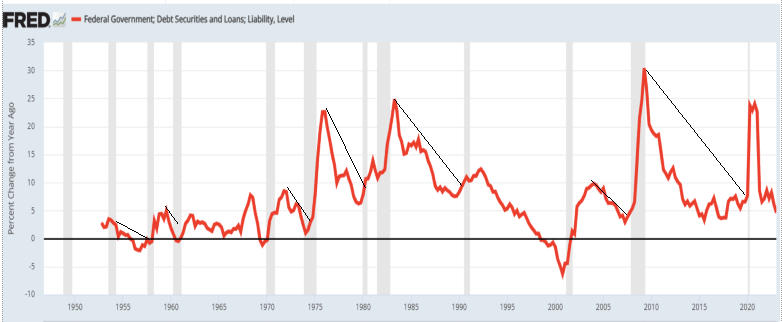
When federal spending declines or doesn’t grow enough, GDP declines. Not only does the formula demand it, but this graph illustrates it:
The red line demonstrates changes in federal deficits. The vertical gray bars are official recessions. The slanted lines show declining deficits leading to recessions, which then are cured by increased deficits.
The graph shows that when federal debt increases too little, we have recessions, which are cured by federal debt increases.
After the government’s record spending in 2020 and 2021 to combat the impact of COVID-19, the deficit dropped by the greatest amount ever in 2022, falling from close to $3 trillion to roughly $1 trillion.
Did you get that line, “Record spending in 2020 and 2021 to combat the impact of COVID-19?” Here, Stein demonstrates his understanding that deficit spending grows the economy, yet still complains about it. And he fails to understand the reverse, that the lack of federal spending will recess the economy.
Quite amazing.
But rather than continue to fall to its pre-pandemic levels, the deficit shot upward.
The deficit shot upward to cure the 2020 recession, a cure that the deficit accomplished.
Budget experts now project that it will probably rise to about $2 trillion for the fiscal year that ends Sept. 30, according to the Committee for a Responsible Federal Budget (CRFB), a nonpartisan group that advocates for lower deficits.
The so-called “non-partisan CRFB” leans heavily to the right, invariably recommending fewer benefits and higher taxes on the middle- and lower-income people, but seldom (if ever) mentions the tax loopholes of the wealthy.
If you go to the CRFB website, you will see many articles grousing about the federal debt and deficits, but none explaining exactly why these are bad for the economy. Perhaps this is the reason for their reticence:
U.S. Depressions tend to come on the heels of federal surpluses.
1804-1812: U. S. Federal Debt reduced 48%. Depression began 1807. 1817-1821: U. S. Federal Debt reduced 29%. Depression began 1819. 1823-1836: U. S. Federal Debt reduced 99%. Depression began 1837. 1852-1857: U. S. Federal Debt reduced 59%. Depression began 1857. 1867-1873: U. S. Federal Debt reduced 27%. Depression began 1873. 1880-1893: U. S. Federal Debt reduced 57%. Depression began 1893. 1920-1930: U. S. Federal Debt reduced 36%. Depression began 1929. 1997-2001: U. S. Federal Debt reduced 15%. Recession began 2001.
That is the information you never will see on the CRFB website nor presumably in any article written by Jeff Stein for the Washington Post.
The unexpected deficit surge, which comes amid signs of strong growth in the economy overall, is likely to shape a fierce debate on Capitol Hill about the nation’s fiscal policies as lawmakers face a potential government shutdown this fall and choices over trillions of dollars in expiring tax cuts.
The deficit surge didn’t come “amid” the signs of strong growth. The deficit surge caused the strong growth. It’s like saying the Cubs’ good pitching came amid signs of a winning streak. No, the good pitching caused the winning streak.
Stein and the Washington Post don’t see the relationship between adding dollars to the economy and economic growth, despite the abovementioned formula for GDP.
The Senate will return from the August recess this week, and the House will return the following week. Biden and House Speaker Kevin McCarthy (R-Calif.) approved a deal in June to raise the nation’s borrowing limit, but it did little to alter the long-term debt trajectory.
Except, the U.S. federal government, which has the unlimited ability to create U.S. dollars, never borrows U.S. dollars. Who says so? The Federal Reserve:
Statement from the St. Louis Fed: “As the sole manufacturer of dollars, whose debt is denominated in dollars, the U.S. government can never become insolvent, i.e., unable to pay its bills. In this sense, the government is not dependent on credit markets to remain operational.”
That phrase, “not dependent on credit markets,” is Fed-speak for “doesn’t borrow.” Accepting T-security deposits is not “borrowing,” as the government never touches the money. The dollars are held in privately-owned accounts and upon maturity, they are returned to the depositors.
The higher deficit may undermine Biden’s attempts to take credit for reining in the budget ahead of the 2024 presidential election.
Because Americans have been programmed to believe, falsely, that federal spending is bad — and perhaps because of his own ignorance about federal financing — Biden takes credit for doing something stupid: Reducing the amount of growth dollars the federal government pumps into the economy.
And it could pose a challenge to Republican lawmakers, who — despite their calls for fiscal responsibility — are pushing to extend more than $3 trillion in tax cuts they approved in 2017.
The Republicans always call for “fiscal responsibility” (i.e. the fiscal irresponsibility of reduced spending) when the President is a Democrat. They don’t want the economy to grow during a Democratic administration.
The 2017 tax cuts were cuts for the rich. The GOP, the party of the rich and Trump, always wants those tax cuts. They don’t want cuts to taxes that ordinary people pay, i.e., FICA.
“The deficit will double from 2022 to 2023,” said Marc Goldwein, senior vice president of the Committee for a Responsible Federal Budget. “This should prompt a serious evaluation of federal policy going forward, though I worry it won’t.”
If the deficit actually does double, the economy will grow beautifully. Remember: GDP = ….etc., etc.
Stock market tip: The larger the deficit spending, the faster the stock market will grow. Cut deficit spending, and we’ll have a recession. We always do.
The surge in red ink has confounded many economists’ expectations. Typically, deficits contract when the economy grows because businesses and consumers owe more taxes, and the government does not need to spend as much to protect those who have lost their jobs.
It confounded only those economists who don’t understand Monetary Sovereignty. (Yes, they exist and some have “Peter Principled” their way up to important jobs. Hello, Larry Summers.)
Deficits begin to contract when the economy grows because the ignorante believe they no longer are needed. Eventually, however, this contraction leads to a recession that is cured by increased deficit spending. Recessions aren’t necessary. They are caused by reduced deficit spending.
Think Jeff, if deficit spending grows the economy and cures recessions, why wouldn’t deficit spending grow the economy during non-recession times?
Then deficits typically expand again in downturns, as those factors go into reverse. And yet, the current surge in the deficit is coinciding with a period of unusually strong economic growth amid historic lows in unemployment and robust corporate profits.
No, Jeff, deficits are intentionally expanded to cure downturns.
Jason Furman, who served as a top economist in the Obama administration and is now an economics professor at Harvard, said the current jump in the deficit is only surpassed by “major crises,” such as World War II, the 2008 financial meltdown, or the coronavirus pandemic.
During a major crisis, the government spends more to cure the problem. One wonders why this is so difficult for Furman to understand. Obama was notorious for not understanding the economy. Perhaps Furman was at fault.
It also is difficult to understand why economists, people who spend their lives looking at the economy and federal spending, can’t make that mental connection. It’s quite simple:
The government has infinite dollars.
Adding dollars to the economy grows the economy.
Therefore the federal government always should run deficits.
Is that really beyond their ken? Or is the problem simply semantic? Words like “debt,” “borrow,” and “deficit” do not have the same implications for a Monetarily Sovereign entity as they do for monetarily non-sovereign entities.
Or do they falsely believe that federal spending causes inflation?
The wrongheaded printing of larger currency denominations when facing inflation gives the illusion that the currency printing causes inflation, when in fact, inflation causes the wrongheaded currency printing.
The slogan, “Inflation is too much money chasing too few goods and services,” should be, “Inflation is too few goods and services.” Period.
Today’s inflation was caused by shortages of oil, food, lumber, computer chips, shipping, labor, and other goods and services. If the Saudis keep cutting production, we will have another increase in inflation. And no, raising interest rates will do nothing to stop it.
In fact, raising interest rates makes things more expensive as interest is a business cost that must be overcome.
The U.S. economy is expected to grow at a steady 2.1 percent this year.
Thankfully, the government was smart enough to increase the spending that pumped growth dollars into the economy.
“To see this in an economy with low unemployment is truly stunning. There’s never been anything like it,” Furman said. “A good and strong economy, with no new emergency spending — and a deficit like this.
The fact that it is so big in one year makes you think it must be some weird freakish thing going on.”
The “weird, freakish thing” is the economy’s normal reaction to federal spending. Seemingly, Mr. Furman, the Harvard economist, doesn’t understand basic algebra: GDP=Federal and Nonfederal Spending + Net Exports.
From August 2022 to this July, the federal government spent roughly $6.7 trillion while bringing in roughly $4.5 trillion. According to the Committee for a Responsible Federal Budget, that represents a total increase in spending of 16 percent relative to last year and a 7 percent decrease in revenue.
Let me rephrase his statement: “From August 2022 to this July, the federal government pumped a net of 2.2 trillion growth dollars into the economy.” And he thinks the GDP growth is “weird and freakish”??
The Treasury Department is also on track to take in substantially less new revenue this year, partly because of the stock market’s slump last year.
Rephrase: “The Treasury Department is also on track to take in substantially fewer growth dollars out of GDP this year.”
In 2021, amid a cryptocurrency bubble and an explosion in housing prices driven by rock-bottom interest rates, investors recorded huge gains that led them to pay capital gains taxes at record levels. But then the bubble burst, leading to a sharp drop in capital gains tax revenue.
Automatic adjustments to the tax brackets to account for inflation also reduced tax obligations for many Americans, resulting in less incoming revenue relative to last year.
Then, a number of other spending increases contributed to the rising deficit — Social Security payments increased because they are indexed to inflation; the government spent more on education, veterans benefits, and health care; and the bipartisan infrastructure law, as well as the 2022 Inflation Reduction Act, started sending billions of dollars out from the government’s accounts.
Experts are fiercely divided on the extent to which the higher deficit amounts to a pressing problem for the economy.
The experts who understand basic algebra and Monetary Sovereignty are not divided. Deficits are not a problem; they are how the economy grows.
The federal government can issue more debt even as interest payments rise, with demand for the dollar remaining strong.
The federal government doesn’t need to “issue debt.” The sole purposes of so-called “debt” (i.e., T-securities) are:
To provide a safe place for people and nations to store unused dollars. This stabilizes the value of the dollar.
To provide a continuing demand for the dollar because taxes must be paid in dollars.
Issuing debt does not provide the federal government with spending money. It creates, ad hoc, all the dollars it spends.
That isn’t always the case: In Argentina, soaring debt levels have forced the government to impose limits to prevent citizens from taking money outside the country.
Argentina printed currency rather than curing the food shortages causing its inflation.
Other government debt crises have been marked by catastrophic drops in the exchange rate amid investor concerns that the currency will be devalued. These signs of distress have not materialized in the United States.
Fears of a debt crisis during the Obama administration also consistently failed to materialize, emboldening those who regarded the warnings of fiscal conservatives demanding budget cuts as overblown and ideologically motivated.
The demands being seen today are overblown, ideologically motivated, and based on national ignorance about Monetary Sovereignty. If the populace understood MS, the politicians would not be able to get away with nutty “debt ceilings” and ignorant arguments by the Committee for a Responsible Federal Budget.
“If you think of places that have actually had problems of real fiscal sustainability which have gotten to the point of crisis — we know what those places look like, and this doesn’t look anything look like that,” said Matthew C. Klein, publisher of the Overshoot, a subscription research service focused on the global economy.
“You can argue about whether you want it, but this is not a crisis.”
Read the excerpts from this article, or for a fuller explanation, click its link to go to the full article.
The most important paragraph may be this: The effort could be more difficult in the United States (than in the Netherlands and other euro nations), where the costs will fall primarily on individuals rather than governments. People had been reticent to do it in the U.S. because it’s a private-paying market, as opposed to Europe, which is all socialized medicine.
But the U.S. government is Monetarily Sovereign. It has the infinite ability to pay for anything, and without levying taxes.
By comparison, the euro nations are monetarily non-sovereign. Unlike America, they cannot create money at will. Their taxpayers pay for everything.
So, again, why will this great idea be “more difficult in the United States“?
By Joann Plockova, New York Times, Reporting from Weesp, the Netherlands, July 3, 2023
On a recent morning in this quiet village outside Amsterdam, an older woman stocked shelves inside the local supermarket.
In the plaza just outside the store, a group of men sat around a table, chatting the hours away. Over in the town square, a woman in a hijab sipped coffee outside the cafe.
If it looked like a typical Dutch town — with a restaurant (which is open to the public), a theater, a pub, and a cluster of quaint two-story brick townhomes on a gridded street map — well, that’s the point.
Many people here don’t realize that they are living in the world’s first so-called “dementia village,” and it can be difficult for visitors to tell the difference between the residents and the plainclothes staff.
The supermarket at the Hogeweyk serves residents, staff, and members of the public. Credit…Courtesy of The Hogeweyk
Since 2009, the Hogeweyk, which sits on four acres in the Amsterdam suburb of Weesp, has aimed to “emancipate people living with dementia and include them in society,” according to its website.
The community, funded by the Dutch government and currently serves 188 residents in 27 houses, marked an evolution from traditional nursing homes by offering residents (and their families) humanized care that feels more like home.
Residents at the Hogeweyk, all suffering from severe dementia, move about the village freely and interact with fellow patients.
They also interact with the trained staff — nurses, doctors, psychologists, physiotherapists, and social coaches — who far outnumber the residents and blend into the community’s daily life.
At the supermarket, for instance, residents can buy food, shampoo, or a postcard, but no real money is exchanged,and the cashier is trained to care for people with dementia.
The homes, which house six or seven residents, come with a living room, kitchen, private bedrooms, a laundry room, and outdoor space, and professional support is available day and night. New residences become available only when a resident passes away.
Over the past decade, as the number of dementia cases has exploded worldwide, more “dementia villages” and senior “microtowns” have opened across the globe.
But experts worry that if the senior-care community is going to keep pace with diagnoses, there will have to be another major paradigm shift, and quickly.
In essence, they want the Hogeweyks of the future to resemble real towns and be real towns.
When the Hogeweyk opened its doors, about 35 million people lived with dementia worldwide. Today, that number is more than 55 million, and the World Health Organization expects it to reach 78 million by 2030.
“The numbers are increasing because the population size is increasing, and the population is aging,” said Dr. Tarun Dua, who heads the Brain Health unit at the W.H.O.’s Department of Mental Health and Substance Use. “This is not something that is going to go away.”
The Carpe Diem dementia village opened in 2020 in Baerum, Norway.
To meet the moment, several facilities around the world — many inspired by Hogeweyk’s “dementia village” — are working to push the model forward by further integrating dementia villages with their surrounding neighborhoods.
In Baerum, Norway, a municipality in the suburbs of Oslo, the Carpe Diem dementia village opened in 2020.
It was conceived as a pilot project to handle the anticipated strain on the senior-care community in Norway, where the number of people living with dementia, roughly 100,000, is expected to double by 2050.
Carpe Diem offers two- and three-story residential buildings to create a contained civic space where residents can roam freely, with supervision. Credit…Carpe Diem
Like the Hogeweyk, Carpe Diem uses its 4.4-acre built environment — two- and three-story buildings in varying shades of brick and wood — to create a contained civic space where residents can roam freely, with supervision.
There is an urban square, landscaped spaces, a looping path, and a “street” with a pub, a salon, and a boutique. The complex, designed by the Nordic Office of Architecture, comprises 136 communal housing units and 22 high-care dementia units.
“The biggest difference, maybe, between Carpe Diem and other nursing homes is that we bring and invite the local society into our village,” said Anne Grete Normann, village manager at Carpe Diem, in a video about the project.
Local neighborhood residents can participate in activities, dine at the restaurant, get a haircut, or walk the manicured grounds.
“Having an open village means a lot, both to those who live there and those who visit,” Ms. Normann said in an email. “The fact that more than just relatives come into the community means that more people become familiar with dementia and life with dementia.
We hope to achieve less stigmatizationof this group in society.”
The local municipality is now planning a new nursing facility that further blends into everyday life in the nearby town of Rykkin — set to include a children’s nursery on the same site.
Half a world away in the town of Bellmere, Australia, NewDirection Care at Bellmere describes itself as the world’s first “microtown” dementia community.
Residents live in what resemble typical single-story homes — there are 17 in four different styles, with seven residents per home. The town center includes a corner store, cafes, a salon, and a cinema.
“It’s very much like a suburb in Australia,” said Natasha Chadwick, the facility’s founder and chief executive.
This “microtown” is fully inclusive, mixing dementia patients, including younger ones suffering from early onset dementia, with senior residents who haven’t been diagnosed with dementia.
“The fact that residents lived in houses with just six other residents was a huge plus for me,” said Elsie Marion Scott, 93, who has lived at NewDirection for just over five years and is not diagnosed with dementia.
“I also have a GOPHA,” she said, referring to a three-wheeled electric scooter, “and I can go up to 7 11 and soon Woolworths when I choose.”
The 17 domestic-style houses at NewDirection Care at Bellmere come in six styles. Each accommodates seven residents and includes an open-plan kitchen, laundry, dining room, and sitting room. Credit…New Direction Care at Bellmere
The next step is to mix in more residents at a planned high-rise community that will house younger residents and “someone who might be living with severe dementia as well as someone who might have a physical disability.
There are no dementia villages in the United States, apart from a Hogeweyk-inspired dementia-care day center in South Bend, Ind.
But one is in development in Holmdel, N.J., with plans to open its doors in the next two to three years.
Designed by Perkins Eastman, an architecture firm based in New York, Avandell will comprise 15 homes in a farmhouse aesthetic to reflect the rural surroundings. The suburban-style community is set to include a town center with a grocery store, bistro, and community center.
A rendering of the Avandell development in Holmdel, N.J., slated to open in the next two to three years. Credit…Perkins Eastman
The effort could be more difficult in the United States, where the costs will fall primarily on individuals rather than governments. People had been reticent to do it in the U.S. because it’s a private-paying market as opposed to Europe, which is all socialized medicine.
In low- and middle-income countries where there may not be resources to build these stand-alone facilities, the community-based approach could be the way of the future.
A street-level rendering of the Avandell development. Avandell has plans for a neurocognitive clinic and a senior resource hub, offering their services to the public. Credit…Perkins Eastman
For those with severe dementia who need extra support, the traditional dementia village will continue to have its place, said Paola Barbarino, chief executive of Alzheimer’s Disease International and a member of the World Dementia Council.
“But not at the cost of shutting people living with dementia outside of the community,” said Ms. Barbarino, who lamented the “huge amounts of stigma” still attached to the condition.
“Because we still think that having people in the community, with a community informed about their condition and what they are experiencing, can help them live a better life.”
Ms. Spiering, the Hogeweyk founder, agrees, but the real challenge, she said, is a major cultural shift. “It is not a challenge to create something like this,” she said.
“The more challenging thing is to create a society where people are really included, whatever label or diagnosis they have.”
No, the real challenges are to convince America’s voters and political leaders that:
Our Monetarily Sovereign nation already has all the financial resources it needs for such projects.
No additional tax dollars are needed.
It isn’t the dreaded “socialism”; it’s just normal funding and supervision of private initiatives.
And people with dementia are well worth helping.
Both parties, but particularly the GOP, have no interest in helping the not-wealthy sick, as witnessed by their preoccupation with ending ACA (Obamacare) and limiting Medicare and Social Security.
We need intelligence and compassion from our voters and leadership from our political leaders, all of which are in especially short supply in America’s right wing.
Rodger Malcolm Mitchell
Monetary SovereigntyTwitter: @rodgermitchellSearch #monetarysovereigntyFacebook: Rodger Malcolm Mitchell
……………………………………………………………………..
Government’s Sole Purpose is to Improve and Protect People’s Lives.




 #Monetary Sovereignty - Mitchell