Fairy tales about money.

We have three main political groups in America:
  1. The Republicans who support rich, white, Christian, NRA men born in America, but claim too much money is given to everyone else.
  2. The semi-Republicans (aka “Libertarians) who also claim the government spends too much helping the poor and middle-income people but support tax breaks for the rich.
  3. The Dems who claim to love ordinary people but still yield to fairy tales about excessive federal deficits and debt.
  4. There’s a fourth category: All those groups that claim to support a specific issue but, in reality, are designed to take votes from one of the major parties.
Veronique de Rugy | Washington Examiner
Veronique de Rugy
Here are some excerpts from an article that demonstrates the fairy tales they all promulgate. It was written by a semi-Republican (Libertarian).

‘Bidenomics’ Is Failing Everyday Americans The big spending has fueled higher inflation, resulted in larger-than-projected deficits, and contributed to a record level of debt.

By Veronique de Rugy, 9/21/2023

We’ve shown you data (here, here, here, here, and elsewhere) that demonstrate why even massive federal spending does not cause inflation. All inflations are caused by shortages of critical goods and services. When anything is in short supply, its price rises. When critical goods like oil and food are in short supply, prices generally increase.  This general increase is called inflation. These shortages can be cured by federal spending to obtain and disseminate the scarce goods and services. The U.S. government spent massively for many years, and we experienced meager inflation. Only when COVID, the Russian/Ukraine war, immigration restrictions, and Saudi greed caused shortages of oil, food, computer chips, lumber, metals, labor, and other Gross Domestic Product necessities did we have the general increase in prices known as “inflation.” GRAPH I.
There is no historical relationship between highs and lows of federal spending (green) and inflation (red).
GRAPH II.
Also, there is no historical relationship between highs and lows of federal DEFICIT spending (blue) and inflation (red).
GRAPH III.
There is a strong correlation between the highs and lows of oil supplies (gray) and inflation (red).

Ordinary Americans aren’t feeling the so-called success of “Bidenomics.”

Superficially, the economy looks solid. Real gross domestic product (GDP) increased at an annual rate of 2.1 percent in the second quarter of 2023.

While August’s unemployment rate rose to 3.8 percent, that’s still considered full employment by economists.

Wages are rising, and we are often told we’re in a manufacturing boom.

But these numbers need perspective. Employment growth was inevitable because we lost millions of jobs during the pandemic.

De Rugy forgets she admitted we’re at full employment. This has nothing to do with employment growth. “Full” means “full.” She makes the strange claim that because we lost jobs during COVID, today’s full employment was a natural result. Sorry, but that right-wing naysaying won’t fly. Federal spending helped create those jobs. We have a labor shortage, partly because right-wingers falsely claim that undocumented immigrants bring crime and drugs to America.

Comparing Crime Rates Between Undocumented Immigrants, Legal Immigrants, and Native-born US Citizens in Texas

This study used uniquely comprehensive arrest data from the Texas Department of Public Safety to compare the criminality of undocumented immigrants to legal immigrants and native-born U.S. citizens between 2012 and 2018.

The study found that undocumented immigrants had substantially lower crime rates than native-born citizens and legal immigrants across a range of felony offenses. Relative to undocumented immigrants, U.S.-born citizens are over 2 times more likely to be arrested for violent crimes, 2.5 times more likely to be arrested for drug crimes, and over 4 times more likely to be arrested for property crimes.
Drugs come in via legal entry ports, not via immigrant families desperate to escape gangs and poverty.)

Cocaine seizures on U.S. borders, for instance, regularly measure in tons, making it impractical to have individual migrants ferry it across. Instead, dealers prefer to smuggle drugs into the country via legal ports of entry, which allow them to bring in high-value substances that are more easily hidden.

“The majority of the illegal drugs that enter the United States through the U.S.-Mexico border cross through formal Points of Entry,” said Joel Martinez, a Mexico research associate for the Center for American Progress

“The drugs that cross in between are very minimal and non-expensive products like marijuana. All the cocaine, fentanyl and methamphetamine — they cross through formal ports because they’re easier to hide […in] freight comp and assorted vehicles.”

So, right-wing bigotry against foreigners, especially those of color, make it almost impossible for those people to gain citizenship.

Unemployment is low, but only because the economy is drunk on spending, simultaneously closing many people out of the labor force.

De Rugy, desperate to minimize Biden’s success, unknowingly admits that federal spending reduces unemployment. Then, strangely, she declares that in some unknown way, federal spending “closes people out of the labor force.” It is not unusual for people to take both sides of an issue when they have no facts.

Moreover, inflation-adjusted median household income has declined—from $76,330 in 2021 to $74,580 in 2022. Labor tensions and strikes are also intensifying.

This problem is not caused by federal spending but rather by the greed of the rich. Plenty of profits reward shareholders via stock price growth and stock by-backs. Companies have plenty of money to reward executives with excessive pay increases, many multiples higher than average workers’. Now, we see the inevitable result: Strikes.

With all this in mind, is the average American becoming better off?

No, the average worker is not making more inflation-measured dollars, which is why Biden (but not the Libertarians and the GOP) favors the strikers. They are striking to narrow the income/wealth/power Gap between the rich and the rest. This is anathema to the Republicans and the faux Republicans (Libertarians), who always favor cutting benefits to the not-rich (while cutting taxes on the rich.)

These troubles are partly caused by inflation, which continues to take its toll. Per the Consumer Price Index (CPI), year-over-year inflation rose to 3.7 percent in August, nudging back up after peaking at 9.1 percent not long ago.

“Core” CPI (excluding food and energy) is down slightly to 4.3 percent. Although these numbers are an improvement after we experienced their highest levels since 1982, they remain disturbingly high.

Excluding food and energy from the measure of inflation and calling the balance “core inflation” makes no sense. It’s like excluding all home runs, triples, and doubles from a baseball player’s statistics and calling singles his “core” batting average. Scarities of energy and/or food are the most common and most important reasons for inflation. The Fed is so focused on money it has lost sight of reality. The reason: The Fed is tasked with curing inflation, and its only tool is interest rates. So, the Fed ignores the scarcity of energy and food and proclaims these products are not “core,” when that is precisely what they are. (“Move on, folks. Nothing to see here.”)

This is bad news for Americans whose standard of living has fallen since early 2021.

The Bureau of Labor Statistics (BLS) reported real average hourly earnings declining in 2021 and 2022, meaning Americans can afford less with their hard-earned dollars.

More than three-quarters of people’s income is devoted to living expenses like housing, transportation, and food—all of which have become more expensive.

The federal government can make all of the above less expensive to Americans. Consumers could receive federal benefits for housing, transportation, and food. FICA could be eliminated; being a federal tax, it pays for nothing. (The federal government pays for everything by creating new dollars ad hoc. Federal tax dollars are destroyed upon receipt.) The right-wing opposes all these solutions to the fallen standard of living.

Food prices, for instance, rose by 19.3 percent. Shelter rose by 16.5 percent since 2021. Gasoline prices are up, too.

Inflation is a tax on every American’s standard of living. It’s also a regressive tax. Low-income workers tend to experience higher-than-average levels of household inflation.

Inflation would not take its toll on Americans if the federal government increased spending to:
  1. Provide free healthcare insurance to every man, woman, and child in America, regardless of wealth and income.
  2. Provide Social Security benefits to every man, woman, and child in America, regardless of wealth and income.
  3. Reduce energy prices by supporting renewable energy and oil drilling/refining.
De Rugy cries crocodile tears for the “Average American’s troubles” but refuses to consider any cure for those troubles. Instead, she worries about the non-existent “troubles” of the federal government, the one entity in America with limitless funds, and never needs to worry about bankruptcy.

Making matters worse, high-interest rates resulting from the Federal Reserve’s fight against inflation also hit lower-income Americans the hardest.

These tend to consume a higher proportion of such incomes and take money from the pockets of people who hold assets in cash or low-yielding bank deposits.

In other words, inflation creates the opposite of an equitable economy.

Both inflation and high-interest rates take money from the pockets of average Americans. But both inflation and high-interest rates are unnecessary and totally within the control of the government. High rates do not “result” from anything. They are the Fed’s primary inflation-fighting tool. Inflation can be cured by federal spending to cure the shortages that cause inflation. And interest rates are determined by the Fed. Raising interest rates not only does nothing to cure inflation but also exacerbates inflation by increasing the price of nearly everything: Real estate, cars and trucks, food, clothing, all imported goods, construction materials. The Fed feeds the patient salt tables to cure high blood pressure. Why does the Fed do it? Because the Fed focuses on money, raising interest rates increases the demand for the dollar. The Fed ignores the obvious fact that adding interest payments to the price of everything increases the purchase price of everything.

Simple example: You buy a $50,000 car and finance the purchase with a 5-year, 3% loan. The total of your 60 monthly payments is $53,852.13.

Alternatively, say you finance that $50,000 car with a 5-year 6% loan. Now, the total of your monthly payments is $57,776.95

That $50,000 car cost you an additional $3,924.82, courtesy of the Federal Reserve. That is the very definition of inflation.

By now, it’s well-known that Bidenomics’ big spending has fueled higher inflation, resulted in larger-than-projected deficits, and contributed to a record level of government debt.

It may be “well-known” that federal spending causes inflation, but what’s “well-known” often contradicts the facts. It once was “well-known” that the earth was the center of the universe, emotional stress was the primary cause of stomach ulcers, and drinking water during exercise causes cramps (Yes, really. When I was young, that was common knowledge.) As GRAPH I and GRAPH II (above) demonstrate, there is no relationship between federal spending and inflation. Nor is there a relationship between federal deficit spending and inflation. There is, however, a robust relationship between oil price increases (which are strongly related to oil scarcity) and inflation. As for de Rugy’s concern about federal debt and deficits, she displays widespread ignorance about Monetarily Sovereign governments. The U.S. federal government’s finances are nothing like those of monetarily non-sovereign governments such as state, county, city, and the euro governments. Monetarily, Sovereign government cannot run short of their own sovereign currency.

Alan Greenspan: “A government cannot become insolvent with respect to obligations in its own currency.”

“Federal debt” is not a debt of the federal government. It is deposited into T-security accounts that are owned not by the government but by the depositor. The government never touches those deposits other than to add interest money, and upon maturity, the money in those accounts is returned to the depository. The two purposes of T-accounts (T-bills, T-notes, T-bonds) are to:
  1. Provide the public with a safe storage place for unused dollars.
  2. To assist the Fed in setting interest rates.
T-securities do not provide the federal government with spending money. To pay its bills, the federal government creates new dollars ad hoc. Federal deficits are not a burden on the federal government or on taxpayers. The government has the infinite ability to pay any obligations. Unlike state and local governments, the federal government does not need or use tax dollars to pay its bills. It always uses newly created dollars for that purpose. Ms. de Rugy’s concerns about federal “debt” and deficits are unwarranted. Federal deficits add dollars to the economy. When federal deficits are too small, the economy ceases to grow (“recessions”) or shrinks (“depressions). Graph II shows this effect. As deficit spending shrinks, the economy goes into a recession, cured by increased deficit spending. Deficit spending grows the economy and does not cause inflation or require taxes. Even if no federal taxes were collected, the federal government could continue spending forever.

The most recent estimate of the full-year deficit for 2023 is $1.5 trillion, up from $946 billion last year. Total federal debt is more than $33 trillion, an increase from $28.5 trillion in 2021. Budget tensions led the credit agency Fitch Ratings to downgrade Treasury debt based on prospects of further fiscal deterioration.

Fitch Ratings did not downgrade Treasury debt because of the size of the debt or deficits. It downgraded the debt because of the uncertainty regarding one of the most ignorance-based laws in American history: The debt ceiling. This harmful law is based on the false premise that federal debt and deficits burden the government and taxpayers. The law threatens to force the federal government to renege on its promise to return the money in T-security accounts to depositors or to fail to pay past obligations to creditors.

This is not great; federal borrowing is projected to be $120 trillion in the next 30 years.

The federal government never borrows dollars. It creates all the dollars it needs and uses ad hoc.

Statement from the St. Louis Fed: “As the sole manufacturer of dollars, whose debt is denominated in dollars, the U.S. government can never become insolvent, i.e., unable to pay its bills. In this sense, the government is not dependent on credit markets to remain operational.”

The prospect of gigantic, never-ending deficits during good times makes investors nervous.

Knowledgeable investors are aware that the size of federal deficits does not, in any way, affect the federal government’s ability to pay its bills.

Borrowing costs like mortgage and car loan rates are rising, as are yields on benchmark 10-year treasury notes. They’re above 4.3 percent, their highest level since 2007—weighty burdens on lower-income Americans.

Here, Ms. de Rugy mixes two errors.
  1. Mortgage rates are whatever the Fed wishes them to be. Sadly, the Fed believes raising rates is the way to fight inflation, while it causes more inflation.

Finally, while America may be experiencing a hike in real construction spending, that’s a far cry from a manufacturing boom.

According to the Institute for Supply Management Report on Business, economic activity in the manufacturing sector in August contracted for the tenth consecutive month following 28 months of growth.

Moreover, manufacturing only accounts for 11 percent of GDP. Even if this sector grew, the benefits wouldn’t be widely shared.

After the COVID recession, GDP grew faster than at any time since WWII.
Manufacturing will continue to contract as we transition to a computer-based society. One day, we all will have 3-D printers that allow us to create what we want without buying manufactured goods. Ms. de Rugy is stretching to find fault with economic growth. She is a member of the “semi-GOP” Libertarians whose sole contribution to the economic discussion is to criticize Democrats.

Nor will Bidenomics’ manufacturing subsidies help workers with college degrees. These handouts, often extensive and rich, benefit companies for projects they would have likely taken on anyway.

It’s not clear why Ms. de Rugy believes manufacturing subsidies won’t help workers with college degrees. And as for projects that “likely” would be taken on without benefits, one wonders where she came up with that bit of fakery.

Take the Inflation Reduction Act, for example. About half of all projects included in the Act were announced before it was passed.

Meaning that half were announced after it was passed. That’s an excellent result.

The private green market was booming even before the subsidies. The remainder of those subsidies overwhelmingly benefit affluent consumers of electric cars and other Biden-favored products.

Ms. de Rugy’s complaint seems ever more desperate. The private green market may or may not have been “booming,” but is that a reason not to invest in green? She objects to government aid for anti-global warming electric vehicles because rich people own them (though average workers build them).

Taken together, these facts can help explain the president’s low approval ratings and the American people’s overall pessimism about the economy’s direction.

With so many working people feeling pinched, who can blame them?

The president’s low approval rates are not related to reality but more to the relentless naysaying from extreme right-wingers like Ms. de Rugy. When you keep pounding people with the message that things are awful, they tend to believe it.

JUST SOME OF BIDEN’S ACCOMPLISHMENTS DESPITE THE EFFORTS OF THE GOP

1) $1.2 trillion infrastructure package 2) $1.9 trillion COVID relief deal 3) Highest appointment of federal judges since Reagan 4) Halt on federal executions 5) Rejoined the international Paris Climate Accord 6) Mandated converting the federal fleet to zero-emission vehicles. 7) Support for transgender service members. 8) Reduced unemployment. 9) Strengthened QUAD alliance with the U.S., India, Australia, and Japan. 10) Student loan debt relief 11) Used the Russia/Ukraine war to strengthen NATO, which Trump tried to weaken. 12) Imposed crippling sanctions on Russia 13) Fought Saudi’s oil price increases by releasing 180 million barrels of oil from the country’s Strategic Oil Reserves. 14) Pardoned people convicted of a federal marijuana charge 15) Respect for Marriage Act 16) Prevented the rail strike and gave workers a significant raise. 17) Passed Government Funding Bill 18) Got us out of Afghanistan, ending years of American deaths. 19) Expanded healthcare. 20) Defended Obamacare 21) Negotiated lifting the debt limit to prevent an economic disaster 22) Rejoined UNESCO 23) Lowest unemployment in years 24) Massive job creation 25) COVID-caused inflation dropping

Considering that unemployment is at historic lows and GDP is at historic highs, consumers’ biggest problem is the COVID-caused shortages causing in inflation. Without the obstinacy of the right-wing, Biden could have passed even more consumer benefit programs to “unpinch” working people. And yes, that would have increased federal spending, a good thing. It would have grown GDP further.

Federal Spending + Nonfederal Spending + Net Exports = GDP
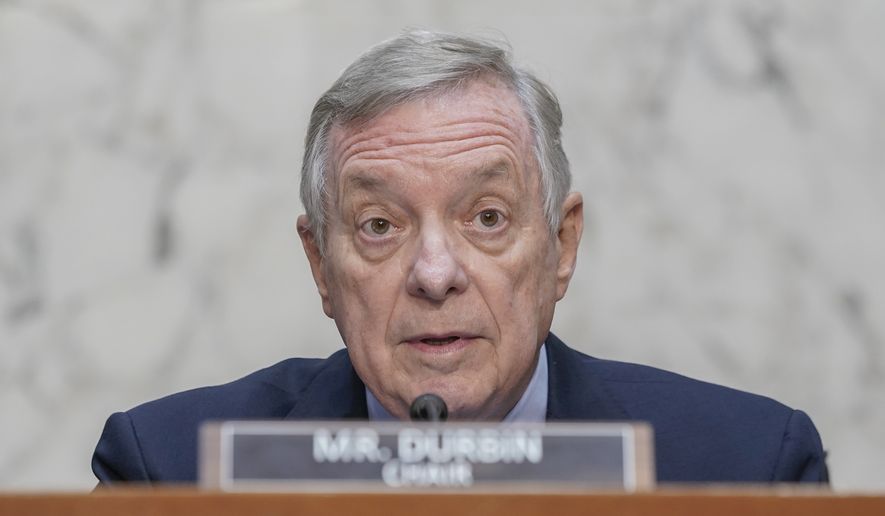
Dick Durbin calls for Clarence Thomas to recuse in key case over executive overreach - Washington Times
Sen. Dick Durbin
Unfortunately, Republicans and faux Republicans are not the only parties guilty of misstating federal finances. Here are excerpts from a Senator Dick Dubin (D-IL) letter I recently received:

September 22, 2023,  Dear Mr. Mitchell,

Thank you for contacting me about the Fiscal Responsibility Act (P.L. 118-5).  I appreciate hearing from you.

          The debt limit is a statutory limit on the amount of debt the federal government may incur.  When government expenditures outpace revenues, the Treasury may issue debt to cover the shortfall. 
Those T-securities don’t cover anything. The government never touches the dollars that purchase T-bills, T-notes, and T-bonds. Though Sen. Durbin has been in Congress for over 26 years, he still does not comprehend the difference between federal and personal finance.

Government spending and revenues vary by month, and even if the government has a surplus for the year, it may need to borrow money to cover a shortfall at some point during the year.  

Why would an entity having the infinite ability to create dollars ever “need to borrow money?” It doesn’t.

On May 26, 2023, Treasury Secretary Janet Yellen projected that without action from Congress, the federal government would be unable to meet its obligations and subsequently default on  June 5, 2023.  

Default would have crashed the economy and impeded the government’s ability to make payments to Social Security and Medicare recipients, military personnel, veterans, federal employees, defense contractors, state governments, and our bondholders. 

The federal government never needs to default. Only foolish actions by Congress and the President can force the government to default.

On May 27, 2023, President Biden and  Speaker Kevin McCarthy reached an agreement.  The Fiscal Responsibility Act avoids default by raising the debt limit through January 1, 2025. 

Notice that Congress can raise the meaningless debt limit merely by deciding to do so.

Alan Greenspan: “There is nothing to prevent the federal government from creating as much money as it wants and paying it to somebody.”

This agreement was a good-faith compromise between President Biden and Speaker McCarthy, and it included some provisions that alter several important federal programs, which includes clawing back unspent pandemic relief funding and expanding work requirements for some beneficiaries of the Supplemental Nutrition Assistance Program (SNAP).  On June 5, 2023, President Biden signed the Bipartisan Budget Agreement into law. 

There is no reason for the U.S. government to “claw back” anything or to expand work requirements. The government has infinite money. There is no reason, but there is a purpose: To make the rich richer by widening the income/wealth/power Gap between the rich and the rich. The wider the Gap, the richer and more powerful are the rich.

This agreement did not include everything I wanted.  I am incredibly disappointed in any reallocation of funding to medical research or the National Institutes of Health.   However, this agreement is what was required to avoid default. 

And, of course, there was no economic reason for the reallocation.

I also have joined Representative Brendan Boyle of Pennsylvania to introduce the Debt Ceiling Reform Act (S. 1882), which would take the threat of default off of the table in the future.  This bill would permanently end the weaponization of the debt ceiling by giving the Treasury Department the authority to continue paying the nation’s bills unless Congress submits a resolution of disapproval, which would need to be signed by the president. 

The full faith and credit of the United States is not a bargaining chip, and it should not be used to enact any party’s extreme agenda.  The Debt Ceiling Reform Act has been referred to the Senate Committee on Finance. 

The whole thing is an exercise in stupidity. If, for some strange reason, Congress and the President wished to reduce spending (a reduction that mathematically would force a recession or depression), Congress and the President merely could stop spending. Period.

Now that we have avoided the default crisis, we must look to passing our twelve regular spending bills through regular order.  I will be sure to keep your views in mind as we develop these spending priorities, and I will continue working to protect and enhance the federal programs on which American families rely. 

If he wants to “protect and enhance federal programs, he should learn Monetary Sovereignty. After 26 years, it’s about time he learned at least this fundamental truth: The federal government cannot unintentionally run short of U.S. dollars. It has infinite dollars.

     Thank you again for contacting me.  Please feel free to stay in touch. 

That didn’t work for Stephanie Kelton; I wonder whether it would work for me. Rodger Malcolm Mitchell Monetary Sovereignty Twitter: @rodgermitchell Search #monetarysovereignty Facebook: Rodger Malcolm Mitchell

……………………………………………………………………..

The Sole Purpose of Government Is to Improve and Protect the Lives of the People.

MONETARY SOVEREIGNTY

Artificial Intelligence bigotry

Humans learn by generalization. That is how the human brain can recognize the differences among dogs, cats, lions, and bears or the differences between a collie and a border collie. Or the subtleties that make for beauty.

Artificial intelligence (AI) may have difficulty understanding such differences.

We learn about this complex world by mentally filling in the blanks: “All _____ are _____.” Bigotry is born of false generalization. A fault wrongly ascribed to a group is attributed to each group member.

If blacks are believed to be poor and uneducated, then every black is considered poor and uneducated. Similarly, all Italians are criminals, all Jews are money-hungry, all Irish are drunks, all Mexicans are lazy, all New Yorkers are rude, all Canadians are passive, all Chinese are inscrutable, all Californians are trendy, all Germans are gruff, all Russians are boorish, all French are arty — you can compile your own silly list.

Artificial Intelligence (AI) learns the same way, by generalization, but it generalizes from massive data sets. The tacit belief is that if they average enough data, the outcome will be representative of – – of something, though no one knows what.

Just as negative generalizations are expressed in humans as bigotry, machines can express bigotry. 

I went to an AI website called “Night Cafe.” It is one of the several AI Art Creator sites where you type in one or more prompts, and the machine produces an illustration that amalgamates what the device “knows” about those prompts.

The amalgamation process requires the computer to weigh the variables and produce an illustration incorporating them according to their importance. “Importance” is the key unknown. It may rely on frequency, source, logic, or other criteria.

Ultimately, all the data evolves from human input, and if that input is bigoted, the machine’s output will reflect that bigotry.

Here are some examples:

In these first images, I asked Night Cafe to produce “A Profile of a Jew.”

Profile of a Jew

The machine produced images with an interesting attribute: The photos had large noses. This is the classic anti-Semitic trope.

As a Jew, I know a great many Jews, and I can’t think of any who have large noses. Perhaps those who were born that way had their noses fixed. I don’t know. But they don’t have large noses now.

So, where did Night Cafe get that idea? From Nazi Germany’s portrayal of Jews? From common bigoted beliefs?

Next, I prompted Night Cafe with “Teen gang member”: 

Teen gang member

Somehow, the machine seems to know of no white teen gang members. In its bigoted brain, it only knows about kids of color, what appear to be Latin. Perhaps it doesn’t associate the word “gang” with white supremacists, Nazis, or other white groups.

Next, I prompted, “Beautiful woman.” it produced nine similar photos, seemingly of white women. None seem to have black, brown, or red features.

Clearly, the machine believes only white women can be beautiful.

Beautiful woman

Next came “A beautiful woman in a bathing suit.” Again, there are no blacks, though one seems to be Asian. All are pretty slender, though the Asian woman is not as thin as the others.

In short, the machine believes a beautiful woman in a bathing suit is skinny, white, and in a bikini.

A beautiful woman in a bathing suit
Finally,  I prompted, “Knowledgeable person,”  expecting to see something with photos hinting at Einstein or some other noted brain. Instead, the AI produced this!
Knowledgeable person

Yikes! I have no idea what the derivation is. Do you?

The purpose of this post is not to demonstrate that AIs can be wrong. There is ample proof of that. Instead, this indicates that:

  1. AIs can be bigoted
  2. And because the output of AI machines is so voluminous (It’s saturating the Internet), its bigotry is being picked up as foundational data by other AI machines, who repeatedly promulgate it until AI may become “all bigotry, all the time.”

Thus, just as with human bigotry, AI bigotry is contagious, only faster. That is how false information can evolve to “common knowledge,” which further can evolve to “accepted truth” and finally “unquestioned fact.”

We all are subject to the problem expressed by, “It ain’t what you don’t know that gets you into trouble. It’s what you know for sure that just ain’t so.” We all know for sure some things that just ain’t so.

How do we acquire this knowledge “for sure”? From repetition. If we hear something from a trusted source and then see it in print from trusted sources, we are likely to believe it.

And if all the people we know and all publications we read say the same thing, we will know it “for sure.” 

So it is, for example, with the MAGAs. Trump tells them he won. Fox News tells them he won. Their MAGA friends (Do MAGAs have any friends who are not MAGAs?) tell them he won. And they read Breitbart that says he won. So they believe, “for sure,” that he won.

Now multiply that kind of false information coming from a lying AI as it pumps trillions of bits of data into the megasphere.

Where can truth be found? How do you recognize it when you see it? What is a trusted source? Those are questions you will have more difficulty answering as AI proliferates.

Rodger Malcolm Mitchell
Monetary Sovereignty

Twitter: @rodgermitchell Search #monetarysovereignty
Facebook: Rodger Malcolm Mitchell

……………………………………………………………………..

The Sole Purpose of Government Is to Improve and Protect the Lives of the People.

MONETARY SOVEREIGNTY

The fundamental lie of Libertarianism

“Libertarianism” says Robert W. Poole (Reason Magazine’s early editor) is “about more than just economics and politics, it really is. It’s about human flourishing and what are the conditions for human beings to have satisfying, flourishing [lives].” Money is power.
Hoover Institution Acquires the Archives of Reason Magazine Co-founder Robert W. Poole Jr. | Hoover Institution
Robert Poole, the voice of Libertarianism
The fundamental philosophy of Libertarians is that power should be with the people, not with the government. Yet Libertarians espouse exactly the opposite when they opt for tax increases and/or benefit decreases to reduce federal deficits. Keep that in mind as you read the following excerpts from an article written by a leading Libertarian. See whether you believe he believes the money and power should be with the people:

Endlessly expanded federal borrowing and spending is not a realistic long-term transportation future

By Robert Poole, Director of Transportation Policy, September 12, 2023

(Robert Poole is one of the founders of the Reason Foundation [which publishes Reason Magazine] and served as its president and CEO from 1978 to 2000.He is currently director of transportation policy at the Reason Foundation and frequently writes about issues related to privatization.)

The national debt will affect the future of transportation funding, and the public-private partnership community needs to understand why and what the implications for P3s may be.

The most recent parts of the story began on Aug. 1, when Fitch Ratings downgraded the federal government’s bond rating from AAA to AA+. For a company, that might not be a big deal, but for the government of the world’s largest economy, the downgrade was a shot across the bow.

This was the second time a rating agency took such an action with the federal government’s bond rating, with S&P doing so in 2011.

Headlines in the financial press, such as The Wall Street Journal’s “America’s Fiscal Time Bomb Ticks Louder” and “U.S. Downgrade Flashes Warning Sign.” indicate how seriously the downgrade should be taken.

The downgrades had nothing to do with the federal government’s ability to pay. They reflected the government’s willingness to pay, as evidenced by the ridiculous debt ceiling laws. Being Monetarily Sovereign, the federal government has the infinite ability to pay for anything. Mr. Poole confuses “ability”with “willingness.” We have written many times about the so-called fiscal “time bomb.” The first mention we noted was in 1940;

September 1940, the federal budget was a “ticking time-bomb which can eventually destroy the American system,” said Robert M. Hanes, president of the American Bankers Association.

Subsequently, references to the federal “debt” as a ticking time bomb appeared regularly in all media, from scholarly journals to daily newspapers. The 1940 mention came when the total federal “debt” was approximately $48 Billion. Today, that debt is roughly $26 Trillion, an astounding 54,000% increase.
Despite that increase, the “ticking time bomb” still has yet to explode, but the doomsday preachers, having learned nothing from the many years of experience, continue to fret. Eighty-three consecutive years of wrong predictions, and people still believe? What word comes to mind?

As the Journal’s Greg Ip wrote: One reason for Fitch’s downgrade was the absence of any political will to deal with the main drivers of the deficit: spending programs for older Americans, including Social Security and Medicare, and repeated cuts to tax rates for most households.

No, the reason for the downgrade was the uncertainty caused by the useless debt limit laws. The word “useless” is appropriate. There is no use for a law that limits the federal government’s ability to pay for what it already has purchased. And should anyone believe the law has any purpose whatsoever, they should explain why, since 1960, Congress has acted 78 separate times to permanently raise, temporarily extend, or revise the definition of the debt limit – 49 times under Republican presidents and 29 times under Democratic presidents. If the law had any value, why is it so easily and often increased without exploding as a “time bomb”? Money is power, so ironically, if one truly believed the power belongs with the people and not with the government, he would favor money flowing to the people and from the government. Yet the exact opposite is stated by the Libertarian writer.

Fitch noted how much worse U.S. fiscal metrics are than its peer countries. For example, The U.S. is on track to spend 10% of federal revenue on interest by 2025, compared with just 1% for the average triple-A-rated country and 4.8% for double-A-rated.

Why, then, isn’t the U.S. rating even lower?

Mr. Poole doesn’t give examples of those “triple-A” and “double-A” rated countries, probably because they aren’t comparable to the U.S. government. Perhaps, they don’t have a foolish, useless debt-ceiling law. Or perhaps, they are not Monetarily Sovereign nations that can issue their national currency in unlimited amounts, as the U.S. can. It would have been helpful for Mr. Poole to list the nations he refers to, but of course, he never will because that would destroy his argument.

Because the reserve status of the dollar and the size and safety of Treasury debt gives the U.S. unprecedented borrowing ability.

First, the U.S. government does not borrow U.S. dollars. It pays for goods and services by creating dollars ad hoc, which it has the unlimited ability to do. The U.S. government never unintentionally can run short of dollars.

Statement from the St. Louis Fed: “As the sole manufacturer of dollars, whose debt is denominated in dollars, the U.S. government can never become insolvent, i.e., unable to pay its bills. In this sense, the government is not dependent on credit markets to remain operational.”

Not dependent on credit markets” means they don’t borrow dollars. Second, “reserve status” merely means that banks keep dollars on reserve to facilitate international trade. Not only does the U.S. dollar have reserve status, but so do numerous other currencies, depending on geography. Though the U.S. dollar is the most common reserve currency, other reserve currencies include: the euro, the Japanese yen, the Mexican peso, the British pound, the Canadian dollar, the Australian dollar, the Indian rupee, the Swiss franc, the Swedish krona, and many other currencies now being held in reserve by banks, worldwide. Being a reserve currency does not bestow special safety on a currency. It does not indicate a nation’s ability to pay its bills. Third, Mr. Poole mentions the size and safety of Treasury debt in the same article about its being a “ticking time bomb.” I suggest he has just exploded his own warning, as well as he should.

Indeed, it was hard to get presidents or Congress to worry about the deficit when interest rates were low. Today, a bond market signaling that the world is no longer safe for debts may be the first step to tackling them.

Interest rates have no meaning for a Monetarily Sovereign nation like the U.S., which has the infinite ability to create its own currency. Whether interest is 1% or 50%, or anything between, the U.S. federal government simply presses computer keys to pay. Further, the U.S. Federal Reserve pays whatever interest rate it wishes. It sets the rate by fiat. Unlike private borrowers, the Fed does not need to set a rate that is attractive to lenders because:

a. The government does not borrow. The purpose of T-bills, T-notes, and T-bonds is not to provide the government with spending money. The goal is to provide a safe storage place for unused dollars. The federal government never touches the dollars in T-security accounts.

b. If the Treasury wanted to issue T-securities that no one wanted to buy, the Federal Reserve could purchase them.

The long-term consequences of the growing debt were estimated in the latest Congressional Budget Office’s (CBO) 2023 Long-Term Budget Outlook.

Its baseline 30-year projection, which assumes no changes in existing laws and programs, is that by 2053, the national debt will constitute 181% of the U.S. Gross Domestic Product—compared with 98% today.

The debt/GDP ratio is the most misunderstood fraction in all economics. Contrary to widespread ignorance, that ratio has absolutely nothing to do with the ability of the U.S. to pay its bills. The federal government has the infinite ability to create dollars, which it does by pressing computer keys.

Alan Greenspan: “There is nothing to prevent the federal government from creating as much money as it wants and paying it to somebody.”

The so-called “debt” is the total of T-security deposits accepted by the federal government. These are dollars in accounts owned by depositors, never touched by the federal government, and paid off simply by returning the dollars in the accounts. The misnamed “debt” consists of net deposits made between yesterday and ten or more years ago. By contrast, GDP (Gross Domestic Product) is a one-year spending measure. So, the debt/GDP fraction compares a multi-year total with a one-year total — mathematically senseless. Imagine your house mortgage being $300,000 and you earning $150,000 a year. That would be a 200% ratio that millions of people support all the time. The debt/GDP is even more senseless than that, because GDP doesn’t pay debt. Of course, you aren’t Monetarily Sovereign — you can’t create dollars at will — and the federal debt isn’t real debt. So, the whole thing is foolish, though no more foolish than current worries about Debt/GDP ratios. If you want to waste time evaluating the world’s most useless ratio, go here. It shows the percentages for dozens of countries. I challenge you to use those ratios to determine the world’s best and worst credit risks.

And paying interest on that debt will increase from taking 15% of federal revenue today to 35% of federal revenue in 2053 (more than any national budget item except Social Security and Medicare). And that’s just CBO’s baseline estimate.

Given that the federal government has the infinite ability to create dollars, why does Mr. Poole stress about paying interest? Ignorance or intent to deceive?

The Committee for a Responsible Federal Budget estimates that, given likely extensions of tax cuts and expansions of federal programs, the 2053 national debt will likely rise to 222% of GDP.

Whether the debt is 22%, 222%, or 2222% of GDP has zero effect on the federal government’s ability to pay its bills.

Where does transportation fit in the discussion about the national debt?

Well, in July, the House Appropriations Committee, in response to conservative members saying they’re concerned about out-of-control federal borrowing while a Democrat is in the White House—as opposed to mainly supporting massive deficit spending during the Trump administration—proposed trimming Fiscal Year 2024 Department of Transportation (DOT) discretionary grant spending by $5 billion.

Here is where we get to Congress’s misunderstanding (intentional or otherwise) of the federal government’s ability to pay for things.

Ben Bernanke: “The U.S. government has a technology, called a printing press (or, today, its electronic equivalent), that allows it to produce as many U.S. dollars as it wishes at essentially no cost.”

Even if the federal government collected zero taxes, it could continue spending forever. There is no reason to cut spending for budgetary reasons. The government has infinite money.

This relatively minor cut would affect only a few programs in six modal agency discretionary grant programs totaling $22.5 billion last year. Yet a headline in Eno Transportation Weekly read, “FY24 House Funding Bill Has Massive Cuts to DOT Grant Programs.”

This proposal raised similar cries of alarm from highway, transit, and rail organizations, such as the headline “Transportation Funding Under Threat in House of Representatives” by United for Infrastructure, which advocates for more infrastructure investment.

Suppose we make the possibly innocent assumption that the Department of Transportation (DOT) had good reasons for its discretionary grant spending. In that case, we now will be forced to do without that spending. The people will be deprived of important transportation improvements, all because of economic ignorance.

Let’s think ahead a few years to when massive federal funding in the Infrastructure Investment and Jobs Act, often referred to as the bipartisan infrastructure law, and the Inflation Reduction Act’s budget has been expended.

At that point, state transportation budgets would be expected to revert to their pre-stimulus spending levels.

This is an important point. Though the federal government, being Monetarily Sovereign, can create infinite dollars, the states, counties, and cities are monetarily non-sovereign. They can and often do run short of dollars.

Ben Bernanke: “The U.S. government has a technology, called a printing press (or, today, its electronic equivalent), that allows it to produce as many U.S. dollars as it wishes at essentially no cost.”

Why then are states asked to fund what the federal government could easily fund without collecting a penny in taxes? Economic ignorance.

But what can we expect transportation organizations and state DOTs to call for?

Based on history, it’s almost certain states will propose the most recent year of those expanded funding levels as their new budget baselines and ask Congress for federal funding.

And if Congress goes along with the calls for that level of infrastructure spending, there will be another massive amount of federal borrowing.

Reminder: The federal government does not borrow. It creates dollars at will.

Quote from former Fed Chairman Ben Bernanke when he was on 60 Minutes: Scott Pelley: Is that tax money that the Fed is spending? Ben Bernanke: It’s not tax money… We simply use the computer to mark up the size of the account.

Since CBO’s dire debt forecasts don’t include this level of increased federal transportation spending, this increase would make all CBO’s 30-year projections seriously underestimating.

Many years ago, a chairman of the Council of Economic Advisers, Herb Stein, propounded what became known as Stein’s Law. “If something cannot go on forever, it will stop.”

But the longer that rude awakening takes to happen, the worse the consequences will be.

Someone, please tell Herb Stein that because the U.S. federal government is Monetarily Sovereign, it can continue to deficit spend forever. It never needs to stop.

America’s transportation leaders should think hard about lobbying for this unsustainable spending to continue.

Sorry, Mr. Poole, but federal spending has proved to be infinitely sustainable. There is no reason for it ever to stop.

The largest contribution to the out-of-control national debt is the impending bankruptcy of Medicare and Social Security.

Because the U.S. government is Monetarily Sovereign, it cannot go bankrupt. For the same reason, no federal government agencies- i.e., Medicare and Social Security- can go bankrupt unless Congress and the President want them to. The federal government could and should eliminate the FICA tax and fund Medicare and Social Security the same way it funds Congress and the White House: By creating dollars. Federal spending is not “out-of-control.” Congress and the President control it. It is exactly what Congress and the President want it to be.

If, or when, Congress finally gets around to grappling with the costs of those programs, it’s likely that most or all federal discretionary programs, including infrastructure programs, will be in for severe and long-term spending cuts.

Transportation leaders should start planning for that significant change now.

Does “severe, long-term spending cuts” in transportation sound like “human flourishing,” the Libertarian excuse for the existence of Libertarianism?

One ray of hope for the highway and bridge sector is the opportunity that comes with the urgent need to phase out per-gallon fuel taxes and replace them with per-mile road user charges, also called mileage-based user fees.

Unnecessary taxes. All federal tax dollars are destroyed upon receipt by the Treasury. Taxes are paid with dollars from the M1 money supply measure. When they reach the Treasury, they cease to be part of any money supply measure. Thus, federal taxes effectively are destroyed upon receipt.

If done right, that transition could fully restore the users-pay/users-benefit principles on which the gas tax was based a hundred years ago.

It could even mean converting state highway systems into revenue-financed highway utilities analogous to electric, gas, and water utilities.

Public utilities, which can be government-owned or investor-owned, charge customers based on how much of the service they use. They also issue long-term revenue bonds backed by the projected income from their user charges to fund the costs of maintaining and improving the infrastructure.

This is the usual Libertarian “soak the private sector” (as opposed to “human flourishing,”), though the federal government has infinite money. Ironically, while Libertarians supposedly favor the private sector, they ask the private sector to give the federal government more money. Do these folks even know what they want?

Long-time traffic and revenue consultant Ed Regan has suggested that metro areas could add a transit tax to charges in the road user charge (RUC) future.

This would mean only residents of an urban area would pay for its transit subsidies—not rural taxpayers or federal taxpayers in general.

This isn’t ideal, but it would be more equitable than today’s system of diverting nationwide highway user tax revenue to transit in a few hundred metro areas.

It would be even more equitable for the federal government to stop pretending it spends tax dollars. The purpose of federal taxes is not to provide spending dollars to a government that has infinite dollars. The fundamental purposes of federal tax dollars are:
  1. Primarily, to control the economy by taxing what the government wishes to discourage and giving tax breaks to what the government hopes to encourage.
  2. Secondarily, to create demand for the U.S.  dollar by requiring taxes to be paid in dollars.
  3. In reality, to widen the income/wealth/power Gap between the rich and the rest by claiming that benefits to the poor and middle are “unaffordable” and “unsustainable.”
That is why you are falsely told that Social Security and Medicare benefits must be cut.

In the near term, as advocates of more spending point out, thousands of bridges still need refurbishment or replacement across the country.

But there is no way that federal taxpayers, via expanded federal spending, can address that total problem without massive tax increases.

That is a lie. Federal taxes do not fund federal spending. Period.

State and local transportation officials should start planning for a self-help transportation future that requires users to pay for the infrastructure they use and utilizes public-private partnerships to fund and operate significant projects.

Rather than taking from the private sector, the federal government should fund infrastructure the same way it funds everything else: By simply creating dollars.

A version of this column first appeared in Public Works Financing.

SUMMARY Unlike state and local governments, the U.S. federal government is Monetarily Sovereign. Two hundred and sixty years ago, the government created laws from thin air, and some of those laws created dollars from thin air. They created as many laws and dollars as they wished and gave those dollars the value they wished. It all was arbitrary. Today, the federal government retains the infinite right to create as many dollars as it wishes and to give those dollars whatever value it wishes. Thus the U.S. government never can run short of dollars and has absolute control over inflation. It can pay for anything instantly without collecting a penny in taxes. Unlike state/local taxes, federal taxes are destroyed upon receipt by the Treasury. Similarly, no federal government agency runs short of dollars unless Congress and the President want them to. This includes such federal agencies as the Supreme Court, the White House, Congress, all the branches of the military, Social Security, Medicare, Medicaid, and every federal Department. Libertarians claim to believe the federal government has too much power. Yet, to cure federal deficits, they want to cut benefits and increase taxes. Libertarians want to take dollars from the private sector and give them to the federal government — exactly the opposite of the Libertarian stated philosophy. They claim to wish for “human flourishing” and for “freedom,” but it is a freedom to be impoverished and without medical care and transportation, ultimately ending in anarchy. Libertarianism is a fraud that claims to want something noble, but in practice opts for something evil. Rodger Malcolm Mitchell Monetary Sovereignty Twitter: @rodgermitchell Search #monetarysovereignty Facebook: Rodger Malcolm Mitchell

……………………………………………………………………..

The Sole Purpose of Government Is to Improve and Protect the Lives of the People.

MONETARY SOVEREIGNTY

Libertarians: Far right conservatives in disguise

The dictionary definition of “Libertarian” is: An advocate or supporter of a political philosophy that advocates only minimal state intervention in the free market and the private lives of citizens. The problem is that each self-proclaimed “Libertarian” invents his definition of “minimal.” So, the real, practical meaning is: “Libertarian is someone who decides how much state intervention he wants.” Period. Thus, everyone is a Libertarian. Or not. If you want to increase Medicare availability but cut Social Security, you can claim to be a Libertarian. If you want to cut them both, you also can claim to be a Libertarian. Do you want to eliminate all federal spending? You’re an extreme Libertarian. Want to stop all federal agencies? Extreme Libertarian. Want to cut federal spending by 99%, 75%, 25%, or 1%? You can do any of it under the guise of “Libertarianism.” Thus, for this reason alone, Libertarianism is the all-purpose bullsh*t excuse for doing whatever you want. But it worsens when we consider why Libertarians want to cut state intervention. There are two fundamental reasons:
  1. Freedom from government control
    Romina-Boccia-cropped2.jpg
    Romina Boccia
  2. Affordability of government spending
And self-proclaimed Libertarians vacillate between the two, depending on their mood.

1. Freedom: Every law reduces someone’s freedom. For absolute freedom, there would be no laws. Libertarians hate laws when their own freedom is reduced but accept laws that protect any of their freedoms.

A true Libertarian thinks people should be free to carry any weapon anywhere. Does that include machine guns, bazookas, flame throwers, drone bombs, poison gas?

Should people be free to keep slaves, spread smallpox, steal, kill, and kidnap? Well, no, that’s too much freedom. So, how much freedom should people have? Ask two Libertarians, and you’ll get five opinions.

Thus, Libertarians claim their right to tell you how much freedom you should have, and whatever they decide is based on their personal desires and their definition of Libertarianism.

2. Affordability: Because Libertarians feign ignorance about Monetary Sovereignty, they claim the thing called “federal debt” is like state/city debt, personal debt, monetarily non-sovereign debt, and business debt.

It isn’t. States, counties, cities, people, businesses, and euro nations can run short of whatever currency they use to pay their bills. The U.S. government cannot.

The finances of the Monetarily Sovereign U.S. government are unique. It alone can afford anything that can be purchased with U.S. dollars. Whether an obligation totals $1 or a hundred trillion dollars or any other number makes no difference to the federal government’s ability to pay for it.

The U.S. federal government pays for everything by creating U.S. dollars ad hoc. It never unintentionally can run short of dollars. Even if the government didn’t collect a penny in taxes, it could continue spending forever.

Alan Greenspan: “A government cannot become insolvent with respect to obligations in its own currency.”

I suggest that Libertarian leaders are well aware of #1 and #2 above, and that there is a different reason for their objections to government spending. I suggest that the Libertarian party is a proxy for the Republican party in being tied to America’s richest 1%. “Rich” is a comparative, relying on the width of the Gaps between the top vs. the middle and bottom. Widening the income/wealth/power Gap between the richest and the rest of us makes the rich richer. Narrowing that Gap makes the rest of us richer.

You are rich if you have $1,000, while everyone else has $10. But you are poor if you have $1,000 while everyone else has $10,000. It is the Gap that determines how rich or poor you are. The wider the Gap below you and the narrower the Gap above you, the richer you are.

The Libertarians, as proxies for the Republicans, work to widen the Gap between the rich and you, making the rich richer. It is reflected in Gap Psychology, the desire to widen the Gap below you and to narrow the Gap above you. Keep this in mind as we review excerpt from the following Libertarian article:

Don’t Let the Government-Shutdown Charade Distract You From the Debt Crisis America’s biggest fiscal challenge lies in the unchecked growth of federal health care and old-age entitlement programs.

These programs primarily benefit those who are not rich. Therefore, they are fair game for the Libertarian budget-cutters, who seldom express concern about tax loopholes for the rich but constantly complain about benefits to the rest of us.

With the Senate and now the House reopening for business, Congress is resuming its negotiations over annual spending on discretionary programs. As Washington tinkers around the edges of the behemoth federal budget, members are steering clear of the biggest budget items—the ones sending U.S. debt to unprecedented heights.

Here are the facts:
  1. The U.S. debt is not the dollars the U.S. government owes. It is the total of dollars deposited into T-security accounts. The so-called “debt” is not a debt of the government any more than your deposit into your safe deposit box is a debt of your bank.
  2. When you open your T-security (T-bill, T-note, T-bond) account and deposit it, the dollars belong to you. The government never touches them other than periodically to add interest dollars.
  3. When your T-security matures, those dollars are returned to you, just as the contents of your safe deposit box are returned to you.
  4. Finally, almost every year, the U.S. debt moves to “unprecedented heights.” With rare exceptions, it has been doing that since 1940, and every year, those ignorant (intentionally or otherwise) about Monetary Sovereignty complain. Yet here we are, with a healthy economy and the federal government having no difficulty paying its bills.

 Discretionary means that Congress hasn’t put these programs on autopilot, unlike so-called mandatory programs. Instead, Congress must vote to either continue or alter the spending. Otherwise, discretionary program funding expires.

While controlling discretionary spending is important for fiscal responsibility, for reducing government waste, and for negotiating the proper size and scope of federal activities, the current shutdown debate is largely symbolic.

To the Libertarians, “fiscal responsibility” and “government waste” refer to benefits received by the middle- and lower-income groups. Tax benefits that allow billionaires like Donald Trump to pay virtually $0 in taxes seldom concern Libertarians.

America’s biggest fiscal challenge lies in the unchecked growth of federal health care and old-age entitlement programs.

Oh, woe! Sick and elderly Americans, especially poor Americans, are receiving more money. To Libertarians, this is outrageous. Never mind that the federal government has the infinite ability to create the dollars that fund these programs. The Libertarians’ concern is not affordability. The federal government can afford anything. The real concern is that the poor and middle classes receive dollars, narrowing the Gaps between the rich and the rest. The rich hate that because it makes them less rich. And what the rich hate, the Libertarians and the Republicans also hate.

Alan Greenspan: “There is nothing to prevent the federal government from creating as much money as it wants and paying it to somebody.”

Repeated shutdown fights and a slew of temporary continuing resolutions have gotten us no closer to reforming Social Security and Medicare.

In the Libertarian world, “reforming” means “cutting.”

Those paying attention to the debt limit debate that ended in early June may be wondering what all the shutdown fuss is about, given that Congress and the White House agreed to new spending limits just a few months ago.

Those limits, specified in the Fiscal Responsibility Act, were a sham from the beginning. Secretive side deals undermined the stated goals of the bipartisan agreement before the ink was dry.

President Joe Biden has requested $40 billion in additional emergency supplemental spending, with the Senate adding several more billion to its appropriations bills, a glaring attempt to evade even modest fiscal restraints.

The federal government has infinite dollars. What, then, is the purpose of “modest fiscal restraints”? The sole purpose is to impoverish the great mass of people so that the rich can continue to rule.

Alan Greenspan: “The United States can pay any debt it has because we can always print the money to do that.”

The debt limit deal did succeed in allowing both Democrats and Republicans to claim political victory while suspending the debt limit for more than 18 months.

The losers are the American people, as excessive federal spending and unchecked entitlement growth drive up inflation and interest rates and undermine stronger economic growth.

Three lies in just eleven words, a remarkable record:
  1. Federal spending does not “drive up inflation.” All inflations are caused by shortages of critical goods and services, most often oil and food. Today’s COVID-induced inflation resulted from a scarcity of oil, food, transportation, metals, lumber, computer chips, labor, and other goods and services.Federal spending to cure these shortages, not interest rate increases, has been moderating inflation.
  2. Federal spending does not “drive up interest rates.” Interest rates are up because the Federal Reserve falsely believes low interest rates lead to inflation, and high rates cure it. This is utter nonsense. Adding high interest to the cost of goods makes those goods more costly. The sole effect of high rates is to stagnate the economy by transferring dollars from borrowers to lenders. A stagnant economy is known as a “recession” or a “depression,” and neither recession nor depression is the opposite of inflation. Apparently, the Fed never heard of “stagflation,” the combination of inflation and a stagnant economy.
  3. Stronger economic growth is defined as increased growth in Gross Domestic Product. (GDP). The formula for GDP is: GDP = Federal Spending + Nonfederal Spending+ Net Exports. Now I ask the Libertarian geniuses, given that formula, what can the federal government do to increase GDP growth? If you know basic algebra, your answer was “increase Federal Spending.” Seemingly, this is beyond the abilities of the Libertarians.

A more responsible way to raise the U.S. debt limit would have paired such an increase with a credible fiscal plan to stabilize the growth in the debt.

Hmm. “Raise the debt limit” by “stabilizing the debt growth.” If that makes sense to you, you are far wiser than me. By setting up a functional impossibility, the Libertarians make sure they always will have something to complain about.

Ben Bernanke: “The U.S. government has a technology, called a printing press (or, today, its electronic equivalent), that allows it to produce as many U.S. dollars as it wishes at essentially no cost.”

The longer Washington waits to fix autopilot spending, the more damage they’ll do. The Congressional Budget Office’s latest long-term budget outlook projects that U.S. government spending will consume nearly 30 percent of the economy by 2053—almost 40 percent higher than the historical average.

Look again at the formula for GDP. Federal spending does not “consume” part of the economy but adds to itBy simple, mathematical formula, increased Federal Spending increases GDP. It also increases Non-federal Spending by adding dollars to the private sector. Thus, IF one wishes to increase economic growth, the last thing would be to cut Federal Spending. The word “if” is accented because increasing economic growth is not a Libertarian goal. They want to widen the Gap between the rich and the rest, a goal that often can be met by recessions or even by depressions.

Quote from former Fed Chairman Ben Bernanke when he was on 60 Minutes: Scott Pelley: Is that tax money that the Fed is spending? Ben Bernanke: It’s not tax money… We simply use the computer to mark up the size of the account.

Recessions and depressions provide opportunities for the rich to become richer. At those times, the rich can snap up assets at bargain prices while forcing labor to slave at meager salaries.

Congress is expected to rack up more than $100 trillion in additional deficits over those 30 years—more than four times what the U.S. government has borrowed over its entire history. Who will lend the U.S. government such vast sums?

More lies from the Libertarians. The federal government, having the infinite ability to create U.S. dollars, never borrows. Never.

Statement from the St. Louis Fed: “As the sole manufacturer of dollars, whose debt is denominated in dollars, the U.S. government can never become insolvent, i.e., unable to pay its bills. In this sense, the government is not dependent on credit markets to remain operational.”

Thus, no one lends to the federal government. Those dollars spent on T-securities do not go to the federal government. They go into T-security accounts, which are owned by the depositors. Those accounts provide a safe place to store unused dollars. This stabilizes the dollar. It does not give the federal government spending dollars, of which it already has infinite.

The main drivers of this increase are heightened interest costs and the growth in health care and Social Security spending.

With Medicare and Social Security responsible for 95 percent of long-term unfunded obligations, according to the Treasury Financial Report, there’s simply no way any serious fiscal reform effort can leave these programs untouched.

Yet another lie. All financial obligations of the U.S. government are “unfunded” until the government funds them by creating new dollars ad hoc. Federal taxes do not fund federal spending. Unlike state/local tax dollars, which remain in the private sector by being deposited into private banks, federal tax dollars are destroyed. When they reach the U.S. Treasury, they cease to exist in any money supply measure. (No money supply measure includes federal dollars because the federal government has infinite dollars. Thus, your federal tax dollars cease to exist once received by the Treasury.) The Libertarians define a “serious reform effort” as anything that takes dollars from the poor and the middle classes.

The most likely outcome from the current standoff is a continuing resolution into December, followed by a spending-laden Christmas tree bill before year’s end. This shutdown debate matters only so much, considering the huge fiscal challenge confronting the United States.

A “Christmas tree bill” is the Libertarian’s intentionally misleading description of anything that provides more money to the poor and middle classes.

By ROMINA BOCCIA , the director of budget and entitlement policy at the Cato Institute.

The Cato Institute claims it promotes “individual liberty, limited government, free markets, and peace, an honest description of an organization that wants the rich to rule. Nothing in that description is about reducing poverty, feeding the malnourished, educating the masses, narrowing the Gap, or being charitable. Quite the opposite. “Individual liberty” means the rich do whatever they want, and the rest do whatever the rich want. “Limited government” and “free markets” mean there will be no laws to prevent the rich from cheating and enslaving the rest of us. And as for “peace,” those angry protests by the poor can be messy. The Libertarians want the downtrodden to accept their lot in life, peacefully. What a perfect society the Libertarians try to force on us. Rodger Malcolm Mitchell Monetary Sovereignty Twitter: @rodgermitchell Search #monetarysovereignty Facebook: Rodger Malcolm Mitchell

……………………………………………………………………..

The Sole Purpose of Government Is to Improve and Protect the Lives of the People.

MONETARY SOVEREIGNTY