Is this good news or bad news?
Country’s trade deficit narrows to a 5-year low. By Ana Swanson, The New York Times.
WASHINGTON — The U.S. trade deficit in goods and services narrowed more than 10% from August to September, as the Trump administration’s tariffs continued to weigh on trade,
data from the Commerce Department showed.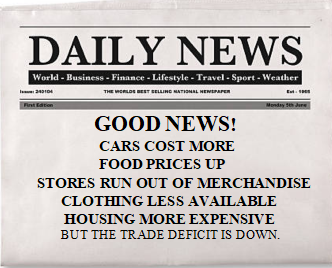
Imports grew just 0.6% from August to $342.1 billion, while exports rose 3% in the month, to $289.3 billion, according to data released Thursday.
Because exports grew more than imports, the U.S. trade deficit shrank, in line with the Trump administration’s goals.
At $52.8 billion, the trade deficit in goods and services hit its lowest level in September since June 2020, when the United States was in the midst of the COVID-19 pandemic.
Trade experts have cautioned against drawing too many conclusions from a few months of Data and said that trade patterns have recently been distorted by businesses’ efforts to avoid paying tariffs.
President Donald Trump has long seen the trade deficit as a sign of economic weakness.
Trump repeats a standard error: treating the trade deficit as a report card on national health. His reason: The word “deficit” confuses people.
If we send more money to foreigners than they send us, that’s a money deficit. If they send us more goods and services than we send them, that’s our goods and services surplus.
A trade is an exchange of presumed equals (“I’ll send you ‘A’ if you send me ‘B.'”)
So why is it called a trade “deficit”? Isn’t it also a trade “surplus”?
Further, the U.S. creates dollars at will by pressing a few computer keys. Virtually no labor or raw materials are required, and we can make dollars endlessly.
The goods and services we receive rely on labor and raw materials, which are limited resources. We offer something that costs us nothing to create, and in return, we receive valuable items; yet, we refer to this as a “deficit.”
It’s quite strange. I would gladly accept that kind of “trade” any day of the year.
It feels more like stealing than trading. Each year, I experience what some might call a “deficit” with my grocer, my favorite restaurants, my gas station, and others. I exchange dollars—currency that my government can produce at no cost—for valuable food and gasoline.
I don’t feel cheated. While I worked for some of my income, as a retiree, most of my current earnings come to me effortlessly. Despite that, I can still exchange those dollars for valuable goods and services.
And still, by the current definition, I’m running a “trade deficit.” It’s nuts.
I wouldn’t have had to work as much if my government had given me dollars for health care, food, housing, education, etc., which it easily could have done at virtually no effort, just by punching a few more computer keys.
The sweeping tariffs Trump has imposed on imports from countries around the world this year, including on automobiles, metals and furniture, have led to big swings in trade.
Before tariffs went into effect, many U.S. businesses brought in a surge of products to avoid paying import taxes.
After Trump’s global tariffs took effect on August 7, imports slowed sharply, then recovered somewhat in September.
On August 29, the Trump administration also ended the “de minimis” exemption, which allowed foreign shipments valued at less than $800 to come into the United States tariff-free.
Opponents criticized the rule as a loophole that penalized U.S. manufacturers in favor of foreign competitors.
That’s another way of saying, “Make imports more expensive to consumers, so American manufacturers can charge consumers more and/or deliver inferior products.“
That might help a few American manufacturers, but do you want higher prices and inferior quality?
Is this good news or bad news? If Americans are buying fewer goods because they are more expensive or harder to obtain, the deficit will decrease. However, this also means a reduction in consumer welfare, which is essentially what inflation and recessions mean.
Currently, we are trading inflation for a shrinking trade deficit—a lousy trade by any definition.
In short, Trump has made trade worse to make the “trade deficit” numbers look better.
SUMMARY
The term “trade deficit” is often misunderstood; it can actually be considered a trade surplus by logical standards. We receive valuable and often scarce goods and services in exchange for dollars, which our government can produce in unlimited quantities at virtually no cost or effort.
Rodger Malcolm Mitchell
Twitter: @rodgermitchell
Search #monetarysovereignty
Facebook: Rodger Malcolm Mitchell;
MUCK RACK: https://muckrack.com/rodger-malcolm-mitchell;
……………………………………………………………………..
A Government’s Sole Purpose is to Improve and Protect The People’s Lives.
MONETARY SOVEREIGNTY
 #Monetary Sovereignty - Mitchell
Why do none of the fifty states worry if they buy more from a certain state than they sell to them. Is the total US imbalance a nationalist ideology problem or a genuine concern?
robert@steinhorn.com
LikeLike
Good question, Robert. The 50 American states, as well as all the counties and cities, are monetarily non-sovereign. So, their first “imbalance” worry must be net outflow of dollars.
According to USA Facts: In FY 2024, the federal government collected around $5.07 trillion from states and their residents through taxes on individuals and businesses and redistributed about $4.87 trillion back to states and residents through programs like Social Security, Medicaid, Medicare, food stamps, and education grants.
The balance varies by state: Californians paid about $275.6 billion more to the federal government than they received, while Virginians received about $89.0 billion more than they paid.
That a monetarily sovereign state pays anything to the Monetarily Sovereign U.S. government is a demonstration of economic ignorance by Congress and the President. The federal government neither needs nor uses any dollars received from states or from anyone else. It creates, ad hoc, all the dollars it spends.
As for interstate payments, as well as city —-> county —–> state payments, all of them are monetarily non-sovereign entities, and must be careful about deficits. It really doesn’t matter who receives the payments as much as it matters who pays..
And, of course, because taxpayers themselves are monetarily non-sovereign, they ultimately are the most impacted.
Nineteen states sent more to the federal government than they received in FY 2024.
Federal government paid more to a state than it received.
Virginia +$89B
Alabama +$45B
South Carolina +$39B
New Mexico +$33B
Mississippi +$33B
Arizona +$33B
Michigan +$32B
Louisiana +$29B
Kentucky +$28B
Pennsylvania +$25B
Maryland +$25B
West Virginia +$22B
Oregon +$21B
Oklahoma +$20B
North Carolina +$18B
Hawaii +$14B
Maine +$14B
Alaska +$11B
Wisconsin +$10B
Idaho +$8B
Montana +$7B
Iowa +$7B
Indiana +$6B
Kansas +$6B
Vermont +$5B
New Hampshire +$4B
Missouri +$3B
Nevada +$3B
North Dakota +$1B
South Dakota +$986M
Wyoming +$653M
State paid more to the federal government than it received.
Arkansas −$426M
Rhode Island −$2B
Utah −$2B
Connecticut −$3B
Tennessee −$4B
Delaware −$5B
Colorado −$10B
Florida −$11B
Nebraska −$19B
Georgia −$19B
Massachusetts −$38B
Minnesota −$50B
Ohio −$52B
Washington −$57B
Illinois −$63B
New Jersey −$68B
Texas −$68B
New York −$76B
California −$276B
Source: Internal Revenue Service and USASpending.gov
LikeLike