When you show a federal “debt” worrier proof that the federal government is Monetarily Sovereign, meaning it has the infinite ability to create dollars, they often will backtrack with: “Yes, but that will cause inflation.”
It has become a matter of faith that “inflation is too many dollars chasing too few goods,” and federal deficit spending “creates too many dollars.”
Therefore, federal deficit spending causes inflation.
If the common knowledge were true, how can one explain this graph?
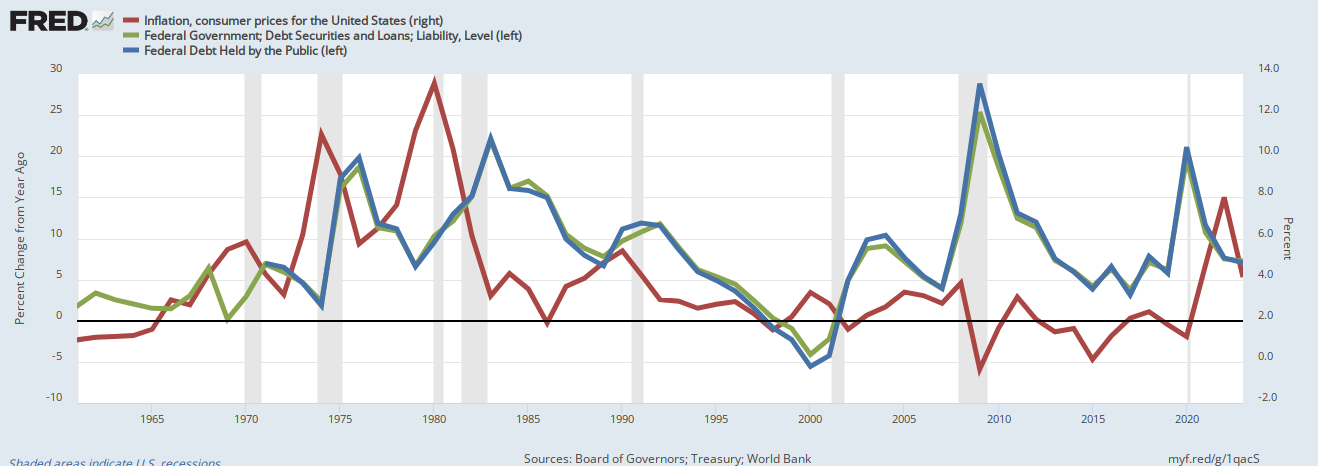
The above graph shows two alternative measures of federal deficit spending: Federal Government Debt Securities and Loans Liability, Level and Federal Debt Held by the Public.
Both measures are quite similar, but they are shown to demonstrate that one measure of federal deficit spending is not some sort of statistical fluke.
Now, compare them with Inflation, Consumer Prices for the United States.
If inflations were caused by “excessive federal deficit spending,” one would not expect a graph like the above, where the peaks and valleys of inflation vs. deficits diverge dramatically. Often, when federal deficit spending goes up, inflation goes down.
Mathematically, there is no correlation between federal deficit spending and inflation. The common knowledge is not supported by historical facts.
So, what does cause inflations? What graph line parallels the inflation line?

The above graph compares the price of oil with inflation. The peaks and valleys show a close relationship.
The price of oil is very sensitive to the demand/supply ratio. When there is plenty of oil, the price goes down.
A shortage of oil raises the price. Thus, the above graph demonstrates how oil scarcity causes inflation. There are far too many parallels for this to be a coincidence.
Oil prices affect the prices of nearly every other product and service. They affect manufacturing, shipping, and storage. Oil prices (i.e. oil shortages) are not totally responsible for inflation; they are highly responsible.
Here is the question most economists fail to answer: If oil shortages are highly responsible for inflation, what would be the best prevention/cure for inflation?
The answer seems clear: To fight inflation, increase the oil supply, or reduce the demand.
Given the two options, reducing demand seems less feasible. It would require recessionary measures that include cuts to driving, trucking, flying, manufacturing, heating, and air conditioning — in short, reducing demand would stall the economy.
However, increasing the supply is not economically destructive. It includes government support for domestic oil drilling. refining, transporting, and distributing, along with federal foreign oil purchasing, all of which require increased federal deficit spending.
There are two problems with the concept:
1. Increasing the supply of oil is not easy or quick. Drilling, refining, and transporting increases can take months or even years. The faster approach would be to convince foreign oil producers to increase output or for our federal government to buy more oil from them.
2. Increasing oil production contributes to global warming.
So these should be considered temporary fixes until more green energy (wind, solar, geothermal, atomic) can be developed.
Oil scarcity is not always the culprit behind inflation. The infamous Zimbabwe hyperinflation was caused by a different shortage.
The government stole farmland from farmers and gave it to people who didn’t know how to farm. The predictable result was a food shortage.
The most recent and ongoing inflation was caused by multiple COVID-related scarcities: Oil, food, shipping, computer chips, metals, paper, labor, etc.
Nowhere have we mentioned the Federal Reserve’s method for combating inflation: Raising prices to reduce demand.
If you feel raising prices is counterproductive to lowering prices, you’re right. Yet that is exactly what interest rate increases do. Lifting interest rates increases the cost of nearly every product and service you buy.
The Fed disingenuously calls it “cooling” the economy, arguing that an economy can be too healthy and needs recessionary pressure to prevent inflation.
If that hypothesis were true, we should expect a close relationship between economic (i.e., GDP) growth and inflation, similar to the relationship between oil supplies and inflation.
Instead, we see this:

Historically, the peaks and valleys of inflation have been randomly distant from those of economic (GDP) growth.

Raising prices does reduce demand, but inflation does that all by itself. The Fed’s interest rate juggling exacerbates the recessionary pressure.
Today, inflation remains, though it is declining, as the COVID-19 shortages have all but disappeared.
A case could be made that inflation would have already ended without the Fed’s price increases.
There is no historical basis for the belief that federal deficit spending can cause inflation.
The illusion occurs when shortages of crucial products cause inflation, and the government’s response is to print currency rather than curing the shortages.
So the public is treated to photos of people carrying currency in wheelbarrows and told that is what caused the inflation.
SUMMARY
Inflation is caused by shortages of key goods and services. The cure for inflation is for the government to obtain and distribute those scarce goods and services.
Inflation is not caused by “excessive” government spending or by “too low” interest rates; cutting federal spending or raising interest rates merely prolongs inflation.
Rodger Malcolm Mitchell
Monetary Sovereignty Twitter: @rodgermitchell Search #monetarysovereignty Facebook: Rodger Malcolm Mitchell; MUCK RACK: https://muckrack.com/rodger-malcolm-mitchell; https://www.academia.edu/
……………………………………………………………………..
The Sole Purpose of Government Is to Improve and Protect the Lives of the People.
MONETARY SOVEREIGNTY
 #Monetary Sovereignty - Mitchell
Once more, Rodger, thank you. I can’t help but remark each time I read someone claim to be “I’m an economist” they predict an increase of “the debt” will be the cause of increasing inflation. It seems axiomatic. I read that twice today from two “reputable sources” no less! They all seem to have this imprinted within some part of their brain causing an automatic, thoughtless response.
Oh yes, they say of course, raising the cost of money will certainly reduce inflation as well. Guess it might after inflation accelerates to such a degree causing massive unemployment? Nice way to induce decreased demand!?
LikeLike
I see those “federal spending causes inflation” comments every day — multiple times a day — but there is one thing I have not seen: Historical data supporting that belief.
So, if any readers can direct me to such evidence, I would be grateful. I’m curious about what supports the belief, and hey, maybe I can learn something.
And while you’re at it, I’d also like to see data supporting the Fed’s belief that raising interest rates lowers prices.
Thank you.
LikeLike
Actions have consequences. Unknowingly, the media relates the stupidity of economists telling us demand for money drops when interest rates go up. The consequences, however, are different. The whole picture is one of a rise in interest by banks and a compensating rise in retail prices by businesses. Of course, they all love to lie about this aspect of pulling the wool over the public’s eyes.
LikeLike