America must return to being the welcoming, caring nation we always have been proud to be. This is not solely a moral imperative, though morals are part of it. It also is a financial and economic imperative.
Two features of America have contributed to our national greatness.
Our population has grown
We have given our people the opportunity to improve their lives.
The American dream is the belief that you can come here, be welcomed, and if you work hard, you can make a good life. We have been proud to be the world’s “shining city upon a hill.”
President Ronald Reagan defined his vision of “the shining city upon a hill.”
“In my mind it is a tall, proud city built on rocks stronger than oceans, windswept, God-blessed, and teeming with people of all kindsliving in harmony and peace; a city with free ports that hummed with commerce and creativity. And if there had to be city walls, the walls had doors and the doors were open to anyone with the will and the heart to get here.”
Of late, we have not been that shining city upon a hill. Our doors have not been open, even to those who are citizens.
We have shut out from society, too many of our neediest. We have built walls within and without. We have closed the doors of opportunity to immigrants, people of color, women, unmarried mothers, children without parents, non-Christians, and the poor.
Three of those groups, unmarried mothers, children without parents, and immigrants have not received the empathy and compassion an “America the beautiful” should (and could) provide.
In that sense, we have descended to a mean-spirited, selfish cold city behind a harsh wall, and America has not benefitted.
We have lost the services, the brainpower and the physical labor of the marginalized groups. We also have lost much of their consuming ability which also would have lifted our economy.
We have been, at best, uncaring about the plight of those groups, and at worst, deliberately cruel. In doing so, we have hurt ourselves. We have cut off our right hand to service the left.
Today, over 40 percent of children are born to single mothers. This trend is troubling, considering that children are, on average, at risk for poorer outcomes when raised outside a married-parent home.
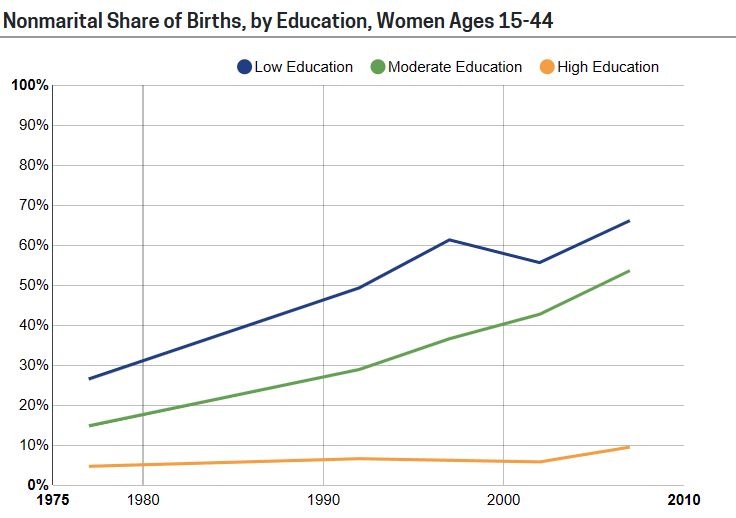
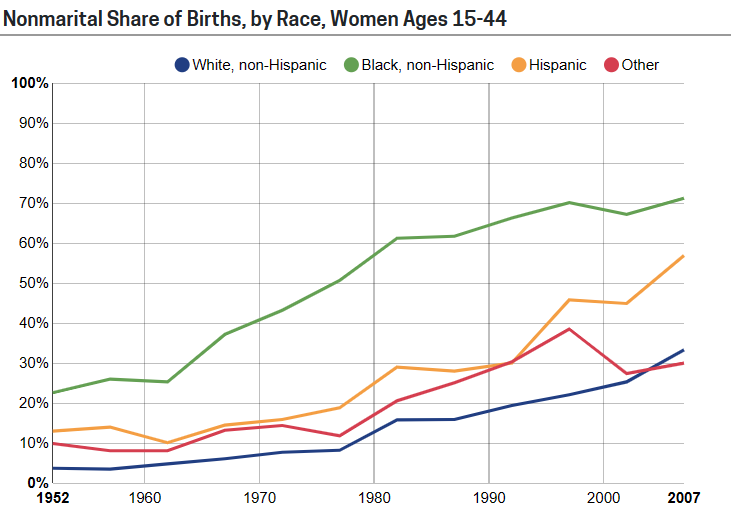
Nonmarital childbearing, once rare in the United States, has become commonplace. This is the case among low- and moderately educated women and across racial lines.
While nonmarital childbearing among highly educated women is still rare, it has nonetheless increased over time, particularly among younger women giving birth for the first time.
Although nonmarital births were already common among Hispanic and black women in earlier decades, today, they are the majority or vast majority of all births.
Among white women and women of other races, nonmarital births were once the exception, but now they are quite typical.
Because of marriage’s decline, far fewer children today reap the benefits of a married-parent family than in past decades.
This is particularly the case among minority children and those from less-educated households.
At the very least, nonmarital childbearing—and the forces behind its rise—should be of great concern when considering the well-being of children.
According to The Hill, the share of American families with children living with a single parent has tripled since 1965. Approximately 75 percent are headed by a mother only.
In 2020 nearly 19 million children, amounting to 25 percent of all children in the U.S., were living in single-parent households.
That percentage is nearly three times the level in 1960 of 9 percent.
Should the government be concerned about, and do something about, the dramatic increase in children born to or living with unmarried parents?
Marriage is not nature’s construct. It is a legal, not a biological creation. It was invented by humans and is followed by most, but not all, humans.
While nature does not frown on unmarried couples living together and having babies, most of society’s laws do. Laws treat married couples differently from unmarried couples, both financially and socially.
Being an unmarried mother requires two full-time jobs, that of raising children in a nurturing household, and that of breadwinner to support the household.
From Psychology Today Magazine: According to the U.S. Census, single moms are one of the most disadvantaged groups—with nearly 30 percent living in poverty.
Many of these single moms cannot provide for their families as they often have lower-paying jobs.
Poverty impacts both sides of the economic equation, productivity, and consumption. Because single mothers have a greater tendency to live day-to-day financially, they produce less and buy less, so they contribute less to the economy.
The government cannot, and should not, even try to change people’s personal desires. Instead, it should support the single parents to help them become more productive.
Childcare and transportation aid, job training, food and rent support would help single parents be more productive for themselves and for America.
In December, the U.S. Census Bureau reported that the nation’s population rose by only 0.5 percent between 2018 and 2019, the slowest growth rate in 100 years since an influenza epidemic contributed to a decline in the number of Americans in 1918.
This would be the lowest since the government started taking population counts around 1790 — even lower than the Great Depression.
Two factors are primarily responsible for this slowdown.
The country’s “natural increase” (births minus deaths) is declining steadily as people wait longer to have children.
The annual number of immigrants to the United States has dropped by almost half since President Trump took office, partly due to policies like turning away refugees.
By contrast, Canada recorded a population growth of 1.4 percent from 2018 to 2019, almost all attributable to an increase in the number of immigrants admitted to that country.
A population slowdown may not sound bad in this climate change era as we try to reduce greenhouse gas emissions and other causes of injury to our environment.
Unfortunately, a sustained population loss would be incompatible with economic growth.
Fewer people would mean a decline in business activity, imminent labor shortages, and a worsening age imbalance that would leave more senior citizens without enough caregivers.
The United States should pursue a healthy birth rate and a welcoming attitude toward newcomers to maintain population growth.
And this:
Congress hasn’t passed a meaningful overhaul to the nation’s immigration system since 1986,even though everyone—representatives of both parties in Washington, successive Presidential Administrations, federal and local agencies, and activists on all sides of the issue—agrees that it has long been unworkable.
And yet, as Dexter Filkins writes in his sobering and richly detailed report from the southern border, the outline of a political solution is unmistakable. “In principle, a legislative compromise on immigration is not difficult to imagine: tougher security on the border, a Republican priority, in exchange for expanded legal immigration, a Democratic priority,” he writes.
“But the prospect of a deal has dissolved in the mutual hostility that typifies congressional politics.”
Also known as Trumpian, name-calling, insulting, lying, dishonest, bigoted politics.
In the absence of meaningful reform, the burden of a disjointed and often unjust set of laws has fallen on the people ensnared in the system: migrants who take immense physical and financial risks to cross the border, overburdened law-enforcement agents pulled in several different directions, and communities that struggle to welcome new members with little outside guidance or support.
It’s a picture of a problem more complex than anyone seems willing to admit.
Add the difficulty of compromise with a party that believes supporting an outright criminal is the path to election success, and the solution is hidden by myths.
Myth: Immigrants are takers who do not pay taxes.(The Fact: Undocumented immigrants significantly contribute to the U.S. tax system by paying sales, income, and property taxes.
In 2021 alone, these households contributed $30.8 billion in total taxes, including $18.6 billion in federal income taxes and $12.2 billion in state and local taxes. Yet, they are not eligible for Social Security benefits or the Earned Income Tax Credit (EITC) though they pay taxes to these and other programs, like Medicare and Medicaid. Immigrants contribute more in tax revenue than they take in government benefits.)
So, what are we afraid of? Why are we building walls? Why is the citizenship approval process so Byzantine and slow? Why are we talking about deporting “Dreamers” or having “tougher security” on our borders?
Why has immigration become one of the biggest issues facing America when we need the people?
Answer: Right-wing bigotry and hatred stoke the fear that punishes us all.
Summary
Each year, ever more children are born to unmarried women. The typical father/mother family structure is becoming less the rule.
Additionally, we are having insufficient births to replace deaths.
Our code of laws and mores needs to be rewritten to accommodate these trends — tax laws, social benefit laws, immigration laws.
Immigrants are unlikely to be criminals, do not take jobs from citizens, pay more taxes than they receive in benefits, seldom bring drugs into America, and help overcome America’s falling birthrate.
In short, immigrants, including undocumented immigrants, and unwed mothers can greatly benefit America if given assistance by the federal government.
The alternatives — direct punishment or by ignoring their plight — not only is immoral but counter-productive for the nation. We need these people to be brought into the fold.
Bottom line: America’s economy needs a growing supply of educated workers and consumers. Immigrants, and single parents, and their children should be aided, not discouraged.
6 thoughts on “What should America do about population shrinkage?”
Open borders make sense. So would new laws on how non-married couples having babies are viewed by all governing bodies. Marriage is on its way out, but how many common-law relationships are still happening. You stated 40% of births were to non-married women , but only 25% were to single mothers. That leads me to assume that 15% of children were born to common-law couples. 15% is a significant number, and should be recognized as a new trend in society. Marriage is not the institution it was. People are recognizing the fact that marriage is a costly way to live in comparison to living together. Especially considering the rising divorce rate combined with the high cost of divorce.
People are intelligent enough to realize that marriage is no longer a “till death do us part” contract. In our society people change faster, not always in the same directions. Domestic violence is not yet on the decline, and is the cause of many divorces, and the cost of divorce almost always favours the violent partner. That has to change!
Another reality is that more and more larger populations are centered in urban communities, and the density of cities is bringing a whole new dynamic to social pressures. The denser the population, the more poverty, crime, and violence there is. These are all deterrents to having babies. Human awareness is growing, and high birth rates are not always a good thing.
Sorry for ranting, but I personally think a negative birth rate is a good thing for G-7 countries. G-7 countries are responsible for most new technologies, which run far ahead of the ability of humans to see their problems until it is too late. Climate disasters are a result of runaway technologies, to name just the worst result! The world needs sanity before it needs another way to destroy life on this planet! Maybe off topic, but still on point!
Today I saw someone wearing a shirt that said transvaxxite on the front.
On the back it said: Although I was not born fully vaccinated, I identify as vaccinated. In other words I am a transvaxxite. Vaccination is a spectrum and you are a bigot if you don’t accept me for who I am.
In a 2021 guest post titled, “Overshoot: Where We Now Stand,” Michael Dowd wrote that Catton’s book is “the single most important book I have ever read.” He also quotes Richard Heinberg saying, “Climate change is not our biggest problem; overshoot is. Global warming is but a symptom of ecological overshoot.”
Indeed, that’s the elephant in the room. Scratch that, the elephant in the Volkswagen. Overpopulation and ecological overshoot are all too real, unfortunately. And the inane and insane addiction to growth for the sake of growth, the ideology of the cancer cell which eventually kills its host, is the root of the problem. The social and economic challenges of an aging and shrinking population pale in comparison to the ecological problems of overpopulation and overshoot.
Fortunately, the two most effective and ethical ways to solve the problem of excessive birthrates are 1) female empowerment, and 2) poverty reduction. No coercion needed.

 #Monetary Sovereignty - Mitchell

Open borders make sense. So would new laws on how non-married couples having babies are viewed by all governing bodies. Marriage is on its way out, but how many common-law relationships are still happening. You stated 40% of births were to non-married women , but only 25% were to single mothers. That leads me to assume that 15% of children were born to common-law couples. 15% is a significant number, and should be recognized as a new trend in society. Marriage is not the institution it was. People are recognizing the fact that marriage is a costly way to live in comparison to living together. Especially considering the rising divorce rate combined with the high cost of divorce.
People are intelligent enough to realize that marriage is no longer a “till death do us part” contract. In our society people change faster, not always in the same directions. Domestic violence is not yet on the decline, and is the cause of many divorces, and the cost of divorce almost always favours the violent partner. That has to change!
Another reality is that more and more larger populations are centered in urban communities, and the density of cities is bringing a whole new dynamic to social pressures. The denser the population, the more poverty, crime, and violence there is. These are all deterrents to having babies. Human awareness is growing, and high birth rates are not always a good thing.
Sorry for ranting, but I personally think a negative birth rate is a good thing for G-7 countries. G-7 countries are responsible for most new technologies, which run far ahead of the ability of humans to see their problems until it is too late. Climate disasters are a result of runaway technologies, to name just the worst result! The world needs sanity before it needs another way to destroy life on this planet! Maybe off topic, but still on point!
LikeLike
Today I saw someone wearing a shirt that said transvaxxite on the front.
On the back it said: Although I was not born fully vaccinated, I identify as vaccinated. In other words I am a transvaxxite. Vaccination is a spectrum and you are a bigot if you don’t accept me for who I am.
LikeLike
I definitely would accept him/her for what he/she is: Stupid.
LikeLike
https://hollymathnerd.substack.com/p/my-coming-out-post-im-trans-vaxxed
Too many of these contrarian thinkers jumped in the gene pool when the lifeguard wasn’t looking.
LikeLike
Does anyone actually believe this is sustainable: https://upload.wikimedia.org/wikipedia/commons/f/ff/Historical_population_of_Egypt.svg Pretty sure for any non-human species ecologists call this ‘overshoot’. https://en.wikipedia.org/wiki/William_R._Catton_Jr.#The_legacy_of_Catton's_1980_book,_Overshoot
In a 2021 guest post titled, “Overshoot: Where We Now Stand,” Michael Dowd wrote that Catton’s book is “the single most important book I have ever read.” He also quotes Richard Heinberg saying, “Climate change is not our biggest problem; overshoot is. Global warming is but a symptom of ecological overshoot.”
LikeLike
Indeed, that’s the elephant in the room. Scratch that, the elephant in the Volkswagen. Overpopulation and ecological overshoot are all too real, unfortunately. And the inane and insane addiction to growth for the sake of growth, the ideology of the cancer cell which eventually kills its host, is the root of the problem. The social and economic challenges of an aging and shrinking population pale in comparison to the ecological problems of overpopulation and overshoot.
Fortunately, the two most effective and ethical ways to solve the problem of excessive birthrates are 1) female empowerment, and 2) poverty reduction. No coercion needed.
LikeLike