Solving the gun crime problem — and a question.

Twitter: @rodgermitchell; Search #monetarysovereignty
Facebook: Rodger Malcolm Mitchell

Mitchell’s laws:
•Those, who do not understand the differences between Monetary Sovereignty and monetary non-sovereignty, do not understand economics.
•Any monetarily NON-sovereign government — be it city, county, state or nation — that runs an ongoing trade deficit, eventually will run out of money.
•The more federal budgets are cut and taxes increased, the weaker an economy becomes..

Liberals think the purpose of government is to protect the poor and powerless from the rich and powerful. Conservatives think the purpose of government is to protect the rich and powerful from the poor and powerless.

•The single most important problem in economics is the Gap between rich and the rest..
•Austerity is the government’s method for widening
the Gap between rich and poor.
•Until the 99% understand the need for federal deficits, the upper 1% will rule.
•Everything in economics devolves to motive, and the motive is the Gap between the rich and the rest..

============================================================================================================================================================================================================================================================

This post offers a solution to the gun crime problem — and asks a question.

Chicago, and many other places in America, have a problem with gun violence. A typical example:

monetary sovereignty

BREAKING NEWS ALERT
January 8, 2016

10 shot in Friday violence, including 1 killed, 2 injured near mayor’s home

One person was killed and two injured in a shooting Friday evening in the North Center neighborhood, about four blocks from Mayor Rahm Emanuel’s home.

The three were among 10 people wounded since Friday morning in Chicago, including five in one incident late Friday evening on the West Side.

Yes, in some Chicago neighborhoods even children carry guns, old people carry guns, women carry guns, men carry guns and many people have multiple guns. But the real problem is that not enough people carry guns.

The solution is simple: More people should carry guns.

There should not be any laws limiting gun ownership, because then only lawbreakers would carry guns. As everyone knows, “The only thing that can stop a bad guy with a gun is a good guy with a gun.” Laws won’t do it.

Similarly, laws against stealing don’t work, because lawbreakers don’t follow the law. And, good guys don’t steal.

And, laws against murder are useless, because only lawbreakers murder. Good guys don’t murder

When you think about it, laws don’t prevent criminals from committing crimes.

So logically, there should be no laws. Laws don’t work.

Problem solved: Give everyone a gun — even a machine gun (why not?) — and eliminate all laws.

Which brings us to the question: Why is the right wing so fearful? These folks seem to be frightened by virtually everything. They are afraid of such “meanies” as:

–Non-Christians in general
–Muslims in particular
–Blacks
–Latinos (especially Mexicans)
–Orientals
–Native Americans
–Immigrants
–Foreigners
–Gays
–“Bad” guys (Anyone not like “me.”)
–Unions
–Planned Parenthood
–Poor people
–The government
–The federal deficit and debt
–Medical marijuana (but not alcohol or cigarettes)
–Science (especially Evolution and Climatology)
–Any politician who might possibly “take their guns”
–The words, “well-regulated militia.”

The list of fears goes on and on. What makes the right wing so terrified that they need to arm themselves (often with multiple, high-powered guns) and even carry those guns in public?

We really should offer compassion to people who have been frightened by their leaders — Trump, Carson, Cruz, Rubio, Limbaugh, Beck, Hannity et al. To live a life of cringing behind the door every time one of the “meanies” comes by — that surely must be painful.

So, let us try not to criticize the conservatives for the ignorance that causes trepidations and weaknesses.

If you can’t offer compassion at least, feel pity.

Rodger Malcolm Mitchell
Monetary Sovereignty

===================================================================================
Ten Steps to Prosperity:
1. Eliminate FICA (Click here)
2. Federally funded Medicare — parts A, B & D plus long term nursing care — for everyone (Click here)
3. Provide an Economic Bonus to every man, woman and child in America, and/or every state a per capita Economic Bonus. (Click here) Or institute a reverse income tax.
4. Free education (including post-grad) for everyone. Click here
5. Salary for attending school (Click here)
6. Eliminate corporate taxes (Click here)
7. Increase the standard income tax deduction annually Click here
8. Tax the very rich (.1%) more, with higher, progressive tax rates on all forms of income. (Click here)
9. Federal ownership of all banks (Click here and here)

10. Increase federal spending on the myriad initiatives that benefit America’s 99% (Click here)

The Ten Steps will add dollars to the economy, stimulate the economy, and narrow the income/wealth/power Gap between the rich and the rest.
——————————————————————————————————————————————

10 Steps to Economic Misery: (Click here:)
1. Maintain or increase the FICA tax..
2. Spread the myth Social Security, Medicare and the U.S. government are insolvent.
3. Cut federal employment in the military, post office, other federal agencies.
4. Broaden the income tax base so more lower income people will pay.
5. Cut financial assistance to the states.
6. Spread the myth federal taxes pay for federal spending.
7. Allow banks to trade for their own accounts; save them when their investments go sour.
8. Never prosecute any banker for criminal activity.
9. Nominate arch conservatives to the Supreme Court.
10. Reduce the federal deficit and debt

No nation can tax itself into prosperity, nor grow without money growth. Monetary Sovereignty: Cutting federal deficits to grow the economy is like applying leeches to cure anemia.
1. A growing economy requires a growing supply of dollars (GDP=Federal Spending + Non-federal Spending + Net Exports)
2. All deficit spending grows the supply of dollars
3. The limit to federal deficit spending is an inflation that cannot be cured with interest rate control.
4. The limit to non-federal deficit spending is the ability to borrow.

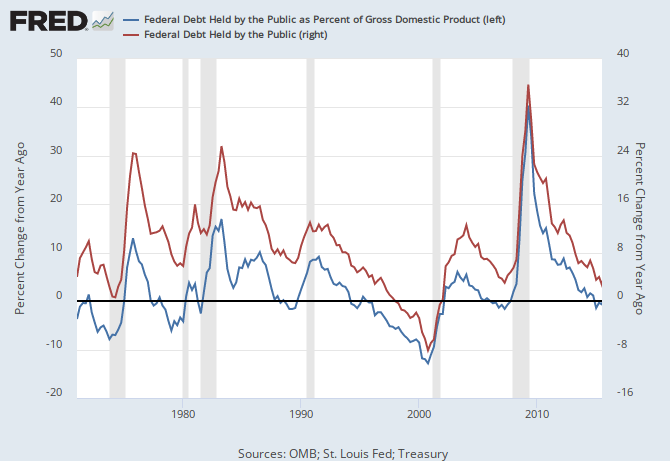
THE RECESSION CLOCK

Recessions begin an average of 2 years after the blue line first dips below zero. There was a dip in 2015. Recessions are cured by a rising red line.
Monetary Sovereignty

Vertical gray bars mark recessions.

As the federal deficit growth lines drop, we approach recession, which will be cured only when the growth lines rise. Increasing federal deficit growth (aka “stimulus”) is necessary for long-term economic growth.

#MONETARYSOVEREIGNTY

Public vs. private: The contradictory and misguided arguments

Twitter: @rodgermitchell; Search #monetarysovereignty
Facebook: Rodger Malcolm Mitchell

Mitchell’s laws:
•Those, who do not understand the differences between Monetary Sovereignty and monetary non-sovereignty, do not understand economics.
•Any monetarily NON-sovereign government — be it city, county, state or nation — that runs an ongoing trade deficit, eventually will run out of money.
•The more federal budgets are cut and taxes increased, the weaker an economy becomes..

Liberals think the purpose of government is to protect the poor and powerless from the rich and powerful. Conservatives think the purpose of government is to protect the rich and powerful from the poor and powerless.

•The single most important problem in economics is the Gap between rich and the rest..
•Austerity is the government’s method for widening
the Gap between rich and poor.
•Until the 99% understand the need for federal deficits, the upper 1% will rule.
•Everything in economics devolves to motive, and the motive is the Gap between the rich and the rest..

============================================================================================================================================================================================================================================================

In the September 3rd, 2013 post, “The private sector myth busted, then, oh no, the public sector myth repeated,” we mentioned Mariana Mazzucato, an economist and professor of science and technology policy at the University of Sussex, UK, and her then latest book, The Entrepreneurial State: Debunking public vs. private sector myths.

The book debunks the myth that the private sector is better at creativity and innovation than is the public sector — a myth often repeated by debt hawks to support their beliefs that the federal government, the federal deficit, and the federal debt all should be cut back.

More recently, TIME Magazine ran a short article, referencing Mazzucato’s findings:

Why Hillary Clinton Is Right About Pfizer
Rana Foroohar, Nov. 24, 2015

Three cheers for Hillary Clinton and other politicians who are decrying Pfizer’s tax “inversion” deal that would allow it to take over an Irish pharma company and relocate there, thus saving $21 billion in American taxes.

One of the many reasons tax inversion deals—merger are so egregious is that the very firms that are most able to do them have also been the biggest beneficiaries of government help.

Pfizer and other such firms will argue that they need to pay lower taxes to fund the research that results in miracle drugs. But that is a myth.

We credit the private sector for the innovation and growth in our economy. But a number of academics and policy thinkers, including University of Sussex economist Mariana Mazzucato, argue powerfully that it is the government (and thus taxpayers) rather than the private sector that deserves the credit for such innovation.

Here is where the confusion sets in:

The U.S. government is Monetarily Sovereign, which means it neither relies on, nor uses, tax dollars to fund spending. It creates dollars, ad hoc, by spending.

Even if all federal taxes fell to $0, the federal government could continue spending, forever. Taxpayers have nothing to do with federal spending.

“Every major technological change in recent years traces most of its funding back to the state,” says Mazzucato, who backs the claim up with powerful statistics and anecdotes in her book.

Most parts of the smartphone that make it smart – GPS, touchscreens, the Internet–were advanced by the Defense Department.

Tesla’s batteries came out of a Department of Energy grant. Google’s search algorithm was boosted by a National Science Foundation innovation.

Likewise, many new drugs that have made big money for firms like Pfizer have come out of NIH research.

The National Institutes of Health have spent almost a trillion dollars since its founding on the research that created both the pharmaceutical and the biotech sectors — with venture capitalists only entering biotech once the red carpet was laid down in the 1980s.

The fact that the federal government has originated many of our great technical advances does not translate into, “Companies should pay more taxes.” It’s a false, confused argument.

Companies invest billions in research and development. Paying taxes reduces their ability to invest.

Since the federal government has no need for tax dollars, and taxpayers do not pay for federal spending, there is no economic advantage to taking money from corporations and giving it to the federal government.

So why the mythology that the private sector deserves all the profits and the credit for innovation? Because there are huge profits to be made with that narrative.

No, the reason is: The federal government doesn’t need or use the money, and taking dollars from the private sector reduces economic growth.

The author seems to have some strange “fairness” issue, as in: “It isn’t fair that the government invests all that money and the private sector gets the credit and the profits.”

But that is exactly what Monetarily Sovereign governments are supposed to do. That is why they are allowed to have control over our money. It’s the fundamental purpose of Monetary Sovereignty.

It was the National Venture Capital industry that in 1976 convinced the government to reduce capital gains tax by 50% in only five years.

Likewise, says Mazzucato, “It is Big Pharma that is able to charge exorbitant prices in the name of recouping their high innovation costs—and also lobby for massive tax reductions related to patents that have no effect on their investments.”

There are better models. The U.S. government in the past has dictated that companies reinvest money in Main Street rather than give it to Wall Street.

That’s how Bell Labs was born, after the federal government pressured AT&T to reinvest profits in innovation. We got the C++ programming language and cell-phone calling technology, among many other advances, out of that. Not a bad precedent.

Or better yet, the federal government could invest money in Main Street via bigger social benefits (better Social Security, Medicare for all, Medicaid, school lunches, food stamps, free college, etc. — The Ten Steps to Prosperity (see below) — rather than trying to micromanage the activities of private companies.

The NIH invests $30 billion per year in research that enriches companies like Pfizer. Meanwhile, Big Pharma spends more on marketing than R&D, and is the leader, along with the tech and energy sectors, in share buybacks that make investors wealthy without creating any real growth or jobs.

Clinton and others should keep the pressure on Pfizer and other such firms—and the next president should make both buybacks and inversions, which cheat the true economic makers in this country, illegal.

No, Clinton should keep the pressure on the federal government to use its unlimited resources to grow the economy and to improve the lot of our citizens.

As for share buybacks, they merely transfer dollars from one part of the economy to another; tax increases remove dollars from the economy.

It is federal taxes, not share buybacks, that “cheat the true economic makers in this country,” the public.

Unfortunately, it’s not just Professor Mazzucato who seems to believe that taking dollars from the private sector helps grow the economy.

LOWERING THE MARGINAL CORPORATE TAX RATE: WHY THE DEBATE?
Nikolay Anguelov, Ph.D., Assistant Professor of Public Policy, Department of Public Policy, University of Massachusetts Dartmouth
© 2015 by Nikolay Anguelov

In light of the politically charged debate in America on the unethical and unpatriotic behavior of Multinational Corporations (MNCs) that engage in tax inversion, this study concludes that relatively high corporate taxes are not the culprit. In fact, they contribute to GDP growth.

Professor devotes many statistics to his belief that in some mysterious — impossible — way, high corporate taxes contribute to GDP growth. (Perhaps this is the time to quote the old phrase: “There are three kinds of lies: lies, damned lies, and statistics.” )

Seemingly, the good Professor does not know the formula for GDP, which is: GDP = Federal Spending + Non-federal Spending + Net Exports.

How corporate taxes can increase any element of the GDP formula, never is explained.

The detriment lies in a system of stimulating economic activity through providing incentives to write off firm debt.

In the United States this policy direction of ever increasing measures to deduct taxes from operational expenses has created a reality in which most firms pay no taxes at all, so that the federal government only collects 9% of its total tax revenue from corporate taxes. This fact renders the debate moot.

The Professor also does not explain why higher firm debt is economically desirable, nor does he explain why cutting non-corporate taxes wouldn’t be preferable to increasing corporate taxes. Are Americans taxed too little?

Reversing such a legacy would be impossible because a whole industry has developed around it of lawyers, accountants, finance managers, and organized groups that represent their interests.

He doesn’t realize he has given an important reason for lowering tax rates. The lower the rates, the less need for expensive lawyers, accountants et al.

The results of this study stress the need for understanding the financial maneuvering of MNCs in managing their debt burden for maximum tax benefits.

MNCs face two incentives in debt management – one is to show high levels of debt when writing off taxes, the other is to show profitability to their shareholders, i.e. – low debt. The winning balance varies based on MNC, nation of incorporation, and how value is presented to shareholders.

Again, the Professor completely misses the point. The ultimate corporate goal is profitability, both for investment (in goods, services and workers) and for shareholder return. A corporation would be remiss in not trying to achieve that goal, partly by cutting taxes.

The bottom line: Taxes reduce corporate profitability. The federal government neither needs nor uses tax dollars. It has the unlimited ability to create dollars for economic stimulation, which it does ad hoc, by spending.

The federal government has been responsible for many scientific advances, and the reason is clear: Innovation requires money, and private money is less willing and less able to take big risks and wait long times for uncertain results.

The notions that corporations should pay more taxes and that the federal government is too large, not only are contradictory but misguided.

Rodger Malcolm Mitchell
Monetary Sovereignty

===================================================================================
Ten Steps to Prosperity:
1. Eliminate FICA (Click here)
2. Federally funded Medicare — parts A, B & D plus long term nursing care — for everyone (Click here)
3. Provide an Economic Bonus to every man, woman and child in America, and/or every state a per capita Economic Bonus. (Click here) Or institute a reverse income tax.
4. Free education (including post-grad) for everyone. Click here
5. Salary for attending school (Click here)
6. Eliminate corporate taxes (Click here)
7. Increase the standard income tax deduction annually Click here
8. Tax the very rich (.1%) more, with higher, progressive tax rates on all forms of income. (Click here)
9. Federal ownership of all banks (Click here and here)

10. Increase federal spending on the myriad initiatives that benefit America’s 99% (Click here)

The Ten Steps will add dollars to the economy, stimulate the economy, and narrow the income/wealth/power Gap between the rich and the rest.
——————————————————————————————————————————————

10 Steps to Economic Misery: (Click here:)
1. Maintain or increase the FICA tax..
2. Spread the myth Social Security, Medicare and the U.S. government are insolvent.
3. Cut federal employment in the military, post office, other federal agencies.
4. Broaden the income tax base so more lower income people will pay.
5. Cut financial assistance to the states.
6. Spread the myth federal taxes pay for federal spending.
7. Allow banks to trade for their own accounts; save them when their investments go sour.
8. Never prosecute any banker for criminal activity.
9. Nominate arch conservatives to the Supreme Court.
10. Reduce the federal deficit and debt

No nation can tax itself into prosperity, nor grow without money growth. Monetary Sovereignty: Cutting federal deficits to grow the economy is like applying leeches to cure anemia.
1. A growing economy requires a growing supply of dollars (GDP=Federal Spending + Non-federal Spending + Net Exports)
2. All deficit spending grows the supply of dollars
3. The limit to federal deficit spending is an inflation that cannot be cured with interest rate control.
4. The limit to non-federal deficit spending is the ability to borrow.

THE RECESSION CLOCK

Recessions begin an average of 2 years after the blue line first dips below zero. There was a dip in 2015. Recessions are cured by a rising red line.

Monetary Sovereignty

Vertical gray bars mark recessions.

As the federal deficit growth lines drop, we approach recession, which will be cured only when the growth lines rise. Increasing federal deficit growth (aka “stimulus”) is necessary for long-term economic growth.

#MONETARYSOVEREIGNTY

More on CRISPR, “the most important invention”

Twitter: @rodgermitchell; Search #monetarysovereignty
Facebook: Rodger Malcolm Mitchell

Mitchell’s laws:
•Those, who do not understand the differences between Monetary Sovereignty and monetary non-sovereignty, do not understand economics.
•Any monetarily NON-sovereign government — be it city, county, state or nation — that runs an ongoing trade deficit, eventually will run out of money.
•The more federal budgets are cut and taxes increased, the weaker an economy becomes..

Liberals think the purpose of government is to protect the poor and powerless from the rich and powerful. Conservatives think the purpose of government is to protect the rich and powerful from the poor and powerless.

•The single most important problem in economics is the Gap between rich and the rest..
•Austerity is the government’s method for widening
the Gap between rich and poor.
•Until the 99% understand the need for federal deficits, the upper 1% will rule.
•Everything in economics devolves to motive, and the motive is the Gap between the rich and the rest..

============================================================================================================================================================================================================================================================

In the previous post, we discussed CRISPR-Cas9 (pronounced: crisper) and described it as the most important invention since the Internet. That well may be an understatement.

CRISPR will change the future of all mankind.

In reality, CRISPR actually was invented by nature — specifically, by bacteria — as a defense against viruses. CRISPR allows certain bacteria to slice up virus DNA to make the virus harmless.

CRISPR provides a very fast, very easy method for editing nearly any gene in any living organism. It can disable a gene, repair a gene or substitute one gene for another.

Here are some of its potential uses:

Breakthrough gene editor sparks ethics debate

Many people hope doctors will soon find a way to use the gene editor to fix mutations that cause genetic diseases, a boon for gene therapy.

Almost immediately after the technology debuted, scientists turned to CRISPR to genetically engineer organisms in the lab, including rhesus macaques, mice, zebrafish, fruit flies, yeast and some plants.

In October, researchers reported setting a record for the most genes edited at once (SN: 11/14/15, p. 6). That record — 62 genes — removed viruses embedded in pig DNA to make pig organs safer for human transplants.

Chinese researchers announced the same month that they had successfully edited dogs with CRISPR, producing a female beagle with a mutation that resulted in more muscular thighs than her unedited littermates.

CRISPR has an application to gene drives — engineered genes designed to break typical inheritance rules and get passed to nearly all of a carrier’s offspring.

In late November and early December, two teams reported the creation of gene drives that could help eradicate malaria.

Great promise comes with these developments, but there are also fears that gene drive–altered organisms could escape the lab and infect wild animals or could run amok in other ways.

Prevent and cure genetic diseases, facilitate animal-to-human transplants (assuring an unlimited supply), improve human and animal muscularity, eliminate mosquito-borne diseases — and that’s just for starters.

Not all bodies act their age

People grow old at vastly different rates.

A study, out of Duke University, analyzed the health of nearly one thousand 38-year-olds and found that some resembled people a decade older while others appeared years younger.

The finding tapped into a mystery that has long captivated scientists and the public alike — “why some people can live to 120 with no disease, and others are already in bad shape at age 70,” says molecular biologist Martin Hetzer of the Salk Institute for Biological Studies in La Jolla, Calif.

Molecular mayhem within cells may lie at the root of aging. Populations of proteins in the brains and livers of rats appear to become damaged over time.

In healthy young people, long stretches of DNA pack tightly together in neat bundles called heterochromatin. These bundles aren’t packaged quite so well in old people.

The molecular events identified this year add to previously discovered signs of aging — the shortening of telomeres, the protective caps on chromosomes, for example, and damage to mitochondria, the energy factories of cells.

Damaged proteins, packaging of DNA, shortened telomeres — these all might be addressed via CRISPR.

And then there’s cancer:

These animals don’t get cancer, and scientists think they could hold a cure

The root cause of cancer is a chance mutation in a group of cells, which is why it’s puzzling that elephants get cancer so rarely – they have 100 times the number of cells us humans do, yet on average only 1 in 20 elephants develop the disease compared to 1 in 5 people.

A team of researchers in the US looked closer, and found an abundance of a gene called TP53. This gene is known for its ability to repair damaged DNA and thus halt the spread of cancer, and it’s some 20 times more common in elephants than it is in human beings. It appears elephants have developed more of these genes as they’ve evolved, in part to protect calves born to older mothers.

Naked mole rats are even more miraculous – they never develop cancer, even when scientists try and induce it artificially. The mechanism involves a polymer called hyaluronan.

Eradicating this polymer in naked mole rats allows cancers to spread as they normally would – which in turn suggests that hyaluronan could be crucial in keeping the disease at bay. The underground creatures have around five times the level of hyaluronan as humans do.

CRISPR could help modify human DNA to produce more hyaluronan. Goodby cancer.

Many animals live much longer than do we humans. Some marine animals live 500+ years.

If we can discover which stretches of DNA account for any species’ longer life, we may be able to duplicate and implant those DNA stretches in humans, allowing us to live 200 years, 500 years, or even more.

Warming continues apace — “hiatus” didn’t exist

A supposed pause in global warming that has been fodder for climate change doubters never really existed.

In June, scientists at the National Oceanic and Atmospheric Administration announced that they had finally found the cause of the hiatus, and it wasn’t shifting winds or pint-size volcanic eruptions as some scientists proposed. Instead, small biases and gaps in temperature data had created an artificial plateau.

“What we’re doing right now to the climate is unprecedented,” says Richard Zeebe, a paleoclimatologist at the University of Hawaii at Manoa.

Scientists now predict that the Arctic Ocean will have its first ice-free summer sometime around 2052, almost a decade sooner than previously projected. The rapid warming in the Arctic may also cause more deadly heat waves across the Northern Hemisphere.

What does CRISPR have to do with climate change? Here’s what:

Climate Change, Threats and Impacts

Rising temperatures and changing patterns of rain and snow are forcing trees and plants around the world to move toward polar regions and up mountain slopes.

As plant communities try to adjust to the changing climate by moving toward cooler areas, the animals that depend on them will be forced to move. Development and other barriers may block the migration of both plants and animals.

In the tropics, increased sea temperatures are causing more coral reefs to “bleach,” as the heat kills colorful algae that are necessary to coral health and survival.

As temperatures rise globally, droughts will become more frequent and more severe, with potentially devastating consequences for agriculture, water supply and human health.

Many plants and animals are genetically suited to warmer, drier (or wetter) conditions.

Consider the probability the CRISPER technique will allow us to implant appropriate genes into affected animals and plants: Grasses, trees, algae, etc. that will allow them to flourish under future climate conditions.

“Cool weather” animals and plants wouldn’t need to migrate to cooler climes.

We may even be able to slow or ward off climate change by increasing the CO2 depletion ability of algae, trees, grasses and other plants.

Man, the explorer, continuously yearns to “go where no man has gone before,” and the greatest untracked territory is outer space. Only the moon has felt man’s step. But to put it modestly:

Interstellar Space travel is really difficult!

Our travellers will have to spend their entire journey floating about in the weightlessness of space. This likely has adverse health effects over time.

Our travellers would need (to carry) enough food (and water).

The psychological stresses of living in space for (many years) are immense and possibly insurmountable.

There are other problems, too. Space is big. Travelling beyond our solar system would require more than a lifetime.

And then there is deadly radiation. Space is filled with it. Adequate shielding would be heavy and that extra weight would compromise the trip.

Some animals hibernate. Their need for food and water and oxygen is reduced.

Some part of their DNA allows them to hibernate, and if that part could be included in human DNA, we could hibernate too. Our need for food, water and oxygen during a space trip, would be reduced, and the problem of boredom eliminated.

In a state of hibernation, humans might live long enough to travel to the stars.

The DNA of certain extremophiles, such as the bacteria Deinococcus radiodurans and tardigrades allows them to withstand acute doses of ionizing radiation. There is strong evidence that radioresistance can be genetically determined and inherited. the proper DNA, humans might be able to withstand space radiation.

Finally, there is the effect of zero gravity on the body. Human muscles and bones weaken. Fish live in a low perceived gravity environment. It might be possible that human DNA can be adjusted so that low or absent gravity does not weaken muscles and bones.

While transplanting electric eel DNA to humans may not help us save on our electric bills, that may be one of the few things CRISPR technology doesn’t do. CRISPR technology might even help us to become smarter, so we would be better able to use the technology — in a rising helix of accomplishment.

We are entering the CRISPR Age, folks.

To paraphrase: “CRISPER, one minuscule step for a gene, one giant step for mankind.”

Rodger Malcolm Mitchell
Monetary Sovereignty

===================================================================================
Ten Steps to Prosperity:
1. Eliminate FICA (Click here)
2. Federally funded Medicare — parts A, B & D plus long term nursing care — for everyone (Click here)
3. Provide an Economic Bonus to every man, woman and child in America, and/or every state a per capita Economic Bonus. (Click here) Or institute a reverse income tax.
4. Free education (including post-grad) for everyone. Click here
5. Salary for attending school (Click here)
6. Eliminate corporate taxes (Click here)
7. Increase the standard income tax deduction annually Click here
8. Tax the very rich (.1%) more, with higher, progressive tax rates on all forms of income. (Click here)
9. Federal ownership of all banks (Click here and here)

10. Increase federal spending on the myriad initiatives that benefit America’s 99% (Click here)

The Ten Steps will add dollars to the economy, stimulate the economy, and narrow the income/wealth/power Gap between the rich and the rest.
——————————————————————————————————————————————

10 Steps to Economic Misery: (Click here:)
1. Maintain or increase the FICA tax..
2. Spread the myth Social Security, Medicare and the U.S. government are insolvent.
3. Cut federal employment in the military, post office, other federal agencies.
4. Broaden the income tax base so more lower income people will pay.
5. Cut financial assistance to the states.
6. Spread the myth federal taxes pay for federal spending.
7. Allow banks to trade for their own accounts; save them when their investments go sour.
8. Never prosecute any banker for criminal activity.
9. Nominate arch conservatives to the Supreme Court.
10. Reduce the federal deficit and debt

No nation can tax itself into prosperity, nor grow without money growth. Monetary Sovereignty: Cutting federal deficits to grow the economy is like applying leeches to cure anemia.
1. A growing economy requires a growing supply of dollars (GDP=Federal Spending + Non-federal Spending + Net Exports)
2. All deficit spending grows the supply of dollars
3. The limit to federal deficit spending is an inflation that cannot be cured with interest rate control.
4. The limit to non-federal deficit spending is the ability to borrow.

THE RECESSION CLOCK

Recessions begin an average of 2 years after the blue line first dips below zero. There was a dip in 2015. Recessions are cured by a rising red line.

Monetary Sovereignty

Vertical gray bars mark recessions.

As the federal deficit growth lines drop, we approach recession, which will be cured only when the growth lines rise. Increasing federal deficit growth (aka “stimulus”) is necessary for long-term economic growth.

#MONETARYSOVEREIGNTY

The most important invention since the Internet

Twitter: @rodgermitchell; Search #monetarysovereignty
Facebook: Rodger Malcolm Mitchell

Mitchell’s laws:
•Those, who do not understand the differences between Monetary Sovereignty and monetary non-sovereignty, do not understand economics.
•Any monetarily NON-sovereign government — be it city, county, state or nation — that runs an ongoing trade deficit, eventually will run out of money.
•The more federal budgets are cut and taxes increased, the weaker an economy becomes..

Liberals think the purpose of government is to protect the poor and powerless from the rich and powerful. Conservatives think the purpose of government is to protect the rich and powerful from the poor and powerless.

•The single most important problem in economics is the Gap between rich and the rest..
•Austerity is the government’s method for widening
the Gap between rich and poor.
•Until the 99% understand the need for federal deficits, the upper 1% will rule.
•Everything in economics devolves to motive, and the motive is the Gap between the rich and the rest..

============================================================================================================================================================================================================================================================

There have been select technological advances in human history that have “changed everything” — the use of fire, the lever, the wheel, the knife, the use of electricity, the computer, the Internet, to name a few, and now . . .

You live at a time of the most important invention since the Internet and you may not yet have heard of it.

It was invented by two women, Jennifer Doudna (UC Berkeley) and Emmanuelle Charpentier (Max Planck Institute).

The invention: CRISPR-Cas9 (pronounced: crisper).

Sound familiar? No? It soon will be all you’ll think about.

Everything You Need to Know About CRISPR, the New Tool that Edits DNA

CRISPR allows scientists to edit genomes with unprecedented precision, efficiency, and flexibility.

The past few years have seen a flurry of “firsts” with CRISPR, from creating monkeys with targeted mutations to preventing HIV infection in human cells.

Earlier this month, Chinese scientists announced they applied the technique to nonviable human embryos, hinting at CRISPR’s potential to cure any genetic disease. And yes, it might even lead to designer babies.

“Designer babies” is the pejorative used to describe human babies that have been “improved” genetically to be faster, taller, smarter, better-looking, stronger, disease-free or in some other ways, to have been changed far more quickly than what breeding by nature accomplishes slowly.

This power is threatening as all power is.

There is an irony to the fact that, for instance, assuring your baby is free of horrible genetic and communicable diseases is an anathema. A distant relation of mine is in a family containing the dreaded Huntington gene. I’m sure they and their afflicted children, would have welcomed a bit of “designing.”

But power corrupts, and CRISPR truly is powerful, so expect the corrupt to use it for corrupt purposes.

CRISPR is actually a naturally-occurring, ancient defense mechanism found in a wide range of bacteria.

CRISPR is one part of bacterias’ immune system, which keeps bits of dangerous viruses around so it can recognize and defend against those viruses next time they attack.

The second part of the defense mechanism is a set of enzymes called Cas (CRISPR-associated proteins), which can precisely snip DNA and slice the hell out of invading viruses.

There are a number Cas enzymes, but the best known is called Cas9. It comes from Streptococcus pyogenes, better known as the bacteria that causes strep throat.

In short, the whole thing is as natural as eating corn on the cob (a human-modified grain). Natural, yes. But that is not where its power lies.

All biologists have to do is feed Cas9 the right sequence, called a guide RNA, and boom, you can cut and paste bits of DNA sequence into the genome wherever you want.

All you have to do is design a target sequence using an online tool and order the guide RNA to match. It takes no longer than few days for the guide sequence to arrive by mail.

You can even repair a faulty gene by cutting out it with CRISPR/Cas9 and injecting a normal copy of it into a cell.

Fast, cheap and powerful, CRISPR will change the world. The question: Will it be a better world?

There already is work being done to apply CRISPR to genetic diseases of the blood, like sickle-cell anemia, where we can repair the mutation that causes it.

CRISPR could, for example, be used to introduce genes that slowly kill off the mosquitos spreading malaria (or the genes for harboring malaria).

Or put the brakes on invasive species like weeds. It could be the next great leap in conserving or enhancing our environment.

CRISPR has been getting a lot of coverage as a future medical treatment. But focusing on medicine alone is narrow-minded.

Precise genome engineering has the potential to alter not just us, but the entire world and all its ecosystems.

Of course, the above-mentioned use of fire, the lever, the wheel, the knife, the use of electricity, the computer, the Internet, etc. all have altered the entire world and its ecosystems. Should we have done without them?

Of course not, but power needs control, and so far, there has been little control over CRISPR.

Easy DNA Editing Will Remake the World. Buckle Up.

Using (CRISPR), researchers have already reversed mutations that cause blindness, stopped cancer cells from multiplying, and made cells impervious to the virus that causes AIDS.

Agronomists have rendered wheat invulnerable to killer fungi like powdery mildew, hinting at engineered staple crops that can feed a population of 9 billion on an ever-warmer planet.

Bioengineers have used Crispr to alter the DNA of yeast so that it consumes plant matter and excretes ethanol, promising an end to reliance on petrochemicals.

With CRISPR, we theoretically could rid the world of every single mosquito, quickly, cheaply and easily (but then, what of the bats and fish that eat mosquitoes and their larvae?)

Over time, we could rid the world of all human diseases. We could extend human life. We could grow more and better foods. We could eliminate any species.

And, of course, this being an economics blog, we should mention money, and as we spoke earlier, corruption:

Just before Doudna’s team published its discovery in Science, Feng Zhang, a molecular biologist at the Broad Institute of MIT and Harvard, applied for a federal grant to study Crispr-Cas9 as a tool for genome editing.

Doudna’s publication shifted him into hyperspeed. He knew it would prompt others to test Crispr on genomes. And Zhang wanted to be first.

Zhang had asked the Broad Institute and MIT, where he holds a joint appointment, to file for a patent on his behalf.

Doudna had filed her patent application—which was public information—seven months earlier. But the attorney filing for Zhang checked a box on the application marked “accelerate” and paid a fee, usually somewhere between $2,000 and $4,000.

A series of emails followed between agents at the US Patent and Trademark Office and the Broad’s patent attorneys, who argued that their claim was distinct.

A little more than a year after those human-cell papers came out, Doudna (learned) that Zhang, the Broad Institute, and MIT had indeed been awarded the patent on Crispr-Cas9 as a method to edit genomes. “I was quite surprised,” she says, “because we had filed our paperwork several months before he had.”

The Broad win started a firefight. The University of California amended Doudna’s original claim to overlap Zhang’s and sent the patent office an 114-page application for an interference proceeding—a hearing to determine who owns Crispr—this past April.

In Europe, several parties are contesting Zhang’s patent on the grounds that it lacks novelty. Zhang points to his grant application as proof that he independently came across the idea.

The stakes here are high. Any company that wants to work with anything other than microbes will have to license Zhang’s patent; royalties could be worth billions of dollars, and the resulting products could be worth billions more.

When the stakes are high, the corrupt move in. And as yet, we don’t even know what “corrupt” means with regard to the use of CRISPR.

This post already has grown too long, but I urge you to use the links referenced above and learn the many biological and ethical implications of CRISPR.

You should make it your mission to learn about the most important invention since the Internet.

Rodger Malcolm Mitchell
Monetary Sovereignty

===================================================================================
Ten Steps to Prosperity:
1. Eliminate FICA (Click here)
2. Federally funded Medicare — parts A, B & D plus long term nursing care — for everyone (Click here)
3. Provide an Economic Bonus to every man, woman and child in America, and/or every state a per capita Economic Bonus. (Click here) Or institute a reverse income tax.
4. Free education (including post-grad) for everyone. Click here
5. Salary for attending school (Click here)
6. Eliminate corporate taxes (Click here)
7. Increase the standard income tax deduction annually Click here
8. Tax the very rich (.1%) more, with higher, progressive tax rates on all forms of income. (Click here)
9. Federal ownership of all banks (Click here and here)

10. Increase federal spending on the myriad initiatives that benefit America’s 99% (Click here)

The Ten Steps will add dollars to the economy, stimulate the economy, and narrow the income/wealth/power Gap between the rich and the rest.
——————————————————————————————————————————————

10 Steps to Economic Misery: (Click here:)
1. Maintain or increase the FICA tax..
2. Spread the myth Social Security, Medicare and the U.S. government are insolvent.
3. Cut federal employment in the military, post office, other federal agencies.
4. Broaden the income tax base so more lower income people will pay.
5. Cut financial assistance to the states.
6. Spread the myth federal taxes pay for federal spending.
7. Allow banks to trade for their own accounts; save them when their investments go sour.
8. Never prosecute any banker for criminal activity.
9. Nominate arch conservatives to the Supreme Court.
10. Reduce the federal deficit and debt

No nation can tax itself into prosperity, nor grow without money growth. Monetary Sovereignty: Cutting federal deficits to grow the economy is like applying leeches to cure anemia.
1. A growing economy requires a growing supply of dollars (GDP=Federal Spending + Non-federal Spending + Net Exports)
2. All deficit spending grows the supply of dollars
3. The limit to federal deficit spending is an inflation that cannot be cured with interest rate control.
4. The limit to non-federal deficit spending is the ability to borrow.

THE RECESSION CLOCK

Recessions begin an average of 2 years after the blue line first dips below zero. There was a dip in 2015.

Monetary Sovereignty

Vertical gray bars mark recessions.

As the federal deficit growth lines drop, we approach recession, which will be cured only when the growth lines rise. Increasing federal deficit growth (aka “stimulus”) is necessary for long-term economic growth.

#MONETARYSOVEREIGNTY