–The Gap, the whole Gap and nothing but the Gap . . . so help me . . ..

Twitter: @rodgermitchell; Search #monetarysovereignty
Facebook: Rodger Malcolm Mitchell

Laws:
●The more federal budgets are cut and taxes increased, the weaker an economy becomes.
●Austerity is the government’s method for widening the gap between rich and poor,
which ultimately leads to civil disorder.
●Until the 99.9% understand the need for federal deficits, the upper .1% will rule.
To survive long term, a monetarily non-sovereign government must have a positive balance of payments.
●Those, who do not understand the differences between Monetary Sovereignty and monetary non-sovereignty, do not understand economics.
●A penalty for ignorance is slavery.
●Everything in economics devolves to motive, and the motive is the Gap.
======================================================================================================================================================================================

The Gap, the whole Gap and nothing but the Gap . . . so help me . . ..

“We hold these truths to be self-evident, that all men are created equal . . . ” reads the Declaration of Independence, and that same concept has permeated human thought and morality, long before and long after that great document was written.

And, it is all a lie..

We humans are not equal, not in physical nor in mental characteristics, nor even in our opportunities, nor our legal rights, nor our human rights, nor in any other facet of our existence. In fact, our inequality is what makes economics possible, so one even may question whether we should be equal..

There is no measure by which one could say that we all are created equal – not one – except perhaps that we all were born and we all die.

Economics is far more a social science than a physical science. Everything in the social sciences boils down to motivation, which in turn boils down to survival.

We evolve by surviving. We evolve to survive — not only in competition with the world, but in competition with our fellow human beings. And that brings us to the Gap.

The ability to survive is power, and in all aspects of human society, there are the few who have the most power and the many who have less power. What separates them is the Gap.

With greater sophistication, the survival urge becomes sublimated into symbols, and so for us humans there are many kinds and levels and symbols of power.

Money is power. Privilege is power. The Law is power. Control, Possessions, Strength, Influence, Glory, Weaponry, Knowledge, Talent – all are power. And despite their vast diversity, they all have one measure: The one measure of power is the Gap between the “haves” and the rest.

Power is not an absolute; it is a comparative. If each person on earth owned one million dollars, no one would be rich. But if one person had just a hundred dollars and everyone else had but one dollar, that one person with the hundred dollars would be rich.

It’s not the absolute amount of money that makes him rich; it’s the Gap.

If everyone had the same privileges, no one would be privileged. But if one person has special privileges, that one person is privileged. And the greater his privileges, compared to the privileges of all others, the greater his power. It is the privilege Gap that gives him power.

From the perspective of the more powerful, there is little benefit to accumulating more money or possessions or influence if the less powerful accumulate at a faster pace.

Because it is the Gap that provides real power and the feeling of power, the powerful understand, either intellectually or by intuition, that to maintain or increase their power, the Gap must be maintained or increased.

Owning a gun provides power, unless everyone else owns a bigger gun.

For every level of power, those below wish to narrow the Gap above them, and those above wish to widen the Gap below them. Thus, those below can be persuaded that Gap-widening strategies are beneficial, so long as the perception is that these strategies will be applied below them.

On average, fear is stronger than desire. The fear of narrowing the Gap below is stronger than the desire to narrow the Gap above. The fear of losing relative power is stronger than the desire to gain relative power.

In evolutionary terms, losing power can result in death, while gaining power may have only marginal benefits.

Being forced financially to move down to a “worse” neighborhood is far more traumatic than is the pleasure of moving to a “better” neighborhood. Being demoted carries deeper, longer-lasting emotions than does being promoted.

That is why the middle-class easily is persuaded by the rich, that social payments (food stamps, unemployment insurance, welfare, etc.) cause sloth, and so should be eliminated. We want to believe those below us are inferior and should be treated as inferiors.

Social payments also benefit the middle, but to the middle, that is less important than widening the Gap vs. the poor.

People emulate those with more power, emotionally trying to narrow the Gap. We approach the rich and famous; we hope to engage in brief small talk; we ask for autographs, we name-drop, we glow in their recognition, we flaunt diamonds and overly expensive cars. These are Gap narrowing (to those above – widening from those below) acts.

(Some Lamborghini cars cost in the neighborhood of $400 thousand. It is difficult and uncomfortable to drive, with an unlawful top speed of 200+ mph. Why would anyone want to own such a car? The Gap.)

We distance ourselves from those with less power. We don’t want to attend their dinners. We don’t want them to live near us. We want them tucked safely away from us, perhaps into jail. We try to widen that Gap.

The Gap can be widened in two ways: By reducing the power of those below, or by increasing the power of those above. “Broadening the tax base” and “reforming Social Security” are euphemistic examples of how the Gap can be widened by punishing those below.

The populace wants both ways to widen the Gap – narrow it above and widen it below..

A few examples of Gap widening:
*Racial, religious and sexual adverse discrimination
*Voting restrictions
*Deficit reduction
*All taxes on salaries and Social Security benefits
*Strict immigration laws
*Forced segregation
*Minimum wage jobs
*Lax or non-existent political contribution limits
*Exclusivity: Country clubs; gated communities
*Laws/judges/politicians favoring higher-power groups or disfavoring lower-power groups.
*Harsh jail terms for crimes typical of the poor; light or no jail terms for crimes typical of the rich.

The universal desire (conscious or subconscious) is to distance oneself from those below and to approach those above. Evolution has taught us this intuition, as the best path to survival.

Sadly, our intuitions inherited from our tribal ancestors, may not serve us well in modern society. The discrimination that built cohesion and strengthened a tribe vs. other tribes, can weaken a nation.

“Fixing” a traffic ticket encourages dangerous driving. Strict immigration laws, while ostensibly to protect jobs, actually reduce the demand for goods and services that creates jobs.

Voting restrictions and lax political contribution limits create dictatorships that diminish the entire nation. Gated communities inevitably yield poorer services to those outside the gates, in turn, creating lawlessness and greater dependency.

Economics is ruled by the psychology of the Gap. Morality tells us to narrow the Gap. Fear tells us to widen the Gap.

Fear is more basic. It overrules logic, which is why people are able to accept the illogical notion that our government of unlimited wealth should take money from the poor.

It’s the Gap, the whole Gap and nothing but the Gap . . . so help me . . . .

Economics is all about the Gap.

Tell the people.

Rodger Malcolm Mitchell
Monetary Sovereignty

====================================================================================================================================================
The Ten Steps to Prosperity:

1. Eliminate FICA (Click here)
2. Federally funded Medicare — parts A, B & D plus long term nursing care — for everyone (Click here)
3. Provide an Economic Bonus to every man, woman and child in America, and/or every state a per capita Economic Bonus. (Click here) Or institute a reverse income tax.
4. Federally funded, free education (including post-grad) for everyone. Click here
5. Salary for attending school (Click here)
6. Eliminate corporate taxes (Click here)
7. Increase the standard income tax deduction annually. (Refer to this.)
8. Tax the very rich (.1%) more, with higher, progressive tax rates on all forms of income. (Click here)
9. Federal ownership of all banks (Click here and here)
10. Increase federal spending on the myriad initiatives that benefit America’s 99% (Click here)

Initiating The Ten Steps sequentially will add dollars to the economy, stimulate the economy, and narrow the income/wealth/power Gap between the rich and the rest.
——————————————————————————————————————————————

10 Steps to Economic Misery: (Click here:)
1. Maintain or increase the FICA tax..
2. Spread the myth Social Security, Medicare and the U.S. government are insolvent.
3. Cut federal employment in the military, post office, other federal agencies.
4. Broaden the income tax base so more lower income people will pay.
5. Cut financial assistance to the states.
6. Spread the myth federal taxes pay for federal spending.
7. Allow banks to trade for their own accounts; save them when their investments go sour.
8. Never prosecute any banker for criminal activity.
9. Nominate arch conservatives to the Supreme Court.
10. Reduce the federal deficit and debt

No nation can tax itself into prosperity, nor grow without money growth. Monetary Sovereignty: Cutting federal deficits to grow the economy is like applying leeches to cure anemia.
Two key equations in economics:
1. Federal Deficits – Net Imports = Net Private Savings
2. Gross Domestic Product = Federal Spending + Private Investment and Consumption – Net Imports

THE RECESSION CLOCK
Monetary Sovereignty Monetary Sovereignty

As the federal deficit growth lines drop, we approach recession, which will be cured only when the lines rise.

#MONETARY SOVEREIGNTY

Cruelty creep: How the rich pretend compassion while slicing flesh from the poor.

Twitter: @rodgermitchell; Search #monetarysovereignty
Facebook: Rodger Malcolm Mitchell

Mitchell’s laws:
●The more federal budgets are cut and taxes increased, the weaker an economy becomes.
●Austerity is the government’s method for widening the gap between rich and poor,
which ultimately leads to civil disorder.
●Until the 99% understand the need for federal deficits, the upper 1% will rule.
To survive long term, a monetarily non-sovereign government must have a positive balance of payments.
●Those, who do not understand the differences between Monetary Sovereignty and monetary non-sovereignty, do not understand economics.
●The penalty for ignorance is slavery.
●Everything in economics devolves to motive.

======================================================================================================================================================================================

“Cruelty creep” is the name I’ve assigned to the slow slicing of the non-rich by the rich, under guise of compassion. Here is an example — an editorial in the Florida Sun Sentinel.

(Background: The Florida Sun Sentinel is owned by the right-wing, Tribune Company, which is controlled by Oaktree Capital Management (23% interest), Angelo, Gordon & Co. (9% interest) and JPMorgan Chase (9% interest). Briefly, the Sun Sentinel is run by the rich.)

Make surgical, not slashing cuts, to food stamp program
By Sun Sentinel Editorial Board, November 4, 2013

Beginning with its headline, the editorial oozes compassion. Don’t “slash” food stamps. Instead make “surgical cuts.”

Never mind that we’re talking about our poorest people, who already have trouble feeding themselves and their children. The Sun Sentinel (Tribune) bosses tell us our Monetarily Sovereign government suddenly has lost the ability to create its sovereign currency, so it needs to cut spending.

And the first thing that must go, according to the rich, is benefits to the poor. But it’s O.K., because the cuts will be “surgical.”

Last week, roughly 3.6 million Floridians saw their food-stamp allotments cut, reductions that will mean the loss of up to $36 per month for a family of four. Unfortunately, the pain may not stop there.

Congress is considering even deeper cuts in the food-stamp program. The U.S. House passed legislation to cut $4 billion annually and tighten eligibility rules to eliminate 10 percent of recipients. The Senate cut is more modest — $400 million a year. The two sides met in conference this week, but couldn’t agree on how to close the yawning spending gap.

The “spending gap” (aka the federal deficit) is “yawning.” We don’t know what “yawning” means, nor do the editorial writers (That’s why they use the term), but we suspect it means “too large.”

How large is “too large”? Since the federal government’s deficit is the economy’s surplus (i.e. money in the pockets of taxpayers), how much of a surplus should the economy have? How much extra money should taxpayers have? This question never will be answered by the rich or those employed by the rich.

While the rich warn us of the “spending gap,” the income/wealth gap (the difference between the rich and the rest) keeps growing, much to the advantage of the rich.

monetary sovereignty

While the economy may be recovering, now is simply not the time for Congress to dramatically cut the Supplemental Nutrition Assistance Program.

There simply aren’t enough good-paying jobs to keep poor and low-income families from going hungry. Already, one in six Americans who can’t make ends meet are forced to skip meals, sometimes for days. Many are children.

Note the word, “dramatically.” According to the rich owners of the Tribune, benefits to the poor always should be cut, but to demonstrate compassion, the rich owners say these benefits should not be cut dramatically — just snipped slowly, steadily and “surgically” — even while admitting that millions of Americans are forced to skip meals — a cruel death of a thousand cuts.

So what next? More “surgical” cuts to make those lazy children miss even more meals?

“Yes, the federal government has budget problems, but children didn’t cause them, and cutting anti-hunger investments is the wrong way to solve them,” Bruce Lesley, president of First Focus Campaign for Children, told the New York Times.

Solutions are not easy, because added funds from the 2009 stimulus package have dried up, representing a loss of $5 billion over the next year.

And here we again come to the false claim that the federal government “has budget problems” so “solutions are not easy.” In fact, the ONLY budget problem the federal government has is the claim that is HAS a budget problem.

A Monetarily Sovereign government never can run short of its sovereign currency, so has no budget “problems.”

Yes, trims are needed in the food stamp program, but draconian cuts to food-insecure Americans are unacceptable.

Florida receives $6 billion in food-stamp benefits, which provides relief to one of every five Floridians, according to the Center on Budget and Policy Priorities, a Washington think tank.

During the Great Recession, the rolls grew dramatically when the Obama administration made it easier for jobless people to apply for benefits. The stimulus also increased the program’s monthly benefit to an average $133 — hardly a champagne-and-caviar amount.

The children and their parents are going to bed hungry, so being compassionate, the rich only want to “trim” the food stamp program, not make “draconian cuts.” Of course, when someone is hungry, even a small “trim” is draconian.

But the rich don’t want the people to die of starvation; they just want them to be desperate. Being desperate, the people will accept low-paying jobs with unpleasant job conditions — exactly what the rich want.

(Why do you think the stock market has been booming while the economy continues to languish? Payroll cuts.)

monetary sovereignty

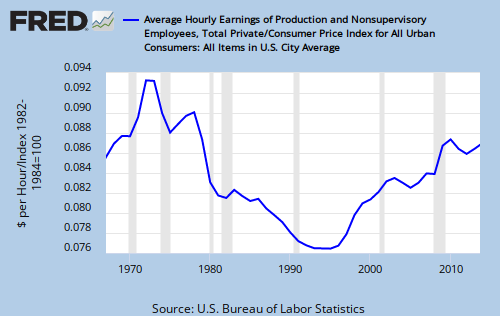
Inflation Adjusted Hourly Earnings of Production and Nonsupervisory Employees has not increased since 1967

Fear of a bloated safety-net program has prompted congressional Republicans to pursue deep cuts. Led by Republican Rep. Steve Southerland from the Florida Panhandle, the House wants to cut $39 billion over 10 years and set new eligibility standards that would remove 3.8 million recipients, including 400,000 Floridians.

As everyone knows, the poor are “takers.” They are lazy, good-for-nothing, shiftless, free-loading criminals, who would rather drink, take drugs, commit crimes and accept food stamps, than do honest work. (At least, that is the lie the rich-owned media want you to believe.)

And, as everyone know, it’s the hard-working taxpayers who must support all that free loading. (That is the lie the rich-owned politicians want you to believe. The truth: Taxpayers do not pay for federal spending.)

“This bill makes getting Americans back to work a priority again for our nation’s welfare programs,” House Speaker John A. Boehner said.

According to the Republicans, the way to “get Americans back to work,” is not to strengthen the economy, but to make joblessness even more punishing than it already is. All those millions of impoverished unemployed could find jobs if only they tried.

(Remember, the Sun Sentinel already has admitted, “There simply aren’t enough good-paying jobs to keep poor and low-income families from going hungry.” So how does cutting food stamps “get Americans back to work”?)

It’s never easy to reduce safety-net benefits, particularly one so tied to an essential commodity – food. Making sensible cuts is one thing. But gutting a program that helps vulnerable families and individuals survive in a weak economy hardly defines American exceptionalism.

According to the Sun Sentinel (aka Tribune), making these cuts is oh-so-difficult. Their hearts bleed for the starving children. So they just wish to make “sensible” cuts — just enough to keep the starving barely alive, not not so much as to kill them.

With unemployment still high and hunger persisting, a viable food-stamp program is still needed.

We urge our representatives to make surgical trims to the program, but block the proposed machete-style cuts that would hurt those Florida families and children who can least afford it.

“See, we’re on your side. We don’t want you to starve to death. We just want you to starve a little more than you already are starving. And remember, this is for your own good. It’s to convince you to get a job.”

“We just want to make small cuts, so that next year, and every year after, we can continue to complain about “yawning spending gaps” and “budget problems,” so that next year and every year after, we cruelly can make more and more “surgical” cuts.

It’s cruelty creep — the day-by-day, year-by-year slicing and shredding of the poor, all to widen the gap between the rich and the rest.

Is there no limit?

Rodger Malcolm Mitchell
Monetary Sovereignty

====================================================================================================================================================
Nine Steps to Prosperity:
1. Eliminate FICA (Click here)
2. Medicare — parts A, B & D plus long term nursing care — for everyone (Click here)
3. Send every American citizen an annual check for $5,000 or give every state $5,000 per capita (Click here)
4. Free education (including post-grad) for everyone. Click here
5. Salary for attending school (Click here)
6. Eliminate corporate taxes (Click here)
7. Increase the standard income tax deduction annually
8. Increase federal spending on the myriad initiatives that benefit America’s 99% (Click here)
9. Federal ownership of all banks (Click here)

—–

10 Steps to Economic Misery: (Click here:)
1. Maintain or increase the FICA tax..
2. Spread the myth Social Security, Medicare and the U.S. government are insolvent.
3. Cut federal employment in the military, post office, other federal agencies.
4. Broaden the income tax base so more lower income people will pay.
5. Cut financial assistance to the states.
6. Spread the myth federal taxes pay for federal spending.
7. Allow banks to trade for their own accounts; save them when their investments go sour.
8. Never prosecute any banker for criminal activity.
9. Nominate arch conservatives to the Supreme Court.
10. Reduce the federal deficit and debt

No nation can tax itself into prosperity, nor grow without money growth. Monetary Sovereignty: Cutting federal deficits to grow the economy is like applying leeches to cure anemia.
Two key equations in economics:
1. Federal Deficits – Net Imports = Net Private Savings
2. Gross Domestic Product = Federal Spending + Private Investment and Consumption – Net Imports

THE RECESSION CLOCK
Monetary Sovereignty Monetary Sovereignty

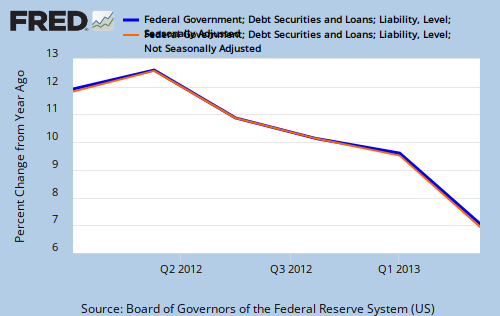
As the federal deficit growth lines drop, we approach recession, which will be cured only when the lines rise.

#MONETARY SOVEREIGNTY

–What thrilling things happen to federal deficits in the years preceding recessions?

Twitter: @rodgermitchell; Search #monetarysovereignty
Facebook: Rodger Malcolm Mitchell

Mitchell’s laws:
●The more federal budgets are cut and taxes increased, the weaker an economy becomes.
●Austerity is the government’s method for widening the gap between rich and poor,
which ultimately leads to civil disorder.
●Until the 99% understand the need for federal deficits, the upper 1% will rule.
To survive long term, a monetarily non-sovereign government must have a positive balance of payments.
●Those, who do not understand the differences between Monetary Sovereignty and monetary non-sovereignty, do not understand economics.
●The penalty for ignorance is slavery.
●Everything in economics devolves to motive.

======================================================================================================================================================================================
Two questions:

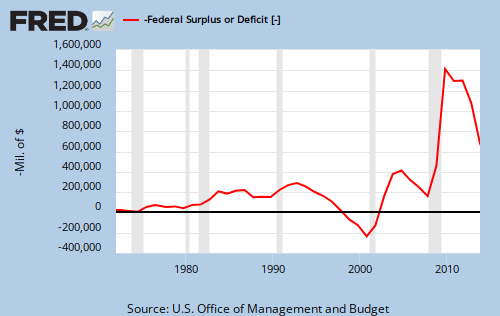
1. What happens to the federal deficit in the years preceding recessions?

2. What happens to the federal deficit during recoveries?

Monetary Sovereignty

————————–FYFSD is the federal deficit————————–

Inspect at the above graph, and consider your answers to those two questions as you read these excerpts from a Washington Times article:

Federal deficit below $1 trillion for first time in Obama’s tenure
By Stephen Dinan

Powered by tax increases and deep budget cuts that held spending in check, the federal deficit dropped to $680 billion in fiscal year 2013. Taxes grew to $2.774 trillion, marking an all-time high.

All those who think tax increases stimulate the economy, please raise your hands.

All those who think reduced federal spending stimulates the economy, please raise your hands.

The deficit is less than half the record $1.413 trillion figure Mr. Obama and President George W. Bush shared in fiscal year 2009.

That is still higher than economists say is healthy, but it’s far more manageable than at the height of the recession.

All those who can explain how deficits “at the height of the recession” were not manageable, please raise your hands.

All those, in classes taught by the above-mentioned economists, please tell me their names and contact info.

White House budget director Sylvia Mathews Burwell said the figures mean Mr. Obama has made good on his pledge to cut the deficit in half.

She said the credit belongs to Mr. Obama for fighting to raise taxes in the January “fiscal cliff” deal, and for drawing down troops in Afghanistan.

All those who wish to give Mr. Obama a nice, big pat on the back, for starving our economy of money, please raise your hands.

The 2013 deficit figure would have been worse if the government hadn’t borrowed nearly $40 billion from the Social Security trust funds.

The deficit also benefited from a $83.5 billion credit from federally backed housing programs Fannie Mae and Freddie Mac.

First translation: In government-speak, “worse” actually means “better,” as in, “If the government had not borrowed from the Social Security trust funds, $40 billion more dollars would have entered the U.S. economy. Somehow, this would have made the economy “worse.”

Second translation: “Deficit benefited” actually means “economy injured,” as in Fannie and Freddie pulled $83.5 billion out of the private sector, which injured the economy.

Now for a bit of irony: Fed Chairman Bernanke falsely claims the Fed stimulates the economy by purchasing $85 billion worth of T-securities each month. The world believes him, and panics when he threatens to stop.

(The claim is that this causes $85 billion new dollars to enter the economy every month.) If the claim were true (It isn’t), adding all those dollars would be quite stimulative.

But (here’s the irony), while bragging about how stimulative the Fed is, with its phony $85 billion supposedly entering the economy every month, the government also brags about more than a trillion dollars leaving the economy, via increased taxes and reduced federal spending.

The populace is thrilled about the Fed adding dollars to the economy, and equally thrilled about Obama taking dollars from the economy.

And no one, including those economists mentioned above, sees anything contradictory about this.

That’s why we’re so thrilled with reduced deficits. We hate deficits but we are O.K. with unemployment, poverty, recessions and depressions.

It’s what we’ve been taught.

Rodger Malcolm Mitchell
Monetary Sovereignty

====================================================================================================================================================
Nine Steps to Prosperity:
1. Eliminate FICA (Click here)
2. Medicare — parts A, B & D plus long term nursing care — for everyone (Click here)
3. Send every American citizen an annual check for $5,000 or give every state $5,000 per capita (Click here)
4. Free education (including post-grad) for everyone. Click here
5. Salary for attending school (Click here)
6. Eliminate corporate taxes (Click here)
7. Increase the standard income tax deduction annually
8. Increase federal spending on the myriad initiatives that benefit America’s 99% (Click here)
9. Federal ownership of all banks (Click here)

—–

10 Steps to Economic Misery: (Click here:)
1. Maintain or increase the FICA tax..
2. Spread the myth Social Security, Medicare and the U.S. government are insolvent.
3. Cut federal employment in the military, post office, other federal agencies.
4. Broaden the income tax base so more lower income people will pay.
5. Cut financial assistance to the states.
6. Spread the myth federal taxes pay for federal spending.
7. Allow banks to trade for their own accounts; save them when their investments go sour.
8. Never prosecute any banker for criminal activity.
9. Nominate arch conservatives to the Supreme Court.
10. Reduce the federal deficit and debt

No nation can tax itself into prosperity, nor grow without money growth. Monetary Sovereignty: Cutting federal deficits to grow the economy is like applying leeches to cure anemia.
Two key equations in economics:
1. Federal Deficits – Net Imports = Net Private Savings
2. Gross Domestic Product = Federal Spending + Private Investment and Consumption – Net Imports

THE RECESSION CLOCK
Monetary Sovereignty Monetary Sovereignty

As the federal deficit growth lines drop, we approach recession, which will be cured only when the lines rise.

#MONETARY SOVEREIGNTY