–Politics vs. people

Mitchell’s laws:
●Those, who do not understand the differences between Monetary Sovereignty and monetary non-sovereignty, do not understand economics.
●The more federal budgets are cut and taxes increased, the weaker an economy becomes. .
Liberals think the purpose of government is to protect the poor and powerless from the rich and powerful. Conservatives think the purpose of government is to protect the rich and powerful from the poor and powerless.
●The single most important problem in economics is
the gap between rich and poor.
●Austerity is the government’s method for widening
the gap between rich and poor.
●Until the 99% understand the need for federal deficits, the upper 1% will rule.
To survive long term, a monetarily non-sovereign government must have a positive balance of payments.
●Everything in economics devolves to motive,
and the motive is the Gap.

=========================================================================================================================================================================================================================

Today’s headline: “Fears grow as millions lose jobless benefits
Body copy: Senate Republican leader, Mitch McConnell of Kentucky, said: “The fastest-growing parts of this Democrat economy aren’t jobs — they’re the crushing burden of the national debt and the size of the federal government.

The “crushing burden” is not national debt, which crushes no one. The crushing burden is the false belief the national debt is a crushing burden.

As a result of this false belief, millions will lose jobless benefits, taxes will be increased, Medicare doctors will receive less than they should, Social Security payments will begin later, Medicaid payments will be cut, defense spending will be reduced, federal funding of K-12 education and school breakfast programs will be cut, mass transit funding will be cut and federal assistance to the states will be reduced — all because of a myth with no factual support.

So you, dear reader, will suffer a significantly degraded life style, all because the debt hawks say the federal debt is a crushing burden and the debt causes inflation, neither of which is supported by any data.

Go to any debt hawk web site and ask them for data proving the U.S. federal debt is unsustainable or causes inflation. If they answer you at all (unlikely), they merely will give you statistics regarding the size of the debt, but no evidence it has a negative effect on America.

Here are a couple debt hawk sites you can visit:
Concord Coalition
The Cato Insitute
The Heritage Foundation
The Manhattan Institute
The Hoover Institution

Go ahead. Contact any of them. Despite impressive doctoral credentials, and oodles of statistics, they have no evidence to back their claims. Why? No such evidence exists, though massive evidence shows the misnamed “debt” (should be called “net money created”) is necessary for economic growth.

Rodger Malcolm Mitchell
http://www.rodgermitchell.com

No nation can tax itself into prosperity
–A partial solution for the gap between rich and poor: Education

Mitchell’s laws:
●Those, who do not understand the differences between Monetary Sovereignty and monetary non-sovereignty, do not understand economics.
●The more federal budgets are cut and taxes increased, the weaker an economy becomes. .
Liberals think the purpose of government is to protect the poor and powerless from the rich and powerful. Conservatives think the purpose of government is to protect the rich and powerful from the poor and powerless.
●The single most important problem in economics is
the gap between rich and poor.
●Austerity is the government’s method for widening
the gap between rich and poor.
●Until the 99% understand the need for federal deficits, the upper 1% will rule.
To survive long term, a monetarily non-sovereign government must have a positive balance of payments.
●Everything in economics devolves to motive,
and the motive is the Gap.

=========================================================================================================================================================================================================================

The debt hawks are to economics as the creationists are to biology.
==========================================================================================================================
AFASDF
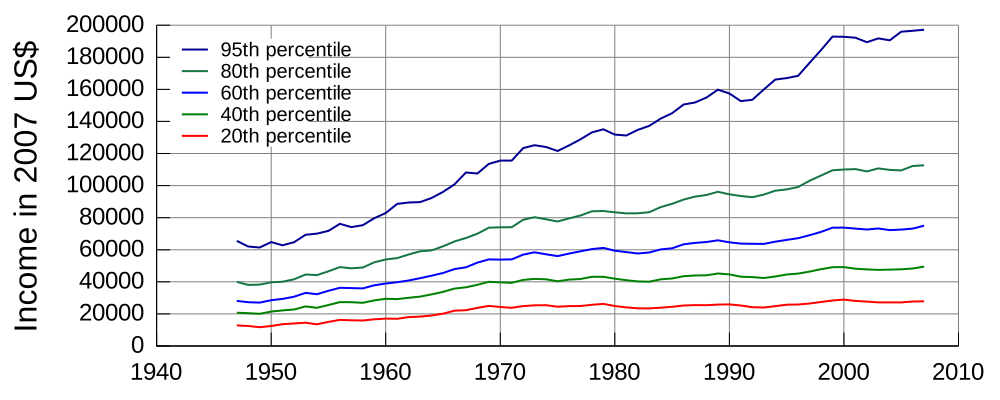
Graph of United States income distribution from 1947 through 2007 inclusive, normalized to 2007 dollars. The data source is “Table F-1. Income Limits for Each Fifth and Top 5 Percent of Families (All Races): 1947 to 2007”, U.S. Census Bureau, Current Population Survey, Annual Social and Economic Supplements.

In Closing the financial gap, I showed how direct money transfers don’t close the gap, and I asked, “Is closing the gap economically wise? That is, would our economy grow better, and would our population live better, happier, more rewarding lives overall, if there were little or no gap?

I believe attention paid to closing the gap, by bringing down the rich, is a diversion from the real economic and moral questions that surround poverty. Concern about the rich feeds on that commonly felt class jealousy to which politicians respond with counter-productive laws, which do nothing for the poor or for the economy.

Classic example: Inheritance taxes. They have little effect on tax collections, and to the degree they would affect tax collections, they also would reduce economic growth. And they do nothing to improve the lot of the poor. These, and all other attempts to reduce the gap, by punishing the rich, tend to hurt the economy and the people who most want the gap reduced.

Punishing the rich should not be the goal, but rather we should try to lift our poorest, regardless of whether or not that closes or even opens the gap. In the previous post I suggested that just as government pays for elementary school, middle school and high school, why not have the government pay for college and even advanced degrees? This would give the poor a better opportunity to lift themselves.

One reader expressed concern this actually could have an adverse effect on the economy: “The world still needs ditch diggers,” he wrote.

My response: “The world does not need ditch diggers. The world needs ditches to be dug. Slowly, inexorably, society is moving away from dumb human labor and toward smart machine labor. Those people who do not have an education will not just be relegated to the lowest jobs. They will have no jobs at all. There simply will be no ditch-digging work available.”

While I agree with Modern Monetary Theory (MMT) in many ways, one of my disagreements is its dual goal of price stability and full employment. MMT calls for the government to be the employer of last resort, so that everyone who wants a job, has a job. But MMT ignores job quality in its quasi-charity approach. Giving jobs to everyone surely would devolve to giving money to everyone for little or no work at all.

While unemployment seems to correspond with recessionary times, I see no evidence that unemployment causes recessionary times. Some might even say that unemployment helps stimulate the prevention and cure of recessions just as hunger feelings help stimulate the prevention and cure of starvation. In fact, that is the very purpose of hunger feelings.

In short, unemployment may be only a symptom, just as hunger is a symptom of starvation. Curing the hunger symptom does not cure the starvation disease, as any anorexic should know. Focusing on the symptom may divert attention from the fundamental problem, which is acquisition ability (AA)– people’s ability to acquire what they want.

MMT may claim full employment is not a symptom, but rather a path toward the AA goal. MMT wants the government to achieve full employment by providing a job to anyone who wants one, and apparently the job can be anything. But I suspect a nation of Walmart greeters is not desirable.

So what about a nation of college grads? Is that better? Despite the typical “Who-will-dig-the-ditches?” questions, the answer may be, “Yes.”

A college grad, digging ditches, may be more likely to think of better ditch-digging methods, to the benefit of society. This is an extreme example, and I’ve left the psychology of job satisfaction out of the mix, but I speculate that education will lift the economy, meaning MMT’s focus on jobs is fundamentally wrong.

Rather than the government being the employer of last resort, perhaps the government should be the educator of first resort. That might do more to lift the poor and lift America, than giving people low level, dead-end jobs.

In summary, the problem is not specifically the gap, but poverty. The partial solution is not low end jobs, but education.

Rodger Malcolm Mitchell
http://www.rodgermitchell.com

No nation can tax itself into prosperity

–Why the slow recovery?

The debt hawks are to economics as the creationists are to biology.

Recessions and recoveries ultimately are associated with money, and more specifically with money growth. In general, less money growth = less economic growth. (That actually is something of a tautology, since economic growth is measured in money.)

There are several definitions of money, most differing on the basis of liquidity, the ease of converting to currency. The most liquid form is called M1, which consists of currency and checking account deposits.

The government no longer measures the less liquid forms, M3, L and the most inclusive form: Debt of Domestic Non-Financial Sectors. And for many reasons, the supplies of the various money forms do not move together. For instance, there are periods when M1 goes up or down more than M2, even though M1 is part of M2.

I found an interesting pattern relative to recessions. In the following graph, you see a strong tendency for one form of money, Federal Debt Held by the Public, to grow more slowly before recessions, then grow quickly during recessions, then resume growing more slowly after recessions.

M1 exhibits a similar, though less consistent pattern, and M2 is less consistent yet. One consistency is: Following every recession, at least one of the money forms grows at an increasing rate — every recession except the most recent one:

Here, despite (or because of) worries about deficits, every measured form of money has shown a sharp decline in growth rate. Perhaps this overall decline in money growth is responsible for the slowness of the recovery — yet another bit of evidence that debt fear has hurt our economy, and increased federal spending is desperately needed.

Rodger Malcolm Mitchell
http://www.rodgermitchell.com

No nation can tax itself into prosperity

–How President Obama’s National bipartisan Commission on Fiscal Responsibility and Reform could destroy America

The debt hawks are to economics as the creationists are to biology.

Parade Magazine, in its 7/4/10 “Intelligence Report”, printed an interview by Steven Beschloss and Janet Kinosian titled, “Can These Men Fix the Deficit?” The men are Erskine Bowles, a former White House chief of staff, and Alan Simpson, a former Republican Senate whip. Today, Messrs. Bowles and Simpson are co-chairs of President Obama’s National bipartisan Commission on Fiscal Responsibility and Reform.

Here, with my comments, are what they said:

BOWLES: “If we don’t solve the (federal) debt problem, we will be paying $1 trillion in interest in 2020. That’s money we can’t spend on Social Security, Medicare, education, infrastructure or innovation to make sure America is competitive in a global economy.”

RMM: “Of course, he’s dead wrong. America is a monetarily sovereign nation. Future spending is restricted neither by past spending, by debt, by deficits nor by tax collections. That $1 trillion in interest will function as an economic stimulus. This is classic cognitive inconsistency. Mr. Bowles believes the government cannot do what he sees with his own eyes, the government actually doing, i.e spending trillions on stimulus plans, despite debt that has grown more than 1,500% in only 30 years. In addition to cognitive inconsistency, he suffers from anthropomorphic economic disease – the mistaken belief that the government’s finances are like yours and mine.

BOWLES: “We’re looking at how we can reduce discretionary spending – things like education, transportation, the military, homeland security – and mandatory spending which includes Social Security, Medicare and Medicaid. We also need to raise revenue.”

RMM: He believes that cutting back on education, transportation, the military, homeland security, Social Security, Medicare and Medicaid, while raising taxes, will “make sure America is competitive in a global economy.” The notion would be laughable if it weren’t so dangerous.

SIMPSON: “We’re not going to cut Social Security – we’re going to stabilize it. None of the ideas that have been presented will affect anyone over the age of 58.”

RMM: “Stabilize” is political double talk for, “We are going to cut Social Security for everyone 58 and younger.”

SIMPSON: “As it is, it (Social Security) can’t sustain itself.”

RMM: Ah, the old (and false) “unsustainable” claim.

BOWLES: “We’re going to work our hearts out succeed.”

RMM: In their world, “Fiscal Responsibility and Reform” are code words for austerity, which always causes recessions and depressions. Heaven help us from those who have power, yet cannot learn.

Rodger Malcolm Mitchell
http://www.rodgermitchell.com

No nation can tax itself into prosperity