–Why bank lending leads to recessions. A counter-intuitive finding.

Those, who do not understand the differences between Monetary Sovereignty and monetary non-sovereignty, do not understand economics.
================================================================================================================================================================================================================
Thirteen months ago, I published a post titled, “Is federal money better than other money.” I believed it was one of the more interesting posts in this long series, because it showed that while reduced federal debt growth led to recessions, increased non-federal debt growth also led to recessions.

At the time, the data stopped at February, 2002. I now have brought the data forward, and am republishing. These new data support the previous findings.

In other posts on this blog, we have discussed how reductions in federal debt growth, as shown by the following graph, “Federal Debt Held By Private Investors,” immediately precede recessions. This comes as no surprise, since a growing economy requires a growing supply of money, and deficit spending is the federal government’s method for adding money to the economy.
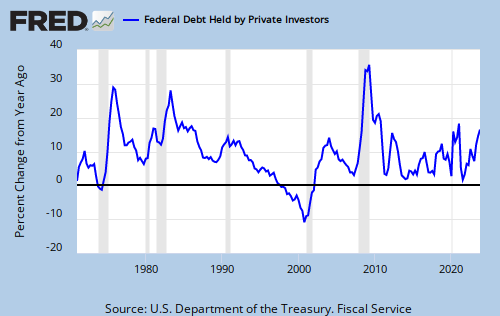
Federal debt

Clearly, federal debt/money growth is essential to keep us out of recessions. Yet, when we look at “Debt Outstanding Domestic Nonfinancial Sectors” which includes not only Federal debt, but also outstanding credit market debt of state and local governments, and private nonfinancial sectors (tan line), we do not see the same pattern.

In fact, when we subtract federal debt from total debt, leaving only state, local and private debt, we see the opposite pattern. Recessions follow increases in state, local and private debt!

4
STATE, LOCAL AND PRIVATE DEBT, PERCENT CHANGE FROM YEAR AGO

Now in one sense, money is money. Your buying on your credit card creates debt/money, just as federal deficit spending creates debt/money. Presumably, both should have the same stimulative effect on the economy. They do, but not long term. Why?

Because, unlike the federal government, you, your business and local governments cannot create new money endlessly to service your debts. Your debts can pile up to the point where you must liquidate them by paying them off or by going bankrupt. When non-federal debts become too large, a growing number of people, states, cities and businesses must pull back and stop further borrowing, i.e. stop creating money, or even destroy money by paying off loans. When that happens, we have a recession.

(As an aside, this is one reason the early stimulus efforts had so little effect. People used the stimulus money to pay off loans, so while the federal deficit spending created money, the loan pay-downs destroyed it. Debt reduction destroys debt/money.)

During the recession, and for a short time after, we tend to cut back on our personal borrowing and liquidate debt/money. Then we begin to resume borrowing, more and more, until again, we hit our personal limits and cut back, causing yet another recession. The sole prevention of this cycle, which averages about 5 years in length, is to make sure that federal deficit spending grows sufficiently to offset periodic money destruction by the private sector.

In summary, federal deficit spending is good for the economy, always good, endlessly good (up to the point of inflation). Private and local government spending/borrowing also is good, but not endlessly. Unlike the federal government, the private and local-government sectors eventually reach a point where debt is unaffordable and unsustainable.

To prevent recessions, the government continuously must provide stimulus spending, then provide added stimulus spending to offset the periodic reduction of money creation by the private sector.
__________________________________________________________________________________________________________________________
These data call into question the popular belief that encouraging bank lending stimulates the economy. While short-term effects may be positive, long-term bank lending seems to lead to recessions, as servicing loans becomes ever more onerous for the monetarily non-sovereign sectors. In contrast, Federal deficit spending easily is serviced by the government, and therefore is preferable to private borrowing as a stimulus.
__________________________________________________________________________________________________________________________
Rodger Malcolm Mitchell
http://www.rodgermitchell.com


==========================================================================================================================================
No nation can tax itself into prosperity, nor grow without money growth. Monetary Sovereignty says: Cutting federal deficits to grow the economy is like applying leeches to cure anemia.

MONETARY SOVEREIGNTY

–Obama joins the Tea Party

Those, who do not understand the differences between Monetary Sovereignty and monetary non-sovereignty, do not understand economics.
============================================================================================================================================================================

In a previous post I asked whether President Obama was a Coward, fool or traitor to America. We now have our answer.

This article by Lori Montgomery, ran in the 7/7/2011 Washington Post: Obama offers Social Security cuts. A few quotes:

President Obama is pressing congressional leaders to consider a far-reaching debt-reduction plan that would force Democrats to accept major changes to Social Security and Medicare in exchange for Republican support for fresh tax revenue.

Not only does he wish to raise taxes, an anti-stimulus move, but he is ready to cut Social Security benefits — anti-stimulus and anti-working class.

At a meeting with top House and Senate leaders set for Thursday morning, Obama plans to argue that a rare consensus has emerged about the size and scope of the nation’s budget problems and that policymakers should seize the moment to take dramatic action.

It is the same rare consensus that said the world is flat, the earth is the center of the universe and the gods live on Mount Olympus — in short, a consensus of fools.

As part of his pitch, Obama is proposing significant reductions in Medicare spending and for the first time is offering to tackle the rising cost of Social Security, according to people in both parties with knowledge of the proposal.

In joining the Tea Party, Obama shows himself to be all three: Coward, fool and traitor to America. The battle is over, folks. Take down your flag and go home. Your leader has surrendered to buy some votes, and America will pay the price.

Rodger Malcolm Mitchell
http://www.rodgermitchell.com


==========================================================================================================================================
No nation can tax itself into prosperity, nor grow without money growth. It’s been 40 years since the U.S. became Monetary Sovereign, , and neither Congress, nor the President, nor the Fed, nor the vast majority of economists and economics bloggers, nor the preponderance of the media, nor the most famous educational institutions, nor the Nobel committee, nor the International Monetary Fund have yet acquired even the slightest notion of what that means.

Remember that the next time you’re tempted to ask a teenager, “What were you thinking?” He’s liable to respond, “Pretty much what your generation was thinking when it ruined my future.”

MONETARY SOVEREIGNTY

–Senator Kirk, a member of the Tea (formerly “Republican”) Party, displays massive ignorance.

The debt hawks are to economics as the creationists are to biology. Those, who do not understand Monetary Sovereignty, do not understand economics. If you understand the following, simple statement, you are ahead of most economists, politicians and media writers in America: Our government, being Monetarily Sovereign, has the unlimited ability to create the dollars to pay its bills.
==============================================================================================================================================================================================

Several days ago, I wrote to my Senator Mark Kirk, telling him the federal deficit and debt are not too high, and that a Monetarily Sovereign nation needs to run deficits in order to grow. This is the incredible response I received:

Dear Mr. Mitchell:

Thank you for contacting me regarding cutting spending and funding the federal government for the remainder of the year. I am greatly concerned about our national debt and believe that Congress needs to change course from spending money that we do not have. We will need shared sacrifice across government as we work to balance the budget and pay down debt.

So neither he nor his minions even bother to read letters. I didn’t contact him regarding “cutting spending and funding,” but rather not cutting spending and funding. And as far as “money we don’t have,” the federal government is Monetarily Sovereign. It has the ability to create unlimited money. Relative to Monetary Sovereignty, “money we don’t have” is nonsensical.

In recent years, our country has witnessed massive spending increases and budget deficits. This has led to an unprecedented amount of borrowing by the federal government. Since 2008, the national debt has increased by more than $4 trillion and currently stands at $14.2 trillion. We are borrowing $4 billion every day and this year we will pay $225 billion in interest on our debt.

If he understood Monetary Sovereignty, he would know federal borrowing is not like personal borrowing. The federal government doesn’t even need to borrow, and could pay off all its debts, tomorrow.

It is in this environment that Congress continues to consider funding for the federal government for the remainder of the year. To put our nation on a path of fiscal responsibility, Republicans and Democrats need to work together to pass a budget that includes serious anti-spending reforms that would make any future additions to our debt increasingly impossible.

In short, to assure a depression.

I have proposed 15 anti-spending reforms, which include a cap on spending, presidential line-item veto, federal hiring and pay freeze and permanent end to earmarks. I am also an original cosponsor of a Balanced Budget Amendment to the United States Constitution that would require Congress to pass balanced budgets and prohibit deficit spending or tax increases. Additionally, I have voluntarily reduced my Senate office budget by 15% to show that even Congress isn’t exempt from cutting back and living within its means.

Mathematically, a balanced budget assures a depression. See: Balanced Budget Idiocy

To ensure that future generations aren’t burdened with debt, we will need shared sacrifice across government and no one program should be singled out. Rest assured, I will continue to keep your thoughts in mind as I work to balance the budget and pay down debt.

Future generations will not pay federal debt. Taxpayers don’t pay for any federal spending. The federal government could eliminate all debt tomorrow, simply by crediting the bank account of T-security holders. The press of a computer button should do it.

Again, thank you for taking the time to contact me. To stay informed on important issues, I encourage you to visit my website at http://kirk.senate.gov and my Facebook page at http://www.facebook.com/SenatorKirk.

Yes, visit his site, and tell him how wrong he is. He really is frightening. He has no understanding of economics, yet proposes and votes on economics laws that will affect us all. Repeatedly, I have offered to teach him, but he isn’t interested. It’s Congressional hubris. I’m sorry to say I voted for this guy, but I won’t make that mistake again.

Rodger Malcolm Mitchell
http://www.rodgermitchell.com

No nation can tax itself into prosperity, nor grow without money growth.

MONETARY SOVEREIGNTY

–The G7’s backwards thinking about the Japanese yen. Save Japan from its friends.

The debt hawks are to economics as the creationists are to biology. Those, who do not understand Monetary Sovereignty, do not understand economics. If you understand the following, simple statement, you are ahead of most economists, politicians and media writers in America: Our government, being Monetarily Sovereign, has the unlimited ability to create the dollars to pay its bills.
========================================================================================================================================================================================================

Once again, the mainstream economists have things backwards. I recently came across this article:

Is G7 yen intervention a good idea? by MICHAEL SCHUMAN, 3/18/2011
In a highly unusual step, the G7 agreed on Friday morning to coordinate their efforts to control the sharp rise in the Japanese yen. The decision today was prompted by a sudden surge of strength by the yen that by Thursday morning (in Tokyo) had pushed the Japanese currency to a record high against the U.S. dollar. Though the yen had subsequently pulled back a bit, it was still at a level worrying to Japanese policymakers. Japan freaks out when the yen strengthens, because it makes Japanese exports more expensive in international markets and thus can dampen economic growth.

Last week, I posted about why charitable contributions to Japan were meaningless. Now, the economists want to facilitate Japanese exports. Before you read any further, stop and think about this question: What is the purpose of Japanese exporting? The answer is not what you may have been told.

The purpose of Japanese exporting is to import yen. Japan doesn’t want to expend massive amounts of time, energy, labor an raw materials just so they can supply us with cars, computers and television sets. The Japanese are a nice people, but they’re not that generous. No, the sole purpose of expending time, energy, labor and raw materials is to acquire yen.

But, Japan is Monetarily Sovereign. It has the unlimited ability to create its sovereign currency, the yen. Even were Japan’s exports to fall to zero, the Japanese government could create sufficient yen to support its economic growth. Japan has no need to import yen (i.e. export goods and services).

The G7 (soon to be overtaken by the E7, but that’s another story) is using an obsolete gold-standard philosophy in a post-gold-standard world. Today, Monetarily Sovereign nations do not need to import their sovereign currencies. Stimulating Japan’s yen imports is like stimulating rain over the ocean.

And in any event, Japan soon will create and spend trillions of yen to rebuild its nation. That massive influx of yen will weaken the yen, and the G7 can breathe a sigh of relief. It also will engage in an orgy of back patting, for accomplishing something not only unnecessary, but something that would have happened naturally.

But what can you expect from a group that still has no concept of Monetary Sovereignty, perhaps partly because three of the “7” (France, Germany, Italy) were foolish enough to surrender their own Monetary Sovereignty.

Rodger Malcolm Mitchell
http://www.rodgermitchell.com

No nation can tax itself into prosperity, nor grow without money growth.

MONETARY SOVEREIGNTY