–GM pays and the innocent cattle “moo.”

An alternative to popular faith

The latest headlines trumpeted, “GM repays loans of $8.1 billion, and it happened ahead of schedule.” Innocent taxpayers cheered this wonderful news. Earlier headlines told how GM went bankrupt, thereby cheating creditors out of more than $20 billion, and then too, innocent taxpayers cheered. Finally, the U.S. government paid $50 billion for 60% of GM, which the government hopes to sell at a profit, and when it does, innocent taxpayers will cheer once again.

So everything is wonderful, right? Actually, those three pieces of news were terrible for America, and thus, terrible for taxpayers.

When GM went bankrupt, and creditors lost more than $20 billion, this represented more than $20 billion that disappeared from the economy. If putting money into the economy is a stimulus, this was an anti-stimulus. Those creditors were real people and real companies. Millions of people were affected.

I myself owned a few of those GM bonds that lost about 70% of their value. That’s money my fellow creditors and I won’t be able to spend on goods and services, nor will we invest that money in economic growth. It’s gone. Disappeared. Poof!

No need to get into the question of why the government chose to lend GM money rather than to make good on GM’s obligations to real people and real companies. It’s probably a combination of politics and economic ignorance.

Then, when GM repaid the government, another $8.1 billion disappeared from the economy – another anti-stimulus. That’s $8.1 billion that GM will not use for employee salaries or for the purchase of goods and services from its thousands of suppliers. That money, too, is gone. Disappeared. Poof!

And lest you believe it went to taxpayers, it did no such thing. It will not put one cent into any taxpayer’s pocket, nor will it reduce federal taxes by even one cent. It simply has disappeared as a credit on a federal balance sheet, never to be seen, again.

Finally, when the government sells its GM stock, all the money it receives will disappear into that same balance sheet. No taxpayer will receive any, and no federal taxes will be reduced. The money simply will be gone. Another anti-stimulus. And if GM makes a profit on its sale of stock, the anti-stimulus will be even greater. Poof!

And the taxpayers will cheer.

I wonder, when you hear the cattle “moo,” while waiting in line to be cut into steaks, is that mooing the way innocent cattle cheer?

Rodger Malcolm Mitchell
http://www.rodgermitchell.com

–The old “taxpayers’ money” fib


An alternative to popular faith

4/12/10: “WASHINGTON (AFP) – The US Treasury Department said Monday it would place its remaining holdings in Wells Fargo and five other bailed-out banks on the auction block over the next six weeks. […] ‘The proceeds of these sales will provide an additional return to the American taxpayer from Treasury’s investments in these banks beyond the dividend payments it received on the related preferred stock,’ said the department headed by Secretary Timothy Geithner.

If someone repeats a lie often enough, they even begin to believe it themselves. You, dear reader, are a taxpayer, and you will not see one cent of that money. It will not lower your taxes. Nor will it lower your children’s taxes. Nor will it enable the federal government to spend more on other projects. Nor will it have any positive effect on you or the nation, whatsoever.

In fact, that auction will cost you money, because whatever money the federal government receives from the private sector is a de facto tax, and taxes do not add to taxpayers’ money. When those millions (billions?) come out of private hands, they will disappear as notations into federal balance sheets, reducing the total money supply, and inhibiting by some degree, economic growth.

Less growth means less money in your pocket. (Remember, this is the same government that added money to stimulate the economy.)

Any time you hear a government official or media hack say that money is going “to taxpayers,” realize this: It’s a great, big, fat lie, and it’s going to cost you.

Wait! I wonder whether Geithner isn’t lying, but really believes that “taxpayers’ money” nonsense.

Rodger Malcolm Mitchell
http://www.rodgermitchell.com

–Federal deficit spending doesn’t cause inflation; oil does

An alternative to popular faith

Ask a debt hawk why he hates federal deficits and he will give you four main reasons:

1. Federal debt must be paid back by taxpayers. (But, because the federal government has the unlimited power to create the money to pay its bills, taxpayers do not fund federal spending.)

2. Federal debt adds to the government’s interest-paying burden. (Again, interest is no burden to a entity having the unlimited ability to create money.)

3. Federal debt uses up lending funds that otherwise would go to private needs. (But, federal spending adds money to the economy, making more, not less, funds available for private lending.)

4. By increasing the money supply, federal deficits reduce the value of money, thereby causing inflation. Readers of this blog have seen the graph (below) which shows no relationship between federal deficits — even large federal deficits — and inflation.

Note how the peaks and valleys of deficit growth do not match the peaks and valleys of inflation growth:

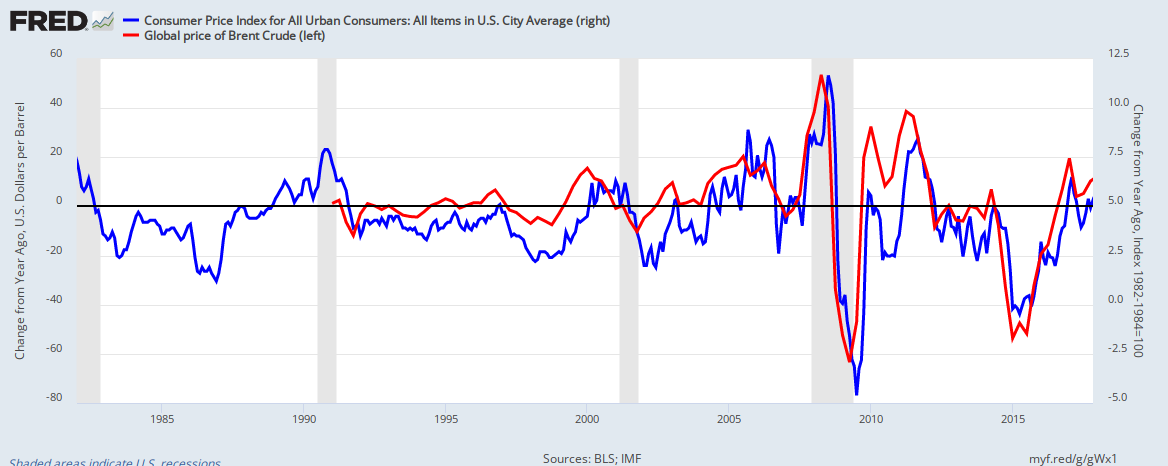
If deficits don’t cause inflation, what does? In a previous post “Is inflation too much money chasing too few goods”, we answered that question (“No.”), and we presented a graph indicating the real cause of inflation may be energy prices, more specifically, oil prices. See below:

The extreme movements of energy prices corresponding with the more modest movement of overall inflation, seem to indicate that energy costs “pull” inflation in either direction.

We can see this parallelism better by magnifing the CPI movement with a different vertical axis:

Monetary Sovereignty

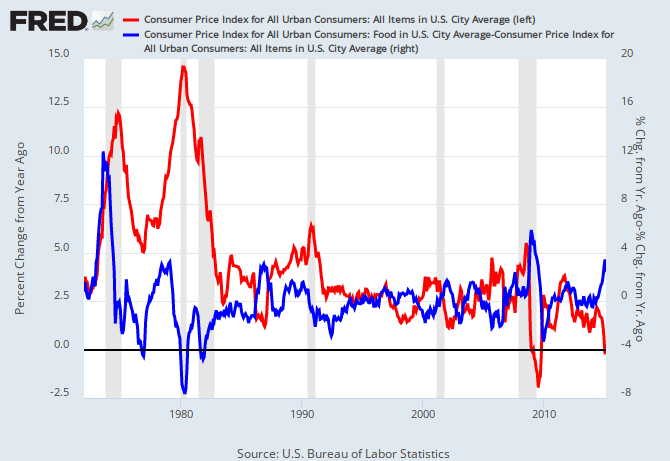
Now here is another graph that may substantiate the hypothesis that energy prices pull CPI:

monetary sovereignty

It compares inflation movements (red line) with the movement of energy prices less the movement of inflation (blue line). Notice how closely the two lines correspond.

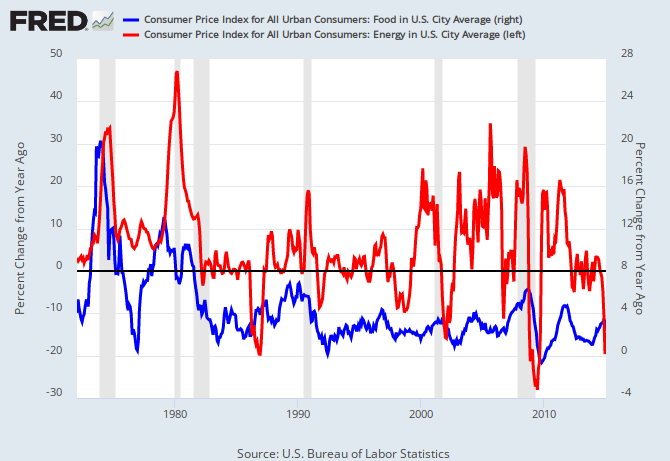
Compare that graph with the graph below. This graph is the same as the one above, except rather than comparing energy price changes with inflation, it compares food price changes. See how there is much less correlation.

monetary sovereignty

Food price changes do not seem to be the key inflation-causing factor. In fact, energy price changes seem to cause food price changes:

monetary sovereignty

Inflations are not caused by too much money. Inflations are caused by shortages.

Energy, and more specifically oil is, aside from food and water, the one universal need. It is the only commodity, the shortage of which, affects the prices of all other goods and services.

Rodger Malcolm Mitchell
http://www.rodgermitchell.com

No nation can tax itself into prosperity. Those who say the stimulus “didn’t work” remind me of the guy whose house is on fire. A neighbor runs with a garden hose and starts spraying, but the fire continues. The neighbor wants to call the fire department, which would bring the big hoses, but the guy says, “Don’t call. As you can see, water doesn’t put out fires.”

–Cuts to Medicare vs deficit spending

An alternative to popular faith

I just received a note from Mark Kirk, Republican Congressman, listing the cuts to be made in Medicare. I don’t know how factual they all are, because frankly the new program not only is complex, but evolving.

In any event, this is what the Republicans (and Democrats) should work on, rather than the “repeal and replace” political effort that has no chance to succeed. Forget the McCain, “There will be no cooperation for the rest of the year” attitude. Focus on correcting the negatives rather than throwing out the baby with the bathwater.

By the way, every one of these cuts could be eliminated if wrongheaded, deficit paranoia were eliminated. The federal government can and should pay, via deficit spending, to eliminate all these cuts. Consideration of real damages to real people should take precedence over imaginary, unproven damage from federal deficits

Here is what Rep. Kirk wrote:

2010: Medicare Cuts to Hospitals: The federal government will reduce Medicare reimbursements for hospitals who provide seniors with long-term and inpatient and rehabilitation care.

2011:Medicare Advantage Cuts Begin: Approximately 121,000 Illinois seniors will be dropped from their chosen Medicare Advantage coverage. Drug Discounts for those in Medicare Part D “donut hole” begin: The federal government will impose a new requirement on pharmaceutical companies to provide a 50% discount on “brand name” prescriptions. Increased Medicare Part D Premiums: Seniors with incomes above $85,000 for individuals and $170,000 for couples will be forced to pay higher Medicare Part D premiums. Medicare Imaging Cuts: The federal government will cut Medicare reimbursements for seniors who use MRI and CT scans. Medicare Cuts to Ambulance Services and Durable Medical Equipment: The federal government will begin cutting Medicare reimbursements for seniors who use ambulances or durable medical equipment.

2012: Medicare Cuts for Hospitals with Readmissions: The federal government will cut Medicare reimbursements to any hospital with a high readmission rate. Medicare Cuts for Hospice Care: The federal government will cut Medicare reimbursements for seniors on hospice care. Medicare Cuts for Dialysis Care: The federal government will cut Medicare reimbursements for Americans – both youth and seniors – on dialysis.

2014: Medicare Board Cuts: The federal government will establish an Independent Payment Advisory Board with powers to make further cuts to seniors on Medicare.

2015: Medicare Home Health Cuts: The federal government will cut Medicare reimbursements for seniors who depend on home health care.

I’d be interested in hearing from those of you who think reducing federal deficits is more important than eliminating these cuts, together with your evidence that deficits are harmful in any way.

Rodger Malcolm Mitchell
http://www.rodgermitchell.com