–Less debt . . . oh, wait. More debt.

An alternative to popular faith

The 6/30/10 editorial in the Chicago Tribune, titled, “Enough debt, already,” had me confused. At first I thought they meant private debt. After all, consumers now deal with mortgages they can’t handle and credit cards charging 20% or more interest. And business profits, or lack thereof, won’t support much more debt without increased consumer buying. Consumers and businesses are going bankrupt in droves, so at this stage of the recession, “Enough debt, already” seems like good advice for the private sector.

But no, that is not what the Tribune meant. They wanted less federal debt and more private debt. The federal government has the unlimited ability to pay any debt of any size. It is a government that neither needs nor uses tax money to pay its debts. Yet the editors say, “. . . the U.S. has gone way, way down the path toward unsustainable debt . . .”

Will the government be unable to service its debts? No, that cannot happen. So, what makes federal debt “unsustainable”? The Tribune editors never say. However they call for more lending to business, despite the fact that growing business debt can be unsustainable. To make matters worse, the Tribune cheers the restriction on unemployment checks to those people who would have used those checks to buy things from businesses, thereby stimulating business. (“Unemployment checks extending up to 99 weeks instead of the usual 26 add more indebtedness.”)

The editors correctly say, “The U.S. economy is hungry for credit,” not realizing this means the U.S. economy is hungry for money, and federal deficit spending is the government’s method for adding money to the economy. The editors lament, “Washington already has bequeathed to our descendants a nation debt of $13 trillion,” – an untrue statement – and simultaneously wants to bequeath to our descendants added business debt. (Who do they think pays for business debt?)

To summarize: The Tribune editors oppose debt creation by the one entity that can afford unlimited debt service, but advocate more debt for the over-extended private sector. They support looser lending standards, so that less qualified businesses can go deeper into debt. They oppose increasing regulations on lenders, the same lenders whose unsupervised, profligate lending triggered the recession. They favor the end to federal stimulus plans, which would add the money they say the economy needs. And they hope the economy will recover — somehow.

Clearly, economics is not the Tribune editors’ forte.

Rodger Malcolm Mitchell
http://www.rodgermitchell.com

No nation can tax itself into prosperity
–I’m angry with the Chicago Tribune

An alternative to popular faith

I live in Chicago, and I’m angry with the Chicago Tribune. It continues to be clueless about economics. In a June 15th editorial, the Tribune said, “With 79 percent of Americans rating (the federal debt) ‘extremely serious’ or ‘very serious,” it tied with terrorism for the top (‘scariest threat’). So what does the Obama administration plan to do about it? It proposes to pile on more debt. . . . Americans have good reason to be so worried about the . . . that someone will have to repay.”

Does the term “exploding national debt” sound familiar. If you go back and read TICKING TIME BOMB , MORE BOMB NONSENSE and DEBT BOMB REDUX you will see that the Tribune and its media friends have been referring to the federal debt in explosive terms for the past seventy years! Think about it. For seventy years the media has told you a debt bomb is been ready to explode, and today we are no closer to any of those dire forecasts than we were in 1940.

Does daily failure of prediction stop the Tribune? Nope. Tribune readers keep following their prophet up the mountain to await the end of the world. When the world fails to end, do they ever begin to question their leader? No, they march back down, and sit mesmerized as their prophet repeats the same old predictions – for more than seventy, long years.

Here is what outrages the Chicago Tribune today: “$50 billion in emergency spending to help state and local governments . . . avert massive layoffs of teachers, police and firefighters . . . Block a 21 percent scheduled cut in reimbursements to doctors who treat Medicare patients.

Yes, helping avert layoffs of teachers, police, firefighters and doctors truly is awful, especially when compared with the unsupported, unproven, patently wrong “risk” of a federal debt that in the Tribune’s misguided words, “someone will have to repay.”

If you read some of the posts on this blog, starting with SUMMARY you will see there is no “someone” who has to pay. Taxpayers neither owe nor service the federal debt. There is no relationship between federal income and federal spending. The so-called “debt” merely is a balance sheet calculation of net money created by the federal government, a calculation that neither inhibits, nor is inhibited by, federal spending.

A curse be upon the person who first labeled this balance sheet column “debt” rather than the correct, “net money created.” Incorrectly calling it “debt” has misled millions of otherwise intelligent people, and worse, has prevented important programs (See: CHILDREN & GRANDCHILDREN) of benefit to us all.

I’m angry with the Tribune, not because they are clueless. Each of us is clueless about many things. I’m angry with them because they have such power to make a positive difference in our economy, but instead they are too intellectually lazy to learn, preferring to parrot the popular myths of the day. What a waste.

Rodger Malcolm Mitchell
http://www.rodgermitchell.com

No nation can tax itself into prosperity

–Anthropomorphic economics disease

An alternative to popular faith

Fundamental to debt hawk beliefs is the idea that monetarily sovereign nations are like you and me. Thus, debt hawks practice “anthropomorphic economics.”

A monetarily sovereign nation is the monopoly supplier of its currency, which currency is not tied to any asset (like gold) or to a foreign currency. A monetarily sovereign nation has the unlimited ability, and the monopoly power, to create its currency.

The U.S., Canada, Australia, China and India are monetarily sovereign. The EU nations are not. That is why so many of the comparisons between Greece and the U.S. are false.

Specifically, here are a few of the assumptions debt hawks have about the U.S. — assumptions that might be correct for individuals, but not for the U.S.

1. The U.S. government must borrow or tax in order to spend.
You and I must obtain money, either by borrowing or by income, before we spend. The reverse is true for the U.S. government. U.S. spending creates money. So-called federal “borrowing” is not like personal borrowing. The U.S. creates T-securities from thin air, then exchanges them for dollars it previously created from thin air. Then it destroys the dollars. When the government repays its ‘debt,” the situation is reversed. It creates dollars, which are exchanged for T-securities, and the T-securities are destroyed. The whole process became obsolete in 1971.

2. Servicing the federal debt is a burden on the U.S.
Because the U.S. pays all its bills by creating money ad hoc, paying its debts never is a burden. Unlike you and me, the government simply credits the bank accounts of its creditors and debits its own balance sheet, which it can do endlessly. The “debt” carried on the government balance sheet is an accounting of the T-securities created by the government. Rather than “debt,” this balance sheet entry should be called “T-securities open.”

3. Federal debt is a burden on future taxpayers
Unlike you and me, the government does neither needs nor uses income in order to spend. There is no relationship between federal taxes and spending. Even were taxes dropped to zero or raised to $100 trillion, neither event would affect the federal government’s ability to spend by one penny. In fact, tax money is destroyed upon receipt, as a credit in a government balance sheet. The government does not spend tax money.

4. Federal surpluses are more prudent than deficits
For you and me, net income is more prudent than net outgo. Not so for the U.S. government. Federal taxes destroy money; federal spending creates money. To grow, an economy must have a growing supply of money. Federal spending is the most reliable, controllable source of money. Federal surpluses are imprudent, because by destroying money, they create recessions and depressions.

5. If U.S. debt is “too big,” nations will refuse to lend to us.
A credit rating is based on the past and future ability and willingness to service debt. You and I need a good credit rating in order to borrow. But, the federal debt has grown 1500% in only 30 years, and no nation has refused to buy our T-securities (not that it would matter, because we no longer need to sell T-securities).

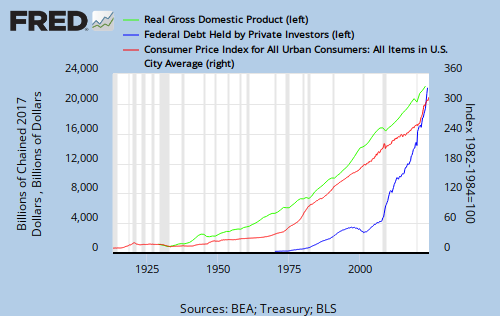
Debt hawks have made the intuitive argument that federal debt is like personal debt – anthropomorphic economics – but are unable to supply data to substantiate their intuition. One person told me the proof is that costs have risen (inflation) and the federal debt also has risen, therefore federal debt must cause inflation. The problem with this cause-effect conclusion is that through time, many things in addition to debt have risen: population, real GDP, the miles of paved roads, satellites in orbit, M3, the number of schools in the Big Ten, the number of cell phones and the years since the Cubs won the World Series. For example:

rising thingsGRAPH

If federal debt caused inflation, we would expect to see greater inflation when deficits are greater and less inflation when deficits are smaller. But, as we have seen at INFLATION there is no historical relationship between deficits and inflation.

In short, debt hawks suffer from anthropomorphic economic disease, the unsubstantiated intuition that the federal government’s finances are like personal finances, where debt must be minimized and spending must follow the acquisition of money.

As I have so often in the past, I again suggest you write to one of the debt hawk web sites – Concord Coalition, the Committee For A Responsible Federal Budget et al – and ask for data to substantiate their claim that federal debt has an adverse effect on our economy. In the unlikely event they answer you, they will supply data showing the debt is large and growing, but no data showing it hurts then economy. The reason: No such data exists. Growing federal debt is economically necessary.

Rodger Malcolm Mitchell
http://www.rodgermitchell.com

No nation can tax itself into prosperity

–Taxing banks to pay for bailouts

An alternative to popular faith

“By MARTIN CRUTSINGER, AP Economics Writer Martin Crutsinger, WASHINGTON – Treasury Secretary Timothy Geithner says the world’s major economies disagree over taxing banks to pay for future bailouts.”

Thank goodness this “one-size-fits-all” idea isn’t flying. The EU nations, which are not monetarily sovereign, use tax money to pay for bail outs. The monetarily sovereign nations — U.S., Canada, Australia, Japan, China, South Korea et al — do not use tax money, but rather pay for bailouts by creating money ad hoc.

A tax, specifically to pay for bailouts, may make sense for the EU, but not for the others. Of course, this all begs the question of whether banks should be bailed out, or whether bank creditors should be saved, while the banks are allowed to fail.

Rodger Malcolm Mitchell
http://www.rodgermitchell.com

No nation can tax itself into prosperity