Today’s irony: John Stossel authored a book titled, “Myths, Lies, and Downright Stupidity.”
He also is a Libertarianand worked for Fox News, both of which explain much, the former explaining ignorance about Monetary Sovereignty and the latter explaining reluctance to speak the facts.
Here is an article he wrote:
Our Government is Now So Deep in Debt that Taxpayers Must Spend $1 Trillion a Year Just In Interest
In a recent video, libertarian pundit John Stossel delves into the alarming state of America’s national debt.
Stossel highlights a staggering reality: taxpayers now must shell out $1 trillionannually just to cover the interest on the federal debt.
This figure surpasses even the country’s defense spending, underscoring the severity of the fiscal crisis.
What should be alarming to anyone who has trusted Stossel’s claims is that he displays abject ignorance of Monetary Sovereignty.
The federal ‘debt” is not debt as you know it, and taxpayers do not owe it. The misnamed “debt” is the total of deposits into Treasury Security accounts (T-bills, T-notes, T-bonds).
Those federal bills, notes, and bonds are nothing like the private sectorbills, notes, and bonds. They merely are depositsinto accounts that are wholly owned by the depositors.
The U.S. federal government is Monetarily Sovereign—i.e., it has the infinite ability to create its sovereign currency, the U.S. dollar, at the touch of a computer key.
It has no need to borrow dollars from anyone, and indeed, it never does borrow dollars.
The government does not owe the dollars held in Treasury Security accounts for the simple reason it never takes ownership of those dollars.
The accounts resemble safe deposit boxes in that the government merely holds the dollars for safekeeping and returns them to the owners, plus interest, upon maturity.
Thus, the purpose of T-securities is not to provide spending funds for the government, which already has infinite spending funds. The purposes are:
To provide a safe storage place for unused dollars, safer than any bank. Because dollars are so vital to world trade, safe storage for billions of unused dollars is vital to stabilize the value of all currencies.
To help the Federal Reserve control interest rates by providing a “floor” interest rate, above which all lending is determined.
Again, the important fact that Stossel misses: The federal government does not borrow U.S. dollars. Who says so? How about:
Former Federal Reserve Chairman Alan Greenspan: “There is nothing to prevent the federal government from creating as much money as it wantsand paying it to somebody.”
Former Federal Reserve Chairman Ben Bernanke: “The U.S. government has a technology, called a printing press (or, today, its electronic equivalent), that allows it to produce as many U.S. dollars as it wishesat essentially no cost. It’s not tax money… We simply use the computer to mark up the size of the account.
Statement from the St. Louis Fed: “As the sole manufacturer of dollars, whose debt is denominated in dollars, the U.S. government can never become insolvent, i.e., unable to pay its bills. In this sense, the government is not dependent on credit markets to remain operational.”
All of this is true because the U.S. is Monetarily Sovereign. This is not just true of the U.S. government. Other entities are Monetarily Sovereign. For example, the European Union is sovereign over the euro:
Former President of the European Central Bank Mario Draghi: (ECB): “We cannot run out of money.”
So, any thinking person would ask themselves, if the U.S. federal government can produce as many dollars as it wishes, why would it ever borrow dollars? It doesn’t.
When President Richard Nixon divorced the U.S. from gold in 1971, the final limitation on the government’s ability to create money by pressing computer keys was lifted.
Seemingly, John Stossel either is clueless about Monetary Sovereignty, or being a Libertarian, he doesn’t want youto know about it. So, he writes misinformation or disinformation, depending on motive.
Stossel starts by lamenting the depth of America’s debt, which has reached unprecedented levels. He notes that the annual interest payments on this debt have ballooned to $1 trillion.
Those interest payments, which are not a burden on U.S. taxpayers and are created at virtually no cost to the government, help grow the U.S. economy.
The reason: A growing economy requires a growing money supply. Net federal spending (spending minus taxes) adds growth dollars to the economy.
Gross Domestic Product = Federal Spending + Nonfederal Spending + Net Imports
The above formula demonstrates the crucial role federal spending plays in economic growth.
Reduce federal spending, and you reduce GDP unless, somehow, Nonfederal Spending increases dramatically.
However, adding fewer federal dollars to the economy decreases Nonfederal Spending. If federal spending decreased, we would need a massive increase in Net Exports for GDP to increase.
Economic growth requires federal spending growth.
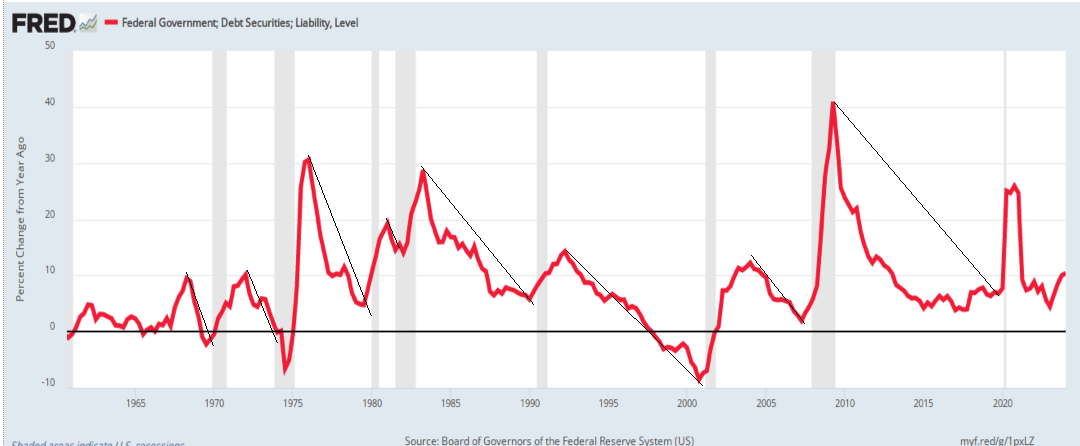
Declines (black diagonal lines) in federal “debt” growth (red) lead to recessions (vertical gray bars), which are cured by increased “debt” growth.
You’ve seen it time and again. We go into a recession, so what does the government do? It increases deficit spending to get us out of the recession.
It always amazes me that people easily accept the fact that federal deficit spending can cure a recession but fail to see that it can also prevent one.
As soon as our deficit spending cures a recession, what do we do? At the behest of the Stossels of the world, we again begin to cut deficit spending because it carries the word “deficit,” which increases the “debt” (which isn’t federal and isn’t debt).
It isn’t federal because the money is owned by the depositors, not by the federal government. It isn’t debt because the federal government doesn’t owe the money; it merely stores it for the owners.
Imagine your team is losing a baseball game. You know you need to score net runs (more runs than the opposition) to win. So you score net runs and begin to win.
The owner of this storage facility didn’t borrow bicycles and a scooter from this customer. They are not part of the facility owner’s debt.
But because you’re ahead, you decide you no longer need to score net runs until you start losing again.
Call that Libertarianism (or “Stosselism”)
This enormous sum not only hampers the nation’s financial flexibility but also threatens its long-term economic stability.
Stossel is confused by the word “debt.”
Imagine you own a self-storage facility, and someone stashes some bicycles in it.
Your financial flexibility wouldn’t be threatened.
And if they gave you more bicycles to put in your storage facility, your financial flexibility still wouldn’t be threatened.
And if they said, “You owe me all those bicycles,” you would say, “They’re yours. Take them out.”
That is exactly how T-bills, T-notes, and T-bonds work. The federal government stores depositors’ money but doesn’t own it. Depositors can have it back without any burden on the government or on taxpayers.
Stossel warns that this unsustainable path will “cripple our future,” yet politicians seem more focused on increasing spending rather than addressing the debt issue.
And there it is again, that word the Libertarians love to use: “Unsustainable.” Except for one problem: They never explain why the federal government can’t “sustain” a so-called “debt” that has been growing since 1940 when it was first called a “ticking time bomb.”
Since 1940, that “time bomb” has been “ticking” year after year while America’s economy grows stronger and stronger.
“Gimme a break”
Stossel criticizes politicians from both major parties for their contradictory statements and actions regarding the national debt.
While some politicians claim to have reduced the deficit, the reality is starkly different.
The debt continues to rise, now increasing by $1 trillion every 100 days.
This disconnect between rhetoric and reality is a significant concern for Stossel, who highlights the bipartisan nature of this fiscal irresponsibility.
The only “disconnect between rhetoric and reality” is Stossel’s claim.
Reflecting on past events, Stossel recalls the bipartisan support for the largest stimulus bill in U.S. history, passed during the early stages of the COVID-19 pandemic.
The stimulus bill did exactly what it was supposed to do. It added the dollars that cured shortages, reduced COVID-19 inflation, ended a recession, and led to today’s growing economy.
This legislation saw overwhelming approval in the Senate, demonstrating a rare moment of unity.
However, Stossel points out that the bill included numerous expenditures that lacked direct relevance to the pandemic, such as funding for NPR and the Kennedy Center.
This, he argues, exemplifies the government’s tendency to spend lavishly without considering the long-term fiscal implications.
Is Stossel saying it was wise to spend economic stimulus money to cure COVID but not to spend money that aids independent news broadcasts? What exactly is he arguing against? COVID dollars are OK, but non-COVID dollars are bad?
Addressing potential solutions, Stossel discusses the commonly proposed ideas of raising taxes on the wealthy or printing more money.
He dismisses these options as insufficient or harmful.
Taxing billionaires, he explains, would only cover a fraction of the debt, while printing more money – a concept embraced by proponents of Modern Monetary Theory – risks severe inflation.
He cites historical examples, including Zimbabwe and 1920s Germany, where unchecked money printing led to economic disasters.
Again, Stossel parrots common (but wrong) beliefs.
A price increase in any one product can come from an increase in demand for that product or from a sudden shortageof that product.
But inflation is an increase in prices for virtually all products and services.
Historically, government spending can’t cause a general increase in demand. When the government increases spending on Social Security, Medicare, and the military (the three largest balance sheet items), this doesn’t suddenly result in increased demand for virtually all products and services.
All inflations in history have been caused by shortages of critical goods and services, most often oil and food.
The current inflation was not caused by increased demand. There was no sudden increase in demand.
What was sudden? COVID. The current inflation was caused by COVID-related shortagesof oil, food, shipping, steel, wood, computer chips, labor, and many other products and services.
The price of oil affects the prices of virtually all other products and services. Historically, oil shortages parallel inflation.
Zimbabwe’s inflation was not caused by currency printing. The Zimbabwe government took land from farmers and gave it to people who didn’t know how to farm. The predictable result was food shortages, which caused Zimbabwe’s hyperinflation.
The Zimbabwe government’s misguided response was to print currency. The correct response would have been to spend money on increased food production while obtaining and distributing food.
The infamous German hyperinflation was caused by a complex series of events, beginning with Germany’s WWI war reparation payments that caused shortages of goods.
Using German hyperinflation as an example of what could happen in America demonstrates Stossel’s superficiality and ignorance of economic history.
German government deficit spending actually increased massively as the inflation ended (partly thanks to the end of the international gold standard) to fund the greatest war machine the world ever had known.
Stossel outlines the grim alternatives facing the U.S.: defaulting on the debt or continuing on the current path.
Defaulting would devastate the savings of everyone who invested in America and wouldn’t solve the underlying problems. Continuing on the current trajectory, however, only deepens the debt, making eventual solutions more painful and disruptive.
Federal “debt” (deposits) increased from about $43 billion in 1940 to about $33 trillion today, an 82,400% increase.
If, in 1940, someone had told Stossell the federal “debt” (deposits) would increase 82,400 percent in the next 84 years, he would have predicted inflations, recession, depression, stagflation, and every other calamity you could imagine.
Yet here we are, with the world’s most successful economy, powerful growth, and full employment. (Now we must reduce the income/wealth/power Gap between the rich and the rest.)
Despite the severity of the debt crisis, Stossel notes that politicians rarely take meaningful action. They talk about reducing the deficit and debt but fail to implement substantial changes.
He cites past presidents who have acknowledged the problem without delivering effective solutions, leading to the doubling of the national debt under recent administrations.
Someone, please tell Stossel that Clinton actually did reduce the federal debt. The result is shown below.
Debt reduction requires the federal government to run a surplus, that is, to take dollars out of the economy.Stossel should learn how reducing the “debt” works in the real world.
Here is the result of every “debt” reduction since 1804:
1804-1812: U. S. Federal Debt reduced 48%. Depression began 1807. 1817-1821: U. S. Federal Debt reduced 29%. Depression began 1819. 1823-1836: U. S. Federal Debt reduced 99%. Depression began 1837. 1852-1857: U. S. Federal Debt reduced 59%. Depression began 1857. 1867-1873: U. S. Federal Debt reduced 27%. Depression began 1873. 1880-1893: U. S. Federal Debt reduced 57%. Depression began 1893. 1920-1930: U. S. Federal Debt reduced 36%. Depression began 1929. 1997-2001: U. S. Federal Debt reduced 15%. Recession began 2001.
Only one period of federal surplus (“debt” reduction) has occurred since 1940, and it caused a recession.
Stossel emphasizes the importance of cutting government spending or at least slowing its growth. He criticizes the current political climate, where both major parties seem more interested in spending increases rather than fiscal restraint.
Why does Stossel want to slow growth? He’s a Libertarian. That is the only answer I can give.
This lack of willingness to address the debt issue leaves the country on a path towards economic instability and potential bankruptcy.
Oh, really. Here is what someone knowledgeable says:
Alan Greenspan:“A government cannot become insolvent with respect to obligations in its own currency.”
People in the comments shared their thoughts on this situation: “The average person had no clue how bad of shape we’re in. Politicians have ruined this once great nation.
“Ruined our once great nation”?? Does this look like it has been ruined?
The above graph shows the real (inflation-adjusted) per capita growth of America’s Gross Domestic Product (blue line). That is solid per-person growth, not the “ruined” nation that Stossel claims.
The red line shows the federal “debt” (deposits) over the same period. As they have grown, so has GDP.
Another commenter added: “Our economy is struggling with uncertainties, housing issues, foreclosures, global fluctuations, and the pandemic aftermath, causing instability.
Rising inflation, sluggish growth, and trade disruptions need urgent attention from all sectors to restore stability and stimulate growth.”
Who exactly was this “other commenter”? Donald Trump? Fox News?
When exactly did any nation not have “uncertainties, housing issues, foreclosures, trade disruptions, instability, and global fluctuations”? It’s called reality.
COVID-related inflation is not rising; it’s falling. Growth certainly is not sluggish. And what “trade disruptions” have been caused by federal deficit spending? Stossel never says, preferring to bleat meaningless generalities.
In concluding his video, Stossel urges viewers to share and spread awareness about the national debt crisis. He believes that increasing public awareness is crucial to pressuring politicians to take necessary actions.
The $1 trillion annual interest payment is a clear indicator of the urgent need for fiscal responsibility and sustainable economic policies.
The $1 trillion interest payment indicates that the federal government has no trouble pumping growth dollars into the economy.
What do you think? What specific steps can the government take to reduce the national debt without compromising essential services?
How can the public hold politicians accountable for their fiscal policies and spending decisions? What are the long-term economic consequences if the national debt continues to grow at the current rate?
These are good questions for which Stossel has no answers. How would he cut federal deficit spending without cutting Medicare, Social Security, the military, and the thousands of other programs the government funds?
If the national “debt” (deposits) continue to grow at the current rate, the economy probably will continue to grow at the current rate.
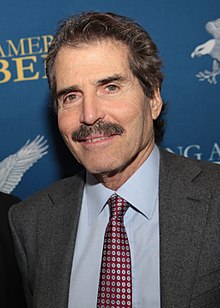
John Stossel
John Stossel puzzles me. When you first conclude he knows nothing about economics, he writes something spot-on. Then he follows up with ignorance about the same subject.
In that, he reminds of Paul Krugman, who alternately understands, then doesn’t understand, Monetary Sovereignty.
Stossel can do it in two sentences. Here is an article on Reason.com, the Libertarian version of QAnon. Look at the subhead.
“Federal government’s budget deficit will bankrupt us.”
Suddenly, the U.S. government will go bankrupt? After world wars, numerous recessions and depressions, now, when the economy is growing rapidly, the federal government is going bankrupt??
The blue line is Gross Domestic Product. The red line is federal “debt.” There is no hint that federal “debt” is leading to bankruptcy. Quite the opposite. As “debt” grows, so does the economy.
.
The green line is real (allowing for inflation), per capita GDP. There still is no hint that increasing federal “debt” leads to bankruptcy. Again, quite the opposite.
If Stossel wants to bet that next year’s budget deficit will bankrupt the U.S. government, I will put up every dollar I own that says Stossel is wrong. One wonders why someone, anyone, would make such a foolish statement and expect belief.
Being Monetarily Sovereign, the U.S. government cannot run short of U.S. dollars. Increased federal deficit spending is necessary for economic growth. GDP=Federal Spending+Non-federal Spending+Net Exports
Former Federal Reserve Chairman, Alan Greenspan:“A government cannot become insolvent with respect to obligations in its own currency.”
I suspect Stossel knows he’s wrong, so I’m guessing he hasn’t moved to another country or exchanged all his U.S. dollars for another currency in advance of a mythical U.S. bankruptcy.
He’s just promulgating the usual Libertarian BS that has been wrong for at least 84+ years and will continue to be incorrect during his lifetime and beyond.
But wait. He also says, “Trade deficits are trivial.” In that, he is correct.
A trade deficit merely means we give other nations some of the plentiful U.S. dollars we create at the touch of a computer key, and in return, we receive valuable and scarce goods and services.
I run trade deficits with my local Costco and with my cleaning lady. I don’t feel bad about it, though I don’t even have the government’s infinite ability to create dollars.
The more money I have, the more stuff I can buy. The federal government has infinite money.
Maybe Donald Trump is such a powerful communicator and pot-stirrer that other countries, embarrassed by their own trade barriers, will eliminate them. Then, I will thank the president for the wonderful thing he did. Genuine free trade will be a recipe for wonderful economic growth.
But I fear the opposite: a trade war and stagnation—because much of what Trump and his followers say is economically absurd.
“What Trump and his followers say is economically absurd”? Who could have guessed that MAGAs know so little? Could it be possible that QAnon, Fox, Alex Jones, Marjorie Taylor Greene, Tucker Carlson, and Donald Trump are not reliable sources?
“(If) you don’t have steel, you don’t have a country!” announced the president.
Lots of things are essential to America—and international trade is the best way to make sure we have them. When a storm blocks roads in the Midwest, we get supplies from Canada, Mexico, and China. Why add roadblocks?
Steel is important, but “the choice isn’t between producing 100 percent of our steel (and having a country) or producing no steel (and presumably losing our country),” writes Veronique De Rugy of the Mercatus Center.
Trump uses the “you don’t have a country” meme for everything. “If you don’t have a steel industry, you don’t have a country.” “If you don’t have a border, you don’t have a country.” “If you don’t have a wall, you don’t have a country.” “If you don’t have a military, you don’t have a country.” “If you don’t have a strong military, you don’t have a country.”
These are a few of his nonsense statements about the end of America. Ms de Rugy’s response was correct.
Today, most of the steel we use is made in America. Imports come from friendly places like Canada and Europe. Just 3 percent come from China.
Still, insists the president, “Nearly two-thirds of American raw steel companies have gone out of business!”
There’s been consolidation. But so, what? For 30 years, American steel production has stayed about the same. Profits rose from $714 million in 2016 to $2.8 billion last year. And the industry added nearly 8,000 jobs.
Trump loves to cherry-pick, twist, and outright lie about statistics to make his point. A day later, he’ll say the opposite. His followers will swoon at each new version despite its incompatibility with what Trump said yesterday.
Trump says, “Our factories were left to rot and to rust all over the place. Thriving communities turned into ghost towns. You guys know that, right?”
No. Few American communities became ghost towns. More boomed because of cheap imports.
It’s sad when a steelworker loses work, but for every steelworker, 40 Americans work in industries that use steel. They, and we, benefit from lower prices.
Right again, John. Wrong again, Donald.
Trump touts the handful of companies benefiting from his tariffs: “Century Aluminum in Kentucky—Century is a great company—will be investing over $100 million.”
Great. But now we’ll get a feeding frenzy of businesses competing to catch Trump’s ear. Century Aluminum got his attention. Your company better pay lobbyists. Countries, too.
After speaking to Prime Minister Malcolm Turnbull of Australia, Trump tweeted: “We don’t have to impose steel or aluminum tariffs on our ally, the great nation of Australia!”
So, the purpose of tariffs is . . . what? To punish our enemies? To reward our businesses? Or simply increase prices for the American consumer.
Economies thrive when there are clear rules that everyone understands. Now we’ve got “The Art of the Deal,” one company and country at a time.
I understand that Trump, the developer liked to make special deals, but when presidents do that, it’s crony capitalism—crapitalism. You get the deal if you know the right people. That’s what kept most of Africa and South America poor.
But Trump thinks trade itself makes us poorer: “We lose … on trade. Every year, $800 billion.”
Actually, last year’s trade deficit with China was $375 billion. But even if it were $800 billion, who cares? All a trade deficit shows is that a country sells us more than we sell them. We get the better of that deal. They get excess dollar bills, but we get stuff.
Right on, John. We have the infinite ability to create dollars by pressing computer keys. The U.S. government can send dollars into the economy whenever it wants to.
Former Federal Reserve Chairman Ben Bernanke:“The U.S. government has a technology, called a printing press (or, today, its electronic equivalent), that allows it to produce as many U.S. dollars as it wishes at essentially no cost.”
But we don’t have the infinite ability to create stuff. So, trading dollars for stuff is a great deal for us.
Sadly, when the U.S. government does it, the Libertarians wrongly complain about federal deficits and debt. I wonder whether Stossel will hear about this from his Libertarian pals.
And now we come to the usual Libertarian BS:
Real problems are imbalances like next year’s $1 trillion federal government budget deficit. That will bankrupt us.
It hasn’t happened. It can’t happen. It won’t happen. It’s just that incredible fearmongering by people who know better and should stop now.
Trade deficits are trivial. You run one with your supermarket. Do you worry because you bought more from them than they buy from you? No. The free market sorts it out.
Trump makes commerce sound mysterious: “The action I’m taking today follows a nine-month investigation by the Department of Commerce, Secretary Ross.”
But Wilber Ross is a hustler who phoned Forbes Magazine to lie about how much money he has. Now he goes on TV and claims, “3 cents worth of tin plate steel in this can. So if it goes up 25 percent, that’s a tiny fraction of one penny. Not a noticeable thing.”
Not to him maybe, but Americans buy 2 billion cans of soup.
Political figures like Ross—and Trump—shouldn’t decide what we’re allowed to buy. If they understood markets, they’d know enough to stay out of the way.
Like so many of the people Trump hires, Ross was, shall we say, a questionable character, with many, many claims against his honesty.
The combination of Libertarianism and its attendant economic ignorance, together with economic dishonesty leads to bad (for America) decisions. Cut federal spending and we’ll have the bankruptcyStossel and the Libertarians predict.
As for John Stossel, he still puzzles me.
Rodger Malcolm Mitchell
Monetary SovereigntyTwitter: @rodgermitchellSearch #monetarysovereigntyFacebook: Rodger Malcolm Mitchell
……………………………………………………………………..
The Sole Purpose of Government Is to Improve and Protect the Lives of the People.



 #Monetary Sovereignty - Mitchell