–Lazy Thinking, Originalists, the Historians Fallacy, Stupid Brains and the Supreme Court

Mitchell’s laws: The more budgets are cut and taxes inceased, the weaker an economy becomes. Until the 99% understand the need for deficits, the 1% will rule. To survive long term, a monetarily non-sovereign government must have a positive balance of payments. Austerity = poverty and leads to civil disorder. Those, who do not understand the differences between Monetary Sovereignty and monetary non-sovereignty, do not understand economics.
==========================================================================================================================================

Sometimes things are better understood, or at least better respected, if they have a name. I always have been troubled by the right wing of the Supreme Court – most notably Justices Anton Scalia and Clarence Thomas – and their insistence on “originalism.”

My belief has been that any judge who prefers adhering to what he considers to be the letter of the law, is just a lazy thinker. He doesn’t need to go through the agony of considering the many ramifications of reality. He isn’t a thinker; he is just a translator.

Originalism is the belief that the original intent of an author should be adhered to in later interpretations of a work.

Several reasons are given for “originalism” in the Supreme Court:

1. Originalism reduces the likelihood the judiciary will create law, a duty of the legislative branch. [History shows that originalist judges can be as activist as non-originalist judges]

2. Non-originalism leads to judges using their own personal values as opposed to the law. [Yet, originalist judges apply their personal opinions about the intent of the framers.]

3. Originalism allows voters to amend their Constitution when necessary to change the law. [An extremely difficult, time consuming task, that forces the population to suffer bad law for an extended time]

4. Originalism strengthens the Constitution as a binding contract. [Circular thinking. It’s a binding contract only if the citizens agree on the original intent.]

5. Originalism forces lawmakers to avoid creating bad laws, rather than leaving them to the courts to amend. [Good hypothesis; bad reality. It has done no such thing.]

The correct name for originalism is ”The Historian’s Fallacy” – “a logical fallacy that occurs when one assumes decision makers of the past viewed events from the same perspective and having the same information as those subsequently analyzing the decision.” (Wikipedia)

Justices Scalia and Thomas assume:

– They know what the framers of the Constitution were thinking.
– The framers were able to anticipate all relevant events occurring in the two-plus centuries after the Constitution was written
– These events do not affect the law or the way the law is administered
– In writing the Constitution, the framers were not subject to political pressures, facts, beliefs and contingencies of the time
– Changing the Constitution is an appropriate and easily accomplished alternative to bad law

They are wrong on all counts. Scalia and Thomas are no different from the religious fundamentalists, who think the bible should be interpreted literally (Exodus 21:17 Anyone who curses their father or mother is to be put to death. Exodus 31:15 Whoever does any work on the Sabbath day is to be put to death.) Like religious fundamentalists, they believe nothing relevant has happened since pen was put to paper.

I suggest that the right wing, originalist branch of the Supreme Court has what we, as kids, called “stupid brains” – academically intelligent people, who when faced with the real world, make foolish decisions.

Sadly, most of the right-wing justices are young, which means we will live under the lash of 16th century justice for a long time.

Rodger Malcolm Mitchell
http://www.rodgermitchell.com


==========================================================================================================================================
No nation can tax itself into prosperity, nor grow without money growth. Monetary Sovereignty: Cutting federal deficits to grow the economy is like applying leeches to cure anemia. Two key equations in economics:
Federal Deficits – Net Imports = Net Private Savings
Gross Domestic Product = Federal Spending + Private Investment and Consumption + Net exports

#MONETARY SOVEREIGNTY

–Politicians get it bass-ackwards: Say, “Yes,” to taxes, “No,” to spending. As usual, 99% are screwed.

Mitchell’s laws: The more budgets are cut and taxes inceased, the weaker an economy becomes. Until the 99% understand the need for deficits, the 1% will rule. To survive long term, a monetarily non-sovereign government must have a positive balance of payments. Austerity = poverty and leads to civil disorder. Those, who do not understand the differences between Monetary Sovereignty and monetary non-sovereignty, do not understand economics.
==========================================================================================================================================

In their single-minded effort, not to benefit the nation, but to gain power, my formerly favorite political party, the Republicans, moved from reasonably sensible to extreme, right-wing, mean-spirited nuttiness.

They put forth a dozen candidates, all of whom embodied serious derangement, and finally wish to be led by the “Zelig” candidate, a man having no core beliefs.

The right-wing anti-spending votes have hurt terribly, and will continue to hurt, the lower 99% income group, while enriching the upper 1%. Some might say the 99% deserve reduced Social Security, reduced Medicare and . . . well, reduced everything . . . along with increased taxes, because they vote for these criminals. But, I feel sorry for them.

Yes, anyone earning less than $300K per year and voting Republican is self-destructive and ignorant, but we all are ignorant about different things, and much of the 99% just happens to be ignorant about economics. No crime there.

But, it brings me to the following article.

There was one positive aspect to right wing nonsense: The belief federal taxes should be reduced. Yes, federal taxes are an unneeded drain on the economy. They can and should be reduced each year, and eventually, eliminated.

Yet now, even that wee bit of sense is beginning to disappear.

GOP showing small shifts on taxes
By Rosalind S. Helderman, Published: May 25, 2012

In GOP activist circles it is known simply as “the pledge,” and over the past generation it has become the essential conservative credential for Republicans seeking elective office. Of the 242 Republicans in the House today, all but six have signed the pledge.

But now, an increasing number of GOP candidates for Congress are declining to sign (Grover Norquist’s) promise to oppose any tax increase, a small sign that could signal a big shift in Republican politics on taxes.

And there you have it. Federal spending adds dollars to the economy; adding dollars is stimulative. Federal taxing subtracts dollars from the economy, which is anti-stimulative.

So, what do the Tea/Republicans now wish to do? Increase taxes.

Said Richard Tisei, an NRCC Young Gun and former Republican state senator in Massachusetts who is running against Democratic Rep. John F. Tierney. “If there’s a loophole that can be closed that ends up generating additional revenue that can be used specifically to pay down the national debt, I’m not going to lose sleep. And I don’t want to be bound by the pledge not to close it.”

Translation: “I want to take dollars from taxpayers’ pockets and give it to our Monetarily Sovereign
nment, which doesn’t need the dollars,
(because it has the unlimited ability to create its sovereign currency, the dollar).”

Freshman Rep. Scott Rigell (R-Va.), who signed the pledge in 2010, recently posted an open letter to constituents indicating that he would not renew the promise as he runs for reelection. He said he fears it could stand in the way of an everything-on-the-table approach to tackling the mounting debt.

Averting bankruptcy requires us to grasp the severity of our fiscal condition and summon the courage to speak boldly about the difficult steps needed to increase revenues and sharply decrease spending,” he wrote.

Translation: “Never mind that in the entire history of the universe, no Monetarily Sovereign nation ever has been, or ever can be, forced into bankruptcy. If the federal debt today were $100,000,000 trillion, the federal government could pay it off tomorrow, by pushing one computer key, and this would not add a single dollar to the economy.

But hey, if that’s what you fools want, I’ll vote for it. My election is more important than your money.

Sure, Rigell knows this. We all do. It’s just our cynical ploy to benefit our 1% money boys at the expense of you poor 99%ers. We know you’ll vote for us, anyway, because we taught you to hate Obama.”

Norquist said that in the days of the debt-ceiling debate last summer, Republicans held firm against tax increases and wrested a deal from Democrats to lower deficits through spending cuts alone.

“That was when the pledge was tested and the commitment of Republicans not to raise taxes was really pushed hard. And Obama and the spending interests failed, and Republicans and the taxpayers won,” he said.

Translation: “We made sure the recession wouldn’t end, so we could blame it on Obama. We all are praying for another recession before November.”

Democrats have said they will not agree to renew some of the tax breaks or avert the defense cuts, as Republicans want, unless Republicans agree to impose higher taxes on the wealthy.

Translation: “Because those Republicans have moved to extreme, right-wing derangement, we Democrats have been forced to move to partial right-wing derangement. Votes are votes.”

Democratic attacks on Americans for Tax Reform and Norquist as obstacles to a debt deal, some Republican candidates report that they are hearing from more voters who want them to reject the pledge than the opposite.

Translation: “Taxpayers have been so brainwashed by the 1%, they actually are begging Congress to take more money out of their pockets — and we’re still recovering from a recession!!”

“Voters want me to represent them and not special interests,” said Gary DeLong, a member of the Long Beach City Council, who will (not sign the pledge).

Translation: “I’m going to represent my re-election by voting to take more money from you voters, and you poor slobs want me to do it! Ain’t democracy wonderful?

Sen. Tom Coburn (R-Okla.), a fiscal conservative who has tangled with Norquist, said he believes candidates are starting to understand that the ATR pledge’s power has been exaggerated by Norquist and the media and that Norquist is wrong when he asserts that it is nearly impossible to win a Republican primary without signing the pledge.

“That’s him patting himself on the back,” Coburn said. “And I think it’s bull crap.”

Translation: “You people have plenty of money. You can afford more taxes. You don’t need so much Social Security. And if you ate right and exercised, you wouldn’t a medical insurance plan as good as mine.

And if you 99%ers say you’re hurting, that’s bullcrap.”

–Employment numbers you may not have thought about — but should.

Mitchell’s laws: The more budgets are cut and taxes inceased, the weaker an economy becomes. Until the 99% understand the need for deficits, the 1% will rule. To survive long term, a monetarily non-sovereign government must have a positive balance of payments. Austerity = poverty and leads to civil disorder. Those, who do not understand the differences between Monetary Sovereignty and monetary non-sovereignty, do not understand economics.
==========================================================================================================================================

The following graph shows employment / population ratios.

Monetary Sovereignty

While the percentage of Americans who are employed has changed very little since 1948 (red line — 57% in 1948; 58% in 2011), the change in the difference between men (blue line) and women (green line) is stunning.

Back in 1948, only 30% of women were employed. Today, more than half are employed. By contrast, 1948 saw more than 80% of men employed, compared with less than 65% today.

There are several reasons for this phenomenon, and at least one is rather sad: Lower salaries for women, make them more attractive hires.

Toward the end of the 1960’s, I worked in the advertising agency business. Back then, it was a male-dominated industry. Just ten years later, it had become female dominated, in terms of employee numbers (though not in job titles). The reason: For any given job, the agencies could hire a woman to do it as well as a man, but cheaper. Since advertising is heavy on personnel, the savings were enormous.

Ironically, the men, by keeping a lid on women’s salaries, did themselves a disservice. They created a competing class of worker, just as skilled, but costing less.
======================================================================================================================================================================================

Lest there is any doubt that a college education helps:

Monetary Sovereignty

During recessions, college graduates seem less likely to be fired, and when the recession ends, the non-graduates must start from a comparatively worse position. I suspect, our increasingly high-tech economy will exacerbate this problem for those who don’t graduate college.

I have proposed, and continue to propose, that just as elementary and high school education is government supported, so should college education be financed by the government. For America to compete and grow in the global market, our young people increasingly need a college education.

Unfortunately, college has become so expensive, only the wealthiest children or those willing to suffer years of huge college debts, can attend. It is foolish and counterproductive to place such barriers in front of our future.

======================================================================================================================================================================================

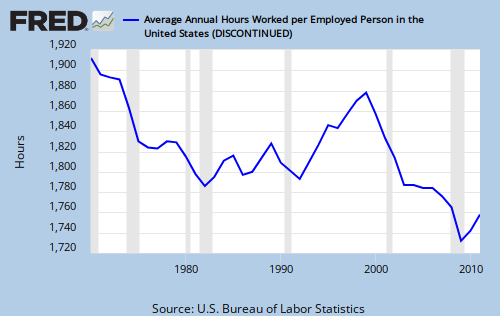
Here is a graph that has me searching for answers.

Monetary Sovereignty

I’m not sure why hours-per-employee went down dramatically from 1970 through the mid 1980’s, then rose in the 1990’s, then crashed during the 2000’s.

I suspect it has to do with the development of computers in business. In the 1970’s, word processors were becoming popular, and in the 1980’s full-fledged computers became more common, especially with the advent of spread sheet programs.

The Internet began to take off in the 1990’s, and the 2000’s saw the rise of Google, followed by the social web pages.

And to all of this, I say, “So?”

Clearly, computers and the Internet have increased productivity, which translated into fewer hours needed to accomplish the same results. But the down – up – down shape of the graph is related to additional effects.

I can speculate that the growth in average hours earlier was related to business growth, but that around the year 2000, computers started to become so efficient that productivity increased faster than business growth, and fewer hours were needed.

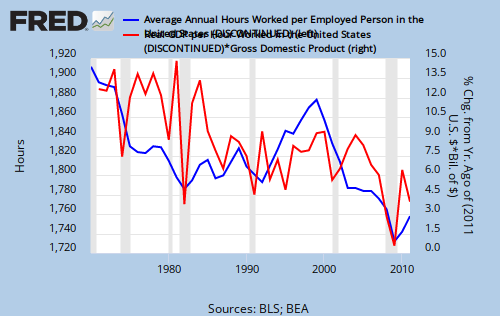
There is a bare hint of that effect in the following graph, where the red line represents GDP growth multiplied by productivity. (Faster GDP growth sends the line down; faster productivity growth sends the line up.)

Monetary Sovereignty

Obviously, any “correlation” is tenuous at best, since population growth, more women in the workforce, trade deficits, tax laws and several other factors may be involved.

Rodger Malcolm Mitchell
http://www.rodgermitchell.com


==========================================================================================================================================
No nation can tax itself into prosperity, nor grow without money growth. Monetary Sovereignty: Cutting federal deficits to grow the economy is like applying leeches to cure anemia. Two key equations in economics:
Federal Deficits – Net Imports = Net Private Savings
Gross Domestic Product = Federal Spending + Private Investment and Consumption + Net exports

#MONETARY SOVEREIGNTY

–Has Vallejo, California found the solution to city financial survival?

Mitchell’s laws: The more budgets are cut and taxes inceased, the weaker an economy becomes. Until the 99% understand the need for deficits, the 1% will rule. To survive long term, a monetarily non-sovereign government must have a positive balance of payments. Austerity = poverty and leads to civil disorder. Those, who do not understand the differences between Monetary Sovereignty and monetary non-sovereignty, do not understand economics.
==========================================================================================================================================

The federal government, being Monetarily Sovereign, has the power to pay any bill of any size. It never can go bankrupt. The states, counties and cities, being monetarily non-sovereign, do not have this power, so many are in financial difficulty.

Has Vallejo, California found a solution?

Washington Post
Vallejo, Calif., once bankrupt, is now a model for cities in an age of austerity
David Paul Morris/Bloomberg

After becoming the largest city in America to declare bankruptcy in 2008, Vallejo, Calif., began to reinvent itself.

The first couple of years were ugly. . . crime and prostitution surged as the police force was thinned by 40 percent. Firehouses were shuttered, and funding for libraries and senior centers was slashed. Foreclosures multiplied and home prices plummeted.

But then this city of 116,000 began to reinvent itself. It started using technology to fill personnel gaps, rallying residents to volunteer to provide public services and offering local voters the chance to decide how money would be spent — in return for an increase in the sales tax. For the first time in five years, the city expects to have enough money to do such things as fill potholes, clear weeds, trim trees and repair tennis courts.

Our states, counties and face a common problem. They cannot create dollars. So, for instance, if they run a balanced budget, and suddenly any expense — meaning ANY expense — increases, they must obtain dollars from the residents or from outside their borders.

But if residents work inside the city’s borders, the same dollars merely recirculate, and eventually the residents become impoverished trying to support their government. This is exactly the same problem residents of Greece and the other monetarily non-sovereign euro nations face.

A rule in economics: To survive long term, a monetarily non-sovereign entity must have money coming in from outside its borders. This money can come from a higher entity — i.e. cities can get dollars from the state — or from exports. But, of course, all states, counties and cities cannot be net exporters, so dollars much come from a higher entity — ultimately from the federal government.

The nation’s cities are weak links in the U.S. economy and, if they collapse in large numbers, it could knock the country’s recovery off course. Cuts at the federal level are being pushed down to the states, which in turn are passing the problems to their cities.

Which demonstrates, yet again, the suicidal foolishness of federal budget cuts.

At least three California cities — Stockton, Mammoth Lakes and Montebello — have declared that they are exploring the (bankruptcy) option. And at least 100 of the state’s 482 cities are on track to face a similar predicament by the end of the year, according to Barbara O’Connor, a professor at California State University at Sacramento.

Economists warn that a number of large bankruptcies of cities, concentrated over a short period of time, could have a devastating effect on the national economy.

Vallejo, about 35 miles northeast of San Francisco, became the poster child for the failures of municipal budgeting in 2008 when its cash reserves dwindled to zero and it was unable to pay its bills amid falling property tax revenue and the soaring cost of employee compensation and pensions.

For Vallejo to survive, two city council members — Marti Brown, 46, a redevelopment worker for the state, and Stephanie Gomes, 45, a legislative specialist for the U.S. Forest Service — decided that the city needed to study best practices from around the world and bring some of them to California.

The police went high-tech, investing $500,000 in cameras across the city that allow officers to monitor a larger area than they could before. The department deputized citizens to participate in law enforcement by sharing tips on Facebook and Twitter.

Gomes, whose husband is a retired police officer, focused on public safety. The couple went neighborhood to neighborhood setting up e-mail groups and social media accounts so people can, for instance, share pictures of suspicious vehicles and other information. “There have been countless cases where ordinary people have stopped crimes this way,” Gomes said.

This is a close relative of the “spy-on-your-neighbor” approach used by many totalitarian governments, and supported by the National Rifle Association. Think: George Zimmerman, neighborhood watch captain, killing Trayvon Martin — an “ordinary person” stopped a crime.

The number of neighborhood watch groups jumped from 15 to 350. Citizen volunteers came together monthly to paint over graffiti and do other cleanup work.

So in addition to paying more taxes, the citizens paid with their time.

And the city council struck an unusual deal with residents — if they agreed to a one-penny sales tax increase, projected to generate an additional $9.5 million in revenue, they could vote on how the money would be used.

In return for paying higher taxes, the citizens would be allowed to vote on how that money could be used. Of course other money could be switched over to other uses.

[In Illinois, lottery money was supposed to support education. So the crooked politicians merely switched away the money that formerly supported education. A perfect scam.]

As the 2012-13 budget season kicks off in California, Vallejo’s neighbors are looking at severe cuts, in part because of reduced support from the state. Gov. Jerry Brown (D) this month revealed that California is facing a crushing$16 billion deficit because of a shortfall in tax revenue. As a result, the state is diverting billions that had been earmarked for redevelopment or housing assistance away from cities that were already under fiscal stress.

As the old saying goes, sh*t flows downhill. The federal government cuts support to the states, so the states cut support to the counties and the cities. All this hardship falls on the people, because the debt hawks say the federal government should live within its non-existent “means.”

The state capital, Sacramento, which is expecting an $18 million deficit for fiscal 2012-13, has proposed cutting 286 full-time jobs, including police and firefighters, a move that would probably leave the city unable to respond to home burglaries and car accidents and lengthen the response time for 911 calls in all but the most dire cases.

Vallejo is in a markedly different situation. While it still faces some serious challenges — crime continues to be a problem

I guess “spy-on-your-neighbor” hasn’t worked too well.

. . . and the housing market remains depressed — the city’s finances are doing so well that a federal judge released it from bankruptcy in November.

Assistant City Manager Craig Whittom, who has worked in Vallejo since 2003, said the bankruptcy may have been the best thing to happen: “It was effective at helping us re-create ourselves and change the culture so that we could restart from a stronger financial footing.”

So all is well, right? Wrong. The fundamental problems remain:

1. Vallejo still is monetarily non-sovereign.
2. The debt-hawks in Washington still push for budget cuts.

So with no changes in #1 or #2, Vallejo again will crash against financial realities. Residents will tire of providing free services, and no amount of neighbor spying or graffiti overpainting will save the city.

Vallejo again will run out of money, thanks to the debt-hawks in Washington.

Rodger Malcolm Mitchell
http://www.rodgermitchell.com


==========================================================================================================================================
No nation can tax itself into prosperity, nor grow without money growth. Monetary Sovereignty: Cutting federal deficits to grow the economy is like applying leeches to cure anemia. Two key equations in economics:
Federal Deficits – Net Imports = Net Private Savings
Gross Domestic Product = Federal Spending + Private Investment and Consumption + Net exports

#MONETARY SOVEREIGNTY