-Taxing poverty to support health care

The debt hawks are to economics as the creationists are to biology. Those, who do not understand monetary sovereignty, do not understand economics. Cutting the federal deficit is the most ignorant and damaging step the federal government could take. It ranks ahead of the Hawley-Smoot Tariff.
==========================================================================================================================================

       It has been estimated 50 million Americans do not have health insurance. Presumably, the vast majority can’t afford it. The U.S. Congress’s solution is to fine each of these people $1,000.
      (Next, we can fine each homeless person $1,000 for not paying rent.)
       The Congressional Budget Office estimates the fines will raise $36 billion over 10 years. Do the math. That $36 billion requires 36 million people to remain uninsured. In short, the government plan requires the program to fail!
       The government claims it would provide subsidies for poor and “some” middle-class families. That will require complex definitions for “poor,” remembering how cost of living varies markedly around the country. A Manhattan resident earning $30 thousand might be poor, while half that income might do very nicely in a rural town. Then there is the question of how to count dependents – children and adults.
      (Next, we can fine each starving person for not buying enough food.)
       And if families are forced to spend money on health insurance, will they be precluded from sending their kids to college or even allowing them to complete high school? Ah, that pesky law of unintended consequences.
      (Next we can fine each jobless person for not working.)
      Part of the plan also includes cutting costs by reducing payments to hospitals. Of course, this would require hospitals to find ways to save money. They can cut nursing staff and equipment, employ fewer doctors and maintenance people and serve cheaper food. And no need to clean the rooms every day. Now that should improve health care.
       If the government can subsidize the poor and “some” middle-class, why not merely subsidize them and forget about the ridiculous tax on poverty and on hospitals? This all is a perfect example of why the government is excellent at supplying money, but truly terrible at managing.

Rodger Malcolm Mitchell
For more information, see http://www.rodgermitchell.com
–Deficits, inflation and hyperinflation

The debt hawks are to economics as the creationists are to biology. Those, who do not understand monetary sovereignty, do not understand economics. Cutting the federal deficit is the most ignorant and damaging step the federal government could take. It ranks ahead of the Hawley-Smoot Tariff.
==========================================================================================================================================

      It commonly is believed large federal deficits cause inflation. Examples often are given of Germany, China, Brazil, Italy and other nations that experienced hyperinflation.

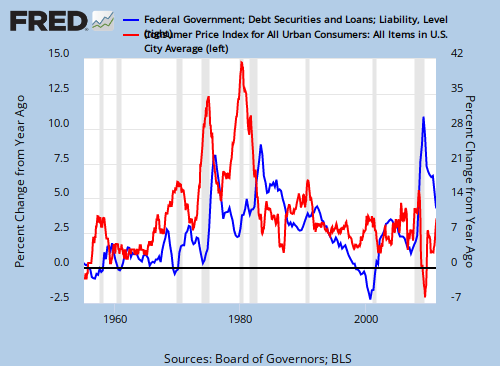
So it might be useful to see what the experience in America has been. Here’s a graph created by the St. Louis Federal Reserve. The blue line is deficit growth. The red line is inflation.

In the past 50 years at least, deficit growth has not been associated with inflation.

Inflation is more closely related to special factors than to deficits; such things as oil shortages, wars and weather are the main culprits.

Deficits vs inflation

I do not suggest the government should create an unlimited amount of money, though it has the power to do so. In 1979, gross federal debt was $800 billion. In 2009 it reached $12 trillion, a 1400% increase in 30 years.

During that period, GPD rose 440% (annual rate of 5.5%) with acceptable inflation throughout. The same 1400% increase would put the debt at $180 trillion in 2039, a mean deficit of $5+ trillion.

This calculates to a 9.5% annual debt increase for the past 30 years. Repeating that growth rate would put the 2010 deficit at about $1.14 trillion, and the 2011 deficit at about $1.25 trillion.

The deficit for year 2039 would be about $15.8 trillion. I know of no reason why the results would not be the same as they have been in the past 30 years.

However, increasing the debt growth rate above 9.5% might show even better results. In the 10 year period, 1980 – 1989, federal debt grew 210%, from $900 billion to $2.8 trillion (a 12% annual debt increase), while GDP grew .96% from $2.8 trillion to $5.5 trillion (a 7% annual increase).

During that same period, inflation fell from 14.5% in 1980 to 5.2% in 1989.
In summary, large deficits have led to GDP growth, while not causing unacceptable levels of inflation. Those are the bare bones.

For more information, see http://www.rodgermitchell.com


-Does taxing the rich help the poor?

The debt hawks are to economics as the creationists are to biology. Those, who do not understand monetary sovereignty, do not understand economics. Cutting the federal deficit is the most ignorant and damaging step the federal government could take. It ranks ahead of the Hawley-Smoot Tariff.
==========================================================================================================================================

President Obama wants us to believe that increasing taxes on the rich allows him to give more to the poor, ala Robin Hood. However, there is no historical relationship between federal spending and federal tax rates, which despite massive deficits and debt, have remained level or declined for the past fifty years.

Yes, raising the tax rate on the wealthiest Americans may address a psychological need to punish the rich for being rich. But, if this tax increase succeeds in collecting more taxes from any group, rich or poor, it will hurt poor people. All taxes remove money from the economy, which slows or reverses economic growth. Even now, with so many unemployed, the poor remain slow to understand that their jobs depend on the financial health of the rich, the spending they do and the businesses they own.

The economy runs on money. Among the government’s most important jobs are to create money and to spend it. In 1971 we went off the gold standard specifically to give the government the unlimited ability to create and spend money. When the government fails to do that job, the economy falters. Every depression in U.S. history and every recession in the past 40 years followed periods of reduced federal deficit growth, and every recovery as been associated with increased federal deficit growth.

The media and the politicians suffer from federal debt paranoia, which is responsible for more misery in America than all the crime and illness combined. Federal debt paranoia keeps us from providing universal health care, fully funded Social Security and improved education, military, infrastructure, energy and policing.

I call it “paranoia,” because, history indicates large federal deficits do not cause inflation, recession or any other negative economic effect. On the contrary, large and growing deficits stimulate the economy. We keep falling back into recessions because of federal debt paranoia.

Although President Obama wants to redistribute wealth, increasing any taxes will reduce overall economic growth, taking from the rich and from the poor.

Rodger Malcolm Mitchell
For more information, see http://www.rodgermitchell.com Continue reading “-Does taxing the rich help the poor?”

-Ten Reasons to Eliminate FICA

The debt hawks are to economics as the creationists are to biology. Those, who do not understand monetary sovereignty, do not understand economics. Cutting the federal deficit is the most ignorant and damaging step the federal government could take. It ranks ahead of the Hawley-Smoot Tariff.
==========================================================================================================================================
*Contributions by Warren Mosler and Randall Wray

11/5/08: The dual needs to stimulate the economy and to provide more health care and retirement funds, provide us with the rare opportunity to do both at one stroke. I recommend we eliminate the FICA tax and instead, fund Social Security and Medicare the same way we fund the military and every other federal agency. Recognizing this is a controversial and counter-intuitive suggestion, I offer ten rationales for discussion:

1. The Social Security part of FICA is a severely regressive tax, unfairly impacting the salaried middle classes far more than the non-salaried or upper income classes. Currently, salaries above $102,000 do not pay FICA for Social Security. Non-salaried people pay nothing.

2. The Social Security part of FICA is a double tax. Salaried workers pay taxes on their FICA contributions and again pay taxes when they receive benefits. Although Social Security is quasi-insurance, no other insurance collects taxes on premiums and on benefits.

3. Eliminating FICA would put more money in the pockets of salaried consumers, stimulating consumer buying and saving – exactly what the economy needs now.

4. Eliminating FICA would give business more money for investment and payroll – the other thing the economy needs now.

5. There are 400+ federal agencies, including all the military agencies, all the Departments, and dozens you never have heard of. When the military needs money to pursue the wars in Iraq and Afghanistan, Congress quickly votes hundreds of billions of dollars to this effort. No tax covers this budget. When the economy needed a stimulus, Congress quickly voted $150 billion to this effort. No earmarked tax was passed. When Freddie Mac and Fannie Mae ran into financial difficulties, the Treasury immediately gave them a blank check. Recently, another $700 billion was voted, and again, no new taxes were levied to cover this government expenditure. The current, annual cost of Social Security and Medicare totals about $1 trillion, well within the government’s proven spending range.

6. The government neither needs nor uses FICA money. In 1971, President Nixon eliminated the final connection between gold and U.S. money. His purpose: To give the government the unlimited power to create money. Even with the current trillion dollar bailout, no additional taxes have been levied. In fact, both presidential candidates promise to reduce taxes, and no federal check ever has or will bounce. There literally is no limit to the amount of money the federal government can create, and no limit to the size of the debt it can support.

7. There is no historical data to demonstrate that deficit spending inhibits gross domestic product, causes inflation or limits any other indicator of economic productivity, nor must federal debt be paid by taxpayers. President Carter oversaw modest deficits with high inflation and low economic growth. President Reagan oversaw huge deficits – the largest in American history – with low inflation and high economic growth. History shows deficits correspond with economic growth, and the larger the deficit, the healthier the economy. To date, the government has spent $10 trillion that has not cost taxpayers a cent.

8. Relying on FICA restricts Social Security benefits, which are too low to support even a modest lifestyle, and are received by too few people. The belief that Social Security and Medicare, uniquely among federal agencies, must be self-funding, causes political leadership to search for impossible “fixes,” something akin to searching for two quarts of water in a one quart bottle. Inevitably, these fixes involve higher taxes and/or reduced benefits, both of which hurt our citizens, our businesses and our economy. The world’s wealthiest country needs to, and can afford to, eliminate FICA taxes while supporting more people with higher benefits.

9. Funding Medicare through FICA limits the number of people covered, now mostly older people. But 40 million Americans do not have health insurance. Either they can’t afford it or have pre-existing conditions. Medicare coverage for these other groups would solve that serious, national problem and stimulate the economy for all.

10. Funding Medicare through FICA limits the size of Medicare payments. America has a severe shortage of doctors and nurses. But limiting the size of benefits has the unintended consequence of discouraging our best and our brightest from entering medicine or from participating in Medicare. A growing number of “boutique” doctors, who do not accept Medicare payments, charge fees only wealthier patients can afford. Federal funding of Medicare could provide better health coverage for Americans.

I first recommended this in my 1995 book, The Ultimate America.

Rodger Malcolm Mitchell
For more information, see http://www.rodgermitchell.com