–The low interest rate/GDP growth fallacy

The debt hawks are to economics as the creationists are to biology. Those, who do not understand monetary sovereignty, do not understand economics. Cutting the federal deficit is the most ignorant and damaging step the federal government could take. It ranks ahead of the Hawley-Smoot Tariff.

==========================================================================================================================================

       The Fed raises interest rates to fight inflation. To fight recession, the Fed does the opposite. It cuts interest rates.

This may sound logical except for one, very small detail. The opposite of inflation is not recession. The opposite of inflation is deflation. So doing the opposite of what you would do to counter inflation makes no sense when trying to counter a recession.

We could have a recession with deflation. We could have a recession with inflation, which is called “stagflation.” The history of Fed rate cuts, as a way to stimulate the economy, is not a good one. The Fed, under Chairman Greenspan, instituted numerous rate cuts. The result: A recession that President Bush’s tax cuts cured.

The Fed, under Chairman Bernanke, instituted numerous rate cuts. The result: The 2008 recession.

Why does popular faith hold that cutting interest rates stimulates the economy? Because popular faith views only one side of the equation. But, for each dollar borrowed a dollar is lent. $B = $L.

Cutting interest rates does cost borrowers less. A business needing $100 million might be more likely to borrow if interest rates are low than when they are high. Further, consumers are more likely to spend when borrowing is less costly. So making borrowing less costly stimulates business growth and consumer buying. At least, that is the theory.

What seems to be ignored is the lending side of the equation. When interest rates are low, lenders receive less money. And who are the lenders? Businesses and consumers.

You are a lender when you buy a CD or a bond, or put money into your savings account. When interest rates are low, you receive less money, which means you have less money to spend on goods and service — which means less stimulus for the economy.

In short, interest rates flow through the economy, with some people and businesses paying and some receiving. Domestically, it’s a zero-sum game — except for the federal government.*

A growing economy requires a growing supply of money. Cutting interest rates does not add money to the economy. That is why there is no historical correlation between interest rates and economic growth. During periods of high rates, GDP growth is not inhibited. During periods of low rates, GDP growth is not stimulated.

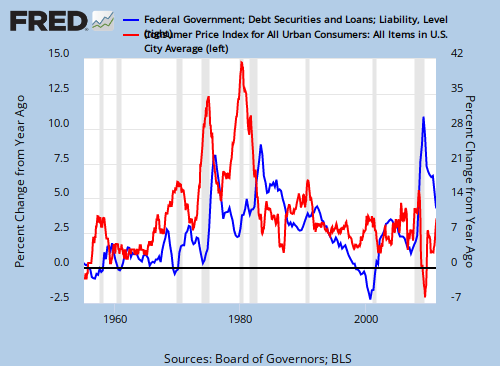
Please review the following graph:

monetary sovereignty

Blue is interest rates. Red is GDP growth. Not only are low interest rates not associated with high economic growth, but the opposite seems to be true. There seems to be a correlation between high interest rates and high GDP growth. How can this be?

*When interest rates are high, the federal government pays more interest on T-securities, which pumps more money into the economy. This additional money stimulates the economy.

This shows why the Fed’s repeated rate cuts do not seem to stimulate the economy. The action has been shown, time and again, to be counter-productive. Cutting interest rates to stimulate the economy is like pouring water on a drowning man.

Do you remember these headlines: “Employers slashed 80,000 jobs in March.” “The U.S. central bank has lowered rates by 3 percentage points since mid-September” “The loss of jobs signals another interest rate cut by the Federal Reserve later this month.” “Federal Reserve Chairman Ben Bernanke acknowledged Wednesday that the country could be heading toward a recession, saying federal policymakers are ‘fighting against the wind’ in combating it.”

Rate cut after rate cut did nothing. So what was the Fed’s plan? More rate cuts. During the previous recession, the Fed also attempted rate cut after rate cut, also to no avail. The recession, finally ended with the Bush tax cuts. The Fed has not learned from experience, but stubbornly adheres to the popular faith that interest rate cuts stimulate the economy.

Rate cuts do not stimulate the economy. They never have. They never will.

“Stimulating” an economy means making it larger. A large economy requires more money than does a smaller economy. Therefore, the only thing that stimulates the economy is the addition of money.

Rate cuts, by reducing the amount of interest the federal government pays, actually reduce growth of the money supply. We are on the edge of a recession, because the economy is starved for money. The coming “stimulus” checks will help, but they are too little and too late. This should have been done months ago, and the amounts should be far larger.

The only way to prevent or cure a recession: Federal deficit spending. There is no excuse for recession or inflation. These problems are not economic failures. They are leadership failures.

Rodger Malcolm Mitchell

For more information, see http://www.rodgermitchell.com
-Taxing poverty to support health care

The debt hawks are to economics as the creationists are to biology. Those, who do not understand monetary sovereignty, do not understand economics. Cutting the federal deficit is the most ignorant and damaging step the federal government could take. It ranks ahead of the Hawley-Smoot Tariff.
==========================================================================================================================================

       It has been estimated 50 million Americans do not have health insurance. Presumably, the vast majority can’t afford it. The U.S. Congress’s solution is to fine each of these people $1,000.
      (Next, we can fine each homeless person $1,000 for not paying rent.)
       The Congressional Budget Office estimates the fines will raise $36 billion over 10 years. Do the math. That $36 billion requires 36 million people to remain uninsured. In short, the government plan requires the program to fail!
       The government claims it would provide subsidies for poor and “some” middle-class families. That will require complex definitions for “poor,” remembering how cost of living varies markedly around the country. A Manhattan resident earning $30 thousand might be poor, while half that income might do very nicely in a rural town. Then there is the question of how to count dependents – children and adults.
      (Next, we can fine each starving person for not buying enough food.)
       And if families are forced to spend money on health insurance, will they be precluded from sending their kids to college or even allowing them to complete high school? Ah, that pesky law of unintended consequences.
      (Next we can fine each jobless person for not working.)
      Part of the plan also includes cutting costs by reducing payments to hospitals. Of course, this would require hospitals to find ways to save money. They can cut nursing staff and equipment, employ fewer doctors and maintenance people and serve cheaper food. And no need to clean the rooms every day. Now that should improve health care.
       If the government can subsidize the poor and “some” middle-class, why not merely subsidize them and forget about the ridiculous tax on poverty and on hospitals? This all is a perfect example of why the government is excellent at supplying money, but truly terrible at managing.

Rodger Malcolm Mitchell
For more information, see http://www.rodgermitchell.com

–Deficits, inflation and hyperinflation

The debt hawks are to economics as the creationists are to biology. Those, who do not understand monetary sovereignty, do not understand economics. Cutting the federal deficit is the most ignorant and damaging step the federal government could take. It ranks ahead of the Hawley-Smoot Tariff.
==========================================================================================================================================

      It commonly is believed large federal deficits cause inflation. Examples often are given of Germany, China, Brazil, Italy and other nations that experienced hyperinflation.

So it might be useful to see what the experience in America has been. Here’s a graph created by the St. Louis Federal Reserve. The blue line is deficit growth. The red line is inflation.

In the past 50 years at least, deficit growth has not been associated with inflation.

Inflation is more closely related to special factors than to deficits; such things as oil shortages, wars and weather are the main culprits.

Deficits vs inflation

I do not suggest the government should create an unlimited amount of money, though it has the power to do so. In 1979, gross federal debt was $800 billion. In 2009 it reached $12 trillion, a 1400% increase in 30 years.

During that period, GPD rose 440% (annual rate of 5.5%) with acceptable inflation throughout. The same 1400% increase would put the debt at $180 trillion in 2039, a mean deficit of $5+ trillion.

This calculates to a 9.5% annual debt increase for the past 30 years. Repeating that growth rate would put the 2010 deficit at about $1.14 trillion, and the 2011 deficit at about $1.25 trillion.

The deficit for year 2039 would be about $15.8 trillion. I know of no reason why the results would not be the same as they have been in the past 30 years.

However, increasing the debt growth rate above 9.5% might show even better results. In the 10 year period, 1980 – 1989, federal debt grew 210%, from $900 billion to $2.8 trillion (a 12% annual debt increase), while GDP grew .96% from $2.8 trillion to $5.5 trillion (a 7% annual increase).

During that same period, inflation fell from 14.5% in 1980 to 5.2% in 1989.
In summary, large deficits have led to GDP growth, while not causing unacceptable levels of inflation. Those are the bare bones.

For more information, see http://www.rodgermitchell.com


-Does taxing the rich help the poor?

The debt hawks are to economics as the creationists are to biology. Those, who do not understand monetary sovereignty, do not understand economics. Cutting the federal deficit is the most ignorant and damaging step the federal government could take. It ranks ahead of the Hawley-Smoot Tariff.
==========================================================================================================================================

President Obama wants us to believe that increasing taxes on the rich allows him to give more to the poor, ala Robin Hood. However, there is no historical relationship between federal spending and federal tax rates, which despite massive deficits and debt, have remained level or declined for the past fifty years.

Yes, raising the tax rate on the wealthiest Americans may address a psychological need to punish the rich for being rich. But, if this tax increase succeeds in collecting more taxes from any group, rich or poor, it will hurt poor people. All taxes remove money from the economy, which slows or reverses economic growth. Even now, with so many unemployed, the poor remain slow to understand that their jobs depend on the financial health of the rich, the spending they do and the businesses they own.

The economy runs on money. Among the government’s most important jobs are to create money and to spend it. In 1971 we went off the gold standard specifically to give the government the unlimited ability to create and spend money. When the government fails to do that job, the economy falters. Every depression in U.S. history and every recession in the past 40 years followed periods of reduced federal deficit growth, and every recovery as been associated with increased federal deficit growth.

The media and the politicians suffer from federal debt paranoia, which is responsible for more misery in America than all the crime and illness combined. Federal debt paranoia keeps us from providing universal health care, fully funded Social Security and improved education, military, infrastructure, energy and policing.

I call it “paranoia,” because, history indicates large federal deficits do not cause inflation, recession or any other negative economic effect. On the contrary, large and growing deficits stimulate the economy. We keep falling back into recessions because of federal debt paranoia.

Although President Obama wants to redistribute wealth, increasing any taxes will reduce overall economic growth, taking from the rich and from the poor.

Rodger Malcolm Mitchell
For more information, see http://www.rodgermitchell.com Continue reading “-Does taxing the rich help the poor?”