Is money real? Let’s first define “real.” Then you decide.
A case could be made that nothing is “real” in that everything is constructed in our brains. René Descartes addressed that problem when he wrote, “I think, therefore I am.” (“cogito, ergo sum”).
It was the one statement he felt he absolutely could accept as accurate. He couldn’t know for sure that the earth, the seas, the stars, and the people were not illusions or dreams.
But since we are defining, we can define real as we choose, so let’s say that “real” means something most people accept as having a physical existence. In one way or another, it can be seen, felt, heard, smelled, tasted, or otherwise having a physical presence.
In that sense, many things we commonly deal with are not real. Numbers are not real. You cannot see, taste, feel, smell, or hear a number. What does the number 6 look like? Does it look like this?

Or like this: Six, SIX, √36, IIIIII, seis
Numbers are concepts or ideas with no physical existence.
In a similar vein, is a story or a novel real? No, a story can be told or written on paper or in a computer’s electrons, but the story itself is not physical. By our definition, that novel you are reading is not real, though the paper and ink are real.

A car and house are real, but is the title to a car or house real? The paper and ink are real if the title is printed on paper. But the title is not real. That title exists not only in printed forms but in electronic form.
The printed form can be in a certificate or computer output, listing one or hundreds of titles.
The title is a legal concept that can exist in many forms and places.
Being a law, a title can exist in the records of one or more government agencies and in the electronic or paper files of a title insurance company, your attorney, or your own files.
You can see a car, but you cannot see a title. At best, you can see a representation of a title. If someone asks for an “original title,” they mean an original copy of a title.
Now we come to the question, “Is money real.” Consider $10 (ten dollars). 

Although the gold $10 coin is worth more in barter than the paper $10 bill, the two are worth exactly the same as money.
They both are titles to ten dollars.
So, where are the real dollars if the coin and bill are titles?
All U.S. dollars exist only as numbers on the books of the issuer of dollars, the federal government. And as we have seen, numbers have no physical existence. All numbers are nothing more than concepts.
Six houses, six cars, and six chickens differ; only their “sixness” is the same. Numbers are not physical, though they exist as concepts.
How did the dollar concept come into existence? They were created by laws, which also have no physical reality. You cannot see, hear, feel, taste, smell, or sense in any material way, a law.
You can read the representation of a law in a book of rules (of which there are many thousand), or you can hear the representation of a law from a judge or police officer.
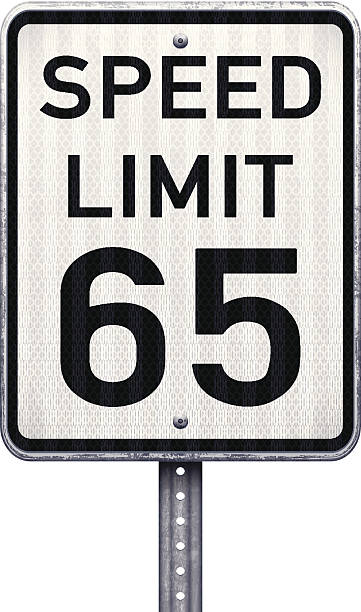
You can see the representation of a law on a traffic sign. The law says you cannot drive faster than 65 (sixty-five) miles per hour.
You also can see a representation of the speed-limit law in law books.
But you cannot see the law itself.
Why is the non-physicality of laws and money important?
If something is physical, its creation relies on the availability of its material constituents. A government is limited in producing gold coins by the availability of gold.
Laws have no such limitations. They have no physical constituents. The federal government can create as many laws as it wishes, whenever it wishes.
And since dollars, which have no physical existence, are created by laws, which also have no physical presence, the federal government has the infinite ability to create dollars. If the federal government wished, it could pass endless laws making infinite dollars.
That power is known as Monetary Sovereignty. The federal government is the absolute sovereign over its creation, the U.S. dollar.
If you were a supplier to the federal government and sent them a bill for a trillion, trillion, trillion dollars, they could pay that bill instantly by passing a law and pressing a computer key.
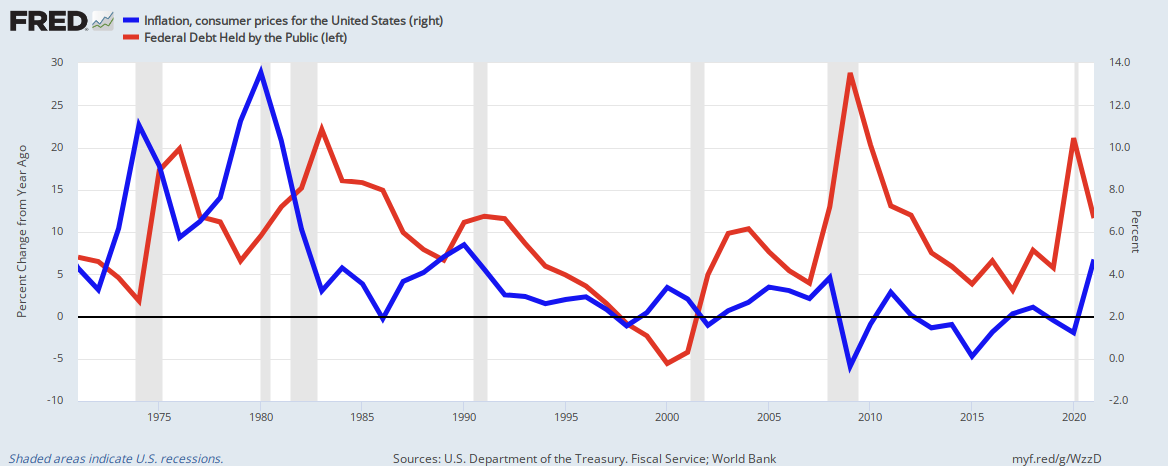
Thus, the so-called federal debt is no burden on the federal government.
Claims that the federal debt must be limited or is “unsustainable” are ignorant at best and heinous lies at worst.
Similarly, no federal government agency (Social Security, Medicare, etc.) can run short of dollars unless that is what the Monetarily Sovereign U.S. government wants.
Then we come to the claims that Social Security and Medicare “trust funds” are on the brink of insolvency. I am too much of a gentleman to term claimers as dirty, rotten liars, so I’ll just leave it as “misguided souls who are spouting ignorance.” Better.
When I call these ignorant claims into question, I am greeted by throat-clearing, followed by the equally ignorant claim that “printing too much money causes inflation.”
First, we do not print money. As we have demonstrated, printed dollar bills are not money.
Second, most dollars are not represented by printed dollar bills.
And third, inflation is not caused by too much money; it is caused by scarcities of significant goods like oil, food, or services like shipping. Scarcities cause prices to rise. That is no revelation.
Governments can prevent/cure inflation by obtaining and distributing the scarce items — and this often requires more money creation, not less.
Our inflation was reduced not by the Fed’s interest rate hikes (which made products and services cost more) but by the government’s release of oil reserves and the financial support given to the manufacturers and shippers of scarce commodities.
The Fed wrongly is tasked with using recession as a tool against inflation. Congress and the President are responsible for reducing the shortages that cause inflation. They need only use their infinite dollar-creation ability to cure those shortages.
The pretense that the finances of our Monetarily Sovereign U.S. government are the same as the finances of monetarily non-sovereign state and local governments stands in the way of doing what a government should do: Improve and protect the lives of the people.
So, “Is money real?” No, if “real” means a substance, the availability of which is physically limited. But yes, if “real” includes concepts, ideas, laws, emotions, beliefs, preferences, and creativity.
Think of money as the Monetarily Sovereign government’s ability to imagine and fund a better world. No limits.
Rodger Malcolm Mitchell
Monetary Sovereignty
Twitter: @rodgermitchell Search #monetarysovereignty
Facebook: Rodger Malcolm Mitchell
……………………………………………………………………..
The Sole Purpose of Government Is to Improve and Protect the Lives of the People.
MONETARY SOVEREIGNTY


 #Monetary Sovereignty - Mitchell