–Learn the bare fundamentals of Monetary Sovereignty in just five minutes

Those, who do not understand the differences between Monetary Sovereignty and monetary non-sovereignty, do not understand economics.
======================================================================================================================================================================================================================================
In comment #4. in the post titled, “Obama joins the Tea Party,” Tyler F. asked, “If you had 3 minutes to speak at a town hall meeting, what would you say?”

Well, three minutes could be a problem, only because so many questions remain unanswered, and for something most people are not prepared to understand, much less believe, the racetrack approach doesn’t work.

Nevertheless, given perhaps five minutes, I might say something like this:

In just five minutes, I can show you how to cure America’s economic problems.

The U.S. became Monetarily Sovereign in 1971, when we went off the gold standard. That change was so counter-intuitive, few economists, politicians or media writers understand it.

Unlike you and me, unlike the states, counties and cities, unlike Greece and Ireland, a Monetarily Sovereign nation has the unlimited ability to pay its bills. I must live within my means. The federal government has no means to live within. You must have a source of money before you spend. The government creates money by spending. The financial rules that apply to you and me, do not apply to the government.

Something else counter-intuitive: The dollar does not exist. Just as the number seven does not exist, the dollar merely is a balance sheet number. If you own a home, you have a title; it is evidence you own the home. But the title is not the home. Similarly, that dollar bill in your wallet is not a dollar. It is a title; it is evidence you own a dollar.

Because a dollar is just a balance sheet number, the federal government has the power to create and destroy dollars, merely by changing numbers. When you receive a government check, that check is not money. It is a set of instructions telling your bank to change the number in your bank account.

Your bank account number goes up, and a government balance sheet number goes down. No dollars move from the government to you. Dollars can’t move because dollars don’t exist. Your bank could be on Mars, and the government could pay you by changing the number in your bank account. That is the meaning of Monetarily Sovereign – infinite control over sovereign currency.

So, how is it possible for a Monetarily Sovereign nation to run short of its sovereign currency? Why would a nation, that can pay all its bills by changing bank account numbers, ever need to borrow its own currency? Why would a nation with infinite control over its sovereign currency, need tax money to pay its bills?

The answers are: The U.S. government never can run short of dollars. The U.S. government no longer needs to borrow money or to levy taxes. Borrowing and taxing are relics of the gold standard. To pay its bills, the U.S. government simply changes numbers in bank accounts.

So, what is the purpose of the debt ceiling? Answer: It has no purpose. It too is a relic of the gold standard.

By definition, a large economy contains more dollars than does a small economy. So, to grow from smaller to larger, an economy must have a growing supply of dollars. The government adds dollars to the economy by deficit spending, that is by changing numbers in bank accounts.

Why then does Congress wish to reduce deficit spending? Because Congress does not understand Monetary Sovereignty.

So, what about inflation? The value of money is based on supply and demand. Demand is based primarily on the reward for owning money, which is interest. So, preventing inflation requires reducing the money supply or increasing interest rates. However, reducing money supply growth historically has led to recessions and depressions. That is why the Fed controls inflation by raising interest rates.

To summarize, There is a simple and direct solution for our economic problems: Grow the economy with federal deficit spending, and use interest rate control to prevent excessive inflation.

Yes, this could be cut to three minutes, but people need more time to absorb a counter-intuitive concept. Even five minutes doesn’t really do it.

That’s why town hall meetings are not informative but rather are stage shows for the amusement of the audience.

Rodger Malcolm Mitchell
http://www.rodgermitchell.com


==========================================================================================================================================
No nation can tax itself into prosperity, nor grow without money growth. Monetary Sovereignty: Cutting federal deficits to grow the economy is like applying leeches to cure anemia.

MONETARY SOVEREIGNTY
–Why bank lending leads to recessions. A counter-intuitive finding.

Those, who do not understand the differences between Monetary Sovereignty and monetary non-sovereignty, do not understand economics.
================================================================================================================================================================================================================
Thirteen months ago, I published a post titled, “Is federal money better than other money.” I believed it was one of the more interesting posts in this long series, because it showed that while reduced federal debt growth led to recessions, increased non-federal debt growth also led to recessions.

At the time, the data stopped at February, 2002. I now have brought the data forward, and am republishing. These new data support the previous findings.

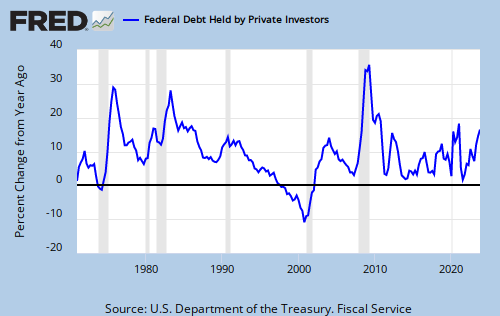
In other posts on this blog, we have discussed how reductions in federal debt growth, as shown by the following graph, “Federal Debt Held By Private Investors,” immediately precede recessions. This comes as no surprise, since a growing economy requires a growing supply of money, and deficit spending is the federal government’s method for adding money to the economy.

Federal debt

Clearly, federal debt/money growth is essential to keep us out of recessions. Yet, when we look at “Debt Outstanding Domestic Nonfinancial Sectors” which includes not only Federal debt, but also outstanding credit market debt of state and local governments, and private nonfinancial sectors (tan line), we do not see the same pattern.

In fact, when we subtract federal debt from total debt, leaving only state, local and private debt, we see the opposite pattern. Recessions follow increases in state, local and private debt!

4
STATE, LOCAL AND PRIVATE DEBT, PERCENT CHANGE FROM YEAR AGO

Now in one sense, money is money. Your buying on your credit card creates debt/money, just as federal deficit spending creates debt/money. Presumably, both should have the same stimulative effect on the economy. They do, but not long term. Why?

Because, unlike the federal government, you, your business and local governments cannot create new money endlessly to service your debts. Your debts can pile up to the point where you must liquidate them by paying them off or by going bankrupt. When non-federal debts become too large, a growing number of people, states, cities and businesses must pull back and stop further borrowing, i.e. stop creating money, or even destroy money by paying off loans. When that happens, we have a recession.

(As an aside, this is one reason the early stimulus efforts had so little effect. People used the stimulus money to pay off loans, so while the federal deficit spending created money, the loan pay-downs destroyed it. Debt reduction destroys debt/money.)

During the recession, and for a short time after, we tend to cut back on our personal borrowing and liquidate debt/money. Then we begin to resume borrowing, more and more, until again, we hit our personal limits and cut back, causing yet another recession. The sole prevention of this cycle, which averages about 5 years in length, is to make sure that federal deficit spending grows sufficiently to offset periodic money destruction by the private sector.

In summary, federal deficit spending is good for the economy, always good, endlessly good (up to the point of inflation). Private and local government spending/borrowing also is good, but not endlessly. Unlike the federal government, the private and local-government sectors eventually reach a point where debt is unaffordable and unsustainable.

To prevent recessions, the government continuously must provide stimulus spending, then provide added stimulus spending to offset the periodic reduction of money creation by the private sector.
__________________________________________________________________________________________________________________________
These data call into question the popular belief that encouraging bank lending stimulates the economy. While short-term effects may be positive, long-term bank lending seems to lead to recessions, as servicing loans becomes ever more onerous for the monetarily non-sovereign sectors. In contrast, Federal deficit spending easily is serviced by the government, and therefore is preferable to private borrowing as a stimulus.
__________________________________________________________________________________________________________________________
Rodger Malcolm Mitchell
http://www.rodgermitchell.com


==========================================================================================================================================
No nation can tax itself into prosperity, nor grow without money growth. Monetary Sovereignty says: Cutting federal deficits to grow the economy is like applying leeches to cure anemia.

MONETARY SOVEREIGNTY

–Obama joins the Tea Party

Those, who do not understand the differences between Monetary Sovereignty and monetary non-sovereignty, do not understand economics.
============================================================================================================================================================================

In a previous post I asked whether President Obama was a Coward, fool or traitor to America. We now have our answer.

This article by Lori Montgomery, ran in the 7/7/2011 Washington Post: Obama offers Social Security cuts. A few quotes:

President Obama is pressing congressional leaders to consider a far-reaching debt-reduction plan that would force Democrats to accept major changes to Social Security and Medicare in exchange for Republican support for fresh tax revenue.

Not only does he wish to raise taxes, an anti-stimulus move, but he is ready to cut Social Security benefits — anti-stimulus and anti-working class.

At a meeting with top House and Senate leaders set for Thursday morning, Obama plans to argue that a rare consensus has emerged about the size and scope of the nation’s budget problems and that policymakers should seize the moment to take dramatic action.

It is the same rare consensus that said the world is flat, the earth is the center of the universe and the gods live on Mount Olympus — in short, a consensus of fools.

As part of his pitch, Obama is proposing significant reductions in Medicare spending and for the first time is offering to tackle the rising cost of Social Security, according to people in both parties with knowledge of the proposal.

In joining the Tea Party, Obama shows himself to be all three: Coward, fool and traitor to America. The battle is over, folks. Take down your flag and go home. Your leader has surrendered to buy some votes, and America will pay the price.

Rodger Malcolm Mitchell
http://www.rodgermitchell.com


==========================================================================================================================================
No nation can tax itself into prosperity, nor grow without money growth. It’s been 40 years since the U.S. became Monetary Sovereign, , and neither Congress, nor the President, nor the Fed, nor the vast majority of economists and economics bloggers, nor the preponderance of the media, nor the most famous educational institutions, nor the Nobel committee, nor the International Monetary Fund have yet acquired even the slightest notion of what that means.

Remember that the next time you’re tempted to ask a teenager, “What were you thinking?” He’s liable to respond, “Pretty much what your generation was thinking when it ruined my future.”

MONETARY SOVEREIGNTY

–S.O.S. Signs of Stupidity. The perfect storm that engulfs us.

Those, who do not understand the differences between Monetary Sovereignty and monetary non-sovereignty, do not understand economics.
==========================================================================================================================================================================================================================

Nations are like people; they just tend to live longer. And like people, nations have individual personalities, individual beliefs, individual histories. There are Italian ethics, Russian mores, American values that transcend and affect those of any individual. Entire nations can go through periods when they exhibit brilliance, periods when they exhibit madness and periods when they exhibit stupidity.

Late 17th century – early 18th century Europe, particularly France, exhibited the brilliance that became known as the Age of Enlightenment. Late 1930’s – early 1940’s Germany exhibited the madness that created World War II and the Holocaust. The Early Middle Ages (some term the “Dark Ages”) were times when nations (tribes, really) exhibited abject stupidity akin to self immolation.

Today, America experiences a confluence of signs of stupidity (S.O.S.), some longstanding, some transient, some quite new – a perfect storm of stupidity – that could lead to our degeneration and downfall. I have listed, without ranking or qualification, some of the S.O.S. we now experience.

Anti-gay marriage
Anti-vaccination
Birthers
Congress (special nod to Rep. Michele Bachmann)
Creationism (aka “intellegent design”)
Drunks
Emailing, cell-phoning, messaging or social networking anything private
Fed Chairmen Alan Greenspan and Ben Bernanke
Federally sanctioned torture
FICA
Flag wavers
Flood plain building
Forest fire fighting
Fox “News”
Governors Rick Perry, Nathan Deal and Jan Brewer
Illinois governors (pardon my bias)
Government actions against Wikileaks
Hummers
Immigration laws; anti-immigration laws
National Rifle Association
News editors (special nod to Chicago Tribune, N.Y. Times, Wall Street Journal)
Old-line economists and the columnists who parrot them
Patriot Act
Rap music
Religious fundamentalists
Sarah Palin
Smoking
Suicide bombers
Supreme Court Justices Clarence Thomas, Antonin Scalia.
Tea/Republican Party (Democrats too, though less so)
Texting, phoning, eating while driving
The EU and the euro
The war on drugs; illegal drug users
Treasury Department Secretary Timothy F. Geithner
U.S. “debt” (aka “T-securities”) debt ceiling, balanced budget, austerity
Wars since WWII (special nod to current Mideast wars)
This list.

Please feel free to edit, disagree or supplement, before the light of intelligence flickers out and you no longer can.

Rodger Malcolm Mitchell
http://www.rodgermitchell.com


==========================================================================================================================================
No nation can tax itself into prosperity, nor grow without money growth. It’s been 40 years since the U.S. became Monetary Sovereign, , and neither Congress, nor the President, nor the Fed, nor the vast majority of economists and economics bloggers, nor the preponderance of the media, nor the most famous educational institutions, nor the Nobel committee, nor the International Monetary Fund have yet acquired even the slightest notion of what that means.

Remember that the next time you’re tempted to ask a teenager, “What were you thinking?” He’s liable to respond, “Pretty much what your generation was thinking when it ruined my future.”

MONETARY SOVEREIGNTY